I. INTRODUCTION
The bulk metallic glasses (BMGs), as a relatively young class of materials, exhibit unique mechanical properties by comparison with their crystalline counterparts.Reference Ashby and Greer1 However, the poor ductility and subsequent premature fracture still limit their applications due to highly localized inhomogeneous deformation.Reference Louzguine, Kato and Inoue2, Reference Liu, Heatherly, Easton, Carmichael, Schneibel, Chen, Wright, Yoo, Horton and Inoue3 Although many investigations on the inhomogeneous deformation of BMGs have been performed, the underlying deformation physics of BMGs remain less firmly established compared with crystalline alloys. Currently, there are still different explanations for the strain-rate-dependent mechanical behaviors for BMGs, even those explanations are in debate, which may be the key to obtaining insight into the physical processes responsible for the strength and ductility of BMGs.
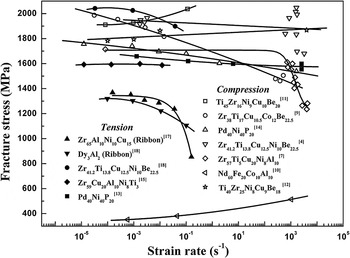
The effect of strain rate on the strength of BMGs has not been well established. Bruck et al.Reference Bruck, Rosakis and Johnson4 and Subhash et al.Reference Subhash, Dowding and Kecskes5 found that the compressive strength of Zr41.2Ti13.8Cu12.5Ni10Be22.5 BMG was independent of strain rate. However, negative strain rate sensitivity was found in Zr/Hf-based BMGs by Li et al.,Reference Li, Subhash, Gao, Kecskes and Dowding6 Zr57Ti5Cu20Ni8Al10 BMG by Hufnagel et al.,Reference Hufnagel, Jiao, Li, Xing and Ramesh7 Zr52.5Ti5Cu17.9Ni14.6Al10 BMG by Dalla Torre et al.,Reference Dalla Torre, Dubach, Siegrist and Löffler8 and Zr38Ti17Cu10.5Co12Be22.5 by Xue et al.Reference Xue, Cai, Wang, Wang and Zhang9 On the contrary, Liu et al.,Reference Liu, Dai, Bai, Wei and Yu10 Zhang et al.,Reference Zhang, Park, Kim and Kim11 and Ma et al.Reference Ma, Kou, Li, Chang and Zhou12 reported that Nd60Fe20Co10Al10, Ti45Zr16Ni9Cu10Be20, and Ti40Zr25Ni8Cu9Be18 BMGs showed positive strain rate dependence on fracture stress, respectively. Mukai et al.Reference Mukai, Nieh, Kawamura, Inoue and Higashi13 reported that the Pd40Ni40P20 BMG exhibited no fracture stress varied during the strain rates increased from 10−3 to 2.8 × 10³ s−1 under tension, while the fracture stress decreased with increasing strain rate in the range from 3.3 × 10⁻³ to 1.7 × 10³ s−1 under compression.Reference Mukai, Nieh, Kawamura, Inoue and Higashi14 Dalla Torre et al.Reference Dalla Torre, Dubach, Schällibaum and Löffler15 also reported that both Zr57.9Cu22Fe8Al12Pd0.1 and Cu50Zr50 BMGs exhibited a change in the strain rate sensitivity from negative to positive values when the temperature decreased from 300 to 77 K. However, Zhang et al.Reference Zhang, Eckert and Schultz16 reported that the Zr59Cu20Al10Ni8Ti3 BMG exhibited no strain rate sensitivity in both compression/tension loading modes, exhibiting the same strain rate sensitivity in different loading modes. Figure 1 shows the strain-rate-dependent flow stress of BMGs reported before, exhibiting that those BMGs with different chemical components manifested different strain rate effect.
Variation of flow strength as a function of strain rate for bulk metallic glasses (BMGs): solid and open symbols correspond to tension and compression, respectively.

Those conflicting results suggest that many factors, such as chemical compositions, level of amorphization, loading mode, and specimen geometry, could significantly influence the mechanical behaviors of BMGs at different strain rates, which are rooted in their internal structure. Therefore, further experimental data is required to understand the deformation nature in BMGs.
The internal local atomic structure of BMGs could be largely influenced by the alloy composition and preparation methods.Reference Kawamura, Shibata, Inoue and Masumoto17–Reference Mao, Zhang, Fu, Wang, Li and Hu21 This article aims to evaluate the influence of local atomic structures on the strain-rate-dependent mechanical properties of BMGs. Based on the specimens with fine distinctions of local atomic structures, the strain rate response to mechanical behaviors for Zr65Al7.5Ni10Cu17.5 was investigated with the strain rate increased from 1.6 × 10⁻⁵ to 1.6 × 10⁻¹ s−1. The relationship between the local atomic structures and the strain-rate-related mechanical mechanism for the present Zr-based BMG was evaluated in detail.
II. EXPERIMENTS
Master alloys of composition Zr65Al7.5Ni10Cu17.5 were produced by arc-melting a mixture of the pure elements with a purity of above 99.9% in a Ti-gettered argon atmosphere. The master alloy ingots were remelted four times to achieve homogeneity. Subsequently, the cylindrical rods with diameter of 3 mm were synthesized by the methods of injection casting and in situ suction casting, respectively. The temperature of the fused masses for injection casting was determined to be 1100 ± 10 °C as monitored by the infrared thermoscope. However, the melting temperature for in situ suction casting may be as high as 3000 °C due to the arc-melting (The bottom part of the fused mass contacted with the furnace floor may be lower than 3000 °C because there were temperature gradients within the molten alloy upon arc-melting.). To describe expediently in this article, the specimens prepared by injection casting at casting temperature of 1100 °C were denoted as the LT specimens and the specimens by in situ suction casting with casting temperature as high as 3000 °C were denoted as the HT specimens.
The amorphous structures of the specimens were confirmed by conventional x-ray diffraction (XRD) with Cu Kα radiation and high-resolution transmission electron microscopy (HRTEM, Tecnai F30 operated at 300 kV, Eindhoven, Netherlands). Thin foils for HRTEM were performed by an ion milling method (Gatan, model 600, Freehold, NJ). The thermal analyses were examined by differential scanning calorimetry (DSC; Netzsch 404C alumina crucibles, Selb, Germany) at a fixed heating rate of 0.33 K/s in a high-purity argon atmosphere. The specimens of 6 mm in length (L/D ratio = 2) were cut from those rods using a low-speed diamond saw under water cooling. The compression planes were polished to assure parallelism. The compression tests were performed on a CMT 4305 testing machine during a strain rate range (1.6 × 10⁻⁵ ∼1.6 × 10⁻¹ s−1) at room temperature. Three tests were performed for a set of specimens. Fracture morphologies of the failed specimens were examined by field-emission scanning electron microscope (SEM, FEI S-4800, Hillsboro, OR).
III. RESULTS
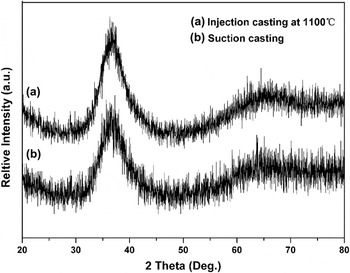
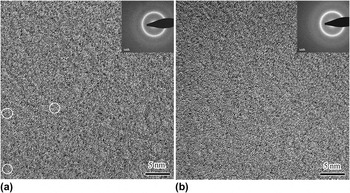
Figure 2 shows the XRD patterns of the LT and HT specimens. The specimens prepared at different casting temperatures consisted of only one broad diffraction peak without any sharp Bragg peaks, indicating that both the LT and HT specimens were amorphous within the sensitivity limits of XRD. Further HRTEM examinations were conducted and the results are shown in Fig. 3. No obvious lattice fringes (nanocrystallization) were found in the HRTEM images, indicating amorphous structures for both the LT and HT specimens within the experimental uncertainties of the technique used. The corresponding selected area electron diffraction patterns for the LT and HT specimens in the insets of Fig. 3 could also be identified to consist of only metallic glass phase.
X-ray diffraction patterns of the Zr-based BMG, revealing no crystals in both the LT and HT specimens.

High-resolution transmission electron microscopy images of (a) the LT specimen and (b) the HT specimen shown amorphous structure. (Inset: selected area electron diffraction patterns in both the LT and HT specimens also implying that no phase separation occurs.)

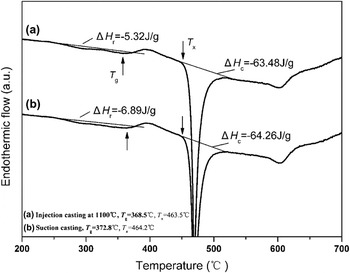
To further evaluate the microstructure (the level of amorphization) of the LT and HT specimens, DSC measurements were also performed. Both the LT and HT specimens in Fig. 4 exhibit clear endothermic events, associating with the glass transition followed by a wide super cooled liquid region and exothermic peaks. The glass transition temperature (T g) and the onset crystallization temperature (T x) for the LT specimen are about 368.5 and 463.5 °C, compared to 372.8 and 464.2 °C for the HT specimen, respectively. The LT and HT specimens showed structural relaxation enthalpy (ΔH r) of 5.32 and 6.89 J/g, respectively. The enthalpy of crystallization (ΔH c) for the LT and HT specimens was calculated to be 63.48 and 64.26 J/g, respectively.
Differential scanning calorimetry curves of the LT and HT specimens at a fixed heating rating of 0.33 K/s. (T g denotes the glass transition temperature and T x the crystallization onset temperature, ΔH r denotes the structural relaxation enthalpy and ΔH c the crystallization enthalpy.)

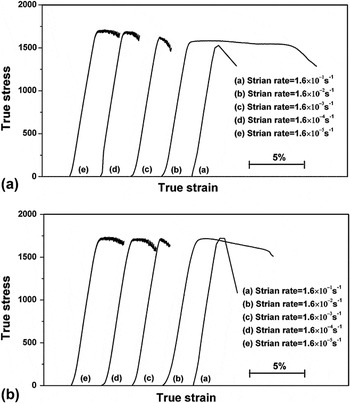
Typical true stress–true strain curves of the LT and HT specimens at different strain rates under compression are shown in Fig. 5. Not only the serrated flow faded away with increasing strain rate, the yield stress also decreased with increasing stain rate from 1.6 × 10⁻⁵ to 1.6 × 10⁻¹ s−1, revealing negative strain rate sensitivity, as seen in Fig. 5(a). The strain-rate-dependent serrated flow for the HT specimen exhibited the same trend compared with the LT specimen; however, the yield stress of the HT specimens exhibited nearly no change with strain rate increased, exhibiting no strain rate sensitivity in Fig. 5(b).
Typical true stress–true strain curves of (a) the LT specimens and (b) the HT specimens under compression at different strain rates, exhibiting negative strain rate sensitivity for the LT specimens where the yield stress decreased with increasing strain rate but little strain rate sensitivity for the HT specimens where nearly no yield stress varied with increasing strain rate.

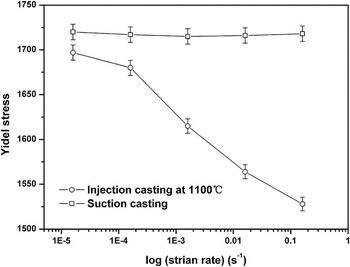
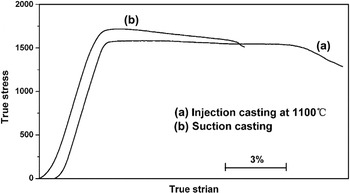
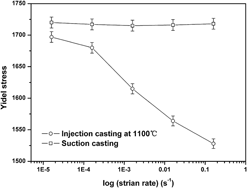
Figure 6 shows the plot of yield strength against log (strain rate) for the specimens, revealing no strain rate sensitivity for the HT specimen and negative strain rate sensitivity for the LT specimen. Figure 7 shows the typical true stress–true strain curves of the LT and HT specimen under compression at 1.6 × 10⁻² s−1. The LT specimen exhibited nearly perfect elastic–plastic behavior, while the HT specimen showed work-softening behavior. It is also shown in Fig. 7 that the LT specimen exhibited larger failure strain than the HT specimen.
Plots of yield strength versus log (strain rate) for the specimens, revealing negative strain rate sensitivity for the LT specimens while no strain rate sensitivity for the HT specimen.

Typical true stress–true strain curves of the Zr-based BMG under compression at strain rate of 1.6 × 10⁻² s−1, exhibiting perfectly elastic-plastic behavior for the LT specimen while work-softening behavior for the HT specimen.

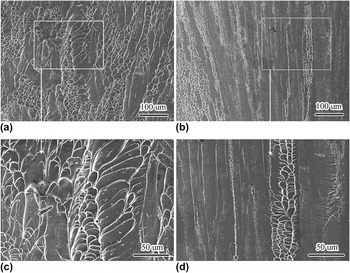
Figure 8 shows the typical shear fracture morphologies of (a) the LT specimen and (b) the HT specimen at strain rate of 1.6 × 10⁻² s−1, and (c) and (d) are high-magnification SEM images corresponding to the zones marked by the rectangles in (a) and (b), respectively. It is seen in Figs. 8(a) and 8(c) that substantive vein-like patterns were observed on the fracture surface of the LT specimen, compared to a mixture of vein-like patterns and smooth shearing distributed alternatively for the HT specimen in Figs. 8(b) and 8(d).
Typical shearing fracture morphologies of (a) the LT specimen and (b) the HT specimen at strain rate of 1.6 × 10⁻² s−1, revealing that the fracture surface of the LT specimen was covered nearly all by well-developed rein-like patterns, however, smooth shearing area was found in the fracture surface of the HT specimen which distributed alternately with vein-like patterns. (c) and (d) High-magnification scanning electron microscopy images corresponding to the zone marked by the rectangles in (a) and (b), respectively.

IV. DISCUSSION
Both the LT and HT specimens were confirmed to be amorphous structure within the sensitivity of XRD, as seen in Fig. 2. It is necessary to give a clear description of structure level in metallic glass before evaluating the effect of local atomic structure on strain-rate-related mechanical mechanism for the present Zr-based BMG. The metallic glass structure may still have the short-range order (SRO) of the nearest neighbor atoms, i.e., icosahedral order.Reference Luo, Sheng, Alamgir, Bai, He and Ma22, Reference Bernal23 Recently, the medium-range order (MRO) in metallic glass was also detected, which was defined on length scale longer than the nearest neighbor to several nanometers.Reference Sheng, Luo, Alamgir, Bai and Ma24–Reference Salmon, Martin, Mason and Cuello27 As a molten alloy consisted of moving atom clusters, different melting temperatures may result in different atomic-scale structures. Compared to the molten alloy by injection casting at 1100 °C, the atomic-scale structure of the molten alloy by arc-melting with temperature as high as 3000 °C could be more disordered and homogeneous. In other words, the size of the ordered clusters in the molten alloy by arc-melting is smaller than that in the molten alloy by injection casting. The microstructures of the specimens possessed strong heredity from the molten alloy.Reference Saboungi, Blomquist, Volin and Price28–Reference Schenk, Simonet, Holland-Moritz and Bellissent31 Compared to the LT specimen, finer ordered clusters could be frozen into the HT specimen during the subsequent rapid casting. The MRO atomic structures about 2–3 nm in diameter (marked by white circles) were observed in the LT specimen, as seen in Fig. 3(a). However, the HT specimen showed a regular atomic arrangement of about four to five layers in Fig. 3(b), indicating smaller local order atomic structures (SRO atomic structures) were formed in the HT specimens by comparison with the LT specimens.
The T g, T x, ΔH r, and ΔH c for the HT specimens are greater than that of the LT specimens, revealing that the HT specimens could be more stable, which trend may be caused by the enthalpy release due to the relaxation of structural ordering. The LT specimen was less disordered than the HT specimen, which induced crystallization upon heating, leading to the early loss of the glass stability.Reference Assadi and Schroers32 Beukel and SietsmaReference Beukel and Sietsma33 assumed that the change in enthalpy ΔH r was related to the change in free volume, which is

where β′ is a constant, ΔH r is the change in relaxation enthalpy, and Δυ f is the change of free volume per atomic volume. Slipenyuk and EckertReference Slipenyuk and Eckert34 proved that the change in free volume was proportional to the change in relaxation enthalpy. Namely, the exothermic event (i.e., the heat release during relaxation) is related to the existence of free volume in BMGs prior to T g. As shown in Fig. 4, the structural relaxation enthalpies ΔH r are 5.32 and 6.89 J/g for the LT and HT specimens, respectively, reflecting that the HT specimen contains more free volume than the LT specimen. It should be noted that the enthalpy release observed during relaxation in DSC could not be simply interpreted as a measure of the free volume and the annihilation of excess volume was actually only one manifestation and consequence of the structural rearrangement.Reference Slipenyuk and Eckert34–Reference Cheng and Ma36 Compared to the molten alloy by injection casting, more disordered structure in the molten alloy by arc-melting means more free volume in the system, which could be frozen into the amorphous structure after rapid solidification. Thus, the HT specimen may obtain more free volume than the LT specimen, which is consistent with the result of DSC.
The LT specimen exhibited the maximum yield stress of 1.7 GPa at strain rate of 1.6 × 10⁻⁵ s−1, subsequently, the flow stress as well as serration decreased gradually with increasing strain rate under compression, as seen in Fig. 5(a), which trend was also found in other BMGs in Fig. 1. Li et al.Reference Li, Subhash, Gao, Kecskes and Dowding6 believed that the observed negative strain rate sensitivity of fracture strength for the Zr/Hf-based BMGs was attributed to the nucleation of cracking immediately following the shear band initiation (at stress levels well below the macroscopic yield stress). Hufnagel et al.Reference Hufnagel, Jiao, Li, Xing and Ramesh7 also found reduced strength with increasing strain rate in Zr57Ti5Cu20Ni8Al10 BMG, revealing that the strain rate dependence on fracture strength was caused by the shear bands formed under quasistatic loading with a nonadiabatic process while involved an adiabatic component in the dynamic case.
Just as the line and area defects influence the mechanical behaviors of crystalline metals, the varying degree of structural orders (the local order developed) could also be the primary structural origin of differences for the mechanical property of BMGs.Reference Cheng, Ma and Sheng37–Reference Zhang, Cheng, Cao, Xu and Ma41 Different from that the LT specimens exhibited negative strain rate sensitivity, the HT specimens exhibited nearly no effect of strain rate on yield stress, as seen in Fig. 5(b). Bruck et al.Reference Bruck, Rosakis and Johnson4 and Zhang et al.Reference Zhang, Eckert and Schultz16 also reported that there were little effect of strain rate on fracture strength for Zr41.25Ti13.75Ni10Cu12.5Be22.5 and Zr59Cu20Al10Ni8Ti3 BMGs under compressive loading. Mukai et al.Reference Mukai, Nieh, Kawamura, Inoue and Higashi13 attributed the absence of strain rate effect of Pd40Ni40P20 BMG to the faster propagating rate of shear bands compared to the applied strain rate. As seen in Fig. 6, the present Zr-based BMGs exhibited different strain-rate-dependent mechanical properties, indicating that the strain rate response to mechanical behaviors is significantly influenced by their internal atomic-scale structures. The critical cooling rate of the Zr41.25Ti13.75Ni10Cu12.5Be22.5 (∼1.8 K/s) is the slowest among the reported Zr-based BMGs,Reference Peker and Johnson42 indicating that the Zr41.25Ti13.75Ni10Cu12.5Be22.5 BMG could be more amorphous in comparison with other BMGs. Compared to the LT specimen, the HT specimen with more disordered structure exhibited no strain rate sensitivity, which is consistent with other results,Reference Bruck, Rosakis and Johnson4, Reference Subhash, Dowding and Kecskes5 revealing that the more amorphous the specimen is, the less influence of strain rate on the flow stress for BMGs is.
It was assumed that the shear band embryos for metallic glass were mainly initiated by the coalescence of free volume.Reference Conner, Johnson, Paton and Nix43–Reference Huang, Suo, Prevost and Nix46 The shear band could also nucleate from the pre-existing stress concentration where the heterogeneous and concentrated stress field rejuvenates the glass structure around the concentrators.Reference Li and Li47 MRO atomic structures were found in the LT specimens, which are sensitive to nanocrystals, leading to that the stress concentration was induced around the area of MRO atomic structures in the LT specimen. In contrast, compared to the LT specimen, the HT specimen exhibited more disordered and homogeneous structure in atomic-scale and had more free volume. It is suggested that the yield stress is mainly related to the initiation of shear band embryos. For the HT specimen, the shear band embryos mainly initiated from the coalescence of free volume, although the amount of shear band embryos increased with increasing strain rate because the number of the coalescence of free volume increased with strain rate increased, the local critical stress that initiated the shear band embryos did not change with increasing strain rate, leading to that nearly no yield stress changed with increasing strain rate. Thus, the HT specimen exhibited no strain rate influence on the yield stress. However, for the LT specimen, except for the shear band embryos initiated from the coalescence of free volume (the free volume in the LT specimen is less in number than that in the HT specimen), the MRO atomic structure and the stress concentration around the MRO atomic structure could also be the main locations for the shear band embryos, where the shear band could nucleate at a stress below the local critical stress for the shear band embryos initiated in the coalescence of free volume. The quantity of shear band embryos initiated from the MRO atomic structure and the stress concentration grew with increasing strain rate, leading to reduced yield stress with increasing strain rate for the LT specimen. Thus, the LT specimen exhibited negative strain rate sensitivity. In addition, the uniform stress field applied on the more homogeneous structure in the HT specimen could lead to higher yield stress than that in the LT specimen, which is the critical stress required for the rejuvenation of the local structure.Reference Cao, Cheng and Ma48 Thus, the LT specimen exhibited lower yield stress than the HT specimen under any variant strain rate in Fig. 6.
The LT specimen exhibited nearly no work softening and greater fracture strain by comparison with the HT specimen, as seen in Fig. 7. It is assumed that the MRO atomic structures in the LT specimen not only acted as the location for shear band embryos initiated but also obstacles, which impeded the shear band propagation and induced multiple shear bands formed, resulting in no work softening and relatively great failure strain in comparison with the HT specimen. As shown in Fig. 8(a), substantive vein-like patterns were formed on the fracture surface of the LT specimen at strain rate of 1.6 × 10⁻² s−1, exhibiting obvious viscous behavior during the plastic deformation process. However, relatively smooth fracture morphologies were observed on the fracture surface of the HT specimen in Fig. 8(b). The vein-like patterns on the fracture surface for the LT specimen are related to the structure contained MRO atomic structures, which could act as obstacles and improved the propagating resistance of the initial shear bands, finally resulting in temperature increment and forming vein-like patterns. However, due to the HT specimen has more disordered and homogenous structure in atomic-scale, when the HT specimen reached the yield stress, the shear band may propagate with relatively less obstacles during shear band propagating by comparison with the LT specimen, resulting in smooth fracture surface as well as work-softening behavior for the HT specimens.
V. CONCLUSIONS
The effect of casting temperature on the strain-rate-dependent mechanical properties of Zr65Al7.5Ni10Cu17.5 BMG was investigated over a wide strain rate from 1.6 × 10⁻⁵ to 1.6 × 10⁻¹ s−1. HRTEM and DSC measurements demonstrated that the specimens prepared by in situ suction casting could be more disordered in atomic-scale structure compared with injection casting. The shear band embryos in the HT specimen were initiated mainly in the coalescence of free volume, resulting in little strain rate sensitivity. However, the shear band embryos in the LT specimen may be initiated from the location of the MRO atomic structure, the stress concentration around the MRO atomic structure, and the coalescence of free volume. It is assumed that the stress for the shear bands nucleated in the region of MRO atomic structure and the stress concentration around the MRO atomic structure is smaller than the local critical stress for the shear bands nucleated in the coalescence of free volume, leading to that the LT specimen exhibited negative strain rate sensitivity. The different strain rate responses to mechanical behavior in the present Zr-based BMG indicates that the more amorphous the specimen is, the less influence of strain rate on the flow stress is. Our new findings in this article may open a new horizon to understand the strain rate dependence on the deformation behavior in BMG systems.
ACKNOWLEDGMENTS
The authors are grateful for the financial support of the National Natural Science Foundation of China (Grant Nos. 10872032 and 51101018) and the Excellent Young Scholars Research Fund of Beijing Institute of Technology (Grant No. 2008Y0416).