They (infrastructures) are political structures and cultural forms that have, for some time, been associated as symbols, promises, and vectors of modernity.Footnote 1
Infrastructure is what connects us below the surface through drainage, sewage systems, electrical grids and waterlines. These infrastructures also include various structures above ground intended to link urban areas, such as parkways, highways and walkways, and the numerous design elements that assist in creating a uniform spatial scheme. In an everyday way, residents of cities tend not to think of the infrastructure that links their homes, lives, and the cities and towns in which they live, unless there is a failure within the system. A growing contingent of researchers are now examining the various ways infrastructure is designed and how it is accessed and embodied by users/residents.Footnote 2 Infrastructure can be uneven in its access and distribution across the built environment, but infrastructure is also malleable, with a plasticity that allows it to be changed as needed or as hegemonic interests dictate. This brings us to the social and political history of infrastructure. It takes us out of the architectural framework of design and construction of systems and towards the ways in which infrastructures were accessed by individual users. Most importantly, a focus on infrastructures aids in understanding the responses to failures within said infrastructural systems, thus expanding our broader understanding of the lived built environment. This can be demonstrated through two main questions: Where were the connective nodes broken or ignored? And how did the Suez Canal Company (SCC) respond to issues related to hygiene, in-door plumbing, and flooding?
Turning to the Suez Canal, we find ample work done on the infrastructural history of the canal itself and the built environment of the new cities formed along the waterway.Footnote 3 Looking at infrastructures outside the dredged, sandy-bottomed Suez Canal offers us unique entry points to lesser told stories. The movement of fresh water into all neighborhoods was a piecemeal project with stops in flows and inadequate access. The new subsidiary canals and water systems that provided potable drinking water also helped to flush out and expel sewage in the twentieth century, when outhouses and cesspools were added to the sewerage grid. The manicuring of tree-scapes along the freshwater canal, the erection of towns along flood zones, and the new home for plankton, mollusks, and seawater fauna all point to the unique environmental outcomes created by the numerous infrastructural interventions across the Suez Canal. Further, centering narratives around infrastructures, such as uneven access to indoor plumbing, aids in unearthing stories of the French company's fetishization of the bathroom habits of native Egyptians. Narratives of hygiene, disease, flooding, and lack of access to infrastructural systems delineate new ways of exploring the SCC's colonial archive to excavate subaltern experiences.Footnote 4
The infrastructural history of the canal and its port cities is highlighted by the large-scale reshaping of adjacent landscapes. A description of the new towns is a useful place to begin. Port Said and Ismailia were laid out in grids carefully structured and organized into distinct areas demarcated by the different features of the built environment for the various communities that would live there: Europeans—of all nationalities—and Egyptians, similar to the manner in which colonial cities were established elsewhere.Footnote 5 This meant that, in Port Said, buildings in the “Arab” quarters were self-built by Egyptian laborers who migrated to the canal for work.Footnote 6 These distinct urban spaces did not mean that residents could not cross into “European” quarters of town; but, from the outset, towns were spatially organized based on race and class. In Suez, the existing settlement was modernized primarily through the erection of a new port on the Red Sea—at the Gulf of Suez—and the extension of a freshwater canal, the demolition of the city walls built by Napoleon, and the redesigning of the old urban pattern, with an organic built environment of narrow streets that ran towards the Gulf of Suez and Red Sea.Footnote 7 To complete these massive infrastructure projects, tons of sand, rock, water, minerals, plants, and numerous other materials were displaced or moved by both coerced Egyptian labor and European-built dredgers.
One of my larger arguments here is that the Suez Canal Company attempted to unify, through urban design and various infrastructures, a cohesive set of visual imagery in the spatial environment of the canal cities, along the course of several new waterways, and in the construction of numerous stations for passing ships to stop in an emergency, refill water, or allow the passage of other ships in-between the larger canal towns. As such the SCC planned and put in place a uniform physical and natural environment and system along the entire length of the Suez Canal that enabled its builders and others to imagine the canal, its new ports and stations as components of a larger single, unifying project. In this roundtable contribution, I hope to point to what was actually a piecemeal implementation of design and infrastructural projects focused primarily on the landscapes owned and managed by the SCC.
For the SCC, the creation of gares—a “station” or “siding”—every five to six miles was part of what made the built environments along the canal uniform. Each gare was regularized in plan and designed to include a water tower containing fresh water, trees, other plants, and a garden connected to the main station house in some cases. These stations were situated between the rigole de service (freshwater canal) and the seawater channel, allowing connections to both as a means of receiving water, materials, and goods from other towns.Footnote 8 When taken as a whole, the uniformity is striking yet mundane in its repetitiveness, with plans demonstrating similar layouts for both small gares and larger stations. Adjacent to these spaces were greenways planted by the SCC to shelter the open-air freshwater canal from dirt and act as a filter. These designs hide or elide the large inequalities in accessing urban services and infrastructure, demonstrating how the SCC expressed itself to its external audience—European travelers passing through the Suez Canal—while continuing to lack concern for the native Egyptian residents of its new towns.
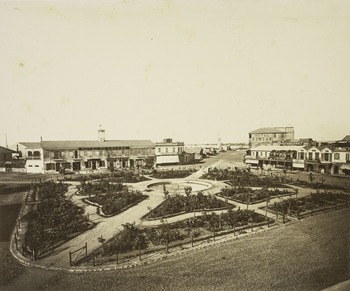
In each new city, the canal company designed and built green spaces as part of the urban environment. Indeed, at the center of a photograph taken at the inauguration of the Suez Canal in 1869, in what was originally called Lesseps Square in Port Said, stands a pool of water set in a cement container. The pool was designed to represent both the future garden and the SCC's ability to demand, in 1863, that Khedive Isma`il have Egyptian laborers build a new branch of the Nile to feed the cities along the canal (Fig. 1). This pool of water would eventually be replaced by a gazebo surrounded by a lush garden, following in the footsteps of the Ezbekkiyya Gardens adjacent to Cairo's new opera house, which opened in the same period.Footnote 9 With the construction of the freshwater canal and later piped water to the city, the rich muddy and marshy topsoil of Port Said prompted Lesseps and SCC engineers and horticulturists to plant trees, develop ornate French-like verdant central squares, and organize tree-lined streets. The square, gardens, and greenways along the canal were central to the SCC's demonstration of attentiveness to the city's hygiene. This was embodied in the freshwater system that brought clean drinking water for both residents and the verdant gardens, like those already in Ismailia.Footnote 10 Planting trees, shrubs and tall grass in a systematic way throughout the entire canal area—and along the freshwater canal in particular—created uniform design elements across the towns of the canal zone. The packed sand and sediment that lined the rigole was also planted with shrubbery and trees from the SCC's plant nursery in Ismailia and gardens at the waterworks on the outskirts of each town. Acacia, tamarisk, date palms, and eucalyptus trees created a uniform line of vegetation along the rigole and helped keep the narrow channel protected from debris.
“View of La Place de Lesseps in Port Said,” photograph by Hippolyte Arnoux (1869, prior to the inauguration of the canal). Visible at the center is the planned square, park, and fountain demonstrating the Suez Canal Company's ability to pipe fresh Nile water to canal cities. Harvard Fine Arts Library, Special Collections Valer and Olga Fricke album of photographs of the Middle East HSM:83:012:035 AKP128.19.

Turning briefly to the variegated uses of the waterworks at nodes along the freshwater canal, which brought potable drinking water to the greater canal area, allows us to examine the intersection of physical infrastructure with man-made manipulation/disciplining of the natural environment. The waterworks and its garden were located along the route where water moved from the Nile Delta through Ismailia and on to Port Said. Though beside a storage facility, the garden of plant and vegetable life became an analogy for the SCC's greening of the land around the waterway. This “greening” aesthetic had been part of the company's project since incorporation, similar to the pool of water at the center of Lesseps Square.Footnote 11 But, adjacent to the large towers storing fresh water was a landscape planted with a large variety of trees, shrubs, fruits, and vegetables. As such, this infrastructure had multiple uses as a storage facility and nursery for trees and shrubs later planted along the canal. In other photographs of SCC administrative properties, the lushness of the plant life and labor involved in its care and upkeep is readily apparent.
Shrubs were the ideal plants for the seawater canal, as they provided protection from erosion and greenness in the sand, while the protective cover of the tamarisk tree kept the fresh waterway clean. This foliage also served as an aesthetic etching on an infrastructural project changing, reshaping, and disciplining the natural landscape. The landscaping of the canals was closely monitored, discussed, and recorded in the company's meeting minutes.Footnote 12 Photographs document the plant growth in intervals of months and show the land on which these plantations were developed. In Suez Canal Company papers, chief administrators, engineers, and health experts discussed the viability of particular plants and trees. The inclusion of such images and discussions highlights the recognized importance of greenery in such large-scale infrastructural projects producing a new, “second nature” layer on the terrain—one that was man-made.Footnote 13
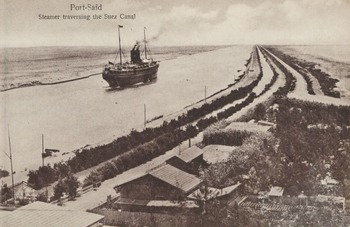
Photography demonstrates how plants were used to protect the banks of the Suez Canal. For example, one archival image of reeds—referred to by their scientific name, arundo gigantean—highlights the fact that they were planted along the canal to prevent erosion. In some cases, the SCC created a triple layer of plantings in areas where the train, seawater canal, and freshwater canal ran. Aerial photographs of the canal at Port Said can be read with these fauna-centered infrastructural projects in mind, shifting the focus of the image from the canal to the landscaped zones surrounding it (Fig. 2).
“Port Said, Steamer Traversing the Suez Canal” (1900). Rice University: https://hdl.handle.net/1911/7043

Most importantly, however, as I sifted through the archival material, was that the disciplining of the environment was intrinsically linked to the water and sewage infrastructure of the towns along the Suez Canal. Indeed, what appeared to be just another postcard photo of the freshwater canal and adjacent tree-lined promenade turned out to hold an entirely different secret. Hidden behind the trees, laying on the ground, were sewage pipes waiting to be installed. This chance view from a postcard coupled with reports and plans in the SCC archives on infrastructural systems prompted further questions about how the networks connecting urban environments worked at a subterranean level. In Ismailia, like the other two cities, the SCC began erecting a sewerage network focused on connecting infrastructure to company property and the residences of top-level French employees as early as the 1870s. In response to instances of flooding in European quarters due to Nile floods and the freshwater canal, the company increased drainages in some neighborhoods in the late 1870s.
The runoff from these lines was first released into the water adjacent to the canal. Then, in the 1880s and 1890s, cultivated land in Abou Rahan used the runoff to water the tall grass and trees set to be planted along the canal.Footnote 14 As both Dell Upton and Donald Reid illustrated in other locations, the project to clean and sanitize urban environments was closely connected to ideas of modernity and the power of engineers and urban planners to control the movement of water below and out of the city.Footnote 15 The Paris sewer system, developed and expanded by Baron Haussmann in the mid-nineteenth century, provided the ultimate example. Originally intended as storm water drainage, these sewers initially allowed only some measure of feces to flow through them; only with the tout à l’égouts (sewer system/network) of the 1890s did the Paris sewers include human waste. Suez Canal Company engineers viewed their project through a similar lens. Building the canal—cleared by forced laborers and machines—was not enough; the SCC would attempt to install contemporary conveniences to make the cities more hygienic. Concerns over cholera spreading through the canal and descriptions of the towns’ poor conditions forced the company to act. Thus, from the 1870s onward, sewers, cast-iron tubing, grates, intercepting connectors, traps, septic tanks, and drainage were added in piecemeal in all canal cities. This was in addition to various water systems already installed, such as the waterworks.
The neighborhoods where Europeans—both laborers and canal administrators—resided and SCC workshops were located were the first to be connected to the water and sewage networks. According to SCC archival material, outhouses and pumps linked to the freshwater canal were the company's only public infrastructure projects in Egyptian neighborhoods. In these neighborhoods, one could only access fresh water from a water pump, fountain, or water-seller, who delivered water in animal hides to residents. The connections between the buildings, the street, and its drains were not part of the master plan; instead, these were assessed individually by neighborhood, need, and whether or not the building sat on company property. SCC property sites were easily connected to the grid, and surviving plans and work-orders attest to their prioritization. The plans and work-orders also highlight the slow process of building this infrastructure.
Concerns about hygiene, fueled in part by the global cholera pandemic of 1892 and a possible malaria problem in Ismailia and Port Said, pushed the SCC and Egyptian government to begin draining swamps, cleaning canals, and expanding and updating the network.Footnote 16 It was at this time that they began to use the term by which Paris's system was known, tout-a'l’egouts. As such, sewerage infrastructural projects in Port Tewfik, Ismailia, and Port Said give us a view of the connections between class and provision, as well as the difficulties in constructing these networked systems in urban environments where buildings, however informal, had existed for decades.
Schematics also began to appear for interior toilets and outhouses, as did architectural/engineering drawings related to the connection of these infrastructures to cesspools and a later sewer system. In one blueprint from 1891, the outhouse plan shows the level of attention latrines received. The Suez Canal Company's interest in human waste and the hygiene of domestic, administrative, and urban environments represents an attempt to discipline and sanitize the cities along the canal. As with other aspects of city planning described above, these outhouse projects were not evenly distributed across the towns’ populations. Orientalist tropes abounded around the different bathroom needs of Arab/Egyptian residents and Europeans. One lodging plan for Port Said specifically spoke of the difference between a Turkish WC and a European one.Footnote 17 While it does show an interiorized bathroom space meant for all employees, the European toilet was to be sat upon and it was assumed Egyptians preferred to squat. Thus, there were separate bathroom spaces depending on one's nationality. Even in new buildings well into the twentieth century—for example, the Court House at Port Fouad, directly across from Port Said—there were two types of latrine systems designed into the plans. Questions regarding hygiene and squat toilets were rife. Initially, these were separate systems with equal facilities, but by 1922, the SCC came to see the Turkish toilet as less hygienic and, as such, the latrines in Arab bathrooms were replaced with typical European-style toilet fixtures and connected to the “egouts de la ville” in Port Said.Footnote 18 Notably, these infrastructures were only built when the company racialized the toilet and deemed the issue to be related to hygiene.
Outside employee housing, these plans also accommodated the building of outhouses in Arab quarters well into the twentieth century. Due to the informal structure of Arab neighborhoods, indoor plumbing still was not possible and the company was not interested in improving conditions. Only when Port Said's outhouses and cesspools were deemed a hygienic nuisance was there discussion of adding indoor plumbing and connection to the sewer system. As a building report from 1910 suggests, the company and British colonial government in Cairo saw replacing homes in Egyptian quarters with brick and concrete structures as a necessity, so that residents would have access to indoor plumbing and an easier connection to the city's sewerage infrastructure. The discussion of hygiene centered around fear of a cholera outbreak in the city and canal zone, as there had been a number of outbreaks in the Red Sea region in the 1890s and early 1900s. Thus, the city became a site that required sanitization in order to protect global trade and travel.
Coupled with plans, studies, and documents, my research demonstrates both the unevenness of the implementation of a unified sewer and water system and the ways the different topologies of the Suez Canal's urban environments played a role in the development of underground and domestic infrastructures across the three cities. I use unevenness—not a new idea—to describe the hierarchy of racialized difference between infrastructural improvements and urban investment in neighborhoods outside the towns’ so-called European areas. Still, not all those with access to European consulates were treated the same. Towns were organized based on one's ethnicity, race, and class.Footnote 19 The discussion of unevenness helps historians unearth new types of social histories and expand our knowledge of how peripheral urban environments were developed and responded to interventions related to urban improvement. These narratives can then be added to the social history of infrastructure. Further, it helps us highlight what Nikhil Anand points out in the introductory quote, that infrastructures, beyond the imaginaries connecting it to “modernity,” are a messy and complicated network of systems.