Introduction
Grammatical gender (henceforth gender) is a linguistic phenomenon present in many of the world's languages. In production, gender sometimes provides an important cue for disambiguating between homophonous or homographic words. In comprehension, gender appears to ease the task of the listener/reader by making referents easier to track (Carreiras, Garnham & Oakhill, Reference Carreiras, Garnham and Oakhill1993; Garnham, Oakhill, Ehrlich & Carreiras, Reference Garnham, Oakhill, Ehrlich and Carreiras1995; Heath, Reference Heath1975; Zubin & Köpcke, Reference Zubin, Köpcke and Collete1986), and by making nouns more predictable and thereby easier to recognize (Bates, Elman & Li, Reference Bates, Elman, Li, Haith, Benson, Roberts and Pennington1994; Dye, Milin, Futrell & Ramscar, Reference Dye, Milin, Futrell, Ramscar, Kiefer, Blevins and Bartos2017; Grosjean, Dommergues, Cornu, Guillelmon & Besson, Reference Grosjean, Dommergues, Cornu, Guillelmon and Besson1994). Despite these benefits, late second language (L2) learners experience persistent difficulty mastering grammatical gender. While recent work has made important steps toward understanding this challenge (e.g., Arnon & Ramscar, Reference Arnon and Ramscar2012; Grüter, Lew-Williams & Fernald, Reference Grüter, Lew-Williams and Fernald2012; Hopp, Reference Hopp2013; Lemhöfer, Schriefers & Indefrey, Reference Lemhöfer, Schriefers and Indefrey2014), a comprehensive picture has yet to emerge.
Some early accounts based in linguistic theory had posited a global knowledge deficit in the ability of late L2 learners to represent abstract gender features if gender is not instantiated in a learner's native language (e.g., Franceschina, Reference Franceschina2005; Hawkins & Franceschina, Reference Hawkins, Franceschina, Prévost and Paradis2004). An abundance of evidence, however, has shown that late L2 learners whose native language (L1) does not have grammatical gender can attain ceiling performance in offline tests of gender knowledge (Alarcón, Reference Alarcón2011; Grüter et al., Reference Grüter, Lew-Williams and Fernald2012; McCarthy, Reference McCarthy2008; Montrul, Foote & Perpiñán, Reference Montrul, Foote and Perpiñán2008; White, Valenzuela, Kozlowska–Macgregor & Leung, Reference White, Valenzuela, Kozlowska–Macgregor and Leung2004), and that they can show online sensitivity to gender agreement during sentence comprehension (Alemán Bañon, Fiorentino & Gabriele Reference Alemán Bañón, Fiorentino and Gabriele2014; Alemán Bañon, Miller & Rothman, Reference Alemán Bañón, Miller and Rothman2017; Gillon Dowens, Guo, Guo, Barber & Carreiras, Reference Gillon Dowens, Guo, Guo, Barber and Carreiras2011; Gillon Dowens, Vergara, Barber & Carreiras, Reference Gillon Dowens, Vergara, Barber and Carreiras2010; Foote, Reference Foote2011; Foucart, Martin, Moreno & Costa, Reference Foucart, Martin, Moreno and Costa2014; Foucart, Ruiz-Tada & Costa, Reference Foucart, Ruiz-Tada and Costa2016; Gabriele, Fiorentino & Alemán Bañón, Reference Gabriele, Fiorentino and Alemán Bañón2013; Sagarra & Herschensohn, Reference Sagarra and Herschensohn2010; Tokowicz & MacWhinney, Reference Tokowicz and MacWhinney2005). Thus, there is strong evidence that late L2 learners can acquire appropriate gender representations and are able to use this information rapidly online when processing gender agreement.
At the same time, some studies have shown that, in contrast to native speakers, L2 learners are inefficient at using gender marking as a cue to anticipate and facilitate the processing of upcoming nouns. Guillelmon and Grosjean (Reference Guillelmon and Grosjean2001) found that, unlike native French speakers, late L1-English L2-French bilinguals were no faster at repeating nouns in an auditory shadowing task when they followed an informative gender-marked determiner compared to when they followed an uninformative gender-neutral determiner. Similarly, looking-while-listening studies have found that late L2 learners of Spanish do not orient faster to target objects in a visual display when gender marking is informative compared to when it is not informative about which noun will be named (Grüter et al., Reference Grüter, Lew-Williams and Fernald2012; Lew-Williams & Fernald, Reference Lew-Williams and Fernald2010).
Neurocognitive research further underscores the fact that, despite their ability to learn words’ genders and become sensitive to gender agreement, late L2 learners do nonetheless frequently show deviations from native norms in their processing of grammatical gender. For example, native speakers of gender-marking languages typically show P600 effects for violations of agreement between nouns and other gender-marked elements (e.g., determiners and adjectives: e.g., Alemán Bañón, Fiorentino & Gabriele, Reference Alemán Bañón, Fiorentino and Gabriele2012; Barber & Carreiras, Reference Barber and Carreiras2005; Barber, Salillas & Carreiras, Reference Barber, Salillas, Carreiras, Carrieras and Clifton2004; Demestre & García-Albea, Reference Demestre and García-Albea2007; Hagoort & Brown, Reference Hagoort and Brown1999; O'Rourke & Van Petten, Reference O'Rourke and van Petten2011). In research on L2 gender processing, some studies have found no P600 effects or that P600 effects are restricted to particular syntactic contexts (e.g., determiner-noun and not adjective-noun agreement), or modulated by experiential factors like age of L2 immersion (e.g., Foucart & Frenck-Mestre, Reference Foucart and Frenck-Mestre2011; Meulman, Stowe, Sprenger, Bresser & Schmid, Reference Meulman, Stowe, Sprenger, Bresser and Schmid2014; Meulman, Wieling, Sprenger, Stowe & Schmid, Reference Meulman, Wieling, Sprenger, Stowe and Schmid2015). Others have found that gender violations may elicit N400 effects (normally associated with semantic processing) in some cases, rather than typical P600 effects (Foucart & Frenck-Mestre, Reference Foucart and Frenck-Mestre2012; Morgan-Short, Sanz, Steinhauer & Ullman, Reference Morgan-Short, Sanz, Steinhauer and Ullman2010). Overall the existing research on non-native acquisition and use of gender and gender agreement, particularly by native English speakers, presents a mixed picture, such that more fine-grained approaches to non-native processing of gender are necessary.
Recent work has shown that online deficits in L2 gender processing can be explained at least in part by item-level knowledge of a noun's gender. In the first study to show this, Lemhöfer et al. (Reference Lemhöfer, Schriefers and Indefrey2014) observed P600 responses to determiner-noun gender violations in L1-German L2 learners of Dutch when trials were sorted based on the subjective gender assignments of participants, but critically observed no P600 effects when trials were sorted by the objective genders of the nouns. The role of item-specific knowledge is further underscored by findings from Alemán Bañon et al. (Reference Alemán Bañón, Miller and Rothman2017), who showed that overall knowledge of grammatical gender does not account for any variance in P600 effect magnitudes after item-specific knowledge is accounted for by restricting trials to those for which the gender of a noun is known. In a set of eye-tracking studies, Hopp (Reference Hopp2013, Reference Hopp2016) showed that late L2 learners’ ability to use gender-marking as an anticipatory cue depends on the accuracy with which they assign grammatical gender to nouns. When trials were sorted based on participants’ subjective gender assignments, participants with greater accuracy in gender assignment showed anticipatory eye movements, whereas those with lower accuracy did not.
In summary, the current evidence on L2 gender acquisition and use suggests that the difficulty L2 users experience with grammatical gender may stem from a combination of knowledge- and processing-based loci. The findings of Hopp (Reference Hopp2013, Reference Hopp2016) and Lemhöfer et al. (Reference Lemhöfer, Schriefers and Indefrey2014) suggest that this knowledge-based locus does not reflect deficient representations at the feature level, but rather inaccurate mapping between representations for grammatical gender and for nouns. Given, however, that studies reporting deficits in online performance also regularly report ceiling performance in offline gender assignment tasks aimed at assessing knowledge of critical nouns (e.g., Foucart & Frenck-Mestre, Reference Foucart and Frenck-Mestre2011, Reference Foucart and Frenck-Mestre2012; Grüter et al., Reference Grüter, Lew-Williams and Fernald2012), a processing-based locus is nonetheless partly implicated. The nature of this processing deficit, moreover, remains unclear.
One avenue that has not yet been explored as a possible source of the difficulty L2 learners experience using gender is the time course of L2 lexical access, and in particular, the time course of feature retrieval in non-native language users. There are a number of reasons for investigating this. First, a recent hypothesis seeking to account for L2 deficits in gender acquisition and processing, the Lexical Gender Learning Hypothesis (LGLH; Grüter et al., Reference Grüter, Lew-Williams and Fernald2012; Hopp, Reference Hopp2013, Reference Hopp2016), proposes that part of the problem with gender stems from differences in how children learn their L1 versus how adults learn an L2. The LGLH claims that these differences lead to the formation of weaker links between nouns and their appropriate gender representation (cf. Gollan, Montoya, Cera & Sandoval, Reference Gollan, Montoya, Cera and Sandoval2008). There is, moreover, indirect evidence for this claim from a set of artificial language learning experiments showing that learning conditions that more closely approximate L1-like learning contexts lead to better learning of grammatical gender (Arnon & Ramscar, Reference Arnon and Ramscar2012; Siegelman & Arnon, Reference Siegelman and Arnon2015). In light of this evidence, Grüter et al. (Reference Grüter, Lew-Williams and Fernald2012) specifically posit that weaker links between nouns and their respective gender features should result in slower retrieval of gender information, and that this slower retrieval has downstream consequences for other processes (e.g., an increased likelihood of retrieval errors resulting in gender assignment errors).
Consistent with this claim, Grüter et al. (Reference Grüter, Lew-Williams and Fernald2012) observed a dissociation between offline gender knowledge and online gender processing which specifically implicates timing as a culprit in L2 gender processing deficits. In an offline sentence-picture matching task, the highly advanced L1-English L2-Spanish participants in their study showed ceiling performance (96% accuracy) that was indistinguishable from native speakers for knowledge of grammatical gender. When online time constraints were imposed, however, the L2 participants’ accuracy in supplying gender assignments dropped to 80% in an elicited production task. Furthermore, these same L2 participants showed no evidence of anticipatory looks to familiar target nouns in an online looking-while-listening task, in contrast to native speakers. The fact that these L2 participants only differed from native speakers in online tasks strongly suggests that these results do not reflect knowledge deficits, but rather deficits in the online use of grammatical gender information, and possibly delays in retrieval and deployment of gender information during processing. This raises the question of whether late L2 speakers differ fundamentally from native speakers in the timing with which grammatical gender information is retrieved. If L2 retrieval of grammatical gender is slower, this could explain the pervasive gender assignment errors under the time pressure of speaking, and the failures to use gender marking as an anticipatory cue if gender information is not retrieved rapidly enough to be mapped onto expectations for impending nouns.
There is also evidence that the time course of lexical feature retrieval is sensitive to task demands and top-down goal-directed influences (Abdel Rahman & Sommer, Reference Abdel Rahman and Sommer2003; Abdel Rahman, Turennout & Levelt, Reference Abdel Rahman, van Turennout and Levelt2003; Shantz & Tanner, Reference Shantz and Tanner2017; Strijkers, Holcomb & Costa, Reference Strijkers, Holcomb and Costa2011; Strijkers, Yum, Grainger & Holcomb, Reference Strijkers, Yum, Grainger and Holcomb2011). Of particular relevance are a set of studies that employed the dual-choice go/no-go paradigm in combination with ERPs. Briefly, in this paradigm, participants are presented with images that differ orthogonally in two dimensions (e.g., grammatical gender and word-initial phone), and are asked to make a set of decisions using two sources of information. One source of information (e.g., gender) will determine whether to press a button or not (the go/no-go decision), and the other source of information (e.g., word-initial phone) then determines whether to respond with the left or right hand if a button press is required (the dual-choice decision). To illustrate, in the experiment described in Shantz and Tanner (Reference Shantz and Tanner2017), native German speakers made decisions based on whether a depicted noun was masculine or neuter in German, and whether that noun began with /b/ or /k/. The authors manipulated which piece of information (i.e., grammatical gender or word-initial phone) was used to make which decision. For example, in one block, participants were instructed to press a button if the noun they were shown was masculine, but to avoid pressing any button if the noun was neuter. That is, grammatical gender determined the go/no-go response. Participants were further told to respond with the right hand if the noun began with /k/, and with the left hand if the noun began with /b/. Thus, phonology determined the dual-choice decision. Given this configuration of instructions, if participants were shown an image depicting a ball, which is a masculine noun in German that begins with a /b/ (der Ball), participants would use the grammatical gender information to determine that a response is required (a go decision), and the word-initial phone to determine that the left hand must be used to execute the response. In contrast, for the neuter word Buch (book), while the word-initial phone would map on to a left-handed response, because the word is neuter the correct response is not to press any button (i.e., a no-go decision).
Inferences about the time course of information retrieval in a dual-choice go/no-go task are drawn on the basis of two ERP components: the lateralized readiness potential (LRP) and the N200. The LRP is a negative-going brainwave that reflects preparation to execute a motor response with a left or right body part (Kutas & Donchin, Reference Kutas and Donchin1974). The LRP has been shown to develop on the basis of partial information that is relevant to preparing a manual response (Kutas & Donchin, Reference Kutas and Donchin1980), even if that response will not be executed (Van Turennout, Hagoort & Brown, Reference van Turennout, Hagoort and Brown1997). In dual-choice go/no-go tasks, if the LRP is found to develop on no-go trials when one source of information determines the dual-choice (i.e., hand) response, but not the other, this is taken to mean that the information source for which a no-go LRP was observed is retrieved earlier than the other information source; that is, participants know which hand to respond with, and start preparing to make that response before the other source of information has been fully retrieved, informing them that no response is needed. The other ERP component, the N200, is a negative-going component that has been linked to response inhibition in go/no-go tasks (see Folstein & van Petten, Reference Folstein and van Petten2008). Whereas the LRP provides an upper-bound estimate of when the information source determining the dual-choice decision is retrieved, the N200 provides an upper-bound estimate of when the information source determining the go/no-go decision is retrieved.
Research using this paradigm has shown that retrieval difficulty can selectively delay the retrieval of one source of lexical information without delaying the other (Abdel Rahman & Sommer, Reference Abdel Rahman and Sommer2003; Abdel Rahman et al., Reference Abdel Rahman, van Turennout and Levelt2003). If the difficulty that late L2 learners experience using grammatical gender online at least partly stems from difficulty retrieving gender information, we should therefore expect to observe delays in the time course of gender information in L2 compared to L1 populations. This possibility is compatible with ceiling performance in offline tasks, where delays in feature retrieval should not preclude the eventual retrieval of the correct grammatical gender information, given enough time. In online comprehension, such delays may constrain the extent to which gender-based predictions are possible or even useful in that delayed retrieval of gender would reduce the time during which anticipation is possible, and/or increase the cognitive resources needed to generate robust expectations in time. Similarly, any delays in gender retrieval may leave less time and resources for post-retrieval monitoring or checking mechanisms to ensure that the correct grammatical gender has been retrieved, which could partially explain why late L2 learners exhibit persistent gender assignment errors in spoken production, and sometimes do not show native-like sensitivity to gender agreement violations in online sentence comprehension. In short, prior research provides good reason to expect that late L2 learners will be delayed in retrieving grammatical gender information during lexical access, and any such delays could help to explain the observed mismatch between offline knowledge and online processing of grammatical gender.
To investigate the possibility of delayed feature retrieval, we combined the use of ERPs with a dual-choice go/no-go task to compare the time course of lexical feature retrieval for L1 and late L2 speakers of German, focusing on the time course for retrieval of gender and phonological information. Previous eye tracking work on the anticipatory use of grammatical gender has provided important information about the factors that modulate L2 speakers’ abilities to use grammatical gender online to execute anticipatory eye movements (e.g., Dussias et al., 2013; Hopp, Reference Hopp2013). Eye tracking, however ultimately does not provide a window into the cognitive processes involved between stimulus apprehension and an overt response (e.g., executing a look to a target image), and thus does not provide information about when grammatical gender becomes available during language processing. Event-related potentials, on the other hand, provide a continuous measure of neural activity between initial stimulus presentation and any response that is ultimately executed. As such, they can provide a more fine-grained measure of when lexical information becomes available to use. Moreover, no work has, to our knowledge, investigated the time course of gender and phonological form retrieval in non-native language production.
Previous research using the same design and materials that we employ in this study found that native German speakers do not differ in the relative timing with which they retrieve grammatical gender information compared to phonological information in a fully counterbalanced within-subjects design (Shantz & Tanner, Reference Shantz and Tanner2017). Specifically, the authors found no LRPs on no-go trials, regardless of whether gender or phonology determined the hand response, and further found no reliable difference in the latencies of N200s elicited by go/no-go decisions based on phonology or gender. Based on these findings, if late L2 learners’ retrieval of gender information is fundamentally delayed and this delay is a pervasive property of lexical access mechanisms in non-native speakers whose L1 does not instantiate grammatical gender, we predict the following: 1) N200 latencies to go/no-go decisions based on gender should be later than N200 latencies based on phonology for late L2ers; 2) no-go LRPs may be observed for late L2ers when phonology determines the hand response, but not when gender determines this response; 3) N200 latencies for gender-based go/no-go decisions should be later for the L2 speakers compared to L1 speakers; 4) in addition, if any delays in lexical feature retrieval selectively impact grammatical gender, N200 latencies for phonology-based go/no-go decisions should not be later for L2 speakers compared to L1 speakers; finally, 5) it is further possible that any delays in the retrieval of grammatical gender will lead to delays in post-retrieval processes, in which case we may observe later onsets for go-LRPs and later reaction times in the dual choice go/no-go task compared to native speakers.
In addition to the dual-choice go/no-go task, we also include a gender decision task in order to assess overall knowledge of grammatical gender as well as individuals’ speed of gender information retrieval in the absence of a secondary task.
Methods
Participants
Twenty L1-English L2 speakers of German (10 female, 6 left-handed) received modest payment to participate in this study. All participants had normal or corrected-to-normal vision, and reported no history of neurological impairments. All participants provided informed consent. Participants also included the twenty native speakers of German (7 female, 3 left-handed, age 20–35, M = 24.5) whose data are reported in Shantz and Tanner (Reference Shantz and Tanner2017). Demographic and proficiency information for the L2 participants are summarized in Table 1. Proficiency was assessed with the Goethe Institut Test, a standardized, 30-item fill-in-the-blank test of German grammar and vocabulary. Based on participants’ scores, the L2 participants ranged from intermediate to advanced proficiency.
Summary of demographic and proficiency information for L2 participants.

Materials
Dual-choice go/no-go task
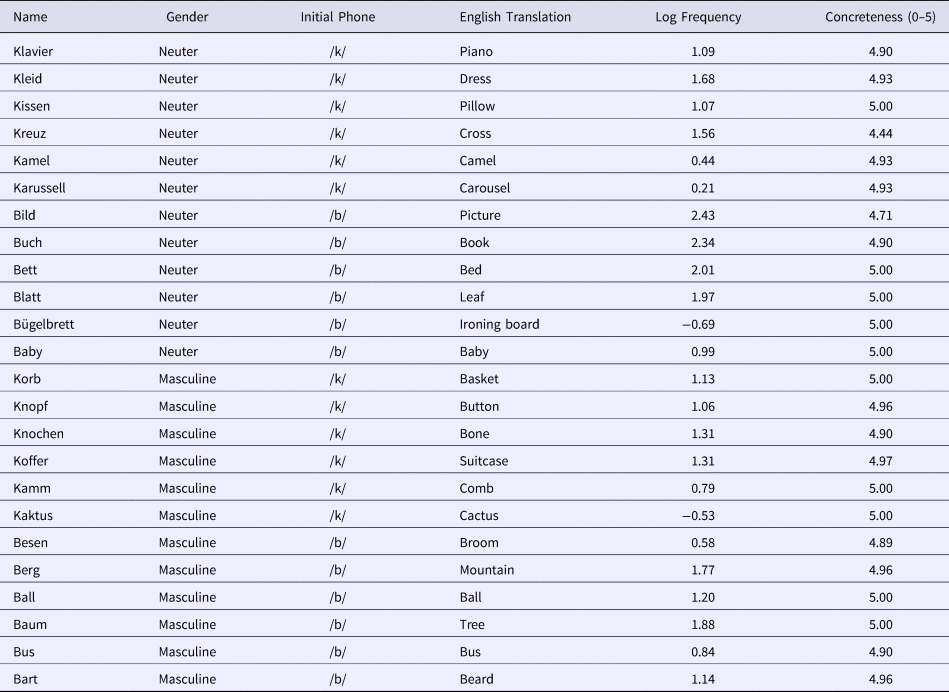
The materials for the dual-choice go/no-go task were 24 black-and-white images depicting frequent, familiar, concrete nouns with high naming agreement in German (Mean proportion = 0.94, SD = 0.072, Range = 0.69–1; Bates, D'Amico, Jacobsen, Székely, Andonova, Devescovi, Herron, Lu, Pechmann, Pléh, Wicha, Federmeier, Gerdjikova, Gutierrez, Hung, Hsu, Iyer, Kohnert, Mehotcheva, Orozco-Figueroa, Tzeng & Tzeng, Reference Bates, D'Amico, Jacobsen, Székely, Andonova, Devescovi, Herron, Lu, Pechmann, Pléh, Wicha, Federmeier, Gerdjikova, Gutierrez, Hung, Hsu, Iyer, Kohnert, Mehotcheva, Orozco-Figueroa, Tzeng and Tzeng2003; Szekely et al., Reference Székely, Jacobsen, D'Amico, Devescovi, Andonova, Herron, Lu, Pechmann, Pléh, Wicha, Federmeier, Gerdjikova, Gutierrez, Hung, Hsu, Iyer, Kohnert, Mehotcheva, Orozco-Figueroa, Tzeng, Tzeng, Arévalo, Vargha, Butler, Buffington and Bates2004). All images were taken from the International Picture Naming Database (Bates et al., Reference Bates, Federmeier, Herron, Iyer, Jacobsen, Pechmann, D'Amico, Devescovi, Wicha, Orozco-Figueroa, Kohnert, Gutierrez, Lu, Hung, Hsu, Tzeng, Andonova, Gerdjikova, Mehotcheva, Székely and Pléh2000). Items differed orthogonally in their grammatical gender (masculine or neuter) and their word-initial phone (/b/ or /k/) so that there were six /b/-initial masculine items, six /b/-initial neuter items, six /k/-initial masculine items and six /k/-initial neuter itemsFootnote 1. No nouns had natural gender or any morphological, orthographic or phonological markers of gender identity. The full list of stimuli is available in Appendix A along with the English translations, frequencies and concreteness ratings of each item.
Gender decision task
Materials for the gender decision task were 60 high frequency nouns and 60 mid frequency nouns; items were morphologically simple and did not have natural gender. High frequency nouns had frequencies greater than 100 occurrences per million, and mid frequency nouns occurred between 10 and 100 times per million words (Heister, Würzner, Bubenzer, Pohl, Hanneforth, Geyken & Kliegl, Reference Heister, Würzner, Bubenzer, Pohl, Hanneforth, Geyken and Kliegl2011). Within each frequency band, 20 nouns were masculine, 20 were feminine, and 20 were neuter. Gender classes within each frequency band were matched for character length. The full list of nouns used in the gender decision task is available in Appendix A.
Procedure
Experimental tasks were administered using Paradigm (Perception Research Systems, 2007). Data collection occurred in a single session lasting between 180 and 210 minutes. Each session began with a language history questionnaire and an abridged version of the Edinburgh Handedness Inventory (Oldfield, Reference Oldfield1971). After this, participants completed a brief warm-up in which they provided the names and grammatical genders for the objects depicted by the experimental stimuli. Participants were given feedback on their performance and were allowed to repeat the warm-up until they were confident that they knew the name for each image and its appropriate grammatical gender. The warmup was used to ensure that participants were using the expected name for each image; for the L2 participants, the warmup was also used to ensure that they knew the grammatical gender of each noun, which is particularly important given that native-like experimental effects with grammatical gender are sometimes only found in L2 populations when knowledge of gender is taken into account (Hopp, Reference Hopp2013, Reference Hopp2016; Lemhöfer et al., Reference Lemhöfer, Schriefers and Indefrey2014; Lewis, Lemhöfer, Schoffelen & Schriefers, Reference Lewis, Lemhöfer, Schoffelen and Schriefers2016). In other words, if any delays are found for grammatical gender, it is important to be able to distinguish delays due to inherent properties of participants’ retrieval mechanisms from apparent delays due to L2ers being unsure of the grammatical gender of a noun, or due to frequent retrieval of the wrong gender, which could lead to apparent delays in the grand-averaged ERPs if LRPs develop initially for the wrong response hand. Thus, by ensuring that our L2 participants knew the gender of each noun, we can be reasonably confident that any delays observed likely reflect delays in the retrieval mechanism rather than knowledge deficits or mis-retrieval, per se.
Following the warm-up, participants carried out the dual-choice go/no-go task. The manipulation of whether grammatical gender (masculine or neuter) or phonology (/k/-initial or /b/-initial) determined the hand response or the go/no-go response was carried out within subjects. Response hand was also counterbalanced within subjects across blocks. Each possible combination of these dimensions occurred in a separate block. Participants thus encountered 8 blocks in total. Items within a block were presented in a randomized order over four repetitions, yielding a total of 96 trials per block. An item was not repeated within a block until all 24 items had been presented in a single repetition. Block order was counterbalanced across four lists, so that for two lists the go/no-go decision was contingent on gender for the first half and phonology for the second half, and for the other two lists this order was reversed. Five L2 participants and five L1 participants saw each list.
Each trial began with a fixation cross in the center of a computer screen that lasted for 300 ms, followed by a blank screen lasting 200 ms. This was followed by an image that remained on screen for a maximum of two seconds. During the image presentation, participants made their go/no-go response with their left and right index fingers on a handheld gamepad. Trials ended when a response was made or after the two second timeout period. After this, there was an 800 ms blank screen followed by a 1700 ms screen that participants had been instructed to use for blinking. Next came a 300 ms blank screen and then the next trial. Participants were given short breaks between blocks, during which they received instructions for the next block. Each block began with a set of practice trials in which participants responded to each experimental item following the new block instructions. Participants were allowed to repeat the practice until they were confident with the new configuration.
After the dual-choice go/no-to task, participants completed the gender decision task. Participants responded by pressing a button on the gamepad with their left index finger if they thought the gender of a word was feminine, with their right index finger for masculine gender, and with their right thumb for neuter gender. Items were presented in a randomized order. Each trial began with a fixation cross in the center of the screen lasting 300 ms, followed by a blank screen of 200 ms and then the word, which remained on screen until a response was made. Once participants made their response, there was a blank screen with a variable ISI between 1500 and 1800 ms before the next trial began.
Data acquisition and analysis
Continuous EEG was recorded from 28 tin scalp electrodes mounted in an elastic cap (Electro-cap International), in accordance with the extended 10–20 system (Jasper, Reference Jasper1958). Eye movements and blinks were monitored with electrodes placed below the left eye and at the outer canthus of each eye. The EEG was amplified with a BrainAmpDC bioamplifier system (Brain Products, Gilchin, Germany) and digitized with a 1000-Hz sampling rate and an online 450 Hz low-pass filter and a 0.016 Hz high-pass filter (10s time constant). Impedances were held below 5 kΩ at scalp and mastoid sites and below 15 kΩ at the ocular electrodes. All electrodes were referenced online to the left mastoid and re-referenced offline to the algebraic mean of activity over the left and right mastoids.
Offline processing was conducted with EEGLAB (Delorme & Makeig, Reference Delorme and Makeig2004) and ERPLAB (Lopez-Calderon & Luck, Reference Lopez-Calderon and Luck2014) toolboxes. Only trials with correct responses were processed for analysis. A 0.1- to 30-Hz bandpass zero phase-shift Butterworth IIR filter (-6-dB cutoff, 12-dB/octave roll-off) was applied offline to the continuous EEG. Trials with excessive artefacts not related to eye movements and blinks, or with ocular activity earlier than 250 ms post-stimulus were hand-rejected. Independent component analysis (ICA) was then used to isolate and remove EEG components related to blinks and eye movements on remaining trials. Artefactual components were selected for removal on the basis of component spectra, time course and scalp topographies. After ICA artefact correction was completed, trials were rescreened to remove epochs with excessive drift, muscle activity or other artefacts. In total, 2.1% of correct trials were rejected for the L2 participants and 4.2% for the L1 participants, leaving an average of 97.9% and 95.4% of trials per condition respectively. The number of rejected trials did not differ significantly across conditions (F (3,152) = 0.12, p = .730) or language group (F(1,152) = 0.92, p = .435), nor was there an interaction between condition and language group (F(3,152) = 0.93, p = .426). Data were then downsampled to 250 Hz.
ERPs were calculated over an 1800 ms window time-locked to the onset of the picture for each participant over each electrode for each condition, relative to a 200 ms pre-stimulus baseline. For the LRPs, this required subtracting the averaged EEG that was ipsilateral to a response hand from the averaged contralateral activity to a response hand (measured at the left/right electrode pair C3/C4, near the primary motor cortex). In order to ascertain whether any reliable LRP activity occurs in the no-go conditions, stimulus-locked LRPs were quantified by averaging each sample from 0–1000 ms for each combination of condition (go/no-go = phonology and hand = gender or go/no-go = gender and hand = phonology), trial type (go or no-go) and participant. This yielded four data points per participant per sample. Go LRP onsets were quantified using a 50% fractional peak latency for the negative peak, which simulation work by Miller, Patterson and Ulrich (Reference Miller, Patterson and Ulrich1998) found to be optimal for measuring stimulus-locked LRPs (see Kiesel, Miller, Jolicœur & Brisson, Reference Kiesel, Miller, Jolicoeur and Brisson2008 for similar findings). These were calculated for each participant in each condition. N200s were quantified in two ways. First, in keeping with prior literature using the dual-choice go/no-go paradigm, N200s were quantified as the peak latency in the no-go minus go difference waves at Fz (cf. Shantz & Tanner, Reference Shantz and Tanner2017) in the 200–700 ms time window for each combination of condition, trial type and participant. We also measured the 50% fractional peak latencies of these same difference waves in order to estimate the onsets of the N200s, thereby providing an estimate of the approximate average latency by which the information determining the go/no-go decision had been retrieved. Latencies for the N200s and the go LRPs were computed using the jackknife procedure to improve the signal-to-noise ratio and improve statistical power without inflating Type I error (see Kiesel et al., Reference Kiesel, Miller, Jolicoeur and Brisson2008; Miller et al., Reference Miller, Patterson and Ulrich1998; Ulrich & Miller, Reference Ulrich and Miller2001).
All statistical analyses were carried out in R (R Core Team, 2017). N200 peak latencies and LRP onset latencies were analyzed with ANOVAs using the ez package (Lawrence, Reference Lawrence2016). F-values were corrected for the jackknife procedure following Ulrich and Miller (Reference Ulrich and Miller2001). Factors for the ANOVA analyses were condition (go/no-go = phonology, go/no-go = gender) and group (L1, L2). To determine whether any no-go LRP activity was present, LRPs were analyzed as a time series by fitting a generalize additive mixed model (GAMM; see Wood, Reference Wood2006) to the time series data using the mgcv (Wood, Reference Wood2011) and itsadug (van Rij, Wieling, Baayen & van Rijn, Reference van Rij, Wieling, Baayen and van Rijn2017) packages. For a brief explanation of the benefits of using GAMMs instead of traditional methods to analyze the presence of no-go LRPs, see Shantz and Tanner (Reference Shantz and Tanner2017).
The GAMM that was fitted to the LRP data included parametric terms for condition (go/no-go = phonology and hand = gender, or go/no-go = gender and hand = phonology), trial type (go or no-go) and language group (L1, L2), as well as smooths for time for each combination of condition, trial type and language group, and random smooths for time by subject by condition and time by subject by trial type. A full model summary is provided in Appendix B.
The behavioral data were analyzed with mixed effects regression models, using the lme4 package (Bates, Mächler, Bolker & Walker, Reference Bates, Mächler, Bolker and Walker2015). Only correct responses were analyzed for the reaction time data. Prior to model fitting, responses in the gender decision task were removed if they were shorter than 200 ms, longer than 3000 ms, or greater than 2.5 standard deviations from a participant's mean response time. This resulted in a loss of 0.8% of correct trials for L1 participants and 3.4% of correct trials for the L2 participants. No trials were trimmed from the dual-choice go/no-go task, as there were no correct responses shorter than 200 ms and trials timed out at 2000 ms. The predictor of interest in the model fitted to the gender decision data was language group. Predictors of interest in the dual-choice go/no-go accuracy data are trial type (go or no-go trial), condition (whether gender or phonology determined response hand), language group, and the following interactions: language group x trial type, language group x condition, and language group x trial type x condition. Predictors of interest were the same for the reaction time data except that trial type was not included, as only go trials could be analyzed. All models were fit with the maximal random effects structure that was justified by the design and would converge on the data (Barr, Levy, Scheepers & Tily, Reference Barr, Levy, Scheepers and Tily2013; but see Matuschek, Kliegl, Vasishth, Baayen & Bates, Reference Matuschek, Kliegl, Vasishth, Baayen and Bates2017). When models failed to converge, random effects structures were simplified by removing random slopes either until the model converged or until only random intercepts for item and participant remained for the reaction time models, or only the random intercept for participants remained for the accuracy models. Frequencies and reaction times were log transformed, and all continuous predictors scaled and centered. Categorical predictors were modelled using sum coding. Models were fit on the full parameter structure without model simplification due to the issues associated with this procedure (see Harrell, Reference Harrell2001, pp. 56–60). Distributional assumptions on the residuals were not assessed, following the recommendations of Gelman and Hill (Reference Gelman and Hill2007, p. 46) and Harrell (Reference Harrell2001, p. 83) for using mixed models to do hypothesis testing. Full model results are reported in Appendix B. Effects in the linear mixed-effects models are considered significant at an absolute t-value of 2 (Baayen, Davidson & Bates, Reference Baayen, Davidson and Bates2008). Any reported model estimates and pairwise comparisons were calculated using the lsmeans package (Lenth, Reference Lenth2016).
Results
Behavioral Results
Gender decision task
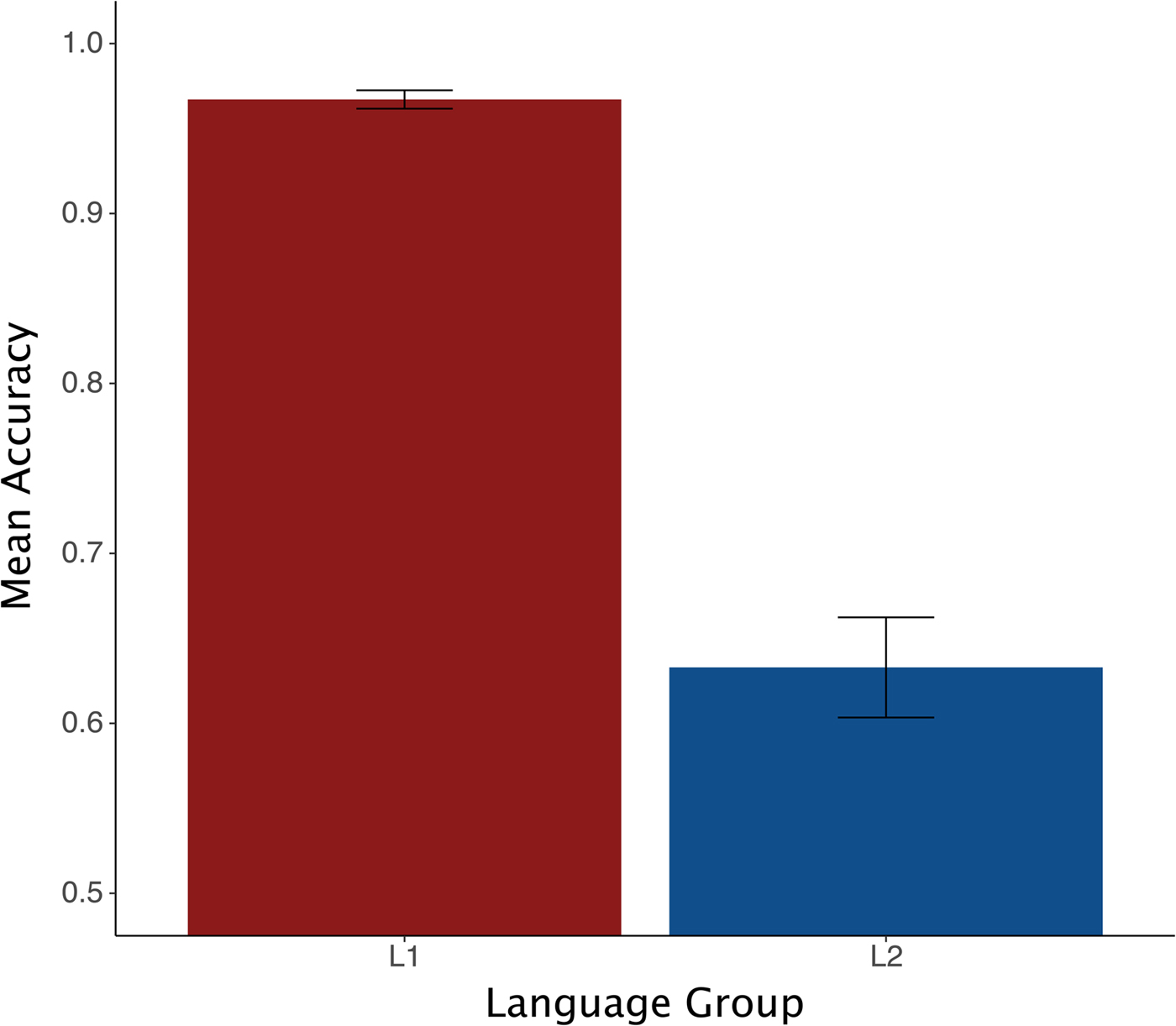
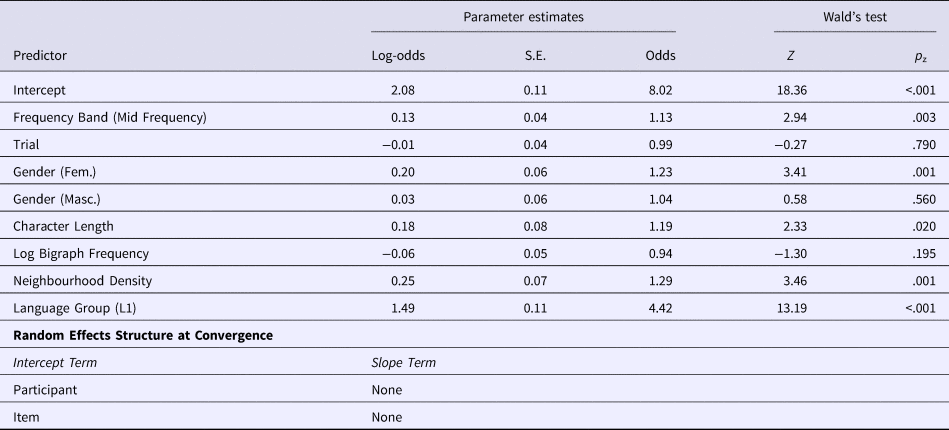
L2 participants had an overall accuracy of 63.3% (SD = 13.2%) compared to 96.8% (SD = 2.4%) for the native speakers (Figure 1). This difference came out as significant in the logistic mixed effects regression model fit to these data (log-odds = 1.49, p < .001; L1: LS mean (log-odds) = 3.57, SE = 0.18, LS mean (%) = 97.3; L2: LS mean (log-odds) = 0.60, SE = 0.14, LS mean (%) = 64.5). The full model summary for the gender decision accuracy data can be found in Appendix B.
Mean accuracy and standard error by language group in the gender decision task.

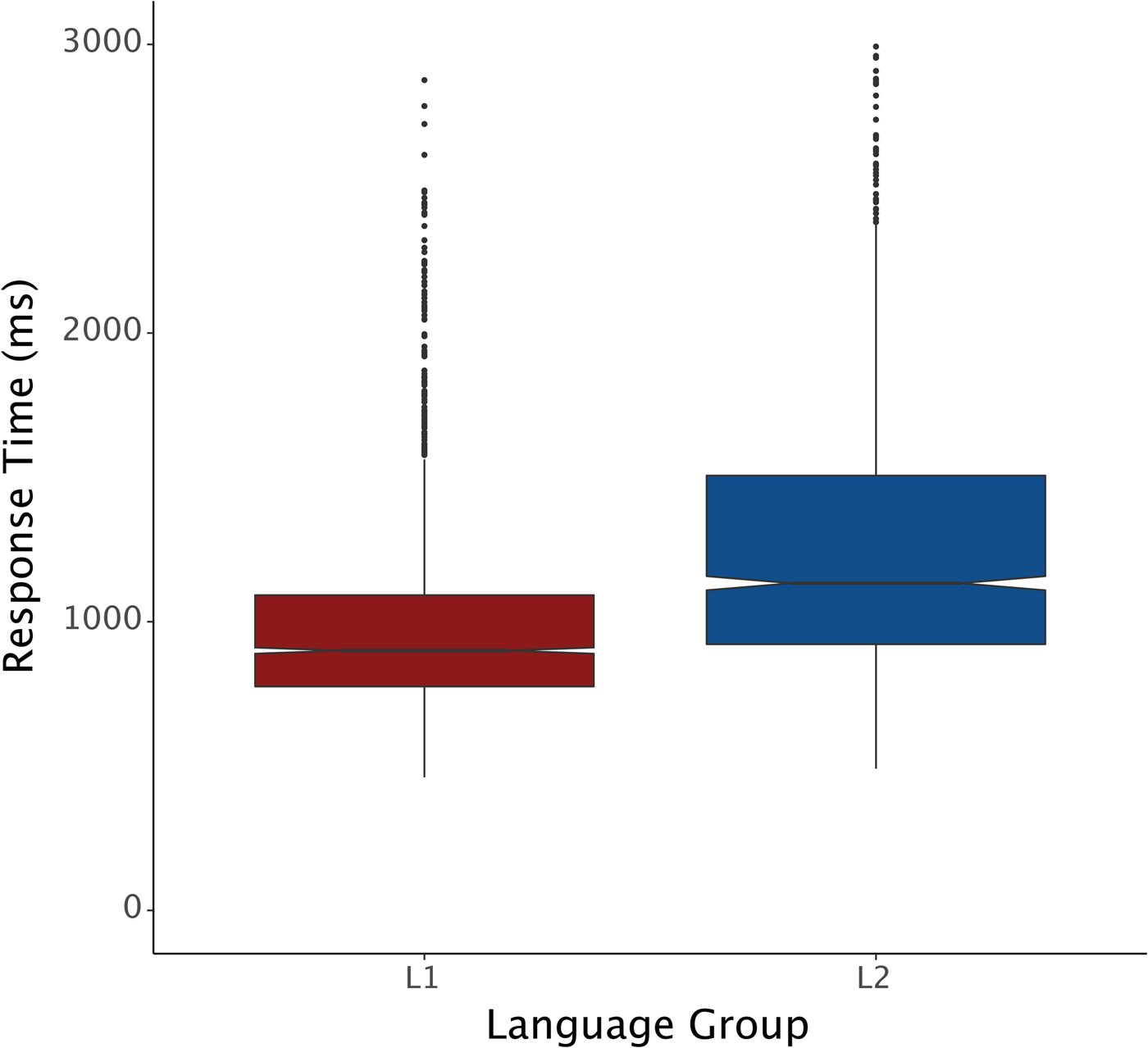
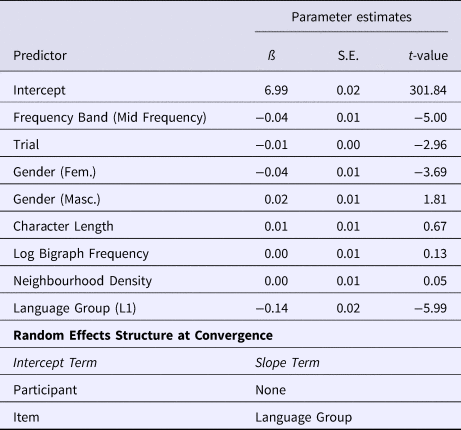
Reaction time results for the gender decision task paralleled those for the accuracy data. L2 participants had an average response time of 1279.9 ms (SD = 175.2 ms), and L1 participants had an average of 982.0 ms (SD = 156.3 ms). These are shown in Figure 2. The linear mixed effects regression model fit to these data found this difference to be significant (ß = −0.14, t = −5.99; L1: LS mean (log RT)= 6.85, SE = 0.03, LS Mean (ms) = 945.05 ms; L2: LS mean (log RT) = 7.12, SE = 0.03, LS mean (ms) = 1241.66). A full model summary can be found in Appendix B.
Reaction times in the gender decision task by language group.

Dual-choice go/no-go task
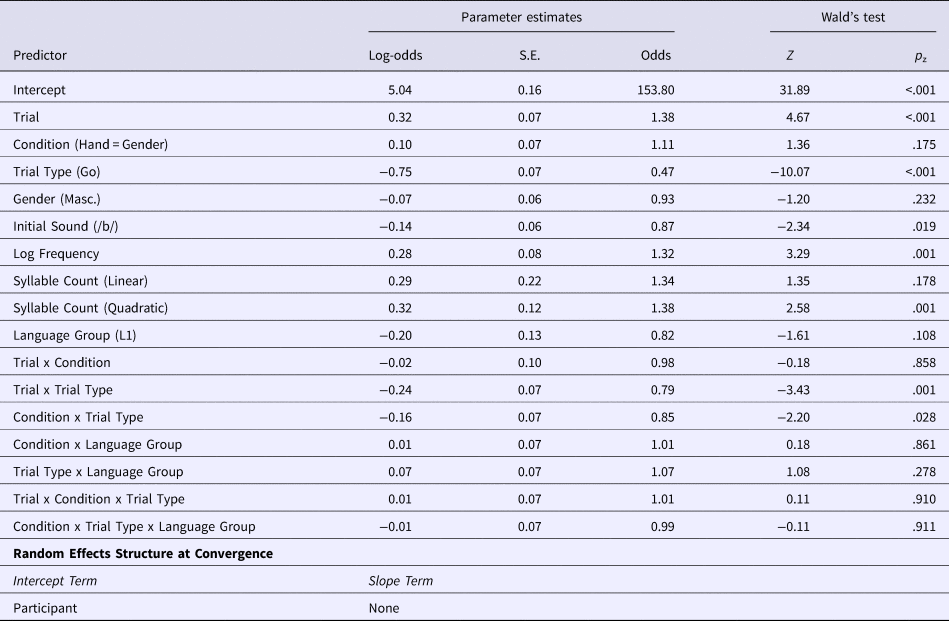
Mean accuracy in the dual-choice go/no-go task was very high. L2 participants were on average 99.0% (SD = 0.7%) accurate, and L1 participants were on average 98.6% (SD = 1.1%) accurate. Modeling results found no significant difference in accuracy between L1 and L2 participants (log-odds = −0.20, p = .11), nor did any interactions with language group emerge as significant. The model further found a reliable effect of trial type (log-odds = −0.75, p < .001) such that accurate responses were more likely on no-go trials (LS Mean (log-odds) = 5.78, SE = 0.19) than on go trials (LS Mean (log-odds) = 4.29, SE = 0.15). A full model summary can be found in Appendix B.
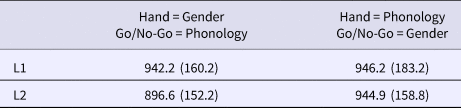
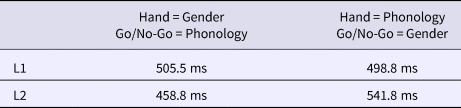
Mean reaction times for the dual-choice go/no-go task were 919.0 ms (SD = 143.3 ms) on go trials for L2 participants, and 943.8 ms (SD = 166.7 ms) for L1 participants. Reaction times by language group and condition are summarized in Table 2. Although L2 participants were descriptively faster, modeling results did not show any reliable differences in response times between L2 and L1 participants (ß = 0.01, t = 0.54), nor was there a reliable interaction between group and condition (ß = 0.01, t = 1.07). A full model summary is available in Appendix B.
Mean response times in milliseconds for the dual-choice go/no-go task by condition and group.

Note: Standard deviations are given in parentheses.
EEG results
Lateralized readiness potential
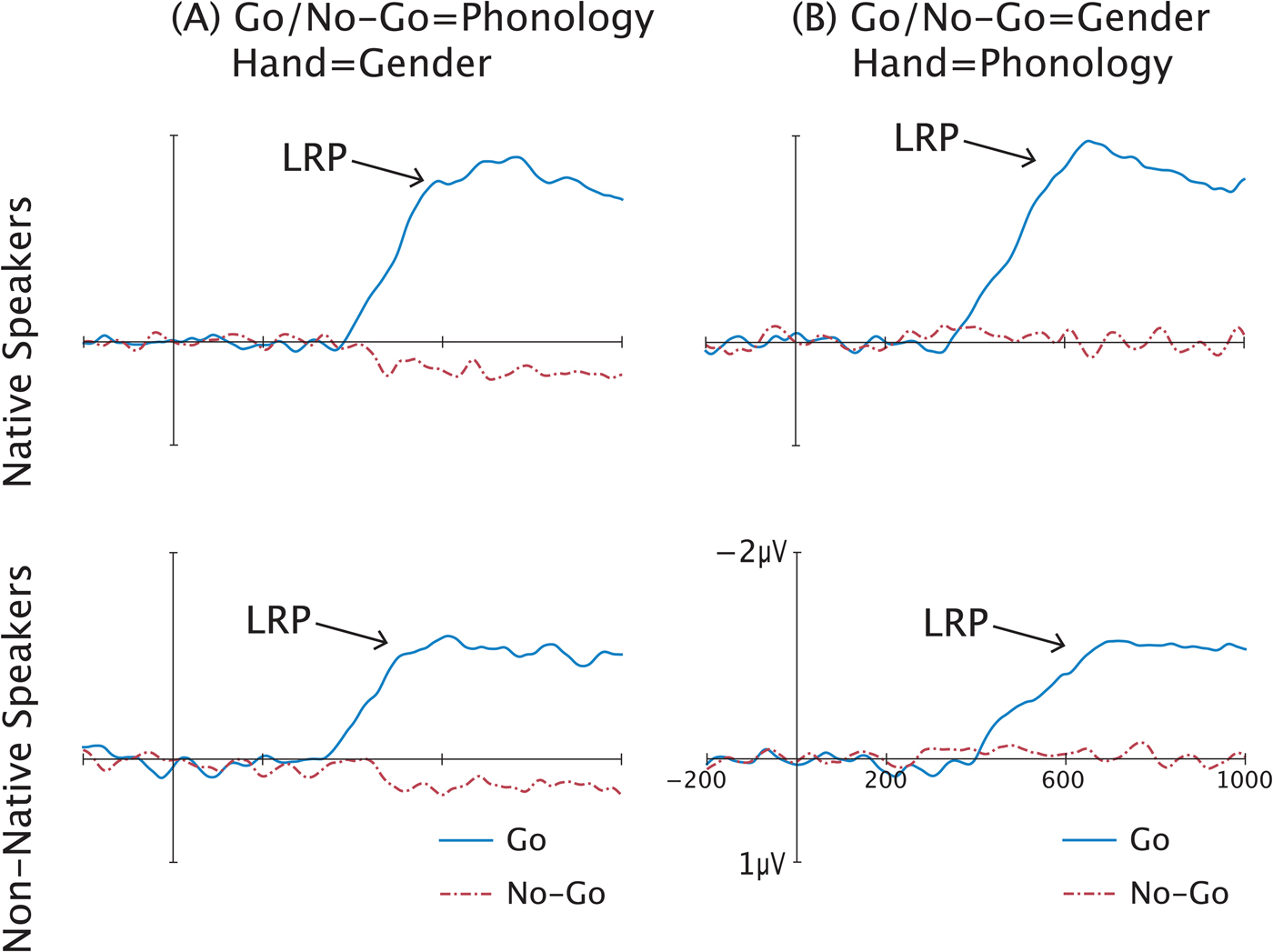
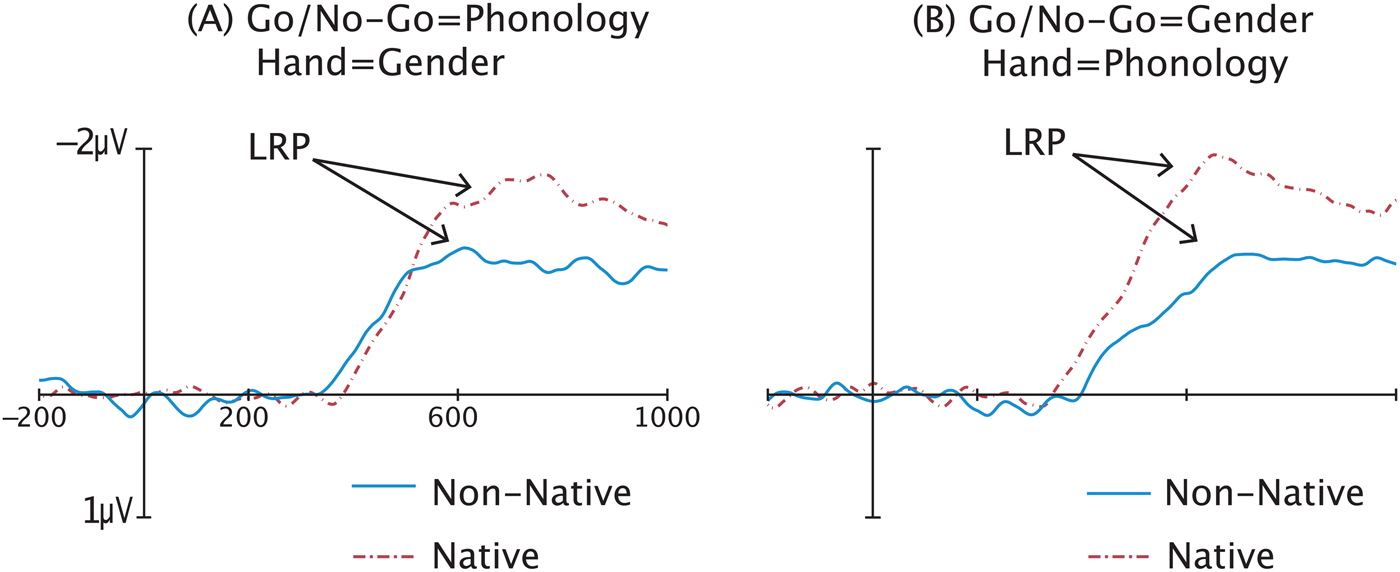
Figure 3 shows the stimulus-locked LRP waveforms for L1 and L2 participants in each condition. Full model results for the GAMM fit to these data are available in Appendix B. When interpreting the GAMM results below, note that p-values for the smooth terms (i.e., the non-parametric parameters) indicate whether a smooth deviates significantly from a zero effect. In order to determine the timing and nature of an effect, however, it is necessary to plot smooths with 95% confidence intervals to examine if and when these differ from zero or from each other. The GAMM fit to the LRP data found no significant non-linear activity for native speakers when hand = gender on no-go trials (edf = 3.83, F = 1.50, p = .191), but it did find reliable non-linearity when hand = phonology on no-go trials (edf = 8.13, F = 6.01, p = .002)Footnote 2. For the L2 speakers, the GAMM found no significant non-linearity on no-go trials when hand = phonology (edf = 1.00, F = 0.33, p = .566), and found marginal non-linearity on no-go trials when hand = gender (edf = 7.68, F = 1.97, p = .063). Figure 4 shows the model fits for no-go LRPs by condition and language group. For both groups when gender = hand, the model fits show non-linear activity that becomes increasingly positive over time. These are therefore not consistent with no-go LRPs, which should begin around zero μV, show a brief negative excursion, and then return to zero for the remainder of the trial. Similarly, the straight line fit for L2 speakers when hand = phonology is incompatible with a no-go LRP. Finally, for the native speakers when phonology = hand, the shape of the model fit is consistent with a no-go LRP. The confidence intervals, however, include zero μV for the entire epoch, indicating that the increased negativity between 200 ms and 600 ms is indistinguishable from noise. In short, we did not find reliable evidence for no-go LRPs for either group in any condition.
ERP plot of LRP effects (computed from electrodes C3 and C4) for native and non-native speakers. Panel A shows LRPs when phonology determines the go/no-go response and gender the hand response, and panel B shows LRPs when gender determines the go/no-go response and phonology the hand response. 200 ms of prestimulus and 1000 ms of poststimulus activity are depicted; negative voltage is plotted up. Vertical bars indicate stimulus onset. Tick marks are shown on the x-axis at −200 ms, 200 ms, 600 ms and 1000 ms.

Fitted GAM smooths for the no-go LRPs for native and non-native speakers. Panel A shows the model fits when phonology determines the go/no-go response and gender the hand response, and panel B shows the model fits when gender determines the go/no-go response and phonology the hand response. Shading indicates the 95% confidence interval. A significant deviation from zero is indicated when the 95% CI does not overlap with zero. Negative voltage is plotted up.

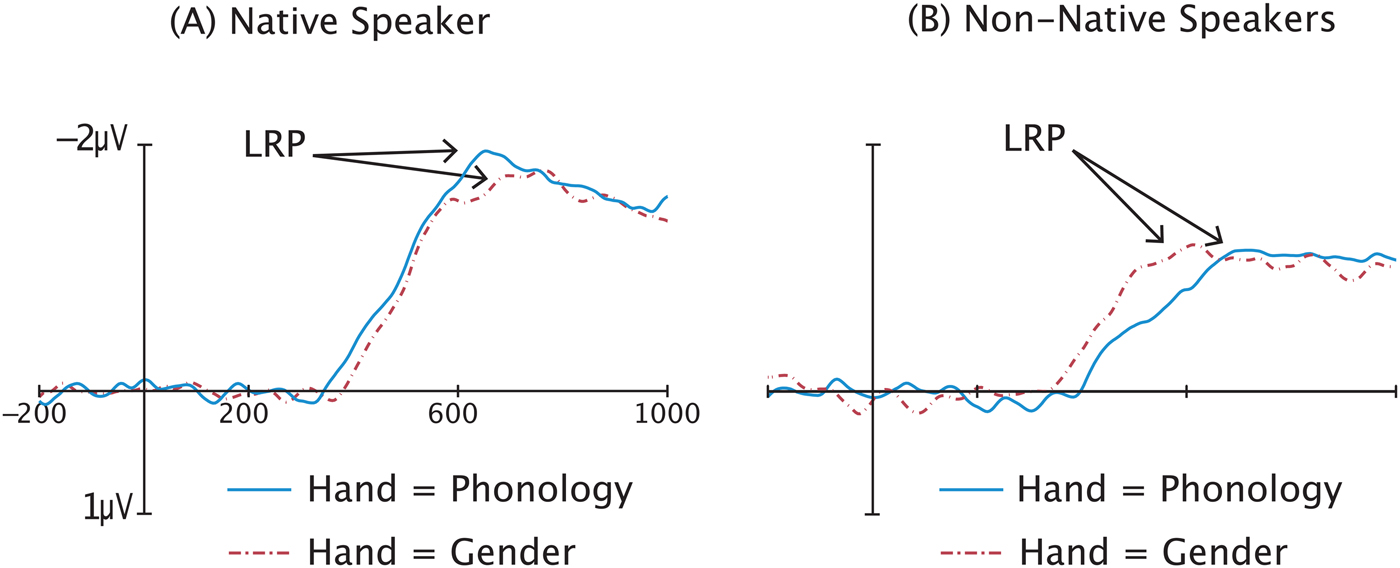
Figure 5 over-plots the stimulus-locked go LRPs in each condition for the L1 and L2 groups. Mean onset latencies as determined using the 50% fractional peak latency are summarized in Table 3. A 2 × 2 ANOVA of these data found no main effect of group (F (1,38) = 1.59, F corrected = 0.00, p corrected = .947), a significant main effect of condition (F (1,38) = 1684.42, F corrected = 4.67, p corrected = .037), and a significant interaction between group and condition (F (1,38) = 2316.75, F corrected = 6.42, p corrected = .016). Follow-up pairwise comparisons were computed using lsmeans. Bonferroni corrections were applied to the p-values obtained after correcting the t-statistics for the jackknife procedure using an alpha of .05 for four tests. Results of these comparisons showed that the effect of condition was reliable for the L2 group (t (38) = 63.06, t corrected = 3.32, p corrected = .008), but not for the L1 group (t (38) = −5.01, t corrected = −0.26, p corrected ≈ 1). In other words, the stimulus-locked go LRPs began significantly earlier for non-native speakers when hand = gender and go/no-go = phonology than when hand = phonology and go/no-go = gender. This effect is shown in Figure 6. In contrast, the native speakers’ LRPs did not differ reliably in their onsets across conditions. The follow-up comparisons further found no reliable difference in onsets for L1 compared to L2 participants when hand = phonology and go/no-go = gender (t (65.37) = −25.24, t corrected = −1.33, p corrected = .755) nor when hand = gender and go/no-go = phonology (t (65.37) = 27.35, t corrected = 1.44, p corrected = .619).
Overplot of the go LRPs for native and non-native speakers when phonology determines the go/no-go response and gender the hand response, and when gender determines the go/no-go response and phonology the hand response. 200 ms of prestimulus and 1000 ms of poststimulus activity are depicted; negative voltage is plotted up. Vertical bars indicate stimulus onset. Tick marks are shown on the x-axis at −200 ms, 200 ms, 600 ms and 1000 ms.

Overplot of the go LRPs by condition for native and non-native speakers. 200 ms of prestimulus and 1000 ms of poststimulus activity are depicted; negative voltage is plotted up. Vertical bars indicate stimulus onset. Tick marks are shown on the x-axis at −200 ms, 200 ms, 600 ms and 1000 ms.

Mean stimulus-locked go LRP onset latencies by condition and group as determined by the 50% fractional peak latency.

N200
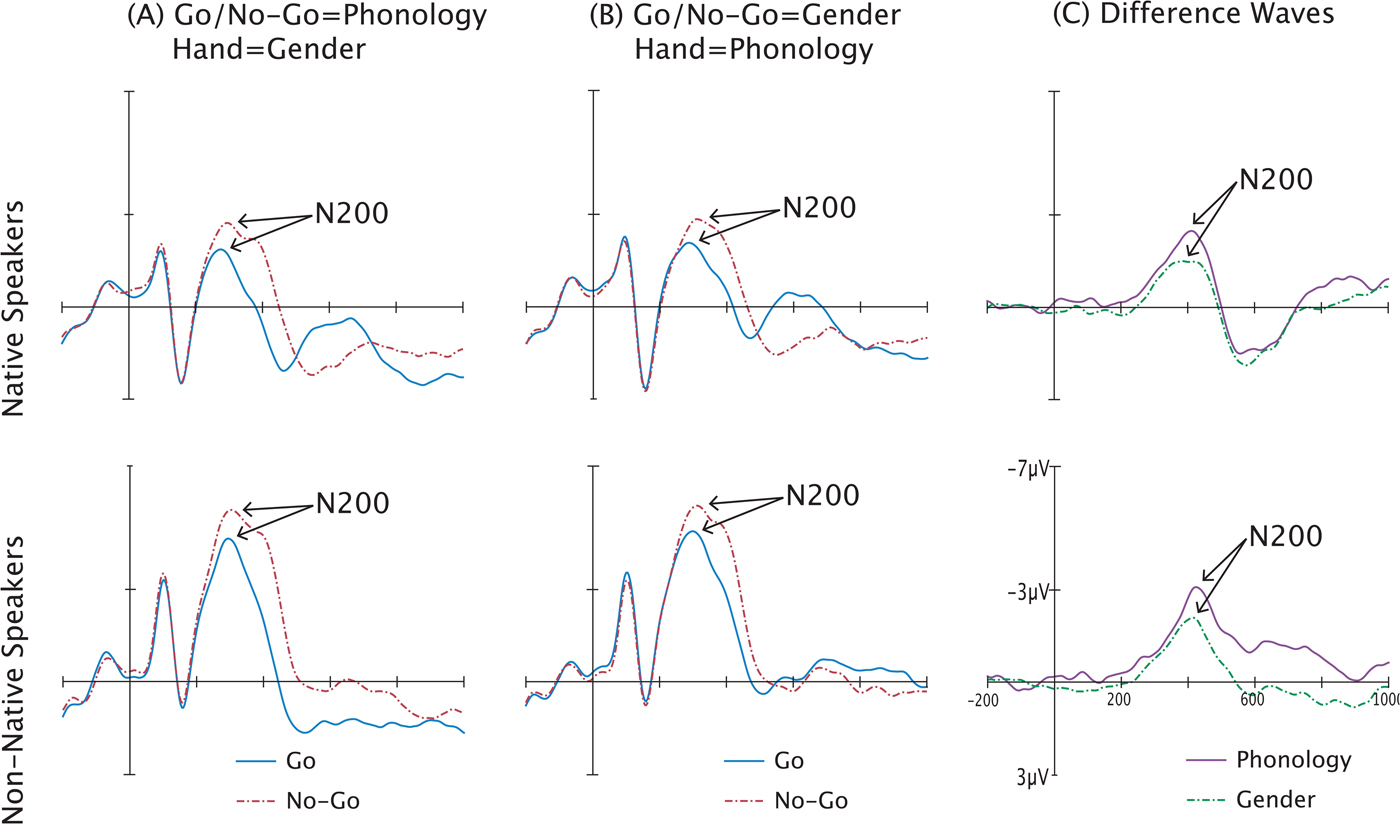
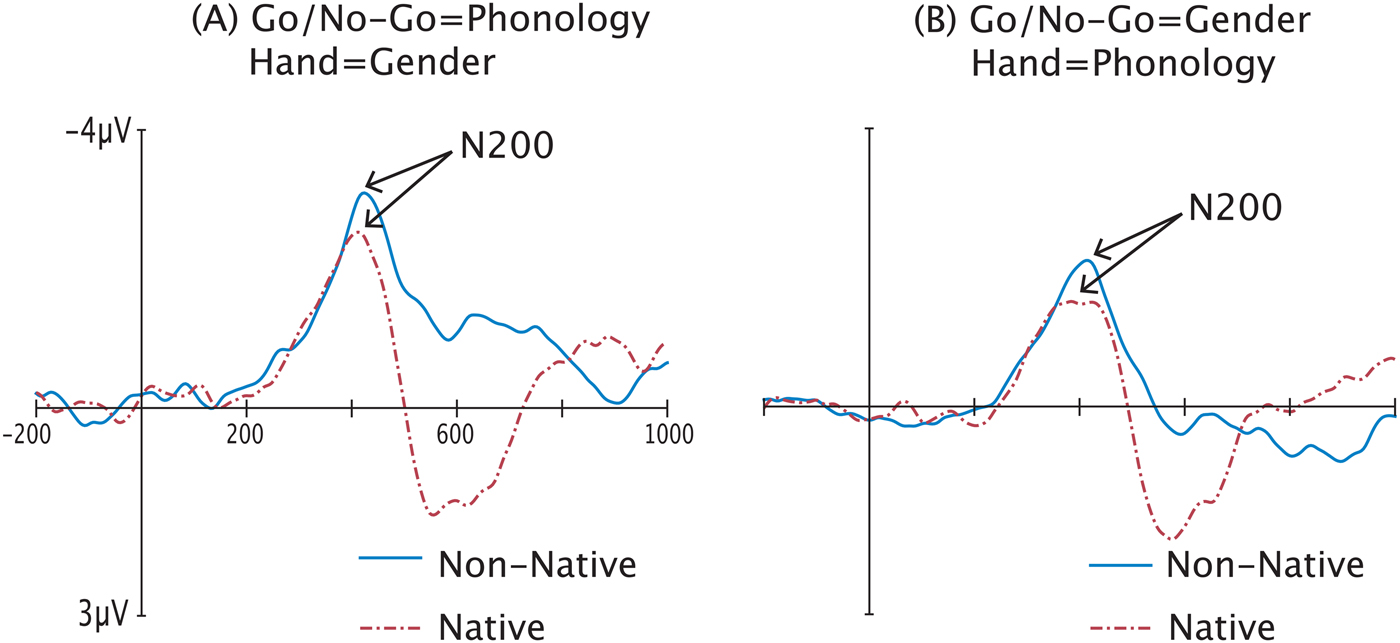
Figure 7 shows the N200s for each condition for L1 and L2 participants, and Table 4 summarizes the mean peak and onset latencies of the difference waves. Difference waves for L1 and L2 participants are over-plotted in Figure 8. A 2 × 2 ANOVA on the peak latencies found no significant main effects of group (F (1,38) = 16.84, F corrected = 0.05, p corrected = .830) or condition (F (1,38) = 10.25, F corrected = 0.03, p corrected = .867), nor did it find a reliable interaction between the two (F (1,38) = 17.21, F corrected = 0.05, p corrected = .828). The same analysis of the 50% fractional peak latencies similarly found no significant main effects (Group: F (1,38) = 479.18 F corrected = 1.33, p corrected = .256; Condition: F (1,38) = 198.456, F corrected = 0.55, p corrected = .463) and no reliable interaction between group and condition (F (1,38) = 1.20, F corrected = 0.00, p corrected = .954).
ERP plot of the N200 effects at frontal electrode Fz for native and non-native speakers. Panel A shows N200 effects when phonology determines the go/no-go response, panel B when gender determines this response, and panel C plots the difference waves of these effects. 200 ms of prestimulus and 1000 ms of poststimulus activity are depicted; negative voltage is plotted up. Vertical bars indicate stimulus onset. Tick marks are shown on the x-axis every 200 ms from −200 ms to 1000 ms.

Overplot of the N200 difference waves for native and non-native speakers when phonology determines the go/no-go response and when gender determines this response. 200 ms of prestimulus and 1000 ms of poststimulus activity are depicted; negative voltage is plotted up. Vertical bars indicate stimulus onset. Tick marks are shown on the x-axis every 200 ms from −200 ms to 1000 ms.

Mean N200 peak latencies and onset latencies (50% fractional peak latency) by condition and group.

Discussion
This study compared the time course of lexical feature retrieval for grammatical gender and phonological information in L1 and intermediate–advanced L2 speakers of German, using familiar nouns whose gender participants had strong knowledge of. The goal was to identify whether delays in retrieval of grammatical gender are an inherent, pervasive property of the lexical access system for a non-native speaker of a gender-marking language (German), whose L1 does not instantiate grammatical gender (English). We hypothesized that the retrieval of grammatical gender in L2 participants might be delayed relative to words’ phonological information, which in turn might partially explain L2 difficulties using gender during language production. Counter to this hypothesis, however, we found no reliable evidence for any specific delay in the retrieval of grammatical gender relative to phonology nor relative to native speakers. Reaction times in the dual-choice go/no-go task were similar for L1 compared to L2 speakers (Prediction 5). In addition, like the L1 participants, L2 participants did not show no-go LRPs in any condition (Prediction 2). This indicates that there is no selective delay for retrieving gender information for our L2 speakersFootnote 3. This further suggests that the relative time course of lexical feature retrieval for intermediate–advanced L2 speakers is similar to that of L1 speakers. Consistent with this, the N200 peak and onset latencies were similar in all conditions (Prediction 1) and for both language groups (Prediction 3), in addition to which there was no interaction between condition and language group (Prediction 4), again indicating that L2 gender retrieval is not delayed, at least for highly familiar words.
The finding that N200 latencies were not delayed for L2 versus L1 participants echoes findings from Guo and Peng (Reference Guo and Peng2007), who found no delay in the retrieval of semantic and phonological information in an L2 compared to in an L1. These results along with ours suggest that there is no inherent upper bound for lexical feature retrieval in a late-learned L2, at least for the features tested in these studies. This places important constraints on models of second language acquisition and processing with respect to how lexical information in an L2 is represented and how it is accessed online. With respect to representation, our results indicate that models of L2 acquisition must permit for lexical information to be learned and represented in such a way that enables rapid retrieval of lexical features on a time course comparable to that of native speakers. Although this does not entail that representations in the L2 are identical to representations in the L1, a parsimonious explanation would be that L2 representations are either highly similar to L1 representations, or that they can become more L1-like through increased use and familiarity. The lack of a delay in our covert picture naming task further suggests that lexical information in an L2 is or can become directly linked to conceptual representations rather than being mediated by the L1 (cf. Kroll & Stewart, Reference Kroll and Stewart1994).
While we find no reliable differences in the relative time course of lexical feature retrieval for L1 versus L2 participants, our L2 participants were reliably slower and less accurate at assigning grammatical gender in the gender decision task. This indicates that the native-like performance of our L2 participants in the dual-choice go/no-go task cannot be attributed to exceptionally high proficiency with grammatical gender in general, as we would otherwise expect ceiling performance in the gender decision task. Instead, the discrepancy in performance across tasks suggests that, while gender is still challenging for these participants, it is possible to retrieve grammatical gender on a native-like time course when nouns are highly familiar and the gender of a noun is well-known.
The fact that response times were slower in the gender decision task is also consistent with the claim of the LGLH that gender retrieval in an L2 should be slower due to weaker links. This claim must be qualified, however, by the fact that our ERP data showed no reliable delay in gender retrieval for our L2 compared to L1 participants. Together, these results suggest at least two possibilities that are not mutually exclusive. One is that the timing of gender retrieval is mediated by the relative strength of associations between nouns and their gender representations (cf. Grüter et al., Reference Grüter, Lew-Williams and Fernald2012). In this case, the lack of any delays found in the ERP data could be due to the fact that these nouns were highly familiar, and thus likely had strong associations with their gender representations. A second possibility is that gender retrieval is not fundamentally delayed, but rather the observed delays in the gender decision task reflect post-retrieval mechanisms such as monitoring or checking. Under this account, the delays in the gender decision task could stem from post-retrieval monitoring processes taking longer due to weaker links and/or lower certainty for these less familiar nouns, or these delays may reflect an increased likelihood of retrieving the incorrect gender for nouns with weaker gender links, which would require re-retrieval in order to make a correct response. This latter possibility might explain why incorrect gender assignments are regularly observed under time constraints, where pressure to speak or comprehend with minimal delay might outweigh any pressure to use the correct grammatical gender.
An important caveat to the results discussed thus far is that the nouns used in the dual-choice go/no-go task were highly practiced and familiar due to use of the warm-up and the multiple repetitions over the course of the experiment. Because of this, we cannot claim that the rapid, L1-like time course we found in the present dual-choice go/no-go task would extend to other, less-familiar nouns. The present results instead provide a view of upper-bound possibilities for L2 retrieval of lexical features like phonology and gender for highly familiar items. It is also important to consider whether multiple repetitions of items may have influenced the relative time course estimates we saw in the present study. First, we note that repetition occurred for both the L1 and L2 participants, so that any effects of repetition should play out similarly for both groups. Moreover, all prior research using the dual-choice go/no-go paradigm has used repetition of items, and this research has consistently been able to find differences in the time course with which different information sources are retrieved. Thus, repetition of items within an experiment does not eliminate retrieval timing differences for lexical features. In addition, if there are any inherent delays to gender retrieval in L2 processing that are a consequence of the architecture of non-native lexical retrieval mechanisms, these should remain present even when items are repeated. Thus, if English speakers’ retrieval of gender information in an L2 were inherently slower, these delays should still have been measurable, even for highly familiar nouns. As such, our results show that it is possible for late L2 learners to retrieve gender information on a similar time course to native speakers during word production, suggesting that gender retrieval is not fundamentally delayed in a late-learned L2, even when gender features are absent from the L1.
Though the relative time course with which our L1 and L2 participants retrieve lexical feature information is highly similar, we do find some differences in the overall time course with which lexical features are mapped onto an overt decision once retrieval has occurred. Specifically, the onset latencies of the stimulus-locked go LRPs for our L2 participants were impacted by condition, with LRPs beginning earlier when the hand decision was determined by gender and the go/no-go decision by phonology. In contrast, the L1 participants showed no effect of condition on LRP onsets. In other words, whereas L1 and L2 participants did not differ in their retrieval of individual lexical features, as measured by the N200 latencies and the absence of no-go LRP effects, they did differ in the time course with which lexical feature information is mapped onto an overt motor response, but only after both relevant features had been retrieved. Unfortunately, the direction of the effect is difficult to interpret. Because the L2 LRP onsets did not differ reliably from those of the native speakers, and because LRP onsets for the L2 participants were numerically earlier compared to L1 onsets when hand = gender, but later when hand = phonology, it is not clear whether it was easier to prepare a response when hand = gender or harder when hand = phonology. It is also not clear why this should be the case given that both conditions require the same processes and retrieval of the same sources of information.
What these data do suggest, however, is that L2 lexical access may more susceptible to top-down influences such as goal-directed behaviors driven by intention (e.g., Strijkers, Holcomb et al., Reference Strijkers, Holcomb and Costa2011; Strijkers, Yum et al., Reference Strijkers, Yum, Grainger and Holcomb2011) or attentional biases (e.g., Shantz & Tanner, Reference Shantz and Tanner2017). A post-hoc analysis of LRP onsets as a function of task order supports this conclusion. Shantz and Tanner (Reference Shantz and Tanner2017) found that the time course of lexical feature retrieval in L1 German speakers is affected by the task configuration that participants have at the beginning of the experiment. L1 participants who started the experiment with the phonology = go/no-go and gender = hand configuration had a mean LRP onset latency of 496.6 ms, whereas those beginning with gender = go/no-go and phonology = hand had a mean LRP onset latency of 519.4 ms (difference = 22.8 ms)Footnote 4. Performing a similar post-hoc analysis by task order in the L2 participants in the present study found that the difference in onset latencies for the L2 participants is nearly three times larger, at 485.6 ms for the phonology = go/no-go first participants, and 553.8 ms for the gender = go/no-go first participants (difference = 67.2 ms). This suggests that task order had a much larger impact on L2 participants than on L1 participants. Greater susceptibility to top-down influences may help explain why L2 users often deviate from target-like behavior. In production, if the goal is to convey a message efficiently and intelligibly, greater attentional resources may be devoted to message- and lexeme-level information, leaving fewer resources for efficient monitoring of gender retrieval. Similarly, when listening or reading, comprehension goals may demand greater allocation of attentional resources to message-level information. If gender information is not crucial for understanding the message, L2ers may fail to notice errors or may avoid devoting additional resources to revision processes, particularly if prior experience (e.g., L1) biases them toward privileging certain cues over others.
Despite the differences observed for the go LRPs, there were no reliable effects of condition in the response time data. On the one hand, this suggests a trade-off between how long it takes to retrieve lexical feature information and map it onto a response, and how long it takes to evaluate that response before executing it. That said, though the difference was not significant, response times were numerically faster for the L2 participants when gender = hand compared to all other conditions. This is consistent with the earlier LRP onset in the gender = hand condition for the L2 group. L2 participants may, thus, have been faster overall in this condition. Again, why this should be the case is not clear. Whatever the effect of condition, it did not appear to affect accuracy. Model results found no main effect of condition and no interactions with language group. There was, however, a reliable interaction between condition and trial type. As had been reported in Shantz and Tanner (Reference Shantz and Tanner2017), pairwise comparisons showed that participants were more accurate on no-go trials than on go trials, and that this difference was larger when hand = gender (Go: LS Mean (log-odds) = 4.23, SE = 0.16, No-Go: LS Mean (log-odds) = 6.05, SE = 0.26) than when hand = phonology (Go: LS Mean (log-odds) = 4.35, SE = 0.16, No-Go: LS Mean (log-odds) = 5.52, SE = 0.21). While this might suggest a speed–accuracy trade-off for the L2 participants, where earlier onsetting LRPs and faster response times when hand = gender led to lower accuracy, it is difficult to reconcile this with the fact that this same interaction was found independently for the native speakers, for whom no effects of condition were found for the LRP onsets. In addition, any conclusions about the accuracy data should be drawn with caution, given that the model did not converge on the optimal random effects structure.
Though not statistically significant, we also believe the quantitative differences in N200 latencies comparing L1 to L2 participants warrant discussion, as they are large enough to be cognitively meaningful. Comparing N200 onset latencies as measured by the 50% fractional peak latency, we do see numeric evidence for a global delay in the L2ers. Onset latencies were, on average, 31.2 ms later when go/no-go = phonology, and 34.0 ms later when go/no-go = gender. Importantly, the difference in this delay across conditions is only 2.8 ms. This is unlikely to be meaningful at the timescale of speech production. Thus, while L2 feature retrieval does show some evidence for a delay, it appears to be global rather than specific to grammatical gender.
The peak latencies do provide some evidence that gender might also be selectively impaired in that peak latencies were 23.2 ms later for L2ers compared to L1 participants when go/no-go = gender, and only 0.4 ms later when go/no-go = phonology. We would argue, however, that the onset latencies provide a better upper-bound estimate of feature retrieval, as these measure the time at which go and no-go waveforms start to diverge, which is only possible if information relevant to making that decision has been retrieved. In comparison, evidence supporting the conflict monitoring theory of the frontal N200 has shown that N200 amplitudes and peak latencies are positively correlated with response times (Yeung, Botvinick & Cohen, Reference Yeung, Botvinick and Cohen2004). This suggests that N200 peaks may be better taken as an index of how long it takes to resolve a response conflict (e.g., to inhibit a prepotent response), irrespective of when the information relevant to making that response has been retrieved. This, moreover, is consistent with the fact that we do not find no-go LRPs in any condition for the L2ers. If retrieval of gender were later than phonology, we would expect to find no-go LRPs when hand = phonology. Thus, to the extent that the numerical trends we observe in our data may reflect real delays in L2 feature retrieval, these delays are not specific to grammatical gender.
Finally, it is worth noting that our participants are all from an intermediate–advanced range of proficiency. It is therefore unclear to what extent our findings generalize to L2 speakers at higher and lower proficiency ranges. As such, it may be fruitful for future work to investigate if and how the time course of feature retrieval changes as a function of proficiency during L2 acquisition.
Conclusion
In this study, we examined whether L2 deficits in online use of grammatical gender may partially reflect delays in gender retrieval. Results from a covert production task found no reliable behavioral nor physiological evidence that L2 grammatical gender retrieval is selectively delayed compared to phonological information or native speakers. These results suggest that the time course of L2 lexical feature retrieval has no inherent upper bound for gender and phonological information. In addition, these data are consistent with the conclusions of Hanulová, Davidson and Indefrey (Reference Hanulová, Davidson and Indefrey2011), who in a comprehensive review of the research on L2 picture naming suggest that the delays found in L2 naming compared to L1 naming likely occur at late, post-lexical stages of production. We further found that the L2 go LRP onsets were affected by condition, whereas L1 LRP onsets were not. This indicates that L2 lexical access may be more susceptible to top-down influences related to goals or attention. Despite no reliable delays being found in the ERP data, our L2 participants were nonetheless slower and less accurate at assigning gender to nouns not used in the dual-choice go/no-go task. Based on these results, we suggest that the impairments observed with grammatical gender in L2 processing and use may stem from post-retrieval processes rather than delayed retrieval, and that retrieval may interact with the relative strength of noun-gender associations such that it becomes slower and/or retrieval errors becomes more likely as association strength decreases.
Author ORCIDs
Kailen Shantz, 0000-0003-2778-2201
Acknowledgements
This research was supported in part by a grant from the Illinois Campus Research Board (Grant RB14158) to DT. KS received financial support from a Doctoral Fellowship from the Social Sciences and Humanities Research Council of Canada, and from an Illinois Distinguished Fellowship from the University of Illinois. DT was supported by NSF BCS-1349110 and BCS-1431324. We thank Nyssa Bulkes, Jack Dempsey, Lorenzo Grego, Chase Krebs, Yisi Liu, MahaTolba, Rebekah Seyfert and Fiona Weingartner for help with data collection. We also thank various attendees at the BUCLD 2015 meeting for helpful discussions, and three anonymous reviewers for helpful feedback. Any remaining errors are our own.
Appendix A
Dual-choice go/no-go items with their grammatical gender, initial phone, English translation ,log lemma frequency (Heister et al., Reference Heister, Würzner, Bubenzer, Pohl, Hanneforth, Geyken and Kliegl2011), and concreteness ratings (Brysbaert, Warriner & Kuperman, Reference Brysbaert, Warriner and Kuperman2014).

Items in the gender decision task with their English translations and grammatical gender.

Appendix B
Accuracy model for the gender decision task.

Reaction time (log) model for the gender decision task.

Accuracy model for the dual-choice go/no-go task.

Reaction time model for the dual-choice go/no-go task.

Generalized additive mixed model of the lateralized readiness potential.