


Introduction
Depression is an extremely common mental health disorder. The Adult Psychiatric Morbidity survey (McManus et al., Reference McManus, Bebbington, Jenkins and Brugha2016) estimates that the 12-month prevalence rate in the UK is around 2.9%. Increases from 2007 (2.6%) (McManus et al., Reference McManus, Meltzer, Brugha, Bebbington and Jenkins2009) and 1993 (1.8%) (Meltzer et al., Reference Meltzer, Petticrew and Hinds1995) have been noted. In 2010/11, the Centre For Economic Performance (2012) reported that the National Health Service (NHS) spent £0.2 billion providing psychotherapy. Psychotherapy is evidence-based (Cuijpers et al., Reference Cuijpers, Berking, Andersson, Quigley, Kleiboer and Dobson2013) and NICE (2009) recommend its use for those with mild to severe depression. Demand, however, continues to outstrip capacity in the UK (NICE, 2011). The National Prescribing Centre (2010) report that the NHS spent around £227 million on anti-depressant medications and although evidence supports the use of such treatment (Gartlehner et al., Reference Gartlehner, Hansen, Morgan, Thaler, Lux and Van Noord2011), NICE (2009) only recommends they are prescribed to those with moderate to severe depression.
The large and rising demand for psychotherapy and the cost of providing such care in the UK led to the introduction of the ‘Improving Access to Psychological Therapies’ (IAPT) programme (Layard et al., Reference Layard, Clark, Bell, Knapp, Meacher and Priebe2006). Patients with mild to moderate depression receive the least intrusive intervention first, with the aim of reducing their symptomology and also preventing their symptoms from worsening whilst waiting for access to psychotherapy. Low-intensity interventions such as bibliotherapy are recommended by NICE (2009) to treat those with mild to moderate depression. Evidence supports their use for this patient group (Floyd et al., Reference Floyd, Scogin, McKendree-Smith, Floyd and Rokke2004), but bibliotherapy in the UK predominantly stems from a cognitive behavioural (CBT) perspective, and if there is not a good person/activity fit with CBT then there are few other options available to these patients, other than joining a large waiting list for psychotherapy or taking anti-depressant medications. CBT for the treatment of depression is evidence based [see Cuijpers et al. (Reference Cuijpers, Berking, Andersson, Quigley, Kleiboer and Dobson2013) for an overview], but evidence is emerging from other fields of psychology regarding low-intensity interventions. For example, within the field of positive psychology evidence supports the use of low-intensity interventions for mild to moderate depression.
Positive psychology interventions (PPIs) are ‘treatment methods or intentional activities aimed at cultivating positive feelings, positive behaviors, or positive cognitions’ (Sin and Lyubomirsky, Reference Sin and Lyubomirsky2009; p. 467). PPIs were initially designed to increase well-being, but evidence suggests that PPIs that are unguided can also reduce depression symptoms. Seligman et al. (Reference Seligman, Steen, Park and Peterson2005) recruited 577 adults via the website that accompanies Seligman's (Reference Seligman2002) book ‘Authentic Happiness’. Participants were randomized into one of four unguided PPIs that were delivered via the internet, or into a placebo control group. There were no differences in depression at baseline, but those who used either of the two tasks listed below had significantly decreased depression scores for up to 6 months post-intervention. The ‘Three good things’ task asked participants to write down three things that went well each day and their causes every night for one week. The ‘Using signature strengths in a new way’ task asked participants to take the Values in Action Character Strengths online measure (available via authentichappiness.org). This questionnaire revealed participants’ top five scoring strengths, which are referred to as signature strengths. They were then asked to use their signature strengths in new or different ways for one week. Participants in this study were, however, recruited via a website that accompanies a positive psychology book that they had purchased. The study was advertised to participants using the title ‘Happiness Exercises’ and the author of the book (who also led this research) discussed these interventions as being beneficial for boosting happiness. Perhaps a placebo effect took place, whereby participants took part in the study expecting to feel better. The findings were, however, replicated by Gander et al. (Reference Gander, Proyer, Ruch and Wyss2013), who concealed the nature of the study by using the title ‘Train your Strengths’ to advertise the study and thus overcome the potential for a placebo effect or experimenter bias to occur. Further researchers have also explored the impact of unguided PPIs on symptoms of depression (e.g. Mongrain et al., Reference Mongrain, Komeylian and Barnhart2016; Reiter and Wilz, Reference Reiter and Wilz2016) with similar results, and to date two meta-analyses of the use of PPIs for depression have been conducted. Sin and Lyubomirsky (Reference Sin and Lyubomirsky2009) analysed 25 PPI studies, which measured depression as an outcome variable. Effect size r ranged from small (–.28) to large (.81) (Cohen, Reference Cohen1992) with 80% of effect sizes in favour of PPI. The unweighted mean r = .31 demonstrated a medium effect size. Bolier et al. (Reference Bolier, Haverman, Westerhof, Riper, Smit and Bohleijer2013) later carried out an updated meta-analysis, with fourteen PPI studies, where depression was measured as the outcome variable. At post-test the standardized mean difference between the intervention group and control was d = .23, again indicating small effects for PPIs using Cohen's d (Cohen, Reference Cohen1988).
Disseminating these evidence-based interventions beyond a research setting to people in the real world with symptoms of depression (Hone et al., Reference Hone, Jarden and Schofield2015) is now a viable option. Self-help books may be one appropriate method as bibliotherapy can effectively reduce depression symptomology in comparison with no treatment (Den Boer et al., Reference Den Boer, Wiersma and Van Den Bosch2004) or treatment as usual (Naylor et al., Reference Naylor, Antonuccio, Litt, Johnson, Spogen and Williams2010).
One method of accessing bibliotherapy is via books on prescription schemes. The first of these schemes was piloted in Cardiff in 2003 with the Welsh Assembly rolling this scheme out nationally in 2005 (NHS Direct Wales, 2017). From 2003 schemes based on the Cardiff model were in operation across the UK (NHS Direct Wales, 2017), with the Reading Well – Books on Prescription Scheme launching nationally in England in 2013 (The Reading Agency, 2013). Books are prescribed via multiple access routes, for example general practitioners (GPs), IAPT practitioners or other healthcare professionals are able to prescribe self-help books to patients who are experiencing disorders such as depression, anxiety, phobias or chronic fatigue, etc. Patients then take their prescription to a participating library, whereby they are able to borrow the self-help title prescribed. People can also borrow any of the self-help titles available at their local library without a prescription and indeed this is a popular access route, with 80% of book prescriptions in England coming via self-referrals in 2013 (The Reading Agency, 2015a).
These types of schemes, and bibliotherapy more generally, may not however be accessible to those with low levels of literacy. Indeed, Martinez et al. (Reference Martinez, Whitfield, Dafters and Williams2008) found that the reading ages of eight of the self-help books prescribed as part of books on prescription schemes in England and Wales, ranged from 12.6 to 15.4, which could be problematic given that the National Literacy Trust (Jama and Dugdale, Reference Jama and Dugdale2012) report that around one in six adults in the UK have literacy levels below that of an 11-year-old.
The books prescribed as part of books on prescription schemes are all derived from CBT, for example in England there are three books available for depression (Gilbert, Reference Gilbert2009; Greenberger and Padesky, Reference Greenberger and Padesky1995; Williams, Reference Williams2011) which all stem from this perspective. However, as previously discussed, there is a growing evidence base to suggest that PPIs can effectively reduce depression (Bolier et al., Reference Bolier, Haverman, Westerhof, Riper, Smit and Bohleijer2013) and, as such, bibliotherapy and books on prescription schemes should be considered as a method of disseminating these interventions to those with mild to moderate depression (Parks and Szanto, Reference Parks and Szanto2013). Until fairly recently, however, there were no positive psychology self-help books that specifically targeted depression.
‘Positive Psychology for Overcoming Depression’ (Akhtar, Reference Akhtar2012) is the first self-help book that contains PPIs to specifically target depression. The aim of the current study is to establish whether a positive psychology self-help book, which is aimed at those with symptoms of depression, is as effective as a CBT self-help book, in terms of reducing depression and boosting feelings of well-being. This will be achieved via a randomized controlled trial (RCT) that will test the efficacy of the above self-help book in comparison with the CBT self-help book ‘Overcoming Depression: A Self-Help Guide using Cognitive Behavioural Techniques’ (Gilbert, Reference Gilbert2009) over an 8-week intervention period. Although grounded in the evidence-based theory of CBT, there is actually little direct evidence for the use of the above book for the reduction of depression symptomology. As a result, the current study will also seek to provide evidence for the effectiveness of Gilbert (Reference Gilbert2009) alongside Akhtar (Reference Akhtar2012).
Method
Sample
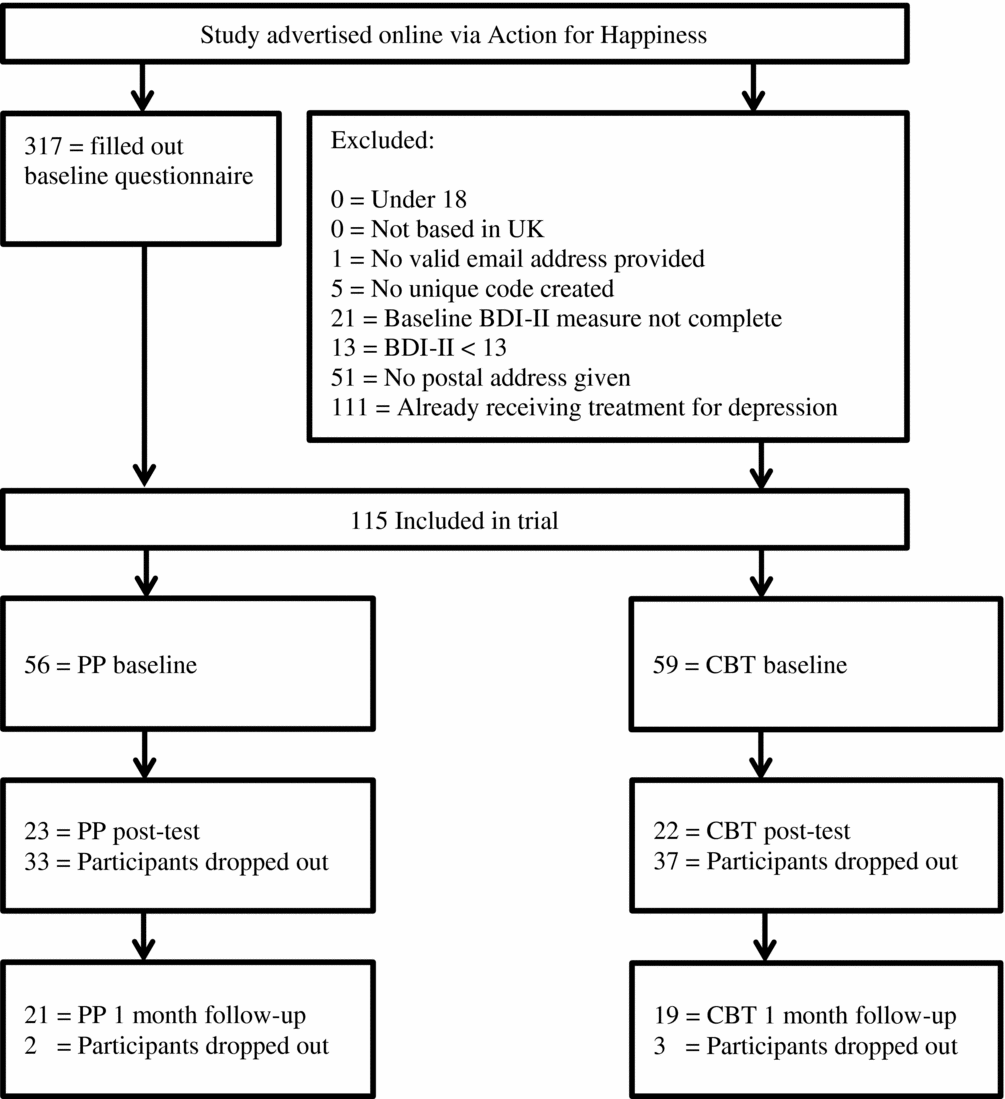
Three hundred and seventeen participants responded by completing the baseline questionnaire. To be eligible to take part, participants needed to be aged 18 or over, provide valid contact information (e.g. email and postal address), have symptoms of depression at baseline [measured via the Beck Depression Inventory-II (BDI-II)], not already be receiving treatment, and be based in the UK. One hundred and fifteen participants were eligible to take part in the study (see Fig. 1 for exclusion criteria). Participants were aged between 19 and 69 years (mean = 39.48, SD = 11.32); 86.96% were female, and 90.43% were White/White British with the remaining participants made up of Asian/Asian British (5.22%), mixed/multiple backgrounds (1.74%), European (1.74%) or Black/Black British (0.87%). Participants’ mean score on the BDI-II (Beck et al., Reference Beck, Steer and Brown1996b) was 28.49 (SD = 10.06), indicating moderate depression.
Flow of participants through the trial.

Participant flow
Figure 1 shows the flow of participants through the trial.
Power analysis
G*Power (Erdfelder et al., Reference Erdfelder, Felder and Buchner1996) revealed that for a mixed between–within analysis of variance, with 95% power and an alpha level of .05, a total sample size of 32 participants (16 per group) was required for a small effect size (f = 0.25). Larger numbers were, however, recruited as high rates of attrition are commonly reported for participants using self-help interventions, who have symptoms of depression (e.g. Williams and Whitfield, Reference Williams and Whitfield2001).
Measures
At baseline, 8 weeks post-test and 1 month follow-up, the participants filled out the BDI-II (Beck et al., Reference Beck, Steer and Brown1996b). Participants were asked to rate 21 items (e.g. ‘Sadness, Crying, Loss of energy’, etc.) in terms of how often they have felt this way during the previous 2 weeks using a 4-point scale that ranged from 0 to 3, with high scores indicating a higher occurrence of each item during the 2 week time period. A score > 13 indicates the presence of symptomatology. The BDI-II has demonstrated high levels of internal consistency in previous research (α = .91) (Beck et al., Reference Beck, Steer, Ball and Ranieri1996a), with α = .81, .93 and .89 reported at baseline, post-intervention and follow-up in the current study.
The Subjective Happiness Scale (SHS; Lyubomirsky and Lepper, Reference Lyubomirsky and Lepper1999) was also administered, with participants asked to rate four statements (e.g. ‘Some people are generally very happy. They enjoy life regardless of what is going on, getting the most out of everything. To what extent does this characterization describe you?’) in terms of agreement using a 7-point scale. Higher scores indicate a positive response; except for question 4, which is reverse coded, before all items are summed to create a total score. High total scores indicate higher levels of subjective happiness. The scale has demonstrated good internal consistency in previous research (α = .79 to .94) (Lyubomirsky and Lepper, Reference Lyubomirsky and Lepper1999), with α = .76, .88 and .74 reported at baseline, post-intervention and follow-up in the current study.
The Satisfaction with Life Scale (SWL; Diener et al., Reference Diener, Emmons, Larsen and Griffin1985) was also administered. Participants are asked to rate their agreement with five statements (e.g. ‘In most ways my life is close to my ideal’) using a 7-point scale that ranges from 7 = strongly agree, to 1 = strongly disagree. High scores indicate high levels of life satisfaction. The SWL has demonstrated good internal consistency in previous research (α = .87) (Diener et al., Reference Diener, Emmons, Larsen and Griffin1985), with α = .82, .91 and .89 reported at baseline, post-intervention and follow-up in the current study.
The Positive and Negative Affect Scale (PANAS; Watson et al., Reference Watson, Clark and Tellegen1988) was also administered. Participants are asked to rate 20 emotions (e.g. ‘Interested, Distressed, Excited’, etc.) in terms of how much they feel they have experienced each emotion over the past few weeks using a 5-point scale that ranges from 1 = very slightly or not at all, to 5 = extremely. Positive and negative emotions are summed independently to create positive and negative affect scores, with high scores indicating higher levels of affect. The PANAS has demonstrated good internal consistency (α = .86 to .90) previously (Watson et al., Reference Watson, Clark and Tellegen1988), with α = .61/.72, .77/.62 and .77/.62 reported for positive affect and negative affect respectively at baseline, post-intervention and follow-up in the current study.
Finally, the Ryff Scales of Psychological Well-Being (PWB; Ryff, Reference Ryff1989; Ryff and Keyes, Reference Ryff and Keyes1995) were administered to measure six facets of psychological well-being, namely; Autonomy (e.g. ‘I have confidence in my opinions, even if they are contrary to the general consensus’), Environmental Mastery (e.g. ‘In general, I feel I am in charge of the situation in which I live’), Personal Growth (e.g. ‘I think it is important to have new experiences that challenge how you think about yourself and the world’), Positive Relations with Others (e.g. ‘People would describe me as a giving person, willing to share my time with others’), Purpose in Life (e.g. ‘Some people wander aimlessly through life, but I am not one of them’), and Self-Acceptance (e.g. ‘I like most aspects of my personality’). Participants are asked to rate 42 statements in terms of agreement using a 6-point scale that ranges from 1 = strongly disagree, to 6 = strongly agree. High scores indicate high levels of psychological well-being. The PWB demonstrates good internal consistency in previous research (α = .86 to .93) (Ryff, Reference Ryff1989; Ryff and Keyes, Reference Ryff and Keyes1995), with α = .87/.91/.90 (Autonomy), .64/.83/.78 (Environmental Mastery), .76/.72/.76 (Personal Growth), .70/.70/.64 (Personal Relationships), .73/.72/.72 (Purpose in Life) and .76/.87/.85 (Self-Acceptance) reported at baseline, post-intervention and follow-up in the current study.
Adherence was also measured post-intervention by asking participants to indicate how much of each chapter they had read, with responses ranging from 0 to 100%. An overall adherence score was created. Maintenance was measured at the 1 month follow-up. Participants were asked ‘Have you kept the self-help book?’ and ‘If yes, have you continued to read the self-help book and perform the exercises it describes?’ (responses were coded ‘yes’ or ‘no’ in both cases).
Materials
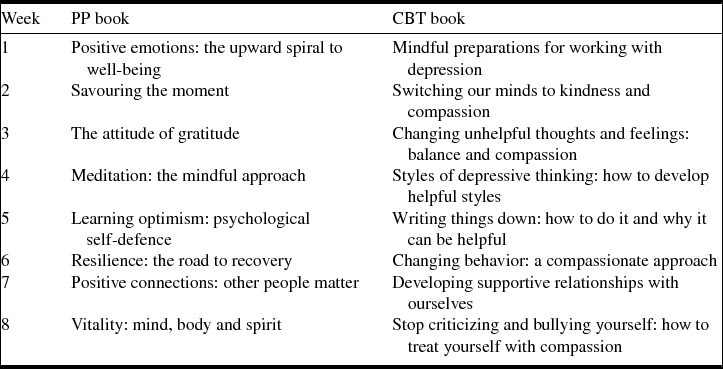
Participants in the PP group received ‘Positive Psychology for Overcoming Depression’ (Akhtar, Reference Akhtar2012). This book contains 12 chapters, which discuss depression and introduce the theory of positive psychology, as well as specific topics such as gratitude or optimism. Each chapter is evidence-based and links to published research in the area in an accessible way. References are provided at the end of the book for readers who wish to follow up. The book contains exercises throughout each chapter for the reader to complete, for example the optimism chapter contains multiple exercises to cultivate optimism, such as Sheldon and Lyubomirsky's (Reference Sheldon and Lyubomirsky2006) version of the ‘best possible selves’ interventions. In this task, the reader is asked to spend 20 minutes writing about a version of their future, in which everything has gone as well as it possibly could. Participants in the CBT group received ‘Overcoming Depression: A Self-Help Guide using Cognitive Behavioural Techniques’ (Gilbert, Reference Gilbert2009), a self-help book for depression that is available in England as part of the books on prescription scheme (The Reading Agency, 2013). Gilbert (Reference Gilbert2009) was selected due to its popularity and lower recommended retail price (RRP) in comparison with Greenberger and Padesky (Reference Greenberger and Padesky1995) and Williams (Reference Williams2011). The Amazon best-selling rankings were used as a proxy to rate popularity, in the absence of loan data via books on prescription schemes. This book contains 22 chapters, which are split into three sections. Part 1 of the book helps the user to gain an understanding of depression and its causes. Part 2 provides the user with guidance on managing their depression. It focuses on increasing the user's activity levels, breaking problems down into manageable steps, and looks briefly into issues such as lack of sleep and alcohol misuse, etc. The book also explores the role of thoughts and feelings in depression, and identifies methods for labelling and challenging negative thoughts that may contribute to the symptoms of depression. Part 3 of the book looks at particular problems associated with depression, such as guilt, etc. Again, each chapter is evidence-based with references provided at the end of the book. Exercises are provided throughout each chapter for the reader to complete. Table 1 shows the eight book chapters that participants were asked to read during the course of the study.
Books chapters that participants were asked to read over the course of the 8-week intervention

Alongside the book, participants received an instruction letter, in which they were asked to read one chapter per week, and given the investigator's contact details should any issues arise. Participants also received a leaflet called ‘Feeling worse not better’ which detailed where to go for help should symptoms worsen during the course of the study. Participants were sent weekly reminder emails outlining which chapter they were to read each week (see supplementary material for instruction letter, leaflet and sample emails).
Procedure
The study was advertised online via Action for Happiness (actionforhappiness.org) and called for participants who were ‘feeling down, low, sad or experiencing symptoms of depression’. Participants were asked to complete a questionnaire to assess their suitability to take part in the study. This questionnaire measured baseline depression and well-being scores, as well as demographic information such as age, gender, ethnicity and history of depression (participants were asked ‘Have you been diagnosed with depression in the past?’ with a yes/no answer format). Eligible participants were randomizedFootnote 1 to either the PP or CBT group. Participants were posted their self-help book and asked to read one chapter per week for 8 weeks. They received weekly emails to remind them which chapter to read. After 8 weeks post-test, and again at 1 month follow-up, participants were emailed a questionnaire that measured depression and well-being post-intervention, as well as attrition, adherence and maintenance. Participants who completed all questionnaires were sent a £10 voucher.
Ethics
This study was designed in accordance with The British Psychological Society Code of Ethics and Conduct (BPS, 2009). Ethical approval was gained from Sheffield Hallam University.
Results
Attrition
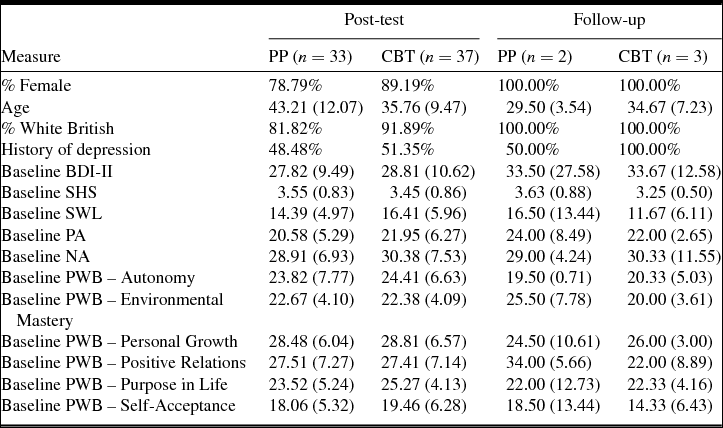
Figure 1 shows rates of attrition from the study. Chi square analysis found no significant differences in drop-out at post-test [χ (1) = .45, p = .50] or 1 month follow-up [χ (1) = .529, p = .47] between the two groups. Table 2 shows the characteristics of those who withdrew. Data were pooled across the two conditions for those who withdrew and those who remained in the study. There were no significant differences between those who failed to provide data and those who did, at either the post-test or the 1 month follow-up, in terms of gender, age, ethnicity, history of depression or baseline depression and well-being scores (p > .20 in all cases).
Mean (SD) and percentage demographic characteristics and baseline depression and well-being scores for participants in the PP group versus the CBT group who dropped out of the study at 8 weeks post-test and 1 month follow-up

Sample
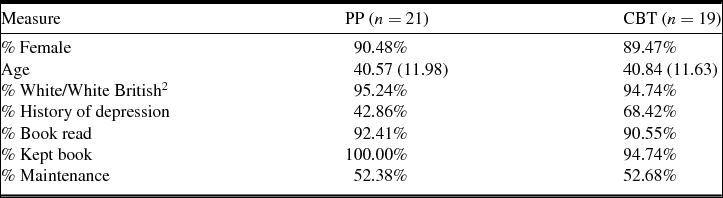
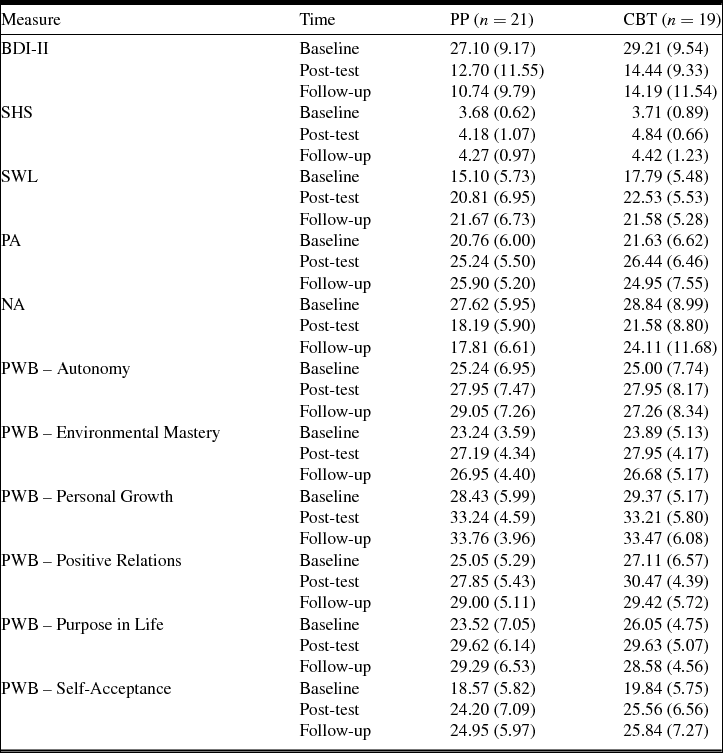
Table 3 shows the characteristics of the participants in the PP group (n = 21) and the CBT group (n = 19) who provided data at all three time points (i.e. baseline, 8 week post-test and 1 month follow-up). Chi square analysis found no significant differences between the two groups for gender, ethnicity, history of depression, percentage who kept the book post-intervention and maintenance (continued use of the book and/or exercises post-intervention) (p > .12 in all cases). Independent samples t-tests indicated no significant difference between the two groups for mean age (t (37) = –.20, p = .84) or adherence (percentage of book read during the intervention period) (t (36) = .80, p = .94). Table 4 shows the mean depression (BDI-II) and well-being (SHS, SWL, PA, NA and PWB subscales) scores at baseline. A one-way multivariate analysis of variance (MANOVA) was used to test for differences in mean depression and well-being at baseline between those in the PP and CBT groups (see supplementary material for assumptions). The analysis showed that there were no significant differences between the two groups (F (11, 27) = .52, p = .87, Wilk's Λ = .81, η2 = .19) prior to taking part in the study.
Mean (SD) and percentage demographic characteristics of participants in the PP group and CBT group who provided 8 week post-test and 1 month follow-up data

Mean (SD) depression and well-being scores for participants in the PP group and CBT group who provided baseline, 8 week post-test and 1 month follow-up data

Effect of PP and CBT bibliotherapy on depression and well-being
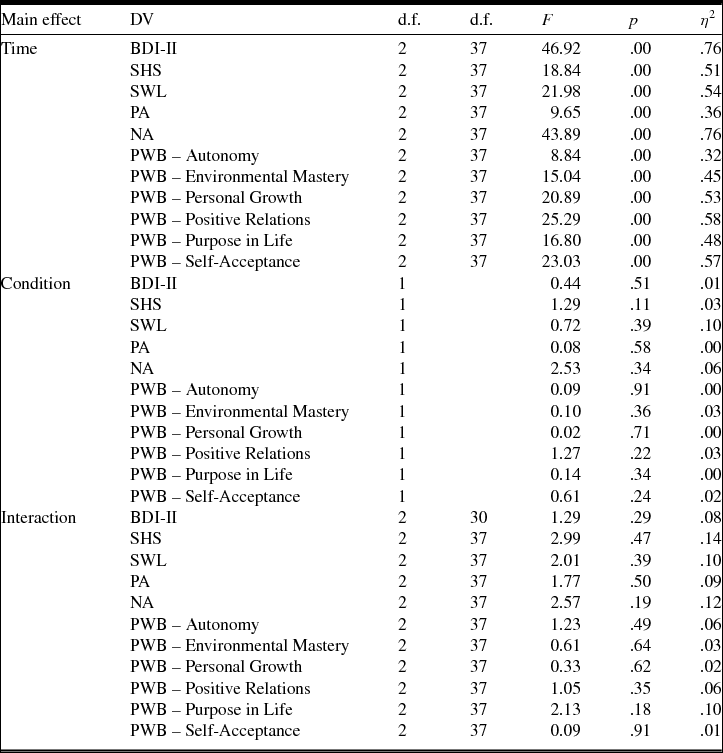
Table 4 also shows the mean depression and well-being scores at post-test and 1 month follow-up. Table 5 shows a series of 2-way between-subjects (group: PP versus CBT) by 3-way within-subjects (time: baseline versus post-test versus 1 month follow-up) analyses of variance (ANOVAs). Depression and well-being scores were used as dependent variables (DV) to determine whether there were significant differences between the two groups across the three time points (see supplementary material for assumptions). The analysis found that for those in both the PP and CBT groups there was a significant main effect of time, indicating significant changes in depression and well-being from baseline to follow-up. Effect sizes ranged from a low of d = .32 to a high of d = .76, indicating small to medium effect sizes using Cohen's d (Cohen, Reference Cohen1988). Table 4 shows that BDI-II and NA scores decreased from baseline to post-test and follow-up, whilst SHS, SWL, PA and PWB subscale scores increased over the same time frame. Post hoc analysis, with Bonferroni adjustments, revealed that rates of depression and well-being fell significantly from baseline to post-test (p < .01 in all cases) and 1 month follow-up (p < .01 in all cases), but there were no significant changes in depression and well-being between post-test and 1 month follow-up (p > .13 in all cases), meaning that improvements were sustained for 1 month post-intervention. The main effect of group was not significant, indicating that there was no significant difference between the two books in terms of improvement in depression and well-being. There were no significant interactions between time and group for any of the depression and well-being measures.
2 × 3 Mixed ANOVAs investigating the effects of time (baseline vs 8 week post-test vs 1 month follow-up) and condition (PP versus CBT) on levels of depression and well-being

Discussion
The current study sought to empirically test the efficacy of Akhtar (Reference Akhtar2012) in comparison with Gilbert (Reference Gilbert2009). It is the first RCT to test a PP self-help book designed specifically for the reduction of depression symptoms. The current study also sought to empirically test Gilbert (Reference Gilbert2009) as, although Gilbert (Reference Gilbert2009) is a popular book in the UK that is often recommended by therapists (Anderson et al., Reference Anderson, Lewis, Araya, Elgie, Harrison and Proudfoot2005), there is little empirical basis for its use.
The results of the current study show that the PP book ‘Positive Psychology for Overcoming Depression’ (Akhtar, Reference Akhtar2012) was as effective at reducing symptoms of depression and increasing feelings of well-being as the CBT book ‘Overcoming Depression: A Self-Help Guide using Cognitive Behavioural Techniques’ (Gilbert, Reference Gilbert2009) when delivered over an 8 week intervention period with reminder emails sent weekly. Changes in depression and well-being scores were sustained for 1 month post-intervention.
As a result, the main issue for researchers to address, with regard to PPIs, is how best to disseminate these interventions to those who would most benefit (Hone et al., Reference Hone, Jarden and Schofield2015). Given the findings of the current research, bibliotherapy may be one appropriate method of dissemination. Bibliotherapy can be accessed in a number of ways, for example via the private purchase of a self-help book or via books on prescription schemes.
In England, 93% of libraries take part in books on prescription schemes, with participating libraries reporting nearly half a million loans of titles included on the books on prescription scheme since 2013. Prescriptions for these books come via multiple avenues such as GPs, IAPT services or other healthcare professionals. The vast majority in England, however (80% in 2013), come via self-referrals (The Reading Agency, 2015a). Since the scheme began in England, there has been a 97% increase in loans of the self-help titles included in this scheme, showing how inclusion of a title on this list is beneficial in terms of garnering the attention of those the book is targeting (i.e. those with mild to moderate symptomology). One of the main advantages of dissemination via books on prescription schemes is the ability to access those with mild to moderate depression who may not present for treatment via traditional routes (e.g. 80% of loans are via self-referral to the scheme). Another advantage to these types of schemes is their accessibility. The Psychiatric Morbidity Survey (McManus et al., Reference McManus, Bebbington, Jenkins and Brugha2016) reported a link between common mental health disorders (such as depression) and socio-economic adversity. Those who reported receiving the Employment and Support Allowance (ESA), a benefit aimed at those unable to work due to poor health or disability, were more likely to be experiencing a co-morbid mental health disorder, with nearly half reporting a suicide attempt. Bibliotherapy and particularly books on prescription schemes may be especially well placed to reach these vulnerable individuals. Whereas other self-help interventions, such as computerized self-help or apps that target mental health disorders, all require the user to have the technology to access these treatments (e.g. a computer, an internet provider or a smartphone, etc.), books on prescription schemes are accessible to all who have a free library membership and, as such, are open to all socioeconomic groups.
In 2014, only around half of those experiencing symptoms of depression in the UK were receiving treatment, with those with more severe symptomology more likely to be receiving treatment (McManus et al., Reference McManus, Bebbington, Jenkins and Brugha2016). If this scheme is able to reach those with mild to moderate symptoms of depression, who are (a) not presenting via traditional access routes (e.g. via GP surgeries or IAPT services), (b) not economically able to access other forms of unguided support (such as computerized self-help) and (c) are less likely to receive psychotherapy due to long waiting lists and the prioritizing of patients with more severe symptomology, then inclusion of a range of evidence-based books, from different perspectives, is crucial. Not all patients will find CBT a suitable treatment approach and NICE (2009) guidelines state that a patient's preferences should be taken into consideration when allocating treatment. Patient preference in the treatment of depression has more recently come under investigation (Winter and Barber, Reference Winter and Barber2013), with some researchers finding an improvement in efficacy when patients are allocated their preferred treatment (Geers et al., Reference Geers, Rose, Fowler, Rasinski, Brown and Helfer2013), although the evidence is mixed (see Gelhorn et al., Reference Gelhorn, Sexton and Classi2011). Evidence suggests that psychotherapy from a range of other perspectives (e.g. interpersonal psychotherapy, behavioural activation, problem-solving therapy, psychodynamic therapy, social skills therapy and supportive counselling) is effective at reducing depression symptomology (Barth et al., Reference Barth, Munder, Gerger, Nüesch, Trelle and Znoj2013) and given the evidence for PP for reducing depression symptomology it would be beneficial for patients to have a range of treatment approaches represented via books on prescription schemes, where evidence-based self-help books are available.
From a public health perspective the inclusion of self-help titles from psychological perspectives other than CBT may be a cost-effective way to reach those with mild to moderate symptoms of depression who may not be receiving treatment elsewhere, and who may not wish to use CBT. Books on prescription schemes are seen as a cost-effective method of providing self-help treatment to those with mild to moderate symptomology. The Reading Agency (2015b) estimate that the national cost average of delivering a ‘treatment’ (i.e. a book loan) is £1 per person. In comparison, each IAPT session costs between £32.50 and £55.20, depending on treatment type (e.g. low vs high intensity) (Department of Health, 2011). As the majority of patients accessing this scheme are self-referring (The Reading Agency, 2015a), rather than being referred via traditional routes such as IAPT, the cost savings are potentially substantial. Future research should seek to evidence the cost-effectiveness of both books on prescription schemes and ‘Positive Psychology for Overcoming Depression’ (Akhtar, Reference Akhtar2012), along the lines of Bolier et al. (Reference Bolier, Majo, Smit, Westerhof, Haverman and Walburg2014), who have explored the cost-effectiveness of a PPI delivered via an online format.
Limitations and future research
Drop-out rates from the study were notably high, at over 60% in both the PP and CBT group. The number of participants remaining in the RCT was small, although sufficient numbers remained in each group to detect a small effect size (Erdfelder et al., Reference Erdfelder, Felder and Buchner1996). High levels of attrition from self-help studies for depression are commonly found in the literature (e.g. Williams and Whitfield, Reference Williams and Whitfield2001), but little is known about why this may be. Participants in the current study who dropped out did not have more severe symptomology prior to taking part in the study. Future research is needed to assess the factors that lead to high rates of drop-out in self-help studies, especially for those suffering from symptoms of depression.
Participants in the study were asked to read eight chapters of the books they were allocated. This may have been time consuming and a potential contributor to the high drop-out rates experienced. Further research should seek to explore whether reading this amount is necessary, or whether directing participants to the interventions contained within the books is sufficient in terms of reducing symptomology.
The sample was also predominantly made up of white British females, and as a result the findings should be interpreted with this in mind. Whilst unipolar depression is twice as common in females, there remains an issue with the stigma of mental illness and the help-seeking behaviours of males, who are less likely to seek help for depression, and are less likely to receive a diagnosis even when presenting with the same symptomology as female patients (WHO, 2017). Furthermore, although little is known regarding attitudes towards bibliotherapy, some researchers have found that females have more positive attitudes towards bibliotherapy than males (Wilson and Cash, Reference Wilson and Cash2000). In addition, the Mental Health Foundation (2017) report that Black, Asian and minority ethnic (BAME) communities are more likely to be diagnosed with mental health disorders to begin with, and when receiving treatment are more likely to disengage from mental health services (such as IAPT, etc.). As a result, future research should explore the use of the PP book and PPIs in general for depression with a more diverse sample, particularly sampling male and BAME participants who may benefit from a broader range of treatment options.
No wait list or no-treatment control group was used in the current study and as a result we do not know how much more effective the PP book is over no-treatment or watchful waiting. In addition, it is also possible that the phenomenon known as ‘regression to the mean’ took place. Future research may wish to compare the PP book with a no-treatment control group, in order to prevent the above from occurring (Yu and Chen, Reference Yu and Chen2015).
Participants in the current study self-selected to take part and self-reported symptoms of depression, and future research may wish to explore the efficacy of the PP book with a GP or IAPT referred sample, who have a clinical diagnosis of depression. Books on prescription schemes are, however, open to people without a clinical diagnosis or referral, who self-report symptoms of mental health disorders. In fact the majority of those using the English books on prescription scheme in 2013 (80%) fell into this category (The Reading Agency, 2015a).
As with the critique of Seligman et al. (Reference Seligman, Steen, Park and Peterson2005) noted earlier, it is also possible that a placebo effect took place in the current study. The study was advertised online via Action for Happiness and it is possible that participants expected to feel happier and less depressed as a result of taking part in a study endorsed by this organization. It is also possible that participants may have had considerable previous knowledge of the concepts of Positive Psychology as they were following Action for Happiness on social media. In addition, the therapeutic effects of reading on depression symptoms have been noted (e.g. Billington et al., Reference Billington, Dowrick, Hamer, Robinson and Williams2010), but one could argue that the same placebo and therapeutic effects would occur when readers choose a self-help book endorsed by one of the books on prescription schemes available in the UK and beyond. Further research is needed to test the PP book in situ, but it is hypothesizded that similar reductions in symptomology would occur.
The Psychiatric Morbidity Survey (McManus et al., Reference McManus, Bebbington, Jenkins and Brugha2016) noted co-morbidity between many mental health disorders, including depression, and lower verbal IQ. Those with lower scores on The National Adult Reading Test (Nelson and Wilson, Reference Nelson and Wilson1991) were more likely to report experiencing a mental health disorder such as depression. This is problematic for books on prescription schemes, and the use of bibliotherapy to treat mild to moderate depression, as many of those in need may not have the reading ability to utilize these resources. Indeed, Martinez et al. (Reference Martinez, Whitfield, Dafters and Williams2008) found that around 5.2 million adults in England can be described as ‘functionally illiterate’, meaning that they would be unable to read many of the books prescribed via these schemes. The reading age of the PP book is unknown at this time (and future research should seek to remedy this), but regardless of this, other means of dissemination, alongside self-help books, are required given the differences in preferences for depression treatment (Hanson et al., Reference Hanson, Webb, Sheeran and Turpin2016). Audio books may be one such method for reaching this audience, and they could be distributed alongside self-help books via libraries (McKenna et al., Reference McKenna, Hevey and Martin2010). Researchers have yet to assess the impact of listening to an audio self-help book on depression symptomology and future research in this area is also required.
Finally, the current study tested the efficacy of two specific self-help books, one from a CBT perspective and one from a PP perspective, and while these books were effective at reducing symptomology in the current study, generalizations cannot be made to all self-help books targeting depression.
Conclusions
The current study was primarily concerned with establishing whether PPIs could be effectively delivered via bibliotherapy. Previous research suggested that PPIs could effectively reduce symptoms of depression and improve well-being (Bolier et al., Reference Bolier, Haverman, Westerhof, Riper, Smit and Bohleijer2013; Sin and Lyubomirsky, Reference Sin and Lyubomirsky2009), with researchers now focused on determining effective ways of disseminating these interventions to patients (Hone et al., Reference Hone, Jarden and Schofield2015). The results of the current pilot study found that both ‘Positive Psychology for Overcoming Depression’ (Akhtar, Reference Akhtar2012) and ‘Overcoming Depression: A Self-Help Guide using Cognitive Behavioural Techniques’ (Gilbert, Reference Gilbert2009) reduced symptoms of depression and increased feelings of well-being when delivered over an 8 week intervention period with reminder emails sent weekly. Changes in depression and well-being scores were sustained for 1 month post-intervention with no differences noted between the two books.
As a result of this pilot investigation, further research should assess the use of ‘Positive Psychology for Overcoming Depression’ (Akhtar, Reference Akhtar2012) as a bibliotherapy intervention for depression and well-being. Future studies should seek to (1) include a no-treatment control group, or treatment as usual control group, (2) recruit a clinical sample of participants who have a diagnosis of depression, and (3) recruit a larger sample that is gender-balanced and ethnically diverse. Bibliotherapy may be able to reach those with mild to moderate symptomology who may not currently be presenting via traditional routes, or who may not be prioritized for high-intensity interventions due to long waiting lists for treatment. Currently, users of bibliotherapy are able to access self-help books in numerous ways, such as privately purchasing self-help books or accessing self-help books via books on prescription schemes. The latter is preferable due to the evidence-based nature of the titles prescribed. One drawback, however, is the fact that all the titles on offer for depression are written from a CBT perspective, offering little choice for those patients who have found that CBT is not a good fit for them. The expansion of these schemes to include other evidence-based titles may be beneficial to the NHS in terms of reducing the cost and burden of treating the growing numbers of patients presenting with mild to moderate symptoms of depression in the UK and beyond.
Acknowledgements
Thanks to Action for Happiness (http://www.actionforhappiness.org) for advertising this study, and to Dr Mark Williamson for initial advice and support on this project. Thanks are also due to Dr Lynne Barker for her insight into later drafts of this work.
Ethical statement: This research was conducted in accordance with the Ethical Principles of Psychologists and Code of Conduct as set out by the APA (http://www.apa.org/ethics/code/). Ethical approval was granted by Sheffield Hallam University.
Conflicts of interest: Dr Katie Hanson has no conflicts of interest with respect to this publication.
Financial support: This work was supported by an internal grant awarded by Sheffield Hallam University.
Supplementary material
To view supplementary material for this article, please visit https://doi.org/10.1017/S1352465818000218




Comments
No Comments have been published for this article.