Congenital cardiac disease is the most common birth defect, afflicting approximately 8 per 1000 live births or 32,000 newborns each year in the United States.1 Owing to the fact that the advances in the peri-operative care of children with congenital cardiac disease during the last 25 years have markedly increased the survival of children undergoing cardiac surgeries, prevention of peri-operative morbidity and in particular acute neurological complications have been the subject of increasing attention. Several studies have shown a high frequency of clinically silent pre-operative brain injuries in neonates with congenital cardiac defects.Reference Mahle, Tavani and Zimmerman2–Reference McQuillen, Barkovich and Hamrick4 Neonates with transposition of the great arteries have a relatively homogeneous cardiac anatomy without identifiable genetic syndromes and a favourable outcome, hence offering the chance to investigate the impact of pre-operative management on brain injury.Reference Newburger, Jonas and Wernovsky5, Reference Bellinger, Jonas and Rappaport6 In neonates with transposition of the great arteries, mixing of oxygenated and deoxygenated blood at the atrial and/or ductal level is a prerequisite for adequate oxygen delivery.Reference Liebman, Cullum and Belloc7 Percutaneous balloon atrial septostomy has been applied in neonates with transposition of the great arteries with inadequate mixing at the atrial level in order to enlarge or create an interatrial septal defect.Reference Rashkind and Miller8 Although recently an association between balloon atrial septostomy and stroke has been described,Reference Block, McQuillen and Chau9, Reference Mukherjee, Lindsay and Zhang10 its effect on peri-operative brain injury remains controversial.Reference Petit, Rome and Wernovsky11–Reference Beca, Gunn and Coleman13 We performed a systematic review and a meta-analysis of the effects of balloon atrial septostomy on peri-operative brain injury in neonates with transposition of the great arteries.
Methods
We followed the Meta-analysis of Observational Studies in Epidemiology guidelines during all stages of design, implementation, and reporting of this meta-analysis.Reference Stroup, Berlin and Morton14
Search strategy and data sources
We attempted to identify all relevant observational studies that provided an effect estimate for a potential association between balloon atrial septostomy and brain injury regardless of the language or publication status – published, unpublished, in press, or in progress. Inclusion criteria were observational studies that included neonates born with transposition of the great arteries who had pre-operative evidence of brain injury by magnetic resonance imaging or a coded diagnosis of stroke (defined as International Classification of Diseases-9 code 745.10 or 430–434) at discharge.
Electronic searches
We performed our search using MEDLINE, EMBASE, BIOSIS, CINAHL, the Cochrane library; one of the investigators also hand-searched the reference lists of identified studies. Our MEDLINE search terms were balloon atrial septostomy, transposition of the great arteries, and brain injury.
Study selection
Two reviewers checked the titles and abstracts identified with the search strategy and examined in full any article that potentially met the inclusion criteria. Any disagreement between the two authors was settled by discussion with a third author until a consensus was reached. Agreement between the two reviewers on study inclusion was excellent (k = 1). The study's primary author was contacted for clarification whenever needed.
Data extraction and quality assessment
The data extraction form was designed by one author, which was validated by the other authors before data abstraction. Data were extracted by two authors independently. The primary authors of the studies were contacted to provide missing data, whenever needed. There was one author who entered the data onto the computer following standard double-entry procedure. Owing to the fact that no standardised criteria have been established for judging the quality of observational studies, quality scores can differ depending on the scale chosen, and interpretation of such scores is difficult.Reference Juni, Witschi, Bloch and Egger15 We selected a priori several important elements that may affect study quality to evaluate as source of heterogeneity. We were particularly interested in the type of outcome assessment (magnetic resonance imaging versus International Classification of Diseases-9), its timing (pre-operative versus at discharge), and the use of multivariate analysis for the estimation of statistical association between balloon atrial septostomy and brain injury.
Data analysis
The primary outcome measure for this meta-analysis was brain injury such as stroke, white matter injury, periventricular leukomalacia, or intraventricular haemorrhage at any time from admission to hospital discharge. A 2 × 2 table with the number of patients who experienced the event and the total number of patients for each comparison group was derived from each study. The results were expressed as odds ratios with 95% confidence intervals. All statistical calculations were performed using the Review Manager version 5.1 software package.Reference (RevMan)16 Heterogeneity between studies was assessed with the chi-square and I2 statistics. Pooled risk estimates were calculated using a random-effect model by the method of DerSimonian and Laird with inverse-variance weighting. All reported p-values are two sided. Values of p < 0.05 were considered statistically significant. Potential publication bias was assessed graphically by funnel plot, as well as by Begg and Mazumdar's rank correlation and Egger's regression, using the Comprehensive Meta-Analysis software package.Reference Borenstein, Higgins and Rothstein17
Results
Description of studies
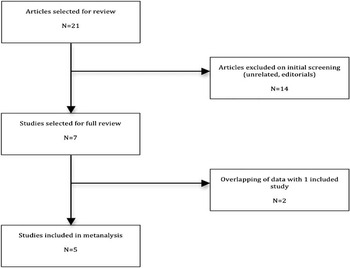
Our search results are detailed in Figure 1. The search strategy produced three prospectiveReference Block, McQuillen and Chau9, Reference Petit, Rome and Wernovsky11, Reference Beca, Gunn and Coleman13 and two retrospectiveReference Mukherjee, Lindsay and Zhang10, Reference Applegate and Lim12 cohort studies investigating the association between balloon atrial septostomy and brain injury (Table 1).
Study flow diagram.

Characteristics of included studies.

BAS = balloon atrial septostomy; BI = brain injury; ICD-9 = International Classification of Diseases-9 code; IVH = intraventricular haemorrhage; MRI = magnetic resonance imaging; PVL = periventricular leukomalacia; SV = single ventricle; TGA = transposition of the great arteries; WMI = white matter injury
*Unpublished information obtained from authors
Source of information
For all the five studies, we extracted data from published articles. In one study, contact with authors provided additional unpublished information.Reference Block, McQuillen and Chau9
Description of participants
In all five studies, patients born with transposition of the great arteries represented both cases and controls. There were three studies on term neonates.Reference Block, McQuillen and Chau9, Reference Petit, Rome and Wernovsky11, Reference Beca, Gunn and Coleman13 In two studies, gestational age was not mentioned as a selection criteria.Reference Mukherjee, Lindsay and Zhang10, Reference Applegate and Lim12 There was one study on children with an International Classification of Diseases-9 code of transposition of the great arteries and age of admission less than 30 days,Reference Applegate and Lim12 whereas another study included children with an International Classification of Diseases-9 code of transposition of the great arteries and age of admission less than 60 days.Reference Mukherjee, Lindsay and Zhang10 On account of the less severe inclusion criteria, the population enrolled in Block's study comprised less stable neonates compared with other studies included in this meta-analysis.Reference Block, McQuillen and Chau9
Outcomes
Magnetic resonance imaging scans were used to identify the presence of stroke, white matter injury or intraventricular haemorrhage and results were reported in two studiesReference Block, McQuillen and Chau9, Reference Beca, Gunn and Coleman13 while the presence of stroke and periventricular leukomalacia identified by magnetic resonance imaging was reported in one study.Reference Petit, Rome and Wernovsky11 Neonates underwent magnetic resonance imaging scans on the day of surgery in one studyReference Petit, Rome and Wernovsky11 and once they were stable and before surgery in two studies.Reference Block, McQuillen and Chau9, Reference Beca, Gunn and Coleman13 In two studies, the outcome was represented by the presence of a coded diagnosis of a clinically evident stroke at discharge.Reference Mukherjee, Lindsay and Zhang10, Reference Applegate and Lim12
Balloon atrial septostomy and brain injury rates
The overall balloon atrial septostomy frequency was 22.4% (2273 of 10,108), with reported rates ranging from 20% to 75% (Table 1). Peri-operative brain injury was present in 105 of 10,108 neonates considered for analysis, with an overall rate of 1.0%. In the three prospective cohort studies, pre-operative magnetic resonance imaging scans identified brain injury in 51 neonates, with a brain injury rate of 38.6% (51 of 132). The most common pre-operative abnormality was white matter injury, which occurred in 35 infants (69%), with single-institution rates ranging from 54% to 75% (Table 1). Stroke was present pre-operatively in 20 patients (39%) and intraventricular haemorrhage in four patients (8%).
Effect of interventions
Primary outcome: brain injury
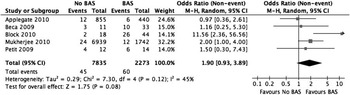
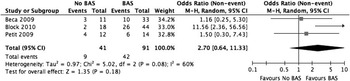
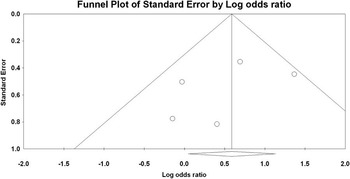
We computed data from five cohort studies (n = 10,108). The brain injury rate for neonates who underwent balloon atrial septostomy versus control patients was 60 of 2273 (2.6%) and 45 of 7835 (0.5%), respectively (pooled odds ratio, 1.9; 95% confidence intervals, 0.93–3.89; p = 0.08; I2 = 45%, p for heterogeneity = 0.12, random-effects model; Fig 2). A subgroup analysis of the three studies that used pre-operative brain injury as the primary outcome found no significant association between balloon atrial septostomy and brain injury (pooled odds ratio, 2.70; 95% confidence intervals, 0.64–11.33; p = 0.18; I2 = 60%, p for heterogeneity = 0.08, random-effects model; Fig 3). Funnel plot graphical analysis, Begg and Mazumdar's rank correlation, and Egger's regression did not suggest significant publication bias (Kendall's tau = 0.1, p = 0.8; Egger's regression intercept = 0.78, p = 0.7; Fig 4).
Forest plot of the odds ratio for peri-operative brain injury. BAS = balloon atrial septostomy; CI = confidence interval.

Forest plot of the odds ratio for pre-operative brain injury. BAS = balloon atrial septostomy; CI = confidence interval.

Funnel plot. Kendall's tau = 0.1, p = 0.8; Egger's regression intercept = 0.78, p = 0.7.

Discussion
Despite the optimisation of peri-operative care of infants with transposition of the great arteries, the overall rate of brain injury in this population remains very high. Long-term neurodevelopmental outcomes still represent a major issue in this population of patients. It has been recently shown that children who underwent early surgery to correct transposition of the great arteries between late 80s and early 90s had an increased prevalence of behavioural problems at the age of 8 years.Reference Bellinger, Newburger, Wypij, Kuban, duPlesssis and Rappaport18 In this systematic review and meta-analysis of five studies that included more than 100 cases, we failed to identify significant higher odds for developing brain injury in neonates with transposition of the great arteries who underwent balloon atrial septostomy. Moderate heterogeneity was present. A subgroup analysis of the three studies that investigated the presence of pre-operative brain injury by means of magnetic resonance imaging scans and utilised multivariate analysis confirmed the absence of an association between balloon atrial septostomy and brain injury and a higher degree of heterogeneity. The enrolment of neonates with evidence of haemodynamic instability in Block's paper, which would not have qualified for the Beca and Petit studies, may have caused the occurrence of contradictory results from studies with apparently uniform study designs.
Several factors provide plausible biological mechanisms for an effect of balloon atrial septostomy on the risk for brain injury. Vascular access and the effect of the balloon atrial septostomy procedure itself represent risk factors for thrombosis. It has been hypothesised that pre-existing thrombi could be displaced after balloon atrial septostomy through the umbilical vein.Reference Chandar and Wolfe19 It is likely though that brain injury in neonates with transposition of the great arteries is multifactorial. Several mechanisms such as inflammation, infection, ischaemia, and impaired cerebral autoregulation play a role in the development of white matter injury. Previous studies have identified balloon atrial septostomy, brain immaturity, longer time to surgery, lower mean pre-operative oxygen pressure and oxygen saturation as risk factors for brain injury.Reference Block, McQuillen and Chau9, Reference Petit, Rome and Wernovsky11, Reference Licht, Shera and Clancy20 Despite the fact that our analysis did not show a significant association between balloon atrial septostomy and brain injury, these results should be interpreted with caution. The number of studies included in this meta-analysis is limited. In particular, sample sizes from the three prospective single-institution studies were small, thus limiting the chance to detect significant associations between potential pre-operative risk factors and brain injury. Moreover, studies with population-based retrospective designs were considered together with prospective magnetic resonance imaging studies with different methodology and definition of outcome. Indeed, the two retrospective studies included in the analysis only investigated the association between balloon atrial septostomy and clinically evident stroke as defined by International Classification of Diseases-9 code.Reference Mukherjee, Lindsay and Zhang10, Reference Applegate and Lim12 In both studies, it was not possible to state that balloon atrial septostomy was always regularly performed before the diagnosis of stroke. Furthermore, the contribution of other risk factors for brain injury other than balloon atrial septostomy such as cardiopulmonary bypass and cardiac surgery was not disentangled. In addition, in the three studies that investigated pre-operative brain injury, differences in the brain injury rates may relate to an unexpected lack of consensus regarding image acquisition, interpretation of identified lesions, and the timing of magnetic resonance imaging scans. Petit et alReference Petit, Rome and Wernovsky11 defined stroke as “a focal area of diffusion restriction in an arterial territory” and white matter injury as “punctate periventricular lesions associated with T1 hyperintensity with or without restriction of water diffusion”. Block et al defined white matter injury as “single lesions in the white matter that measured 3 millimetre or less” whereas “larger lesions were classified as stroke”. Owing to the fact that stroke and white matter injury are likely to be scarcely differentiated by magnetic resonance imaging, a sensitivity analysis was also made reclassifying all lesions as either stroke or white matter injury, showing that the association between balloon atrial septostomy and brain injury did not change.Reference Block, McQuillen and Chau9 Beca et alReference Beca, Gunn and Coleman13 referred to stroke as “discrete areas of hyperintensity on diffusion weighted imaging, with hypointensity on the corresponding apparent diffusion coefficient scan and/or hyperintensity on T2-weighted images” and to white matter injury as “discrete, usually punctate, foci of T1 hyperintensity and/or T2 hypointensity”. In Block and Beca's papers, magnetic resonance imaging scans were performed once the infants were clinically stable to be transported and before surgery, whereas magnetic resonance imaging scans were completed on the day of surgery by Petit et al. Moreover, balloon atrial septostomy frequency was also extremely variable with rates fluctuating from 20% to 75%, indicating different clinical practice pattern variations that are likely to play a role in the development of brain injury. Data relating to arterial oxygen saturation and arterial blood gas were not uniformly recorded between studies, both in terms of frequency of measurements and data collection (prospective versus retrospective), thus affecting the interpretation of the associations between brain injury and objective signs of hypoxaemia.
Implication for practice
The limitations of our revision of the literature and meta-analysis, mainly related to the small number of papers available for meta-analysis and the different sensitivity and specificity of clinical and imaging outcomes, make firm conclusions difficult to reach. Nonetheless, some reasonable assumptions can be made. As for today no clear evidence that avoiding balloon atrial septostomy or altering its frequency will improve neurodevelopmental outcome of neonates with transposition of great arteries. Despite the scarcity of raw data, our analysis suggests that balloon atrial septostomy is not associated with increased odds for peri-operative brain injury. The combination of the results of the three prospective papers in our analysis seems to exclude the presence of competing risks – brain injury from balloon atrial septostomy but white matter injury from waiting too long for surgery in the presence of hypoxaemia. On the basis of existing data, it is our opinion that the selective use of balloon atrial septostomy for those patients with significant hypoxaemia, haemodynamic instability or both, and the completion of the arterial switch operation as early as feasible still represents the right strategy for the optimisation of neurodevelopmental outcome of neonates with transposition of the great arteries.Reference Petit, Rome and Wernovsky11, Reference McQuillen21
Implication for research
Future studies should aim at elucidating the role of already identified risk factors and identifying further risk factors, that is, the role of post-balloon atrial septostomy prostaglandin infusion, technique for performing balloon atrial septostomy, heparinisation during balloon atrial septostomy, gestational age, complications related to delivery, and important anatomic variance such as ventricular septal defect or aortic arch malformation by means of multi-centric studies with harmonised image acquisition and interpretation. In addition, as the greater number of arterial blood samples for gas analysis are usually obtained during periods of instability, a given time unit can bias the calculated average oxygen pressure level; therefore, the “area under the oxygen curve” should be probably considered in order to calculate the number of hours of exposure to hypoxaemia and desaturation as a risk factor for brain injury. It is also necessary to establish a correlation between radiological findings and neurodevelopmental outcome.