INTRODUCTION
The family Porcellanidae Haworth, 1825 is a group of crab-shaped anomuran crustaceans, commonly known as porcelain crabs. These crabs occur worldwide in primarily intertidal and sublittoral zones of tropical and subtropical regions, and occupy habitats such as depressions under stones, algae, and corals (Haig, Reference Haig1960; Gore & Abele, Reference Gore and Abele1976; Baeza & Stotz, Reference Baeza and Stotz1995).
Porcelain crabs number about 280 species, partitioned among 30 genera (Rodríguez, Reference Rodríguez, Hernándes and Felder2005). Most species are free-living but a few live commensally (Ross, Reference Ross and Abele1983). Among the latter, Polyonyx gibbesi Haig, 1956 is the only species of the genus Polyonyx that occurs in the western Atlantic, and is a known commensal of the polychaete worm Chaetopterus variopedatus (Reiner, 1804). This annelid builds U-shaped tubes in shallow waters along the Atlantic coast. The tubes are buried upright, with only about 2.5 cm of narrow siphon at either end showing above the surface of substrate (Gray, Reference Gray1961).
The distribution of P. gibbesi is considered mostly anti-tropical, and it has been reported only sporadically in tropical waters. According to Rodríguez et al. (Reference Rodríguez, Hernándes and Felder2005), this species occurs in Massachusetts, Rhode Island, North Carolina, South Carolina, the east and west coasts of Florida, and Texas, USA. The crab has also been reported from Caledonia Bay in Panama, Papuy in Venezuela, Trinidad, Cuba, Puerto Rico, and from Rio de Janeiro to southern Brazil, and at La Paloma, Uruguay. More recently, Belleggia et al. (Reference Belleggia, Boschi, Schejter, Bremec, Sánchez and Figueroa2010) extended the occurrence of P. gibbesi to the continental shelf of Argentina, with specimens found in the stomachs of the narrownose smoothhound shark Mustelus schmitti.
This paper provides a new record for the commensal porcellanid crab Polyonyx gibbesi, and information about its biology as a commensal of the polychaete worm Chaetopterus sp., from the State of Sergipe, north-eastern Brazilian coast.
MATERIALS AND METHODS
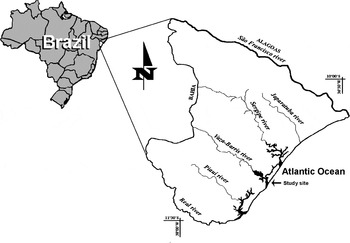
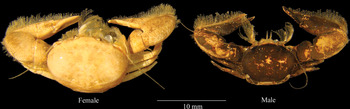
The samples were obtained on an estuarine mudflat of the Vaza-Barris River, located in the State of Sergipe in north-eastern Brazil (11°08′20.77″S 37°09′19.02″W) (Figure 1). The collections were made during diurnal spring tides in October and November 2010. The specimens of Polyonyx gibbesi (Figure 2) were obtained by manual capture of their host, a U-shaped polychaete identified as belonging to the genus Chaetopterus (Amaral & Nonato, Reference Amaral and Nonato1996).
Study site on the north-eastern Brazilian coast (arrow points to the sample area in the estuary of the Vaza-Barris River).

Dorsal view of male and female of the commensal porcellanid crab Polyonyx gibbesi.

The polychaetes were placed in individual plastic bags and transported to the laboratory, where they were dissected and analysed for the presence of P. gibbesi. The 17 polychaetes collected in November were measured for the total length and maximum diameter of the tube, and the diameter of the siphon opening. Unfortunately, during the first sampling conducted in October 2010, the methodology was not yet completely defined. The ten polychaetes collected during this month were stored together after they were checked for the presence of crabs, preventing any further analyses. All the crabs were sexed and measured for carapace width (CW), using a digital caliper (accuracy 0.05 mm). Female crabs were examined for the presence of eggs. The eggs of ovigerous females were separated and counted with the aid of a stereomicroscope.
To assess the population distribution of the symbiont species on their hosts, the observed frequency distribution was tested for any significant difference from random by comparing it with the Poisson distribution. A Chi-squared (χ2) test of goodness of fit was used to examine differences between observed and expected (random Poisson) distributions (Sokal & Rohlf, Reference Sokal and Rohlf1995). The relationship of size (CW) between crabs occurring in pairs in the same host was evaluated by a simple linear regression.
RESULTS
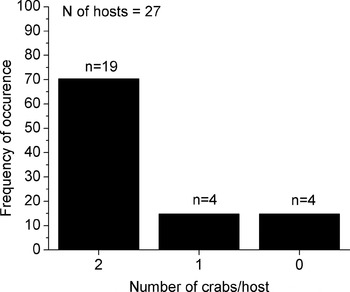
Of the 27 polychaetes collected, 23 (85.18%) were inhabited by P. gibbesi. Four polychaetes contained a single individual, and 19 had two individuals (Figure 3). In all cases in which more than one crab was found in a host, they were a male and female pair. In the hosts examined, 42 crabs were found, 21 males and 21 females. Five of the females were carrying eggs (Table 1).
Frequency of host under different presence conditions of Polyonyx gibbesi.

Descriptive statistics of demographic categories of Polyonyx gibbesi and its polychaete host.

CW, carapace width; Diam, maximum diameter of tube; Ovig., ovigerous; Siphon, siphon aperture; SD, standard deviation.
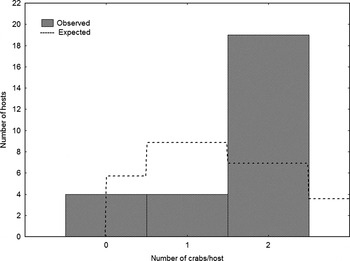
The population distribution of P. gibbesi in the polychaetes did not display a random pattern (Chi-square of goodness of fit: χ2 = 5.75, df = 1, P = 0.016). This was explained by the large number of polychaetes found with a male and female pair, compared to the number predicted by the Poisson distribution (Figure 4).
Population distribution of the porcellanid crab Polyonyx gibbesi. Observed frequency of crabs in the hosts differs significantly from expected Poisson random distribution.

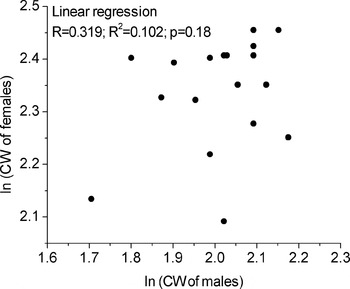
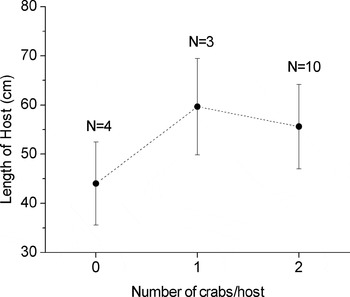
No correlation was found between the sizes (CW) of pairs of males and females inhabiting hosts (simple linear regression, P = 0.18) (Figure 5). The crabs tended to prefer larger-sized hosts (length of tube) (Figure 6).
Relationship between the size of carapace width (CW) of males and females, when a couple cohabited on a single host.

Mean size and standard deviation of host length under different presence conditions of Polyonyx gibbesi.

DISCUSSION
Polyonyx gibbesi was present in high frequency in its host, indicating that its occurrence was not accidental or sporadic at the study site. The presence of ovigerous females in the population indicates the existence of mature and sexually active individuals that were effectively reproducing, at least during the sampling period. In all cases in which more than one crab was found in a host, they were a male and female pair. Symbiotic crustaceans are expected to live as heterosexual pairs in or on hosts, and exhibit monogamy when their hosts are large enough to support a few (e.g. two) individuals, but not more, when the hosts are relatively rare and when predation risk away from the hosts is high (Baeza & Thiel, Reference Baeza and Thiel2003, Reference Baeza, Thiel, Duffy and Thiel2007; Thiel et al., Reference Thiel, Zander, Valdivia, Baeza and Rueffler2003; Baeza et al., Reference Baeza, Bolaños, Hernandez, Lira and Lópes2011; Baeza, Reference Baeza2008). The present observations of P. gibbesi agree in general terms with previously suggested explanations of the population distribution and mating system of symbiotic crustaceans (Baeza & Thiel, Reference Baeza and Thiel2003; Baeza & Piantoni, Reference Baeza and Piantoni2010; Baeza et al., Reference Baeza, Bolaños, Hernandez, Lira and Lópes2011).
Species that are intimately associated with other living organisms may derive important benefits (protection and food), but may also incur substantial costs (defence and restricted mobility) from their symbiotic lifestyle (Thiel et al., Reference Thiel, Zander, Valdivia, Baeza and Rueffler2003). These costs are primarily owing to the impossibility that most host organisms can satisfy all requirements of their symbiont, and consequently, the symbiont may have to leave its host temporarily to fulfil these needs, e.g. to obtain food or mating partners (Thiel et al., Reference Thiel, Zander, Valdivia, Baeza and Rueffler2003). To reduce the costs of leaving the host to obtain a mating partner, many symbiont species inhabit their hosts as heterosexual pairs (Vannini, Reference Vannini1985). This is probably the case for P. gibbesi, as observed in this investigation and also previously by Gray (Reference Gray1961) and Grove & Woodin (Reference Grove and Woodin1996).
Another observation of this study was the lack of association between the size of the individuals (couple) and their host. The size of the crabs was always greater than the size of the opening of the host siphon. This probably indicates that these crabs choose the host during their early stages of development and metamorphose into the adult form while resident within the host, as reported previously for other pinnotherid crabs (Grove & Woodin, Reference Grove and Woodin1996). This also eliminates the possibility of the crabs moving between different host individuals during the adult phase, and further suggests that male–female pairs of P. gibbesi might represent long-term (perhaps lifetime) monogamous pairs. Therefore, the wide variation in size found between individuals from the same host is probably related to different periods of colonization, growth, and/or differential mortality between sexes.
Polyonyx gibbesi was found associated mainly with larger-sized hosts (tube length), as also reported by Grove & Woodin (Reference Grove and Woodin1996). This is probably related to the limited space provided by the smaller-sized host individuals. Recent theoretical considerations suggest that host structural complexity and host size (relative to the species using a host) are the most important parameters modulating the cost and benefit of refuge monopolization and, therefore, the distribution of symbiotic crustaceans (Baeza & Thiel, Reference Baeza and Thiel2003, Reference Baeza, Thiel, Duffy and Thiel2007; Baeza, Reference Baeza2008; Baeza & Piantoni, Reference Baeza and Piantoni2010). The availability of space or food resources from individual hosts may have strong effects on the intra- and inter-specific interactions among associates (Baeza et al., Reference Baeza, Stotz and Thiel2001). Thus the size of the host and its characteristics (supply, resource value and defensibility) will greatly affect the life history of crustacean associates, and may act as a limiting factor.
The expansion of the known distribution of P. gibbesi to the State of Sergipe may contribute to changing the current concept of anti-tropical distributions of this species and other marine invertebrates from the western Atlantic. Probably, the current state of knowledge about this species' distribution is the result of its commensal lifestyle, which makes it difficult to collect, as well as the scarcity of investigations along the north-eastern Brazilian coast.
ACKNOWLEDGEMENTS
We thank Dr Paulo da Cunha Lana from the Universidade Federal do Paraná for the identification of the polychaete. All the collections in Brazil were carried out according to state and federal laws (ICMBio#27111427) regarding wildlife. This research received no specific grant from any funding agency, commercial or not-for-profit sectors.