The aria ‘Trostlos schluchzet Philomele’ from Johann Andreas Schachtner and Wolfgang Amadeus Mozart's unfinished singspiel Zaide, k336b, evokes a number of figures who had come to represent the innocent held captive far from home.Footnote 1 First is Ovid's heroine, the virgin princess Philomela, violated and maimed in a wooded cabin by her brother-in-law, King Tereus, while en route to visit her sister Procne. Like her mythical forebear, Zaide languishes in a harem far from her native land, a captive of Sultan Soliman; in fact, she has just been recaptured after attempting to escape with her fellow prisoner Gomatz (whom she will later discover is her long-lost brother). Her double confinement is reflected in the other subject of Zaide's allegorical lament: Philomela's namesake bird, the nightingale. Philomela was transformed into a nightingale to escape Tereus, but in this bourgeois sequel, the nightingale is now a caged pet, who hops about looking for a way out, her lament a song ‘steeped with tears’, to paraphase Spenser:Footnote 2
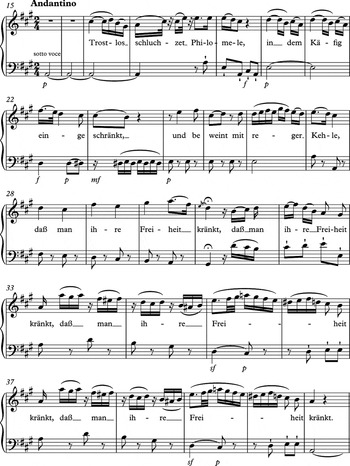
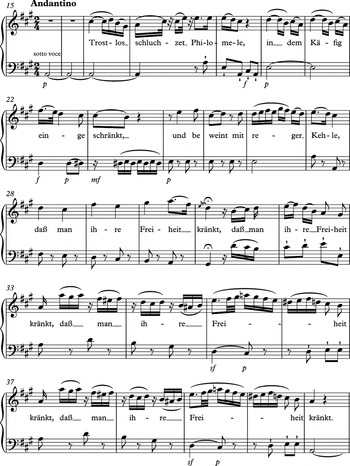
Mozart's setting is a lilting, duple-metre rondo in A major (see Example 1). Birdlike, the melody hovers around the mediant C♯, circling back to this plaintive tonal perch as the refrain returns after each of two episodes. The repeating lower-neighbour-note gestures cement the association with birdsong, as does the anempathetic nature of the melody: its lyricism, measured tempo, bright tonality and diatonic purity are at odds with the grief and desperation conveyed in the text (a musical displacement, perhaps, to complement the textual displacements just cited). Nor is Zaide's aria a quiet moment of contemplation. Rather, her ‘agile throat’ resounds with despair. The phrase ‘daß man ihre Freiheit kränkt’ is repeated to excess (four times in the first refrain, seven times in the third), and the melodic repetition of the effusive phrase at bars 33–37, which encompasses a leap to the A above the staff (the upper limit of the vocal tessitura in this aria), is immediately recognizable as extravagant. Although we cannot know whether Schachtner and Mozart intended for Zaide to have onstage auditors at this moment (the libretto is lost and, in the autograph score, this aria lacks a preceding line of spoken dialogue as one finds in some of the other numbers), her tune is both piteous and enthralling: both a private expression and a public declaration.
W. A. Mozart, ‘Trostlos schluchzet Philomele’, from Zaide (Das Serail), bars 17–41, vocal and bass line only (Neue Mozart-Ausgabe, series 2/5, volume 10, ed. Friedrich-Heinrich Neumann (Kassel: Bärenreiter, 1957)). Used by permission
Such was the problematic appeal of caged birds in the eighteenth century: their songs were construed as expressions of their essential liberty, even (for many, especially) when sung from within the confines of a cage.Footnote 4 This is the plight, for instance, of the protagonist of William Blake's poem ‘How sweet I roam'd from field to field’, caught by the ‘prince of love’ and shut up ‘in his golden cage’. Thereafter,
As Blake's poem unmistakably illustrates, birds and cages were also poignant symbols of sexual availability, pursuit and conquest. They appear frequently in galant painting, most famously François Boucher's Les oiseleurs (The Bird-Catchers, 1748) and Jean-Baptiste Greuze's many gauzy portraits of young girls and their (often dead) birds.Footnote 6 Song, as it had done for centuries, served as both mood music for the act of seduction, and the inevitable lament that followed an act of deflowering. It could even be employed to manipulate actual birdsong, as we find in the serinette, a small barrel-organ designed to coax vocalizations from pet birds that figures in such paintings as William Hogarth's The Graham Children (1742) and Jean-Baptiste-Siméon Chardin's La Serinette (1751).Footnote 7 The more sinister, erotic subtexts to the image of the caged bird are surely at play in the many musical works prior to Zaide in which the figures of Philomela and the nightingale are employed to evoke love's ‘sweet pain’.Footnote 8
One might read yet a further layer of signification to ‘Trostlos schluchzet Philomele’, however – another downtrodden, charismatic figure to complement the three elided personas of mythical victim, harem slave and caged bird. That figure is the child – or, more specifically, the professional child actor. Mozart and Schachtner based Zaide on an anonymous singspiel called Das Serail (The Seraglio) that was in the repertoire of the Bernersiche Gesellschaft, one of the most popular and long-lived of the eighteenth-century Kindertruppen.Footnote 9 These were wandering companies composed solely or chiefly of young performers, who specialized in adaptations of adult plays, operas, ballets and pantomimes. Like the inhabitants of the fantastical harem of the eighteenth-century imagination, wandering troupes were conspicuously vagabond assemblages of players, all of whom came from ‘somewhere else’. Their charismatic, authoritarian impresarios collected, exhibited and replaced performers, just as European readers imagined sultans did. The result was a kind of rootlessness and interchangeability that gained added significance when the recruits were as young as five. The Kindertruppen thus recall Alain Grosrichard's description of the child captives of the fictional harem: ‘orphans with no natural or cultural roots, no memory’, who, like those other personifications of multiplied lack (women, mutes and eunuchs) ‘stand negatively for the fragmented body of the despot’.Footnote 10
As Grosrichard has argued (echoing Edward Said), the fantastical seraglios of eighteenth-century European literature and drama exerted a voyeuristic appeal, elaborating the ‘endoscopic fantasy’ of the Orient – affirming Eurocentric values while also providing a carnivalesque outlet for the indulgence of taboo fantasies.Footnote 11 In this article I argue that a similar contradictory appeal characterized the phenomenon of the Kindertruppen – particularly when, as in Das Serail, young actors portrayed captives in a seraglio. The repertoire and the reception of these troupes were bound up with wider renegotiations regarding theatrical propriety, naturalness and absorption; and in exploiting the incongruity between young performers and adult dramatic situations, the troupes directly confronted the nascent protectionist discourses around age-appropriate literature, youthful virtue and the rights of children.
Adulthood, Forged and Feigned
That a Kindertruppe like Berner's could perform a singspiel set in a harem might give our twenty-first-century sensibilities pause, but at the time it would have been fairly unremarkable, for a number of reasons. First, although the troupes made the youth of their performers a selling-point – calling themselves ‘Piccoli Hollandesi’, ‘Französische Pantomimische Kinder’ and the like – they generally included a mix of children, adolescents and young adults. ‘Kindertruppe’ is an anachronism, a blanket term invented by historians, and it can be particularly misleading in the case of the Berner troupe, which was most often advertised by Berner himself as a ‘junge Schauspielergesellschaft’ (young person's theatrical company) and included members ranging in age from four to twenty-eight.Footnote 12
On their first visit to Salzburg in 1766 (about which more below) the court diarist described Berner's troupe as ‘10 kindern, 6 mägdln und 4 knaben’ (ten children: six lasses and four lads).Footnote 13 The actual ages of the performers at this time, according to a memoir by the former Berner troupe member Franz Xaver Garnier, were as follows:Footnote 14

In 1781, six years before the troupe disbanded, it was described in the Nuremberg press as ‘die Bernerische Gesellschaft…, die meist aus Kindern bestand’ (the Berner Company, which consisted mostly of children).Footnote 16 In that year, the ages of the documented members of the troupe were as follows:

The average age of a performer therefore rose from eleven in 1766 to fourteen in 1781, but the age spread widened, from an average of eight and a half to thirteen years.
Such statistics tell us less than we might hope about the way the performers were perceived. Adolescence was certainly a recognized phase of life, but one that, then as now, was flexible and often contradictory in its construction. Johann Heinrich Zedler's Universal-Lexicon (1731–1754), for instance, defined ‘Mannbar’ (full puberty, or readiness to enter the married state) by first citing ancient Roman law that the age of pubertas was fourteen for males and twenty for females. He then added the following caveat: ‘Nowadays, however, one no longer looks at years, but rather at the outward gifts of nature, strength and dexterity of the body’.Footnote 18 Zedler also recognized a period that he called ‘near-puberty’, lasting from age eleven to twelve in females, thirteen to fourteen in males.Footnote 19 In 1792 the Prussian Civil Code initiated under Frederick the Great deemed that ‘Minderjährigkeit’ – which represented something akin to our modern ‘minority’, in other words the inability fully to govern one's own affairs – could last until as late as twenty-four.Footnote 20 And these are just two isolated historical sources; regional, gender, legal and socioeconomic factors could yield very different understandings of the outer limits of childhood, youth and adolescence.Footnote 21
The situation was even murkier with young performers in the German-speaking commercial theatre. Almost every adult Wandertruppe – including those of Joseph von Kurz, Karl Theophil Döbbelin and Emanuel Schikaneder – had a handful of young actors on board, usually children of company parents who were being raised in the family business and who from an early age took on small roles in the main works or featured on their own in intermezzos, afterpieces, pantomimes and ballets.Footnote 22 As Peter Schmitt has shown, the average age of debut for actors in late eighteenth- and early nineteenth-century German companies was sixteen to eighteen.Footnote 23 The eldest members of a Kindertruppe were thus often older than fully fledged members of adult companies.
The age of the performers, whether real or perceived, counted for only part of the spectacle of a Kindertruppe performance. The other part had to do with the nature of the works being performed: not just their technical difficulty, but the maturity of their content. Over a century earlier, comedies in the Elizabethan boy companies' repertoire frequently made use of provocative, bawdy passages – in part, as Michael Shapiro puts it, to ‘encourage the audience to savor the disparity between the actors and their roles’.Footnote 24 Their eighteenth-century successors traded on the same disparity: a tacit awareness among both spectators and performers that they were witnessing something incongruous, the representation by children of emotions and even acts of which they were not yet supposed to be aware.
Evidence of this cultural perception can be found in the anonymous article ‘Von Pantomimen’ from the 1746 Frankfurt periodical Literarischer Briefwechsel, which describes a pantomime by the earliest known Kindertruppe active in the German-speaking lands, Filippo (?) Nicolini's Piccoli Hollandesi. The pantomime includes a fairly explicit love scene in which the hero covers the heroine's face with kisses, after which they become inflamed ‘as though they have been infected with the venom of a tarantula’, and they ‘throw themselves on the ground in a swoon … And they would probably have sacrificed themselves to each other completely’, were it not for the sudden appearance of the girl's mother, who separates the lovers and locks the daughter up in her room alone.Footnote 25 The author marvels at the performers' skill in ‘the silent presentation of what are usually fantastical impressions to amorous minds’.Footnote 26
Following her confinement, the frustrated innamorata steps forward to sing of her ‘bitterest woe’ in an aria marked by a ‘quite melancholy melody’.Footnote 27 Piccoli Hollandesi pantomimes frequently included an interpolated aria (usually in Italian or French) for the lovers, often on the theme of captivity to Cupid.Footnote 28 The account in the Literarischer Briefwechsel does not identify this particular aria, but the theme of captivity is already written into the plot, and this moment is described as the sensual apex of the evening's performance for its spectators. Much of its pathetic and even erotic charge came from the ‘innocent frankness’ (‘unschuldsvoller Freymüthigkeit’) of the performer, her absorption and her authentic display of pathetic emotions, showing an expertise – and implying a life experience – far beyond her years. The reviewer observed:
one could hardly believe that it was adopted manners, but rather that it was a natural outbreak of imagination, so completely had her heart and thoughts taken on an unaffected manner … Thus it is no wonder that each tone from them could arouse an excitation in the hearts of the listeners in the liveliest and most natural way, starting from the most innocent state.Footnote 29
The latter invocation of the term ‘natural’ seems calculated to normalize what was evidently an expected arousal on the part of the spectator. But the matter-of-fact tone of the account suggests that this somewhat illicit love-pantomime was not in itself objectionable – at least, not to the Frankfurt reviewer.
This is perhaps to be expected, given early modern Europe's informal attribution of a greater degree of sophistication to the young than we are generally familiar with today. An attitude of benign indulgence toward the savoir-faire of children, toward certain forms of sexual expression in their presence and toward the spectacle of the child labourer more generally had not yet fully given way to the ideology of protection, nor to the privatization of virtue as a domestic pedagogical objective.Footnote 30 At this time, for instance, children were not felt to require a separate literary diet: once they had learned to read, they could theoretically partake of any materials their level of literacy enabled them to comprehend. To elaborate on Philippe Ariès, while childhood did indeed exist before the Enlightenment, it was not seen as an especially sheltered phase of life.Footnote 31
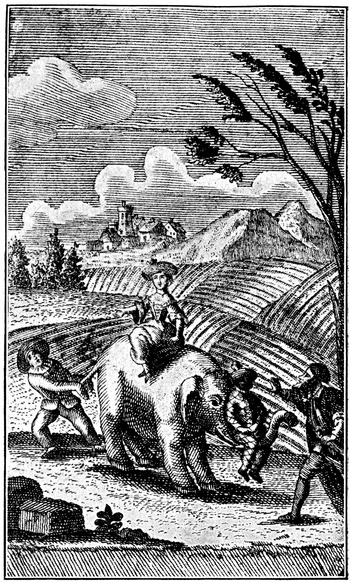
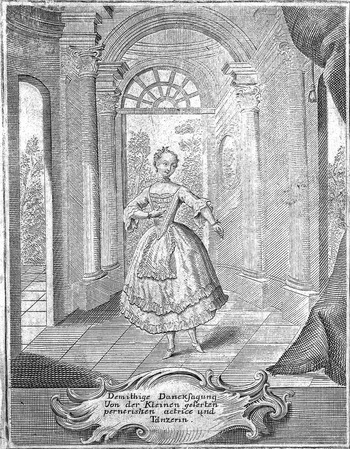
A more interventionist approach toward all manner of societal ‘primitives’, near and far, began to take hold around mid-century, and, inspired by Jean-Jacques Rousseau, the Philanthropinist movement in Germany set about reforming pedagogy and child-rearing.Footnote 32 The reformers' concern for limiting (indeed, eliminating) the exposure of children to illicit material was already being felt in theatrical circles, as is apparent from the language with which Nicolini's successor Franz Joseph Sebastiani promoted his own troupe, the Französische Pantomimische Kinder. In 1756 Sebastiani's application to perform in Frankfurt promised the mayor of that city that his troupe's performances would not be ‘scandaleuses’, and that they would surpass the pantomimes that were performed at the coronation of Emperor Francis in that same city eleven years earlier – both unmistakable references to the Piccoli Hollandesi, who had performed to great acclaim during that festival, including before the emperor himself.Footnote 33 Over the course of the 1760s Sebastiani moved away from the semi-improvised, highly physical comedies (Stegreifkomödie) of the Piccoli Hollandesi towards the more literate, moralizing, ‘regelmäßig’ (literally, ‘rule-bound’) and bourgeois family dramas then gaining favour on the adult stage. Sebastiani was praised, therefore, for achieving ‘an ardently sought end’ to the Stegreifkomödie, and with ‘imparting to our German nation a nobler and loftier conception of the German stage’.Footnote 34 Though obviously loaded with nationalist ideology, these statements were borne out historically: Thomas Betzwieser has demonstrated the important role played by Sebastiani's and Berner's troupes in establishing an opéra-comique-based tradition of literate singspiel in German-speaking lands, and the Piccoli Hollandesi played an equally important role in disseminating the Neapolitan intermezzo throughout the same region in the 1740s.Footnote 35 Yet, as Figure 1 illustrates, the roots of the Kindertruppen in traditions of farce and commedia dell'arte persisted long after the deliberate adoption of loftier, wordier dramas.
Detail from engraving in Franz Xaver Garnier, Nachricht von der Bernerischen jungen Schauspieler Gesellschaft, von der Aufnahme und dem Zuwachse derselben … (Bayreuth[?], 1782); reproduced in Gertraude Dieke, Die Blütezeit des Kindertheaters: Ein Beitrag zur Theatergeschichte des 18. und beginnenden 19. Jahrhunderts (Emsdetten: Lechte, 1934). Bodleian Library, Oxford. Used by permission

Likewise, the incongruity of the spectacle persisted even as the repertoire's content was purified and elevated. In some of their original works, children's troupes even self-consciously addressed their peculiar blend of charm, absurdity and impropriety from within the repertoire itself, perhaps as a way to forestall any criticism while playing up their novelty appeal. The debut opéra comique of Nicholas-Médard Audinot's Parisian children's troupe, the Théâtre de l'ambigu-comique, was pointedly titled Il n'y a plus d'enfans (There Are No More Children, 1769). In it, the older characters constantly marvel at the precocious love intrigues of the ‘youngsters’. When the young lovers Lolotte and François wish to practise declaring themselves to Lolotte's mother, Arlequin offers to impersonate the mother, and he plays his role well, remarking with exaggerated maternal disapproval, ‘youth at the moment is so libertine!’.Footnote 36 The authentic mother arrives on the scene, prompting Arlequin to protest that they were merely ‘playing a comedy’.Footnote 37 This metatheatrical alibi, significantly, is rejected by the mother, who laments the foolishness upon which she has stumbled. In doing so, of course, she delivers the punchline of the work as a whole, given that, like all the other characters, she too is played by a young actor.
A similarly satirical tone characterized a staple of the Berner troupe repertoire, Die verkehrte Welt, oder: Die Gubernantin nach der Mode (The World Turned Upside-Down, or: The Fashionable Governess, 1770).Footnote 38 In this opera buffa, a father exposes the corruption of a household of children at the hands of their self-centred, vacuous governess by going undercover (and in drag) as a rival governess. In one exchange between the disguised father and his son, the child readily admits that he can neither write, read, recognize his letters or pray, but that he can play, dance, sing, jump, fib and swear ‘like the Devil’. The father asks, can he cheat as well? The son replies, ‘Why not! in time one learns everything’.Footnote 39 The self-referentiality of this statement, uttered by a child actor who was performing harlequinades and comic operas on alternate nights, would surely not have been lost on the audience.
Even when they did not write their incongruity into the works themselves, the children's troupes could not help but raise questions about verisimilitude. A 1775 review of another Salzburg sojourn by the Berner troupe noted that Der Deserteur aus Kindesliebe (The Deserter for the Sake of Filial Love) – a play by Johann Gottlieb Stephanie the Younger – ‘was performed entirely by children; it made for some quite comical entrances when very small children playing guards led away giant prisoners’.Footnote 40 Others were more disturbed than amused: two years later, a Viennese review of the Berner troupe found the spectacle of a child impersonating an adult inherently unnatural, and therefore abhorrent:
It is either unclear or burlesque, when a boy in the role of an old man says things which only a man should know. If these plays are not expressly produced for children, if there is that which only grown people are supposed to portray, then such a play remains supremely unnatural.Footnote 41
This reaction conveys not just an allegiance to the laws of theatrical verisimilitude, but a new sense of moral scrutiny attending upon the theatre, one that had emerged in the writings of Johann Christoph Gottsched and coalesced in Friedrich Schiller's famous 1784 manifesto ‘Die Schaubuühne als eine moralische Anstalt betrachtet’ (The Theatre Considered as a Moral Institution).Footnote 42 Questions about the moral role of the theatre became still more fraught when they turned upon the child performer. By the middle of the eighteenth century it was a commonplace that performance required a heightened level of identification with the role, not just the representation of emotion but its active embodiment.Footnote 43 Johann Gottfried Herder and the psychologist Karl Philipp Moritz were among those who argued that children were inherently sincere, less adept at dissembling than adults – this in turn made them even more vulnerable than adults to internalizing the characters, emotions and morals they portrayed on stage.Footnote 44 But this same ‘dual consciousness’ could, if the material was age-appropriate, make child actors better equipped than adults to serve the goal of an edifying theatrical experience, as we see in a review of the Berner troupe's 1783 appearance in Gmunden, Austria:
The few pieces that they performed during their stay inspired admiration – innocence and charm combined with genuine art gave every word double emphasis, and the moral, which often left one cold when uttered from the stage by an equivocal flibbertigibbet, warms the hearts of the viewers when spoken by these youthful lips.Footnote 45
Establishing a sanitized dramatic corpus for children was big business for German publishers in the 1770s, motivated in no small part by the pedagogues' agitation in favour of the anxious surveillance and even pathologizing of children's contact with all forms of sensual expression. In the words of Christian Gotthilf Salzmann, writing in 1785, the danger was ‘prematurely sensitiz[ing]’ children to ‘temptations … whose enjoyment was intended for them many years hence’.Footnote 46 To expose children to love stories, indeed to any kind of fiction, was believed preemptively to deny them that which was increasingly being essentialized as inherent to childhood: not just chastity, but asexuality. Joachim Heinrich Campe, for instance, published a children's reader, the Kleine Kinderbibliothek, whose express goal was providing reading material ‘which would be as entertaining as [it was] instructive, and by any consideration would be completely harmless’.Footnote 47 Campe divided each volume of his digest into three parts according to the intended age group of the reader (five to seven, eight to ten and eleven to twelve).Footnote 48 Campe's fellow pedagogue, the singspiel librettist Christian Felix Weisse, adapted the French théâtre d'éducation and dialogues pedagogiques into ‘Kinderschauspiele’ for his periodical Der Kinderfreund (The Child's Friend, 1775–1782). These plays and singspiels were intended for domestic performance, in which middle-class children played not adults, but themselves, and not for money, but for their own edification and that of their immediate family and friends. As in Campe, the ages of the characters were specified and the material was vaunted as morally impeccable.Footnote 49 Weisse even used Der Kinderfreund to promote these theatricals as an alternative to the repertoire of the Kindertruppen. In one issue, he has one of his fictional avatars lament the shocking performance of ‘eine gewisse Schauspielgesellschaft von Kindern’ (a certain acting company of children) that had come through Leipzig in the 1770s:
I could not stand it, as I heard them singing and saying the most amatory, I don't want to say, the most rude things, accompanied by the most brazen gestures. O how I pitied the poor innocent victims of cheap profit: for I have already seen what they must soon become, since already the shame of their first youth (many were still children) had been killed, and what they perhaps would already be, had not the paternal eye of God watched over them, and wrested them from perdition in a miraculous way.Footnote 50
Weisse's vehement antipathy to the exploitation of these actors may have been motivated by more than just noble concern for child welfare. After all, the domestic children's theatricals he published were just as much commercial products, just as much ‘for sale’, as the other theatricals he sought to discredit. Nevertheless, his condemnation registered the uncomfortable realities of the Kindertruppen's intersections with sexuality and commerce, as well as the continuing popularity of their enterprise even after the Philanthropinist movements were well underway.
Singing from the Seraglio
Captivity, foreignness, innocence threatened: all converged in the seraglio, that convenient site for Grosrichard's ‘endoscopic fantasy’, for that marketable combination of titillation, mild auto-critique and self-righteous pity so common to Enlightenment representations of the Orient. Given that Kindertruppen usually performed repertoire that was identical to that of their adult counterparts, and given the period's rage for all things Turkish, it should come as no surprise that most had at least one work in their repertoire set in an exoticized ‘East’ (see Appendix).Footnote 51 Many of these seraglio operas feature a female captive from elsewhere, the embodiment of virtue under threat, who performs for her captors in a musical tableau, often as part of her ‘audition’ either for membership in the harem or for selection by the sultan for his evening's pleasure. Such musical tableaus (to use Tili Boon Cuillé's terminology) often call upon the character to comment on her plight, and their quality of mise-en-abyme foregrounds the subject position of the real-world audience in the theatre. Producing ‘[a] certain tension between virtue and eroticism’, they address, if only obliquely, the moral quandaries presented by the staging of the seraglio for the pleasure of a Western audience.Footnote 52 When performed by a Kindertruppe, such tableaus blur the persona of the young actor with those other categories of the exotic abject (female, foreigner, captive/slave), as we have seen in ‘Trostlos schluchzet Philomele’. The spectacle of a young woman singing both for her fictional captors and for her real-world audience aligned one figure of consumption, objectification and oppression with the other, apparently showing an awareness of the fraught cultural politics of operatic spectatorship, particularly as it intersected with emerging notions of childhood vulnerability.
Audition scenes can be found in two of the most popular seraglio operas of the late eighteenth century, both of which were staples of the Berner troupe repertoire in German translation: Paul-César Gibert and Charles-Simon Favart's 1761 opéra comique Soliman Second, ou les trois sultanes and the 1771 Zémire et Azor by André-Ernest-Modeste Grétry and Jean-François Marmontel.Footnote 53 Each of their respective musical tableaus employs bird imagery as a symbol of sexual conquest, especially Zémire's aria ‘La fauvette avec ses petits’ (The Warbler with Her Children), a parable about a mother bird who lovingly protects her chicks until a bird-catcher appears and ravishes her. A manuscript copy of the score to Zémire et Azor was in Mozart's library at the time of his death (possibly in Mozart's own hand), and he probably saw Soliman Second when he was in Paris in 1778, suggesting that either or both may have influenced his treatment of Zaide's bird-aria.Footnote 54
By the late 1770s Mozart had also encountered the seraglio in a number of his own works. One of the entr'acte ballets for his 1772 Lucio Silla (k135) at the Regio Ducal Teatro, Milan, was Le gelosìa del serraglio by Charles le Picq; Mozart's sketch (kv Anh. 109/135a), probably produced for Lucio Silla, includes copies of individual numbers from several of le Picq's source ballets by Franz-Anton Hilverding and Jean-George Noverre.Footnote 55 Mozart was also familiar with the 1777 Salzburg revival of Voltaire's 1732 tragedy Zaïre, for which Michael Haydn composed incidental music. The revival did not open until 29 September, and Mozart had left the city one week earlier, on 23 September. But the topic doubtless came up in conversation, and Leopold later wrote to Wolfgang on 30 September and 6 October praising Haydn's music.
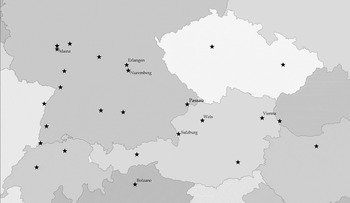
While these sources and others probably played some role in the conception of Zaide, its most immediate source was Das Serail.Footnote 56 The means by which Mozart and Schachtner came by Das Serail, and the exact nature of their relationship to Berner, are difficult to pin down. They certainly had a copy of the anonymous libretto, published in Bozen (now Bolzano) in 1779, since the first four numbers of their Zaide bear a close resemblance to the texts of the first four numbers in Das Serail.Footnote 57 There is no evidence, however, to confirm whether Mozart or Schachtner had a copy of the Das Serail score by Joseph Friebert, who was at the time the music director at the court in Passau.Footnote 58 The first known performance of Das Serail by the Berner troupe was in June 1777 in Wels, Austria, and they performed it in Erlangen and Nuremberg in April 1778, so in all likelihood at other stops along the way (see map, Figure 2).Footnote 59
Map showing the principal cities and towns visited by the Berner troupe, 1761–1787, and identifying the cities most closely associated with Das Serail

At present while there is no evidence that Mozart or Schachtner witnessed a performance of Das Serail, the Berner troupe had passed through Salzburg several times before. Their first sojourn was from December 1766 to February 1767, with their debut taking place one day after Mozart's licenza k33i (the tenor concert aria ‘Or che il dover / Tali e cotanti sono’) was heard as part of the celebration of the anniversary of Archbishop Schrattenbach's consecration. Information is lacking about what the Berner troupe performed at their Salzburg debut; but at the time the troupe had a Bastienne singspiel in their repertoire, and commentators believe this was the means by which Mozart and Schachtner came to collaborate on their own Bastien und Bastienne (k46b), ten years before they took on Das Serail.Footnote 60 The Berner troupe returned again to Salzburg in the autumn of 1774, where they performed in the presence of the Archbishop – which also probably meant in the presence of Mozart and Schachtner, who were by this time both employed in the court music.Footnote 61 On this occasion, the troupe performed a Bastienne singspiel, which may have been their own original version or Schachtner's adaptation, possibly even with Mozart's music.
For its part, Berner's Das Serail was probably based at least in part on a singspiel of the same title, now lost, written in 1765 by Franz Joseph Sebastiani for his own Kindertruppe and documented as having been performed in Mainz.Footnote 62 Although there appears to have been no direct contact between the Sebastiani troupe and Mozart, they are linked through the librettist Johann Heinrich Friedrich Müller, who also contributed to Bastien – and who would eventually produce the replacement to Zaide at the Vienna National-Singspiel, Mozart's Die Entführung aus dem Serail (k384). Müller had acted as a substitute impresario for Sebastiani's Kindertruppe for three months in 1763, and in 1779 – when Mozart and Schachtner were developing Zaide – Müller's duties at the National-Singspiel were reduced so that he could establish a ‘Theatralpflanzschule’ (literally, theatrical nursery) at the Kärntnertortheater, intended as a training ground and feeder institution for the National-Singspiel.Footnote 63 One wonders, therefore, whether Zaide might at some point have been intended for Müller's Theatralpflanzschule. For now, this must remain a speculation: the repertoire of the short-lived Theatralpflanzschule does not appear to have included any seraglio operas, and the Mozart family correspondence does not mention Müller's side project.Footnote 64 As for Mozart, he seems to have abandoned Zaide on the recommendation of Gottlieb Stephanie the younger, ostensibly because it was too sombre for Vienna, but perhaps also in order to make room for Stephanie's proffered alternative, the libretto to Die Entführung.Footnote 65
While there is no exact counterpart in Das Serail to Zaide's ‘Trostlos schluchzet Philomele’, one number may have provided Mozart and Schachtner with inspiration: the arietta ‘Ich seh, mit Narrheit gwinnt man mehr’ (I see with foolishness one gains more). Like ‘Trostlos’, ‘Ich seh, mit Narrheit’ is sung by a European female harem captive. In this case, however, the singer is not the sentimental heroine but the ‘second woman’: an unnamed Sclavinn (slave-girl) who has until now functioned chiefly as comic relief within the drama. A peasant girl from from Upper Austria, it is she who enacts Das Serail's audition-scene tableau, singing two light-hearted stage-songs for the sultan, vizier and slave-handler: a shepherd's song and a nonsensical quodlibet in dialect.Footnote 66 Her auditors marvel at her voice and beauty while haggling over her price. Once she is alone, however, she gives voice to her despair and her longed-for liberation.
Coming as it does immediately after those episodes of somewhat degrading appraisal – appraisal in which, by virtue of the stage-songs, the audience has been complicit – the world-weary, even melancholy text of ‘Ich seh, mit Narrheit’ seems also to address the audience.
The slave-girl's expressions of xenophobic disgust for the Turkish ‘apes’ among whom she must live ‘like a dog’ seem to welcome in the spectator conspiratorially. She indicts the economy of the seraglio for revering her as a talented performer and simultaneously debasing her as a commodity, and as a buffoon. But the reference to apes might also have reminded certain audiences of Gotthold Ephraim Lessing's famous dismissal of the Piccoli Hollandesi as ‘kleine Affen’ (an epithet whose staying power is evinced by its reappearance, over a hundred years later, in the Allgemeine deutsche Biographie entry on Nicolini).Footnote 67 Thus the arietta might also be read as an auto-critique of the Kindertruppe enterprise as a whole.
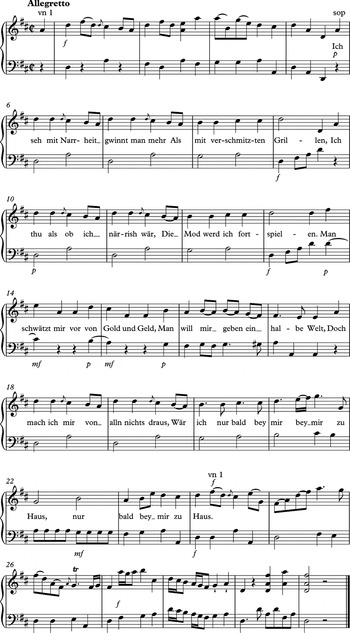
It may seem improbable that Berner would have subtly undermined the legitimacy of his own company from within one of his singspiels. But in the context of other self-reflexive moments in the Kindertruppe repertoire (like Il n'y a plus d'enfans and Die verkehrte Welt), as well as the equivocal critical assessments of the troupes at this time, it begins to seem less far-fetched. One might consider, too, the music of ‘Ich seh', mit Narrheit’, whose jaunty contredanse rhythms, typical of the Singspiellied, undermine the bitter tone of the words (see Example 2). Its anempathetic quality, in fact, prefigures that of ‘Trostlos schluchzet Philomele’.
Joseph Friebert, ‘Ich seh, mit Narrheit gwinnt man mehr’, from Das Serail, eine Teutsche Operette (Passau, 1779), voice, first violin and bass lines only. Copyright Don Juan Archiv, Vienna. Used by permission

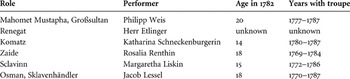
The metatheatrical critique implied by the slave-girl's arietta takes on further nuance in light of the member of Berner's troupe who took on the role. Cast statistics for the premiere in Wels are not readily available, but we do have cast information for one of the 1782 Nuremberg performances (Table 1). There, the slave-girl was played by Margaretha Liskin, who joined the troupe in 1772 at the age of five and was soon one of its most celebrated soubrettes.Footnote 68 If she originated the role of Das Serail's slave-girl in 1777, she would have been ten years old at the time.
Cast for the Berner troupe's 1782 Nuremberg performance of Das Serail

Liskin was one of the members of the Berner troupe who regularly recited epilogues, particularly when the troupe was taking its leave of a city or town (see Figure 3). One of Liskin's epilogues, reprinted in Garnier's memoir, dates to 1779 in Würzburg, following her lead performance in another theatrical meditation on sexual pursuit and conquest: Das Milchmädchen und die beiden Jäger (The Milkmaid and the Two Hunters), a German translation of the 1761 opéra comique by Louis Anseaume and Egidio Duni.Footnote 69 The opera is rife with zoological allegories of seduction, from the two hunters and their elusive bear, to foxes chasing hens and birdcatchers chasing partridges. The most overt image, however, is the milk itself, with the broken jug a well-known symbol of sexual deflowering.Footnote 70 Liskin's epilogue, delivered at age twelve, knowingly employs this suggestive subtext to the opera and her character:
llustration accompanying the farewell address by an unnamed actress in the Berner Company (Margaretha Liskin?), from a souvenir brochure published in Salzburg in 1783. Stadtarchiv Salzburg, Bibliothek. Used by permission

There is a long tradition of these kinds of epilogues among child performers, who were, after all, only imitating the bawdy epilogues common among adult troupes.Footnote 72 In 1731, for instance, the debut opéra comique of one of the earliest Parisian children's troupes, the Troupe de Drouin, concluded with the following epilogue delivered by the thirteen-year-old actress who had portrayed the widowed aunt:
The ‘little widow’ then sings an air in which she boasts:
Even after the introduction of ‘regelmäßig’ plays into the Kindertruppen repertory in the 1760s such double entendres appear to have been stock-in-trade for actresses like Liskin, part of the long-standing erotic subtext of theatrical spectatorship.Footnote 74 These sentiments suggest a further metatheatrical overlay to ‘Ich seh', mit Narrheit’: like the zesty little widow and the milkmaid, the slave-girl steps outside of her role and addresses her peculiar profession and persona, with its uneasy elision of the chaste and the deflowered, the ‘Mädchen’ and the ‘Frau’.
Agile Throats and Returned Gazes
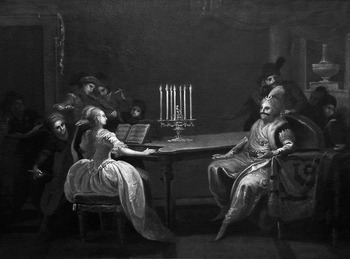
As we have seen, music can act as frame, mediator and irritant in the encounter between subjects and objects of spectatorial desire. Each of these functions is thematized in one of a series of four paintings called Das Serail, created in 1780 by the Bolzano-based painter Carl Henrici, and loosely based on the Berner troupe's Das Serail.Footnote 75 The second painting, known as ‘Die Sklavin singt’, appears to depict the singspiel's audition-scene tableau rather than the private reflection of ‘Ich seh', mit Narrheit’ (see Figure 4). But this makes its placement of singer and spectator especially significant: both figures are equally worthy of the viewer's gaze. If anything, the bodily orientations of the accompanying ensemble direct the eye to the forward-facing sultan, who appears almost as though he could be performing to the slave-girl's accompaniment.
Carl Henrici, ‘Die Sklavin singt’, from the series Das Serail (1780). Stadtmuseum Bozen. Used by permission

There is a confrontational undertone to the frank mutual regard between the two figures. And the bifurcated focal point of the image, not to mention the furtive glances of the secondary figures, leave the viewer unsure with whom to identify. The ‘inscribed beholder’ in Henrici's painting (to adopt Cuillé's terminology for the musical tableau) is a double for the viewer of the painting – just as ‘Ich seh, mit Narrheit’ and the episodes of embedded performance found throughout the seraglio-opera repertoire seem to reflect their own bodily commerce in a mise-en-abyme.Footnote 76 Such ‘thematics of the gaze’ can be found throughout pantomime, as John O'Brien has shown.Footnote 77 But when performed by novelty children's troupes, these encounters have additional connotations, implying both an exoticizing, even voyeuristic attitude toward childhood and a countervailing impulse to preserve, and to venerate, youthful innocence.
The reciprocal nature of the seraglio tableaus explored here is a common theme in current research on the East–West encounter in music and theatre.Footnote 78 Postcolonial theory is also proving increasingly attractive to historians of childhood, many of whom are preoccupied with recuperating the child as a historical agent, a new ‘speaking subaltern’.Footnote 79 The nature of children's subordination to adults has no analogue in other discourses of alterity, however, and the present study is, by postcolonial standards, still an ‘ideological’ one – that is, one concerned with repertoires created by adults, and the critical reception of those repertoires by other adults. The archival record on historical children's lived experience with the troupes and their repertoires is frustratingly limited. But as Carolyn Steedman, Jacqueline Rose and Marah Gubar have shown in nineteenth-century contexts, the ideologies themselves were often unusually self-conscious and negotiable.Footnote 80
We must be careful, however, about imputing too much agency to individual performers in the Kindertruppen. Lacking even the limited self-determination of the rank-and-file members of adult troupes, young performers – particularly women – were often subjected to abuse and abduction. Nicolini, for instance, was reported to have been a strict disciplinarian whose ‘admonitions came fast, began with slaps on the back, and often ended with kicks’.Footnote 81 One female performer in Berner's troupe was apparently carried off by an enamoured clergyman at age fifteen, with only the intercession of Berner himself securing her return.Footnote 82 Finally, Audinot was described by more than one historian as having used his Théâtre de l'ambigu-comique as a ‘private harem’, even going so far as to pay off the parents of one of his favourites.Footnote 83
And the lack of agency was as much theoretical as it was historical. More than one children's troupe had its origins in the marionette theatre, and even those that did not frequently evoked associations with dolls, animals and machines. In his autobiography Garnier proudly described his fellow performers as ‘living machinery’ (lebendigen Maschinerie) and ‘living marionettes’ (lebendigen Marionetten); and in 1780s Paris, the repetiteur of the Théâtre des petits comediens de Beaujolais boasted, ‘the children I teach should be no more than little instruments that only I know how to play; … nothing but little ape imitators’.Footnote 84 Finally, in 1770 the libertine philosopher Nicolas-Edme Restif de la Bretonne, inspired by Audinot's Théâtre de l'ambigu-comique, proposed a utopian théâtre éphébique (juvenile theatre) in an effort to purify the acting profession and wed methodical training to unobjectionable, didactic material. In a confirmation of Grosrichard, Bretonne's favoured candidates for this forerunner to Müller's Theatralpflanzschule were orphans, who, as he put it, could most easily be moulded into virtuous ‘esclaves publiques’ (public slaves).Footnote 85
In the end it was real-world exploitation, rather than any aesthetic scruples, that led to the collapse of the Kindertruppen. The Austrian emperor and empress banned all such troupes in 1821 after it was discovered that the son of an imperial foreign minister had been molesting a number of young girls in a popular Viennese Kinderballett.Footnote 86 The protection of youthful virtue, it seems, was no longer reconcilable with the commercial display of young bodies. Whether this signalled a new attentiveness to the rights of the young, or simply a wish to sequester them in a sanitized private sphere, is perhaps an irresolvable question. But behind all the dramaturgical debates and moral consternation, there is the still incontrovertible fact of the Kindertruppen performers' skill. These were talented and highly disciplined actors, singers and dancers. Jean-Jacques Rousseau himself – from within the pages of Émile, no less – praised the Piccoli Hollandesi for possessing as much lightness and precision in their movements as adult dancers.Footnote 87
Marah Gubar interprets the child actors of Victorian England as counterweights to the predominant image of the child as passive, and childhood as a state of passivity:
Perhaps we can read this fascination with precocity as a form of resistance to the growing pressure to conceive of the child as incompetent, weak, and artless, a separate order of being who could not work alongside or enter into intimate relationships with adults.Footnote 88
With this thought in mind, the echoes of Das Serail's ‘Ich seh' mit Narrheit’ in Zaide's ‘Trostlos schluchzet Philomele’ might resound more clearly. For all that we still don't know about the historical and dramaturgical contexts of Mozart and Schachtner's aria for Zaide, we can still register that apostrophic turn toward the audience: that metatheatrical moment in which, in the absence of any visible cage, the spectator is invited to consider the proscenium, and to acknowledge the captive's limited but persistent degree of agency, even if it is only in demarcating the boundaries of her cell. That more famous ‘completion’ of Zaide, Die Entführung aus dem Serail, registers something of this resistance in Konstanze's aria ‘Traurigkeit ward mir zum Lose’ (Sorrow Has Become My Lot).Footnote 89 As Konstanze puts it, even the air cannot bear to tell her bitter pain, so it brings all her woes back to her bitter heart.Footnote 90 But of course, the air does carry Konstanze's anguished cries to the listener, just as Zaide's Philomela ‘bewails with agile throat’, or in the case of ‘La fauvette avec ses petits’, ‘all resounds with [Zémire's] pain’.Footnote 91 These characters all echo the defiant promise Ovid has Philomela deliver to Tereus, a promise to proclaim the song of her imprisonment and violation, to ‘move the very woods and rocks to pity’ – a promise she is able to fulfil even after her tongue has been removed from her body.Footnote 92 In Philomela's descendant, Zaide, and her sisters in the Kindertruppen, the melancholy paradox of the young performer elides with the seraglio nightingale: exiled from herself, at once wronged and revered, sincere and mechanical, voiceless but with ‘reger Kehle’.
Appendix
Principal eighteenth-century children's troupes active in France and Germany, and some of the Turkish- or seraglio-set works in their repertoireFootnote 93