The relatively infrequent co-occurrence of different life phases in some groups of pleomorphic fungi has made the establishment of a clear relationship between the sexual (perfect or teleomorphic) and its asexual (imperfect or anamorphic) stages difficult. Fungal cultures, chemosystematic markers and, in recent years, DNA sequences, have been routinely used in the settlement of full life cycles of pleomorphic fungi. The case of the lichenicolous genus Abrothallus de Not. and its anamorph Vouauxiomyces Dyko & D. Hawkws. is representative of such a lack of conclusive proofs to connect sexual and asexual phases. The genus Vouauxiomyces was introduced by Hawksworth & Dyko (Reference Muyzer, De Waal and Uitterlinden1979) for coelomycetous fungi characterized by having immersed to erumpent pycnidia and clavate to pyriform-shaped holoblastic hyaline conidia with a truncated base. The type species V. truncatus (B. de Lesd.) Dyko & D. Hawksw. (syn. Phoma truncata B. de Lesd.) grows on the thallus of Flavoparmelia caperata (L.) Hale and represents a candidate anamorph of A. microspermus Tul. Hawksworth & Dyko (Reference Muyzer, De Waal and Uitterlinden1979) did not mention the anamorph-teleomorph connection of Abrothallus and Vouauxiomyces in their description. However, the putative evidence of this relationship, based on frequent co-occurrence of ascomata of Abrothallus and Vouauxiomyces–type conidiomata on the same lichen thallus, was already noted in one of the earliest papers about lichenicolous fungi (Tulasne Reference Tulasne1852). This observation-based connection was accepted and illustrated by later authors (Lindsay Reference Lindsay1857; Kotte Reference Kotte1909; Schaechtelin & Werner Reference Schaechtelin and Werner1927; Keissler Reference Keissler1929; Hawksworth Reference Hawksworth1981) without additional confirmation. In his treatment of lichenicolous coelomycetes, Hawksworth (Reference Muyzer, De Waal and Uitterlinden1981) described the new species V. santessonii D. Hawksw. (on Platismatia glauca (L.) W. L. Culb. & C. F. Culb. and Parmelia saxatilis (L.) Ach.) and recombined Phoma ramalinae Nordin (Nordin Reference Nordin1964) into V. ramalinae (Nordin) D. Hawksw. Up until now, five species of Vouauxiomyces have been described (Index Fungorum http://www.indexfungorum.org, consulted on 20th September 2010). Besides the cited species, V. brattii S. Y Kondr. and V. granulatae Wedin (both growing on Pseudocyphellaria species) have already been published (Wedin Reference Wedin1994; Kondratyuk Reference Kondratyuk1996). Out of the five species, V. bratti is the only one for which a putative teleomorph has not yet been defined (Kondratyuk Reference Kondratyuk1996). During the course of our studies on the genus Abrothallus, we have observed anamorph states accompanying most of the studied specimens (Suija Reference Suija2006; Suija et al. Reference Suija, Pérez-Ortega and Hawksworth2011). As there has been no success in preparing cultures of Abrothallus and Vouauxiomyces from ascospores or conidia, respectively (Crittenden et al. Reference Crittenden, David, Hawksworth and Campbell1995; S. Pérez-Ortega, pers. obs.), the relationships between Abrothallus and Vouaxiomyces have always been assessed by co-occurrence. Here we report definitive proof of the connection between anamorphic Vouauxiomyces and teleomorphic Abrothallus using the fingerprinting technique of Denaturing Gradient Gel Electrophoresis (DGGE; Muyzer et al. Reference Muyzer, De Waal and Uitterlinden1993). We analyzed the anamorph and teleomorph states of Abrothallus growing on both Xanthoparmelia protomatrae (Gyeln.) Hale and Punctelia jeckeri (Roum.) Kalb.
Abrothallus and Vouauxiomyces growing on X. protomatrae were collected in Toledo, Spain (Pérez-Ortega 1750 et al.) and those growing on P. jeckeri in California, USA (Pérez-Ortega 1490 & Amo). Voucher specimens used are deposited in the private herbarium of the first author. Genomic DNA was extracted from 1) lobe tips of the hosts (c. 9 mm2), where we took the youngest areas of the thalli in order to prevent cross contaminations with other fungi (which are likely to be more common in older thallus areas); 2) a single Vouauxiomyces pycnidium with the surrounding host thallus; and 3) a single apothecium of Abrothallus (special care was taken to remove all possible host tissues from the basal area). DNA was extracted using the DNEasy Plant Mini Kit (Qiagen®), following the manufacturer's instructions but extending the incubation time in the lysis buffer to 2 hours. A fragment of 280 bp of the ITS region of the nuclear ribosomal DNA including a fragment of the 5.8S rDNA and the ITS2 was amplified using the ITS4GC/ITS3 pair of primers (White et al. Reference White, Bruns, Lee, Taylor, Innis, Gelfand, Sninsky and White1990). PCR reactions were prepared for a 25 µl final volume containing 1·25 µl of each primer (10 µM), 17·5 µl of distilled water and 5 µl of the DNA template. PuReTaq Ready-To-Go PCR beads (GE Health Care, Amersham Biosciences, 2004) were added to the mix according to the manufacturer's instructions. The thermocycling programme was: 5 min denaturation at 94°C, followed by 30 cycles at 95°C for 30 s, 52°C for 1 min and 72°C for 1 min 30 s, and a final extension step of 30 min at 72°C. The DGGE fingerprinting technique allows the separation of single nucleotide differing DNA sequences (Muyzer et al. Reference Muyzer, De Waal and Uitterlinden1993) and was used in order to separate DNA sequences present in the sample. Acrylamide gels (6%) with a 30–60% urea-formamide denaturing gradient were prepared following the manufacturer's instructions. Lanes were loaded with 22 µl of the PCR product mixed with 15 µl of loading buffer and run at constant 200V for 6 h at 60°C, and stained in ethidium bromide to visualize and photograph the resulting bands. The DGGE bands were excised with the help of a razor blade, diluted in 30 µl of distilled water and incubated for 1 h at 60°C in water. The extracted DNA was re-amplified as described above. Products were cleaned using the QIAquick PCR Purification Kit (QIAGEN®, Valencia CA). Both complementary DNA strands were sequenced by the SECUGEN sequencing company (S. L. Madrid, Spain). SeqMan v.7 (Lasergene®) was used to check, assemble and manually adjust the resulting sequence fragments.
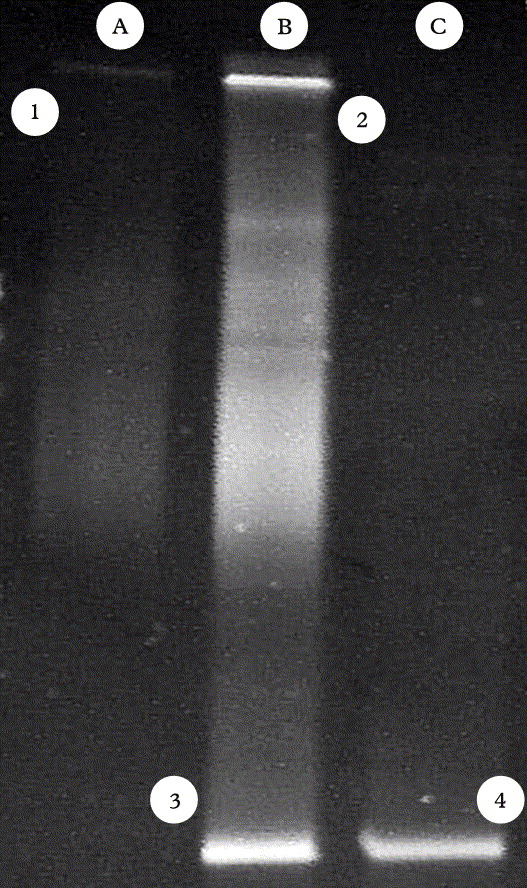
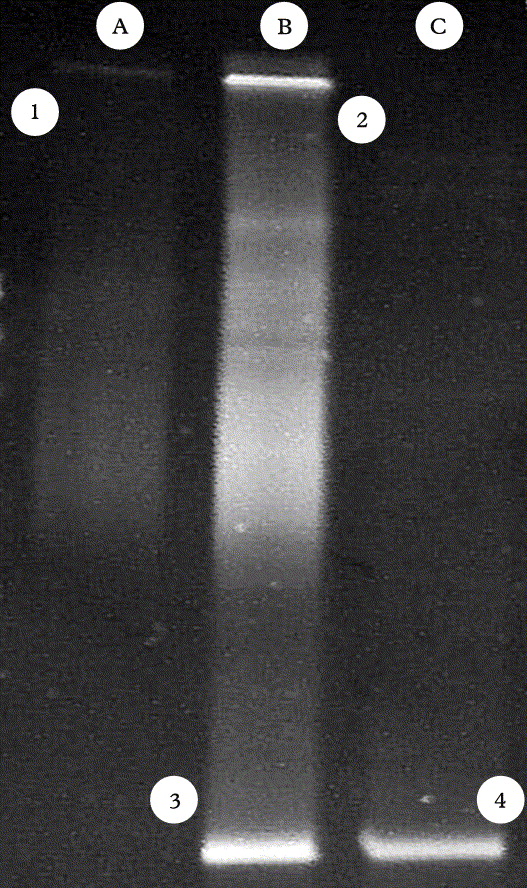
Amplification of ITS fragments from the DNA extraction, obtained both from the lobe tips of the hosts and from Abrothallus apothecia, resulted in a single band ( Fig. 1, lanes A & C, bands 1 & 4 respectively). On the other hand, the amplification from the Vouauxiomyces pycnidium and its surrounding host tissues resulted in two different bands, one corresponding to the band present in the host profile (Fig 1. lane B, band 2) and the other one corresponding to the lichenicolous fungus (Fig 1. lane B, band 3). Equal position of two bands running in two different lanes usually reflects the same nucleotidic composition and the same nucleotide sequence of the PCR products. All the bands were extracted, re-amplified and sequenced (GenBank accession numbers: X. protomatrae HQ702851; A. cf. caerulescens HQ702852; Vouauxiomyces state HQ702853). To our knowledge, these are the first sequences published for Abrothallus and Vouauxiomyces. The sequences obtained from re-amplification demonstrated that Vouauxiomyces corresponds to the mitotic phase of Abrothallus, as both shared the same sequence. In the same way the same sequence was recovered from the lobe tips of the host lichen and the thallus parts surrounding the pycnidium of Vouauxiomyces. A similar pattern was found in the DGGE gel of Abrothallus-Vouauxiomyces growing on Punctelia jeckeri (data not shown), but DNA was lost during its extraction from excised DGGE bands. Using the BLAST algorithm (Altschul et al. Reference Altschul, Gish, Miller, Myers and Lipman1990) and the sequence from Abrothallus-Vouauxiomyces growing on X. protomatrae as query, the highest similarity was found with an uncultured endophytic fungus obtained from the lichen genus Flavocetraria (FJ008686). The DGGE fingerprinting technique has proved itself as a reliable and useful technique for this kind of purpose, especially when working with fungi that are difficult to grow in culture. According to our results, this technique performs better with fresh samples as, when using one-two year old herbarium material, no successful results were obtained. Other techniques [single-strand conformation polymorphism (SSCP), cloning] used for revealing endolichenic diversity in lichen thalli seem to work well with herbarium specimens that are several years old (Muggia & Grube Reference Muggia and Grube2010), although no study has specifically tested how performances may vary with different methods and with thalli of different ages.
Denaturing Gradient Gel Electrophoresis (DGGE) gel of Abrothallus cf. caerulescens, Vouaxiomyces on Xanthoparmelia protomatrae. Lane A, X. protomatrae lobe tips; lane B, pycnidium of Vouauxiomyces and surrounding host tissues; lane C, apothecium of A. cf. caerulescens.
Our special thanks go to M. J. Malo for assistance in the laboratory and to J. C. Zamora for his help collecting the specimens used. This work was supported by grants CTM2009-12838-CO4-O3 and CGL2007-66734-C03-01/BOS from the Spanish Ministry of Science and Innovation. SPO is funded by the JAE-Doc program (Spanish Research Scientific Council). AS was funded by the Estonian Science Foundation grant GP1LM7321, target-financing project SF0180012s09 and through the European Regional Development Fund (Centre of Excellence FIBIR). Two anonymous referees are also thanked for their helpful comments.