Distributional conflict between states often impedes cooperation. According to conventional wisdom, regime integration promises substantial benefits when states disagree about the importance of different issues. States interested in issue A could promise to cooperate on issue B also, and states interested in issue B could offer to cooperate on issue A in exchange.Footnote 1 By integrating regimes—by increasing centralized policy coordination through institutional channels across the regimes—states can realize joint gains.
But the real world presents puzzles for this conventional wisdom. First, the degree of regime integration or separation varies widely. For example, trade regimes tend to be integrated, with the World Trade Organization (WTO) at the pinnacle. In contrast, arms control regimes are quite separated. Between these extremes lie environmental regimes. These vary: the United Nations Environment Program (UNEP) often provides loose coordination, but tighter integration under a new “World Environment Organization” has never materialized, even though the notion has been advocated for years by scholars and practitioners.Footnote 2 Why are some regimes integrated with one another, whereas others remain separate or fragmented?Footnote 3 Moreover, a second puzzle exists: regimes that appear suitable for integration remain separate. Consider climate change management and forest management, which states considered simultaneously in the lead-up to the 1992 Earth Summit in Rio de Janeiro, Brazil. Mitigating climate change combats forest loss, while maintaining forests preserves carbon sinks.Footnote 4 Thus, regime integration seems natural because states interested in climate change management could promise to cooperate on forest management, and vice versa. Indeed, states deliberated integration—but opted not to do so. Why were these natural candidates for integration kept separate?
These puzzles point to a more general question. When can states with divergent preferences expect mutual benefits from regime integration, and when do they prefer regime separation? Previous scholarship describes variation in the degree of regime integrationFootnote 5 but does not provide causal analyses of it.
We develop a strategic model of regime integration and separation. The model assumes that gains are available from cooperation, and it encompasses the possibilities of creating new regimes or integrating existing ones. The model also assumes preference divergence: where subgroups of states disagree about which of two issues is more important, spillovers between the issues shape opportunities for policy coordination between the subgroups. Negative spillovers exist when cooperation in one issue area undermines the pursuit of objectives in another issue area. Positive spillovers exist when cooperation in one issue area aids the pursuit of objectives in another issue area.Footnote 6
Conventional wisdom suggests that spillovers foster issue linkage and greater integration.Footnote 7 But our analysis shows that this mechanism is specific to negative spillovers. States integrate not to exploit positive spillovers between issues but to mitigate negative spillovers. In short: negative spillovers encourage integration; positive spillovers do not.
The prediction initially seems surprising. Positive spillovers mean that cooperation in one issue actually enhances outcomes in the other issue area, so one might expect that issues presenting positive spillovers would be natural to integrate. But this misses a key tradeoff: when positive spillovers exist, separate regimes are superior for inducing states to cooperate, because separation permits all states to enjoy the benefits of substantial cooperation by each individual state. The group as a whole benefits from permitting subgroups of states to invest wholly in respective pet projects, rather than by forcing all to invest in multiple projects that subgroups view coolly.Footnote 8
We test the theory's predictions with a medium-N qualitative analysis and two longer case studies. Our theory is not specific to any single issue area, but examining regimes within a single issue area is useful in holding other factors constant, so long as there is variation in the dependent variable. Environmental regimes fit this requirement. Whereas some domains of international politics (for example, trade) are marked by regime integration and others (for example, arms control) by regime separation, environmental issues host both regime integration and regime separation. Therefore, we examine the regimes surrounding ozone depletion, climate change, deforestation, and desertification. Multiple factors are held constant in the observations: all regimes pertain to the same issue (environmental degradation), have the same range (supra-regional), lack strong enforcement mechanisms, stem from the same time period (late 1980s and early 1990s), and exhibit divergent preferences between subgroups of states. And yet the regimes for these four issues differ widely in their relationships with one another: some are integrated hierarchically, some merely overlap, some are starkly separate. We demonstrate how this variation relates to spillovers between issues.
Our contributions are fourfold. First, by highlighting the pivotal role of spillovers, we place a crucial stricture on the notion that integration aids cooperation. Second, we contribute to the study of international institutionalization among states with very different interests, such as industrialized and developing states, or Western and Asian major powers. Third, we weigh in on contemporary worries about the lack of an integrated international regime for environmental protection, showing that it is neither as odd nor as discouraging as some observers believe. Finally, we offer an analytical instrument to make sense of variation across and within additional regimes. In the conclusion, we discuss how our theory could be applied to other issue areas, such as trade.
Theoretical and Empirical Context
International regimes are “sets of implicit or explicit principles, norms, rules, and decision-making procedures around which actor's expectations converge in a given area of international relations.”Footnote 9 Such sets are often codified in formal treatiesFootnote 10 and may be supported by formal organizations.Footnote 11 We focus on explaining the extent of centralized policy coordination through institutional channels across issues.Footnote 12Integrated regimes achieve high levels of policy coordination, so that collaborative activities on issue A are chosen in conjunction with similar activities on issue B. Separated regimes allow states to isolate their cooperation efforts on each issue.
Integration and separation form a continuum. As Keohane and Victor explain, “at one extreme are fully integrated institutions that impose regulation through comprehensive, hierarchical rules. At the other extreme are highly fragmented collections of institutions with no identifiable core and weak or nonexistent linkages between regime elements.”Footnote 13 Consider the European Union (EU) or the WTO. Each stands in the center of a highly integrated regime and contains specific rules aimed at avoiding discord. For example, WTO rules prevent states from offering tariff concessions to some members while discriminating against others.Footnote 14 In contrast, consider arms control regimes. There, treaties regulating specific weapons systems are not integrated at all. For example, the Chemical Weapons Convention and the Anti-Personnel Landmine Convention carry out their work without coordinating.Footnote 15 Meanwhile, environmental regimes lie between these extremes. While UNEP boasts nearly comprehensive state membership, it does not operate with a core set of harmonizing rules, nor does it wield authority over all international environmental institutions.Footnote 16
Our work extends three literatures: on issue linkages, regime complexes, and regime interactions. The first literature suggests that substantive issue linkages facilitate cooperation and are crucial to integration.Footnote 17 Some issues are not linked because of transaction costs,Footnote 18 or because increased “centralization” may also produce a sovereignty cost.Footnote 19 Nevertheless, when issues are interrelated, states should benefit from coordinated activities.Footnote 20 We build on this literature, as negative and positive spillovers between issue areas influence the choice between regime integration and separation. However, we reach beyond the notion that substantive issue linkage may facilitate regime integration, for we analyze when it does so, and when it does not. Moreover, while we allow for transaction costs, they are not necessary to explain regime separation.
We also build on the regime complexes literature. A regime complex is a collective of partially overlapping but nonhierarchical regimes.Footnote 21 Some research focuses on the impact of regime complexes in specific issue areas, such as trade,Footnote 22 human rights,Footnote 23 or the natural environment.Footnote 24 Other work develops general hypotheses.Footnote 25 These studies draw attention to the prevalence and importance of regime complexity.
Last, we advance the regime interactions literature, which offers a useful analytical typology.Footnote 26 Regimes interact for many reasons. Treaty obligations under one regime can influence behavior under another, or preexisting regimes may inform the design of newer regimes, or cooperation within one issue area can produce spillovers that change outcomes in another issue area.Footnote 27 A given regime also may provide states with information that changes their incentives under other regimes. More recent research identifies the linkability of issues as an important variable generating separated or integrated regimes.Footnote 28
While valuable, studies from these literatures do not provide causal analyses to explain variation in the degree of regime integration or separation across cases. We construct a model to address this gap and test it against data on regime integration and separation in the environmental realm.
A Theory of Regime Integration and Separation
In our model, two groups of states choose levels of cooperation in two issue areas indexed by A and B.Footnote 29 We focus on situations in which states hold diverging preferences regarding the relative importance of cooperation in these issue areas. This analytical scope condition allows us to focus on a range of empirically salient cooperation problems, and it is of particular importance for understanding North-South interactions under global interdependence. Within this condition, we focus on variation in the nature of spillovers between the issues, and we allow for continuous variation in the size of the spillovers. Under negative spillovers, states cooperating in issue A impede cooperation in issue B. Under positive spillovers, the opposite is true. Our cases provide examples. Substantial negative spillovers exist between ozone depletion and climate change: to heal the ozone layer, countries banned certain ozone-depleting substances, but they adopted substitutes that are potent greenhouse gases. Substantial positive spillovers exist between deforestation and climate change: because forests are natural carbon sinks, forest preservation mitigates climate change.Footnote 30
The model predicts that states integrate not to exploit positive spillovers, but to mitigate negative spillovers. Under positive spillovers, regime integration is counterproductive. After all, keeping regimes separate allows states to invest in cooperation on their priority issues, so higher levels of cooperation are feasible. In the presence of powerful negative spillovers, however, regime integration is more compelling.
Two other analytical scope conditions warrant a discussion. First, states have an interest in some form of cooperation, so they choose between regime integration and separation. We omit the strategically prior decision to somehow cooperate. While our model can thus explain how states cooperate, it does not shed light into why they cooperate. Second, we abstract away from the choice between creating new and using existing regimes. New regimes generally provide states with design flexibility, while existing regimes reduce transaction costs and uncertainty. Regardless of whether states choose to rely on new or existing regimes, they face the choice between integration and separation. They may even choose to integrate an existing regime with a new regime. Our analysis does not explain the decision between new and existing institutional frameworks, but our insights regarding integration and separation apply to both.
Assumptions
International cooperation is mutually profitable policy adjustments that cannot be implemented without coordination among states.Footnote 31 Assume two types of states, a and b, can engage in cooperation on two issue areas, A and B. States of type a have a keen interest in addressing issue A, whereas states of type b have a keen interest in addressing issue B. While type-a states prefer aggressive efforts on issue A and little collective action on issue B, type-b states hold the opposite preferences. For example, states of type a could have a keen interest in liberalizing trade in industrial goods while states of type b would have a strong interest in reducing barriers to agricultural trade. Type-a states are “pushers” in issue area A because their benefits are high and costs low. Conversely, in issue area B, type-a states could be “draggers” because of high costs and low benefits.Footnote 32
Both costs and benefits of cooperation are allowed to vary across types of states. For example, benefits may vary because some states expect larger gains from trade liberalization, or are more vulnerable to certain environmental threats. Costs may vary because some states face import competitors with a lot of political clout in domestic politics, or because some states are heavy polluters. Thus, states of type a would expect relatively large benefits and pay a limited cost for cooperation on issue A. Conversely, their cost-benefit ratio for cooperating on issue B would be much worse.
Note that we focus on cooperation under anarchy, where two factors make cooperative deals difficult to enforce.Footnote 33 First, countries may fail to comply with their commitments.Footnote 34 Second, countries might not participate in cooperative arrangements.Footnote 35 The literature on sanctions and enforcement indicates that such free-riding incentives are difficult to constrain, both because powerful sanctioning mechanisms are difficult to deviseFootnote 36 and because the senders themselves face a second-order collective action problem with regard to implementing costly sanctions.Footnote 37
The main outcomes are regime separation and integration. By regime separation, we refer to a situation wherein cooperation in issue area A is conducted in the absence of coordination with activities in issue area B, and vice versa. Each type is able to focus on its priority issues, so states of type a invest heavily in issue area A and remain passive in issue area B. As states begin to negotiate on cooperation in issue area A, states of type a announce their willingness to contribute and form institutional arrangements that allow them to effectively implement policies. States of type b remain inactive. The opposite dynamics are expected in issue area B.
The alternative to regime separation is integration. Under integration, states have agreed to coordinate policy on both issue areas, and thus they cannot prioritize their preferred issue at the expense of the other issue. States of type a also must participate in activities in issue area B, and states of type b must participate in activities in issue area A. This increases the cost of cooperation, because each state also must participate in the regime that carries a higher cost. For example, states could agree under the WTO that service liberalization rules cannot undermine previous rules on manufactured goods. Regime integration helps states address negative spillovers.
Regime separation is the default outcome. Recall that we assume states have an interest in cooperation, and therefore fully noncooperative behavior is excluded. Without a collective decision by states of different types, separation follows as interested states form cooperative arrangements in their respective issue areas of interest.Footnote 38 But if regime integration promises to realize joint gains, then states can collectively decide to integrate the regimes.
A critical determinant of separation versus integration is the presence of negative spillovers. Suppose states are allowed to pursue their interest in cooperating on their respective priority issues. Under regime separation, such pursuits are not coordinated. If states of type a choose to address issue A, their optimal actions may produce negative spillovers for states of type b in regard to issue B. While measures to liberalize trade in commodities may create economic growth and lower consumer prices, they could also increase the volatility of export revenue and thus complicate the planning of development projects in countries that are dependent on commodity exports. Through regime integration, states could avoid such negative spillovers by structuring their coordinated policies to be mutually supportive. For example, commodity trade liberalization could be accompanied by the creation of a stabilization fund for the least developed countries.
We adopt the simplifying assumption that the spillovers are symmetric: if cooperation in issue area A spills over to issue area B, then the opposite also holds. If the spillovers were asymmetric, their influence on the separation-integration choice would probably diminish because distributional conflict would impede collective decisions. In such circumstances, power relations would play an important role, and interests of powerful states would influence the choice between regime integration or separation.
Positive and negative spillovers can exist simultaneously. In such situations, relative importance matters. If the positive spillovers are central to state payoffs, while negative spillovers are negligible, then positive spillovers are the primary determinant of outcomes. If the negative spillovers are substantial, then they create demand for integration. States consider both factors, and choose to prioritize the one that will have the larger payoff effects. For example, in the case of the relatively integrated ozone and climate regimes that we study, negative spillovers were central: while some ozone-depleting gases were also greenhouse gases, cost-minimizing substitutes included even more potent greenhouse gases. Thus, states agreed that ozone cooperation should not be allowed to threaten climate cooperation.
Hypotheses
Based on these assumptions, we formulate two hypotheses regarding the degree of regime separation versus integration. First, when would one expect the default outcome of regime separation?
H1: All else equal, in the absence of powerful negative spillovers, regimes will be separate.
If uncoordinated cooperation on each issue under regime separation produces mostly positive or no significant spillovers to the other issue with respect to state payoffs, regime separation is the design of choice for states. By keeping regimes separate, states allow each type to pursue their preferred projects without the burdensome requirement to also contribute to the other issue area. Relatively high cooperation levels are attainable and neither issue area suffers from “excessive” cooperation in the other. Under positive spillovers, high levels of cooperation among passionate states in each issue area benefit states of the other type. Thus, states should not have a strong incentive to move away from regime separation.
When would one expect regimes to be integrated? In addition to entailing transaction costs, regime integration forces states to operate in a lower-priority issue area, and this reduces each state's incentive to cooperate. Nevertheless, avoiding separation is useful given powerful negative spillovers.
H2: All else equal, in the presence of powerful negative spillovers, regimes will be integrated.
With negative spillovers, uncoordinated action produces little collective welfare, because cooperation in one issue area undermines cooperation in another issue area. By integrating regimes, states coordinate policies in both issue areas simultaneously and mitigate negative spillovers. Unless the transaction costs are overly high, regime integration allows states with different preferences to realize joint gains.Footnote 39
In Figure 1, we offer a graphical illustration. The x-axis shows the spillovers (positive or negative) and the y-axis shows the payoff from regime separation (line) and integration (dashes).Footnote 40 In the presence of strong negative spillovers, regime integration provides the higher payoff to states. In the absence of strong negative spillovers, regime separation provides the higher payoff to states. Therefore, regime integration is expected on the left side of the dotted vertical line, while regime separation is expected on the right side.
State payoffs from regime integration and seperation

The reason regime separation is the dominant institutional design under positive spillovers lies in the basic logic of cooperation under anarchy. If cooperation were perfectly enforceable and transaction costs negligible, regime integration would be the preferred choice of states, even if the benefits from coordination were relatively modest. Economies of scale would drive states toward regime integration. But cooperation is imperfectly enforceable in international politics, so sovereign states decide whether to contribute.Footnote 41 They contribute when they expect tangible and readily available benefits. International institutions, though not epiphenomenal, are designed in view of imperfect enforceability.
Alternative Explanations
Alternative explanations should be considered. In particular, five other factors may matter: transaction costs, complexity, distributional conflict, enforcement, or individual leadership. First, international cooperation theorists ascribe much variation in regime design to transaction costs.Footnote 42 Specifically, high transaction costs may raise impediments to regime integration. A large number of participating states and uncertainty about the state of the world increase such transaction costs.Footnote 43 Therefore, these factors should increase the probability of regime separation.
Second, integration or separation may be due to bounded rationality. If the issue in focus is highly complex, states may prefer to sequester the relevant regime from other issues.Footnote 44 Thus, unusually complex problems may be less amenable to regime integration than simple problems.
Third, scholars of tactical issue linkage have argued that regime integration is necessary to create a zone of agreement.Footnote 45 If states disagree on the importance of cooperation in different issue areas, they may exchange concessions. Thus, distributional conflict per se may create incentives for regime integration. Notably, however, such preference divergence is one of our scope conditions. Therefore, tactical issue linkage may have limited explanatory power given distributional conflict between state subgroups.
Fourth, states may also integrate regimes to improve enforcement: if a group of states can threaten defectors by suspension of cooperation in multiple issue areas, the cost of defection increases.Footnote 46 If regimes are integrated so that defection in one regime results in suspended cooperation in the other regime, enforcement is a plausible rationale for regime integration.
Last, individual leadership by “policy entrepreneurs” may influence regime design.Footnote 47 Influential individuals' personal preferences may drive regime integration or separation. However, this explanation is consistent with our model if these individuals' preferences stem from recognition of spillovers between regimes.
Empirics: Regime Integration or Separation in Global Environmental Politics
We now turn to empirical evaluation using case studies of six regime pairs related to the natural environment: climate-ozone, deserts-ozone, forests-ozone, climate-deserts, climate-forests, deserts-forests. The case study findings align with the predictions of the theory. Climate-ozone is the only pair containing significant negative spillovers between issues, and it is also the only pair exhibiting hierarchical integration between regimes. For the other five pairs, the spillovers between issues are either positive or not significant, and there is separation between regimes. Before discussing these results further, we explain variable operationalization and case selection.
Variable Operationalization
The dependent variable is integration or separation across regimes. To operationalize this, we build on Keohane and Victor, who examine integration or fragmentation within regimes.Footnote 48 At one end of their continuum is full integration, marked by a largely unrivaled institutional core and by regulation through a hierarchical, comprehensive structure. At the other end is extreme separation, marked by the lack of any identifiable institutional core and by weak or nonexistent institutional linkages. Between these endpoints, there are arrangements that are relatively integrated (for example, with an identifiable core and a semi-hierarchical structure) or relatively separate (for example, with overlapping but nonhierarchical institutions).Footnote 49
For each regime pair, we ask the following. First, is there evidence of integration—do institutional arrangements have an identifiable, unrivaled core and/or a hierarchical, comprehensive structure? Second, is there evidence of separation—do institutional arrangements lack any institutional core and/or have either weak or nonexistent institutional linkages?Footnote 50 A given institutional arrangement could possess elements of integration and separation simultaneously, so the relationship between two regimes can range from clearly integrated or relatively integrated, to relatively separate or clearly separate.
We expect the nature of spillovers between two regimes to drive such variation. To operationalize this explanatory variable, we ask the following. First, is there evidence of positive spillovers—does cooperation in issue area A aid the pursuit of objectives in issue area B? Second, is there evidence of negative spillovers—does cooperation in issue area A undermine the pursuit of objectives in issue area B? Because any allocation of resources to one issue area implies that those resources are not available for another issue area, we consider whether evidence of negative spillovers goes beyond mere opportunity costs.
The answer to one or both of the questions could be “no,” so that spillovers between regimes do not exist. If the answer to both of the questions is “yes,” we consider the relative importance of the positive and negative spillovers. For both questions, we also examine the validity of the simplifying assumption that the spillovers are symmetric between issue areas A and B.
Case Selection
To test our predictions, we consider the regimes for ozone depletion, climate change, deforestation, and desertification. Several considerations inform case selection. First, the cases offer consistency and controls that account for alternative explanations. Because the transaction costs of integrating regimes vary with the number of states participating,Footnote 51 we chose cases with similar numbers of participating states. All four regimes are supra-regional, involving states from around the world. Similarly, because the impediments of transaction costs and bounded rationality vary with uncertainty about the state of the world,Footnote 52 we chose cases in a common general issue area. All four regimes deal with environmental degradation, which requires scientific research about possible long-term repercussions. Next, because integrating regimes is compelling if one regime offers a strong mechanism for enforcement, we chose cases that do not include such mechanisms.Footnote 53 Not even the ozone regime contains an enforcement mechanism that threatens to suspend cooperation in the face of defection.Footnote 54
Numerous other systemic conditions could affect regime integration, so we chose cases in a common time period. All four regimes stem from the late 1980s or early 1990s. Conditions within states or across states are more constant than if we examined regimes from varying time periods, enabling us to focus on the differing nature of spillovers across regimes. The presence of policy entrepreneurs was not a criteria for case selection, but in the analysis we also consider it. Given the factors held constant, our empirical test is a hard one. High transaction costs, issue complexity, and the lack of enforcement through issue linkage operate against regime integration. Given this, the probability of regime integration without considering our causal mechanism should be low.
Second, the cases offer preference divergence. Preference divergence is not unique to environmental concerns. However, in environmental politics different priorities among states are stark and relatively straightforward. Sometimes preferences diverge along geographic lines: arid regions worry about desertification, while temperate or tropical regions worry about deforestation. Often preferences diverge along North-South lines: industrialized countries tend to prioritize “green” issues (for example, addressing ozone depletion), while developing countries tend to prioritize “brown” issues (for example, the reversal of land degradation).Footnote 55 Many developing countries view issues such as climate change as by-products of overconsumption by the North, and they warily eye environmental regimes as tools by which industrialized countries gain control over the South's policies.
Third, the cases offer generalizability. To test our hypothesis about regime integration or separation, the issue area must offer variation on the dependent variable. Not all issue areas vary in this way: for example, trade regimes tend to be quite integrated, while arms control regimes tend to be quite separated. Environmental regimes lie between these extremes, providing variation.
Fourth, the cases offer substantive importance. The ozone regime is known for its success, the climate regime for its contentiousness, the forests regime for lacking a formal convention, and the deserts regime for its development focus.
Fifth, the cases offer breadth and depth. There are no large-scale data sets containing detailed information about regime separation and integration.Footnote 56 Therefore, we turn to qualitative methods. We consider four different regimes. This permits us to test our predictions across six pairwise relationships.
Background on the Ozone, Climate, Forests, and Deserts Regimes
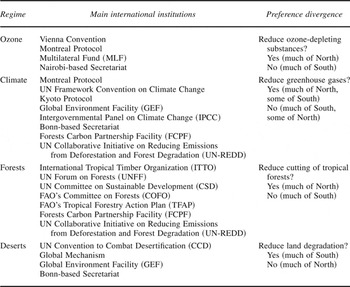
We now provide background needed to evaluate the empirical evidence. For each regime, we discuss the main international cooperation problems and establish the presence of diverging preferences among the states involved. We also introduce the main international intergovernmental institutions. Table 1 summarizes.
Summary of background information for four regimes

Ozone
The ozone layer prevents radiation damage to the vulnerable tissues of humans. In the mid-1970s, scientists implicated chlorofluorocarbons (CFCs)—a family of chemicals used in products such as air conditioners and aerosol cans—in the depletion of the ozone layer.Footnote 57 The United States moved early: the government cooperated closely with the chemical industry, which began manufacturing hydrochlorofluorocarbons (HCFCs) as a replacement for CFCs. European producers turned to a replacement of their own, hydrofluorocarbons (HFCs). Unfortunately, this threatened a different aspect of the natural environment: both substitutes for ozone-depleting CFCs are extremely potent greenhouse gases that are implicated in climate change.
Industrialized countries played foremost roles in crafting the ozone regime's first agreement, the 1985 Vienna Convention. Meanwhile, developing countries “showed little interest in participating in negotiations aimed at curtailing products that seemed almost synonymous with the standards of living to which they aspired.”Footnote 58 Brazil, China, India, and Indonesia argued that ozone depletion was a rich-country blunder and a rich-country responsibility. Industrialized states sheepishly concurred. Consequently, the 1987 Montreal Protocol supplied developing states with a lagged control schedule, as well as unprecedented financial and technical assistance.Footnote 59 Today, the main international intergovernmental institutions in the ozone regime are the Vienna Convention and the Montreal Protocol, as well as the Multilateral Fund (MLF) and the Nairobi-based secretariat that serve them.
Climate
Like ozone, greenhouse gases are useful: they warm the lower stratosphere, providing a habitable climate. But humans' burning of coal, oil, and other carbon-based fossil fuels may increase greenhouse gases and thereby alter the natural climate.Footnote 60 Evidence for this grew in the twentieth century. By the early 1990s, many industrialized states, especially in Europe, were thinking about “remak[ing] the climate process in ozone's image.”Footnote 61 This would entail a binding international treaty.
Most developing countries disliked the idea. They counted on the use or export of fossil fuels for their development. Further, they were more concerned about regional, immediate environmental problems than about global, future ones. Developing states argued that climate change was the fault of the North, so it ought to be fixed by the North or not addressed at all.Footnote 62 The language of the 1992 United Nations Framework Convention on Climate Change (UNFCCC) was watered down, and the 1997 Kyoto Protocol imposed binding controls on only industrialized countries. Yet the Kyoto Protocol also exhibits an intriguing design: it pinpoints the ozone regime's Montreal Protocol as a key institution regulating greenhouse gases. Today, along with the UNFCCC and the two protocols, other main international intergovernmental institutions in the climate regime are a Bonn-based secretariat, the Global Environment Facility (GEF), and the Intergovernmental Panel on Climate Change (IPCC). In addition, two new climate-related bodies have emerged in the last few years: the Forests Carbon Partnership Facility (FCPF) and the United Nations Collaborative Initiative on Reducing Emissions from Deforestation and Forest Degradation (UN-REDD).
Forests
Forests prevent silt buildup, soil erosion, and land degradation, while serving as natural carbon sinks.Footnote 63 Yet by the early 1990s, humans had converted about 40 percent of the planet's land surface from forests and grassland to cropland and pasture.Footnote 64 In industrialized countries, many resources already had been depleted. But the developing world hosted new waves, even cementing deforestation into public policy. For instance, with its Vision 2020 program, Malaysia's government sought to spur economic development by aggressively exporting timber and the crops grown on newly cleared land.Footnote 65
Deforestation in the South alarmed the North. Forests in developing countries provided enticing carbon sinks that could address the planet's greenhouse gases. At the 1990 Group of 7 (G-7) summit, the world's richest countries suggested that “forests could be seen as a global commons because all humanity has a stake in forest conservation.” The South went livid: through their Group of 77, the South countered that “forests are a sovereign natural resource to be used in line with national development objectives.”Footnote 66 The North-South rupture continued through the watershed 1992 Earth Summit in Rio de Janeiro, where states produced merely a nonbinding declaration of “Forest Principles” and a “Combating Deforestation” section in the Agenda 21 Action Plan. At present, no overarching forest convention exists. The main international intergovernmental institutions in the forests regime are FCPF, UN-REDD, the International Tropical Timber Organization (ITTO), the United Nations Forum on Forests (UNFF), the United Nations Committee on Sustainable Development (CSD), the Food and Agriculture Organization's Committee on Forests (COFO), and the Food and Agriculture Organization's Tropical Forestry Action Plan (TFAP).Footnote 67
Deserts
Desertification haunts the developing world even more than deforestation does.Footnote 68 The phenomenon entails “land degradation in arid, semi-arid, and dry sub-humid areas.”Footnote 69 Developing countries are particularly prone to deforestation and other activities that lead to land degradation. Furthermore, they are poorly equipped to respond to famine and other costly consequences. As one developing country official put it, the “scorching breath of the desert is not readily felt by the prosperous public of the rich North.”Footnote 70
Shortly before the 1992 Earth Summit, African states led calls for a deserts treaty. Their eyes were on money: if the North could pay to fix ozone depletion, and now convene a conference to consider climate change, then why could the North not also finance a regime to combat desertification? The industrialized countries had very different priorities. They “felt they bore no responsibility for the problem of desertification worldwide … and were therefore unwilling to incur obligations to increase their financial assistance to affected countries.”Footnote 71 At the 1992 summit, they relented somewhat, promising to negotiate a deserts treaty without new funding sources. That promise was fulfilled in 1994, when states finalized the United Nations Convention to Combat Desertification (CCD). Today, the main international intergovernmental institutions in the deserts regime are the CCD, its Bonn-based Secretariat, the Global Mechanism, and the GEF.
Relationships Among the Ozone, Climate, Forests, and Deserts Regimes
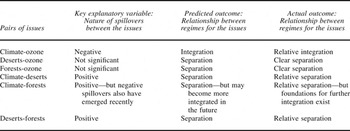
Next we examine the regimes' relationships with one another. Table 2 summarizes. Several observations support H1: regimes with positive or neutral spillovers between them are clearly or relatively separate. Meanwhile, the climate-ozone case supports H2: substantial negative spillovers exist between these regimes, and this pairing is also relatively integrated. In addition, the climate-forests pairing contains some preliminary evidence for H2. As discussed in the longer case study, calls for regime integration have recently grown stronger as negative spillovers have come to light.
Summary of relationships among six regime pairs

Key explanatory variable: nature of spillovers
First, we consider the nature of spillovers across regime pairs. We do not find evidence of either positive or negative spillovers for two pairs: deserts-ozone and forests-ozone. Ozone in the troposphere—that is, at the earth's surface or close to it—could affect soil or vegetation, but the ozone regime analyzed here deals specifically with the stratosphere many miles higher.Footnote 72 For these pairings, cooperative efforts in one issue have neither a direct beneficial nor harmful impact on the other issue.
Spillovers are largely positive and symmetric for climate-forests, climate-deserts, and deserts-forests. For these pairs, the greater the cooperation in one issue area, the greater the benefits for the other issue area.Footnote 73 Evidence indicates that positive spillovers exist between forests and climate change because maintaining forests preserves crucial carbon sinks, while mitigating climate change combats forest loss or relocation by preventing marked shifts in temperatures, precipitation, and evaporation.Footnote 74 Positive spillovers also exist between desertification and climate change because arid regions are particularly vulnerable to changes in the earth's temperature and precipitation, while changes in land use and cover alter climate balances.Footnote 75 Last, positive spillovers exist between deforestation and desertification, because the removal of trees is a key cause of soil erosion and land degradation, while nutrient-rich soil provides more hospitable conditions for forests.Footnote 76
We find evidence of substantial negative spillovers in the climate-ozone pairing only. Cooperation in the ozone regime threatens climate change mitigation: several of the substitutes for ozone-depleting CFCs are particularly potent greenhouse gases or are less energy-efficient.Footnote 77 Conversely, cooperation in the climate regime also threatens the healing of the ozone layer: some climate projects have incentivized the continued production of ozone-depleting substances,Footnote 78 and more recent calls for “geo-engineering” to counteract climate change could damage the ozone layer.Footnote 79 Positive spillovers exist as well, but as the negative spillovers became known, states moved to integrate the ozone and climate regions—as our theory predicts.
Dependent variable: regime integration or separation
Next, we consider regime integration and separation. Applied to these specific environmental regimes, our model predicts integration between the climate and ozone regimes, but separation between the other five pairs. In general, reality mirrors these predictions.
Clear separation exists in two pairings: deserts-ozone and forests-ozone. Other than the exception discussed later, ozone depletion is handled in a self-contained regime that is unconnected to regimes addressing other forms of environmental degradation. There is no hierarchical, comprehensive institutional structure coordinating stratospheric ozone policies along with desert or forest policies. Neither the original nor the updated texts of the Vienna Convention and the Montreal Protocol even mention any relationships with agreements concerning other environmental issues.Footnote 80
Furthermore, there is no identifiable institutional core linking the ozone regime to the deserts or forests regimes. The ozone secretariat is based in Nairobi, Kenya. Meanwhile, the deserts secretariat is located in Bonn, Germany, and the forests regime lacks any formal convention or secretariat.Footnote 81
Moreover, the funding mechanism for the ozone regime is kept distinct. Financial assistance for the ozone regime comes through the ozone-specific MLF, while financial assistance for the deserts and forests regimes comes through the GEF. There is some overlap in the administrators of the MLF and the GEF,Footnote 82 but the latter is a World Bank creation “not formally linked to the ozone-specific Multilateral Fund.”Footnote 83
The deserts-ozone and forests-ozone pairings meet the earlier definition of regime separation. Across these two pairings, we observe “highly fragmented collections of institutions with no identifiable core and weak or nonexistent linkages between regime elements.”Footnote 84 This aligns with our strategic theory, for we found no significant spillovers.
Relative separation exists in three pairings: climate-deserts, climate-forests, and deserts-forests. For each pair, there is no hierarchical, comprehensive structure that coordinates policies across the two regimes. Nor is there an identifiable institutional core. UNEP plays roles in the climate, deserts, and forests regimes, but it does not wield formal authority over the other international intergovernmental bodies that also are involved in these regimes. Moreover, although nesting the conventionless forests regime within the climate regime might seem natural, even this has not happened.
Yet the regimes are not fully separate, either. Institutions in these three pairings are nonhierarchical, but they do overlap somewhat. First, consider the deserts-forests pair. The deserts regime participates with the forests regime in a common funding mechanism, the GEF.
Second, consider the climate-deserts pair. The deserts regime shares a bit more with the climate regime than with the forests regime. Both the climate and deserts regimes can utilize the GEF for funding. In addition, the secretariats for the two regimes are both located in Bonn, Germany, and maintain a formalized dialogue.Footnote 85
Third, consider the climate-forests pair. Compared to the two pairings just discussed, the climate and forests regimes have more international intergovernmental institutions in common. In the future, such institutions may serve as foundations for regime integration, particularly if—as explored in the case study below—negative spillovers arise. And yet at present, these various institutions are in some ways competitors, rather than strictly collaborators. Both the climate regime and the forests regime utilize the GEF, which is administered jointly by eleven agencies from inside and outside of the UN system. Four of these agencies, in turn, have created two new bodies that consider climate change and deforestation simultaneously. On the one hand is UN-REDD, which was launched by the UN Environment Program, the UN Development Program, and the Food and Agriculture Organization (FAO). On the other hand is the FCPF, an analogous body that was launched by the World Bank almost concurrently.Footnote 86 UN-REDD and FCPF have similar professed objectives for addressing both deforestation and climate change—however, their collaboration has been modest to date, and the two bodies remain under the UN and World Bank, respectively.Footnote 87 Developing countries generally advocate working through the UN system, where each member-state wields one vote and where the majority of member-states are developing countries. In contrast, industrialized countries often favor utilizing the World Bank, which operates by weighted voting and grants the majority of votes to wealthy member-states. Observers have criticized the UN-REDD and the World Bank-sponsored FCPF as attempts to splinter the climate regime rather than integrate the climate regime with the forests regime. After all, the FCPF in particular is not formally nested underneath the contentious UNFCCC, but in fact could be seen as a rival to it.Footnote 88
Institutional overlap indicates that the climate-deserts, climate-forests, and deserts-forests pairings are not fully separate. But they are far from clearly integrated, either. Even the climate-forests pair, where institutional overlap is most extensive, falls short of the earlier definition of regime integration: a situation wherein states have agreed to coordinate policy in two issue areas, and thus cannot prioritize their priority issue at the expense of the other issue. This aligns with our strategic theory, for we found positive spillovers.
Relative integration exists in one pairing: climate-ozone. Institutional arrangements across the climate and ozone regimes have an identifiable (though not unrivaled) core and a hierarchical (though not comprehensive) structure. The ozone regime's Montreal Protocol is a core institution for the climate regime as well, and the climate regime's Kyoto Protocol indicates for itself “a subordinate position in relation to the Montreal Protocol.”Footnote 89
The text of the Kyoto Protocol specifies that the climate regime will pursue reduction of emissions of “greenhouse gases not controlled by the Montreal Protocol.”Footnote 90 Moreover, the Montreal Protocol's primacy vis-à-vis the Kyoto Protocol can expand. The ozone regime contains a mechanism by which member states can add to the list of substances that the Montreal Protocol regulates.Footnote 91
Thus, of the six regime pairs, only climate-ozone displays meaningful integration. This aligns with our strategic theory. Given the lack of spillovers between desertification and ozone depletion, or between deforestation and ozone depletion, separation is unsurprising. And given the greenhouse-gas nature of several substitutes for ozone-depleting substances, relative integration between the climate and ozone regimes also is unsurprising. What is surprising is that regimes for issues with obvious positive spillovers are not tightly integrated. Our argument explains why: given positive spillovers between issues, a group of states as a whole may benefit more by permitting subgroups of states to invest wholly in respective priority issues, rather than by forcing all to invest in multiple projects that subgroups view coolly.
According to our strategic theory, negative spillovers encourage integration. For causal substantiation, we next conduct a more detailed analysis of two pairings. First, we examine the relationship between the climate and forests regimes—a regime pair whose lack of integration surprises many observers. We find that positive spillovers played an important role in the actual politics of regime separation. Second, we analyze the climate-ozone case. We show that states were aware of the need to control the negative spillovers and therefore moved to integrate the regimes.
The Role of Positive Spillovers in the Separation of the Climate and Forests Regimes
The regimes surrounding climate change and deforestation seem to be natural candidates for integration. Negotiations on the UNFCCC and the Forestry Principles occurred simultaneously, in the lead-up to the 1992 Earth Summit in Rio de Janeiro. Furthermore, combating deforestation would help combat climate change, and vice versa—after all, the 13 million hectares of the world's forests lost because of deforestation every year account for up to 20 percent of the global greenhouse gas emissions that contribute to global warming, and the global cost of climate change caused by deforestation is estimated to be $1 trillion per year.Footnote 92 Forest management is a particular concern of developing countries, who possess the majority of the globe's remaining large stands of trees. Conversely, climate change management is a particular concern of industrialized countries, whose publics and scientific communities are among the most vociferous advocates of fighting global warming. According to conventional thinking, this combination of propitious timing and positive spillovers would facilitate regime integration. So why did states not integrate these two regimes?
States recognized positive spillovers. For instance, in the IPCC's inaugural 1990 report, Working Group III extensively discussed deforestation's contributions to climate change.Footnote 93 That same year, a U.S. government background paper noted that “predicted potential consequences due to forest loss [range] from destabilization of the global climate to destruction of water supplies, erosion, and desertification.”Footnote 94 Other industrialized countries knew this too.Footnote 95
Both North and South realized the flip-side of positive spillovers: if deforestation fueled climate change, then forest preservation could help mitigate it. Industrialized states were eager to exploit this spillover, because preserving existing carbon sinks looked like a simpler solution than reducing carbon emissions. Developing states chafed at this idea. To them, industrialized countries had brought the climate change problem upon themselves and had no right to tell other countries how their own forests could be used.Footnote 96 For instance, Malaysia's ambassador to the FAO declared, “We are certainly not holding [our forests] in custody for those who have destroyed their own forests, and now try to claim ours as part of the heritage of mankind.”Footnote 97 Developing countries did not mind a forests regime—what they did mind was the idea of subjugating the forests regime to the climate regime.
But this is precisely what the European Community (EC) proposed when climate change negotiations began in 1990. The Europeans took the lead in response to the U.S. and developing countries' lack of interest in a climate change treaty. The EC suggested nesting a forests protocol within the UNFCCC. The Group of 77, representing the developing world, countered with a suggestion for an energy protocol. The protocol would be inserted in the UNFCCC and would highlight industrialized countries' disproportionate, inefficient, and carbon-emitting energy use. The Europeans were determined somehow to push through a climate change treaty. They indicated their willingness to include both protocols.Footnote 98 The two regimes would be arranged hierarchically, with forests policy nested under broader climate policy.
Permitting forests policy to be shaped within the climate regime presented risks for the South, however. Many developing countries possessed extensive endowments of forests. At the same time, they were unenthusiastic about combating climate change. Developing countries were leery of curbing carbon emissions and feared that “greener” practices would hinder their industrialization. They also suspected that overall financial contributions from the North to the South for climate and forests projects would be larger if the two issue areas remained separate, so that industrialized states could target funding to whichever issue area they valued more highly. Consequently, they warily viewed the notion of including a forests protocol within the climate treaty. Greater integration between the forests and climate regimes would bring the danger of a narrow focus on forests as carbon sinks, sidelining other reasons for forest protection or utilization.Footnote 99
Placing forests and energy protocols under the climate regime also posed a threat for the United States. For one thing, the country was dealing with a media blitz surrounding new logging in spotted-owl habitats in its Pacific Northwest. This was not a propitious time to permit the EC to spearhead a forests protocol. Furthermore, the United States was the most conspicuous target of the proposed energy protocol, so it could not allow developing countries to insert something this incendiary into the framework convention on climate change. Moreover, the United States perceived little benefit in nesting the forests regime within the climate change regime. If forest preservation were achieved, then its natural positive spillovers would result in climate change mitigation too, regardless of whether the two regimes were formally integrated. And if forest preservation were not achieved, then formal integration would add nothing.
Maintaining separate regimes could keep one from bogging down the other. As one U.S. official recalled: “So how do you do that? The way to do it is to say, ‘Forests are too important. They provide a wide range of goods and services. And therefore they should be negotiated in a free-standing convention of their own.’ This kills the forest protocol, which in turn kills the energy protocol.”Footnote 100 The tactic succeeded in keeping the regimes distinct. The United States also offered a new $150 million pool of forests-targeted bilateral aid, secure in the knowledge that regime separation would prevent the resources from being diverted to climate change work. It then challenged other donor states to step up their own funding for forest preservation, so that the North's contributions to this issue would double from $1.35 billion to $2.7 billion.Footnote 101 The U.S. moves reinforced developing countries' premonition that compensation from the North would be more abundant under separate forests and climate regimes, rather than in integrated regimes.
To date, a framework forests convention has not materialized. The forests regime also has not been formally subordinated to the climate regime. However, negative spillovers that were not apparent in the early 1990s have emerged more recently. On the one hand, some climate change policies have undermined forest protection.Footnote 102 For example, a 2003 climate policy directive by the EU includes the promotion of biofuels as alternatives to high-carbon fossil fuels.Footnote 103 The directive was intended to reduce carbon emissions, yet it unintentionally affects forests: as governmental and nongovernmental groups have pointed out, the EU policy creates incentives to clear forested lands in order to grow more plants used for biofuels.Footnote 104 On the other hand, some forest policies also have undermined climate change mitigation. For example, southeast Asian countries such as Malaysia have encouraged the planting of oil palms. However, because of the lucrativeness of this product, landowners have not been satisfied with using already cleared land. Instead, they have removed more tropical forest to expand palm oil plantations—and this results in greenhouse gas emissions from former carbon sinks.Footnote 105
Growing awareness of these negative spillovers has been accompanied by the creation of new international intergovernmental institutions that consider forests and climate policy together. In 2008, the UN launched UN-REDD. The following year, the World Bank launched a similar organization of its own, the FCPF. There still is no clear integration between the climate and forests regimes,Footnote 106 but these institutional developments do provide some common regime elements between the issue areas.Footnote 107 While the two regimes remain relatively separate today, they may move toward greater integration as further negative spillovers come to light.
The Role of Negative Spillovers in the Integration of the Climate and Ozone Regimes
In contrast to the climate and forests regimes, the climate and ozone regimes are relatively integrated. The text of the climate regime's Kyoto Protocol explicitly specifies for itself a subordinate position vis-à-vis the ozone regime's Montreal Protocol. The climate regime regulates greenhouse gases not already regulated by the ozone regime. In addition, because the ozone regime contains mechanisms for adding to the list of substances it regulates, the Kyoto Protocol may lose jurisdiction as that list expands.
Is the relative integration of these two regimes traceable to negative spillovers between the issue areas? Negative spillovers are unlikely to be the sole contributor to regime integration. The Montreal Protocol preceded the Kyoto Protocol, and therefore a desire to avoid duplicate regulatory responsibilities likely informed the choice to place the latter in a subordinate position vis-à-vis the former. Note also that there are some positive spillovers between ozone depletion and climate change: cooperation in healing the ozone layer can aid efforts to address climate change. Some ozone-depleting substances (ODSs) are thousands of times more powerful than carbon dioxide (CO2) as contributors to global warming. Therefore, without the ozone regime's reduction of ozone-depleting substances since the 1980s, “the contribution of ODSs to climate change would almost have matched that from CO2 by 2010.”Footnote 108
In addition to positive spillovers, the climate-ozone case presents negative spillovers, and they are substantial. CFCs are greenhouse gases as well as ozone-depleting substances. Yet the ozone regime's phase-out of CFCs has prompted states to turn to substitutes—specifically, HCFCs and HFCs—that pose at least two challenges for the climate regime. First, HCFCs and HFCs are particularly potent greenhouse gases. Some of these substitutes exacerbate global warming. HFC-23, for instance, “has no impact on the ozone layer [but] is more than 14,000 times more powerful as a greenhouse gas than CO2.”Footnote 109 Second, the energy efficiency of CFC-substitutes also matters greatly. Conventional measures of a chemical's “Global Warming Potential (GWP)” consider the chemical in isolation, without accounting for the fact that the operation of equipment (for example, in refrigeration and cooling) may require greater quantities of HCFCs or HFCs than were required with the original CFCs.Footnote 110 Thus, the potency and energy inefficiency of substitutes for ozone-depleting substances present significant negative spillovers for the climate regime.Footnote 111
In short, “by promoting certain CFC substitutes [such as HFCs and HCFCs], the ozone regime complicated matters and actually contributed to [greenhouse gas] emissions.”Footnote 112 Ozone negotiators became aware of these complications by the 1988–90 period, and they began considering ways to reduce use of these greenhouse gases as well.Footnote 113 While states made further changes to the Montreal Protocol, climate change was “in the back of their minds.”Footnote 114 After states realized the threat posed by negative spillovers, they integrated the emerging climate regime with the existing ozone regime.Footnote 115 In 1992, the ozone regime added HCFCs to its own list of regulated substances, planning to phase out their use over several decades. In 1997, the final text of the Kyoto Protocol emphasized that its jurisdiction is limited to the reduction of emissions of “greenhouse gases not controlled by the Montreal Protocol.”Footnote 116 This “subordination” helped to ensure that policymaking in the ozone regime would take account of climate implications as well.
By the early 2000s, several advocacy groups began to argue for even greater climate-related tasks for ozone institutions. Their arguments explicitly cited negative spillovers between the two regimes. The Ozone-Climate Campaign, for example, declared that without immediate action to halt HCFCs, these substitutes for ozone-depleting CFCs would “undermine future efforts to mitigate climate change.”Footnote 117 In 2007, states agreed to accelerate the phase-out of HCFCs—an “easy win” that was made possible by the fact that negative spillovers between ozone depletion and climate change were recognized early and the two regimes already had been linked hierarchically.Footnote 118
With their relatively integrated arrangements, the ozone and climate regimes have dealt with a number of challenges. However, additional negative spillovers between the two issue areas are being recognized. Such recognition is accompanied by demands for further regime integration. The Institute for Governance and Sustainable Development (IGSD), for instance, argues:
The regulation and phase-out of CFCs and HCFCs under the Montreal Protocol is driving rising production, consumption, and emissions of HFCs. In addition, through the [Multilateral Fund], developed countries have funded projects in developing countries aimed at replacing CFCs and HCFCs with high [Global Warming Potential] HFCs to assist them in complying with their Montreal-Protocol-mandated obligations but, in the process, are creating an enduring market for HFCs…. The undeniable causal connection between activities undertaken pursuant to the Montreal Protocol and HFC proliferation creates a special relationship and obligation on the Montreal Protocol to minimize the adverse environmental effects of HFCs on the climate system.Footnote 119
Jurisdiction over HFCs currently rests in the “injured party,” the climate regime. Instead, according to the IGSD and others, that jurisdiction should be moved to the “culprit,” the ozone regime.Footnote 120 Such a move would more deeply subordinate the climate regime to the ozone regime, and it would prompt the latter to regulate HFCs with an eye toward both the ozone and the climate implications. Advocates of greater climate tasks for the ozone regime point out that the ozone regime has the institutions to accomplish such tasks.Footnote 121
Negative spillovers have been important in the development of relative integration between the ozone and climate regimes. But in closing, we must consider whether one other factor played a role: policy entrepreneurs. Indeed, integration between the climate and ozone regime has been fueled by the policy entrepreneurship of influential individuals or groups.Footnote 122 For instance, both IGSD and OCC have encouraged the distinctive arrangement between the Kyoto and Montreal Protocols. In making their arguments, they regularly highlight negative spillovers, emphasizing that CFC-substitutes are particularly potent greenhouse gases.Footnote 123 They advocate greater regime integration to internalize negative spillovers.Footnote 124 Therefore we find policy entrepreneurs to be complements, rather than rivals, to our explanation.Footnote 125
Conclusion
States regularly hold divergent preferences over issues addressed by various regimes. Under such conditions, when can states expect mutual benefits from integrating regimes, and when do they prefer to keep regimes separate? We highlight the nature of spillovers between issues to construct a strategic theory of regime integration and separation. Conventional wisdom suggests that spillovers foster issue linkage and greater integration, but our analysis shows that this logic is specific to negative spillovers. States integrate regimes not to exploit positive spillovers but to mitigate negative spillovers. The conventional wisdom misses a key tradeoff: when positive spillovers exist, separate regimes are superior for inducing states to cooperate because the group as a whole benefits more by permitting subgroups of states to invest wholly in respective pet projects rather than by forcing all to invest in multiple projects. Negative spillovers encourage integration; positive spillovers do not.
The theory and evidence make at least four contributions to international relations scholarship. First, we highlight the double-edged nature of linkages. There is a crucial caveat to the view that integration facilitates cooperation. When actors value issues differently, links and integration can be impediments if positive spillovers exist between the issues. Further incentive is unnecessary to attract an actor's investment in a highly valued issue, and linking a highly valued issue with a less valued one dilutes the incentives already in place. Such integration makes sense in the presence of negative spillovers, where the issues' undermining of one another makes dilution attractive. But it is counterproductive in the presence of positive spillovers, where the issues' reinforcement of one another makes maximal investment attractive.
Second, our analysis is of particular relevance for contemporary world politics because it sheds light on the possibility and limits of international institutionalization among states with very different preferences. Since World War II, international regimes have been dominated by Western liberal democracies, and by the United States in particular.Footnote 126 But developing countries—China, India, and others—have increased their economic and political capabilities. In many issues, the preferences of these emerging powers starkly diverge from those of the traditional powers.Footnote 127 We have proposed that in such circumstances of preference divergence, spillovers between issues are central determinants of regime integration and separation. This insight lays a theoretical foundation for examining the transformations in international governance that the global power shift will produce.
Third, we shed light on the lack of an integrated transnational regime for the natural environment. Politicians, international bureaucrats, and scholars have advocated for a “World Environment Organization,” an overarching global body to coordinate transnational environmental issues.Footnote 128 However, actors' valuations of various environmental issues regularly divide along geographic or North-South lines. For instance, developed countries worry about longer-term problems such as climate change and endangered species, while developing countries wrestle with nearer-term problems such as land degradation or water contamination. Such divisions alone impede integration. When they are coupled with the positive spillovers engendered in environmental protection of various aspects of the global ecosystem, integration becomes even less likely. We reveal that regime separation is not necessarily a failure in institutional design or a failure to facilitate cooperation. On the contrary, it can serve as a design strategy that promotes cooperation. What is more, it is a strategy that will not be abandoned as time passes—unless circumstances change with respect to spillovers, preference divergence, or both.
Finally, we provide a general framework for analyzing regimes in parts, as well as holistically. Our strategic theory generates testable predictions: integrated regimes in the presence of negative spillovers and separated regimes in the presence of positive or no significant spillovers. Here, we apply the framework to regimes in different issue areas within the broad domain of global environmental politics. However, it also could be applied to regime elements within a single specific issue area. In addition, it could be applied to an entirely different domain, such as trade. Negative spillovers are prevalent in international trade. For example, a state's preferential trade agreement with country A can result in “diversion” that increases trade with country A at the expense of trade with country B. Or, treaties that reduce tariffs on manufacturing inputs can be offset by increased tariffs on final products. Or, a government that commits to remove subsidies from the production of goods can shift those subsidies to the production of services. We argue that with negative spillovers, cooperation in one area undermines the pursuit of objectives in another area, and thus, there is an impetus to integrate multiple areas under a common umbrella. Indeed, as our theory predicts, trade regimes are quite integrated, with the WTO at the pinnacle. WTO membership encompasses more than three-fourths of the states in the world, and it requires member-states to harmonize even their regional and bilateral trade arrangements with WTO rules. This indicates how our theory can make sense of variation across and within regimes throughout international politics.