Introduction
Social policies designed to promote ‘ageing in place’ are central to meeting the challenges of ageing populations. Such policies reflect the wishes of older people who generally are in favour of growing old in their own home and in familiar surroundings rather than moving to other forms of housing and, in particular, to residential settings should they require substantial support with daily activities (Appleton Reference Appleton2002; Croucher Reference Croucher2008; Sixsmith and Sixsmith Reference Sixsmith and Sixsmith2008). They also reflect the financial preoccupations of governments to control public expenditure associated with the high costs of long-term care. Many European countries have therefore incorporated the concept of ‘ageing in place’ within a general framework of social care policies and a raft of measures have been in place at least since the 1980s to enable disabled older people to remain in their own homes. These include the deinstitutionalisation of long-term care and support for carers, the development of local programmes that incorporate the implementation of home modifications, the installation of new technologies for assisted living, and the setting up of home care services that include building maintenance and repairs (Evans, Kantrowitz and Eshelman Reference Evans, Kantrowitz and Eshelman2002; Fänge and Iwarsson Reference Fänge and Iwarsson2003; Heywood, Oldman and Means Reference Heywood, Oldman and Means2002; Kerjosse and Weber Reference Kerjosse and Weber2003; Oswald et al. Reference Oswald, Wahl, Schilling, Nygren, Fange, Sixsmith, Sixsmith, Szeman, Tomsone and Iwarsson2007).
More recently, ‘ageing in place’ initiatives have formed an important part of broader ‘ageing well’ or ‘active ageing’ strategies within Europe (Boulmier Reference Boulmier2010; European Commission Information Society and Media 2010; UK Local Government Association 2013). In this respect, the domains of habitat and housing are placed at the forefront of preventative actions that seek to limit the risks of dependency and the costs associated with it. The focus of ‘ageing in place’ is therefore widened to include measures aimed at informing all older members of households how their home and immediate environment can be adapted and facilitating access to services which promote independent living. Moreover, it is increasingly recognised that home environments, regardless of the age of occupants, should be ‘age inclusive’ and modifiable to meet different situations encountered throughout the lifecourse. Some European countries have been at the forefront of this inclusive approach, as witnessed by the Lifetime Homes, Lifetime Neighbourhoods initiative in the United Kingdom (Department for Communities and Local Government 2008) and similar housing strategies in The Netherlands and Denmark (Winters Reference Winters2001). Others have been slower to respond and in these countries the home environment has featured much less as an important element in promoting the quality of life among the majority of older people who are not severely impaired, and its significance is therefore underplayed in the overall context of ‘ageing well’ (Boulmier Reference Boulmier2010).
Given the increasing focus on the importance of habitat for ‘ageing well’, the research presented here is designed to contribute to an understanding of the place of home environments and adaptations within this broader perspective. The focus is on how individuals construct the space both within their own home and their immediate surroundings and how this construction is linked to their own perception of ageing and growing old. Central to this investigation is the premise that the physical and psychological adaptations made to and within the context of home environments are contingent on the availability of different forms of socio-economic and cultural capital. This investigation is achieved through the analysis of in-depth interviews and the paper proposes a heuristic schema for understanding how individuals respond to real or possible lifecourse changes in the context of their home environment. Finally, it is suggested that this schema can inform social policies designed to promote independent living and ageing well.
The organisation of the paper is as follows. In the first section, we present the key elements of previous research relating to home environments that are relevant to our research question and present the French context within which the research was undertaken. This is followed by a description of the study from which the data are drawn and a presentation of the details of the 28 participants. The methodology employed to analyse the data is then presented, followed by the results of the analysis and the classification of the data into a typology comprising four components. A concluding section discusses the implication of the results for policy and practice.
Challenges to understanding adaptations in the home environment
The home environments of older people have received increasing attention in recent years within the context of environmental gerontology. Building on the early work of Lawton (Reference Lawton, Birren and Schaie1977, Reference Lawton, Lawton, Windley and Byerts1982, Reference Lawton, Bengtson and Schaie1989), environmental gerontology seeks to describe and explain the relation between older people and their socio-spatial surroundings (Wahl and Weissman Reference Wahl and Weissman2003). In the context of ‘ageing in place’ policies, the home environment, with the opportunities and constraints that it presents to maintaining independence, has a central role. Yet as noted in a seminal paper (Gitlin Reference Gitlin2003), measures of the home in relation to ageing are underdeveloped, and they mostly relate to the presence of technical aids within households. One barrier to assessing whether a particular home may be suitably adapted for changing circumstances over the lifecourse consists in the sheer diversity of housing types and physical aspects of homes, which can range from old and poor-quality housing to modern purpose-built homes fitted with new technologies (Bonvalet and Ogg Reference Bonvalet and Ogg2008). Added to the range of housing stock are the many different forms of living arrangements and social relations observed within older families which, as emphasised within environmental gerontology, are crucial to take into account when addressing the question of home environments. Developments in consumer items for the home as well as the proliferation of new technologies designed specifically for older households pose further difficulties in assessing the extent to which a home may be ‘adapted’ for old age.
These problems notwithstanding, most surveys directed towards ageing populations include questions relating to specific features in the home that assist people with physical impairments or health problems, such as the availability of widened doorways, ramps, automatic doors, chair lifts, bathroom and kitchen modifications (National Centre for Social Research 2012; Survey of Health, Ageing and Retirement in Europe 2013). These facilities are commonly referred to as ‘adaptations’. However, a major difficulty with attempts to measure these facilities lies in the challenges of identifying adaptations that do not ‘fit’ the pre-defined categories, as well as the mismatch between the intended item measure and the interpretation of it by the respondent. Gitlin argues that ‘potential research directions [should] include the development of measures and methodologies that evaluate everyday adaptive responses and the specific person and environmental characteristics that contribute to living at home…’ (2003: 635, our emphasis). It is precisely this ‘everyday adaptive response’ that is the focus of the research presented in this paper.
Recent studies that have focused on the home environment of older people have emphasised the central place of person–environment interaction and there is increasing recognition of the importance of understanding the adaptive responses of older people to their environment, including how the environment is transformed and how the older person ‘interacts with objects and persons within the home to accomplish daily routines and self-care activities’ (Gitlin Reference Gitlin2003: 631). However, most of these studies have been concerned with older adults who experience major disabilities such as dementia or vision impairment (Gignac, Cott and Badley Reference Gignac, Cott and Badley2000; Gitlin et al. Reference Gitlin, Corcoran, Winter, Boyce and Hauck2001; Wahl, Oswald and Zimprich Reference Wahl, Oswald and Zimprich1999) or with those that experience severe health decline (Petersson, Lilja and Borell Reference Petersson, Lilja and Borell2012; Petersson et al. Reference Petersson, Kottorp, Bergström and Lilja2009; Thomése and Broese van Groenou Reference Thomése and Broese van Groenou2006). A central focus of research in this domain has been the prevention of accidents, especially falls by frail older adults (Lowery, Buri and Ballard Reference Lowery, Buri and Ballard2000; Petersson, Lilja and Borell Reference Petersson, Lilja and Borell2012). There has been less research on the adaptive strategies that may be adopted by non-disabled older adults where modifications to the home may be undertaken to improve quality of life in general as well as providing safe and secure environments for active ageing. For example, environmental hazards are common in homes irrespective of age and it is well known that many accidents occur in the home (Gershon et al. Reference Gershon, Dailey, Magda, Riley, Conolly and Silver2012). As Gitlin points out, ‘the relationships between predictors of environmental problems and the role of home environments in postponing or contributing to disability remain largely unanswered’ (2003: 631).
The question of how older individuals create adaptive responses to the process of ageing is central to understanding changes to the home environment. A process of compensation and optimisation in later life (Baltes and Baltes Reference Baltes, Baltes, Baltes and Baltes1990) has been identified to explain the gains and losses inherent in the ageing process and how the flexible strategies put in place optimise personal functioning. This requires the maintenance of cognitive, personality, material and social resources (Baltes and Lang Reference Baltes and Lang1997). Importantly, the strategies employed for the maintenance of these resources depend on the perception of the individual's ability to adapt as much as the benefits that will arise from undertaking the adaptations. In this context, the concept of déprise, a French word signifying how individuals negotiate loses and gains associated with growing old, is important (Barthe, Clément and Drulhe Reference Barthe, Clément and Drulhe1988). Caradec (Reference Caradec2007) builds on this concept to explain how, in the context of the constraints that individuals experience when growing old, strategies of adaptation, abandonment or ‘bouncing back’ are put in place to compensate or overcome difficulties. For example, technical aids such as a walking stick, Zimmer frame and grab rails can be considered to be strategies of adaptation. Abandonment can take several forms, such as giving up an activity altogether or substituting it with an alternative (e.g. choosing home delivery shopping service) or selecting a less demanding but similar activity (e.g. in the case of failing eyesight, giving up choir practice whilst concentrating on reading with a magnifying glass). Finally, déprise can entail reinvestment in an activity after a period of interruption.
In addition to the psychological changes described by Baltes and Baltes (Reference Baltes, Baltes, Baltes and Baltes1990) that are associated with ageing, the diverse social meanings of old age are also integral to the process of adaptation. The formation of each individual's perceptions and experiences of ageing is a dynamic process that pertains to self, social norms and their interplay (Steverink et al. Reference Steverink, Westerhof, Bode and Dittmann-Kohli2001) and reflects the way an individual internalises social norms (Levy Reference Levy2003; Westerhof and Barrett Reference Westerhof and Barrett2005). Several researchers have suggested that it is ageing stereotypes, which in old age become ageing self-stereotypes, that influence older people's conceptions of ageing and old age and, consequently, how they adapt to changing circumstances (Levy Reference Levy2003). For example, age identification studies, whereby chronological and perceived age are compared, have demonstrated not only that older individuals with high levels of financial, social and health capital identify themselves with people of younger age, but also that they are less likely to relate life options according to age (Chamahian and Lefrançois Reference Chamahian and Lefrançois2012; Demakakos, Gjonca and Nazroo Reference Demakakos, Gjonca and Nazroo2007). Thus, the capacity to adapt depends not only on intrinsic psychological factors, but is also shaped by how the contemporary experience of ageing is structured (Gilleard and Higgs Reference Gilleard and Higgs2000). These theoretical perspectives guide the understanding of how individuals adapt the space and objects within their home environments and they are used to inform the analysis of the research undertaken below.
Habitat and ageing – the French context
Given that the research presented here was carried out in France, it is important to outline the policy approach to housing and ageing. In France, the housing environment in relation to ageing has until recently been portrayed as one which must accommodate the illness, incapacity and dependency of later life (Hillcoat-Nallétamby et al. Reference Hillcoat-Nallétamby, Ogg, Renaut and Bonvalet2010). This is in part due to a long-standing French tradition of interpreting ageing through the bio-medical lens with its focus on individual pathology and the strong influence of the medical profession on successive government policies (Ogg and Gorgeon Reference Ogg and Gorgeon2003). Thus, France's strategic discourse on ageing populations and housing reflects a more ‘person’ than ‘person–environment’ focus, such that the relationship between individual and environment has been far more tenuous than in some other northern European countries such as the United Kingdom or Sweden. Major policy initiatives that aim to address the challenges of an ageing population have until recently made little reference to housing. For example, in the 2006 report Solidarité grand âge [Solidarity with Older People] (Ministère délégué à la Sécurité sociale, aux Personnes âgées, aux Personnes handicapées et à la Famille 2006), it is noted that older people can lose their independence if their home and neighbourhood environments are not suitably adapted to their needs, but the practical measures accompanying this theme make little explicit reference to the condition or adaptation of the housing environment. Reference to choice in this report is limited to offering older people the possibility of remaining at home by investing in support services in various settings. The report Bien vieillir [Ageing Well] published in 2007 contains only two short paragraphs that address the question of housing needs and conditions (Ministère de la Santé et des Solidarités, Ministère délégué à la Sécurité Sociale aux Personnes âgées aux Personnes handicapées et à la Famille 2007), and these are set within a much more dominant discourse around the need to promote social cohesion and intergenerational solidarity. It is not until the publication in 2013 of the Broussy report on the challenges facing an ageing society that the housing environment is comprehensively placed within policy recommendations (Broussy Reference Broussy2013).
In practical terms, the French housing stock displays many of the features familiar to most European countries, whereby un-modernised homes built at the beginning of the 20th century combine with the regeneration of cities and towns from the 1950s and where apartments and flats are predominant. Both of these home environments can pose difficulties in later life. Rural and semi-rural areas tend to have high levels of older housing stock than cities and large towns. The two types of environments broadly reflect the context of the qualitative study described below. They may influence how older people in France and their families perceive the place of habitat and housing in relation to the loss of independence, insofar as they are more likely to look to personal services than modifying the home environment.
Data sources and methods
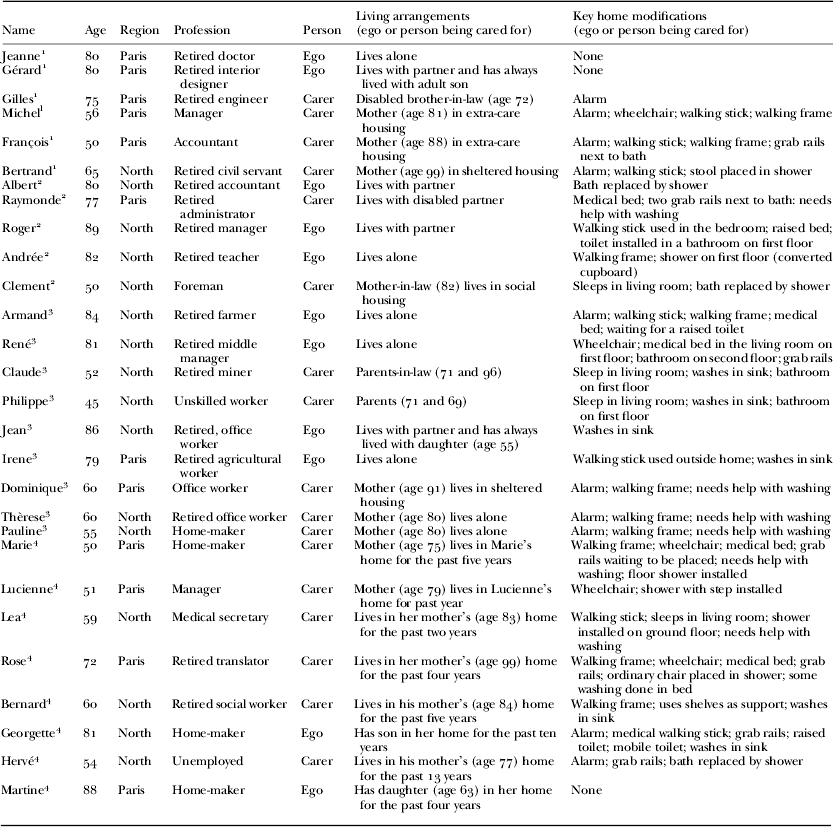
In 2010, a qualitative study was undertaken among a sub-sample of respondents from the 2008 French Handicap-Santé-Ménages (HSM) Survey [Disability and Health Survey], by the Institut national de la statistique et des études économiques (Insee) [National Institute of Statistics and Economic Studies] and the Handicap-Santé-Aidants (HSA) Survey [Carers Survey].Footnote 1 The two regions for the study were the Nord-Pas de Calais (North region) and Ile-de-France (Paris region) and the inclusion criteria were persons who agreed in 2008 to be re-interviewed, who were aged 75 years and above if they had participated in the HSM survey, and aged 45 years and above and providing care to someone aged 65 and above if they had participated in the HSA survey. The target sample was 50 individuals and the addresses of 98 individuals (96 at a separate address) who had agreed in 2008 to participate in a follow-up study were provided by Insee to the authors. Allowing for death, change of address and refusals, 28 interviews were carried out, 12 in the Paris region and 16 in the Nord-Pas de Calais region. The participants comprised 15 men and 13 women (mean age 68 years; 11 were aged 75 years or above – mean age 83 years) and 17 carers (mean age 58); ten participants lived within a multi-generational household (parent and adult child) – either a child who had returned to live with an ageing parent (N=6), or an ageing parent who had moved to the home of a child (N=2), or a household where an ageing parent and adult child had always lived together (N=2). Details of the sample are given in Table 1.
Characteristics of participants and presence of key home modifications

Notes: See Figure 1 for correspondence with the schema of responses: 1. Liberty to choose/‘wait and see’: act when the time is right; 2. Liberty to choose/action: anticipation and prevention; 3. Constraints/‘wait and see’: situational constraints or resignation; 4. Constraints/action: recourse to the domestic economy and co-habitation.
The research team (four authors) separately arranged a visit to the participant's home and conducted an interview that was recorded with the consent of the participant. The interviews were semi-directive and the questionnaire was constructed on the basis that the questions applied equally (or could be adapted) to the older respondents who received care as well as their carers. Questions were grouped in three blocks, dealing with the residential history of the participant and their current neighbourhood environment, a description of the home and the existence of any aids or adaptations, and the representation of domestic space in the context of ageing. Question prompts were used across the following themes: first, the residential history of the participant, the perception of the neighbourhood and local environment, mobility outside the home; second, the condition of the home, the organisation and use of space within the home, knowledge and use of aids and adaptations; and last, projects for home improvements or adaptations, and attitudes towards ageing and growing old. Interviews were recorded and transcribed and lasted on average for an hour. Photographs were taken of the interior and exterior of the home, and these were consulted when analysing the interviews in relation to how objects and space in the home were organised. The photographs were also important in assessing how the participants moved around in the home. On completion of the interview, a summary was immediately prepared by the researchers, supplementing the data source with information on the context of the interview, how the interviewer was welcomed and the way in which the interview developed.
The analysis was thematic (Boyatzis Reference Boyatzis1998). In a first stage, the research team separately coded the content of the interviews according to concepts that arose in relation to the principal research questions, i.e. how the participants talked about their home, the space within it and in the immediate environment, knowledge and use of aids and adaptations, attitudes and behaviour in relation to ageing and growing old, family relationships and lifecourse events. Regular meetings were held between the team members to refine the codes in this first stage so that over-arching themes could be identified and merged into categories during the second stage of the analysis. Use was also made of Denzin's (Reference Denzin1989) concept of the ‘thick description’ underlying the participants’ discourse, and attention was paid to details in the narratives that enabled an understanding of how the meanings, actions and feelings of the participants related to the context of their environment. The validation of the final categories retained was a collective process involving discussion between the four authors.
Results
A recurrent theme that emerged from the analysis was the multi-dimensional experience of ageing and the diversity of types of home environment. Individual lifecourse histories combined with socio-economic and socio-psychological factors to shape each individual's perception of the home environment and the adaptations that were made to it in the context of growing old. At one level, the process of ageing and the possibility that frailty or disability could impact on daily living was understood by all the participants. However, the experience of ageing was not uniform, and these differences resulted in turn in different perceptions of the home environment and the adaptations, undertaken or envisaged, to it. Some participants spoke about their home environment in the context of a perceived short life-span horizon or the eventual onset of disability, whilst other participants paid little or no attention to the ‘problems’ associated with old age. Other respondents had incorporated representations of old age as a period of inevitable decline, based on the experience of their ageing parents or other relatives, and had begun to adapt their home environment in anticipation of restricted mobility or eventual illness and disability.
These different experiences and the behaviours resulting from them were not necessarily determined by the chronological position of an individual in the lifecourse. Hazards such as unsecure carpeting, steep stairs without banisters or cluttered living spaces were unnoticed by some frail older participants aged 80 and above, while some younger participants with mild or no disabilities were much more aware and pro-active in adapting their home environment to avoid possible dangers or simply to increase the ease of mobility in and around the home.
Overall, the analysis revealed the polarity of these two positions. On the one hand, there were participants who tended to be immersed in long-established daily routines within their home, so that modifications or adaptations were seen as potential threats that could upset the balance of these routines and ultimately the stability of the person–environment identity. These respondents did have some awareness that adaptations could improve the comfort and quality of the home environment. However, they considered that such modifications were not relevant for them at the present time or that they did not want to have recourse to any aids or adaptations because of the association between them and growing old (or negative representations of ageing).
On the other hand, the analysis revealed participants for whom space and objects had a different signification and one which rendered them susceptible to adapting the home environment accordingly. For the purpose of the analysis, we label these two types of logic ‘action’ and ‘wait and see’. Action signifies a position whereby the individual anticipates new situations and adapts the home environment accordingly by transforming space and objects within it or by residential relocations. Wait and see refers to situations where individuals do not adapt the home environment, opting instead to put off any modifications and ‘wait and see’ how their situation changes as they grow old.
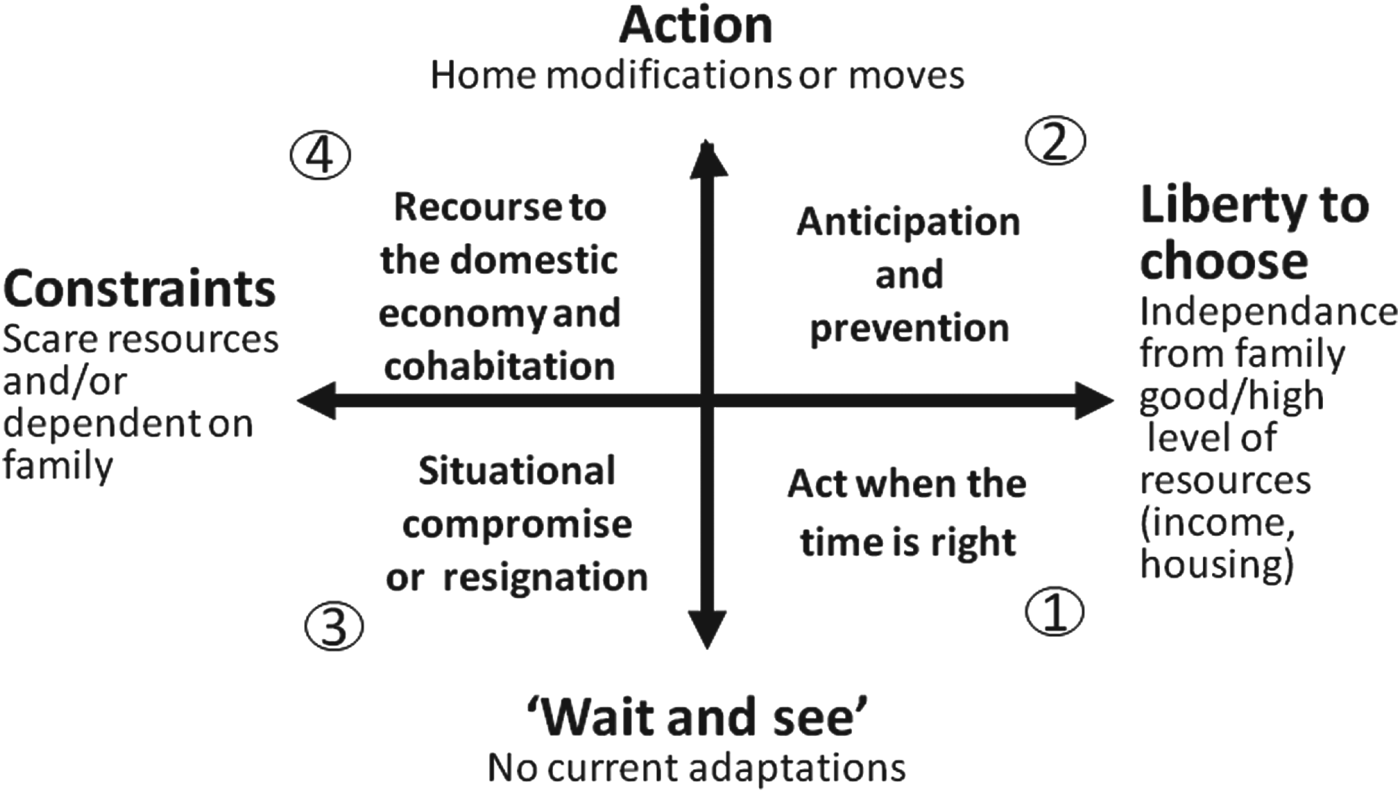
Our analytic framework accentuates the influence of socio-economic characteristics combined with attitudes to ageing. Among the participants, the way growing old was experienced by a retired doctor living in a comfortable apartment in a well-off district of Paris was not the same as that witnessed by the partner of a former miner living in a declining provincial town in northern France. Differences in levels of socio-economic resources and attitudes towards ageing combine and result in two positions that we label ‘constraint’ and ‘liberty to choose’. Constraint signifies a position where decisions relating to the home environment are largely dependent on factors such as a low level of resources, characterised by low income and a reliance on other family members. Liberty to choose signifies a position where levels of resources, income, housing and family relations do not constrain individual decisions. The two axes are represented schematically in Figure 1.
Schema of responses to home modifications in relation to growing old.
At the intersection of the two axes, four behavioural types are identified that categorise the participants according to if and how they modify and adapt their home environment (or the home of the person being cared for): ‘act when the time is right’, ‘situational compromise or resignation’, ‘anticipation and prevention’ and ‘recourse to the domestic economy and co-habitation’. These four behavioural types are described and illustrated below.
Act when the time is right (liberty to choose/wait and see)
Some participants, although not unaware of the difficulties that can be encountered in old age, were able to maintain a lifestyle pattern that entailed very few modifications to the home environment and, moreover, one in which future scenarios were not a preoccupation. These participants, largely in control of their lives, were confident in their ability to face any future problems without difficulty and therefore they were inattentive to changing or modifying their homes. Jeanne, 80 plus, owner of an up-market apartment in a select area of Paris, expresses her indifference to questions posed concerning the usefulness of bath rails and stair rails:
I have never thought about them. What would I need them for? No, for the moment and I don't need anything like that. Like everybody, I don't know what the future holds, what will happen, nobody can foretell the future, I might even fall on the stairs tomorrow coming back from the bakers. (Jeanne)
A similar outlook can be found in the case of Gérard, age 80, a retired interior designer living in a spacious apartment for more than 50 years. Nothing much had changed in his flat over the years and, moreover, he does not envisage making any modifications or adaptations despite recent mobility problems experienced by his wife.
We'll wait and see what happens, if something happens to us, then we will have to make some modifications, but for the moment, to get somebody to do something for something that might never happen, is it worth it? … For my wife, at the moment she has some problems getting in and out of the bath, but for the moment there is no real problem, and if the time comes, there are always those rails that can be installed to help you get up. (Gérard)
A further example of participants who had either made few or no modifications to their home environment or who did not anticipate doing so can be seen in the case of Gilles, a 75-year-old retired engineer living in a detached house. The house is built on the side of a small hill, and typical of many French homes of this type, the living quarters are to be found on the first floor, requiring steep steps from the level of the road. Access to the home therefore is not easy, and Gilles described how bringing the shopping up from the car was becoming increasingly difficult. The architectural layout of the house therefore posed difficulties for the couple, as it does for ageing neighbours living in the same street and confronted with the same problems, but they had no intention of moving home or making any major modifications to it. Gilles explains:
It is difficult to know what is going to happen in life, at different stages in life, all these little things that happen and that are unexpected. We do talk about the steep steps as there has even been an accident by one of the neighbours who fell going down and didn't recover.
The example of François shows how the experience of his ageing mother has an effect on his own perception of ageing. François’ mother bought a flat ten years ago which proved to be unsuitable after she suffered a quick decline in health which resulted in a loss of independence. In fact, despite being aware that inside steps may prove to be difficult to negotiate one day, she decided to wait until this time was reached before acting. Her recent loss of independence prompted a move to sheltered accommodation and in her new home François describes how his mother repeats the same behaviour of ‘wait and see what happens’ when faced with an unmodified bathroom:
At my mother's home, the bathroom doesn't have any major or special modifications. I advised her to replace the bath with a shower, or at least to do something to it that would make it easier for her to get in and out. But it's something she hasn't done for the moment and I don't think that she will. It is not a problem of money, and when I suggest anything that might make things easier she says ‘I'll be long dead before I will be able to manage with those sorts of things, and what is the use of doing any major work to the house if tomorrow I will no longer be there?’
François adds that it was not possible to sway the opinion of his mother, who with hindsight had not made the ‘right’ choice when moving into a flat at the age of 79, and one which proved to be inappropriate ten years later. Moreover, François himself shares the same outlook on horizons in old age, namely that it is best to ‘act when the time is right’.
These different situations that characterise the participants who preferred to ‘act when the time is right’, irrespective of their chronological age, can be summarised with reference to a common theme. The notion of prevention, of adapting the home for future eventualities, did not make much sense for them. This was neither because of a lack of knowledge or information about the potential difficulties in the home environment associated with growing old, nor a denial of fear of the ageing process. Instead, they would act when the time is right, confident that they would have some resources to do so even if decisions would be hard to make.
Anticipation and prevention (liberty to choose/action)
Among this group of participants, an appreciation of environmental constraints had been fostered by either a direct experience or by the experience of another family member. Participants who had been or who were currently carers often showed the capacity either to move home or to undertake modifications in order to ‘prepare’ for growing old. The case of Albert demonstrates this capacity. Albert and his wife were living in a town house when the health problems of his ageing mother resulted in her moving in with Albert. The ideal solution would have been that she had a bedroom on the ground floor, but she was obstinate that she wanted a bedroom upstairs. The result was that in the final years of her life it was very difficult for her to be mobile within the home. After the death of his mother, and arriving at the age of 70, Albert decided to move. He explains his decision:
About ten years ago I suppose, I was 70 and living in a two-storey house. We lived more or less on the first floor, so that every time someone called, we had to go downstairs, and bring things up from downstairs … and then there was all the maintaining of the outside of the house to do … well, there came a moment when things got too much, and I decided that I was not going to wait any longer, we would move into a small flat. This is where we have been ever since and we haven't had any problems.
Raymonde's experience related to the long period during which she had cared for her husband. He had recently suffered two strokes and at the time of interview he was recovering from a fractured femur. Raymonde and her husband had moved home some years prior to the interview, selling their home to rent a smaller flat. She does not rule out the possibility of a further move, even to a retirement home, although the future is uncertain as she explains:
There is my bedroom and a separate bedroom for him where he has a hospital bed. Yes, I have adapted the home, of course, and especially the bathroom … I won't move from here now unless I can get a housing association flat on the ground floor and some more help for my husband. Otherwise we'll think about going to a retirement home where there will be more help and less problems.
In other situations the participants appeared to have integrated many ‘preventative’ measures linked to growing old, but in subtle ways that avoided the social stigma frequently associated with old age, such as walking canes, Zimmer frames and other more traditional occupational therapy aids. Roger, 89, a former civil servant, lives with his wife in the home they had built 25 years ago for their retirement and in which they have invested a lot of time and money. The bedroom is situated upstairs, but this does not pose difficulties since they have recently installed a second toilet in the upstairs bathroom as well as banisters on the stairs.
Yes, I arranged to have the second toilet put in upstairs, because we were not getting any younger and to have to go downstairs to the toilet at night … so then we had to put the banisters in as well, because of going downstairs at night …
During the interview, other forms of adaptations to the home environment were revealed, such as the couple's bed, recently acquired, which could be raised and lowered and a stick that served uniquely as a support for Roger's wife to get out of the bed. The use of these non-medical items, often adapted in ingenious ways to meet their needs, was a form of behaviour often encountered among this group of participants. Andrée, a retired school teacher aged 82, used her Zimmer frame in the small courtyard of her home, but not inside her house where the narrow passageways between the rooms rendered its use awkward. Instead, objects of furniture had been placed at strategic points throughout the house where Andrée could find support as she moved around the home. In addition, she did not want to be seen in public with her Zimmer frame. One strategy was to ‘replace’ the Zimmer frame with a shopping trolley in supermarkets, thus avoiding the stigma she associated with her frame and adapting an everyday object for her needs.
For some participants, a home move in mid-life and the choice of housing, although not principally made to prepare for old age, incorporated aspects of their experience of how ageing parents had faced difficulties with particular types of habitat when growing old. Clément and his wife had recently chosen to move to a bungalow. This choice was in part based on the experience of Clément's 82-year-old mother-in-law, as he explains:
Sure, we wanted a bungalow, that's what we were looking for … because we said to ourselves, in the coming years … my wife, she said to me, ‘I can't see myself climbing up the stairs and doing the housework, it's too tiring’. And we have seen what has happened to my mother-in-law, who can't go upstairs to her bedroom any more so she sleeps in one of the downstairs rooms.
The two behavioural responses of ‘acting when the time is right’ and ‘anticipation and prevention’ discussed above bring together participants for whom the question of resources, financial or otherwise, did not figure largely in their approach to the home environment. In the situations described below, resources played a much larger part, prompting the participants to either act within the constraints posed by low resources, or to a more passive course of action that entailed adapting to the home environment.
Situational compromise or resignation (constraints/wait and see)
Among those participants with low levels of resources, many of whom were tenants in social housing or private rental accommodation, planning for new horizons in old age by modifying and adapting the home environment was not an immediate priority. These participants could sometimes be resigned to their inability to change their environment, and consequently they did not reflect or dwell on the subject. The demands of everyday life took priority over thinking about the future and simple changes were made to ensure as far as possible that they could age in place and avoid at all costs moving to a retirement home. Irene, 79 years old and with mobility restrictions, no longer uses the upstairs of her home since the death of her husband who fell on the stairs, since as she told us, ‘my children have locked the upstairs rooms and I can't use them anymore’. Using a downstairs sitting room and bedroom, Irene has access to a downstairs bathroom, but she no longer uses the bath which she cannot get in and out of, and does not envisage using a shower. Irene explains how she adapts to the home environment rather than making adaptations to it:
Things don't bother me, I get washed in the sink. It takes me about an hour … there is a chair in the bathroom so I make do with that. In any case, my children have told me that it is not possible to install a shower, there is a window above the bath and it isn't possible to put a shower in front of a window.
Adamant that whatever happens she will not move from her home, Irene is forced to compromise with her home environment whilst at the same time she is resigned to thinking that nothing can be done to improve her quality of life within the home.
Armand is also resigned to adapting to his home environment. Armand, whose wife died eight years ago, suffers from Parkinson's disease. His old house has not been modernised and despite the presence of a hospital bed, a Zimmer frame and a home alarm system, the home interior is unsuitable for someone with his level of disability. Small, unobtrusive modifications could be made to make life easier, such as the installation of grab rails and ramps, but Armand does not contemplate the installation of such devices:
I don't know … the time that it would take to install them … and at the moment I can manage in the night on my own. All I really need is someone to give me a bit of help dressing, preparing meals and doing some cleaning, and I have already got someone to do that … so I think I'm ok.
The rapid onset of his disability coupled with a low level of financial resources seems to have instilled in Armand a sense that not much can be done about his home environment that would improve his quality of life. His situation is similar in many ways to René, aged 81, who lives in social housing. Unable to access his bedroom on the second floor, René has made do with having a medical bed place in the sitting room on the first floor. According to René, the housing association believes that the best solution for him would be to move to smaller, more accessible accommodation:
They say that I should move from here, but I'm not going to, I'm staying here. They don't realise that I know my neighbours well here. Things could be made better here, but because they won't do them I shall have to live with it. I mean, they have put some small things in, like grab rails, but they don't want to install a shower.
This impasse between René and his housing situation was a recurrent feature among participants in social housing. Jean and his wife have lived in the same rented accommodation since 1952. The housing association had recently installed a new boiler and double glazing, but for the couple, aged 88 and 86, respectively, their daily routine is becoming more difficult. Nevertheless, the couple see no point in asking the housing association to modify the home, as they expect that they will be refused. Jean explains:
The bath-tub, we installed that. The housing association gave us permission, we had to pay for it ourselves. And now we don't even use it. We get washed in the sink, like our grand-parents did! I suppose we could ask them to install a shower, but they don't always agree. They want to sell off their housing stock and this building is already up for sale. They are giving preference to the existing tenants, but how can we buy at our age?
Situations where there are no current modifications and whereby participants seem resigned not to modify their home environment were also apparent among the younger participants who were caring for an elderly parent. Dominique, aged 60, visits her 91-year-old mother every weekend at the sheltered housing scheme where she has been living for a number of years. An only child, Dominique told us ‘Sometimes I get fed up with it all’, since the sheltered housing is not a suitable home environment for the increasing loss of independence and social isolation that her mother is experiencing. Due to building regulations (the sheltered housing accommodation is within a convent) and the reluctance of her mother to use a walking stick, Dominique can see no solutions to the situation and only envisages a deterioration in the near future. Nevertheless, the negative experience of her mother's ageing, as expressed by Dominique, has enabled her to reflect on her own experience of growing old and the risks that home hazards can present in the context of ageing.
When you see your own parents go downhill, then yes, it's difficult and you become anxious about how you are going to grow old. And because you see what's going on, you think about it in relation to yourself, unlike some other people who tend to put off thinking about their old age or doing things now to make it easier for the future. For example, because I live alone, I always take the mobile phone with me when I have a shower.
Recourse to the domestic economy and co-habitation (constraints/action)
The final group of participants is characterised by situations of (re)co-habitation, i.e. where a parent and adult child have combined households after having previously lived separately. Two situations are observed: first, where the children invest heavily in the care of their ageing parents by co-habiting with a parent, either by instigating a move to the parental home or arranging for a parent to come and live with them; second, where although the child helps the parent, the needs of the child are a major consideration that leads to co-habitation, often arising from ruptures in family and professional life. A common reason for either form of co-habitation was the pooling of resources and the fact that this initiative often came from the adult child of the ageing parent. Apart from the sharing of resources, the circumstances of these situations differed. In some cases, the decision to ‘take in’ an elderly mother or ‘to go and live with Mum’ can be seen to be closely linked to a sense of filial obligation expressed by an only child or the eldest daughter among siblings. In other cases, situations of co-habitation were more linked to the needs of adult children, who had often experienced difficulties themselves in their adult lives.
Two participants had decided to go and live with their ageing mother, whilst emphasising that in so doing they were able to permit her to continue to age in place. Lea, 59, decided with her husband that they should move into her mother's home after the death of her father. The mother, 86, had mobility difficulties and it was decided that she should no longer use the upstairs bedrooms. She was living on the ground floor of the house where the daughter had installed a sofa that converts to a bed in the sitting room. Lea and her husband intended to stay in the home after the mother's death or eventual move to a retirement home. Drawing on her mother's experience, she intended to modify the home for her old age, ensuring that all the facilities would be available on the ground floor. At the same time, she did not envisage undertaking any immediate major modifications to the home which could benefit her mother, such as adding a bedroom to the ground floor, a modification which given the type of house did not present any architectural problems. As the interview progressed, Lea revealed her positive attitude towards retirement homes and indicated that she did not rule out this possibility for her mother or even, in the years to come, herself:
I have already thought about it, if I can't manage to do things on my own anymore, then they should put me in a home. I don't have any children, and well, you have to be realistic, this would be the best solution.
Rose, a divorced former translator, decided to move in with her 99-year-old mother who was gradually losing her sight. Unlike Lea, this decision was prompted by the possibility of her mother moving to a retirement home, an eventuality that Rose wanted to avoid at all costs. Rose explains:
When she started to lose her sight, I talked things over with my brother and the only solution was that I should go and live with her. There was no question of her going into a home – on that we were clear.
Rose did not regret this decision, despite the fact that her mother was, at the time of the interview, severely disabled and spent most of the time in bed. As far as her own future was concerned, Rose's discourse appeared to be one of ambivalence and the inability to think beyond the moment. At the same time, it became evident that she had begun to put into place a strategy which would ensure that she ages in place in her mother's home:
No, I live only for the present. You know, it is really difficult to think about what life would be like at my mother's age … but I see myself staying in this house. You know, I have converted a couple of the rooms downstairs into a studio flat, with a bathroom. When my mother is no longer here I can rent it out and then after …
The home modifications made by Rose and Lea entailed a move into their ageing parent's home. For Marie and Lucienne, it was the mother that had moved into the home of her daughter and in both cases this move was presented by the daughters as a unilateral decision, one that was inevitable given the circumstances. These circumstances, although they involved the declining health of the mother, also revealed other factors such as being the only child or the eldest daughter and an attachment to the neighbourhood. Marie decided that her mother should move in with her after a long period of hospitalisation during which the doctors told her that it was no longer possible for her to return home. As the eldest daughter, Marie felt that this was her duty since on no account could the family envisage her mother entering a residential home. Having recently bought a new property in which Marie had envisaged some modifications for her own home comfort, the house was subsequently adapted to provide a bedroom and sitting room for her mother. Lucienne decided that it would be best for her mother, widowed four years previously, to move in with her, despite the fact that she rented a small one-bedroom flat in the centre of Paris. Mother and daughter therefore share a bedroom and small living room, a situation necessitated by the perceived isolation of the mother in her previous housing block, where although the flat (on the fifth floor) was larger there was no lift.
The four examples described above illustrate situations where home environments are modified to address the needs of frail elderly parents. These types of situations, however, combine with those where the greater need is to be found among the children. Family obligations are manifest differently, as for example in the case where a son returns to live with his elderly mother after a divorce or other difficulties encountered during his adult life. Hervé, 54, lives in the home of his 77-year-old mother, an arrangement which at first was envisaged as a temporary solution to his housing problems but which has since transformed into a permanent living arrangement. Bernard, 60, decided to move in with his recently widowed mother, whose home was formerly that of her parents-in-law, because of his financial difficulties and problems in securing a home for himself. Bernard explains:
I share this home with my mother. In fact, I used to live nearby in a really rundown house, and when my father died, well, there was a spare room and I decided to move in. I've replaced my father … not on all levels of course, but since my mother was alone and financially it was better for me, that's what I did. I am one of the tenants now as well as my mother.
In these cases of co-habitation, the practical matters relating to the adaptation of the home environment and the financial implications associated with them were inextricably linked with family histories and attitudes towards ageing. The degree of physical limitations and social isolation of ageing parents as perceived by the participants differed and so too did the course of action.
Conclusion
In this paper, we have sought to understand the meanings attributed to home environments and the adaptations that are made to them in the context of ageing and growing old. Through the analysis of qualitative interviews undertaken with older people and their carers, everyday adaptive responses to the environment have been confronted with attitudes and perceptions to ageing and growing old and the socio-economic and cultural resources available to individuals, households and families. Drawing on theoretical perspectives that explain the compensations that individuals make to adjust to changes associated with growing old as well as the attitudes to and perceptions of ageing that are influenced by lifecourse and social factors, the research has presented different pathways and outcomes adopted by individuals in relation to their home environment. ‘Autonomous’ individuals, characterised by a good level of financial and social resources but also a certain independence from other family members, can either anticipate and act preventively to forestay any eventual problems or wait until a problem presents itself and act ‘when the time is right’. Individuals with lower level levels of resources tend to act in concert with other family members or be resigned to not modifying or adapting their home environment.
To summarise, the socio-economic characteristics of the household, the type of home and environmental situation, tenure and household composition are the macro factors that determine how individuals perceive the need to modify their home and environment. This is followed by the properties of the adaptations required, requested or installed – their ‘technical’ qualities, conception, and usability and relevance for individual situations. Finally, at the personal level, the factors that influence how individuals approach decision making regarding their home and local environment depend upon their own experience of ageing and growing old.
These results go some way to contributing towards a greater understanding of why some people ‘adapt’ on both a personal and practical level to their home environment and others do not. They show the complexity of the person–environment interaction where life histories as well as contextual characteristics relating to the availability of resources interact to produce the different outcomes described above. In this way, the findings stress the importance of social factors that shape the experience of ageing. It should be noted, however, that the French context of the research where home adaptations have less of a profile in ageing policies and local initiatives than in some other countries may influence some of the findings and that further research is needed in different institutional settings to confirm the validity of the different discourses identified above.
The findings have a range of policy implications. First, they reinforce the importance of environmental gerontology and, in particular, Gitlin's (Reference Gitlin and Schulz2006) message that the starting point for approaching the question of adaptations to the home environment in later life is the individual and not the physical device or modifications. Our finding that individuals who have high levels of resources tend to ‘act when the time is right’ suggest that they may not be receptive to conventional messages designed to change or make home environments modifiable before the onset of disability and illness. At the same time, individuals with lower levels of resources are likely to have more recourse to constructing ‘everyday solutions’, and as such health and social care professionals need to be aware of how these solutions are put into place. Whilst much attention has been paid in recent years to the usefulness of new technologies in facilitating independence within the home, this may be at the expense of not having a holistic view of how individuals interact with their home environment. Our findings reinforce previous research that has stressed the importance of involving individuals in the concept and design of changes to the home (Heywood Reference Heywood2004; Lewis et al. Reference Lewis, Torrington, Barnes, Darton, Holder, McKee, Netten and Orrell2010; Nord et al. Reference Nord, Eakin, Astley and Atkinson2009). Moreover, solutions need to be found in adaptations that move beyond traditional occupational therapy-related aids and devices more familiar to professionals in the context of disability and illness. The ‘everyday’ experience of modifying the home environment that has been demonstrated in the research also stresses the importance of small repairs and minor modifications as part of an overall strategy of ‘ageing well’ policies.
The policy indications of the research strongly suggest that there is no ‘one size fits all’ message regarding adapting or modifying the home environment. Individuals interpret the messages relating to home modifications given by families and professionals according to their situational profiles and as demonstrated by Petersson, Lilja and Borell (Reference Petersson, Lilja and Borell2012), services that encapsulate home modifications need to pay particular attention to individual strategies that are devised to address particular difficulties. For some, the association of aids, adaptations and home modifications within a dependency model of ageing results in inaction, which may have deleterious consequences specifically for older individuals with a low level of resources. Local and national policy measures should therefore be designed to include a wide range of options and solutions that go beyond the provision of assistive devices and other technological aids and which place an emphasis on the capacity of home modifications to bring about global improvements to quality of life and wellbeing.