




No CrossRef data available.
Indian Clubs and Colonialism: Hindu Masculinity and Muscular Christianity
Published online by Cambridge University Press: 31 January 2005
Extract
Following Edward Said's Orientalism (1978), there has been considerable interest in studying gender images and engendered practices that emerged out of colonialism, both during the era of colonialism (Cooper and Stoler 1997; R. Lewis 1996; Stoler 1991; 1995; 2002), and subsequently (Altman 2001; Enloe 1993). Many of these studies have shown how colonized women were subject to the gendered and often sexualized gaze of Western men (Carrier 1998; Doy 1996; Grewal 1996; Yegenoglu 1998), and how colonized men were often regarded as either effeminate or “martial” by virtue of their birth into a particular group. Arguably, the latent ambiguity of regarding all colonized men as effete, and yet categorizing some colonized men as strong and aggressively virile, points to one of the many complex contradictions manifest in the cultural politics of colonialism. A similar point could be made with regard to nationalism, wherein women, and the image men want women to present of themselves, reflects masculine ambivalence about modernity (Chatterjee 1993). In any case, even when colonial discourse essentializes the virile masculinity of various subject groups—in particular the so-called martial castes of South Asia (Hopkins 1889; MacMunn 1977)—the putative masculinity of these groups is ascribed to breeding and latent “savagery,” and is rarely, if ever, conceived of as an achieved status, much less something an individual from some other group might achieve on the basis of training or practice.
Information
- Type
- Research Article
- Information
- Copyright
- © 2004 Society for Comparative Study of Society and History
The man who uses the clubs diligently will never need to have his coats “built out” on the shoulder, or padded in front and rear. He will have the form of a man, as his Maker intended him to be. The club-exercise will do more, perhaps, than any other, to check the bad habits of body, so easily contracted by students, professional men, business men and all who have to bend much over books and desks. It will cure such habits more quickly and thoroughly than any other exercise. Like the wand of some kind of fairy, the Indian Club transforms all whom it touches. It makes the crooked straight, gives a manly fullness to the narrow chest, gives breadth and massive power to the rounded back, puts firm, knotted muscle in place of flabby, impotent matter, and fills every vein with bounding life (C. R. Treat, “Indian Clubs” The Riverside Magazine for Young People, 1869: 4).
Introduction: Orientalism, Gender, and Contextual Disorientation
Following Edward Said's Orientalism (1978), there has been considerable interest in studying gender images and engendered practices that emerged out of colonialism, both during the era of colonialism (Cooper and Stoler 1997; R. Lewis 1996; Stoler 1991; 1995; 2002), and subsequently (Altman 2001; Enloe 1993). Many of these studies have shown how colonized women were subject to the gendered and often sexualized gaze of Western men (Carrier 1998; Doy 1996; Grewal 1996; Yegenoglu 1998), and how colonized men were often regarded as either effeminate or “martial” by virtue of their birth into a particular group. Arguably, the latent ambiguity of regarding all colonized men as effete, and yet categorizing some colonized men as strong and aggressively virile, points to one of the many complex contradictions manifest in the cultural politics of colonialism. A similar point could be made with regard to nationalism, wherein women, and the image men want women to present of themselves, reflects masculine ambivalence about modernity (Chatterjee 1993). In any case, even when colonial discourse essentializes the virile masculinity of various subject groups—in particular the so-called martial castes of South Asia (Hopkins 1889; MacMunn 1977)—the putative masculinity of these groups is ascribed to breeding and latent “savagery,” and is rarely, if ever, conceived of as an achieved status, much less something an individual from some other group might achieve on the basis of training or practice.
Given what a range of scholars have said about the nature of nineteenth-century colonial discourse on the racialized and categorical difference between Oriental and non-Oriental physiques (Gould 1981; Fausto-Sterling 2000; Schueller 2001; Terry and Urla 1995) it is almost inconceivable to think that Englishmen, as a group, would come to adopt and popularize a form of physical fitness training that not only originated in India, but was regarded—seemingly from the moment it was first “discovered”—as superior to English forms of exercise in terms of the idealized “body type” it reflected. If this is not exactly inconceivable—given the precedent of polo on the one hand (Levine 2000; Parkes 1996), and, on the other, that ideas about daily baths and good hygiene were “discovered” in South Asia (Collingham 2001)—then an example of such a case would certainly afford an opportunity to critically reevaluate the relationship between colonialism, physical fitness, and gender.1
In many ways critical historical scholarship on so-called “mixed race” marriages and other kinds of institutionalized sexuality (See Cooper and Stoler 1997), is a comparable, if much more politically and morally marked, situation wherein there is a great deal of ambiguity and outright contradiction between colonial policy, practice, ideology, and “behavior.” It is, in many ways, in the much less morally and politically marked domain of physical fitness that it is possible to work through some of the details in the relationship between gender, physiology, and the “plasticity” of masculinity.
Following from this, this essay explores a set of questions: Does it necessarily hold that colonizer and colonized stand in relation to one another in terms of categorically contrasting masculinities? Is there a clear and unambiguous link between colonial power and masculinity as an expression of gendered power relations?2
This question is linked to a broader problem in gender studies, namely that expressions of masculinity are not always directly linked to physical power and violence. Moreover, when physical power and dominance are factored out of masculinity, so to speak, it is wrong to assume that by default what gets expressed is, mimetically, an effete, effeminate, and affected articulation of femininity. This is particularly so with respect to nineteenth-century dandyism in Europe and the United States (see Adams 1995; Garelick 1998: Howells 1996; Prevost 1957).
Writing in the early nineteenth century, an officer in the British Army made the following observation:
The wonderful club exercise is one of the most effectual kinds of athletic training, known anywhere in common use throughout India. The clubs are of wood, varying in weight according to the strength of the person using them, and in length about two feet and a half, and some six or seven inches in diameter at the base, which is level, so as to admit of their standing firmly when placed on the ground, and thus affording great convenience for using them in the swinging position.
The exercise is in great repute among the native soldiery, police, and others whose caste renders them liable to emergencies where great strength of muscle is desirable. The evolutions which the clubs are made to perform, in the hands of one accustomed to their use, are exceedingly graceful, and they vary almost without limit. Beside the great recommendation of simplicity, the Indian Club practice possesses the essential property of expanding the chest and exercising every muscle of the body concurrently (quoted in Kehoe 1867:9).
Not only did so-called “Indian Clubs” become extremely popular in England around the middle of the nineteenth century, by the end of the Civil War they had become one of the most important gymnastic apparatuses in the American physical fitness movement of that era, and came to symbolize the essence of so-called muscular Christianity between 1865 and 1900. They were relatively light weight and swung rhythmically with choreographed precision involving complex moves. Most maneuvers involved full arm extensions and multi-directional swings through the complete range of 360 degrees. For several decades around the turn of century, Indian Clubs were an integral part of mass-drill gymnastic routines, primarily for young women in schools, colleges, clubs, and church groups. However, by the end of the 1920s, following a cultural shift away from concerns with health reform and fitness, club swinging virtually disappeared from the landscape of physical education.3
Curiously, however, Indian Clubs regained popularity several decades later, not as a means by which to “expand the chest and exercise every muscle of the body concurrently,” but as collectable antiques representing a genre of American folk art (Hoffman 1996).
In the city of Banaras in central North India there are several gymnasiums devoted exclusively to club swinging for physical training, as well as an organized system for regional inter-gymnasium competition. The technique of swinging in these gymnasiums is simple and straightforward with little or no variation in style. Although some clubs are relatively light weight, most are heavy and the technique of swinging is based on the principle of rhythmic weight lifting rather than complex, choreographed maneuverability. The clubs are lifted off the ground and inverted so that each one rests against a shoulder and extends upward along the side of the head. In turn each club is swung in a pendulum arch behind the back. First the club on the right is lifted upward and tilted to the left behind the head from where it is swung down from left to right. Upon reaching the end of its arch the club is pulled forward until it again rests on the right shoulder. As this procedure is being completed, the club on the left shoulder is lifted and swung such that both clubs are always in motion. Rhythm and timing are important to both maintain balance and prevent the clubs from hitting each other (see figure 1).

A member of Akhara Karan Ghanta, Banaras, swinging a pair of large Jori, 1988. (Author's collection)
On one level, at least, the form of practice manifest in these gymnasiums sharply contrasts with Alice Hoffman's spectacular documentation of vintage Indian Clubs from the United States (1996), showing not just beautifully carved, painted, decorated, and embossed pairs of clubs, but all manner of club swinging accessories and numerous photographs of women in drill formation holding their relatively light weight bowling-pin shaped clubs in symmetrical configuration (see figure 2). The image of enormously strong men lifting and swinging very heavy clubs in North India set against images of women from church groups in the United States swinging Indian Clubs is striking to say the least.

Choreographed mass drill for women, Berlin 1912. From the September 1913 issue of La Culture Physique, p. 12. (Todd-McLean Physical Culture Collection)
What is to be made of the discourse and practice associated with Indian Club swinging in this dramatically transnational, historically defined, and colonially mediated environment of changing practice? Clearly Indian Clubs are a perfect example of what John MacAloon refers to as the “empty form” of sport (1994), given that sports can be emptied of old meaning and significance and refilled with new meaning and significance with greater ease and flexibility than other cultural practices. But the key question is why and how does a particular sport or gymnastic regimen transmutate through time. Does the “emptiness of form” enable a critical examination of how various vectors of meaning and significance come together and diverge?
A useful and historically meaningful way to address this question is to contextualize club swinging in relation to muscular Christianity, which was a broad cultural movement concerned with the moral training of young men through exercise and organized sports from the late 1850s through the end of first World War (Putney 2001). It is important to note that in muscular Christianity muscle development and athleticism were understood as means to an end—the end being character development, ethics, morals, and “devotion to God and Country” (Gron and Goldstein 1993:88)—rather than as ends in themselves. Beyond this, there are three important points that can be made about the discourse and practice associated with Indian Clubs in this context.
First, as it developed in England and the United States, muscular Christianity was intimately and subtly linked to colonialism. This connection was through race, to be sure, as a number of scholars have argued, but also through ideas about the muscular nature of masculinity manifest in physical fitness and body building (Budd 1997; Hall 1994; Ladd and Mathisen 1999; Putney 2001; Rotundo 1993).
Second, late nineteenth-century muscular Christianity, as manifest in the post-Civil War health reform movement, developed out of a broad-based crisis of masculinity reflected in ideas about sex and sexuality in general (Nissenbaum 1980; Sokolow 1983; see also Graham 1972) and homosexuality in particular (Budd 1997:58–80), as homosexuality was imagined as a distinctive category of biologically based psycho-social behavior (Pronger 1990). In this respect Indian Club swinging, as it became extremely popular first among men in the late 1860s and early 1870s, and then even more so among women during the 1880s and 1890s, provides insight into the relationship between physiology, sex, and gender in the “decades of fitness.” The “decades of fitness” immediately preceded a fin de siecle concern with competitive “athleticism” wherein men's muscles and women's reproductive health were increasingly subject to very different disciplinary strategies (Numbers 1976).
Third, although well aware of the development of Indian Clubs in England and the United States—and very willing to adapt and modify colonial forms of knowledge to other local forms of athletic and sportive practice such as surya namaskar, kabbadi, and yoga, for example (Alter 2004; 2000a; 2000b)—Indian Club swinging in India, known as jori or mugdal ferana, developed through didactic, if somewhat ambivalent, opposition to the kinds of gymnastic drill invented by the British Army, modified by German and Swedish physical culturists, and refined and popularized by Simon Kehoe and other “muscular Christians” in the United States.
Whereas an Indian “Hindu” form of the art defined itself in terms of a kind of competitive muscular masculinity that was anti-colonial and anti-Western, but decidedly modern, the English and American “Christian” form of the tradition developed into a choreographed form of muscular development that quickly lost touch with both its colonial point of origin and its manifestation in England, during the Victorian era, “as the most modern and effective means to build a masculine physique.” Ironically, a rhetoric of muscular Hinduism that integrated United States-based Indian Club swinging techniques into anti-colonial practice—thereby transforming a transatlantic para-colonial appropriation into a nationalist re-appropriation—reflects some of the ambivalence about embodied sexuality manifest in the nervous rhetoric concerning physical fitness.
As a new cult of the body beautiful emerged in the late 1890s and early 1900s (Budd 1997; Todd 1998), fin de siecle physical culture took on many different dimensions. Institutionalized sports and structured physical education programs were developed for both men and women. From the 1860s to early 1900s, the specific concern with moral development gave way to a more complex concern with muscular masculinity, and the narrowly structured discipline of female bodies in terms of domestic labor, sexual health, and reproductive potential characteristic of the Victorian era began to give way as well (Todd 1998). But, ironically, as more and more women became involved in sports and physical education, the turn of the century was marked by “a renewal, and indeed an expansion, of the biological deterministic views which had been used to circumscribe the movement of women for most of the previous century” (Vertinsky 1990:171).
Once dislocated from any single cultural context, what the history of Indian Clubs shows—in addition to the extremely localized form and contingent chronology of history—is that while gender as such is elemental to discourses of colonialism and nationalism, physical fitness can manipulate the meaning of gender and subject physiology to the work and politics of culture. Working through and against colonial trajectories of history—British/American and British/India—culturally constructed physiology can subvert the meanings ascribed to gender.
Joris and Mugdals: Club Swinging in Contemporary Banaras
A pair of jori or mugdal, upon which Indian Clubs are modeled, are stylized wooden clubs, themselves ostensibly modeled on ancient war clubs described in some detail in a number of the Sanskrit classics. Jori—the Hindi term itself meaning “pair”—are of various sizes and shapes ranging in weight and length from a modest 5 kilograms and 750 centimeters to those that, at upward of 70 kilograms and 1.5 meters each, are almost, but not quite, unswingable. Each club is carved of wood and shaped like an inverted cone, with a wide, flat base tapering up to a narrow collar. A cylindrical handle with a knob at the end is used to grip and swing the club. Although made of wood, heavy metal rings are often affixed to the base of each club, both adding and shifting weight to a lower center of gravity.
While it is unlikely that ancient war clubs were shaped in this way, it is difficult to know historically how the clubs came to be so designed. Given the widespread use of very similar clubs throughout the Middle East and the extent of contact between South Asia and this part of the world at various points in time, it is likely that club swinging emerged as a quasi martial art that flowed through the trade, military, and political networks of Islamic conquest. With reference to war clubs, most of the Sanskrit literature refers to gadas, a kind of mace which finds modern gymnastic form in large stone balls affixed to bamboo polls that are swung for exercise. In any event, photographs taken of jori in the 1930s (Mujumdar 1950) show clubs that resemble ones that are currently in use, and it is reasonable to assume that it was these kinds of clubs that colonial military personnel, police officers, and missionaries saw being swung in India in the late eighteenth and early nineteenth centuries.
Although aware of its similarity to an extremely popular and somewhat more recognized tradition throughout the Middle East, where something very much like it is referred to as mil in the zarkhanhe of Iran (Rochard 2000), jori swinging is characterized by enthusiasts from the city of Banaras and across northern India as a sport that is associated with the area now defined by the state of Uttar Pradesh. Just as kabaddi is regionally identified with Maharashtra (Alter 2000b), and kallaripayattu with Kerala (Zarrilli 1989; 1998), jori swinging is regarded—with both pride and a degree of resentment for being thus marginalized—as a manly rural sport of the Gangetic plane. It is closely associated with a tradition of Indian wrestling, and is regarded as one of several training exercises for this sport (Alter 1992).
Jori swinging has also become a competitive sport in its own right. As of 1985, the competitive season is defined as lasting three months during the monsoon, when there are approximately twenty dangals (tournaments) organized by several civic groups in the larger metropolitan area of Banaras, and by approximately ten of the well known jori akharas (gymnasiums) in the region. Jori swinging is popular throughout many areas of North India. Here, however, the reference point for analysis will be Banaras.
Competitions usually involve different ranks of seeded local champions competing to see who can swing a specific pair of clubs the most number of times. Judges and referees are involved to determine that clearly defined rules are followed, and to provide an official count of the completed number of swings. Tournaments build up to a climax when the strongest, heavy-weight champions swing the heaviest pair of clubs. Although there is some very minor variation in how clubs are swung, the standard for competition is called a hath (hand). To complete one hand, the pair of jori are “stood up” such that they are gripped by both hands and rested upon each shoulder. One at a time, each club is lifted off the shoulder with one hand and swung back and down in a pendulum arc behind the back and then lifted up to rest on the shoulder again, as described above. Each swing counts as a hand, the number of hands decreasing in number as the weight of the jori increases. There is a loose ranking of jori established by the Banaras Society for Jori and Gada Swinging (BSJGS), with small, medium and large pairs weighing 50, 57, and 73 kilograms, respectively. However, since weight is not precisely standardized, competitions revolve around specific named pairs.
The jori in jori akharas are not simply weighted clubs. They are, most significantly, named and artfully decorated. They possess an identity of their own, and that identity is linked to the place they hold in the local history of swinging. A pair of jori is always very clearly associated with a particular gymnasium, and is named either after the person who commissioned their production or the competitor who swung them the most number of times.4
This resonates, with a degree of irony as described below, in the personalized “brand naming” of clubs in the post-Civil War era, and subsequently in the elaborate fetishization of the clubs as highly stylized—and artistically sculpted—collectibles in the marketplace of Americana folk-art antiques (Hoffman 1996).
Some indication of these names, and the somewhat sacred aura that is still associated with them, is given in a list of the most important jori in Banaras provided to me by a leading member of Azad Akhara, one of the most highly ranked gymnasiums in the city: At Bari Gaivi Vyayamshala there is a pair called “The White Ones” (Safeda Wali); at Karan Ghanta a pair referred to as “The Tigers” (Sher Wali); at Malaviya Market Vyayamashala a pair called “Hanuman Ones” honor the patron deity of almost all gymnasiums; at Choti Gaivi Akhara is a pair called “Punwasi Wali,” named after the man who swung them the most number of hands; and at Sant Ram Akhara there are two famous pairs, known as “The Mountainous Ones” (Pahar Wali) and “The Glass Spiked Ones” (Shishe Wali), the former so-named on account of their large size and a painted design at the base, and the later because of pieces of glass which make swinging these clubs more difficult and dangerous. Indicating the extent to which size and weight really does matter, at Shyam Bazaar Vyayamshala there is a pair called “Sakra Wali” which, “no one has ever been able to lift and swing.”5
The ornate and artistically sculpted clubs from the nineteenth-century United States—which, as illustrated by Alice Hoffman, (1996) are antiques of significant value—contrasts sharply with the aesthetic of the “vintage” clubs with modern significance in the gymnasiums of Banaras. And yet there are interesting points of congruence in the concern for artistic design and expression, the self-signifying fetishization of form and function, and in particular the emphasis placed on uniqueness as against generic functional standardization and mechanical utility.
Jori-swinging enthusiasts often spend hours talking about the unique features of each pair, debating finer points of history and discussing the most recent competition in which each was featured. Thus, there is very little abstract technical discourse on the art of swinging. Almost everything is couched in terms of the particular history of first-person, pronominal local practice: what might be called intimate history. It is therefore ironic that the transnational global history of Indian Clubs—where connections are forgotten almost faster than they are made—is in many ways the antithesis of this kind of history.
As might be expected, given the emphasis placed on size and weight, in jori gymnasiums everything hinges on the strength and skill of the individual swingers who compete with one another. This strength and skill is directly and unambiguously embodied. Jori swingers possess tremendously strong forearms, wrists, shoulders, and necks, and their chests are even more expanded than wrestlers, even though, as with wrestlers, what is ultimately important is overall “tone” and a kind of balanced development reflected in the ideal of a smooth, thick, solid “body of one color” (Alter 1993).
To the same extent as in wrestling, if not even more so, jori swingers have come to articulate and embody what I have referred to elsewhere as nervous masculinity (Alter 2002). What has come to matter more than anything else is sheer strength. Claims to embody sheer strength and power—and demonstrate that embodiment—speak to a profound anxiety about what will happen if strength and stamina dissipate. What this produces is an escalating scale of exaggeration wherein a first-person pronominal discourse comes to articulate a local history that is almost, but not quite, unbelievable. For example, Rajesh Kumar recounts the history of Raghunath Maharaj, who founded one of the most important akharas of Banaras: “Raghunath Maharaj was himself a man of singular talents. He had a number of different techniques for exercising, but performing fantastic feats and exerting phenomenal strength while doing dands [jack-knifing push ups] was his speciality. Once he took a vow to do 50,000 dands in a month. There is a three-hundred and fifty kilogram stone statue of a horse that still stands at shitala ghat, witness to the fact that Raghunath Maharaj would daily bury the horse in the sand and then uncover it again before bathing in the Ganga. But today these achievements have faded into memory as just myths and legends” (1985:11).
Keshav Jhingaran provides a similar perspective on the past, by pointing out that “just one hundred years ago, when India was made up of different princely states, many rajas and maharajas kept wrestlers and jori swingers for no other purpose than for showing off their skill and strength.” He contrasts this with the present age when men who swing joris and gadas are strong, but nothing in comparison to the classical age of the Ramayana and Mahabharata when men were warriors whose strength “was measured in terms of the strength of elephants” (1985:7). Such as it is, the strength of contemporary jori swingers is defined in sharp contrast to the almost congenital weakness of the vast majority of modern Indian men whose condition is described with bitter sarcasm by Surya Prasad Singh: “In this modern age we have reached a point of progress and development in which strength has no value. Blind, lame and men with crippled limbs who have not even the strength to flip a switch, affect the stance of warriors even as they engage in their own self destruction” (1985:19).
It is the memory of legendary men like Raghunath Maharaj, played out and embodied by contemporary jori swingers, that defines a kind of hyperbolic nervous masculinity set against the affected backdrop of everyman's impending self-destruction. Although this was clearly not exactly the same nervousness reflected in the post-Civil War era of health reform—where morality itself was seen as a problem apart from the body—the mix of masculinity, nationalism, and questions about sexuality were, as we shall see, strikingly congruous in each case.
Although it helps, one need not be a Freudian to appreciate the phallic nature of jori swinging, since the exercise is designed to enhance the kind of strength reflected in and produced by the associated practice of brahmacharya (celibacy). Even though they have obvious phallic connotations, as I have pointed out elsewhere (Alter 1992; forthcoming), jori are consciously associated with teats. Jori swingers in Banaras are often Yadav dairy farmers and it is said by many of them that the grip needed to swing a hand is very much like the grip needed to milk a buffalo. Milking is often regarded as hard work, and a sign of physical prowess, if not also a kind of exercise. One man spoke of the number of buffalos he had milked in a manner very similar to the number of hands he had swung a pair of jori. In any case, through association with milking and churning—another analogy replete with sexual significance—jori swinging is consciously associated with milk and what in general might be regarded as female symbolism. Polysemically, however, milk is an androgynous substance. It is linked directly and unambiguously to semen, through the jori swingers milk-based diet, as this diet is associated with celibacy and the power derived thereby.6
It is not possible here to go into the logic of this association. For a more complete analysis see Alter (1992).
Jori swinging is a reflection of virility as it is linked to fertility and fecundity, and is not simply virility that reflects male bravado, in the mode of mine-is-bigger-than-yours. To swing jori is to produce and contain semen. Containment is crucial, and mitigates, to a degree, the whole discourse of violent bravado. However, unlike other forms of exercise that also produce semen—jor (wrestling practice), dands (jack-knifing push-ups), bethaks (deep knee-bends), for example—jori swinging exhibits a kind of masculinity that is somewhat more intimately linked—and problematically so—to sex as an act (Alter forthcoming). While the question of representation is always interpretive, and therefore neither here nor there, jori swingers in Banaras wear gamcas (loin cloths) around their waists. Although worn by many men as very casual attire, the swingers' loin cloth is distinctively folded in such a way that a thick wad of pleats hangs down between his legs from his waist to his knees. This contrasts sharply with the langot (g-string) he wears underneath, which both literally and figuratively “binds” and firmly contains his genitals; both figuratively and literally contains and restricts the expression of his masculinity.
Jori swinging, as I have indicated, is done by wrestlers as part of their exercise routine, and, like dands and bethaks, is not at all a group activity. As an exercise it is also designed as a kind of “weight swinging” to the extent that the idea is to swing a pair until one no longer has the strength to do so, thus building both muscle strength and stamina as well as one's reserve of semen. As Daya Ram puts it, writing for the Banaras Society of Jori and Gada Swingers: “Those who participate in this sport must practice as hard and be as self-disciplined as wrestlers. They must be celibate, honor and respect their guru, and along with having enough strength to digest a rich diet, they must engage regularly in daily practice” (1985:5).
Stamina, strength, and internalized vital power increase one's ability to digest food, and the efficient digestion of food is integral to the production of semen. In Banaras I never saw anyone swing jori in any other way but this. Although there are certainly some men, mostly older, who swing relatively light clubs as a kind of callisthenic regimen, the very idea of jori swinging in contemporary Banaras is associated with the impress of extremity and a kind of over-the-top, maximized masculinity where the power of sex is just barely internalized. As we shall see, the history of this development is not as intuitively logical as it might seem. Nevertheless, it contrasts sharply with, but is directly linked to, the history of club swinging's development in the United States.
Jori swinging is not directly concerned with the discipline of men's bodies in the interest of promoting what I have referred to elsewhere as “somatic nationalism” (Alter 1994a). However, there is often a sense of nervousness in the way jori enthusiasts write about Indian society at large being dangerously unhealthy, how this reflects poorly on the Nation's position in the world, and how jori swinging provides a re-masculated response to the kind of pervasive emasculation perpetrated by modernity. Although the Banaras Society for Jori and Gada Swinging is simply a regional organization intent on reviving, promoting and standardizing the rules for jori and gada competitions, it is overtly nationalistic to the extent that it seeks to promote jori swinging as an indigenous response to alien forms of exercise. As Kanaiya Lal Jhingaran writes:
It used to be that here in Banaras people would swing jori and gadas, wrestle, exercise on the wrestler's pillar, box and engage in all kinds of exercise with great enthusiasm. But the wheel of time has moved on, pushing these activities aside and leaving them behind. In the old days people would swing jori for exercise. But now, in order to make their bodies solid and strong men engage in lifting weights. Is this anything like Bhim, guardian of the nation, wielding his atom-bomb like mace in the battle against the Kauravs? It is to keep the glorious tradition of Bhim alive that we have organized, under the auspices of the regional committee on physical education, a regional jori and gada swinging competition (1985: 3).
Whether successful or not, the organization of the BSJGS must be seen as part of a concerted effort throughout many parts of India to promote indigenous physical education. As Jhingaran points out, “forty or fifty years ago [around 1920 or 1930] the sport of jori swinging was not organized, and many of the clubs were crudely carved from branches. Most of the time people just swung them on their own or for recreation at weddings.” He contrasts this situation, “which still characterizes what goes on in villages,” with the situation in Banaras “where people are amazed that a man can swing clubs that weigh more than he does.” Whether true or not, in Jhingaran's view jori swinging must be hyper-modernized—in order to push modern weight lifting aside and thereby overcome the dystopic post-colonial modernity of the past fifty years—and reconnected with the glory of its ancient practice. Nervously reflected in the physical fitness of legendary men like Raghunath Maharaj, the image of the epic hero Bhim stands in contrast to both the unhealthy “crippled” modern man, as well as to the tree-trunk swinging rural bumpkins of colonized India.
Significantly, there was a clearly defined, although little analyzed or appreciated, physical fitness movement in India that began toward the end of the nineteenth century and reached a peak in the 1920s (Alter 2000b; Rosselli 1980). During this time, Professor Ram Murti Naidu developed his scheme of mass drill exercises, Rajratan Manikrao established revolutionary gymnasiums in Baroda adapting paramilitary drill regimens, the Raja of Aundh popularized surya namaskar exercises, kabbadi was routinized, the YMCA devised a scheme for training physical education instructors (Harsha 1982), Gama was the reigning world champion wrestler, yoga was reinvented as an indigenous form of physical culture, and, under the auspices of the Hanuman Vyayam Prasarak Mandal, a team of Indian athletes toured Europe in the 1930s and demonstrated various Indian gymnastic routines in the Lingiad, an international physical culture competition in Sweden (H. V. Deshpande 1958; Jodh 1983; Vaidya 1951). As part of this movement—which was nationalistic to different degrees and in different ways—D. C. Mujumdar published a comprehensive ten-volume Encyclopedia of Indian Physical Culture in Marathi. An abridged, one-volume edition was published in English in 1950.
Mujumdar's Encyclopedia is clearly designed to show that there is such a thing as Indian physical culture (See also, S. H. Deshpande 1992; Rajagopalan 1962). As such it was a clear statement against the pervasive colonial idea—or sense that there was an idea—that India was a country made up of listless, sedentary peasants, reclusive otherworldly ascetics, overfed Brahmin priests preoccupied with scholarly learning, and ruthless, pernicious despots. Although successful in this regard—since the colonial images were, of course, artifactually fragile by virtue of being rigidly stereotyped—what is intriguing about Mujumdar's Encyclopedia is the way in which it mixes together photographic images that seem to speak directly and unambiguously to the point of India's national, pre-colonial heritage, and others that are distinctly modern, but that are meant to speak to exactly the same point. There are, for example, several undated photographs of men in rural dress standing beside a collection of enormous jori, gadas, and nals (stone weights—see figure 3), and illustrations of very muscular men lifting and swinging heavy clubs. However, most of the section devoted to jori swinging is curious insofar as it depicts a man wearing a Pharsi cap, a dhoti, and what looks like a Western-style shirt, swinging a pair of short, lightweight clubs. Significantly, he is depicted as not just swinging them, but swinging them in a range of different, choreographed patterns. Although swinging “jori,” he seems to be swinging them as “Indian Clubs.” The irony is compounded by the inclusion of a separate section devoted to “real” Indian Clubs being swung by a boy in his late teens who is wearing a singlet and khaki shorts (see figure 4). No reference is made to jori swinging in this section and the technique illustrated is that which was developed in the United States at the end of the nineteenth century.

Large clubs and heavy stone weights. Reproduced from D.C. Mujumdar's Encyclopedia of Indian Physical Culture. Baroda: Good Companions, 1950.

Indian Club drill. Reproduced from D. C. Mujumdar's Encyclopedia of Indian Physical Culture. Baroda: Good Companions, 1950.
The fact that Indian Club exercise routines found their way back to India in the early twentieth century and were incorporated into an expressly anti-colonial project is not, in itself, that surprising. Professor Ram Murti Naidu modeled his mass drill exercises on Swedish drill routines, and Raja Balasaheb Pant of Aundh was inspired to reinvent modern surya namaskars by Eugene Sandow, who toured India in 1905 (Budd 1997:83–87). Swami Kuvalayananda transformed yoga into a form of public school physical education drill—among many other things—after studying with Rajratan Manikrao and reading the works of Bernarr MacFadden and other American advocates of physical fitness training. But what is surprising, and thereby instructive with regard to questions of colonialism and masculinity, is that Indian Club swinging both started as jori swinging and then was incorporated back into a kind of nationalized, formalized, and regimented jori swinging that articulated with a number of different kinds of masculinity, and a number of gendered physiologies that were being mapped out discursively across the globe between the mid-nineteenth and late twentieth centuries.
Indian Clubs: From Hindu Masculinity to Muscular Christianity
A great deal more research could be done on the history of Indian Clubs as they were adapted from Indian practice by the British Army, modified by various schools of European gymnastics—primarily German and Swedish7
Swedish drill in particular seems to have played a crucial role in defining the structure of nineteenth-century physical culture all over the world (Lewis 1916; Melio 1889; Melio and Chant 1889; Spalding and Collett 1910). Given the colonial structure of global power, and imperial channels of intellectual, military, and economic engagement, it is curious that a northern European system of physical education, with its point of origin nominally and nationalistically intact, without any direct link to colonialism, came to have such a profound influence on European, American, Indian, and Chinese (at least during the Nationalist period) programs of physical fitness and physical education. The channels of transfer are probably military and therefore pragmatically martial, but it would be important to study the purely gymnastic articulation of drill-for-the-purpose-of-health in this nexus of nationalism and transnationalism.
Edward Thomas is engaged in the rediscovery and modern application of Indian Club swinging for restorative health (http://indianclubs.com/cstkdtarticle.html).
It seems that the ideal of heavy “weight swinging” remained part of English practice, and that to a degree this filtered into club swinging in the United States, where several pugilists and so-called “strong men” worked out with heavy clubs.9
For example, Jan Todd points out the George Windship owned a club weighing 137 pounds (1993:5–6). In the case of heavy clubs in the United States it is important to note the difference between “clubs,” plural, and “a club,” singular. Strictly speaking, Indian clubs were swung in pairs, and the practice of swinging a single club would have been much more comparable to gada swinging in India. Nevertheless, there are clearly examples of heavyweight clubs and competitive heavy-club swinging in the United States.
Brady refers to a book called Walker's Manly Exercises (1888) (see figure 5), where the British drill regimen is outlined and where there are several “unsatisfactory” examples of the Indian practice upon which this drill was based.10
This book is the eleventh edition of what was first titled British Manly Exercises (1834).

Indian club exercise. Reproduced from Donald Walker's Walker's Manly Exercises: Containing Rowing, Sailing, Riding, Driving, Racing, Hunting, Shooting and other Manly Sports. London: George Bell and Sons, 1888.
Thomas cites a more or less comparable, although significantly later, 1914 United States Army Manual of Physical Training which gives some indication in the shift in priorities away from muscle building (http://indianclubs.com/cstkdtarticle.html): “The effect of this exercise, when performed with light clubs, is chiefly a neural one, hence they are primary factors in the development of grace and coordination and rhythm. As they tend [to the] articulation of the shoulders and the upper and fore arms and wrists, they are indicated in cases where there is a tendency toward what is ordinarily known as “muscle bound” (2001:2).
It is highly likely that there were relatively light clubs in use in India during the early part of the nineteenth century, and that there was also, most likely, a tradition of rhythmic swinging. A British Army officer writing at this time points out that, “the evolutions which the clubs are made to perform, in the hands of one accustomed to their use, are exceedingly graceful, and they vary almost without limit” (quoted in Kehoe 1867:9). Nevertheless, what is important is the extent to which, in colonial discourse, Indian jori and mugdal swinging in India was associated with muscle-building and feats of great strength—albeit feats performed with grace. Whatever its choreographed, rhythmic elements were, they were brought out and “improved” through combination with Swedish drill, once club swinging was removed from the context of colonial practice. As Treat points out, the popularity of Indian Club swinging in England was based on the image of the strong man, but this image—as embodied by the likes of Professor Harrison (n.d.), one of the many so-called missionaries of physical culture—was affected through a “return to the original source” (1869: 2), and the swinging of extremely heavy clubs of more direct Indian ancestry.
Although the popular image of the strong man, often suited in the campy, caveman savagery of tiger skins, persisted into the early part of the twentieth century, usually through the chicanery of circus acts staged with hollow clubs or look-alike canvas-covered apparatuses with a weight of several hundred pounds printed on the side, the light-weight gymnastic drill routine became much more popular, and more directly linked to health concerns. As Jan Todd, one of the foremost authorities on the history of women's exercise, makes clear (1998:218–23), an interest in light weight training extended well beyond Indian Clubs and was in large part due to Dio Lewis' development of the so-called New Gymnastics and the global dissemination of this system through the training program for physical education instructors established by him. In the context of light weight training, it is interesting to note that the first Indian Clubs were ostensibly brought to the United States in 1855 by Baron Nils Posse,11
Jan Todd has pointed out that, given the trans-Atlantic popularity of Donald Walker's books, it is highly probable that Indian Clubs were known in the United States several decades earlier than 1855 (personal communication). It is also possible that characters such as Posse might have thought they were the first to have brought them across the Atlantic, or at least made such claims to promote their own interests.
In a curious twist of gymnastic history—if the clubs alone were not curious enough—moderately weighted dumbbells are used in Indian akharas, but they are typically lightweight and not lifted, but swung like Indian Clubs.
After the publication of Kehoe's Indian Club Exercise (1867), and after Kehoe had put clubs into mass production, distributing them to gymnasiums, public schools, and the United States military, there was a spate in comparable publications, each claiming to provide a complete and comprehensive guide to club-swinging exercises (Betz 1892; Bornstein 1880; Burrows n.d.; “By an Amateur” 1884; Cruden 1889; Gardiner 1884; Gulick 1905; Harvey 1897; Hill 1880; Krohn 1924; Lemaire 1890; Lord 1903; Pardon 1899; Schatz 1908; Warman 1923; Wheelwright 1871). A search through WorldCat, one of the most comprehensive online library consortium databases, produced a list of nearly fifty books, most of which were published between 1867 and 1920.13
This simply reflects more broadly “the astounding literature on the subject of health, exercise, physical education, and athletics that was produced” during this same period (Park 1989:149).
Apart from this dramatic “erasure”—a graphic example of what John MacAloon refers to as the “empty form” of sport (1994)—several other features distinguish the early publications, all of which were directly part of what is referred to as an athletic revival that revolved around the principles of muscular Christianity (Green 1986:181–215; Grover 1989). First and foremost, these books reflect what Roberta Park, one of the foremost scholars of the period, refers to as an American preoccupation “if not at times obsess[ion], with images of the man who embodies health strength and moral rectitude” (1986: 121). In making this statement she draws attention to the frontispiece of Kehoe's book (see figure 6). It is important to keep in mind that although in important ways the “image” was that of real flesh and blood men and women, the publications of this era often contain idealized images in the form of intricate line drawings. Part of the full title of Kehoe's book contains the phrase “photographed from life” to underscore the real possibility of embodied reform, even though it contains no real photographs as such.14
This reference to, but lack of, real photographs is understandable given the history of photography and its novelty and relative rarity at this time. As Michael Budd points out, the development of a new cult of the body that emerged out of the health reform movement in the early part of the twentieth century was directly linked to new ways in which the body could be viewed and “consumed” through photography and mass media (1997:58).

Indian club exercise. Reproduced from S. D. Kehoe. The Indian Club Exercise: Explanatory Figures and Positions. Photographed From Life; Also General Remarks on Physical Culture. New York: Frederic A. Brady, 1867.
Although there were significant changes in what constituted an ideal male body after the Civil War (see Mrozek 1989), the idea that the male body reflected moral character, and that strong, healthy men made up a strong healthy nation, carried through into the twentieth century and was integral in the development of physical education programs in schools, the “playground movement” in the growing urban centers of the Midwest, and neighborhood and community gymnastics clubs. The embodied image of the strong healthy man was also integral to the emergence of athletic associations and the all-important National Collegiate Athletic Association. But, as we will see, the image had changed significantly by 1920 as the reference point for muscular Christianity began to shift from disciplined gymnastic exercise regimens to sportive, competitive athleticism and personal fulfillment. There was a corresponding change in the inter-war years away from discipline through drill to what Donald Mrozek has termed a “cult of pleasure” and visceral “body love” (1989).
Clearly and distinctly there was a strand of development throughout this period that placed emphasis on strength and the development of muscles. The best examples of this are Bernarr MacFadden, whose magazine Physical Culture arguably redefined the principles of body building, and Eugene Sandow who popularized weight lifting and weight training (Budd 1997; Chapman 1994; Kasson 2001). There are many others, but perhaps most notably during the specific era of Indian Club popularity was George Windship, the so-called Roxbury Hercules of Harvard who lifted 2,200 pounds off the ground (Todd 1993). However, muscular Christianity, as articulated by the likes of Russell Trall, Simon Kehoe, and Dioclesian Lewis, seemed to have a rather different attitude toward “body building” than is usually denoted by the term today; the contemporary denotation, embodied most dramatically by Arnold Schwarzenegger, derives more directly from the likes of MacFadden and Sandow.
Manifest particularly in the Indian Club exercises, but also in so-called parlor gymnasiums and “light weight training,” is a related but subtly and significantly different attitude toward physical fitness, morality, strength, and gender than that reflected in the assertively masculine ideal of sportive athleticism and the development of sheer strength and power. During the 1850s and early 1860s, advocates of muscular Christianity such as Dio Lewis developed systems of physical education that, in the words of Robert Trall, were designed not so much to build up strength for the sake of strength, but provide “efficient auxiliaries in mental education, by inducing habits of order, exactness, and directness in mental operations” (quoted in Green 1989: 183). Trall went on to point out that gymnastic exercises produced intelligence. Others, such as Maurice Kloss, pointed out that gymnastic routines prevented nervous exhaustion and—inadvertently echoing the nervousness of some late twentieth-century semen-preserving jori swingers in India—“early failure in the powers of life” (in Green 1989:184). As Green points out, some displayed a degree of ambivalence if not outright hostility toward muscle building: “[Dioclesian] Lewis and many of his followers were advocates of light exercises, designed to increase stamina and flexibility. While admitting ‘that no man can be flexible without a good degree of strength,’ Lewis noted that ‘it is not . . . that kind of strength involved in great lifting.’ He thought heavy weights ‘spoiled’ a gymnast's muscles and compared heavy lifters to the ‘India-rubber men’ of the circuses: Each were ‘mischievous extremes’” (1989:199). In other words, these early advocates of physical fitness were concerned with the body as it was linked to health very broadly defined, and not directly with the muscles themselves.
What this meant was, at least in part, that some of the earliest advocates of muscular Christianity, which otherwise had—or came to have early in the twentieth century—a distinctly masculine tone, developed gymnastic systems that were strikingly geared as much if not more toward women than toward men (Stanley 1996; Todd 1998; Verbrugge 1988) (see figure 7). Although there were precedents set for women's physical culture in the 1830s and probably before, it was in the late 1850s and then throughout the early post-Civil War period that a great deal of attention was given to women's health. This mostly took the form of a number of men, and some women such as Catherine Beecher, advocating that women exercise to become better wives and mothers (Todd 1998:137–70). Advocacy of this kind was often associated with temperance and crusades against tight-lacing, the corset and “fashion” broadly defined. It was also linked directly to the medicalization of menstruation and menopause and what Patricia Vertinsky refers to as the pervasive image of the eternally wounded woman (1990).
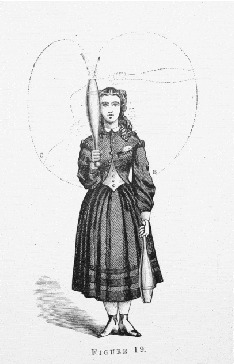
Indian club exercise for women. Reproduced from S. D. Kehoe. The Indian Club Exercise: Explanatory Figures and Positions. Photographed From Life; Also General Remarks on Physical Culture. New York: Frederic A. Brady, 1867.
However, Dio Lewis, among a number of others, developed exercise regimens that were specifically designed for women so as to not only counteract the deleterious effects of tight-lacing and other sartorial vices—or heal their “eternal wounds”—but to enable them to develop good health and fitness, along with men, in the otherwise unhealthy environment of what was then the new middle-class environment of urban America. As Green points out, Lewis' book New Gymnastics for Men, Women and Children, first published in 1862, went through ten editions, “and his willingness to include women in classes and in his normal school (half of his first class of graduates were women) was one of the building blocks of the system's popularity” (1989:186; see also Todd 1998:173–280). Significantly, one of the reasons why women's health was regarded as an important issue was a kind of pro-natalist, anti immigrant eugenicist sentiment articulated by the likes of Edward C. Clark in 187315
It is not possible here to go into the many links between ideas of physical fitness, racial purity, social hygiene, and the development of “sexual fitness.” Clearly much of the literature on this topic is focused on questions of nineteenth- and early twentieth-century biology, as well as anthropological theories of race and social evolution (Paul 1995; Webster 1981). A historical study of the relationship between physical education, body-building, and eugenics would contribute significantly toward an understanding of social engineering in the nineteenth century.
All advocates of physical education were not cut of this cloth—Dio Lewis most certainly was not (Todd 1998:211–60)—but physical fitness for women fit directly into the very different views expressed by G. Stanley Hall on the one hand and Charlotte Perkins and other feminist critics on the other (Vertinsky 1990:169–233). In any case, it is the slippery and shifting relationship between reproductive health, physical fitness, sexuality, and gender identity that brings attention back—albeit not necessarily in terms of the ambiguous phallic symbolism manifest in jori swinging—to fertility on the one hand and both the sex and gender implications of Indian Club swinging on the other. With their respective orientations toward semen, nerves, flexibility, and reproductive health, both Indian Clubs and jori elide muscularity, and the simple correlation between masculinity and muscularity.
Although further study is required, several interesting, provisional points can be made here about the implications of this. The last two decades of the nineteenth century in particular was a time during which medical science began to scrutinize, define, and typologize sexuality in general and homosexuality in particular (Fausto-Sterling 2000). Significantly, early theories about homosexuality, dating to the time of Kehoe's publication on club swinging, were linked to the body's physical development. As Jennifer Terry points out, “For many of the earlier sexologists, including, notably, Viennese psychiatrist Richard von Krafft-Ebing and, later, British essayist Havelock Ellis, the homosexual invert was a living sign of modern degeneracy who suffered from an underlying nervous disorder that could manifest in a certain kind of physical stigmata as well as in sexually inverted personality traits” (1995:131).
In conjunction with this concern with “constitutional degeneracy,” homosexuality was regarded as a disease of civilization to the extent that a putative increase in cases among “intelligent women and artistic men” was linked to the idea that increased cultural complexity, sophistication, and refinement led to a pathological antipathy toward reproduction (1995:132). Although after the turn of the century attention was to shift away from a focus on nervous disorders and the pathological complexity of modern life—exacerbated by masturbation, the reasoning went (Terry 1995:133)—toward psychogenic models and the scientific “reading” of tell-tale signs of deviance marked on male and female genitalia (Fausto-Sterling 2000), it is reasonable to assume that the late nineteenth-century health reform movement, as it was concerned with the problem of modern civilization and nerve enervation, was, at least in part, designed as a means by which to prevent homosexuality and promote healthy sexual reproduction.16
In his discussion of Thomas Arnold, one of the early architects of the movement, Clifford Putney makes note of the way in which muscular Christianity was directly concerned with the problem of sexuality: “Sports were also viewed by Arnold as a means of channeling and dispersing those boyish energies (particular sexual energies) which, if left unchecked, might result either in masturbation (`the deadly habit') or in other illicit behavior” (2001:17).
However, it is important also to understand this against the backdrop of a somewhat earlier thriving urban bachelor subculture that “emphatically rejected” the middle-class Victorian ideal of self-control and regimented self-development in favor of “masculine camaraderie, drinking, whoring, [and] fighting” (Gorn and Goldstein 1993:73). Although counter-cultural in class terms, this bachelor sub-culture was also linked to other manifestations of “deviance.” As Gorn and Goldstein note, there were very strong homoerotic undertones in this subculture where a particular kind of powerful male beauty was idealized (1993:74). While analyzing the discourse of sexuality that surrounded Eugene Sandow's public presentation of his muscular body, Michael Budd points out that, “[c]onsciously or not, physical culture media catered to the overarching “pornographic” gaze of consumerism, as well as an elite penchant for sexually crossing the class divide. . . . [T]he homosocial character of such publications provided space for a variety of men to enjoy and imagine the male body, to communicate, and even meet one another” (1997:72).17
Although one should most certainly not indiscriminately read contemporary interpretations back in time, it is interesting to compare Budd's analysis of the homoerotic in the origins of body building with contemporary studies which seem to indicate that homoerotic issues are deeply vested in the world of modern gymnasiums, where “gay” and “straight” are not nearly as clear-cut as one might otherwise think (Bordo 1997:48–54; Mohr 1992; Pronger 1990).
In this regard club swinging was both different and the same. As an exercise that was designed to produce a specific kind of “muscular masculine morality,” club swinging also led to the production of bodies that had a new and more public, and perhaps more problematic, erotic appeal. In any event, the phenomenal popularity of Indian Club swinging as uniquely devised for nerve development rather than muscle building, and the apparent popularity of books depicting the un-enervated bodies of athletic men, emerged at a time when nerves were nervously implicated in the “deviant” sexuality of men and women.18
The growing interest in body-building and the male body around the turn of the century was directly linked to Greek Revivalism. To an extent at least, Greek Revivalism brought the issue of homoeroticism directly into focus given the extent to which sexuality was integral to the activities of the classical gymnasium (Guttman 1996; Scanlon 2002). Needless to say, this did not resolve the issue; it simply complicated the picture, since some found in this fact an explanation for the debauched end of classical civilization as they knew it, and others an expression of its greatest virtues.
It is also significant that Kehoe's Indian Club exercises, and the numerous so-called “new systems” developed by others around the turn of the century, started out as exercises for the development of both men's and women's health, but as time progressed and muscular Christianity evolved into a kind of nationalist masculine athleticism—most clearly embodied by Teddy Roosevelt—Indian Club swinging become more distinctly gendered; the nervous, shadow form of the “really” big stick, one might say. This is perhaps anticipated in the work of Donald Walker. Following the publication of British Manly Exercises in 1834, in 1835 Walker published a book entitled Exercises for Ladies Calculated to Preserve and Improve Beauty. In it he advocated the use of the “Indian scepter” which was an “ornamental version of the Indian Club” weighing about two pounds. As Todd points out, “Walker hyperbolically called the scepter exercises ‘the most useful and beautiful exercises ever introduced into physical education,’ maintaining that they had ‘vast advantages over the dumb-bells’ for women” (1995:8–9).19
As Jan Todd notes, “Walker further claimed that his text marked the first time this apparatus had been described in any book, although it is not clear whether Walker meant Indian clubs or only the smaller Indian scepters” (1998:97).
The ornamental Indian scepter was quite different from the forty-seven pound “mugdhas” swung by Professor Harrison of London in the 1850s (Todd 1995:9). In any case, another distinctive feature of all of the post-Civil War publications I have examined is the emphasis placed on choreography and the development of balanced, rhythmic movement. For example, to describe and explain his system Kehoe developed an alphabetical notation code to support the line drawings in his book. These drawings are, in and of themselves, often exquisite works of art. However, Cobbett and Jenkin's, writing in 1893, provide such a detailed formula for coded movements that it takes very careful reading to figure out how the system works. Dougherty's system, explained in Indian Clubs and Dumbbells (1901), is somewhat more comprehensible, but contains some diagrams where the number of intersecting lines makes the sequence of movements almost incomprehensible.
In and of itself this concern with fluid, flexible movement is not gendered per se, but the kind of lean, flexible “greyhound physique” it was designed to produce in men was, I think, a masculine ideal for only a very short period of time after the Civil War. One need only contrast the ideal bodies depicted by Kehoe in 1867–which resemble those in Walker's 1834 text, and seem to evoke more than anything else an image of the foppish dandy (Adams 1995; Garelick 1998)—with MacFadden's images some thirty years later, which are more in keeping with the image of the thick-set, muscular Professor Harrison illustrated in Trall's 1857 publication.20
More research is required to locate the history of Indian Club swinging within the broader dynamics of class-demarcated athleticism and class-based ideas about health, fitness, and masculinity. It is possible that heavy-weight club swinging produced “heavy-weight” bodies that were idealized in the working class bachelor subculture of the pre-Civil War era. It is clear, however, that organized mass-drill club swinging was linked to the development of upper middle class, and subsequently middle class, interests in the establishment of athletic clubs (Gorn and Goldstein 1993: 132–34).
Although most of the publications following Kehoe's landmark work depict men swinging clubs in order to demonstrate technique, it is significant that many historical accounts of the athletic revival depict and describe club swinging as a mass-drill choreographed exercise routine engaged in by women's groups, associations, and clubs (see Green 1986:192, 194; Hoffman 1996:12–13, 16; cf. Park 1989:149). As Todd's work indirectly but clearly points out, men and women used dumbbells as part of large-scale mass drill routines in the United States and Europe in the early nineteenth century (1995), but it seems that women's groups in the United States between 1870 and 1920 transformed Indian Club swinging into a distinctly gendered mass-drill exercise routine. As men shifted toward institutionalized sports, organized team athletics, and a cult of body-building, women, under the banner of such groups as the Turners—German-American gymnastic societies—were organized into gymnastic drill formation.21
With respect to sports as such, the involvement of women in mass-drill club swinging may be seen as symptomatic of the broader trend toward the hyper-masculinization of athletics, and what Gregory Stanley refers to as the “fall of the sportswoman” (1996).
Back To India: Engendered Irony and Muscular Hinduism
Just as Donald Walker's self-consciously effete Indian scepters coexisted with Professor Harrison's forty-seven pound mugdahs—the word itself is tellingly Anglicized Urdu22
According to Jan Todd (1995), the term mugdah—in this case spelled mugdaugh—is listed in Dewitt's Athletics Exercises for Health and Strength (1835).
What is less clear, but far more important, is the way in which the history of one is directly, rather than coincidently—and thereby only ambiguously and analogically—linked to that of the other. The BSJGS is directly affiliated with the Banaras district committee for the development of physical education. This district committee is part of the state apparatus for coordinating physical education in schools and other institutions. In turn, this state apparatus is part of the Indian central government scheme for the development of sport and physical education in each of the states of the Republic. The inception of this state apparatus took place in Maharashtra—then the Bombay Presidency—in the 1920s, but has developed in a linear fashion since then, through Independence in 1947 up to the present.
Although most contemporary physical education and sport in India is based on Western-style gymnastics and exercise—most of the sports are British in origin even though the American YMCA is the model for physical education23
Dr. J. H. Gray, A. G. Noehren, and in particular H. C. Buck were instrumental in first popularizing “scientific physical training” in India under the auspices of the YMCA, originally in Calcutta in 1908 but more systematically in Madras in the early 1920s. See Harsha (1982) for a concise account of this history.
Although institutions like Kashi Vyayamshala and the gymnasium at BHU, as well as the much larger and more active Hanuman Vyayam Prasarak Mandal in Madhya Pradesh, promote the development of Indian exercises and gymnastics, given the history of physical education in India they do so by fitting these systems of training into a Western mold in general and the mold of the Young Men's Christian Association in particular. The nominal etymology of this mold, like the origin of the Indian Clubs in the United States, is not often remembered or recognized. In other words, despite direct, intimate, and programmatic connections, the “Christian”-based American history of the YMCA (Higgs 1995; Putney 2001) does not mesh very well with the “Hindu” history of physical education in Indian nationalism, just as the “Indian history” of club swinging does not mesh with the moral rhetoric of muscular Christianity. Significantly the principles of Western physical education were often applied in the Indian context with explicitly nationalist intentions, as in the case of the transformation of kabaddi from a manly rural game into a highly rule-bound regulated national sport (Alter 2000b). In this regard, D. C. Mujumdar's Encyclopedia of Physical Education (1950) is a perfect case in point, as are various manuals produced by Manikrao, Professor Ram Murti Naidu—the title “Professor” being derived from the world of muscular Christianity—and others.
Thus the organizational structure of the BSJGS, reflected in the structure of the regional Jori and Gada Swinging Competition, further reflects one kind of post-colonial Indian nationalism. In terms of protocol and structure, these competitions are very much like contemporary Western-style sporting events. Representatives of the state in the person of the district magistrate and deputy superintendent of police give prizes of miniature silver-cast joris to the winners in various weight classes, who are then photographed on tiered podiums with ribbons across their chests. The structure of the BSJGS derives from a history in which Indian Clubs—of the kind popularized by Kehoe—were integral to a process that led to the development of muscular Christianity, the YMCA, and the invention of modern physical education.
The formalized structure of the BSJGS reflects the same irony as does the integration of Indian Club-swinging techniques into an Encyclopedia of Indian Physical Culture. The irony is amplified, at least in the case of the Encyclopedia since it was explicitly written to demonstrate that Indians were not effete. To illustrate a feature of Indian masculinity, Mujumdar drew on a modern system of exercise oriented as much toward women as toward men—and certainly toward female fertility and reproductive health—and on a system that was more concerned with intellectual and neurological development than with masculine strength and power. In terms of body type, and of the complexity of movements, the image of the slight, young man swinging his light clubs in Mujumdar's book (see figure 4) bares a stylistic resemblance to the gentlemen athletes depicted by Walker, Kehoe, Dougherty, Cobbet and Jenkin, and many others. In all cases the nature of masculinity is not as distinctly “masculine” as one might think, even though what was at issue was, very much, masculinity, and, at least to a degree, male sexuality (see Budd 1997:79).
But just as there were a number of Pharsi bodybuilders in Bombay around the turn of the century—Mahatma Gandhi's physician Denshaw Mehta being one of them—and just as Professor Harrison “went back to the source” to develop his muscles by swinging English “mugdhas,” neither the publication of Mujumdar's Encyclopedia and other similar books, nor the institutionalization of Western-style physical education in India precluded the development of what might be called alternative masculinities. Indeed the Encyclopedia contains numerous photographs of men engaged in exercise routines that are designed to produce what I have referred to elsewhere as “bodies of one color” (Alter 1993). Clearly these practices have changed over the years, perhaps even following the trajectory of Jhingaran's account, quoted above, wherein true “bodies of one color” only characterize an earlier, classical era of Hindu civilization. Nevertheless it is ironic, to say the least, that late eighteenth- or early nineteenth-century colonial encounters with subject Indian men who appeared to have very strong, healthy bodies helped to set in motion a history of physical education that came back around again in the form of mass-drill exercises and produced disciplined bodies of a very different kind.
Aside from references in Mujumdar's Encyclopedia, there is no evidence that Indian Club swinging ever became very popular in India. The influence it had on jori swinging is in terms of the displaced institutionalization and standardization of sport, and the refracted antipathy jori swingers tend to have toward Western-style weight lifting and body building in particular. Significantly, however, mass-drill exercises did become extremely popular in India in the first decades of the twentieth century and were an integral feature of various manifestations of somatic nationalism, most notably in the lathi-wielding nationalistic regimen of the Rashtriya Swayamsevak Sangh (Alter 1994a), Apa Pant's experiment with democracy and surya namaskar exercises (Alter 2000a), Swami Kuvalayananda's formalization of yoga in the physical education curriculum of schools, and even the “performance” of cotton spinning as collective self-discipline in Gandhi's ashram. Ram Murti Naidu, among a number of others, devised a whole system of Indian mass-drill training based on rhythmic movement and marching commands. To understand the close and direct relationship between European/American physical education, and the development of nationalist regimens in India, it is important to focus on the way in which—jori swinging aside—mass drill at the fin de siecle was the modus operandi of those concerned with disciplining the social body at a point of high modernity (Alexander 1892; Houghton 1891; Noakes 1893; Wilbur 1920).
Although the historical process that lead to the development of mass-drill regimens is a subject unto itself—and obviously linked to military training—its seems clear that one of the primary functions of mass drill is to break individuality down and build up a collective body. By way of discipline and regimentation, this collective body is greater than the sum of its parts. In the United States this enabled the translation of any given woman's health and fitness into the idea of women's health and fitness as an issue of public health. Whereas parlor gymnasiums allowed women to exercise in the privacy of the home, but otherwise still conform, through reproductive labor, to the priorities of the Victorian family, mass drill defined a context wherein women's bodies were both liberated but also thereby disciplined in the service of national interests. Although European immigrant groups, who were first responsible for making drill routines popular in the 1850s, continued to practice group gymnastics and calisthenics into the 1920s and 1930s, mass drill does not ever seem to have been a very “manly” activity in the United States, perhaps because rugged individuality was so closely linked to masculinity (see Putney 2001). Reflecting the extent to which masculinity in the United States was linked to ideas of individual virility and power, Bernarr MacFadden—one of the first and best-known muscle men of the twentieth century—is famous for advocating recreational sex as exercise and for inventing the peniscope, a glass tube, rubber hose, and vacuum pump contraption that made it possible to give the genitalia a work out. It is hard to imagine this in a mass drill format.
In India around the turn of the century, however, mass drill—rather than individualized manly exercise—was thought to provide the best means to develop a kind of community based masculinity defined in terms of moral character and, significantly, disciplined sexuality. Just as nerve enervation, women's reproductive health, and nationalist eugenics are the sub-text of Indian Club swinging in the United States, mass drill in India—which was, until quite recently, a male domain—was understood to be important for health, at least in part because of modern theories about the relationship between semen, celibacy, and self-control (Alter 1994b). In this context, perhaps Indian Clubs—and most certainly jori and mugdals—were simply too sexual, and too closely linked to the essence of singular male bodies. In a sense, through metonymic links to the kinetics of sex as an act, they were, in their own way, a bit too much like Macfadden's peniscope.
In a slightly different but analogous mode, involving violence rather than sex, contemporary Indian wrestling produces a body that cannot be easily subject to abstracted, militant ideologies that are mass-drill oriented. Instead Indian wrestling defines—in terms of a kind of overblown, nervous masculinity—its own form of self-contained somatic nationalism. In any case, the link between sex, health, and women's bodies in the United States was like that between sex, health, and men's bodies in India, insofar as both were concerned with self-contained health, nerve fitness, and character development rather than the power to impregnate, or simply the power to have sex, as manifest in MacFadden's ideal of the perfect man who—peniscope in hand—could “keep it up” for an hour (Green 1986:249). The shift to competitive athleticism in the 1920s also reflects this more general and equally aggressive, kinetic theory of “spermatic economy” wherein physical energy was released in order to build up the male body so as to beat everyone else and be a man among men, if not also a man's man.24
In many respects modern twentieth-century sports, as they are intimately linked to the powerful expression of masculinity, emerged out of this shift to competitive athleticism. A great deal has been written recently about the problems and paradoxes associated with masculinity and sports (Birrell and McDonald 2000; Burstyn 1999; Messner 1992; Messner and Sabo 1994). In this context it is important to keep in mind the significant difference between structured gymnastics, fitness regimens, and competitive athleticism. In form and function they are somewhat analogous, but in terms of the way in which they produce gendered bodies, and principles of gendered health, they can be quite distinct.
Confusion and Conclusion
In a recent article Andrew Morris (2000) rightly criticizes Allen Guttman's analysis of sports in the context of colonialism (1994). Guttman's position is that the globalization of Western sports and sporting institutions reflects cultural borrowing rather than cultural imperialism. However, as Morris shows, through a detailed analysis of the influence of Western sports culture on Late Qing and early Republican China, there is no question but that sports and physical education were, in fact, tools of cultural imperialism, but that this did not in any sense preclude reformers, educators, and nationalists from using specific features of physical culture to achieve their own ends. The important question Morris asks is “which aspects of modern physical culture” were integrated into turn-of-the-century Chinese nationalism, and why those aspects and not others. In his conclusion Morris makes the following observation:“The modern forms and notions of physical fitness, strength, and physical culture rendered virtually all of the diverse forms of Chinese physical culture obsolete by the last decades of nineteenth century, and relegated them to history” (2000:899). Morris qualifies this, of course, with reference to the martial arts, which, in a sense have been relegated to both tradition and modernity, if not to the obsolescence of history.
With this in mind, the most general question explored in this essay is what are the dynamics involved in the relationship of physical education to nationalism—as this relationship often involves issues of race, sexuality, and gender—when the “directional flow” of both cultural imperialism and cultural borrowing is multidirectional and circular if not also mobiously eliptical in its historical orientation?
It would be wrong to say that a tradition of jori swinging has persisted, underground, and that in going to Banaras and conducting ethnographic field research one is able to document and preserve this tradition. There is no way to systematically reinscribe as “cultural” what has been erased by a peculiar history of post-colonial, colonial, and—if one is to track down the Middle Eastern etymology of the word mugdal—pre-colonial, Middle Eastern encounters, and no value in doing so. In fact, imbedded as it is within the state-mandated institutional structure of physical education in India, contemporary jori swinging must exist as part of a complex, transnational history from which its “local” Indianness was never completely erased, but in which its “local” Indianness is also not at all “indigenous” in any meaningful sense. Thus, when contemporary writers bemoan the proliferation of modern sports in India (Bhargava 1985:1), chafe at the way in which colonialism “undermined the development of [their] minds and bodies” (Lal 1985:12), and express resentment toward the modern institutionalization of indigenous sports like kabaddi and kho kho (Ram 1985:6)—and do so by seeking to reinstate really, truly manly sports like wrestling and jori swinging (Singh 1985:19–20; K. L Jhingaran 1985:4)—a particular kind of masculinity is invoked. While nominally linked to the classical images of Bhim and Hanuman, and nervously ascribed to Raghunath Maharaj, among other “historical” figures, this masculinity is also defined in relation to the images of these figures as they have taken shape in relation to unhealthy modernization and the particular form of modernity manifest in a spectrum of different “sexual meanings” that are linked to various transnational articulations of religion, morality, and gender.
Therefore, in terms of a history of the body that breaks free of colonial and postcolonial historiography and “provincializes the world,” and not just Europe—as Chakrabarty indicates that it should (2000)—it is much more meaningful and analytically interesting to point out that Daya Ram, Kanaiya Lal Jhingaran, and Surya Prasad Singh are speaking the language of nationalism, but are engaged in a broader discourse of masculinity, gender, and power that is transnational. In this respect, their provincialism—their search for origins and the golden age of classical strength and purity—is matched by parochialism in the United States. Alice Hoffman notes (1996:44) that the English/Indian origin of the Indian Club was so quickly “erased” that a number of publications dating to the late nineteenth century mistakenly linked Indian Clubs with bowling pins, and at least once—in a truly perverse twist of colonial transnational confusion matched only by Columbus' original mistake—claimed that Indian Clubs were a modern American cooptation of Native American war clubs that had been used to do battle with late seventeenth-century pilgrims.
With reference to the epigraph for this essay, C. R. Treat could not fully have appreciated just how hyperbolically apt his observation would be with regard to history as well as people: “Like the wand of some kind of fairy, the Indian Club transforms all whom it touches” (1869:4).
References
Adams James
1995
Dandies and Desert Saints
Cornell
Cornell University Press
Alexander Alexander
1892
Physical Drill of All Nations
London
George Philip and Son
Alter Joseph S.
1992
The Wrestler's Body: Identity and Ideology in North India
Berkeley
University of California Press
Alter Joseph S.
1993
The Body of One Color: Indian Wrestling, the Indian State and Utopian Somatics.
Cultural Anthropology
8
1
49
72Google Scholar
Alter Joseph S.
1994a
Somatic Nationalism: Indian Wrestling and Militant Hinduism.
Modern Asian Studies
28
3
557–88Google Scholar
Alter Joseph S.
1994b
Celibacy, Sexuality and the Transformation of Gender in Nationalism.
Journal of Asian Studies
53
1
45
66Google Scholar
Alter Joseph S.
2000a
Gandhi's Body: Sex, Diet and the Politics of Nationalism
Philadelphia
University of Pennsylvania Press
Alter Joseph S.
2000b
Kabaddi, A National Sport of India: The Internationalism of Nationalism and the Foreignness of Indianness
Noel Dyck, ed.
Games, Sports, and Cultures
Oxford
Berg
83–115
Alter Joseph S.
2002
Nervous Masculinity: Consumption and the Production of Embodied Gender in Indian Wrestling
Sarah Lamb and Diane Mines, eds.
Everday Life in South Asia
Bloomington
Indiana University Press
132–45
Alter Joseph S.
2004
Yoga in Modern India: The Body Between Philosophy and Science
Princeton
Princeton University Press
Alter Joseph S.
forthcoming
Empowering Yourself: Sport, Sexuality and Autoeroticism in North Indian Jori Swinging
James Mills, ed.
Sport and Colonialism in South Asia
Oxford
Berg
Altman Dennis
2001
Global Sex
Chicago
University of Chicago Press
Betz Carl
1892
A System of Physical Culture
Chicago
A. Flanagan
Bhargava Govind Ram
1985
Do Shabda. Smarika: Pratham Jila Jori Gada Pratiyogita—Jila Khelkudh Protsahan Samiti Awen Jila Mugdal Jori Gada Sangh Dwara Ayojit.
Govind Ram Bhargava, 1
Varanasi
Dr. Sampuranananda Stadium
Birrell Susan
Mary G. McDonald
2000
Reading Sport: Critical Essays on Power and Representation
Boston
Northeastern University Press
Bordo Susan
1997
Reading the Male Body
Pamela Moore, ed.
Building Bodies
New Brunsick, N.J.
Rutgers University Press
31
73
Bornstein M.
1880
Manual of Instruction in the Use of Dumb Bells, Indian Clubs and Other Exercises
New York
M. Bornstein
Brady Frederic A.
1867
Publisher's Introduction
Simon D. Kehoe, ed.
The Indian Club Exercises
New York
Frederic A Brady
9–10
Budd Michael Anton
1997
The Sculpture Machine: Physical Culture and Body Politics in the Age of Empire
New York
New York University Press
Burrows Thomas
n.d.
The Text-Book of Club-Swinging
London
Athletic Publications, Ltd.
Burstyn Varda
1999
The Rites of Men: Manhood, Politics and the Culture of Sport
Toronto
University of Toronto Press
By an Amateur
1884
Indian Club Swinging
Providence
E. L. Freeman
Carrier Jean-Luc
1998
Femmes Et Féminités D'Orient Sous L'Oeil Des Occidentaux Du XIVe Au XVIIIe Siècle
Villeneuve d'Ascq
Universitaires du Septentrion
Chakrabarty Dipesh
2000
Provincializing Europe: Postcolonial Thought and Historical Difference
Princeton
Princeton University Press
Chapman David L.
1994
Sandow the Magnificent: Eugen Sandow and the Beginnings of Bodybuilding
Urbana
University of Illinois Press
Chatterjee Partha
1993
Nationalist Thought and the Colonial World
Minneapolis
University of Minnesota Press
Cobbett G. T. B.
Jenkin A. F.
1893
Indian Clubs
New York
Macmillan and Co
Collingham E. M.
2001
Imperial Bodies: The Physical Experience of the Raj, 1800–1947
Cambridge, England
Polity Press
Cooper Frederick
Stoler Ann
1997
Tensions of Empire: Colonial Cultures in a Bourgeois World
Berkeley
University of California Press
Cruden George
1889
Cruden's Calisthenic Training and Musical Drill, Containing Thorough Instructions and Progressive Exercises and Dumb-Bells, Bar Bells, Indian Clubs, and Hoops, and in Free Gymnastics and Marching
New York
Dick and Fitzgerald
Deshpande H. V.
1958
Brief Note on History and Development of Shree Hanuman Vyayam Prasarak Mandal
Amravati
Saraswati Printing Press
Deshpande S. H.
1992
Physical Education in Ancient India
New Delhi
Bharatiya Vidya Prakashan
Dewitt
1870
Dewitt's Athletic Exercises for Health and Strength
New York
Dewitt
Dougherty J. H.
1901
Indian Clubs and Dumb Bells
New York
American Sports Publishing Company
Doy Gen
1996
Out of Africa: Orientalism, Race and the Female Body
London
Sage Publications
Enloe Cynthia
1993
The Morning After: Sexual Politics at the End of the Cold War
Berkeley and Los Angeles
University of California Press
Fausto-Sterling Ann
2000
Sexing the Body: Gender Politics and the Construction of Sexuality
New York
Basic Books
Gardiner Benjamin
1884
Indian Club Swinging: By an Amateur
Providence
E. L. Freeman and Co
Garelick Rhonda
1998
Rising Star: Dandyism, Gender and Performance in Fin de Siecle
Princeton
Princeton University Press
Gorn Elliott J.
Goldstein Warren
1993
A Brief History of American Sports
New York
Hill and Wang
Gould Stephen Jay
1981
The Mismeasure of Man
New York
Norton
Graham Sylvester
1972
The Greatest Health Discovery: Natural Hygiene and Its Evolution, Past, Present and Future
Chicago
Natural Hygiene Press
Green Harvey
1986
Fit for America: Health, Fitness, Sport and American Society
New York
Pantheon Books
Grewal Inderpal
1996
Home and Harem: Nation, Gender, Empire and the Cultures of Travel
Durham
Duke University Press
Grover Kathryn
1989
Fitness in American Culture: Images of Health, Sport and the Body, 1830–1940
Rochester
University of Massachusetts Press
Gulick Luther Halsey
1905
Ten Minutes' Exercise for Busy Men, A Complete Course in Physical Education; Free Work, Chest Weights, Dumb Bells, Wands, Indian Clubs. . . .
London
British Sports Publishing Company Ltd
Guttman Allen
1996
The Erotics in Sports
New York
Columbia University Press
Hall Donald E.
1994
Muscular Christianity: Embodying the Victorian Age
Cambridge
Cambridge University Press
Harrison Professor
n.d.
Indian Clubs, Dumb-Bells and Sword Exercises. 2d ed.
London
Dean and Son
Harsha Ambi
1982
Development of Physical Education in Madras, 1918–1948
Madras
Christian Literature Society
Harvey Francis Joseph
1897
1,000 Gymnastic Exercises with Dumb Bells, Wands and Indian Clubs, Suitable for Home Practice, or for Class, Competition or Display Purposes
Exeter, England
Physical Training School and Gymnasium
Higgs Robert J.
1995
God in the Stadium: Sport and Religion in America
Lexington
University Press of Kentucky
Hill Gus
1880
Gus Hill's Champion Club-Swinging and Dumb-Bell Manual: A Complete Guide by which Anyone can Learn these Healthy Exercises, as It Contains Instructions in Everything Appertaining to these Useful and Beneficial Accomplishments, Together with the Requirements and Construction of the Gymnasium
New York
New York Popular Publishing Company
Hoffman Alice
1996
Indian Clubs
New York
H. N. Abrams
Hopkins Edward Washburn
1889
The Social and Military Position of the Ruling Caste in Ancient India as Represented by the Sanskrit Epic; With an Appendix on the Status of Women.
New Haven
Tuttle, Morehouse and Taylor
Houghton E. B.
1891
Physical Culture: First Book of Exercises in Drill, Calisthenics and Gymnastics
Toronto
Warwick
Howells Bernard
1996
Baudelaire: Individualism, Dandyism and the Philosophy of History
Oxford
Legenda, European Humanities Research Centre
Jhingaran Kanaiya Lal
1985
Kashi Ki Jori: Ek Jhalka. Smarika: Pratham Jila Jori Gada Pratiyogita—Jila Khelkudh Protsahan Samiti Awen Jila Mugdal Jori Gada Sangh Dwara Ayojit. Govind Ram Bhargava, 3–4
Varanasi
Dr. Sampuranananda Stadium
Jhingaran Keshav
1985
Hanuman Se Haldhar. Smarika: Pratham Jila Jori Gada Pratiyogita—Jila Khelkudh Protsahan Samiti Awen Jila Mugdal Jori Gada Sangh Dwara Ayojit. Govind Ram Bhargava, 7–8
Varanasi
Dr. Sampuranananda Stadium
Jodh K. G.
1983
Amravati Cradles the Nationalist Movement
Amravati
All India Languages and Literary Conference
Kasson John F.
2001
Houdini, Tarzan, and the Perfect Man: The White Male Body and the Challenge of Modernity in America
New York
Hill and Wang
Kehoe Simon D.
1867
The Indian Club Exercise. Explanatory Figures and Positions. Photographed from Life; Also General Remarks on Physical Culture
New York
Frederic A. Brady
Krohn Robert
1924
Dumb Bell, Wand and Indian Club Exercises: Grammer Grades
Portland
Portland Public Schools
Kumar Rajesh
1985
Jori Kala Me Akhara Raghunath Maharj Ka Yogdan. Smarika: Pratham Jila Jori Gada Pratiyogita—Jila Khelkudh Protsahan Samiti Awen Jila Mugdal Jori Gada Sangh Dwara Ayojit. Govind Ram Bhargava, 11
Varanasi
Dr. Sampuranananda Stadium
Ladd Tony
Mathisen James A.
1999
Muscular Christianity: Evangelical Protestants and the Development of American Sports
Grand Rapids, Mich.
Baker Books
Lal Madan
1985
Jori, Vartman Aur Atit. Smarika: Pratham Jila Jori Gada Pratiyogita—Jila Khelkudh Protsahan Samiti Awen Jila Mugdal Jori Gada Sangh Dwara Ayojit. Govind Ram Bhargava, 12
Varanasi
Dr. Sampuranananda Stadium
Lemaire E. Ferdinand
1890
Indian Clubs and How to Use Them: A New and Complete Method for Learning to Wield Light and Heavy Clubs, Graduated from the Simplest to the Most Complicated Exercises
London
Iliffe and Son
Levine Emma
2000
A Game of Polo with a Headless Goat
London
André Deutsch
Lewis Dio
1862
The New Gymnastics for Men, Women and Children
Boston
Ticknor and Fields
Lewis J.
1916
Swedish Drill Illustrated: A Short Course for Recruit Squads, Volunteer Training Corps, Lads' Brigades, Scouts, Senior Boys' Classes, and for Home Use
London
Harrison and Sons
Lewis Reina
1996
Gendering Orientalism: Race, Femininity and Representation
New York
Routledge
Lord Charles E.
1903
Indian Club Exercises: With Hints on Training
London
Percy Lund, Humphries and Co, Ltd
MacMunn Sir George
1977
The Martial Races of India
Quetta, Pakistan
Gosha-e-Adab
Melio George L.
1889
Manual of Swedish Drill (Based on Ling's System)
New York
Excelsior Publishing House
Melio George L.
Chant Ormiston
1889
Manual of Swedish Drill: As Used in the Swedish Army and Navy. . . .
London
Sampson Low, Marston, Searle, and Rivington
Messner Michael A.
1992
Power At Play: Sport and the Problem of Masculinity
Boston
Beacon Press
Messner Michael A.
Donald F. Sabo
1994
Sex, Violence, and Power in Sports: Rethinking Masculinity
Freedom, Calif.
Crossing Press
Mohr Richard
1992
Gay Ideas: Outing and Other Controversies
New York
Beacon Press
Morris Andrew
2000
“To Make the Four Hundred Million Move”: The Late Qing Dynasty Origins of Modern Chinese Sport and Physical Culture.
Comparative Studies in Society and History
42
4
876
906Google Scholar
Mrozek Donald J.
1989
Sport in American Life
Kathryn Grover, ed.
Fitness in American Culture: Images of Health, Sport and the Body
Rochester
University of Massachusetts Press
Mujumdar D. C.
1950
Encyclopedia of Indian Physical Culture
Baroda
Good Companions
Nissenbaum Stephen
1980
Sex, Diet, and Debility in Jacksonian America: Sylvester Graham and Health Reform
Westport, Conn.
Greenwood Press
Noakes S. G.
1893
A System of Free Gymnastics and Light Dumb Bell Drill as Practiced in the Military Gymnasia
London
Gale and Polden
Numbers Ronald L.
1976
Prophetess of Health: A Study of Ellen G. White
New York
Harper & Row
Pardon George Frederick
1899
Gymnastics, Containing Dumb Bell Exercises, Indian Clubs, Parallel Bars, the Horizontal Bar and the Trapeze.
London
Ward, Lock and Company
Park Roberta
1989
Healthy, Moral, and Strong
Kathryn Grover, ed.
Fitness in American Culture: Images of Health, Sport, and the Body, 1830–1940
Rochester
University of Massachusetts Press
Parkes Peter
1996
Indigenous Polo and the Politics of Regional Identity in Northern Pakistan
Jeremy MacClancy, ed.
Sport, Identity and Ethnicity
Oxford
Berg, 43–68
Paul Diane B.
1995
Controlling Human Heredity, 1865 to the Present
Atlantic Highlands, N.J.
Humanities Press
Prevost John C.
1957
Le Dandysme En France, 1817–1839
Gencive
Droz
Pronger Brian
1990
The Arena of Masculinity: Sports, Homosexuality, and the Meaning of Sex
New York
St. Martin's Press
Putney Clifford
2001
Muscular Christianity: Manhood and Sports in Protestant America, 1880–1920
Cambridge
Harvard University Press
Rajagopalan K.
1962
A Brief History of Physical Education in India (From the Earliest Times to the End of the Mughal Period)
Delhi
Army Publishers
Ram Daya
1985
Jori. Smarika: Pratham Jila Jori Gada Pratiyogita—Jila Khelkudh Protsahan Samiti Awen Jila Mugdal Jori Gada Sangh Dwara Ayojit. Govind Ram Bhargava, 5–6
Varanasi
Dr. Sampuranananda Stadium
Rosselli John
1980
The Self-Image of Effeteness: Physical Education and Nationalism in Nineteenth Century Bengal.
Past and Present
86
121–48Google Scholar
Rotundo Anthony E.
1993
American Manhood: Transformations in Masculinity From the Revolution to the Modern Era
New York
Basic Books
Said Edward
1978
Orientalism
New York
Pantheon Books
Scanlon Thomas F.
2002
Eros and Greek Athletics
Oxford
Oxford University Press
Schatz W. J.
1908
Club Swinging: For Physical Exercise and Recreation
Boston
American Gymnasia Company
Schueller Malini Johar
2001
U.S. Orientalisms: Race, Nation and Gender in Literature, 1790–1890
Ann Arbor
University of Michigan Press
Singh Surya Prasad
1985
Vyayam Vidya Awen Parivartith Swarup. Smarika: Pratham Jila Jori Gada Pratiyogita—Jila Khelkudh Protsahan Samiti Awen Jila Mugdal Jori Gada Sangh Dwara Ayojit. Govind Ram Bhargava, 19–20
Varanasi
Dr. Sampuranananda Stadium
Sokolow Jayme A.
1983
Sylvester Graham, Health Reform, and the Origins of Victorian Sexuality in America
Rutherford
Fairleigh Dickinson University Press
Spalding M. H.
Collett L. L.
1910
The Swedish Drill Teacher
London
J. Curwen
Stanley Gregory Kent
1996
The Rise and Fall of the Sportswoman: Women's Health, Fitness and Athletics, 1860–1940
New York
P. Lang
Stoler Ann Laura
1991
Sexual Affronts and Racial Frontiers: National Identity, “Mixed Bloods” and the Cultural Genealogy of Europeans in Colonial Southeast Asia
Ann Arbor
University of Michigan Press
Stoler Ann Laura
1995
Race and the Education of Desire: Foucault's History of Sexuality and the Colonial Order of Things
Durham
Duke University Press
Stoler Ann Laura
2002
Carnal Knowledge and Imperial Power: Race and the Intimate in Colonial Rule
Berkeley
University of California Press
Terry Jennifer
1995
Anxious Slippages Between “Us” and “Them”: A Brief History of the Scientific Search for Homosexual Bodies
Jennifer Terry and Jacqueline Urla, eds.
Deviant Bodies
Bloomington
Indiana University Press, 129–69
Indiana University Press
1995
Terry, Jennifer and Jacqueline Urla, eds.
Deviant Bodies
Bloomington
Indiana University Press
Todd Jan
1993
“Strength Is Health”: George Barker Windship and the First American Weight Training Boom.
Iron Game History
3
1
5
6Google Scholar
Todd Jan
1995
From Milo to Milo: A History of Barbells, Dumbells and Indian Clubs.
Iron Game History
3
6
4
16Google Scholar
Todd Jan
1998
Physical Culture and the Body Beautiful: Purposive Exercise in the Lives of American Women, 1800–1870
Macon, Ga.
Mercer University Press
Trall Russell Thacher
1879
The Illustrated Family Gymnasium
New York
Fowler and Wells
Treat C. R.
1869
Indian Clubs.
The Riverside Magazine for Young People: An Illustrated Monthly
3
Reproduced on http://ejmas.com/pt/ptart_treat_0501.htmGoogle Scholar
Vaidya A. K.
1951
We Go to the Lingiad
Amravati
Hanuman Vyayam Prasarak Mandal
Verbrugge Martha H.
1988
Able-Bodied Womanhood: Personal Health and Social Change in Nineteenth-Century Boston
Oxford
Oxford University Press
Vertinsky Patricia
1990
The Eternally Wounded Woman: Women, Doctors and Exercise in the Late Nineteenth Century
Manchester and New York
Manchester University Press
Walker Donald
1834
British Manly Exercises; In Which Rowing and Sailing Are Now First Discussed
London
n.p
Walker Donald
1888
Walker's Manly Exercises: Containing Rowing, Sailing, Riding, Driving, Racing, Hunting, Shooting and Other Manly Sports
London
George Bell and Sons
Warman Edward Barrett
J. H. Dougherty, and Henry Schuyler
1923
Indian Club Exercises
New York
American Sports Publishing Company
Webster Charles
1981
Biology, Medicine and Society, 1840–1940
New York
Cambridge University Press
Wheelwright Samuel T.
1871
A New System of Instruction in the Indian Club Exercise: Containing a Simple and Accurate Explanation of All the Graceful Motions as Practiced by Gymnasts, Publicists, Etc.
New York
O'Kane
Wilbur William H.
1920
The Koehler Method of Physical Drill
Philadelphia
J. B. Lippincott
Yadav Premnath
1985
Samay Ki Den. Smarika: Pratham Jila Jori Gada Pratiyogita—Jila Khelkudh Protsahan Samiti Awen Jila Mugdal Jori Gada Sangh Dwara Ayojit. Govind Ram Bhargava, 21–22
Varanasi
Dr. Sampuranananda Stadium
Yegenoglu Meyda
1998
Colonial Fantasies: Towards a Feminist Reading of Orientalism
Cambridge
Cambridge University Press
Zarrilli Phillip
1989
Three Bodies of Practice in a Traditional South Indian Martial Art.
Social Science and Medicine
28
12
1289–309Google Scholar
Zarrilli Phillip
1998
When the Body Becomes All Eyes: Paradigms, Discourses and Practices of Power in Kalarippayattu, a South Indian Martial Art
Delhi
Oxford University Press
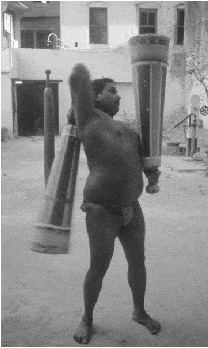
A member of Akhara Karan Ghanta, Banaras, swinging a pair of large Jori, 1988. (Author's collection)
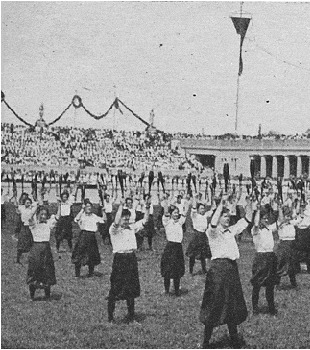
Choreographed mass drill for women, Berlin 1912. From the September 1913 issue of La Culture Physique, p. 12. (Todd-McLean Physical Culture Collection)
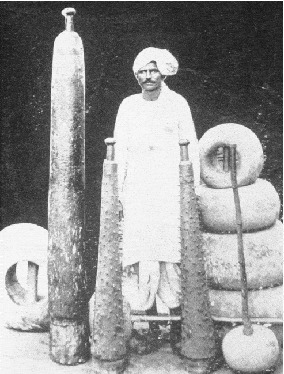
Large clubs and heavy stone weights. Reproduced from D.C. Mujumdar's Encyclopedia of Indian Physical Culture. Baroda: Good Companions, 1950.
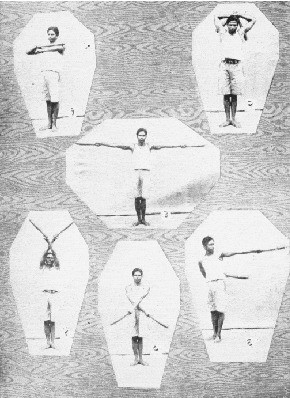
Indian Club drill. Reproduced from D. C. Mujumdar's Encyclopedia of Indian Physical Culture. Baroda: Good Companions, 1950.
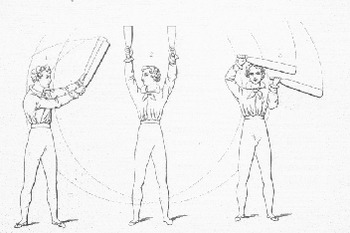
Indian club exercise. Reproduced from Donald Walker's Walker's Manly Exercises: Containing Rowing, Sailing, Riding, Driving, Racing, Hunting, Shooting and other Manly Sports. London: George Bell and Sons, 1888.

Indian club exercise. Reproduced from S. D. Kehoe. The Indian Club Exercise: Explanatory Figures and Positions. Photographed From Life; Also General Remarks on Physical Culture. New York: Frederic A. Brady, 1867.

Indian club exercise for women. Reproduced from S. D. Kehoe. The Indian Club Exercise: Explanatory Figures and Positions. Photographed From Life; Also General Remarks on Physical Culture. New York: Frederic A. Brady, 1867.
 You have
Access
- 40
- Cited by