Introduction
Internationally, over 35 million individuals suffer from dementia, with the majority of these residing in developed countries (International, 2013). In Australia, approximately 300,000 people were estimated to have dementia in 2011, and the prevalence is predicted to reach 900,000 by 2050 (AIHW, 2012). Although cognitive deficits are the main clinical feature of dementia, non-cognitive symptoms are common and can dominate disease presentation (Small et al., Reference Small1997). BPSD, also known as neuropsychiatric symptoms, are a spectrum of non-cognitive manifestations of dementia, and may include aggression, agitation, psychosis, sleep disturbances, depression, apathy, or wandering (Cerejeira et al., Reference Cerejeira, Lagarto and Mukaetova-Ladinska2012). BPSD is assumed to affect up to 97% of the people with dementia to some degree at some time and may be difficult to manage by the caregivers (Wetzels et al., Reference Wetzels, Zuidema, de Jonghe, Verhey and Koopmans2010).
Antipsychotic agents are frequently used for the management of BPSD (Hollingworth et al., Reference Hollingworth, Siskind, Nissen, Robinson and Hall2010). The prevalence of antipsychotic use in patients with dementia in residential aged care facilities has previously been reported to be high, ranging between 20% and 50% (Testad et al., Reference Testad2010; Snowdon et al., Reference Snowdon, Galanos and Vaswani2011; Wetzels et al., Reference Wetzels, Zuidema, de Jonghe, Verhey and Koopmans2011), with increasing use of atypical antipsychotics (Snowdon et al., Reference Snowdon, Galanos and Vaswani2011). However, atypical antipsychotics have limited efficacy for BPSD, and are associated with serious adverse effects, including stroke, hip fracture, pneumonia, and death (Pratt et al., Reference Pratt, Roughead, Ryan and Salter2010a; Pratt et al., Reference Pratt, Roughead, Ramsay, Salter and Ryan2010b; Pratt et al., Reference Pratt, Roughead, Ramsay, Salter and Ryan2011). Antipsychotic use in patients with dementia is associated with a poorer quality of life (Ballard and Margallo-Lana, Reference Ballard and Margallo-Lana2004). Many atypical antipsychotics also have anticholinergic activity, and so may reduce the effectiveness of the anticholinesterase dementia medicines through an antagonistic mechanism of action (Campbell et al., Reference Campbell2009). Furthermore, successful discontinuation of antipsychotic agents in patients with dementia has been reported (Cohen-Mansfield et al., Reference Cohen-Mansfield, Lipson, Werner, Billig, Taylor and Woosley1999; Ballard et al., Reference Ballard2008; Ballard et al., Reference Ballard2009; Declercq et al., Reference Declercq2013; Pan et al., Reference Pan, Wu, Gau, Chan and Banerjee2014).
The recommended strategy for the use of antipsychotics in people with dementia is to start the medication at a low dosage, up-titrate the dosage slowly and to regularly review the treatment with the intent to minimize treatment duration (AMH, 2014; Weekes, Reference Weekes2014). Antipsychotic use beyond a period of three months for BPSD is no longer indicated in Australia, with the indication being restricted in 2015 to a maximum of 12 weeks duration (TGA, 2015). Studies have shown antipsychotics may be safely reduced or discontinued without a worsening of BPSD (van Reekum et al., Reference van Reekum2002). Prior studies have shown long-term use of antipsychotics has been reported to be common among patients with dementia in residential aged care facilities in Sweden (Gustafsson et al., Reference Gustafsson, Karlsson and Lovheim2013). Australian studies also suggest long term use of antipsychotics, with a large Tasmanian study of 1,307 residents of aged care facilities that assessed medicine use at two time points 12 months apart, finding 60% were still taking the same antipsychotic at the same dose 12 months after first assessment (Westbury et al., Reference Westbury, Beld, Jackson and Peterson2010). A small Sydney study involving 25 residents in aged care facilities found a mean duration of 521 days for risperidone use to treat BPSD (Snowdon et al., Reference Snowdon, Brodaty, Ames and Day2006). This latter study also showed that doses did not change substantially across time (Snowdon et al., Reference Snowdon, Brodaty, Ames and Day2006). Apart from the small study involving 25 residents of aged care facilities, the other Australian studies have relied on cross-sectional studies to assess duration of antipsychotic use. The extent to which medicines are up or down dose-titrated or temporarily ceased cannot be assessed via cross-sectional study.
For this research, we used individual patient supply records for packaging individual dosage units to be administered within aged-care facilities. Thus, this record is very close to a consumption data record and enables an assessment of day to day dosing provided in aged-care facilities. Using this data set, we examined the appropriateness of dosing at initiation and extent of long-term use of antipsychotics among people on anti-dementia medicines in Australian aged care facilities
Methods
A retrospective cross-sectional survey of medication utilization among residents from 40 residential aged care facilities in New South Wales, Australia was conducted. Data were obtained from a pharmacy individual unit dose packaging database. For the facilities included in the study, all medicines are supplied via packaged dose administration aids, thus the data source includes information on all medications administered to all residents during their residential aged care stay. Data available for each resident included medication name, strength and dose, time of administration, dispensing, and packaging dates for all medications supplied. As the data set is for individual patient supply, co-packaging of medicines at four different medication administration times each day is recorded enabling assessment of intended co-administration. Diagnostic data were not available, so to ensure we included aged care residents with dementia, residents who had an anti-dementia medicine packed in their dose administration aids between July 1, 2008 and June 30, 2013 were included. The study was approved by the Sydney South West Area Health Service Human Research Ethics Committee – Concord Repatriation General Hospital.
Medications were defined according to the Anatomical Therapeutic Chemical (ATC) classification system. Concomitant use was defined as co-packaging of anti-dementia medicines (ATC code N06D) and antipsychotics (N05A) for one or more days. Prevalence of concurrent antipsychotic use was measured during the study period and the monthly trend of concomitant antipsychotic use for one or more days in a month was established.
Amongst the dementia population between January 1, 2009 and December 31, 2011, incident antipsychotic use was defined as antipsychotic dispensing after no other antipsychotics in the previous three months. Information on the supply of pro re nata (PRN) or “as needed” antipsychotics was available. However, as PRN antipsychotic use accounted for below 1% of all antipsychotic use and actual consumption was not known and no individuals received a prn pack prior to receiving regular antipsychotics, prn orders were not included in the analysis. Information about initial and maximum titrated doses, type and duration of antipsychotic use was collected and evaluated according to Australian drug information sources. Risperidone is the only atypical antipsychotic medication approved and subsidized in Australia for BPSD (Hollingworth et al., Reference Hollingworth, Siskind, Nissen, Robinson and Hall2010). It is restricted to use where non-pharmacological interventions have been unsuccessful. The initial dose for BPSD is 0.25 mg orally twice daily, increasing by 0.25 mg orally every two or more days with a maximum dose of 2 mg per day. The guidelines state that treatment should be regularly reviewed (AMH, 2014; Weekes, Reference Weekes2014).
Kaplan–Meier method was used to assess the duration of the first episode of antipsychotic treatment in patients receiving anti-dementia medicines until a break in therapy post initiation. Patients were followed from incident antipsychotic use for one year and were censored for death or end of study. Data were analyzed using SAS version 9.4 (SAS Institute Inc. Cary, NC, USA).
Results
Out of 6,468 people from 40 residential aged care facilities, there were 291 (4.5%) residents (mean age 83.8, SD = 7.3, 72% women) receiving treatment with anti-dementia medicines during the study period. Donepezil was dispensed to 60% (n = 174), galantamine to 22% (n = 63), rivastigmine to 9% (n = 27), and memantine to 9% (n = 27).
Concomitant use of antipsychotics with anti-dementia medicines
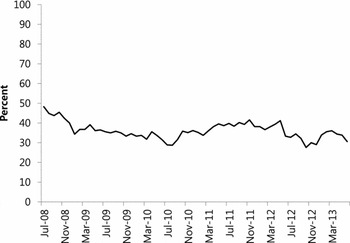
One hundred and twenty nine (44%) patients received antipsychotics concomitantly with anti-dementia agents at some point of time. Atypical antipsychotics accounted for 89% of all antipsychotic use, with risperidone being the most commonly used (67% of all antipsychotics), followed by quetiapine (11%) and olanzapine (11%). Haloperidol (9%) was the most commonly used conventional antipsychotic. Figure 1 shows that approximately one-third of people on anti-dementia medicines were concomitantly dispensed antipsychotics each month throughout the period.
Percent of people on anti-dementia medicines in residential aged care facilities using antipsychotics concomitantly for at least some time each month.

Incident use of antipsychotics in patients on anti-dementia medicines
There were 59 residents in whom antipsychotics were initiated while using anti-dementia medicines. Risperidone (N = 43, 73%) was the most commonly used antipsychotic agent for the initial choice, followed by quetiapine (N = 7, 12%) and olanzapine (N = 5, 9%). Eight of the initial risperidone users were switched to alternative antipsychotics (two quetiapine, two olanzapine, three haloperidol, and one aripiprazole) during the course of treatment.
Amongst persons for whom risperidone has been initiated (n = 35), 15 (43%) patients had doses of more than 0.5 mg/day for their initial dose. Seventeen (49%) patients maintained the initial dose throughout the period whilst two (6%) patients exceeded 2.0 mg/day for their maximum dose.
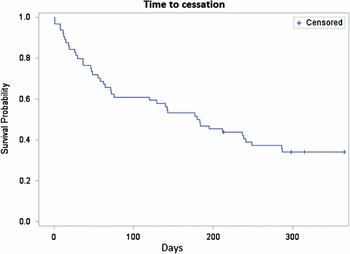
The median duration of the first treatment episode with antipsychotics in patients on anti-dementia medicines was six months (181 days, 95% Confidence Interval 71–249) (Figure 2). Three people were censored for death. While 39% received a short course of treatment (below three months), 53% continued to receive antipsychotics for more than six months. Of the patients for whom antipsychotic agent was initiated, five stopped treatment with the antipsychotics but it was then re-initiated after a gap in therapy of more than three months.
The duration of the first treatment episode with antipsychotics in patients receiving anti-dementia therapy in residential aged care facilities.

Discussion
This study showed that the concomitant use of antipsychotics with anti-dementia medicines in residents of aged care facilities was prevalent and that inappropriate use of antipsychotics was common in terms of the initial dose and excessive duration of treatment. For more than half of the residents, there was no evidence for downward dosage titration over time or trial periods of cessation despite recommendations that therapy not be continued beyond three months. In our study, a total of 44% of patients on anti-dementia medicines used antipsychotics concomitantly at some point of time. These results have significant implications for therapeutic outcomes in patients. In addition to the harms that can arise from antipsychotics, the co-administration of antipsychotics with anti-dementia medicines may lead to therapeutic failure of the anti-dementia medicines. Further, antipsychotics themselves can contribute to cognitive impairment, further exacerbating the problem. Studies have shown that antipsychotics can be safely withdrawn without worsening BPSD symptoms for the majority of patients (Declercq et al., Reference Declercq2013; Pan et al., Reference Pan, Wu, Gau, Chan and Banerjee2014), thus, mechanisms to support review and dose reduction or cessation are required.
Considering the method of determining people with dementia as those who were being administered anti-dementia drugs due to the lack of indication on diagnoses or degree of dementia, the study findings need to be interpreted with caution when they are compared with other studies on the use of antipsychotics in patients with dementia. Since people with dementia on anti-dementia drugs may have a different prevalence of BPSD with those not on such medication, it may affect the use of antipsychotics in people with dementia.
Our results are consistent with other studies of residential aged care facilities which have shown the prevalence of antipsychotic use in patients with dementia varied from 20% to 50% (Snowdon et al., Reference Snowdon, Day and Baker2005; Testad et al., Reference Testad2010; Wetzels et al., Reference Wetzels, Zuidema, de Jonghe, Verhey and Koopmans2011). Differences in antipsychotic use in residential aged care facilities appear to be related to structural and cultural differences between facilities rather than patient characteristics (Testad et al., Reference Testad2010). One study found that behavioral problems and environmental factors such as absence of a clock or calendar and telephone were associated with a higher likelihood of antipsychotic use, while other studies suggested that prescribing culture may contribute to antipsychotic use (Chen et al., Reference Chen, Briesacher, Field, Tjia, Lau and Gurwitz2010; Testad et al., Reference Testad2010).
Risperidone was the most commonly used antipsychotic agent in our study, followed by quetiapine and olanzapine. Olanzapine and risperidone have shown modest efficacy for the treatment of behavioral disturbances in patients with dementia with minimal adverse effects at lower doses and these two antipsychotics are recommended in Australian Medicine Handbook (Sink et al., Reference Sink, Holden and Yaffe2005; AMH, 2014). However, risperidone is the only atypical antipsychotic medication both approved by the regulatory authority, Therapeutic Goods Administration (TGA) and subsidized by the Pharmaceutical Benefits Scheme (PBS) in Australia for BPSD, which is likely to have contributed to its high use (Hollingworth et al., Reference Hollingworth, Siskind, Nissen, Robinson and Hall2010; TGA, 2010).
In our study, 43% of patients were initiated on a dose of risperidone of greater than 0.5 mg/day and 6% of patients exceeded 2.0 mg/day for their maximum dose. This indicates practice which is not consistent with the recommendation that dosing for risperidone in BPSD is 0.25 mg orally twice daily, increasing by 0.25 mg orally every two or more days until BPSD is controlled or the maximum dose of 2 mg per day is reached (AMH, 2014).
We found that although 40% of concomitant users received a short course of treatment of less than three months duration, approximately half were treated with antipsychotics for six months or more. These results raise questions about the appropriateness of both the choice of dose and the duration of use. Current recommendations emphasize that treatment should be time-limited and regularly reviewed. Further, antipsychotics are associated with significant serious adverse effects including hip fracture, pneumonia, stroke, and death (Pratt et al., Reference Pratt, Roughead, Ryan and Salter2010a; Pratt et al., Reference Pratt, Roughead, Ramsay, Salter and Ryan2010b; Pratt et al., Reference Pratt, Roughead, Ramsay, Salter and Ryan2011). While the risk of pneumonia due to antipsychotic use has been found to diminish with time, the risk of hip fracture is sustained with long term use, with one hip fracture likely to occur for every 12 to 15 patients who may benefit from treatment (Pratt et al., Reference Pratt, Roughead, Ramsay, Salter and Ryan2011). Thus, the long durations continue to place patients at risk of harm, whereas tapering therapy to check for symptom resolution may be a more appropriate option. One double-blind crossover study in the US found that symptoms of patients with dementia remained stable when they were withdrawn from the conventional antipsychotic agent, haloperidol (Cohen-Mansfield et al., Reference Cohen-Mansfield, Lipson, Werner, Billig, Taylor and Woosley1999), and other studies showed that most of patients with dementia could discontinue chronically prescribed antipsychotic agents safely with longer term follow-up finding a significant reduction in mortality compared to those who stayed on antipsychotic therapy (Ballard et al., Reference Ballard2008; Ballard et al., Reference Ballard2009). In Australia, the Senate Community Affairs References Committee report on the care of Australians living with dementia, released in 2014 (Weekes, Reference Weekes2014), contains recommendations for more judicious use of antipsychotics in people with BPSD, including review by the prescribing doctor every three months to assess the ongoing need for antipsychotics initiated in residents of aged care facilities. In 2015, the Australian TGA revised the indication for risperidone, limiting its use to short-term treatment (up to 12 weeks) of BPSD in patients with moderate to severe dementia of Alzheimer type (TGA, 2015). Risperidone is no longer indicated in the other dementia types.
One of strengths of our study is that the data are from individual patient unit dose packaging records, which allowed us to determine days on and off treatment. Therefore, the duration reported here are not likely to be overestimates, and reflect intent of use for every day of the duration episode.
This study had some limitations. First, since this study was based on unit dose packaging information, there was no clinical information on type of dementia or the indication for antipsychotic use available. Second, it is possible the study population may have included patients with psychiatric disorders, although a previous study showed that most residents of aged care facilities for whom antipsychotics were prescribed did not have a diagnosis of schizophrenia or other psychiatric disorders (Snowdon et al., Reference Snowdon, Day and Baker2005). Furthermore, since our study analyzed incident antipsychotic use in patients with dementia, use is likely to be because of BPSD rather than psychiatric disorders. Finally, while our data set was individually dosed packaged medicines, it is possible that omissions of therapy at the time of medication administration occurred.
In this study, the prevalence of concomitant use of antipsychotics with anti-dementia medicines in residential aged care facilities was high and there appeared to be inappropriate use of antipsychotic agents especially with regard to initial dose and excessive duration of treatment. Given the significant harms associated with antipsychotics in patients with dementia, including risk of pneumonia, hip fracture, stroke, and death, the use of antipsychotics in patients with dementia needs to be carefully monitored and reviewed, and discontinued wherever possible in order to improve patient outcomes.
Conflict of interest
None.
Description of authors’ roles
H. Shin designed the study and H. Shin and S. Gadzhanova performed the statistical analyses. HS, SG, E. Roughead, M. Ward, and L. Pont interpreted the results. HS drafted the manuscript. All authors critically reviewed and approved the final manuscript.
Acknowledgments
We would like to acknowledge Mr Gerard Stevens OA, and Webstercare for contributing to data collection and access.