Obstructive sleep apnea-hypopnea syndrome (OSAHS) is a chronic condition which, if untreated, is associated with increased daytime sleepiness, impairment of cognitive function and a reduction in health-related quality of life (HRQoL) (Reference Moyer, Sonnad, Garetz, Helman and Chervin27). Tests such as the apnea/hypopnea index (AHI) are widely used to diagnose OSAHS and to classify the severity of the condition. In addition, tests such as the Epworth Sleepiness Scale (ESS) are commonly used to measure daytime sleepiness. The symptoms of OSAHS can impact on the way people with OSAHS engage in work, home and leisure activities. In addition, OSAHS has been associated with an increased risk of road traffic accidents (RTA). Over the longer term, OSAHS may be a risk factor for hypertension, myocardial infarction and stroke (Reference Sassani, Findley and Kryger33).
An important option in the medical treatment of OSAHS is continuous positive airway pressure (CPAP) during sleep. Other treatment options for OSAHS exist, including dental devices, lifestyle advice, surgery or drugs; however, available evidence does not support the use of surgery or drugs (Reference Smith, Lasserson and Wright34;Reference Sundaram, Bridgman, Lim and Lasserson36). This study reports on the cost-effectiveness of CPAP compared with dental devices and lifestyle advice: treatments which are routinely available in the UK National Health Service (NHS).
The National Institute for Health and Clinical Excellence (NICE) has undertaken an appraisal of CPAP to assess its effectiveness and cost-effectiveness in the NHS (28). This study reports on research that was commissioned by the NHS Health Technology Assessment (HTA) Programme to inform the NICE technology appraisal. The full technical report of this research is available elsewhere (Reference Mc Daid, Griffin and Weatherly26).
Several studies have evaluated the cost-effectiveness of CPAP (Reference Ayas, FitzGerald and Fleetham2;Reference Chilcott, Clayton and Chada11;Reference Mar, Rueda and Duran-Cantolla24;31;Reference Tousignant, Cosio, Levy and Groome37). However, none of these included dental devices as a comparator, and none made use of the full range of trial evidence to estimate the cost-effectiveness of treatments for OSAHS or the impact of treatment on daytime sleepiness, blood pressure, HRQoL, and other relevant outcomes (266). A new, probabilistic cost-effectiveness model was, therefore, developed to address these limitations. Data on the long-term impact of OSAHS on HRQoL, cardiovascular events, RTA, and other outcomes were incorporated within the analysis.
METHODS
Overview
This study examines the costs to the NHS and the health outcomes associated with CPAP, dental devices and lifestyle advice. The economic evaluation methods that were used adhere to NICE's guidance on preferred methods for economic evaluation (29). Health outcomes were expressed in terms of quality-adjusted life-years (QALYs) over the expected lifetime of patients diagnosed with OSAHS and include effects of changes in sleepiness, blood pressure, RTA, and HRQoL. The base-case analysis considered a male cohort aged 50 years old: this reflects the average patient participating in the randomized controlled trials (RCTs) found in the systematic review that was conducted to inform the model (Reference Mc Daid, Griffin and Weatherly26).
Model Structure
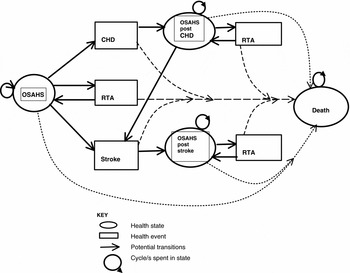
A Markov state-transition model was developed using yearly cycles (Reference Briggs, Claxton and Sculpher7). The model structure is illustrated in Figure 1. It characterizes the patient's prognosis over their lifetime based on four health states: OSAHS, OSAHS post-coronary heart disease (CHD), OSAHS post-stroke, and death. The model records the HRQoL of a hypothetical patient cohort in terms of their initial HRQoL, and any improvements resulting from a reduction in symptoms associated with treatment. The trial data describe the effect of treatment on blood pressure, which may in turn affect the incidence of CHD and stroke. The evidence suggests that interventions for OSAHS have a beneficial effect on sleepiness, which may in turn affect the risk of RTA, therefore, this event is also included in the model (Reference Mc Daid, Griffin and Weatherly26).
Economic model structure. OSAHS, obstructive sleep apnea-hypopnea syndrome; CHD, coronary heart disease; RTA, road traffic accidents.

Evidence Used in Model
The evidence used to estimate the parameters of the model includes RCT data obtained from a systematic review (Reference Mc Daid, Griffin and Weatherly26) and individual patient data from three RCTs (Reference Jenkinson, Stradling and Petersen22;Reference Pepperell, Ramdassingh-Dow and Crosthwaite30;Reference West, Nicoll, Wallace, Matthews and Stradling38), nonrandomized trials, modeling studies, analyses of administrative databases, and expert clinical opinion.
Additional searches were undertaken to estimate specific parameters of the model. MEDLINE was used to identify data on HRQoL studies, literature linking CVE, particularly stroke and CHD, to OSAHS; and literature linking RTAs to OSAHS (Reference Mc Daid, Griffin and Weatherly26). The nature of this evidence is described below.
Treatment Effects
NICE's methods guidance (29) indicates that the QALY is the health outcome measure of choice for assessing cost-effectiveness. QALYs are calculated by multiplying the length of time spent in a health state by a “HRQoL weight,” expressed on a 0 (equivalent to death) to 1 (equivalent to good health) scale, with negative values possible. NICE recommends that these HRQoL weights be derived from a validated, generic, preference-based measure of HRQoL, such as the EQ-5D (29). HRQoL weights and quality-adjusted survival were infrequently reported in the RCTs of CPAP: one trial reported EQ-5D scores based on a before and after analysis (Reference Chakravorty, Cayton and Szczepura9). A search of the literature identified four studies containing potentially relevant HRQoL data; however, none included dental devices and none linked the HRQoL weights to the information on clinical efficacy (Reference Chakravorty, Cayton and Szczepura9;Reference Jenkinson, Stradling and Petersen22;Reference Mar, Rueda and Duran-Cantolla24;Reference Tousignant, Cosio, Levy and Groome37). To make use of the RCT data, a link was made between measures of clinical effectiveness and two preference-based measures of HRQoL (SF-6D (Reference Brazier, Roberts and Deverill5;Reference Brazier, Usherwood, Harper and Thomas6) and EQ-5D). The trials did not report treatment effects for CVEs or RTAs.
Expressing Clinical Effectiveness in Terms of HRQoL
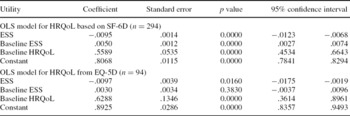
In the RCTs reviewed (Reference Brazier, Usherwood, Harper and Thomas6), the ESS was the most frequently reported measure assessing subjective sleepiness (n = 27 trials). Data on the mean difference in ESS were available for twenty-three RCTs comparing CPAP to placebo and six RCTs comparing CPAP to dental devices. To link change in ESS to change in HRQoL, three sets of individual patient data were obtained, two measuring ESS and the SF-36 profile (which incorporates the SF-6D) in the same patients (Reference Dolan, Gudex, Kind and Williams14;16) and one measuring these and the EQ-5D in the same patients (Reference Jenkinson, Davies, Mullins and Stradling21) The SF-36 data and EQ-5D data were translated into HRQoL weights based on existing algorithms which incorporate the preferences of the UK population (Reference Brazier, Roberts and Deverill5;Reference Dolan, Gudex, Kind and Williams14). The three datasets were used to develop prediction models for estimating the relationship between ESS and HRQoL weights based on SF-6D and the EQ-5D, respectively.
An increase of one point in ESS was associated with a reduction in HRQoL of 0.01 for both the SF-6D and EQ-5D instruments (see Table 1). There was no evidence for a change in the relationship between different levels of baseline ESS. The baseline HRQoL weight for the hypothetical patient population was predicted from the specified baseline ESS score. Changes in ESS associated with treatment were converted to changes in HRQoL (HRQoL increments) using the predicted relationship between ESS and HRQoL.
Predicting HRQoL Weights from ESS

HRQoL, health-related quality of life; ESS, Epworth Sleepiness Scale.
The HRQoL decrements associated with stroke (mean = −0.0524; SD = 0.0002), CHD (mean = −0.0635; SD = 0.0001), and age per year (mean = 0.0007; SD = 0) were based on a regression analysis reported by Sullivan and Ghushchyan (Reference Sullivan and Ghushchyan35). HRQoL decrements and increments can be applied to the baseline utility of the cohort to reflect the HRQoL associated with being in any health state in the model. The HRQoL associated with experiencing an RTA was based on EQ-5D data from the Health Outcomes Data Repository (HODaR) (mean = 0.62; SD = 0.27) (Reference Currie, McEwan, Peters, Patel and Dixon12).
The trial data were pooled to derive the overall effect of treatment on ESS. Subgroup analyses by baseline ESS score were conducted by pooling the trials grouped by average baseline ESS.
Linking Reduction in Blood Pressure to Cardiovascular Events
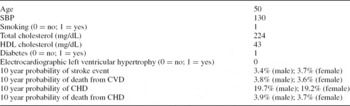
The Framingham risk equations were used to link the reported treatment effect on blood pressure and the incidence of fatal and nonfatal CVE. Systolic blood pressure (SBP) was selected as the primary measure of blood pressure for use in the model (Reference Anderson, Odell, Wilson and Kannel1). Risk equations were estimated separately by sex using the baseline characteristics of the hypothetical patient population (see Table 2), which were based on RCT data where possible or, alternatively, plausible assumptions. It was assumed that the only risk factor affected by use of CPAP was blood pressure.
Hypothetical Baseline Patient Characteristics for Use in the Risk Equations
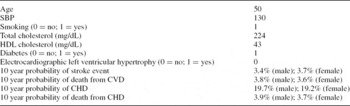
SBP, systolic blood pressure; HDL, high density lipoprotein; CVD, cardiovascular disease; CHD, coronary heart disease.
The relative risk reduction for CVE suggested by the difference in SBP with CPAP compared with lifestyle advice is estimated to be relatively low using the Framingham risk equations (RR ~= 0.98 for mean reduction in SBP of 1.06 mm Hg).
Estimating the Treatment Effect of Interventions on RTAs
The impact of CPAP on RTAs was based on the results of a meta-analysis of eight before and after studies (Reference Ayas, FitzGerald and Fleetham2), which was updated to include a subsequent study Barbe et al. (Reference Barbe, Sunyer and de la Pena3): the only additional study found. Log odds ratios were pooled by means of inverse variance weighting to give an odds ratio of 0.17 with variance 0.00098.
No studies were identified that assessed the impact of treatment with dental devices on RTAs. Therefore, an adjusted odds ratio for dental devices compared with lifestyle advice was estimated by applying the ratio of the treatment effects on ESS for CPAP and dental devices versus lifestyle advice to the odds ratio for RTAs for CPAP versus lifestyle advice.
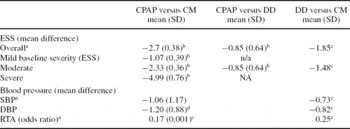
Patients left disabled following a first stroke were assumed to have no further risk of an RTA. The proportion of first strokes that were disabling was estimated as 31 percent (Reference Jones, Griffin and Palmer23). Scenario analyses were undertaken which excluded the risk of RTA to assess the impact on patients who do not drive. Table 3 summarizes the treatment effects used to populate the model.
Treatment Effects for Populating the Model

a Base-case analysis.
c Derived parameter.
b See Reference 26.
d Function of CPAP versus CM according to ratio of treatment effects on ESS.
e Update of Ayas meta-analysis (Reference Ayas, FitzGerald and Fleetham2).
CPAP, continuous positive airway pressure; CM; DD; ESS, Epworth Sleepiness Scale; SBP, systolic blood pressure; DBP, diastolic blood pressure; RTA, road traffic accidents.
Compliance
Most trial data were based on less than 12 weeks follow-up; therefore, long-term compliance with CPAP was estimated using observational data. McArdle et al. reported compliance over 6 years in a cohort of Scottish patients with a median age of 50 and an average ESS score at baseline of 12 (Reference McArdle, Devereux, Engleman and Haidarnejad25). The results indicated that 84 percent of patients continued to use CPAP 1 year after treatment initiation, and that compliance was steady after a period of 4 years with 68 percent of patients continuing treatment. The percentage of patients compliant at 2 and 3 years after treatment initiation was read from the survival curve (74 percent and 73 percent, respectively). These data were used to model the rate of discontinuation from years 1 to 4 in the model. Equivalent data on compliance were not available for dental devices, so compliance was assumed to be equivalent to compliance with CPAP. Patients discontinuing treatment were assumed to return immediately to the levels of ESS, SBP, and HRQoL associated with no treatment. For costing purposes, it was assumed that 90 percent of patients who discontinued treatment with CPAP returned their machine.
Mortality Rates
Supplementary Table 1 (available at www.journals.cambridge.org/thc) reports the parameters associated with CHD, stroke, and RTAs.
The age- and sex-specific mortality rates for individuals who have not experienced CHD or stroke were taken from UK life tables (http://www.gad.gov.uk). The all-cause mortality hazard was reduced by the proportion of people dying of CVD or ischemic heart disease (IHD) causes to obtain the hazard of death for non-CVD or non-IHD causes (Reference Chiang10). The risks of fatal CHD or stroke events were described by the Framingham risk equations for patients without previous CVE events. For patients who experienced nonfatal CHD or stroke, an elevated mortality rate was used, based on published relative risks. For CHD and stroke, relative risks of death of 3.2 (Reference Rosengren, Wilhelmsen, Hagman and Wedel32) and 2.3 (Reference Dennis, Burn and Sandercock15), respectively, were used.
Resource Use and Costs
The analysis was undertaken from the NHS and Personal Social Services (PSS) perspective. Costs comprised the costs of the interventions and the healthcare resources used due to stroke, CHD, and RTAs (see Supplementary Table 2) and were reported in 2005–06 prices.
The CPAP machine was estimated to have a device life of 7 years (31). Based on clinical opinion, the dental device was estimated to last for 2 years. The costs of the devices were expressed as equivalent annual costs (Reference Drummond, Sculpher, Torrance, O'Brien and Stoddart18) using an annual discount rate of 3.5 percent. Resource use data for treatment initiation with CPAP were entered probabilistically using data supplied by ResMed in their submission to NICE (31).
No published NHS costs of dental devices for the treatment of OSAHS were found and, therefore, this was estimated based on clinical opinion. It was assumed that the dentist provided a Thornton Adjustable Positioner (TAP): a device which is commonly used for the treatment of OSAHS in the United Kingdom. Based on the new NHS Dental Contract figures, the provision of TAP was calculated at £251. Based on clinical expert opinion, it was assumed that each year the patient would have a check-up appointment.
The cost of lifestyle advice was estimated as the cost of a one-off general practitioner consultation in which the patient receives advice on posture, dietary habits and lifestyle. Costs borne by the patient were not included, consistent with the perspective of the analysis. The costs associated with stroke and CHD were based on published estimates (Reference Bravo Vergel, Palmer and Asseburg4; Reference Briggs, Mihaylova and Sculpher8) The costs of RTAs were based on estimates from the Department of Transport (17).
Analysis
Cost-effectiveness results are expressed in terms of incremental cost-effectiveness ratios (ICERs); that is, the extra cost per additional QALY gained with more costly but more effective interventions. This can be compared with a cost-effectiveness threshold. NICE declares its threshold to be in the region of £20,000 to £30,000 per QALY gained (29), although it considers factors in addition to cost-effectiveness in its decision-making. To reflect uncertainty in the evidence base, probabilistic sensitivity analysis (PSA) was undertaken (Reference Briggs, Claxton and Sculpher7). This characterizes uncertainty in evidence in terms of probability distributions (Reference Briggs, Claxton and Sculpher7). Full details are available in the technical report (Reference Mc Daid, Griffin and Weatherly26) (http://www.hta.ac.uk/project/1592.asp) but, for example, uncertainty in probabilities and costs is expressed as beta and gamma distributions, respectively. The PSA allows the probability that each treatment represents the most cost-effective use of resources to be reported given currently available evidence (Reference Fenwick, Claxton and Sculpher20;Reference van Hout, Al and Gordon39). A probability of cost-effectiveness of 0.7 indicates that there is a 70 percent probability that the treatment is the most cost-effective given a cost-effectiveness threshold of £30,000 per QALY gained, or, alternatively, that the error probability is 0.3.
To inform future research priorities, the expected value of perfect information (EVPI) was calculated to quantify the value of eliminating all uncertainty through additional (perfect) research (Reference Briggs, Claxton and Sculpher7). Although, in practice, research cannot be undertaken to eliminate all uncertainty, EVPI provides a broad indication of the extent of the remaining uncertainty in the decision about the cost-effectiveness of CPAP. Furthermore, the EVPI can be compared with the potential cost of additional research to indicate whether there is potential value in further research to reduce uncertainty.
Subgroup analyses were undertaken to explore the influence of gender, OSAHS severity according to average baseline Epworth Sleepiness Score (ESS), and other baseline patient characteristics relevant to assessing the cost-effectiveness of each treatment. Secondary analyses were undertaken to explore the impact on cost-effectiveness of several modeling assumptions, including use of different outcomes (e.g., with and without RTAs) and various adjuncts to CPAP (e.g., a humidifier).
RESULTS
Base-Case Analysis
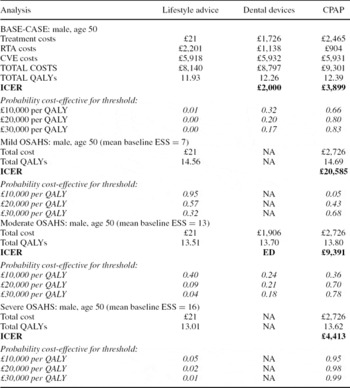
As seen in Table 4, CPAP was associated with higher costs and higher QALYs compared with treatment with dental devices or lifestyle advice. The main difference in costs related to the difference in treatment costs themselves. In a scenario where RTA costs were included, CPAP was cost saving relative to the other two treatments. In a scenario where CVE costs were included, they were very similar across the three treatments. The incremental cost per QALY gained with CPAP, compared with dental devices, using base-case assumptions and an assumed age of 50 years, was £3,899 for men and £4,335 for women. The probability of CPAP being more cost-effective than dental devices and lifestyle advice at a cost-effectiveness threshold of £20,000 per QALY was 0.78 and 0.80 for men and women, respectively.
Results of the Base-Case Analysis and a Subgroup Analysis by Baseline Severity of OSAHS as Measured by ESSa

a Note that all of the trials comparing CPAP to dental devices were classified as moderate OSAHS based on average baseline ESS.
OSAHS, obstructive sleep apnea-hypopnea syndrome; ESS, Epworth Sleepiness Scale; CPCP, continuous positive airway pressure; RTA, road traffic accidents; CVE,; QALY, quality-adjusted life-year; ICER, incremental cost-effectiveness ratio; ED, extended dominance; NA, not applicable.
On examining the treatment effects of CPAP by baseline severity, cost-effectiveness varies (see Table 4) with CPAP being most cost-effective in patients with severe OSAHS. CPAP has an ICER below a cost-effectiveness threshold of £20,000 at moderate and severe levels of OSAHS. The ICER for the mild severity subgroup was estimated at £20,585.
Secondary Analysis
There are a number of uncertainties over several of the modeling assumptions. Although ICERs for CPAP vary by different assumptions, they consistently fall below a threshold of £20,000 per QALY in patients with moderate and severe OSAHS. The largest effect on the CPAP ICER comes from applying the higher acquisition cost for the treatment using the costs of an auto-titrating positive airways pressure machine (APAP) and a humidifier.
Value of Information Analysis
The base-case per episode EVPI was estimated at £183 (male) and £202 (female) for a cost-effectiveness threshold of £20,000 per QALY. Assuming a lifetime for the technology of 5 years and incidence of OSAHS of 0.1 percent in the UK population aged between 16 and 65 (39 m) gives an effective population of 0.18 m (http://www.statistics.gov.uk/). This corresponds to a population EVPI of £33 m (male), which is the notional value of eliminating all uncertainty relating to the decision about whether CPAP is cost-effective. If this is considered to be greater than the cost of undertaking additional research, it suggests the research has potential value. When CVE and RTA events were excluded from the model, the population EVPI increases to £51 m, based on per episode EVPI of £277 in men.
DISCUSSION
When interpreting the results of the economic evaluation some caveats must be noted. The link between ESS and HRQoL weights was achieved through simple regression models derived from three sets of patient-level data. The data predominantly contained patients receiving CPAP. Only two outcome measures from the trial data were incorporated in the model. Potentially some other measures reported in the trials could impact on HRQoL independently of ESS. Trials are currently under way which include generic HRQoL instruments to provide a direct measure of preference-based HRQoL that could reflect any adverse effects from treatment. The effect of CPAP on reducing RTA was derived from observational studies. While it would not seem feasible to conduct an RCT to measure such a rare effect, it would be preferable to be able to link this information to that obtained in the systematic review. Some trials report the impact of CPAP on BP; however, this outcome is infrequently reported, and the trial durations are too short to directly measure the impact on CVE, therefore, estimated changes in CVE rates are inferred from other published risk equations. The uncertainty in linking the effect of ESS to utility and BP to CVE may be one reason why the EVPI is high, indicating that additional research may be valuable. Further analyses to establish which parameters are associated with the most value of information could be used to direct any additional research.
The majority of patients in the trials tend to be middle-aged men. It is unclear whether therapeutic benefits are similar in other groups, in particular, the elderly where other causes of cognitive impairment and cerebrovascular disease are more prevalent. Fewer outcomes relevant to the economic analysis were reported for the comparison of CPAP to dental devices, the relative benefits of which were only reflected in terms of ESS based on trial data for patients with moderate baseline ESS. Given the variety of devices represented in the trials it remains unclear as to what type of devices may be effective. The cost-effectiveness of dental devices compared with CPAP in mild and severe disease populations is also unclear. The estimates of cost-effectiveness of CPAP by baseline severity in OSAHS should be considered with caution. It was only possible to group trials by severity using average study-level data. Because it was not possible to estimate treatment effects on BP or RTA by baseline OSAHS severity, these effects were excluded from this subgroup analysis. As noted in Mc Daid et al., OSAHS is strongly linked to obesity (Reference Mc Daid, Griffin and Weatherly26); however, none of the relevant comparators demonstrated efficacy in terms of weight loss and reducing BMI, therefore, this was not included in the analysis.
The economic evaluation presented here is, to our knowledge, the first cost-effectiveness study to compare all relevant treatment options in the NHS and to reflect the implications for long-term costs and QALYs of a broad range of trial evidence on sleepiness. In addition, it explores a range of scenarios and quantifies decision uncertainty and the EVPI. The analysis presents reasonably strong evidence to suggest that, at a cost-effectiveness threshold of £20,000 per QALY, CPAP is cost-effective compared with dental devices or lifestyle advice with one exception: the mild baseline severity subgroup. The results were not sensitive to leaving CVE and RTA events from the model, thus the ESS is driving the cost-effectiveness. The probability of CPAP being more cost-effective than dental devices or lifestyle advice was high at the cost-effectiveness thresholds used by NICE. The finding that CPAP is cost-effective compared with a lifestyle intervention alternative is consistent with previously published comparable economic evaluations once the time frame is considered (Reference Ayas, FitzGerald and Fleetham2;Reference Chilcott, Clayton and Chada11;Reference Mar, Rueda and Duran-Cantolla24;31;Reference Tousignant, Cosio, Levy and Groome37. In summary, this analysis supports the use of CPAP in adults with moderate or severe symptomatic OSAHS, as reflected in the NICE guidance http://www.nice.org.uk/nicemedia/pdf/2008023SleepApnoea.pdf.
CONTACT INFORMATION
Helen Weatherly, MSc (hlw4@york.ac.uk), Research Fellow, Centre for Health Economics, Susan Griffin, MSc (scg3@york.ac.uk), Research Fellow, Centre for Health Economics, Catriona Mc Daid, PhD (cm36@york.ac.uk), Research Fellow, Centre for Reviews & Dissemination, Kate Durée, PhD (kr505@york.ac.uk), Research Fellow, Centre for Reviews & Dissemination, Centre for Health Economics, University of York, Heslington Road, York, YO10 5DD, UK
Robert J. O. Davies, DM (robert.davies@ndm.ox.ac.uk), Professor of Respiratory Medicine, John R. Stradling, DM FRCP (john.stradling@ohr.nhs.uk), Professor of Respiratory Medicine, Nuffield Department of Medicine, University of Oxford; Oxford Centre for Respiratory Medicine, Oxford Radcliffe Hospital, Headington, Oxford, OX 7LJ, UK
Marie Westwood, PhD (mew3@york.ac.uk), Senior Research Fellow, Centre for Reviews & Dissemination, Mark J. Sculpher, PhD (mjs23@york.ac.uk), Professor of Health Economics, Centre for Health Economics, University of York, Heslington Road, York, YO10 5DD, UK