Introduction
Central to the establishment of genebanks and other strategies to conserve plant genetic resources has been the concept of genetic erosion: the loss of variation in crops. Already Baur (Reference Baur1914) warned of the consequences of the disappearance of traditional landraces for the future of plant breeding (note that throughout this paper we have used the term ‘landrace’ to denote varieties developed and maintained by farmers. Other authors have used this term to include local varieties, traditional varieties or farmers' varieties). Harlan (Reference Harlan, Frankel and Bennett1970), one of the early contributors to the science of plant genetic resources, stated: ‘The varietal wealth of the plants that feed and clothe the world is slipping away before our eyes, and the human race simply cannot afford to lose it’. The reported loss in variation was mostly based on anecdotal evidence, with rather dramatic predictions about the future of genetic diversity. Frankel and Bennett (Reference Frankel, Bennett, Frankel and Bennett1970) referred to a ‘very real and immediate threat that the treasuries of variation in the centres of genetic diversity will disappear without a trace’ and Harlan (Reference Harlan1975) predicted a ‘genetic wipe out of centres of diversity’.
Although a genetic wipe out of centres of diversity has not occurred, modern cultivars have undoubtedly replaced many traditional varieties. However, the adoption rates of modern cultivars vary considerably between countries, regions and crops (Fig. 1). In the highly developed agricultural systems of North America and North-Western Europe, the replacement of traditional landraces of major field crops with cultivars had practically been completed when, in the 1970s, the Green Revolution in the developing world started. For example, in the United Kingdom, only a few historical landraces of cereals survived into the 20th century as most had already been replaced by cultivars before that time (Scholten et al., Reference Scholten, Maxted and Ford-Lloyd2006), and also in the Netherlands most landraces of field crops had disappeared by mid 20th century (van der Meer and van den Ban, Reference van der Meer and van den Ban1956). At present, in North America and North-Western Europe, landraces have become almost absent, while in developing countries the situation is rather different. In Southern Africa, for crops with relatively minor breeding activities such as sorghum and millets, only 14 and 15% of the total cultivated area was planted with improved cultivars in 1995/1996, respectively (Maredia et al., Reference Maredia, Byerlee and Pee2000). For crops with active, international and national breeding programmes, such as wheat, rice and maize, the adoption figures of modern cultivars are higher (Fig. 1). However, even for these crops, it is clear that very large areas are still planted with local varieties and that the predictions of a complete disappearance of landraces have not come true. Especially, in the major centres of genetic diversity, such as the Middle East, Ethiopia and the Andes, landraces are still common, even for crops with substantial breeding activities such as potato (Brush et al., Reference Brush, Kesseli, Ortega, Cisneros, Zimmerer and Quiros1995) and wheat (Bardsley and Thomas, Reference Bardsley and Thomas2005; Kebebew et al., Reference Kebebew, Tsehaye and McNeilly2001).
Uptake of modern varieties of several key crops by decade and region (after Evenson, Reference Evenson, Evenson and Gollin2003).

The conditions conducive to a rapid uptake of modern cultivars as present in the late 19th and early 20th centuries in North America and Western Europe do apparently not exist to a similar extent in other parts of the world. When modern plant breeding methods were developed, several countries in Western Europe already had a, for that time, highly developed agriculture, characterized by a labour and land intensive production system (van Zanden, Reference van Zanden1991), in which a specialized seed industry played an important role. This set the conditions for a rapid uptake of modern cultivars in these areas. In many other parts of the world, seed industries are less developed, and many farmers are subsistence orientated and use very little external inputs. Moreover, modern cultivars have not been able to meet the requirements of the many differing environments, cultural preferences and agricultural practices. As a consequence, the replacement of landraces with modern cultivars occurs in many areas at a slower rate than was envisaged in the early 1970s.
It is not just modern plant breeding efforts that are regarded as the cause of genetic erosion of crops. Genetic erosion may also be caused by the effects of urbanization and modern agricultural practices. Use of fertilizers, mechanization, irrigation, abandonment of marginal lands and crop specialization are all factors, which could lead to a loss of landraces because the habitat to which the landrace is adapted is no longer used or does no longer exist. Climate change and environmental degradation can also result in changed cropping patterns and disappearance of traditional varieties. Changes in food preferences of a growing urban population and a decreasing demand for local products may also add to the loss of diversity. Furthermore, natural disasters or human conflicts, which result in a large-scale displacement of farmers, can lead to the loss of the agricultural diversity that was used by the farmers involved (Richards and Ruivenkamp, Reference Richards and Ruivenkamp1997).
Although some are convinced that ‘plant breeding is a strong force in the reduction of genetic diversity’ (Gepts, Reference Gepts2006), and view the introduction of modern cultivars as evidence of genetic erosion (Bennett, Reference Bennett and Frankel1973), it remains unclear to what extent the onset of modern breeding efforts has really affected diversity levels in crops. Particularly in the last decade, encouraged by the availability of modern molecular tools, attempts have been made to quantify the level and impact of genetic erosion. The current study looks in detail at the concept of genetic erosion in crops, and how the concept of genetic erosion relates to the general diversity trends in crops. The different approaches in the recent literature to measure genetic erosion in crops have been reviewed. Two stages are recognized in this analysis: the initial replacement of landraces by cultivars and further trends in diversity as a consequence of modern breeding. The results are discussed and an attempt is made to distil general trends in crop diversity from the research results analyzed. Recommendations for future endeavours regarding the study of genetic erosion in crops are presented.
Genetic bottlenecks in crops
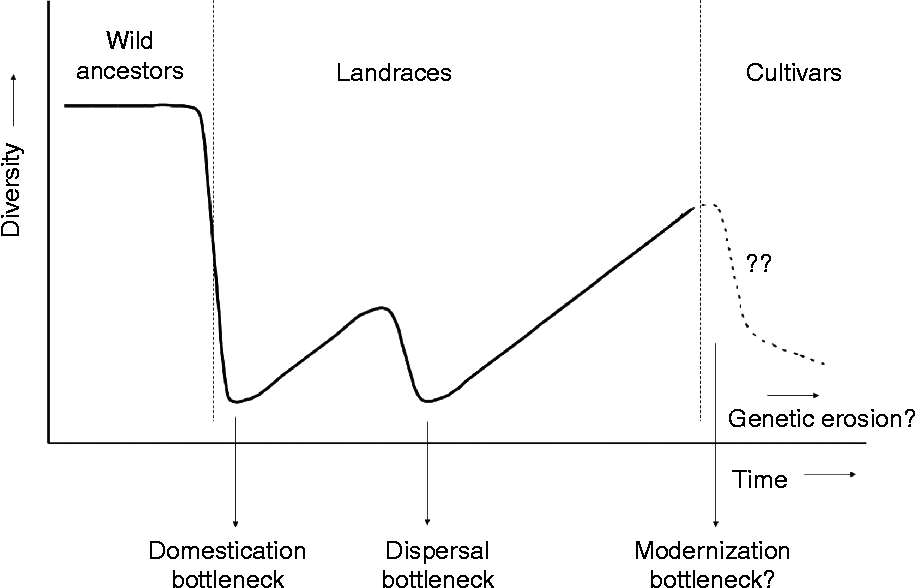
Several important events in the history of a crop led to the diversity levels found at present (Fig. 2). At the time of domestication, the species experienced a genetic bottleneck as only a subset of the diversity in the progenitor found its way into the domesticated species. This domestication bottleneck is caused by a process in which a small founder population experienced intense selection for agronomically desirable characteristics (Tanksley and McCouch, Reference Tanksley and McCouch1997). The severity of the domestication bottleneck must have varied much between different types of crops. Members of the grass family probably had large effective population sizes during the domestication process in most cases, as large quantities of grain are needed for subsistence, leading to less severe bottlenecks (Buckler et al., Reference Buckler, Thornsberry and Kresovich2001). The effective population size will have been relatively small in cases where polyploidization or specific mutations were involved in the domestication process. Aegilops tauschii Coss. shows considerable more genetic variation than what is found in the A. tauschii-derived D genome in hexaploid wheat (Lelley et al., Reference Lelley, Stachel, Grausgruber and Vollmann2000), pointing to a severe bottleneck in the development of bread wheat. Similar severe bottlenecks, involving hybridization events, have been reported for groundnut (Kochert et al., Reference Kochert, Stalker, Gimenes, Galgaro, Lopes and Moore1996).
Model of trends in diversity of crops from wild ancestors to modern cultivars.

In addition to a population bottleneck, directional selection will have reduced the diversity even further of those genes that are selected for during the domestication process. For several crops, key domestication genes, such as those regulating fruit size, have been identified (Theissen, Reference Theissen2002; Zeder et al., Reference Zeder, Emshwiller, Smith and Bradley2006). For example, in maize a very severe loss in diversity was found in putative domestication genes (66–100%), in addition to an average diversity loss of only 20% in the other genes studied as a result of domestication (Tenaillon et al., Reference Tenaillon, U'Ren, Tenaillon and Gaut2004). Similarly, in glutinous rice the waxy locus showed a reduced nucleotide variation compared to other, unlinked genes in the rice genome (Olsen and Purugganan, Reference Olsen and Purugganan2002). It is unknown whether recombination typically limits the effect of selection to a small genomic region or whether large genomic regions are ‘dragged along’ with selected genes (Doebley et al., Reference Doebley, Gaut and Smith2006). There are some indications that in maize, apart from the domestication genes, relatively few other genes have been affected (Clark et al., Reference Clark, Linton, Messing and Doebley2004; Palaisa et al., Reference Palaisa, Morgante, Tingey and Rafalski2004), while for rice it has been suggested that strong selection has affected genome-wide polymorphism patterns (Caicedo et al., Reference Caicedo, Williamson, Hernandez, Boyko, Fledel-Alon, York, Polato, Olsen, Nielsen, McCouch, Bustamante and Purugganan2007).
Besides a domestication bottleneck, a bottleneck caused by the dispersal of the crop may have occurred as well (Fig. 2). This secondary bottleneck can be even more severe than the domestication bottleneck if only a few individuals become disseminated around the world (Zeder et al., Reference Zeder, Emshwiller, Smith and Bradley2006). Recent examples of dispersal bottlenecks are the introduction of soybean to North America (Hyten et al., Reference Hyten, Song, Zhu, Choi, Nelson, Costa, Specht, Shoemaker and Cregan2006) and the introduction of coffee to South America, which can be traced back to one single tree (Purseglove, Reference Purseglove1974). A dispersal bottleneck may be so severe that it limits breeding progress. For example, the rupture of the South Asian bottleneck of lentil has provided a new scope to the improvement of lentil (Erskine et al., Reference Erskine, Chandra, Chaudhry, Malik, Sarker, Sharma, Tufail and Tyagi1998).
For crops with a high naturally occurring gene flow between the domesticates and their wild relatives, diversity in the genes that are not selected for could increase gradually after the initial reduction in diversity as a result of the domestication and dispersal bottlenecks. Farmers do select and use introgressed types (Jarvis and Hodgkin, Reference Jarvis and Hodgkin1999). As a consequence, the diversity found in landraces often increased after the initial bottleneck, sometimes to near similar levels as found in the wild species, as has been observed for eastern Mediterranean barley landraces (Jana and Pietrzak, Reference Jana and Pietrzak1988) and in Mexican Capsicum annuum (Hernandez-Verdugo et al., Reference Hernandez-Verdugo, Luna-Reyes and Oyama2001). For crops where gene flow with wild relatives is absent, diversity must have increased much slower after the initial bottlenecks, as in these cases a diversity increase necessarily depended on de novo generated variation. However, de novo generated variation, such as through mutations and recombinations, can make an important contribution to a crop's diversity (Rasmusson and Phillips, Reference Rasmusson and Phillips1997).
The possible presence of a ‘modernization’ bottleneck (Fig. 1) as a consequence of scientific breeding and modern agriculture is the subject of the present study. Genetic erosion is referring to a reversal of the trend of increasing diversity after the domestication and dispersal bottlenecks. Similar to what happened during domestication, two different effects may have contributed to a reduced diversity in new cultivars: a population bottleneck due to the utilization of a limited number of landraces as the basis for the development of new cultivars, and a reduced diversity due to directional selection in new ‘key modern breeding genes’. Among these modern breeding genes are the genes responsible for a reduced response to gibberellin which resulted in the dwarfing character of the Green Revolution crop types (Peng et al., Reference Peng, Richards, Hartley, Murphy, Devos, Flintham, Beales, Fish, Worland, Pelica, Sudhakar, Christou, Snape, Gale and Harberd1999).
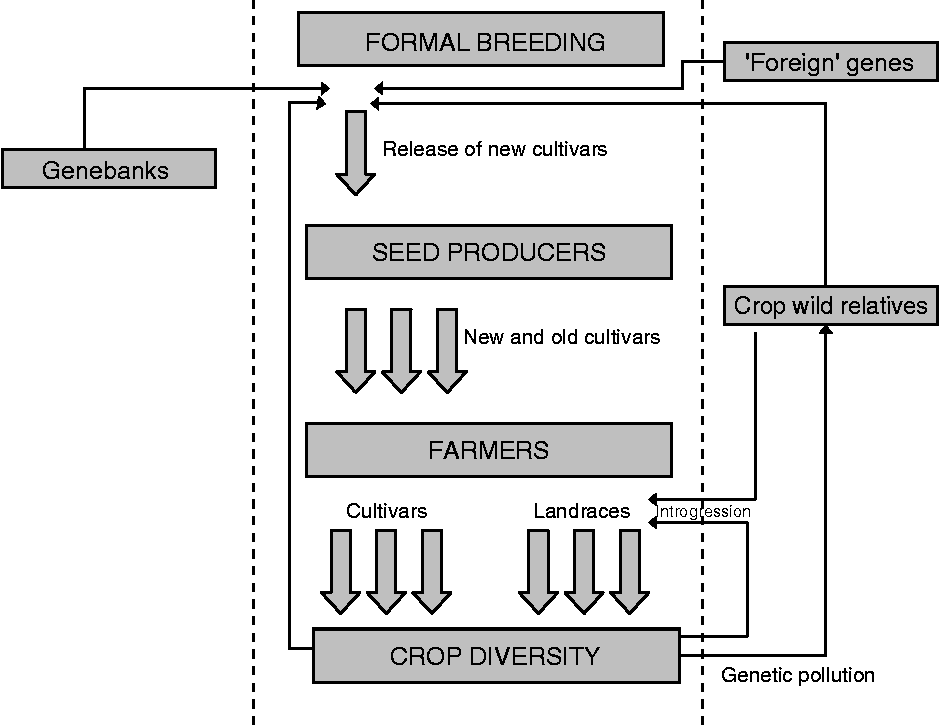
Two phases in the modernization bottleneck can be distinguished, the initial replacement of landraces with modern cultivars, and the further trends in crop diversity as a result of new cultivar releases. Landraces and cultivars differ in their access to sources of new alleles (Fig. 3). Landraces can gain new diversity through introgression of alleles from wild relatives, other landraces or cultivars. In addition, breeders can, using modern techniques, incorporate genes from taxa which are genetically more distant from the crop species. Moreover, through the use of genebanks and through international exchange, breeders can have access to germplasm from a much wider geographic area than farmers. Although most breeders have access to a wider source of diversity than farmers do, their more stringent selection for specific traits and the requirements for uniformity and stability might still cause a decrease in diversity. Also, as a result of the transition to a formal breeding system, a relatively low number of breeders replace a multitude of farmers in the generation and maintenance of diversity.
The interaction of cultivars and landraces with sources of new alleles.

Genetic erosion of crops: a definition
It is not exactly clear when the term genetic erosion was first coined, but probably some time in the 1960s it was first used to describe the process of the loss of genetic diversity in agriculture (Pistorius, Reference Pistorius1997). The diversity in crops consists of the crops, landraces and cultivars grown by farmers (Fig. 3). For the purpose of this paper, we did not consider ex situ collections to contribute directly to the crop diversity, just as zoos may be considered not to contribute to the biodiversity of a country, although they may function as an important back-up and a source for re-introduction and restoration of genetic diversity. The concept of genetic erosion in agriculture can be applied at three different levels of integration: at crop level as an impoverishment in the assemblage of crops used in agriculture, at the level of varieties of a specific crop or at the level of alleles.
In the literature, three different views on methods to quantify genetic erosion can be found:
(1) Genetic erosion as an absolute loss of a crop, variety or allele (e.g. Peroni and Hanazaki, Reference Peroni and Hanazaki2002; Gao, Reference Gao2003; Tsegaye and Berg, Reference Tsegaye and Berg2007; Willemen et al., Reference Willemen, Scheldeman, Cabellos, Salazar and Guarino2007). The use of an absolute loss as evidence of genetic erosion ignores the dynamic nature of a farming system and population genetic processes. This approach only looks at what has been lost, and not at what has replaced this lost material.
(2) Genetic erosion as a reduction in richness (e.g. Hammer et al., Reference Hammer, Knupffer, Xhuveli and Perrino1996; Hammer and Laghetti, Reference Hammer and Laghetti2005; Ford-Lloyd, Reference Ford-Lloyd, Ford-Lloyd, Dias and Bettencourt2006; Nabhan, Reference Nabhan2007). A reduction in richness (that is a reduction in the total number of crops, varieties or alleles) is a better indicator for genetic erosion, as it does recognize the dynamics in the system. A reduction in richness is always accompanied by an absolute loss, but an absolute loss does not necessarily imply a reduction in richness, as a loss may be compensated for by novel diversity. A drawback in the use of richness as a criterion for genetic erosion is that very rare varieties or alleles contribute as much to the diversity as the most common varieties or alleles, and therefore richness might only poorly reflect increased levels of uniformity in agriculture. Also, the level of richness found depends to a large extent on the intensity of the investigation. A more detailed survey will most likely yield a larger number of varieties or alleles and thus shows a higher level of richness.
(3) Genetic erosion as a reduction in evenness (e.g. Khlestkina et al., Reference Khlestkina, Huang, Quenum, Chebotar, Roder and Borner2004; Ford-Lloyd, Reference Ford-Lloyd, Ford-Lloyd, Dias and Bettencourt2006). Genetic erosion as a reduction in evenness originates from the diversity indices used in vegetation ecology and population genetics, such as Shannon's index (Maughan et al., Reference Maughan, Saghai Maroof, Buss and Huestis1996) or Nei's gene diversity index (Nei, Reference Nei1973), respectively. Diversity is measured using the frequencies of alleles within a group of genotypes or using the production areas of landraces, cultivars or crop species in a region. Diversity levels are lowered due to increasing dominance of a single or small number of crop species, genotypes or alleles, even though alleles or varieties are not necessarily lost. Using evenness, rare varieties or rare alleles contribute little to the diversity. The risks of losing alleles or varieties are higher when distributions are very skewed. Using evenness as a measure for genetic erosion offers the opportunity to take action before a reduced diversity results in an absolute loss and reduced richness. Furthermore, it is not as sensitive to the sampling procedure as compared with the previous measures. Considerable overlap between these three views on genetic erosion exists, and most studies use a combination of the different approaches.
The use of the concept of genetic erosion is not limited to the field of crop diversity. Genetic erosion equates genetic impoverishment and this concept is also applied to conservation ecology and animal husbandry, as the genetic impoverishment of a species or a population. Genetic erosion in ex situ collections may occur due to the loss of accessions or loss of alleles as a result of regeneration and storage practices (Parzies et al., Reference Parzies, Spoor and Ennos2000).
Analysis of genetic erosion at different levels of integration
Genetic erosion: the loss of crop species
Genetic erosion as reflected in the assemblage of crops used in agriculture was also recognized by Harlan, as he stated (without providing supporting data): ‘The number of crops we grow has been declining steadily’ (Harlan, Reference Harlan1975). A trend towards regional crop specialization as agriculture develops is well established (Kurosaki, Reference Kurosaki2003), a process resulting in a reduced evenness and richness in crop species at a regional scale. To what extent this has also resulted in a reduced richness in the crop assemblage at a larger scale is not known. Currently over 900 cultivated plant species, of which the vast majority was never strongly domesticated, are thought to be endangered and 14 species are reported to have disappeared from agriculture (Hammer and Khoshbakht, Reference Hammer and Khoshbakht2005). At the same time, new species are still being domesticated: the highbush blueberry was domesticated as late as the 20th century (Boches et al., Reference Boches, Bassil and Rowland2006) and also macadamia nuts were domesticated at that time (Hammer and Khoshbakht, Reference Hammer and Khoshbakht2005). The net effect of the disappearance and new domestication on the richness of the world's crop assemblage are not known, but there is as yet no evidence for a strongly reduced richness.
In several cases, crop species once thought to be threatened with extinction have found a new niche with the cultivation areas again expanding. Changing climates and changing consumer preferences have given new potential to species once thought to be redundant. Quinoa (Chenopodium quinoa Willd.) has now found a new niche due to its lack of gluten (Bonifacio, Reference Bonifacio2003) and cultivation of maca (Lepidium meyenii Walp.), a once threatened tuber crop from the Andes, is rapidly expanding due to its alleged health benefits and medicinal properties (Brinckmann and Smith, Reference Brinckmann and Smith2004).
Although modern agriculture has been blamed as one of the causes of genetic erosion, the increased yields of the staple crops as a result of modern agriculture might actually have freed land for other crops, as has happened in many countries in Asia, where the share of rice in the total harvested crop area has declined since the 1970s and crop diversity as expressed in levels of evenness has increased (Dawe, Reference Dawe2003).
Varietal erosion
Genetic erosion as a loss of varieties (landraces and cultivars), sometimes described as varietal erosion (Sperling, Reference Sperling2001), has been studied by many authors. The focus of most of these studies has been the transition stage in which landraces were replaced by modern cultivars.
Two approaches to quantify the loss of landraces have been used. The first approach is a comparison of the number of landraces or botanical varieties found in an area during collection missions at two different times (Ochoa, Reference Ochoa, Frankel and Hawkes1975; Hammer et al., Reference Hammer, Knupffer, Xhuveli and Perrino1996; Buerkert et al., Reference Buerkert, Oryakhail, Filatenko and Hammer2006). A possible problem with this approach is that a more intensive survey might yield more landraces, and it may be difficult to copy the approach of the original collection mission. A second approach is interviewing farmers about landraces formerly grown in the area (Peroni and Hanazaki, Reference Peroni and Hanazaki2002; Tsegaye and Berg, Reference Tsegaye and Berg2007; Willemen et al., Reference Willemen, Scheldeman, Cabellos, Salazar and Guarino2007). In all these studies, evidence for genetic erosion as reflected in a decrease in the number of landraces or botanical varieties was found. However, the cultivars that were introduced to the farming system in the studied period were ignored. Therefore, these studies do not make it clear if indeed the total richness of the crop as expressed in the sum of traditional and introduced varieties used has been reduced. Landraces and heirloom cultivars are important as documents of the history of agriculture and form part of our bio-cultural heritage, but a loss of such varieties does not necessarily lead to erosion of the genetic diversity of the crop or to the reduction of the diversity in a region. Throughout history, there has always been a loss and gain of new landraces by exchange of seeds between areas and through selection of promising variants by farmers. When a landrace is lost, the characters or alleles present in that landrace might still be found in other cultivars or landraces, albeit in different combinations.
There are several problems with using the number of varieties (landraces or cultivars) as a basis for studying genetic erosion. It is not always clear how distinct landraces or cultivars really are. Strong gene flow between villages has been demonstrated for maize in Mexico (Pressoir and Berthaud, Reference Pressoir and Berthaud2004). Farmers often single out one character to identify a landrace, and through positive mass selection they ensure that this character is maintained, even in the presence of high gene flow between populations (e.g. ear type in Mexican maize, Louette and Smale, Reference Louette and Smale2000). Landraces that are grown in the same region will then be rather similar genetically, except for the character(s) for which the farmers select. For crops with a significant gene flow, a reduction in the number of landraces may not necessarily affect diversity levels much and in many cases it would be preferable to refer to landrace groups. It seems likely that many of the 400,000 varieties of rice which used to exist in India, and which number was reduced to 30,000 by the mid 19th century (Lopez, Reference Lopez1994), were genetically closely related.
The addition of improved cultivars with a foreign origin to a group of closely related landraces could actually increase local diversity levels and also be a source of new, advantageous genes for these local landraces. However, some authors consider that genetic erosion has taken place as soon as new alleles are introduced through introgression from advanced cultivars into traditional landraces (Ishikawa et al., Reference Ishikawa, Yamanaka, Fukuta, Chitrakon, Bounphanousay, Kanyavong, Tang, Nakamura, Sato and Sato2006), as the original genotype will then have changed. However, this ignores the dynamic nature of the management of landraces by farmers. Even without introgression from advanced cultivars, a current landrace will not remain genetically identical to that same landrace a decade ago, due to constant farmer selection and incorporation of new alleles.
The dynamics of diversity in a clonal crop are very different from seed-propagated crops. The process of farmer's selection and adaptation of clonal crops to a local environment is targeted directly towards the genotype and not towards alleles as is the case in seed-propagated crops. For landraces of clonal crops, perhaps the unique combination of alleles as represented in a genotype and hence the diversity at the level of varieties are of more value, as a clonal landrace has a stable character and may be maintained for many generations. For some clonal species, it will be easier to obtain new clones by using seeds than for others (e.g. potatoes vs. bananas), and the dynamics and options for selection by farmers will differ much between species. Using isozymes to study diversity in Peruvian potato landraces, it was found that even on a single farm almost all alleles found in the region were present, while for individual genotypes this was not the case, with many clones showing a very restricted distribution (Brush et al., Reference Brush, Kesseli, Ortega, Cisneros, Zimmerer and Quiros1995). The impact of a loss of genotypes will in this case not affect the allelic diversity and richness very much. When farmers have very limited possibilities of selecting new clones, such as for banana or garlic, varietal erosion might have much more serious effects and is more likely to result in the loss of important alleles.
The identification of landraces is not without pitfalls. Introduced cultivars adopted by farmers are often renamed with local names (Jusu, Reference Jusu1999), the information about their origin might subsequently have been lost, and the varieties might be viewed by farmers as ‘traditional’. At the same time, landraces with the same name might in fact be different, as that name might only be a reflection of a limited number of characters, and landraces with different names might be identical, as was found for example with landraces of enset (Negash et al., Reference Negash, Tsegaye, van Treuren and Visser2002). A simple counting of numbers of landraces or cultivars without information about their genetic background or diversity is therefore not sufficient to draw conclusions about the occurrence of genetic erosion.
Genetic erosion reflected in pedigrees
Pedigree studies have been used in an attempt to overcome some of the problems in assessing diversity based on varieties. Using information on ancestors, these studies estimated the distinctness of cultivars and the extent to which old landraces are present in the pedigree of modern cultivars (Souza and Sorrells, Reference Souza and Sorrells1989; Dobrotvorskaya et al., Reference Dobrotvorskaya, Martynov and Pukhalskyi2004; Martynov et al., Reference Martynov, Dobrotvorskaya and Pukhalskiy2005; Martynov et al., Reference Martynov, Dobrotvorskaya and Pukhalskiy2006). The calculated diversity indices of groups of cultivars are based on the frequencies of the original ancestors in the pedigrees. The results of these studies show that diversity in the released cultivars has either been maintained, or has increased in the last 50–80 years. A large proportion of the local landraces disappeared from the pedigree of the released cultivars, but these were replaced by foreign material resulting in maintenance of diversity levels. The loss of local landraces from the pedigrees is viewed by the authors as evidence of genetic erosion (Dobrotvorskaya et al., Reference Dobrotvorskaya, Martynov and Pukhalskyi2004; Martynov et al., Reference Martynov, Dobrotvorskaya and Pukhalskiy2005, Reference Martynov, Dobrotvorskaya and Pukhalskiy2006). However, as local diversity levels were maintained, the results did not point towards genetic erosion at a regional level, while a conclusion about genetic erosion at a global level can only be made if it can be demonstrated that this lost material harboured unique characters that are not present in other areas or varieties.
A discrepancy or a low correlation is found between the diversity values obtained using molecular markers and using pedigree information (Soleimani et al., Reference Soleimani, Baum and Johnson2002; Almanza-Pinzon et al., Reference Almanza-Pinzon, Khairallah, Fox and Warburton2003). Pedigree studies suffer from some methodological flaws as they ignore selection pressures and assume the parental contributions to be equal. In addition, pedigree studies assume the original ancestors to be unrelated, which lead to overestimation of the diversity (Soleimani et al., Reference Soleimani, Baum and Johnson2002). Furthermore, pedigree studies depend on the availability and reliability of pedigree information, which for many crops are often rather limited. A further bias is introduced since the more recent cultivars will have better pedigree information and therefore more ancestral parents in their pedigree. Pedigree studies do demonstrate that breeders are able to harness variation from a wide range of sources (Smale et al., Reference Smale, Reynolds, Warburton, Skovmand, Trethowan, Singh, Ortiz-Monasterio and Crossa2002), which suggests that the modernization bottleneck cannot be simply characterized as a population bottleneck, resulting from the use of a limited number of original ancestors as the basis of new cultivars.
Allelic erosion
The development of molecular techniques in the last decades has made it possible to study genetic erosion at the level of alleles. The drawbacks of studying genetic erosion at the level of varieties or using pedigree information are overcome by looking into more detail at the genetic make up of the genotypes. Allelic richness is important for the survival of a species as a significant loss of alleles can affect the evolutionary potential of even common species (Ellstrand and Elam, Reference Ellstrand and Elam1993), and allelic richness is important for breeders as a basis for the continuous improvement and adaptation of the crop. Diversity in both nuclear and cytoplasmic DNA is important (Levings, Reference Levings1990; Kik et al., Reference Kik, Samoylov, Verbeek, Van Raamsdonk and Mitochondrial1997).
Monitoring of genetic erosion should focus on those alleles that are locally common. Globally common alleles are highly unlikely to be in danger of disappearance, while alleles with a low frequency in a population can be lost and gained quite easily. The loss and gain of rare alleles are part of normal population-genetic processes and although sometimes even the disappearance of rare alleles is considered as genetic erosion (Portis et al., Reference Portis, Acquadro, Comino and Lanteri2004), the disappearance of rare alleles is too common an event to be a true reflection of genetic erosion. In contrast, an allele that is locally common is likely to be involved in adaptation to the local environment, agricultural practices or consumer preferences. It has a good chance of being a useful allele and the disappearance of a possibly useful allele from the gene pool is certainly a loss, even if it is compensated by the gain of another useful allele. Landraces with a long history of farmers' selection and adaptation to specific agricultural and cultural niches are likely to be an important source of these locally common alleles, and therefore efforts to conserve these landraces are certainly warranted.
The modernization bottleneck
Replacement of landraces with modern cultivars
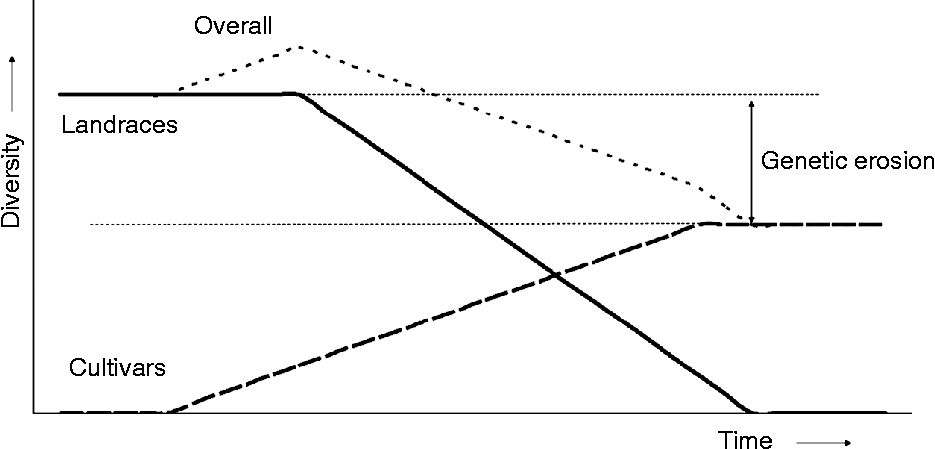
The first stage in the modernization bottleneck possibly leading to genetic erosion is the replacement of landraces by modern cultivars (Fig. 4). The replacement of landraces with modern cultivars is a gradual process, and the length of the transition period will vary much between crops and regions. In developing countries, the replacement of landraces is currently in progress, while in North America and many European countries for many crops landraces have become absent and only modern cultivars are grown by farmers. The first cultivar introduced in an area will not immediately displace landraces, and therefore it is likely that the total diversity will initially show an increase, especially if the introduced cultivar is of a foreign origin. In the early stages, the contribution of the cultivars to the total diversity will be minor, while in the latter stages the landrace contribution will become small. For studying trends in diversity during the process of replacement of landraces with cultivars, the total diversity at a certain time period should be taken into account. A possible modernization bottleneck due to the replacement of landraces by cultivars would be reflected in a higher diversity of the landraces before the introduction of cultivars when compared to the diversity of the cultivars after the replacement with the landraces is completed.
Model showing suggested trends in diversity of a crop during the replacement of landraces by cultivars.

Studies that compare groups of landraces with sets of cultivars mostly show a reduction in both richness and evenness of alleles (e.g. Roussel et al., Reference Roussel, Koenig, Beckert and Balfourier2004; Reif et al., Reference Reif, Zhang, Dreisigacker, Warburton, van Ginkel, Hoisington, Bohn and Melchinger2005b; Hao et al., Reference Hao, Zhang, Wang, Dong, Shang and Jia2006b; Nersting et al., Reference Nersting, Andersen, von Bothmer, Gullord and Jorgensen2006; Thomson et al., Reference Thomson, Septiningsih, Suwardjo, Santoso, Silitonga and McCouch2007; Warburton et al., Reference Warburton, Crossa, Franco, Kazi, Trethowan, Rajaram, Pfeiffer, Zhang, Dreisigacker and van Ginkel2006). In one study no difference in the level of diversity between landraces and cultivars was found (Hyten et al., Reference Hyten, Song, Zhu, Choi, Nelson, Costa, Specht, Shoemaker and Cregan2006). This study, on soybean, is however a special case, as the landraces had not locally evolved but had been introduced to the area.
The assumption in many of these studies is that landraces preceded cultivars, although in reality over a substantial period, early cultivars and landraces will have been grown side by side. Also, in these studies the groups of landraces are all lumped together, without indication of the era in which they were grown and then compared to groups of cultivars released during a very limited time span. It is often not clear what stage in the transition period between landraces and cultivars is being studied and if the landraces preceded the studied cultivars or were contemporary (Yang et al., Reference Yang, Maroof, Xu, Zhang and Biyashev1994; Fu et al., Reference Fu, Diederichsen, Richards and Peterson2002; Reif et al., Reference Reif, Zhang, Dreisigacker, Warburton, van Ginkel, Hoisington, Bohn and Melchinger2005b; Hao et al., Reference Hao, Zhang, Wang, Dong, Shang and Jia2006b). In cases where contemporary landraces and cultivars are compared for their diversity (Prashanth et al., Reference Prashanth, Parani, Mohanty, Talame, Tuberosa and Parida2002; Thomson et al., Reference Thomson, Septiningsih, Suwardjo, Santoso, Silitonga and McCouch2007), the diversity differences found might be more a reflection of the stage of development of agriculture than of a possible genetic erosion, as the contribution of cultivars to the total diversity will increase as the replacement of landraces by cultivars advances (Fig. 4).
Most studies compare landraces and cultivars that originate from the same region in order to get an indication of the level of genetic erosion in that region. In several studies, the group of landraces and cultivars compared does not have a relation with each other, as they originate from entirely different areas (Fu et al., Reference Fu, Diederichsen, Richards and Peterson2002; Reif et al., Reference Reif, Zhang, Dreisigacker, Warburton, van Ginkel, Hoisington, Bohn and Melchinger2005b). This need not be problematic if the samples of landraces and cultivars were selected as representative for the total (global) diversity within landraces and cultivars, respectively (e.g. Reif et al., Reference Reif, Zhang, Dreisigacker, Warburton, van Ginkel, Hoisington, Bohn and Melchinger2005b; Warburton et al., Reference Warburton, Crossa, Franco, Kazi, Trethowan, Rajaram, Pfeiffer, Zhang, Dreisigacker and van Ginkel2006).
The observed loss of alleles in the comparison of landraces with cultivars might be partly due to the elimination of deleterious or unwanted alleles. Plant breeding may lead to a reduction in allelic diversity owing to purifying selection rather than erosion of possibly useful genetic variation (Allard, Reference Allard1996). It is not clear what part of a reduction in the allelic diversity in the transition from landraces to cultivars could be due to purifying selection, and therefore it is not clear to what extent the observed genetic erosion would constitute a problem.
Studies on the development of the total genetic richness and diversity for areas where both landraces and modern cultivars are grown side by side are very rare. The comparison of accessions from collection missions at different times (Hammer et al., Reference Hammer, Knupffer, Xhuveli and Perrino1996; Khlestkina et al., Reference Khlestkina, Huang, Quenum, Chebotar, Roder and Borner2004; Barry et al., Reference Barry, Pham, Beavogui, Ghesquiere and Ahmadi2008; Bitocchi et al., Reference Bitocchi, Nanni, Rossi, Rau, Bellucci, Giardini, Buonamici, Vendramin and Papa2009) does offer the opportunity to study the two temporal groups in detail for genetic diversity and distinctness. Using this approach no change in diversity levels, but a change in allelic composition in the wheat varieties collected in four regions in Europe and Asia over a 40–50 year time span was found (Khlestkina et al., Reference Khlestkina, Huang, Quenum, Chebotar, Roder and Borner2004). However, usually the focus of collection missions is on landraces, and not on the advanced or early cultivars that might also have been cultivated in the same period. A comprehensive view on the genetic erosion that has taken place will then still be difficult to attain since only one side of the coin has been properly studied. As most germplasm collections have been carried out in the last 50 years, information on modern cultivars that were grown during the time of the historic collection might still be available from other sources than the collection mission reports, and so it might still be possible to get a more complete overview of the crops' diversity.
A comparison of rice genetic diversity in villages in Guinea between 1979 and 2003 did also include improved varieties besides landraces (Barry et al., Reference Barry, Pham, Beavogui, Ghesquiere and Ahmadi2008). This study demonstrated an enhanced allelic richness and significant changes in allelic composition as a result of the introduction of cultivars. However, the enhanced richness might have been caused by the larger number of varieties collected in 2003, raising the possibility that the older collection (which had limited data) was not exhaustive. Also in a study on potato in Peru, where landraces and cultivars are grown side by side, it was concluded that genetic erosion has probably been insignificant (Brush et al., Reference Brush, Kesseli, Ortega, Cisneros, Zimmerer and Quiros1995). The mere fact of introduction of modern cultivars does not automatically lead to a genetic impoverishment of landraces. The alleles introduced by modern cultivars were not taken into account in this study, and these will probably have increased both the overall allelic richness and diversity of the potato varieties grown in the region. Both the Guinean rice study and the Peruvian potato study seem to indicate that in the early stages of the replacement of landraces by modern cultivars, the total diversity levels in the region might increase.
Diversity trends in modern breeding
The second stage in the modernization bottleneck is reflected in the diversity trends in cultivars after the replacement of traditional landraces by modern cultivars has been completed. Genetic erosion could then occur if the cultivars grown by farmers are increasingly similar to each other and/or the total number of different cultivars grown is reduced. The most common approach used to study diversity trends in modern breeding is the comparison of the genetic diversity of groups of cultivars with different release dates using a diverse array of molecular techniques. Results from studies using this approach vary considerably. Some studies showed a decrease in diversity over time (Fu et al., Reference Fu, Peterson, Scoles, Rossnagel, Schoen and Richards2003; Reif et al., Reference Reif, Hamrit, Heckenberger, Schipprack, Maurer, Bohn and Melchinger2005a; Hao et al., Reference Hao, Wang, Zhang, You, Dong, Jia, Liu, Shang, Liu and Cao2006a; Malysheva-Otto et al., Reference Malysheva-Otto, Ganal, Law, Reeves and Roder2007), while others observed diversity increases (Fu et al., Reference Fu, Peterson and Morrison2007; White et al., Reference White, Law, MacKay, Chalmers, Smith, Kilian and Powell2008) or a dip in the diversity levels after which an increase occurred (Roussel et al., Reference Roussel, Koenig, Beckert and Balfourier2004; Qi et al., Reference Qi, Zhang, Zhang, Wang, Sun, Wei, Qiu, Tang, Cao, Wang and Li2006). The diversity levels found can fluctuate strongly from one time period to the next (e.g. Christiansen et al., Reference Christiansen, Andersen and Ortiz2002; Tian et al., Reference Tian, Zhou and Jia2005; White et al., Reference White, Law, MacKay, Chalmers, Smith, Kilian and Powell2008). A meta analysis using these and other papers on the diversity trends as a result of modern breeding showed that overall no substantial reduction in diversity has occurred (van de Wouw et al., Reference van de Wouw, van Hintum, Kik, van Treuren and Vissersubmitted). A significant reduction in genetic diversity in the 1960s was observed, but even here the observed reduction in diversity was only 5%, and indications are that after the 1960s and 1970s breeders have been able to again increase the genetic diversity as released in cultivars.
The recovery of diversity after the 1960s might reflect the greater use of exotic germplasm and crop wild relatives in the breeding process. In addition, the breaking of a domestication bottleneck by using advanced breeding techniques such as synthetic hybrids in wheat (Warburton et al., Reference Warburton, Crossa, Franco, Kazi, Trethowan, Rajaram, Pfeiffer, Zhang, Dreisigacker and van Ginkel2006) might have been partly instrumental in increasing the total diversity.
Most studies focus on the diversity released by breeders during a certain period (the top arrow in Fig. 3), with the assumption that what is released by breeding programmes is a reflection of what is grown by farmers. However, breeding programmes are not always able to meet the requirements of the farmers (Palladino, Reference Palladino1990). On the other hand, a successful cultivar will be grown for many years, and so does not only contribute to the diversity of the crop in its year or decade of release. For crops with a high turn over of cultivars and a good take up by farmers using the time of release of the cultivar would better reflect diversity trends than for crops where cultivars are grown for many years and farmers and breeders are not very innovative, unless the time periods compared are very long. Also, the focus on time of release will reflect the level of activity in breeding of the crop studied and not necessarily reflect the diversity available to farmers. Little diversity will be released during periods with little breeding activity, even though the total number of cultivars available to farmers and the diversity levels of the planted crop might not have changed.
Le Clerc et al. (Reference Le Clerc, Cadot, Canadas, Lallemand, Guerin and Boulineau2006) included all varieties present in the official lists during a decade and not just the cultivars newly released during that period. This approach probably provides a better reflection of the total diversity that is available to farmers. If all cultivars that are made available to farmers by the seed producers in a period are included (the middle arrows in Fig. 3), the resulting diversity can be higher than if only the new releases are included, as for example was found for wheat in Argentina (Manifesto et al., Reference Manifesto, Schlatter, Hopp, Suarez and Dubcovsky2001).
In most of the studies on allelic diversity in cultivars, evenness as a measure for diversity is used in a different way than at variety level, as it looks at the frequency of the alleles in the germplasm studied and does not take the relative importance, that is acreage, of the germplasm into account. Information on the acreages on which specific cultivars are grown is often very difficult to find, as statistics are usually collected on a crop basis, and not on a variety basis. For the more recent past this information is occasionally available, and as a result the picture regarding genetic erosion can change considerably. Using weighted coefficients reflecting the area grown by farmers between 1973 and 1993, a reduction in Australian wheat genetic diversity was found, mostly due to the choice of variety by the farmers and not so much due to the diversity released by breeders and available to farmers (Brennan and Fox, Reference Brennan and Fox1998).
In studying trends in allelic richness, equal sample numbers (Martos et al., Reference Martos, Royo, Rharrabti and del Moral2005; Roussel et al., Reference Roussel, Leisova, Exbrayat, Stehno and Balfourier2005) or methods to correct for unequal sample numbers, such as rarefaction methods (Roussel et al., Reference Roussel, Koenig, Beckert and Balfourier2004; Fu et al., Reference Fu, Peterson, Richards, Somers, DePauw and Clarke2005, Reference Fu, Peterson, Yu, Gao, Jia and Richards2006; Le Clerc et al., Reference Le Clerc, Cadot, Canadas, Lallemand, Guerin and Boulineau2006; Huang et al., Reference Huang, Wolf, Ganal, Orford, Koebner and Roder2007; Malysheva-Otto et al., Reference Malysheva-Otto, Ganal, Law, Reeves and Roder2007), have been used. Although methods to correct for different sample sizes of large populations are commonly used in ecology, in the studies reported here such methods are less appropriate. The group of cultivars in a certain time period may be rather limited and might vary substantially during different time periods, and therefore for studying trends in total allelic richness it is essential to know how many varieties were present in a certain period and what proportion of these varieties were used in the samples studied. Le Clerc et al. (Reference Le Clerc, Cadot, Canadas, Lallemand, Guerin and Boulineau2006), who were able to study all cultivars that were available in a certain period, found in their study an increased total number of alleles for both garden peas and maize over time, while the allelic richness after rarefaction showed a small (not significant) decrease. This decrease was however more than compensated for by the larger number of cultivars in the variety lists in the more recent period.
Although a new gene introduced in a crop should increase its overall richness, it might actually be counter effective, if this new gene becomes very popular and all farmers switch to the cultivars with this new gene (Smale, Reference Smale1997). This has happened in Australia with new midge-resistant sorghum hybrids, which were planted by more than 80% of the farmers. The move to these hybrids was associated with a narrowing of genetic diversity (Jordan et al., Reference Jordan, Tao, Godwin, Henzell, Cooper and McIntyre1998).
Genetic erosion at a regional and global scale
Although genetic erosion is often presented as a global issue, it is most often studied at a regional scale. In recognizing genetic erosion regionally, it is understood that what is happening with the diversity of a crop in a region will affect the global richness of the crop or might be extrapolated to global events.
Ancient dispersal bottlenecks could have led to distinct diversity at different locations. By using germplasm from other regions, breeders can contribute strongly to the removal of a dispersal bottleneck. This could lead to a higher similarity of the germplasm in the various regions and genetic erosion at the global scale. One of the factors contributing to genetic erosion is the push for uniformity, a result of a development in which centralized breeding institutes of a limited number of breeding companies produce varieties that can be grown across different ecosystems and localities (Heal et al., Reference Heal, Walker, Levin, Arrow, Dasgupta, Daily, Ehrlich, Maler, Kautsky, Lubchenco, Schneider and Starrett2004). In regions and countries with strong breeding programmes, improved cultivars may have evolved gradually from local germplasm. In Italy close links have been demonstrated between old and new wheat cultivars, while in Spain old wheat cultivars have been replaced by foreign material, resulting in the loss of the link between old and new cultivars (Martos et al., Reference Martos, Royo, Rharrabti and del Moral2005). In the latter case, any regionally unique alleles that might have been present in the original germplasm will have been lost in the process, even though the levels of diversity were maintained in the region. Therefore, maintenance of diversity at a regional scale is no conclusive argument for the lack of genetic erosion in a crop at the global level.
A reduced regional diversity might lead to a reduction in evenness and richness on a global scale, making the total gene pool more vulnerable to loss and extinctions. However, a decrease in diversity levels in a specific region does not necessarily result in genetic erosion at a larger geographical scale. In Australian wheat, no change in diversity (using coefficients of parentage) was observed at the national level, although in some states a narrowing of the genetic base was observed (Brennan and Fox, Reference Brennan and Fox1998). Similarly, in a study on barley diversity in the Nordic and Baltic countries, a decrease in the allelic diversity was observed in some of the countries studied, while overall diversity levels were maintained (Kolodinska Brantestam et al., Reference Kolodinska Brantestam, von Bothmer, Dayteg, Rashal, Tuvesson and Weibull2004).
It seems clear that a simple extrapolation of regional events to global trends is not warranted. Only if diversity and similarity are compared among several regions that form a representative sample of the crops' global gene pool, one can make predictions about the occurrence of genetic erosion at a global scale.
Regional maintenance of diversity is important in its own right to reduce vulnerability to pests and diseases and to increase resilience to adverse weather conditions. Several infamous examples exist where due to genetic uniformity of a crop severe yield losses occurred. The potato blight epidemic in the 1840s in Ireland is perhaps the most well known, as it caused, together with the social conditions at the time, the death or displacement of 25% of the Irish population (Fraser, Reference Fraser2003). Other, more recent examples are the Southern corn leaf blight incident, which devastated maize production in the USA in the 1970s (Lopez, Reference Lopez1994) and the failure of the wheat crop in the Ukraine due to adverse weather conditions in 1972 (Fowler and Mooney, Reference Fowler and Mooney1990). Also uniformity at the crop level is important at a regional scale: an increased area under cultivation of a single crop can have negative impacts on the natural biocontrol of pests in other crops (Landis et al., Reference Landis, Gardiner, van der Werf and Swinton2008). Maintaining regional levels of diversity is also important for economical reasons: a country with a large dependence on just one crop makes that country vulnerable to price drops at the international markets.
Conclusions and recommendations
Genetic erosion in cultivated species is a complex process, and although it does seem very likely that genetic erosion occurred as agriculture developed, sound scientific evidence supporting this hypothesis is difficult to find. Studies on the transition from landraces to cultivars often have a genetic resources perspective and mostly focus on what has been lost, and not at what has replaced this lost material, while studies with a breeder's point of view tend to focus on the supply side and formal sector of field crops in the developed world, and not look at what happens at the farmer's level.
It is fairly easy to study the genetic diversity and richness of a crop as it is now, but in order to obtain estimates on the genetic erosion that might have taken place, it will also be necessary to obtain information on the genetic diversity that was available in the past. Since the historic information and material are often no longer available, this limits genetic erosion studies. It is however essential that the available historic information should be used as fully as possible. It is important that it is clear how well the landraces and cultivars selected for the study represent a certain era and region. Germplasm collecting missions with extensive and complete datasets might be able to offer a baseline for a future study on possible genetic erosion, although a lack of information on the cultivars that were also used at the time of collection, but were not included in the survey, will always make it difficult to get a complete picture on the trends in crop diversity.
Genetic erosion in a crop as reflected in allelic richness and evenness appears to be the most useful definition, but this has to be viewed in the context of events occurring at the variety level. Using pedigree analyses to infer genetic erosion suffers from too many flaws to be useful. New developments emerging from studies on diversity trends and bottlenecks during domestication should be followed closely by those researchers interested in genetic erosion, as many parallels between the two subject areas exist and as a result similar approaches might be used in genetic erosion studies.
Despite the limitations and drawbacks of the various studies reviewed in this paper, they do point to one most likely scenario in diversity trends within crops as a result of the modernization of agriculture. The first modern cultivar introductions seem to have led to an initial regional increase in diversity (if these cultivars had at least partly a foreign origin), after which a reduction in diversity occurred when the disuse of certain landraces increased until the transition from landraces to cultivars was completed. After the completion of this transition, no further reduction in diversity seemed to occur, although a small dip in the diversity levels of cultivars during the 1960s has been observed. More research would be needed to confirm this scenario. Most of the studies reviewed in this paper have focussed on field crops, and it is not clear whether the same diversity trends would be apparent in horticultural crops. In general, it is important that trends in a crop's diversity are monitored, as even subtle reductions in diversity could gradually lead to a severe genetic erosion.
To what extent the global diversity of crops has been affected by genetic erosion is not known, but it appears that a sudden and substantial collapse in diversity has not occurred, as that would have been fairly easy to demonstrate. Most genetic erosion studies took a regional perspective, and for extrapolation of the findings to global events it is necessary to find the origin of the new genes that were introduced by the cultivars. In particular, if regionally common alleles are replaced by globally common alleles useful variation might get lost and lead to an impoverishment of the crop's gene pool. In addition to the cultivated types, the primary gene pool of a crop contains also the crop wild relatives (Harlan and de Wet, Reference Harlan and de Wet1971). Also these wild relatives need to be taken into account to obtain a complete view on a possible reduction of diversity in the crop's primary gene pool.
Genetic erosion of crops has been mostly associated with the introduction of modern cultivars. It is not clear whether an active breeding programme, with many new releases, contributes to maintaining a certain level of diversity, or if an active breeding programme is counter effective and actually hastens a potential process of genetic erosion. The threat of genetic erosion as a result of the modernization of agriculture is perhaps the highest for crops for which no breeders' interest exist. Crop species that cannot meet changing demands by farmers and consumers become neglected and farmers will abandon such species in favour of more promising crop species. Special attention to the conservation of threatened crop species and their associated diversity should be given, as curators tend to ignore these minor species and germplasm collections of these underutilized crops are often very limited in size and scope (IPGRI, 2002). Also, breeding efforts in these minor crops should be encouraged, so that these crops will keep their place in farming systems and the food chain, while agriculture modernizes.
The vulnerability of the crops due to uniformity is as much related to the choice of variety and species by the farmers, as it is by the number and nature of varieties offered by the breeders. Both play a key role in combating uniformity. Farmers should be encouraged to diversify and not all select the same cultivars and species, while breeders need to ensure that farmers can choose from a wide range of locally adapted cultivars with a diverse genetic base.
Acknowledgements
This project was financed by the Netherlands Ministry of Agriculture, Nature and Food Quality.