

1 Introduction
In a world with gains from specialisation, transport costs may reduce the benefits of trade and retard economic growthFootnote 1. Gallup et al. (Reference Gallup, Sachs and Mellinger1999), for example, found that coastal regions and those linked to coasts by ocean-navigable waterways are strongly favoured in development in comparison with their hinterlands. Other articles also indicate that geography and transport costs affect trade and economic growth (Rousslang and To Reference Rousslang and To1993; Eaton and Kortum Reference Eaton and Kortum2002; Overman et al. Reference Overman, Redding and Venables2003).
Historical evidence has been useful for analysing the economic effects of transport costs and technological innovations in transportation over long periods of time. In particular, the economic impact of railroads in the 19th and early 20th centuries has received much attention in the literature. Rostow (Reference Rostow1962), for example, indicated that «the introduction of the railroad has been historically the most powerful single initiator of take-offs. It was decisive in the United States, Germany and Russia…» (Rostow Reference Rostow1962, p. 302). Fremdling (Reference Fremdling1977), Price (Reference Price1975) and Metzer (Reference Metzer1974) also support the hypothesis that railroads played an important role for economic growth in Germany, France and Russia, respectively. Fogel (Reference Fogel1962, Reference Fogel1964, Reference Fogel1979), however, argues that pre-rail modes of transportation in the United States were not necessarily associated with high transport costs, and therefore the construction of railroads in the 19th century did not yield large social savingsFootnote 2.
In the case of Latin America, historical studies support the hypothesis that transportation costs were high in the pre-rail era and that the construction of railroads led to large social savings. Coatsworth (Reference Coatsworth1979) indicates that in Mexico, before the railroad, waterways were not available in the habitable regionsFootnote 3, and thus freight was transported by wagon or on the backs of animals and men. The construction of railroads then reduced time and money transport costs, increasing trade and market integration (Dobado and Marrero Reference Dobado and Marrero2005). Similarly, for Brazil, Leff (Reference Leff1972) and Summerhill (Reference Summerhill2005) indicate that prior to the construction of railroads, waterways were not widely used for transportation and the conditions of the terrain were poorFootnote 4. As a result, transport costs from the agricultural regions to the largest markets were high. In addition, McGreevey (Reference McGreevey1971) and Hoernel (Reference Hoernel1976) also indicate that railroads played an important role in reducing transport costs and promoting economic growth in Colombia and Cuba, respectively.
Overall, it seems that prior to railroads, the availability of waterways provided a low cost mode of transportation. Transportation in wagons or on the backs of animals and men was more expensive. The impact of railroads on transport costs depended on the existence of waterways: if waterways were not available, the impact of railroads on transportation costs was large.
For Peru, some studies have analysed the role of transportation costs in the mining sector in the Central Andes and the interaction between the railroad and the traditional system of mules and llamas. According to Miller (Reference Miller1976), railroads played an important role for the mining sector in the central highlands of Peru but yielded small effects in other sectors, in particular agriculture. More recently, Contreras (Reference Contreras2004) and Deustua (Reference Deustua2009) also indicated that the construction of railroads facilitated the expansion of mining production, especially copper, in the Central AndesFootnote 5.
In this article, I examine the system of transportation in the 19th and early 20th centuries in Peru and analyse the effect of geography and transport infrastructure on transport costs, trade and economic growth during this period. The main objective of this study is to explore to what extent the transportation system of Peru contributed to the slow growth of the Peruvian economy during this period. This article is one of the few studies on the history of transportation in Peru and may help to understand the impact of geography and transport infrastructure on economic growth in a backward economy.
The study of transportation in Peru for this period is crucial for explaining the sluggish record of economic growth of this country. Peru is a special case, because it had a poor economic performance in spite of its favourable factor endowments. Contemporary observers described the abundance of natural resources, especially agricultural and mineral (Ledesma and Bollaert Reference Ledesma and Bollaert1856; Markham Reference Markham1874). In spite of the abundance of natural resources, in the early 20th century, income levels of Peruvians were among the lowest in the region. High transport costs may constitute one possible explanation for the sluggish economic performance of Peru during this period.
The structure of the paper is as follows: Section 2 describes the geography, transport infrastructure and modes of transportation in the 19th and early 20th centuries. Section 3 reports some estimates on freight rates for using roads, railroads and the sea. Section 4 reports some estimates on time costs for the different modes of transportation. Section 5 discusses the possible effects of transportation costs on trade and economic growth in Peru during this period. Section 6 concludes the paper.
2 Roads, railroads and waterways
In this section, I will provide an overview of the geography, transport infrastructure and modes of transportation of Peru during the 19th and early 20th centuries. As I will show, geography and the lack of infrastructure imposed severe obstacles to transportation during this period.
On the coast, geography and weather generated great challenges for transportation. The coast was largely constituted by large plains of sandFootnote 6, which made the traction of wheels and even the work of horses and mules very difficult. These difficulties made journeys seem longer than they wereFootnote 7. Moreover, the heat in the desert could be deadly for the traveller and his horse, which meant that travellers preferred to travel at night in order to avoid the heat, although they ran the risk of straying off course when there was no moonlightFootnote 8. Freight was carried in wagons or directly on the backs of horses and mules (Deustua Reference Deustua2009). Horses were faster than mules in regular conditions. However, in the extreme conditions of the sandy, dry Peruvian deserts, mules were probably better than horsesFootnote 9. Even on the Lima–Callao route, traffic was «unthinkable without mule trains» (Waszkis Reference Waszkis1993, p. 137).
The sea became an alternative means of transportation for coastal towns. With the introduction of steam navigation in the 1840s, travel along the coast was not affected by ocean currents and wind, and travellers enjoyed a faster and safer mode of transportationFootnote 10. Coastal towns could then engage in trade by using the sea as a means of transportation. However, navigation faced some difficulties. For instance, with the exception of Callao, the main Peruvian port, the other coastal ports lacked proper installations to facilitate trade: they were simply natural ports (Contreras Reference Contreras2004)Footnote 11.
In the highlands, geography and inadequate transport infrastructure made transportation even more difficult than on the coastFootnote 12. Long, steep ascents, deep canyons, almost vertical hillsides and narrow roads made transportation very difficult and almost impeded the use of the wheel. In the 1890s, Ernst Middenford observed that the geography of the Andes was never as complex as in Peru. The terrain was rarely flat, with the exception of the plateau of Titicaca and the valleys of Jauja and Vilcanota in the most populated regions (Middenford Reference Middenford1974, p. 10, Vol. III). Deep precipices and narrow roads made travel very dangerous. Roads were, in fact, so narrow that in some places two mules could not pass at the same time. In addition, during the rainy season (December-April), communication could be completely haltedFootnote 13.
In the highlands, freight was carried on the backs of mules and llamas. Mules had some advantages and disadvantages in comparison to llamas. One of the advantages of mules is that they could carry up to 300 pounds, whereas llamas could not carry more than 125 pounds, and even 100 pounds was usually considered a full load (Hills Reference Hills1860, p. 101). Mules were then more appropriate for carrying heavy items. In addition, mules were faster than llamas: mules could cover as many as 35 miles per day, whereas llamas could only manage 15 miles at the most. Finally, mules could stand the heat of the coastal desert, whereas llamas could not. For journeys to or from the coast, then, mules were required for at least part of the route. On the other hand, llamas were better suited than mules for the difficult terrain and weather of the AndesFootnote 14, and did not require much care since they were mostly fed from any herbage, which lowered their maintenance costs (Cisneros Reference Cisneros1906, p. 124).
As a result of the differences between mules and llamas, mules were better for transporting heavy cargo on long journeys. Llamas were better for transporting smaller amounts of freight on short journeys in the highlands. In mining, for example, prior to the construction of the Central Railway, llamas were better for transporting minerals from a large number of mines in the Central Andes to the main mining haciendas where the minerals were concentrated, whereas mules were used for transporting minerals from those haciendas to Callao. On the coast, mules had to be used for even short journeys because llamas could not stand the heat in the sandy deserts.
One important drawback of Peru's topography is that rivers were not navigable in the habitable regions. Rivers flowed from the highlands to the Pacific coast, but they were not appropriate for navigation. Navigable rivers existed only in the jungle, which was mostly uninhabitedFootnote 15. Jones (Reference Jones1927) indicated that the lack of navigable rivers imposed enormous trade handicaps. «… No large navigable rivers offer routes into the interior and other means of entering the mountain zone are not easily providedFootnote 16.»
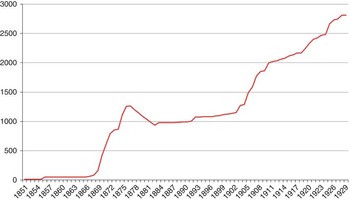
Peruvians could also use railroads for transportation from the mid-19th century, but only for a few routes. Railroads were built from the 1850s, starting with the Lima–Callao railroad. The abundance of fiscal revenues in the 1850s and 1860s allowed the government to expand the railway network (Figure 1). The length of the railway system increased from 60 miles in 1865 to 415 miles in 1870 and 1,113 miles in 1875. However, the decline in guano exports from the mid-1870s, the defeat in the War of the Pacific (1879-1883) and the consequent economic crises in the 1880s and 1890s paralysed railroad construction. The length of the railway system actually declined to 937 miles in 1883 and then increased to only 993 miles in 1890 and 1,118 miles in 1900.
Railroad length (in miles)
Source: Extracto Estadístico (1939).

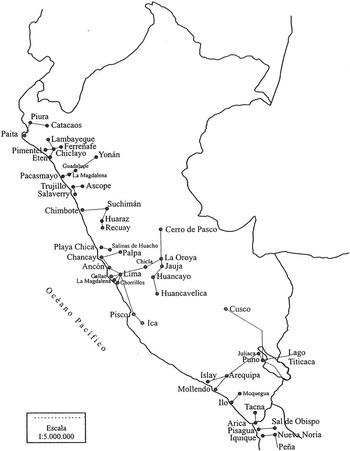
A large number of towns were not connected by railroads in the early 20th century (Figure 2). Dávalos y Lissón (Reference Dávalos Y Lissón1919) indicated that, according to a study by the engineer Tizón y Bueno, in the 1910s there were around 10,000 towns in Peru and that only 300 of them were connected by railroad. Similarly, Milstead (Reference Milstead1928) indicated that railroad infrastructure was very deficient not only in the highlands, but also on the coast. According to Milstead, in the early 1920s primitive transportation facilities persisted in around 85 per cent of the country. Only 2,018 miles of steam railroads and 100 miles of street and interurban lines were in operation in 1924. Although some railways had been constructed in the 1850s, there was no integrated railway network (Milstead Reference Milstead1928, p. 68). Most towns depended largely on the traditional system of mules and llamas.
Map of Railroads in Peru, 1930
Source: Deustua (2010, p. 191).

A comparison with other countries indicates that Peru had a relatively low level of railway coverage. In 1913, Peru only had 0.7 miles of railway track per 1,000 inhabitants. In contrast, the corresponding figure for Argentina was 4.3 miles. Other countries with at least 1 mile of railway track per 1,000 inhabitants were Brazil, Chile, Costa Rica, Cuba, Mexico, Panama and UruguayFootnote 17.
Therefore, geography and the lack of proper transport infrastructure imposed challenges on Peruvians in the 19th and early 20th centuries. Transportation along the coast and in the highlands was a difficult task. Several sources largely agree on the difficulties of travelling in the arid sandy desert or the steep Andes Mountains, and on the lack of proper port installations and of navigable rivers in the habitable regions. The construction of railroads, which started in the mid-19th century, probably made transportation faster and less costly. However, by the early 20th century only a few miles had been built. In these circumstances, time and money transport costs for most Peruvians must have been high.
3 Freight rates
This section reports some estimates of freight rates for overland and sea transportationFootnote 18. As indicated previously, the geography and transport infrastructure in Peru imposed some difficulties on transportation. Freight rates, then, must have been highFootnote 19.
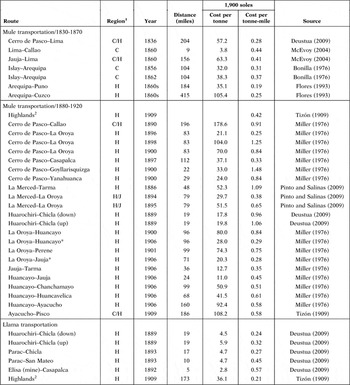
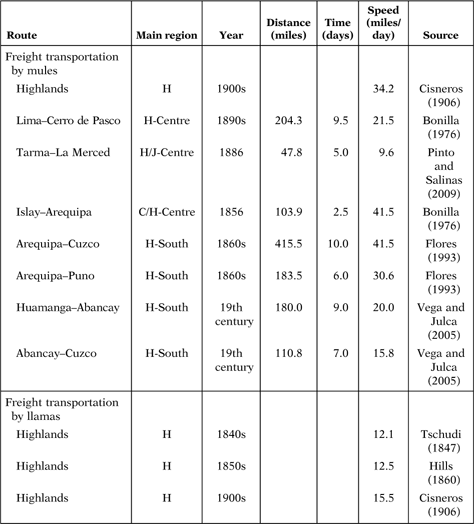
Let us start with the analysis of the traditional system of animal transportation. Table 1 reports freight rates for using mules and llamas. There was great disparity in freight rates between different routes, regions and dates. However, it is possible to locate some patterns that will allow us to identify some of the determinants of freight rates.
Freight Rates of the Traditional System of Overland Transportation

Notes: Freight rates are in 1,900 soles.
1C: coast, H: highlands, J: jungle.
2Tizón (Reference Tizón1909) reports freight-rate figures for a distance of 50 leagues in the highlands for mules and llamas. Tizón does not specify a route.
*A railway competed with mule transport for the whole of part of the route.
First of all, some of the differences in freight rates were due to the differences in the demand for mules and llamas. The importance of demand seems high when looking at the evolution of freight rates. As the need for transportation increased, freight rates increased. According to Miller (Reference Miller1976), for example, as the production of copper started to boom in the central highlands in the late 1890s, the demand for transporting copper, therefore, increased and the price of transportation increased substantially. The cost of renting a mule (in constant 1,900 soles per tonne) for the Cerro de Pasco–La Oroya route increased from 21 soles in 1896 to 104 soles in 1898, although it then declined to 70 soles in 1900. Over the same period, the cost of renting a llama rose fourfold (Miller Reference Miller1976). Freight rates were high in 1900 not only for Cerro–La Oroya but also for other mining routes, such as Cerro de Pasco–Goyllarisquizga and Cerro de Pasco–Yanahuanca. Contreras (Reference Contreras2004) indicates that some attempts to reduce transport costs were made, but they were not successful. In 1899, a transportation company and miners reached an agreement to charge 53 current soles for transporting minerals from Cerro de Pasco to La Oroya. The company hired arrieros and provided the service to miners. However, this agreement was soon broken because of the scarcity of men. The company did not find arrieros to transport the mineral, requesting miners to bring their own men. Arrieros’ salaries and the consequent cost of transportation then increased.
In other regions, freight rates also increased in response to the increasing demand for transportation. The increase in coffee production in Junin, for example, led to an increase in the price of transportation. According to the municipality of Chanchamayo, freight rates by mule between La Oroya and La Merced increased from 30 constant soles in 1894 to 52 constant soles in 1895 (Pinto and Salinas Reference Pinto and Salinas2009, p. 130).
On the other hand, the construction of railroads increased the supply of transportation and led to a reduction in freight rates. For instance, on the La Oroya–Huancayo route mule freight rates declined from 80 constant soles in 1900 to only 28 constant soles in 1906. Furthermore, with the construction of railroads, the demand for mules and llamas declined in nearby regions, and thus the cost of renting these animals declined.
In addition, rates depended on the difficulty of the journey. In particular, the price of transportation was greater on uphill routes than on downhill journeys, because the depreciation of the animal was greater in the case of the former. For the Huarochiri–Chicla route, for example, Deustua (Reference Deustua2009) indicates that in the late 1880s the price of transportation by mule was 19.8 constant soles on uphill routes and 17.8 soles per tonne downhill, whereas the corresponding freight rates by llama were 5.9 soles and 4.5 soles per tonne.
Finally, llama freight rates were usually cheaper than mule rates. Llama rates were usually lower than 0.5 soles per tonne-mile, whereas mule rates were usually higher than 0.5 soles per tonne-mile, and in some cases they were more than 1 sol per tonne-mileFootnote 20. The lower cost of using llamas is not surprising considering that these animals did not require much care, since they mostly fed upon practically all species of herbage from the mountains, and were better suited than mules to the natural conditions of the Andes (Hills Reference Hills1860, p. 101). In addition, by the mid-19th century, the price of a strong, fully grown llama ranged between 3 and 4 soles, and a regular llama could be purchased for 2 soles (Tschudi Reference Tschudi1847, p. 308); however, the price of a regular mule ranged between 45 and 50 soles, and could reach up to 250 soles (Deustua Reference Deustua2009, pp. 176-177).
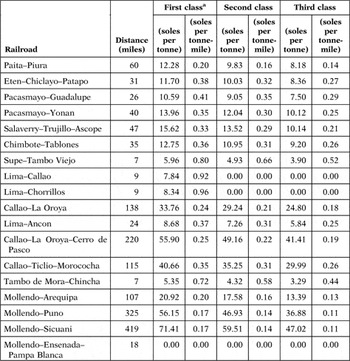
A comparison with other modes of transportation indicates that the traditional system of animal transportation was very costly, especially as the needs for transportation increased at the turn of the century. Let us consider the freight rates charged by railroads, a more time efficient mode of transportation. Table 2 reports the effective freight rates for a number of routes for three types of freightFootnote 21. First class referred to imported goods, second class to manufacturing goods and third class to mining and agricultural products.
Railroads of Peru: Freight Rates per Metric Tonne (1,900 soles), 1908

Notes and sources: The sources are Costa y Laurent (Reference Costa Y Laurent1908) and Galessio (Reference Galessio2007).
Data are not available for Lima–Magdalena and for Pisco–Ica.
aIn the cases of Lima–Callao and Lima–Chorrillos (1908), freight rates are the only rates available.
If we compare mule and railroad rates, we find that effective freight rates were usually lower for railroads than for mules, especially on long routes. According to Tizón (Reference Tizón1909), transporting loads by mule cost around 0.42 soles per tonne-mile in the highlands. This rate was higher than third-class effective freight rates for most railroads, and was higher than second-class rates for railroad journeys of more than 10 miles. Since mineral and agricultural products were transported in third-class wagons, transporting these products by railroad was cheaper than transporting by mule. Other estimates indicate higher freight rates for mules. The cost of renting a mule for carrying freight was around 1 sol by 1900 on the La Oroya–Cerro de Pasco route. This rate was higher than railroad rates in the Central Railway on the Callao–La Oroya–Cerro de Pasco route, even in first class.
Consider the composition of production costs of copper, including extraction, concentration and transportation from Cerro de Pasco to EuropeFootnote 22. Transportation by animals from Cerro de Pasco to La Oroya accounted for 35 per cent of total cost, whereas transportation from La Oroya to Callao accounted for 11 per centFootnote 23. Animal transportation was then much more costly than railroad transportation. The cost of transporting copper from Cerro de Pasco to La Oroya was around three times the cost of transporting the same amount of mineral from La Oroya to Callao, even though the distance was much shorter: the distance between Cerro de Pasco and La Oroya was 82 miles, whereas the distance between La Oroya and Callao was almost 140 miles.
On the other hand, traditionally, the transportation of light loads for short distances was conducted on the backs of llamas. Compared to railroads, llamas were much slower, but were not necessarily cheaper, especially as the demand for transportation increased. Tizón (Reference Tizón1909) indicates that llama rates were around 0.21 constant soles per tonne-mile in 1900 prices. For the 1890s, Deustua (Reference Deustua2009) indicates that llameros charged even more than 0.40 soles per tonne-mile. Third-class freight rates by railroad were not necessarily higher than llama rates. For example, the freight rate for third class by railroad on the Callao–Cerro de Pasco route was 0.19 soles per tonne-mile, whereas the freight rate between Callao and Morococha was 0.26 soles per tonne-mileFootnote 24.
Motivated by the high transport costs of the traditional system of mules (in time costs and freight rates) and llamas (especially in time costs), several miners supported the construction of the Central Railway. As Contreras (Reference Contreras2004) argues, once the railroad reached La Oroya, there were several attempts to extend the line to Cerro de Pasco. Backus y Johnston and Ernest Thorndike obtained permission to conclude the railroad to Cerro de Pasco. On the northern coast, sugar and cotton hacendados also supported and funded the construction of railroads.
The railroad led to a decline in freight rates. Nevertheless, the reduction in freight rates due to the railroad in Peru was much lower than in other Latin American countries. On average, the rail freight rate in Peru was around 0.16 soles per tonne-mile in 1900 prices. On the basis of the sample of freight rates reported in Table 1, mule freight rates were on average around 2.5 times the average rail freight rate and were always lower than five times the average freight rate, whereas the rate in the case of llamas was less than twice the average rail rateFootnote 25. These differences in freight rates in Peru between railroads and the alternative system of overland transportation were not as large as in Mexico and Brazil. In these two countries, wagons were the best alternative mode of transportation. In Brazil, wagons charged between 7.5 and 14.3 times the average rail freight rate; in Mexico, wagons charged between 5.1 and 10.5 times the average rail rate. The construction of railroads in Peru, then, reduced freight rates, but not to the same extent as it did in Mexico and BrazilFootnote 26.
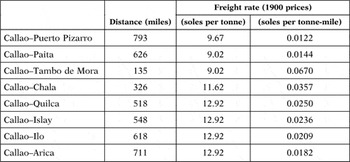
Considering the lack of railroads, the sea was an important means of communication between coastal towns. Table 3 reports data on steam freight rates for 1876 in 1,900 soles. Total transportation cost included shipping rates and port feesFootnote 27. Freight rates ranged between 0.01 and 0.09 constant soles per tonne-mile. The figures suggest the presence of scale economies on distance to a large extent for the high cost of using ports: freight rates were lower for longer distances. The distance between the ports of Callao and Tambo de Mora, for example, was only 135 miles and the freight rate was above 0.08 constant soles per tonne-mile. In contrast, the distance between the ports of Callao and Puerto Pizarro was 793 miles and the freight rate was 0.016 constant soles per tonne-mile. Similarly, the distance between the ports of Callao and Arica was 711 miles and the freight rate was less than 0.03 constant soles per tonne-mile. These figures indicate that the sea as a means of transportation was far cheaper than mules or llamas, especially for long distancesFootnote 28. The sea, however, could not replace animal transportation as it faced a natural limitation: it could only be used for transporting goods along the coast.
Ocean Freight Rates, 1876

Sources: Lemale (Reference Lemale1876), Briceño y Salinas (Reference Briceño Y Salinas1927) and Bonilla (Reference Bonilla1976).
This survey of freight rates shows that the price of transportation for using mules was greater than the price for using the railroad and steam navigation, especially as the needs for transportation increased from the late 1890s. Muleteering was not only a time-inefficient mode of transportation; it was also relatively expensive. Llamas provided a cheaper system of transportation than mules but were much slower than railroads and steam ships and carried much less than mules. However, railroads were limited and did not reach most of the Peruvian territory, and rivers in coastal and highland regions were not navigable, and thus mules and llamas constituted the only or the predominant mode of transportation. Finally, although railroads provided a cheaper mode of transportation than mules and llamas, the reduction in freight rates was not as large as in other Latin American countries.
4 Speed and time costs
Time was a valuable asset. The slow transportation of freight reduced the movement of capital and probably reduced investment opportunities. Thus, low-speed modes of transportation may have reduced the incentives to trade, the gains from specialisation and economic growth.
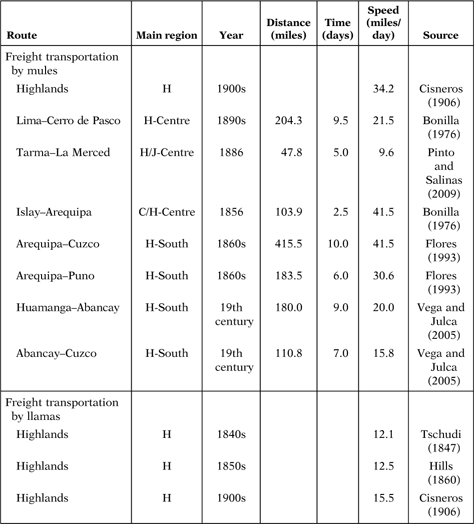
Table 4 reports the average speed of freight transportation for several routes. The speed of mules in transporting freight was not always the same, since it depended on the conditions of the road and the topography of the terrain. In 1906, Cisneros indicated that a loaded mule could complete up to 4 miles per hour, or 34 miles per day, on a regular road in the highlands. Other sources indicate lower speeds. According to McGregor, mules usually took between 9 and 10 days to complete the Lima–Cerro de Pasco route at an average of 19 miles per day. According to Vega and Sulca (Reference Vega and Sulca2005), herds of mules usually took 9 days to complete the Huamanga–Abancay route in the southern highlands at an average speed of 20 miles per day, and took 7 days to complete the Abancay–Cuzco route at a speed of 16 miles per day.
Duration of Trips and Speed of Traditional Overland Transportation
Notes: C = coast; H = highlands; J = jungle.
Llamas were slower than mules. Tschudi (Reference Tschudi1847) indicates that llamas were able to cover between 3 and 4 leagues per day, that is, around 12 miles per day. Similarly, Hills (Reference Hills1860) indicates that llamas rarely managed more than 12 or 13 miles per day. For Cisneros (Reference Cisneros1906), llamas could complete up to 16 miles per day. Since llamas were never fed during the night, the llamero had to stop during the journey to allow the animals to graze (Tschudi Reference Tschudi1847, p. 308).
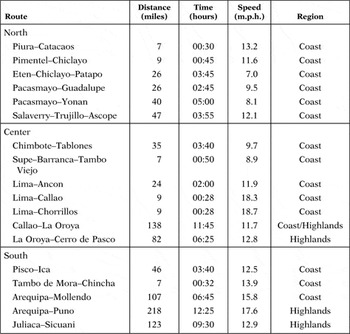
Railroads constituted an alternative mode of transportation from the mid-19th century. Table 5 reports the speed of railroads for a number of routes in 1908. Trains were faster than 7 miles per hour, and thus railroads represented a much faster mode of transportation than mules and llamas. In the central region, for example, a train only took 11 hours to complete the route Lima–Cerro de Pasco, traversing the Andes Mountains, whereas transportation by mule and llama took longer. In 1847, the British Council's John McGregor indicated that animals usually took a rest in Obrajillo on the Lima–Cerro de Pasco route, before continuing the difficult journey up into the mountains; the Lima–Cerro de Pasco route could then take 9 or 10 days for muleteers. Deustua (Reference Deustua2009) indicates that the railroad took 1 day to transport minerals from Callao to Chicla, whereas herds of mules took 7 or 8 days. In the south, the Pisco–Ica railroad completed the 48-mile route in less than 4 hours. In contrast, travellers could take nearly a day by horse through the desert. On his 1838-1842 trips, J. J. Tschudi completed the journey from Pisco to Ica in 1 day. The journeys were undertaken by horse and through the desert from 3 pm to the next morning, avoiding the noon heatFootnote 29.
Duration of Trips and Speed of Railroads

Source: Costa y Laurent (Reference Costa Y Laurent1908).
Therefore, the transportation system of mules and llamas was very slow in comparison to the railway system. Since most of Peru did not have railroads, transportation in most regions was relatively slow. Precisely, Dávalos y Lissón (Reference Dávalos Y Lissón1919) indicated that since Peru had not «improved the scarce, narrow and dangerous roads … the social and political life of the nation is more or less similar to that in the Colony. Towns are isolated some from the others. It is not easy for their inhabitants to travel and they never know the rest of the nation where they live… The people who are hired from the highlands to work for a salary in the haciendas of Pativilca, Casma, Chimbote, Chicama, etc, travel on foot such as during Inca times, needing from four to six days to walk distances of no more than 24 to 28 leagues, which would only require eight or ten hours if traveled by railroad or by car» (Dávalos y Lissón Reference Dávalos Y Lissón1919, p. 371).
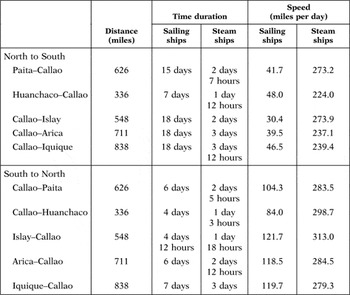
Considering the slow construction of railroads and the difficulties of traditional overland transportation, the sea was an alternative means of transportation for coastal towns (Table 6). A comparison of navigation and animal transportation indicates that sailing ships were more time-efficient than animals when following the Humboldt Current, but yielded about the same time costs when navigating against the current. The speed of mules was around 30 miles a day, whereas that of sailing ships was usually greater than 80 miles a day when navigating northward. Steam ships were much faster than animals with speeds of above 200 miles a day, and in many cases exceeding 270 miles a day. For instance, a steam ship departing from Callao and arriving in Huanchaco completed 298 miles per day. Steam ships, therefore, were much more time-efficient than mules and llamas.
Time Costs and Speed of Sailing and Steam Ships

Source: Denegri (Reference Denegri1976) and Espinosa (Reference Espinosa2002).
In conclusion, the transportation system of mules and llamas was much slower than railroads and steam ships. Since most routes were completed by the traditional system of animal transportation (only a few railroads had been built and the sea could only be used to connect coastal towns, where only a small proportion of the population lived), the system of transportation of Peru generated high time costs.
5 Transport costs and economic growth
Transportation in most of Peru was conducted by the traditional system of mules and llamas. Waterways and railroads only served a small portion of the territory. Transportation costs were high, which probably constituted a barrier to trade and hindered economic growth. As transport costs were high, many towns probably had limitations to participate in trade with other towns, and thus each town produced what it needed to live. In these circumstances, Peru may have faced severe obstacles to exploit its vast natural resources. Dávalos y Lissón (Reference Dávalos Y Lissón1919), for example, argues that
«… most mining companies located in Pallasca, Huailas, Cajabamba, Hualgayoc, Cajatambo, Huallanca and some others had experienced an anemic life because of the lack of means of communication. There is nothing richer in Peru in silver, lead, carbon and tungsten than Ancash, or nothing more abundant in gold than Pataz; but since we do not even have horseshoe roads in those provinces, every effort is exhausted for the impossibility of transportation. For the same cause, the great agricultural wealth of Jaen and Maynas has no value. Not even at ten soles per acre can land be sold, not existing roads to reach them….» Dávalos y Lissón (Reference Dávalos Y Lissón1919, p. 373).
The natural limitations of using animals to transport heavy goods constituted a particular constraint to investment and economic growth. Mules could carry less than 300 pounds, and llamas could carry up to 100 pounds. Heavy machinery, therefore, could not be transported on the backs of mules and llamas and investment was discouraged. Araoz (Reference Araoz1889), for example, argued that the mining business required large concentration plants to reach its «maximum potential». However, the construction of concentration plants required large and heavy machinery, which was practically impossible to carry on the backs of mules and llamas (Deustua Reference Deustua2009, p. 210).
The lack of modern modes of transportation probably constituted a larger a barrier to trade as the demand for transportation increased. When the production levels were low, the needs for transportation were also low, and therefore the system of mules and llamas probably did not represent an important constraint to investment and economic growth. As more mines were exploited and more land was cultivated, the needs for transportation increased, and in this situation mules and llamas could not offer the same service as a more modern system of transportation. The scarcity of animals and arrieros led to the increase in freight rates and represented a significant obstacle to transportation. Nature eventually imposed a constraint on economic growth: the limited numbers of mules, llamas and arrieros were probably not large enough to support the increasing demand for transportationFootnote 30.
However, although the comparison of transport costs between the pre-rail transport system, railroads and the sea, as well as the opinion of contemporary observers, represents valuable information, they do not constitute proof that the system of transportation of Peru represented a significant barrier to trade and economic growth. A more formal testing procedure is required to determine the impact of high transport costs on economic growth in Peru. In particular, testing whether the construction of railroads promoted economic growth may help to understand the economic impact of transport costs. Considering that transportation in most regions of Peru was conducted by mule and llama, if the construction of railroads promoted economic growth one might argue that the system of transportation in most of Peru limited the growth of the economy. Using the terminology employed by Hausmann et al. (Reference Hausmann, Rodrik and Velasco2005), if railroads promoted economic growth, then the lack of railroads in most of the country was a «binding constraint» to economic growth.
Some might question the validity of the argument that if railroads promoted economic growth then the lack of railroads was a binding constraint to economic growth. It is possible, for example, that only those regions with railroads had abundant natural resources. In this case, the construction of railroads in regions with no natural resources would not have fostered economic growth. The evidence, however, indicates that Peru had large endowments of natural resources throughout its territory, and not only in the areas served by railroads. For example, Ledesma and Bollaert (Reference Ledesma and Bollaert1856) indicated that Peru was
«… one of the richest countries in the world for the animal, vegetable and mineral wealth … Peru produces, in its various climates, all the fruits, grain, and vegetables cultivated in different countries, independently of those which are indigenous; the latter including many of exquisite flavor. The transandine region is wonderful for the abundance and singularity of its productions. In its immense forests are ornamental woods in great variety, together with the Peruvian-bark tree, cocoa, coffee, coca, sarsaparilla, vanilla. The mineral kingdom of Peru is celebrated for placeres of gold and mines of silver, mercury, copper, lead, sulphur, and coal; as well as quarries of various marbles. Important are the gold placers of Carabaya the silver mines of Pasco, Puno, Guantajaya, and Gualgayoc; the mercury mines of Guancavelica and Chouta; the salt beds of Tarapaca, and the salt pits of Huacho and Sechura …» (Ledesma and Bollaert Reference Ledesma and Bollaert1856, pp. 217-218)
Similarly, Markham (Reference Markham1874) indicated that the Andes Mountains, «… contain inexhaustible stores of copper and silver, the plains afford pasture for large flocks of alpacas, while the inner slopes of the Eastern Andes produce the best Peruvian bark, coffee, cocoa, coca, arnotto, and are watered by streams containing gold-dust in large quantities» (Markham Reference Markham1874, p. 127). Peru enjoyed the presence of abundant natural resources throughout its territory; therefore, it is reasonable to assume that if the railroad played a key role for economic growth of the regions it reached it would probably also have had a positive impact on the economic growth of other regions.
I use data on exports to estimate the impact of railroads on the economy. The construction of railroads and the consequent reduction in time and money transport costs probably led to the growth of market-oriented production, including production for foreign markets. Not all exports, however, would have been influenced by the construction of railroads to the same extent. Guano, for example, was extracted from coastal islands and transported directly to Europe by ship. Overland transportation facilities were not required for exporting guano. In contrast, crops from the coastal haciendas and minerals from the highland mines were transported to the sea ports by land, and thus the construction of railroads may have facilitated their transportation. In addition, in the case of mineral exports, Contreras (Reference Contreras2004) indicates that the industry of copper was much more influenced by the construction of the Central Railway than the silver industry, because of differences in the value/volume ratios. Copper exports tended to have a much lower value/volume ratio than silver exports, and thus the presence of scale economies in the transportation of minerals was larger in the case of copper. On the other hand, considering that the pre-rail costs for transporting crops from the coastal haciendas to the sea ports were probably lower than the costs for transporting minerals from the mines in the highlands, it is possible that the impact of the railroad was larger for the production of copper in the central highlands than for the production of cotton and sugar on the coast.
An econometric approach is used to test whether the length of the railway network had a significant statistical effect on the level of exports. In particular, the effect of the length of the railway track on the level of exports of the four main export products (copper, silver, sugar and cotton) in 1920 is estimated, as is the effect of the length of the Central Railway on the volume of copper and silver exports. The Central Railway connected the port of Callao, Lima and the mining centres of Junín and Cerro de Pasco and may have had a positive impact on the growth of mining exports. The effect of the length of coastal railroads on the volume of sugar and cotton exports is also estimated. Sugar and cotton had been produced mostly on the coast from colonial times, and thus the construction of railroads along the coast connecting haciendas, the main cities and ports may have impacted on the growth of cotton and sugar exports.
The following four variables measure the level of exports: COPPER is the natural log of the copper exports in metric tonnes, SILVER is the natural log of silver exports in metric tonnes, COTTON is the natural log of cotton exports in metric tonnes and SUGAR is the natural log of sugar exports in metric tonnesFootnote 31. The following two variables measure the length of railroads: RAIL_CENTRAL is the natural log of the quantity of miles of the Central Railway and RAIL_COAST is the natural log of the quantity of miles of the railway system in coastal Peru. RAIL_CENTRAL may have a positive effect on SILVER and COPPER, whereas RAIL_COAST may have positive effect on COTTON and SUGAR.
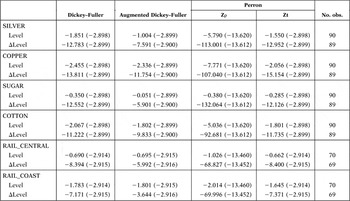
Let us analyse the time properties of the series. Table 7 reports the statistics for the following unit-root tests: Dickey–Fuller, Augmented Dickey–Fuller and Perron. In all tests, the null hypothesis is that the series have unit roots. The table also reports the 5 per cent critical values. If the statistics are greater in absolute value than critical values, then at a 5 per cent significance level the null hypothesis that the series has a unit root cannot be accepted. In the case of the series in levels, the statistics are lower in absolute value than the critical values; in the case of the series in differences, the statistics are greater in absolute value than the critical values. Therefore, all series in our data are integrated of first-order, or I(1).
Unit Root Tests

Notes: The table reports Dickey–Fuller, Augmented Dickey–Fuller (with one lag) and Perron statistics for several models. Null hypothesis is that the variable has a unit root. 5% critical value are in parenthesis.
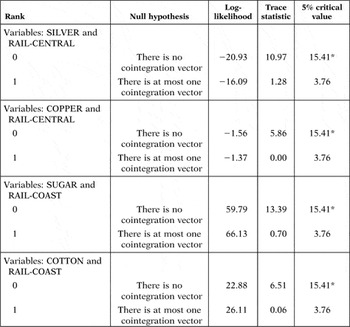
The Johansen method is used to test cointegration. If two series are cointegrated, then the Johansen test indicates the existence of at least one cointegrating vector. Table 8 reports the Johansen statistics for the following hypotheses: there is no cointegrating vector, and there is at least one cointegrating vector. Critical values at a 5 per cent significance level are also reported. I evaluate whether the following pairs of series are cointegrated: COPPER and RAIL-CENTRAL, SILVER and RAIL-CENTRAL, COTTON and RAIL-COAST and SUGAR and RAIL-COASTFootnote 32. In all cases, at a 5 per cent level the null hypothesis that the series are not cointegrated cannot be rejected. There does not seem to be a long-term relationship between the level of exports of the four main Peruvian export products and the length of the railway network.
Johansen Cointegration Test

Notes: The table reports the statistics for a Johansen cointegration test. All vector-correction models include ten lags for the endogenous variables in first differences.
*Acceptance of the null hypothesis.
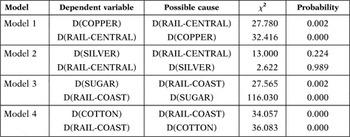
A vector autoregression model for the variables in first differences is then estimated to determine whether the length of the railroad network promoted the growth of exportsFootnote 33. Ten lags are included to capture the long-term lagged effects. A Granger test was conducted to determine the causality relationship. Table 9 reports the results for the Granger test, and the results for Model 1 indicate that D(RAIL-CENTRAL) caused D(COPPER) and D(COPPER) causes D(RAIL-CENTRAL). A faster growth of railway length increased the growth of copper exports. However, a faster growth of copper exports also promoted the construction of the Central Railway. On the other hand, the results for Model 2 indicate that the impact of railway construction on silver exports and vice versa did not seem important. The Granger test indicates that D(RAIL_CENTRAL) did not cause D(SILVER) and D(SILVER) did not cause D(RAIL_CENTRAL). The impulse–response functions consistently indicate that these variables did not cause each other. Cotton and sugar exports were also influenced by railway length. The results for Model 3 indicate that D(SUGAR) and D(RAIL-COAST) also cause each other. From the impulse–response functions, a shock to D(RAIL-COAST) has significant effects on D(SUGAR) after 3, 5 and 10 years, but a negative effect after 4 years. The results for Model 4 indicate that D(COTTON) and D(RAIL-COAST) caused each other. The impulse–response function indicates that a shock to D(RAIL-COAST) had a positive and statistically significant effect on D(COTTON) after 2 years.
Granger Test of Causality

Notes: The table reports Granger statistics and P-values. All vector autoregression models include 10 lags for the dependent variables and WAR lagged one year.
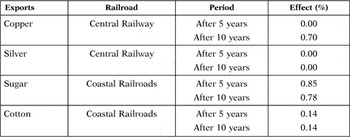
Table 10 simulates the evolution of exports assuming a shock of 1 per cent to the railroad length in year τ. The table reports the ratio of predicted exports with respect to actual exports for years τ + 5 and τ + 10. I used the coefficients from the impulse–response functions and calculated the ratio using the following formula:  for k = 5, 10, where yτ +k is the ratio of predicted exports with respect to actual exports in the year τ + k assuming a shock of 1 per cent to the railroad length in year τ. θj is the coefficient of the impulse–response function and measures the response of the natural log of the level of exports (in first differences) to a shock to the natural log of railroad length (in first differences) after j years. Using the significant coefficients from the impulse–response functions, the results indicate that copper, sugar and cotton exports responded to shocks to the railroad length. In the case of mining exports, predicted copper exports were 0.7 per cent greater than actual copper exports after 10 years, as a result of a shock of 1 per cent to the length of the Central Railway. However, predicted silver exports were the same as actual exports: silver exports did not respond to shocks to the length of the Central Railway. In the case of agricultural exports, sugar and cotton exports responded to railroad construction on the coast. Predicted sugar exports were greater than actual sugar exports by 0.78 per cent after 10 years, whereas predicted cotton exports were 0.14 per cent greater than actual cotton exports also after 10 years.
Effect of an Increase of 1% in Railway Length on the Level of Exports

Notes: The table reports the estimated effect of a 1% shock to the level of railroad length on the level of exports after 5 and 10 years. The estimates have been obtained using the significant coefficients from the impulse–response functions.
These results suggest that the construction of railroads had a positive effect on the growth of exports. In particular, the railroad promoted the extraction and exportation of copper, cotton and sugar. One implication of the econometric results is that if more railroads had been built, the growth of exports would have been greater during this period. Therefore, as argued by Pardo in 1860 (McEvoy Reference McEvoy2004), and Dávalos y Lissón in Reference Dávalos Y Lissón1919 (Dávalos y Lissón Reference Dávalos Y Lissón1919), among several contemporary observers, the absence of low-cost modes of transportation in most of Peru retarded economic growth.
6 Conclusions
This paper analyses the system of transportation and explores the impact of geography and infrastructure on transport costs and economic growth in Peru in the 19th and early 20th centuries. Using primary and secondary sources, I show that geography imposed difficult transport challenges for Peruvians during this period. The coast imposed high barriers to overland transportation as the sandy desert made travelling difficult and exhausting, whereas the highlands and their steep, narrow roads made travelling extremely risky and challenging. In addition, Peru did not have navigable rivers in coastal and highland regions and most roads were inadequate for wagons.
Railroad construction began in the mid-19th century but was, however, a very slow process. In the early 20th century, Peru was far behind other countries in the region. On the coast, railroads connected only a few cities and valleys. Only two railway systems linked the coast and the highlands: the Central Railway, which connected Callao, Lima and the mines of Junin and Pasco; and the Southern Railway, which ran between Arequipa, Puno and Cuzco. Moreover, monopoly power (together with inefficient government regulation) and the abrupt nature of the Peruvian landscape led to high rail freight rates.
Most transportation at the time was conducted on the backs of mules and llamas. This system was associated with high time and money transport costs, in comparison to railroads and waterways. Freight rates were especially high as the needs for transportation and the demand for mules and llamas increased. For instance, as the production of copper started to boom in the central highlands in the late 1890s, freight rates increased drastically. The scarcity of mules, llamas and arrieros led to significant increases in the price of transportation. In such circumstances, it seems that the traditional system of overland transportation using mules and llamas represented an obstacle to economic growth.
Employing econometric techniques, I find that the construction of railroads promoted the growth of the exporting economy. In the highlands, the construction of the Central Railway promoted the growth of copper exports. On the coast, the expansion of the railway system promoted the growth of sugar and cotton exports. This result is crucial for explaining the slow growth of the Peruvian economy. Since railroads had a positive impact on production and exports, the lack of railroads in other coastal, highland and jungle regions of Peru probably retarded trade and economic growth. High transportation costs were then a binding constraint to growth in most of Peru.
Some might argue that it is not possible to extrapolate the positive role of railroads in the copper, sugar and cotton sectors. It is possible that regions without railroads did not have other factors that favoured economic growth. In this case, the construction of railroads would have not promoted economic growth in those areas, and thus the traditional system of transportation did not represent a binding constraint to economic growth. Contemporary evidence, however, suggests that Peru had other favourable conditions for growth. Natural resources, for example, were abundant in other regions. It is possible then that if railroads had been built throughout the country, the reduction in transport costs would have led to increases in trade, gains from specialisation and economic growth.