INTRODUCTION
Delirium is common in the course of hospitalization, and its incidence varies with the age of the patient and illness severity (Elie et al., Reference Elie, Cole and Primeau1998). In the general hospital setting, the occurrence of delirium may reach an average of 30% in medically ill patients and 40% in the hospitalized elderly (Bucht et al., Reference Bucht, Gustafson and Sandberg1999; Lipowski, Reference Lipowski1989). In addition to interventions such as providing a safe and supportive environment, the guidelines for the management of delirium published by the American Psychiatric Association (Trzepacz et al., Reference Trzepacz, Breitbart and Franklin1999) recommend the use of typical antipsychotics, in particular haloperidol. However, with increasing frequency, atypical antipsychotics are selected as the initial somatic intervention for amelioration of the symptoms of delirium due to their favorable side-effect profile (Lonergan et al., Reference Lonergan, Britton and Luxenberg2007; Rea et al., Reference Rea, Battistone and Fong2007).
The current literature highlights the efficacy and tolerability of atypical antipsychotics in providing relief from the distressing symptoms of delirium (Lonergan et al., Reference Lonergan, Britton and Luxenberg2007; Rea et al., Reference Rea, Battistone and Fong2007). Studies have not been able to show differences in efficacy between haloperidol and aripiprazole (Boettger et al., Reference Boettger, Friedlander and Breitbart2011a ), risperidone (Han & Kim, Reference Han and Kim2004; Kim et al., Reference Kim, Jung and Han2005; Liu et al., Reference Liu, Juang and Liang2004), or olanzapine (Hu et al., Reference Hu, Deng and Yang2004; Skrobik et al., Reference Skrobik, Bergeron and Dumont2004), and between risperidone and olanzapine (Kim et al., Reference Kim, Yoo and Lee2010). However, differences in the side-effect profile have been documented. Haloperidol and aripiprazole have been shown to be equally effective in the management of hypoactive and hyperactive delirium, but extrapyramidal symptoms were more common in haloperidol-treated patients (Boettger et al., Reference Boettger, Friedlander and Breitbart2011a ). No differences in efficacy have been shown between haloperidol and olanzapine, and both medications caused a substantial rate of side effects. EPSs were more commonly encountered with haloperidol in both studies (Hu et al., Reference Hu, Deng and Yang2004; Skrobik et al., Reference Skrobik, Bergeron and Dumont2004). In particular, dystonia was measured in up to 31.9% of patients managed with haloperidol and in up to 2.9% of olanzapine-managed patients, whereas sedation/drowsiness was found in 22.2% of haloperidol-managed patients and 18.9% of olanzapine-managed patients (Hu et al., Reference Hu, Deng and Yang2004). Studies comparing haloperidol and risperidone (Han & Kim, Reference Han and Kim2004; Kim et al., Reference Kim, Jung and Han2005; Liu et al., Reference Liu, Juang and Liang2004) have suggested similar efficacy for both medications, with response rates ranging from 58.3 to 75% (haloperidol) and 42 to 77.8% (risperidone). Another study assessing risperidone and olanzapine in the management of delirium found similar response and side-effect rates but concluded that risperidone may result in poorer response rates in older age populations (Kim et al., Reference Kim, Yoo and Lee2010). More recent studies could not find differences among haloperidol, risperidone, and olanzapine (Grover et al., Reference Grover, Kumar and Chakrabarti2011; Yoon et al., Reference Yoon, Park and Choi2013).
To date, the literature comparing the typical and atypical antipsychotics with respect to efficacy and side effects remains limited and warrants further expansion. So we performed an analysis of patients receiving haloperidol, risperidone, olanzapine, and aripiprazole in the management of delirium in order to further explore the comparative efficacy and side-effect profile of these medications.
METHODS
Patients
All patients were recruited from referrals for delirium management to the Memorial Sloan Kettering Cancer Center (MSKCC) Psychiatry Service from July to November of 2000 and from July of 2004 to June of 2006. MSKCC is a 470-bed, private hospital specializing in the treatment of cancer, averaging more than 20,000 admissions each year. The consultation-liaison psychiatry service performs on average more than 2,000 consultations yearly.
The main inclusion criterion was meeting the DSM–IV–TR (American Psychiatric Association, 2000) criteria for delirium. Exclusion criteria included patient or family objections to pharmacological intervention, an inability to participate with delirium rating measures, and severe agitation interfering with interviews.
All patients and their families provided verbal consent to be evaluated and receive antipsychotics for symptomatic relief of delirium. In patients with a limited capacity to provide consent, the patient's primary caregiver provided verbal consent alongside the patient's assent to intervention. All data were obtained from the routine care of patients diagnosed with delirium and entered into the institutional review board-approved database for subsequent analysis, and a waiver was obtained for the data analysis.
Measurements
Delirium severity was measured with the MDAS, a 10-item, 4-point, clinician-rated scale (Breitbart et al., Reference Breitbart, Rosenfeld and Roth1997). The MDAS items reflect the diagnostic criteria for delirium in the DSM–IV–TR and assess disturbance in arousal and level of consciousness, cognitive functioning such as orientation, memory, attention, and perception, as well as psychomotor activity. MDAS scores greater than 10 identify the presence of delirium, and MDAS scores of 10 indicate resolution of delirium in our analysis (Kazmierski et al., Reference Kazmierski, Kowman and Banach2008; Lawlor et al., Reference Lawlor, Nekolaichuk and Gagnon2000). Categorization of delirium was based on the motoric subtype: hypoactive or hyperactive (Camus et al., Reference Camus, Burtin and Simeone2000; Meagher et al., Reference Meagher, O'Hanlon and O'Mahony2000). Additional instruments included the Karnofsky Performance Status (KPS) scale (Karnofsky & Burchenal, Reference Karnofsky, Burchenal and Macleod1949) to provide a measure of physical performance ability and an abbreviated version of the Udvalg for Kliniske Undersogelser Side-Effect Rating Scale (UKU) to record the side effects of the antipsychotics (Lingjaerde et al., Reference Lingjaerde, Ahlfors and Bech1987).
Procedures
Sociodemographic and medical variables were collected at the initial assessment (T1). This information included age, gender, cancer diagnosis, stage of cancer (localized, advanced, metastatic, or terminal), current psychiatric diagnosis, preexistent dementia, presence of brain metastases, and contributing delirium etiologies. MDAS and KPS scores were obtained and side-effect rating performed at initial diagnosis of delirium (T1) and repeated at 2–3 days (T2) and 4–7 days (T3).
The psychiatrist providing the initial diagnosis of delirium decided which antipsychotic to prescribe. Patients received haloperidol, risperidone, olanzapine, or aripiprazole. If the patient's delirium worsened as evidenced by clinical observation or MDAS scores, the current antipsychotic was discontinued and an alternate antipsychotic substituted.
Statistical Analysis
Data analyses were performed with the Statistical Package for the Social Sciences (SPSS, v. 20) for Windows. Descriptive statistics were performed on the dataset to characterize the sample sociodemographically and medically. The primary interest was MDAS score, and the side-effect profile was secondary. Separate datasets describing individual medications were created for comparison of efficacy and side-effect profile. The t test for independent samples was employed for data on the interval scale including age. A MANOVA was computed for the course of haloperidol, risperidone, aripiprazole, and olanzapine over time, and the between factor was the medication administered; MDAS scores at baseline, T1, and T2 were set as dependent measures. For multiple related measures, such as the course of change in MDAS scores for single medications, the Friedman test was utilized, and for multiple independent measures, such as comparison of MDAS scores at single times, the Kruskal–Wallis test. Categorical variables, such as the comparison of delirium resolution rates among medications, were computed with Pearson's chi-square test. For all implemented tests, post hoc, alpha (α) was adjusted with the Bonferroni method. The significance level for α was set at p < 0.05.
Composition of Sample
The sample size for each medication was determined by the medication with the lowest number of patients, which was aripiprazole. The data for haloperidol, risperidone, and olanzapine were matched to the aripiprazole sample based on age, preexisting dementia, initial MDAS scores, and delirium subtype.
RESULTS
Baseline Characteristics of Patients
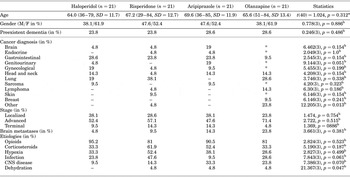
The age of the patients did not differ between groups and ranged from 64.0 (haloperidol) to 69.6 years (aripiprazole). Gender was evenly distributed, with 38.1% male (haloperidol and olanzapine) and 47.6% female patients (risperidone and aripiprazole). The prevalence of preexistent dementia was not different, and was documented in 23.8% of haloperidol- and risperidone-managed patients and in 28.6% of aripiprazole- and olanzapine-managed patients.
Cancer diagnoses and stages were diverse (Table 1). There were no significant differences between types of cancer or stages of illness and medication regimens. The etiologies contributing to delirium were multifactorial and similar between medication groups. The most frequent etiologies were the administration of opioids [81% (risperidone) to 95.2% (haloperidol)], the administration of corticosteroids [33.3% (haloperidol) to 61.9% (risperidone)], the presence of hypoxia [28.6% (olanzapine) to 52.4% (risperidone)], current infection [9.5% (aripiprazole) to 47.6% (risperidone)]. and the presence of central nervous system (CNS) disease (from 9.5% for haloperidol to 33.3% for aripiprazole).
Baseline and medical characteristics of patients

*Recorded as “other cancer.”a t test. bPearson's chi-square test.
The severity of delirium did not differ at baseline and ranged from 18 to 30 on the MDAS. In the haloperidol-managed patients, the mean MDAS score was 19.9, in risperidone-managed 18.6, in aripiprazole-managed 18.0, and in olanzapine-managed patients 19.5. Hypoactive delirium and hyperactive delirium were present in 42.9 and 57.1%, respectively.
Management of Delirium with Haloperidol, Risperidone, Olanzapine, and Aripiprazole
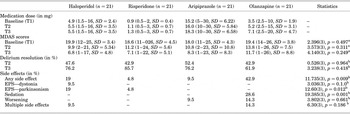
The mean medication doses at T3 were 5.5 mg haloperidol, 1.3 mg risperidone, 18.3 mg aripiprazole, and 7.1 mg olanzapine. MDAS scores decreased in all medication groups. In haloperidol-managed patients, MDAS scores were 19.9 at baseline and decreased to 9.9 at T2 and 6.8 at T3 (Friedman χ2 = 38.30(2), p < 0.001). In risperidone-managed patients, MDAS scores declined from 18.6 at baseline to 11.2 at T2 and to 7.1 at T3 (Friedman χ2 = 29.95(2), p < 0.001). Aripiprazole-managed patients had a baseline MDAS score of 18.0, declining to 10.8 and 8.3 at T2 and T3, respectively (Friedman χ2 = 31.87(2), p < 0.001). In olanzapine-managed patients, MDAS scores were 19.4 at baseline and 13.8 and 11.7 at T2 and T3 (Friedman: χ2 = 13.23(2), p < 0.01). The decline of MDAS scores between medications over time was equal (MANOVA: Wilks's lambda 0.04, F(634.4), p < 0.001). As a result, there were no differences between medications at any single observation point during the observation period (T2, T3) (Kruskal–Wallis, ns). The delirium resolution rates ranged from 42.9% (olanzapine and risperidone) to 52.4% (aripiprazole) at T2 and from 61.9% (olanzapine) to 85.7% (risperidone) at T3 and did not differ between medications (Table 2).
Management characteristics of haloperidol, risperidone, aripiprazole and olanzapine

MDAS = Memorial Delirium Assessment Scale; EPS = extrapyramidal symptom.
aKruskal–Wallis test. bPearson's chi-square test.
Side Effects
Side effects or lack of response were encountered in all medication groups and ranged from 4.8 (risperidone) to 9.5 (aripiprazole), 19 (haloperidol), and 42.9% (olanzapine). The administration of olanzapine most frequently caused side effects, followed by haloperidol, aripiprazole, and risperidone. In particular, haloperidol and also risperidone caused extrapyramidal symptoms (19 and 4.8%, respectively). The most commonly recorded side effect was sedation (28.6% with olanzapine). Sedation may have clinical utility in patients with hyperactive delirium.
DISCUSSION
These findings indicate that the atypical antipsychotics risperidone, aripiprazole, and olanzapine and the typical antipsychotic haloperidol were equally effective in the management of the symptoms of delirium. The side-effect profile, however, was very different. In particular, haloperidol caused increased rates of EPSs and olanzapine substantial sedation, while the administration of risperidone and in particular aripiprazole caused less adverse to no side effects.
A number of studies have compared the safety and efficacy of haloperidol and risperidone, aripiprazole, and olanzapine and found similar efficacy in the management of delirium. Compared to previous findings, the dosing of medication was similar: haloperidol (5.5 mg), risperidone (1.3 mg), aripiprazole (18.3 mg), and olanzapine (7.1 mg). In previous investigations, the dosing of risperidone ranged from 0.75 to 1.7 mg (Han & Kim, Reference Han and Kim2004; Kim et al., Reference Kim, Jung and Han2005; Reference Kim, Yoo and Lee2010; Liu et al., Reference Liu, Juang and Liang2004), aripiprazole was administered at 8.9–18.3 mg (Boettger et al., Reference Boettger, Friedlander and Breitbart2011a ), olanzapine at 2.4– 8.2 mg (Hu et al., Reference Hu, Deng and Yang2004; Kim et al., Reference Kim, Yoo and Lee2010; Skrobik et al., Reference Skrobik, Bergeron and Dumont2004), and haloperidol doses ranged from 1.7 to 6.5 mg (Boettger et al., Reference Boettger, Friedlander and Breitbart2011a ; Han & Kim, Reference Han and Kim2004; Hu et al., Reference Hu, Deng and Yang2004; Kim et al., Reference Kim, Jung and Han2005; Liu et al., Reference Liu, Juang and Liang2004). The efficacy rates of medications were similar to previous findings. In our analysis, 76.2% of haloperidol-managed patients (58.3–87.5%), 85.2% of risperidone-managed (42–84.4%), 76.2% of the aripiprazole-managed, and 61.9% (64.7–82.4%) of the olanzapine-managed patients achieved delirium resolution.
Side effects were encountered with most medications, most commonly EPSs and sedation in haloperidol- and olanzapine-managed patients (19 and 28.6%, respectively). More extrapyramidal symptoms with haloperidol-managed patients have been known (Boettger et al., Reference Boettger, Friedlander and Breitbart2011a ; Hu et al., Reference Hu, Deng and Yang2004), and sedation is a common side effect of management with olanzapine and has previously been described in 18.9% of patients. Side effects in patients managed with aripiprazole and risperidone were less frequent.
The sample in our analysis was evenly distributed. The patient population did not differ in age, gender, preexistent dementia, type and stage of cancer, and etiology. A different recording approach within the olanzapine cases, categorizing multiple diagnoses (marked with an asterisk in Table 1) in the category “other,” increased the number of “other” cancers artificially.
Patients in this sample were of advanced age, ranging from 64.0 to 69.6 years, exceeding the age range documented in other studies. This is not particularly surprising, as advanced age and comorbid dementia are among the main risk factors for developing delirium (Elie et al., Reference Elie, Cole and Primeau1998). Both advanced age and comorbid dementia may be associated with a prolonged and refractory course of delirium (Boettger et al., Reference Boettger, Passik and Breitbart2011b ), thus potentially reducing the response rates in the observation period.
These findings provide further evidence indicating that haloperidol, risperidone, aripiprazole, and olanzapine were similarly efficacious in the management of delirium, but had different side-effect profile. As a consequence, the choice of antipsychotic for the management of delirium may be less determined by efficacy than by side-effect profile, including potentially desirable side effects such as sedation.
Although the data collection had strengths—including the systematic evaluation and documentation of etiologies contributing to delirium, the case matching reducing differences between groups, as well as the observation and recording of side effects—several important limitations have to be noted. Our analysis was based on a retrospective analysis of prospectively collected data. The selection of antipsychotic intervention was not random or based on the treating physicians' preferences. Furthermore, all patients had cancer diagnoses, and the generalizability of these results to the noncancer population may perhaps be limited. The use of antipsychotics in the management of delirium has not been approved by the regulatory agencies, and the use of antipsychotics in elderly patients with dementia carries a black-box warning of increased risk of death (Jeste et al., Reference Jeste, Blazer and Casey2008; Schneider et al., Reference Schneider, Dagerman and Insel2005). All patients were case-matched to the lowest number of cases in each group, and the total number of patients included in the analysis was limited to 21 for each medication group. As a consequence, further investigations, particularly double-blind, randomly assigned, controlled designs of atypical and typical antipsychotics, are required to confirm these results.
In summary, our analysis provided further results indicating that the typical antipsychotic haloperidol and the atypical antipsychotics risperidone, aripiprazole, and olanzapine are similarly efficacious in the management of delirium; however, their side-effect profiles are different. As a consequence, the choice of an antipsychotic was less determined by its efficacy than its side-effect profile, including the use of atypical instead of typical antipsychotics, and reducing extrapyramidal symptoms, as well as the potentially desirable side effect of sedation.
CONFLICTS OF INTEREST
The authors state that they have no conflicts of interest to declare.