1. Introduction
In recent years, robotic manipulators have become an important part of many science and engineering fields [Reference Jin, Li, Yu and He1– Reference Hassan, El-Habrouk and Deghedie6]. Various kinds of robotic manipulators (e.g., ABB and KUKA robotic manipulators) have been designed and investigated [Reference Craig7–Reference Mao, Lu and Xu10]. According to degrees-of-freedom (DOF), these robotic manipulators can be divided into two categories: redundant robotic manipulators and nonredundant robotic manipulators. In general, a robotic manipulator is considered to be redundant, if its DOF is more than the minimum DOF needed for performing the desired end-effector planning task. In comparison with nonredundant robotic manipulator, the redundant one has enough DOF for a given end-effector task, thus enabling alternative purposes (e.g., repetitive motion and obstacle avoidance) when fulfilling the task. Many efforts have thus been contributed to the study of redundant robotic manipulators [Reference Jin, Li, Yu and He1–Reference Siciliano, Sciavicco, Villani and Oriolo8, Reference Guo, Xu and Yan11–Reference Fu and Zhao14]. For example, a metaheuristic-based control framework was presented in ref. [Reference Hassan, El-Habrouk and Deghedie6] for simultaneous tracking control and obstacle avoidance of redundant robotic manipulators. A pseudoinverse-based motion planning scheme was designed in ref. [Reference Guo, Xu and Yan11] for redundant robotic manipulators in the presence of noise. Two methods based on genetic algorithms were investigated in ref. [Reference Filho, da Silva, Praxedes, Hemanth and de Albuquerque13] to solve the singularity problem for redundant robotic manipulators.
In particular, how to achieve the repetitive motion planning (RMP) of redundant robotic manipulators is an important issue [Reference Zhang and Zhang15]. The RMP idea comes from the research of ref. [Reference Klein and Huang16], wherein the so-called nonrepetitive problem is originally presented. The general description of RMP is that the joint-angle trajectory must be repetitive for a closed end-effector path. In other words, when completing the path planning, the final joint state of the redundant robotic manipulator should be returns to its initial state. Notably, with regard to the joint repeatability of redundant robotic manipulators, the sufficient and necessary conditions were analyzed and presented in refs. [Reference Shamir17] and [Reference Shamir and Yomdin18], respectively. Owing to its significance, many studies on RMP have been reported for redundant robotic manipulators [Reference Zhang and Zhang15, Reference Roberts and Maciejewski19–Reference Chen and Zhang33].
There are two general formulations of the existing RMP schemes. One is based on the Jacobian pseudoinverse matrix [Reference Roberts and Maciejewski19–Reference Li, Xu, Guo, Wang and Yuan25], and the other is based on the quadratic programming (QP) [Reference Zhang and Zhang15, Reference Li, Liao, Xu and Guo26–Reference Chen and Zhang33]. For example, the RMP scheme with the pseudoinverse-based formulation was presented in ref. [Reference De Luca, Lanari and Oriolo20] for redundant robotic manipulators. Aided with an online adaptive learning algorithm, the pseudoinverse-based RMP scheme was developed in ref. [Reference Assal21] for constrained redundant robotic manipulators. Using the self-motion technology, the pseudoinverse-based RMP scheme was designed in ref. [Reference Benzaoui and Chekireb22] for redundant robotic manipulators under constraints. Considering the existence of noise, the pseudoinverse-based RMP scheme was investigated in ref. [Reference Li, Xu, Guo, Wang and Yuan25] for redundant robotic manipulators. Differing from the pseudoinverse-based schemes, many RMP schemes with the QP-based formulation were presented and studied for redundant robotic manipulators [Reference Zhang and Zhang15, Reference Li, Liao, Xu and Guo26–Reference Chen and Zhang33]. For example, using the data-driven technology, the QP-based RMP scheme was developed in ref. [Reference Xie, Jin, Luo, Li, Xiao and Syst27] for redundant robotic manipulators with model unknown. Considering a wider range of physical constraints, three QP-based RMP schemes at acceleration level were investigated in ref. [Reference Jin, Xie, Liu, Ke, Li and Yang28] for redundant robotic manipulators. Aided with similar orthogonal projection matrices, the QP-based RMP scheme was designed in ref. [Reference Xie, Jin, Luo, Sun, Liu, Netw and Syst29] for constrained redundant robotic manipulators. In summary, the QP-based RMP schemes have been studied at the levels of joint velocity, joint acceleration, and joint jerk. They have been effectively applied to fixed base, wheeled mobile, and dual redundant robotic manipulators.
Following the previous successful work, this paper further investigates the RMP of redundant robotic manipulators. Specifically, a new pseudoinverse-based RMP scheme is proposed and studied for redundant robotic manipulators. Such a scheme is theoretically proven to possess the characteristic of cube pattern in the end-effector planning precision. Therefore, the proposed RMP scheme has two prominent benefits: the scheme can ensure (i) the end-effector planning with enough precision and (ii) the joint-angle repeatability with enough precision. Moreover, an extended study of the proposed RMP scheme is presented for constrained redundant robotic manipulators. Simulation results based on the four-link robotic manipulator further verify the effectiveness and superiority of the proposed RMP scheme and its extended one.
The rest of this paper is divided into five sections. Section 2 presents the preliminary and the pseudoinverse-based RMP scheme given in ref. [Reference De Luca, Lanari and Oriolo20]. Section 3 describes the detailed formulation of the new RMP scheme, and provides the related theoretical analysis. Section 4 investigates the extension of the proposed RMP scheme. Section 5 shows the simulation results using the proposed RMP scheme. Section 6 concludes this paper with final remarks. The main contributions of this paper are as follows.
-
(1) This paper proposes and investigates a new RMP scheme for redundant robotic manipulators, where the end-effector planning and joint-angle repeatability with sufficient precision are ensured. Such a scheme is further extended to redundant robotic manipulators under joint constraint.
-
(2) In this paper, theoretical analysis and results are given to show the characteristic of the proposed RMP scheme. Computer simulations are conducted to verify the effectiveness and superiority of the proposed RMP scheme and the extended RMP scheme.
-
(3) The theoretical and simulation results indicate that, by using the proposed RMP scheme and its extended one, the end-effector planning precision is in the order of
 $O(\eta^{3})$
, where
$\eta$
denotes the sampling gap. This is an important finding, as it offers the possibility of developing new RMP schemes with high precision for redundant robotic manipulators whether joint constraint is considered or not.


2. Preliminaries and RMP Scheme
In this section, some preliminaries of motion planning for redundant robotic manipulators are presented. Then, the pseudoinverse-based RMP scheme given in the previous work [Reference De Luca, Lanari and Oriolo20] is provided for redundant robotic manipulators.
2.1. Motion planning
In general, the motion planning of redundant robotic manipulators is described as that the joint-angle vector
 $q(t)\in R^{n}$
needs to be determined when giving the desired end-effector path
 $x_{\text{d}}(t)\in R^{m}$
. Mathematically, the motion planning of redundant robotic manipulators can be achieved by effectively solving the following kinematic equation:
 \begin{equation}\phi(q(t))=x_{\text{d}}(t),\end{equation}
where
 $\phi(\!\cdot\!)$
denotes the nonlinear mapping [Reference Li, Jin and Mirza3, Reference Craig7, Reference Siciliano, Sciavicco, Villani and Oriolo8]. Note that
 $m<n$
in (1) for the redundant robotic manipulator, which means that an infinite number of q(t) would exist for a given
 $x_{\text{d}}(t)$
.
Because of the nonlinearity in (1), the motion planning of redundant robotic manipulators is generally studied at the joint-velocity level by differentiating (1):
 \begin{equation}J(q)\dot{q}=\dot{x}_{\text{d}},\end{equation}
where
 $\dot{q}\in R^{n}$
denotes the joint-velocity vector,
 $J(q)\in R^{m\times n}$
denotes the Jacobian matrix, and
 $\dot{x}_{\text{d}}\in R^{m}$
denotes the time derivative of
 $x_{\text{d}}$
. Evidently, (2) is an underdetermined system. The pseudoinverse-based motion planning approach [Reference Li, Jin and Mirza3, Reference Siciliano, Sciavicco, Villani and Oriolo8] at the joint-velocity level for redundant robotic manipulators is given by
 \begin{equation}\dot{q}=J^{+}\dot{x}_{\text{d}}+(I-J^{+}J)z,\end{equation}
where
 $J^{+}\in R^{n\times m}$
denotes the pseudoinverse matrix of J,
 $I\in R^{n\times n}$
denotes the identity matrix, and
 $z\in R^{n}$
denotes the vector that is chose by optimization criteria [Reference Li, Jin and Mirza3, Reference Siciliano, Sciavicco, Villani and Oriolo8].
2.2. Pseudoinverse-based RMP scheme
As mentioned previously, the RMP is a significant issue in the study of redundant robotic manipulators. In ref. [Reference De Luca, Lanari and Oriolo20], the following pseudoinverse-based RMP scheme was presented by selecting
 $z=\mu(q_{0}-q)$
in (3):
 \begin{equation}\dot{q}=J^{+}\dot{x}_{\text{d}}+\mu(I-J^{+}J)(q_{0}-q),\end{equation}
where
 $q_{0}\in R^{n}$
denotes the initial joint state, and
 $\mu>0\in R$
denotes the design parameter that makes the scheme (4) realize the RMP purpose. Notably, the selection of z is explained and presented in Appendix A.
Lemma 1. The pseudoinverse-based scheme (4) possesses the RMP characteristic for redundant robotic manipulators.
Proof: See ref. [Reference De Luca, Lanari and Oriolo20] and also Appendix A.
It is worth pointing out that the scheme (4) may introduce the divergence problem of the end-effector planning error denoted as
 $e=\phi(q)-x_{\text{d}}\in R^{m}$
. By adding the feedback to (4), the following scheme is further obtained for redundant robotic manipulators [Reference De Luca, Lanari and Oriolo20]:
 \begin{equation}\dot{q}=J^{+}(\dot{x}_{\text{d}}-\kappa(\phi(q)-x_{\text{d}}))+\mu(I-J^{+}J)(q_{0}-q),\end{equation}
where
 $\kappa>0\in R$
denotes the feedback gain. Such a scheme (5) still has the property of achieving the RMP for redundant robotic manipulators [Reference De Luca, Lanari and Oriolo20].
3. New RMP Scheme
In this section, based on (5), the new pseudoinverse-based RMP scheme is developed for redundant robotic manipulators. Theoretical results are also presented to show the excellent characteristic of such a scheme.
3.1. Scheme derivation and formulation
Recall the presented RMP scheme (5). It is depicted in a continuous-time form and can thus be discretized to derive a new RMP scheme for redundant robotic manipulators.
Specifically, according to ref. [Reference Zhang, Qi, Li, Qiu and Yang34], the following difference formula is used for approximating joint velocity
 $\dot{q}_{k}=\dot{q}(t_{k}=k\eta)$
at time
 $t_{k}$
:
 \begin{equation}\dot{q}_{k}=\frac{6q_{k+1}-3q_{k}-2q_{k-1}-q_{k-2}}{10\eta}+O(\eta^{2}),\end{equation}
where joint angle
 ${q}_{k}={q}(t_{k}=k\eta)$
and sampling gap
 $\eta=t_{k+1}-t_{k}=t_{k}-t_{k-1}=t_{k-1}-t_{k-2}$
with iteration number
 $k=2,3,\cdots$
. Utilizing (6) to discretize the scheme (5) yields
 \begin{equation*}\begin{split}q_{k+1}=\frac{1}{2}q_{k}+\frac{1}{3}q_{k-1}+\frac{1}{6}q_{k-2}+\frac{5}{3}J^{+}_{k}(\eta\dot{x}_{\text{d}k}-h(\phi(q_{k})-x_{\text{d}k}))+\nu(I-J^{+}_{k}J_{k})(q_{0}-q_{k})+O(\eta^{3}),\end{split}\end{equation*}
where
 $J^{+}_{k}=J^{+}(q_{k})$
,
 $J_{k}=J(q_{k})$
,
 $\dot{x}_{\text{d}k}=\dot{x}_{\text{d}}(t_{k}=k\eta)$
, and
 ${x}_{\text{d}k}={x}_{\text{d}}(t_{k}=k\eta)$
. Furthermore,
 $h=\kappa\eta>0\in R$
denotes the step size and
 $\nu=5\mu\eta/3>0\in R$
denotes the repetitive parameter.
Dropping
 $O(\eta^{3})$
from the above formulation, the new pseudoinverse-based RMP scheme proposed in this paper for redundant robotic manipulators is thus given by
 \begin{equation}q_{k+1}=\frac{1}{2}q_{k}+\frac{1}{3}q_{k-1}+\frac{1}{6}q_{k-2}+\frac{5}{3}J^{+}_{k}(\eta\dot{x}_{\text{d}k}-h(\phi(q_{k})-x_{\text{d}k}))+\nu(I-J^{+}_{k}J_{k})(q_{0}-q_{k}),\end{equation}
which has the truncation error of
 $O(\eta^{3})$
. To complete the initialization process for the proposed RMP scheme (7), the following computation is used to determine
 $q_{1}$
and
 $q_{2}$
for a given initial joint state
 $q_{0}$
:
 \begin{equation*}\begin{cases}{q}_{1}={q}_{0}+J^{+}_{0}(\eta\dot{x}_{\text{d}0}-h(\phi(q_{0})-x_{\text{d}0}))+\nu(I-J^{+}_{0}J_{0})(q_{0}-q_{0}),\\{q}_{2}={q}_{1}+J^{+}_{1}(\eta\dot{x}_{\text{d}1}-h(\phi(q_{1})-x_{\text{d}1}))+\nu(I-J^{+}_{1}J_{1})(q_{0}-q_{1}).\end{cases}\end{equation*}
Remark 1: As shown in the existing literature [Reference Guo, Li, Khan, Feng and Cai24, Reference Zhang, Qi, Li, Qiu and Yang34–Reference Yang, Zhang, Hu and Qiu38], lots of difference formulas have been established for numerical differentiation, and have further been utilized to the discretization of a continuous-time model/scheme. In this paper, being a case study, the difference formula in ref. [Reference Zhang, Qi, Li, Qiu and Yang34] is used to discretize the scheme (5), and the scheme (7) is thus obtained for the RMP of redundant robotic manipulators. Similarly, other difference formulas [Reference Guo, Li, Khan, Feng and Cai24, Reference Mathews and Fink35–Reference Yang, Zhang, Hu and Qiu38] can also be used to discretize (5), and the resultant RMP schemes will exhibit different performances on redundant robotic manipulators. In general, if the difference formula has a truncation error of
 $O(\eta^{k})$
(with
 $k=1,2,\cdots$
), then the corresponding RMP scheme would have the truncation error of
 $O(\eta^{k+1})$
. By referring to the existing literature, designing additional RMP schemes using more difference formulas for redundant robotic manipulators can be a future research direction.
Remark 2: Many methods/schemes for realizing the RMP of redundant robotic manipulators have been presented in the previous studies [Reference Zhang and Zhang15–Reference Chen and Zhang33]. Being different from these studies, this study proposes the RMP scheme (7) by using a typical difference formula [Reference Zhang, Qi, Li, Qiu and Yang34] to discretize the scheme (5). Theoretical analysis and simulation results provided in the ensuing sections indicate the cube pattern of (7) in the end-effector planning precision (being an important finding). That is, the planning precision will increase by 1000 times when sampling gap
 $\eta$
decreases by 10 times. This study offers insight into the design of new RMP schemes with high precision, which may affect future research of redundant robotic manipulators.
3.2. Theoretical analysis and results
In this subsection, the theoretical analysis and results of the proposed RMP scheme (7) are presented to show its excellent property.
Lemma 2. The proposed RMP scheme (7) is zero stable and consistent.
Proof: For the proposed RMP scheme (7), its zero stability is derived from the analysis of the characteristic polynomial [Reference Zhang, Qi, Li, Qiu and Yang34]. Furthermore, the consistency of (7) is derived in view of that the scheme has the truncation error of
 $O(\eta^{3})$
[Reference Griffiths and Higham39]. The proof is thus completed.
According to Lemma 2 and ref. [Reference Griffiths and Higham39], it can be concluded that the proposed RMP scheme (7) is convergent with the truncation error being
 $O(\eta^{3})$
for
 $t_{k}\in \{0,\eta,2\eta,\cdots,T\}$
, where T denotes the planning duration. In addition, when k is sufficiently large, the following result is obtained:
 \begin{equation}{q}_{k}={q}^{*}_{k}+O(\eta^3),\end{equation}
where
 ${q}_{k}$
is the solution computed by (7), and
 ${q}^{*}_{k}={q}^{*}(t_{k}=k\eta)$
satisfying
 $\phi(q^{*}_{k})-x_{\text{d}k}=0$
at any time
 $t_{k}\in \{0,\eta,2\eta,\cdots,T\}$
.
Besides, according to Lemma 1, the scheme (4) enables the RMP of redundant robotic manipulators. That is, the joint state at the final time returns to its initial state, which is mathematically depicted as
 ${q}^{*}_{T}={q}^{*}(t_{k}=T)={q}_{0}$
. Considering (8) and in view of that the proposed scheme (7) is the discrete-time form of (4), this scheme still achieves the RMP for redundant robotic manipulators. That is, the final joint state
 ${q}_{T}$
computed by (7) would satisfy
 \begin{equation*}|{q}_{T}-{q}^{*}_{T}|=|{q}_{T}-{q}_{0}|\leqslant \epsilon,\end{equation*}
where
 $\epsilon\in R^n$
denotes the vector with each element being a sufficient small value, and
 $|\cdot|$
is the absolute operator.
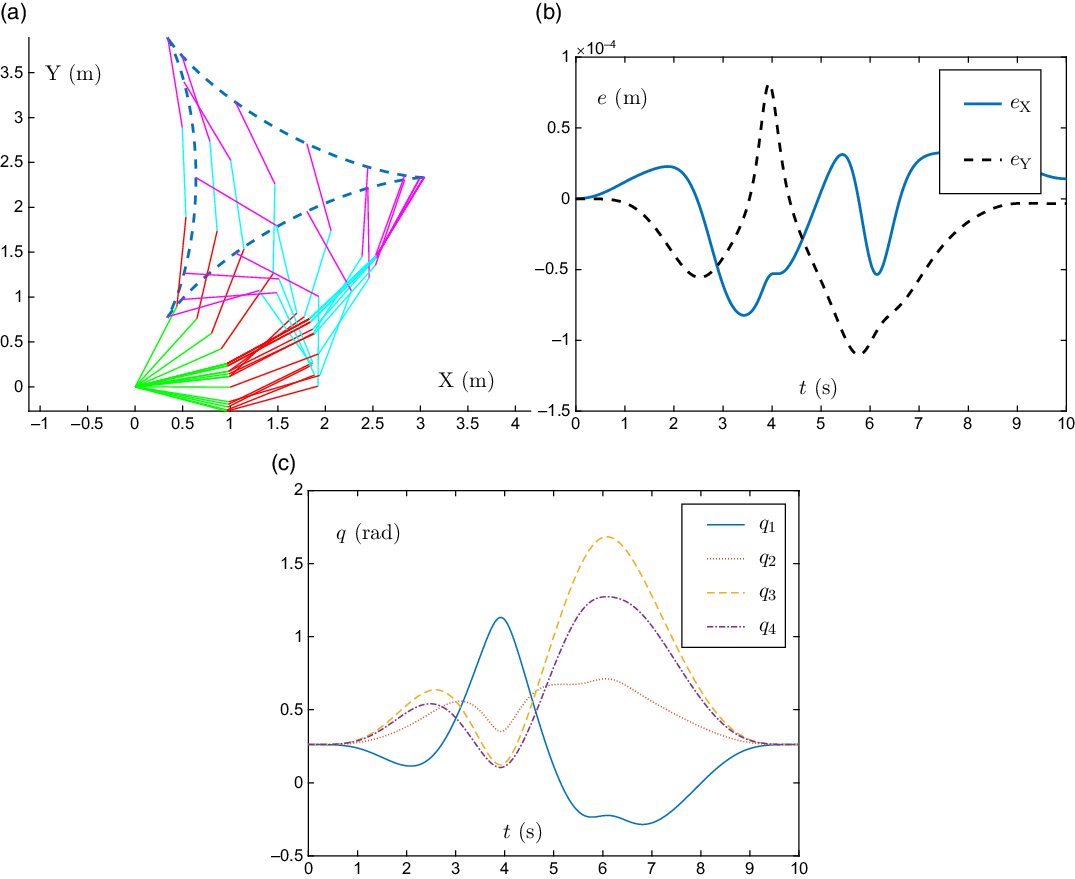
Simulation results using the proposed RMP scheme (7) with
 $\eta=0.01$
,
 $h=0.5$
and
 $\nu=0$
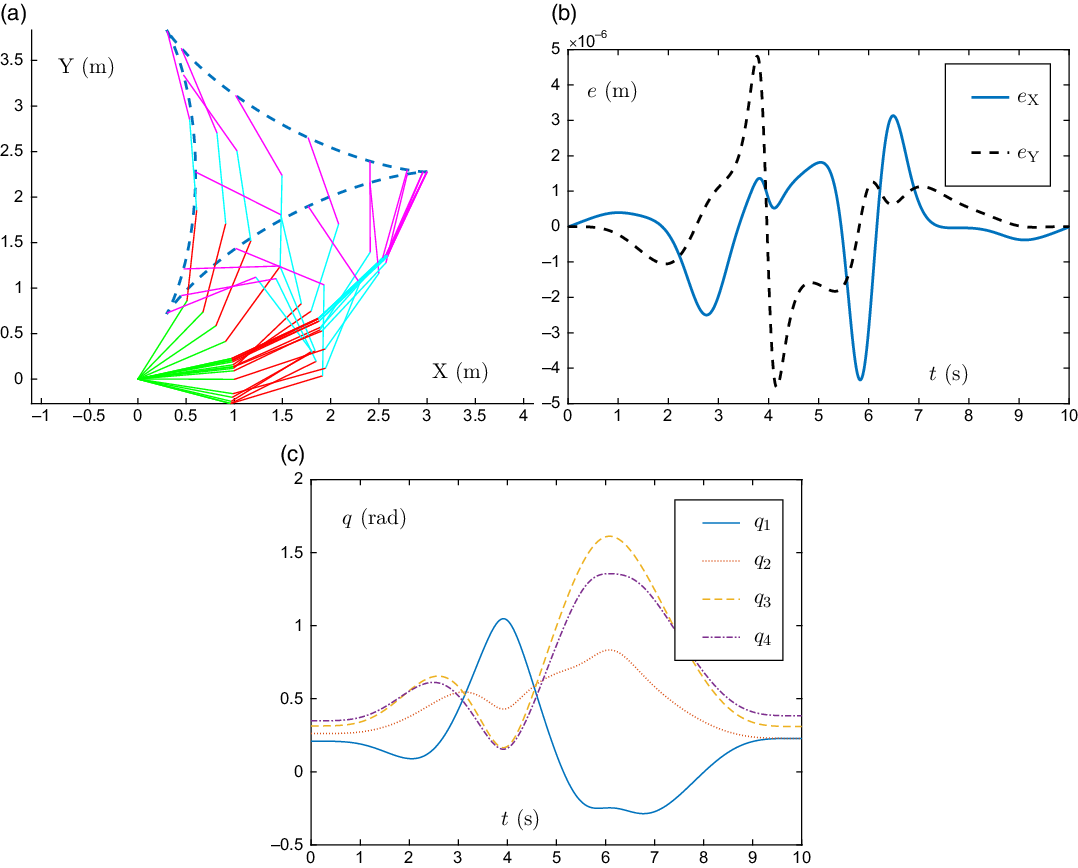
for the four-link robotic manipulator performing the tricuspid path planning task. (a) Robotic trajectory. (b) End-effector planning error. (c) Joint angle.

Simulation results using the proposed RMP scheme (7) with
 $\eta=0.01$
,
 $h=0.5$
and
 $\nu=0.5$
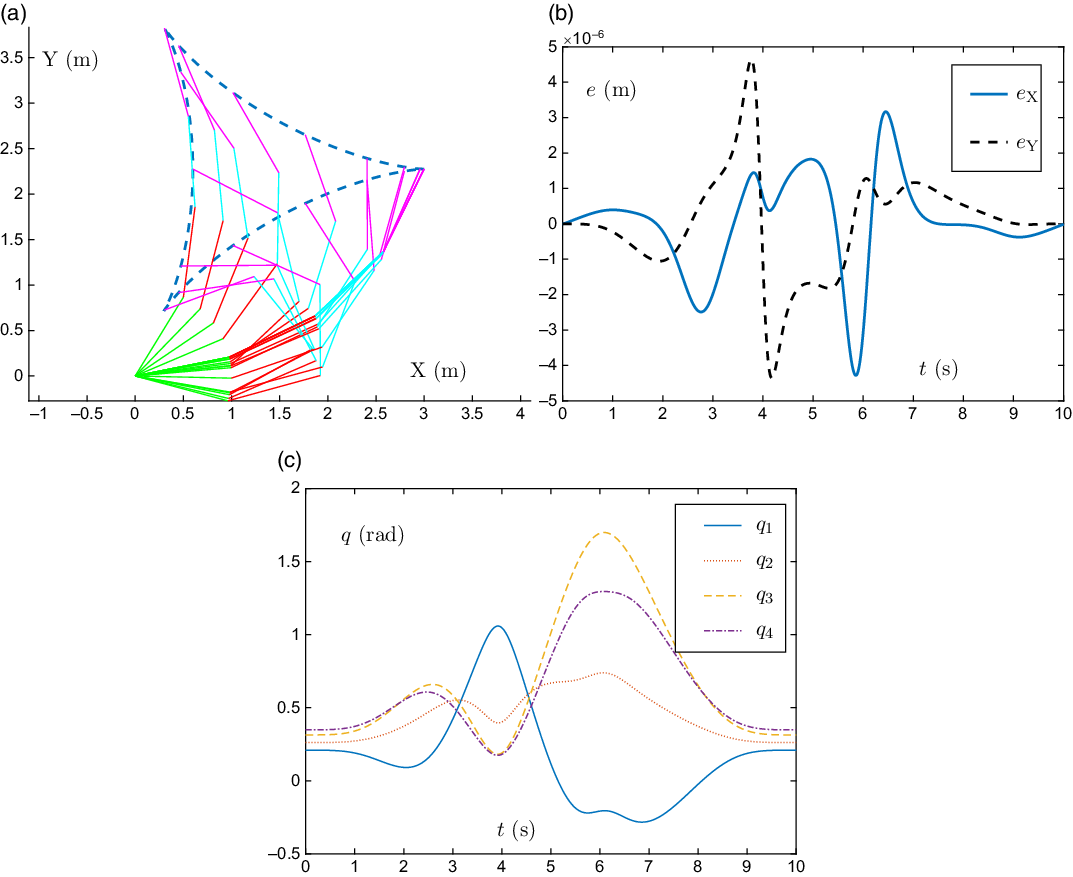
for the four-link robotic manipulator performing the tricuspid path planning task. (a) Robotic trajectory. (b) End-effector planning error. (c) Joint angle.

Simulation results using the proposed RMP scheme (7) with
 $\eta=0.01$
,
 $h=0.6$
, and
 $\nu=0.5$
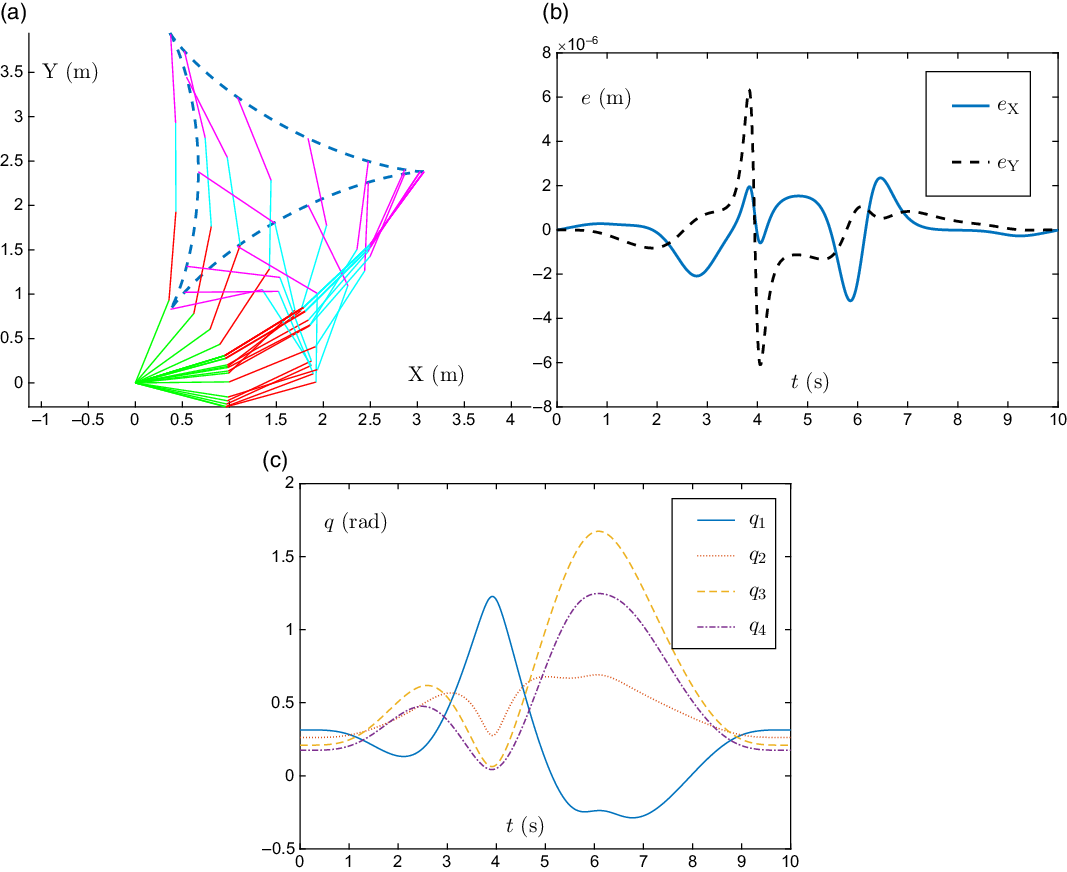
for the four-link robotic manipulator performing the tricuspid path planning task. (a) Robotic trajectory. (b) End-effector planning error. (c) Joint angle.

Simulation results using the proposed RMP scheme (7) with
 $\eta=0.001$
,
 $h=0.6$
, and
 $\nu=0.5$
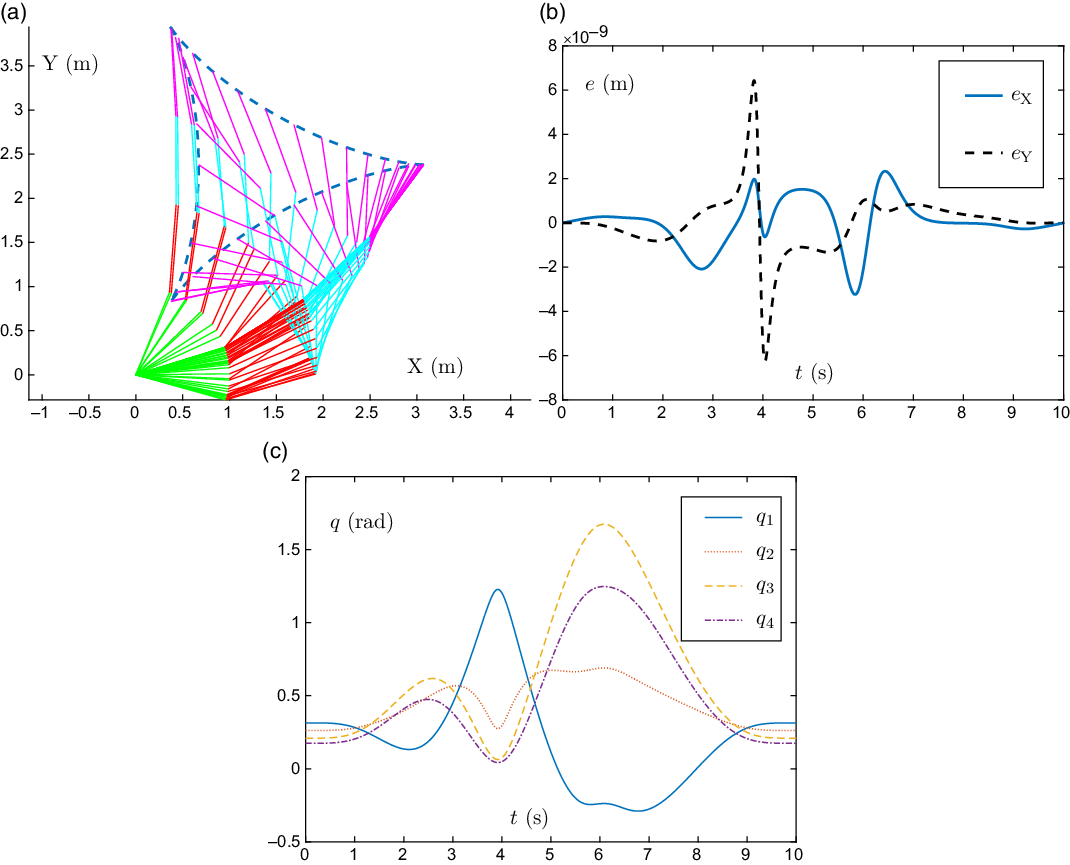
for the four-link robotic manipulator performing the tricuspid path planning task. (a) Robotic trajectory. (b) End-effector planning error. (c) Joint angle.

Simulation results using the proposed RMP scheme (7) with
 $\eta=0.01$
,
 $h=0$
, and
 $\nu=0.5$
for the four-link robotic manipulator performing the tricuspid path planning task. (a) Robotic trajectory. (b) End-effector planning error. (c) Joint angle.

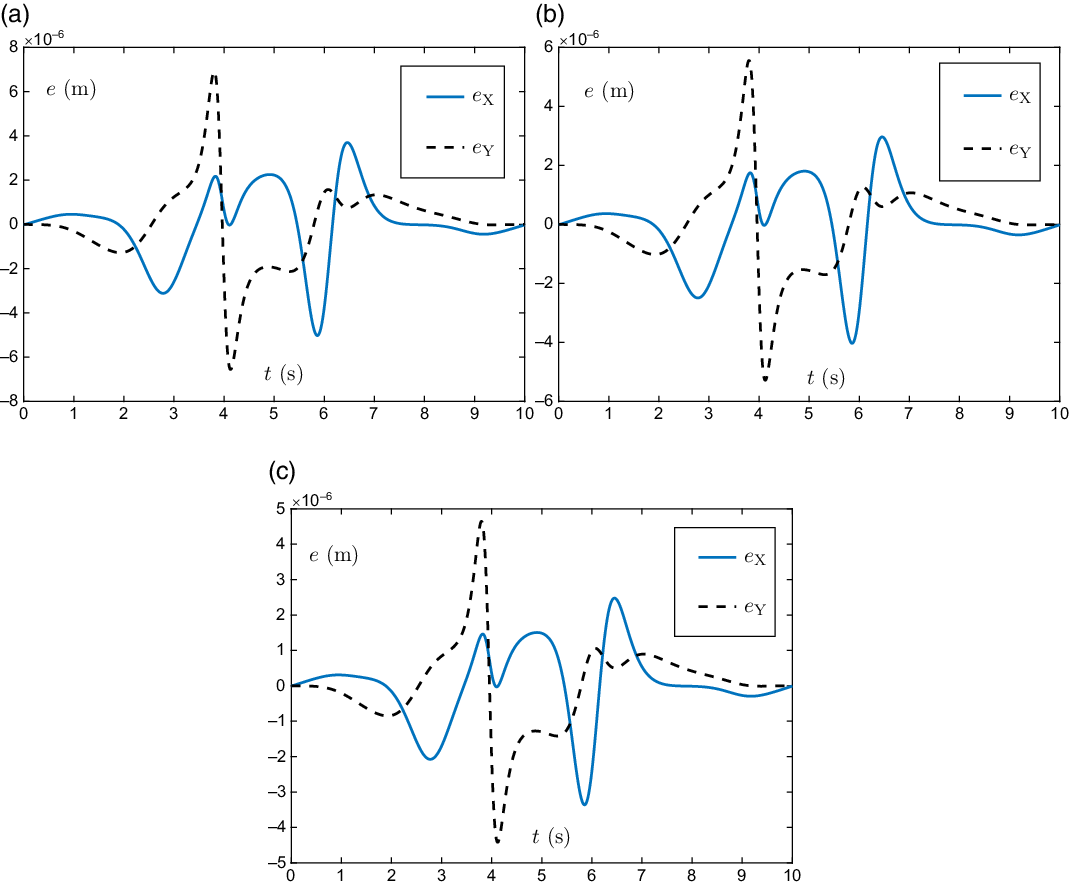
End-effector planning error using the proposed RMP scheme (7) with
 $\eta=0.01$
,
 $\nu=0.5$
, and different h for the four-link robotic manipulator performing the tricuspid path planning task. (a) With
 $h=0.4$
. (b) With
 $h=0.5$
. (c) With
 $h=0.6$
.

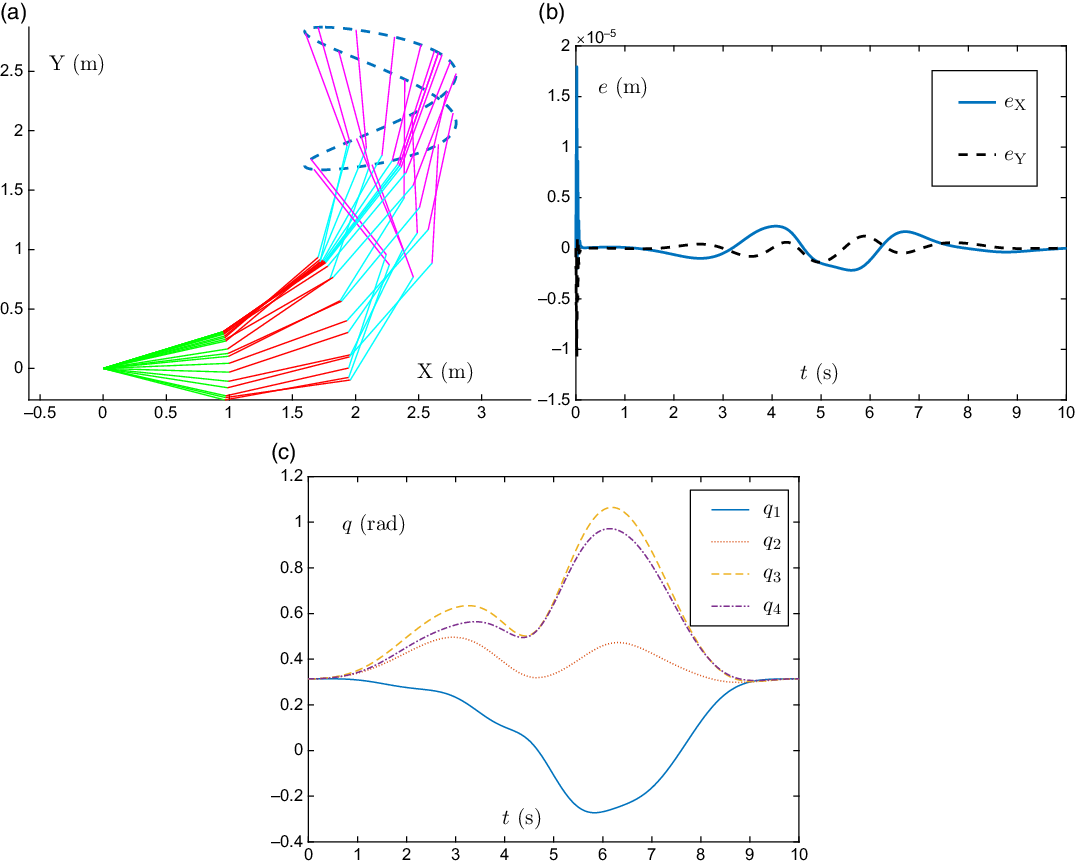
Simulation results using the proposed RMP scheme (7) with
 $\eta=0.01$
,
 $h=0.5$
, and
 $\nu=0.5$
for the four-link robotic manipulator performing the Lissajous path planning task. (a) Robotic trajectory. (b) End-effector planning error. (c) Joint angle.

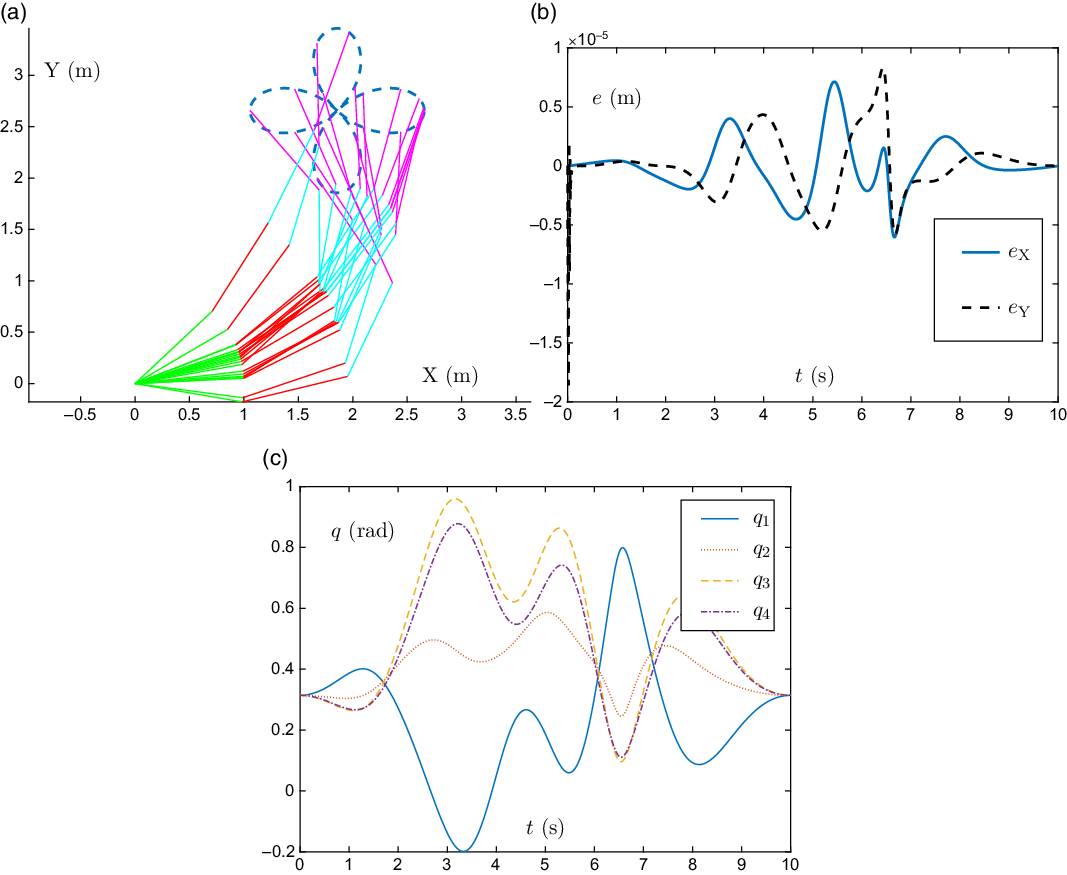
Simulation results using the proposed RMP scheme (7) with
 $\eta=0.01$
,
 $h=0.5$
, and
 $\nu=0.5$
for the four-link robotic manipulator performing the Rhodonea path planning task. (a) Robotic trajectory. (b) End-effector planning error. (c) Joint angle.

Simulation results using the extended RMP scheme (18) with
 $\eta=0.01$
,
 $h=0.5$
,
 $\nu=1.0$
, and
 $\delta=0.01$
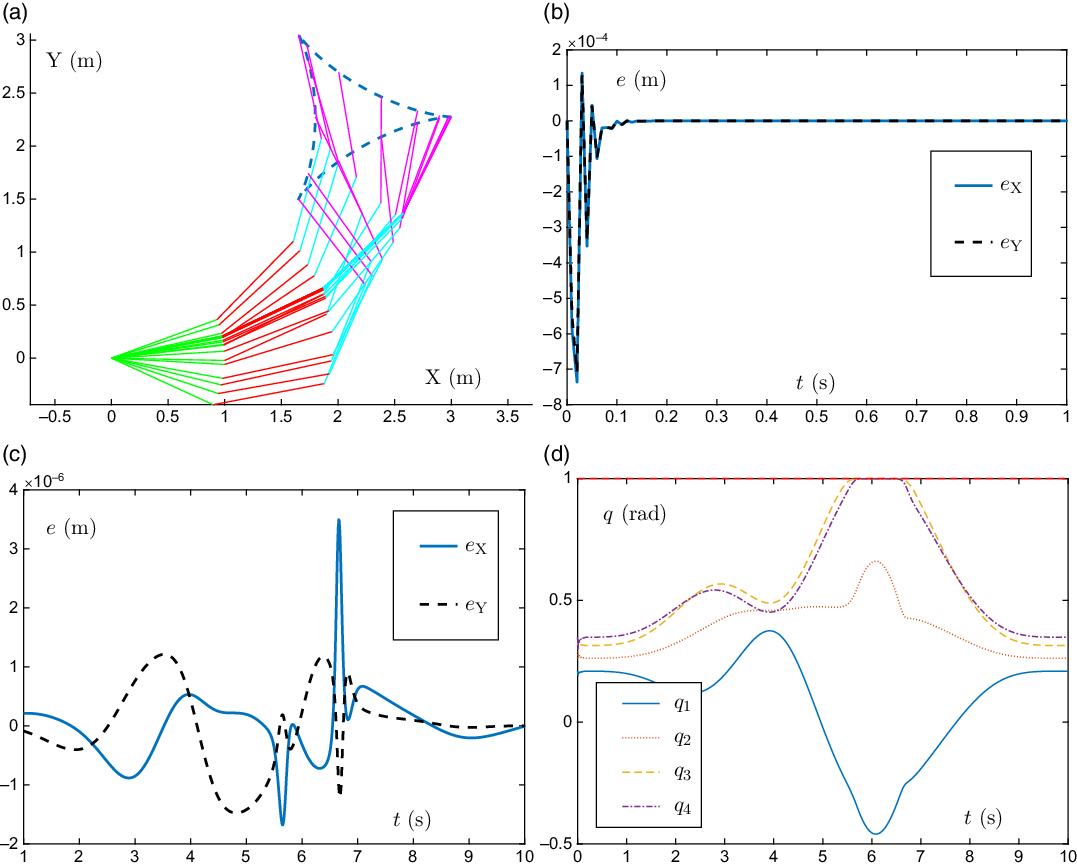
for the four-link robotic manipulator performing the tricuspid path planning task. (a) Robotic trajectory. (b) End-effector planning error within [0,1] s. (c) End-effector planning error within [1,10] s. (d) Joint angle.

Simulation results using the extended RMP scheme (18) with
 $\eta=0.001$
,
 $h=0.5$
,
 $\nu=1.0$
, and
 $\delta=0.01$
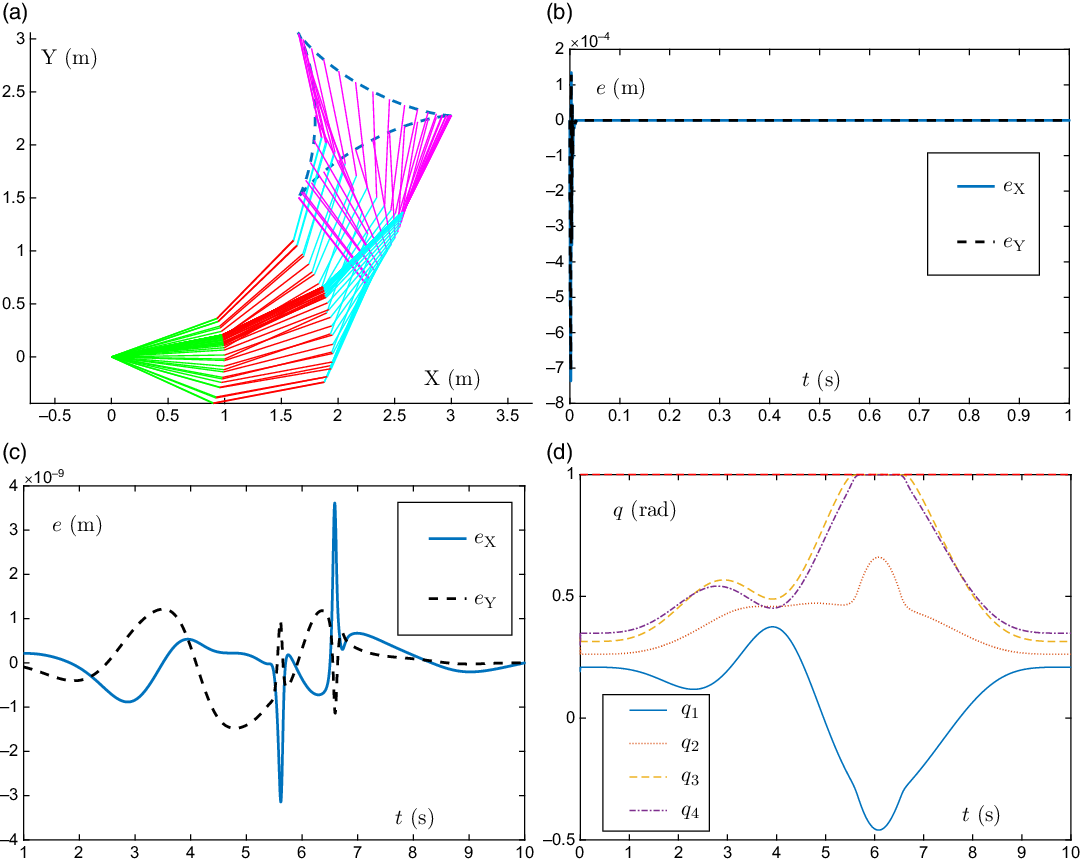
for the four-link robotic manipulator performing the tricuspid path planning task. (a) Robotic trajectory. (b) End-effector planning error within [0,1] s. (c) End-effector planning error within [1,10] s. (d) Joint angle.

Simulation results using the extended RMP scheme (18) with
 $\eta=0.01$
,
 $h=0.5$
,
 $\nu=1.0$
, and
 $\delta=0.01$
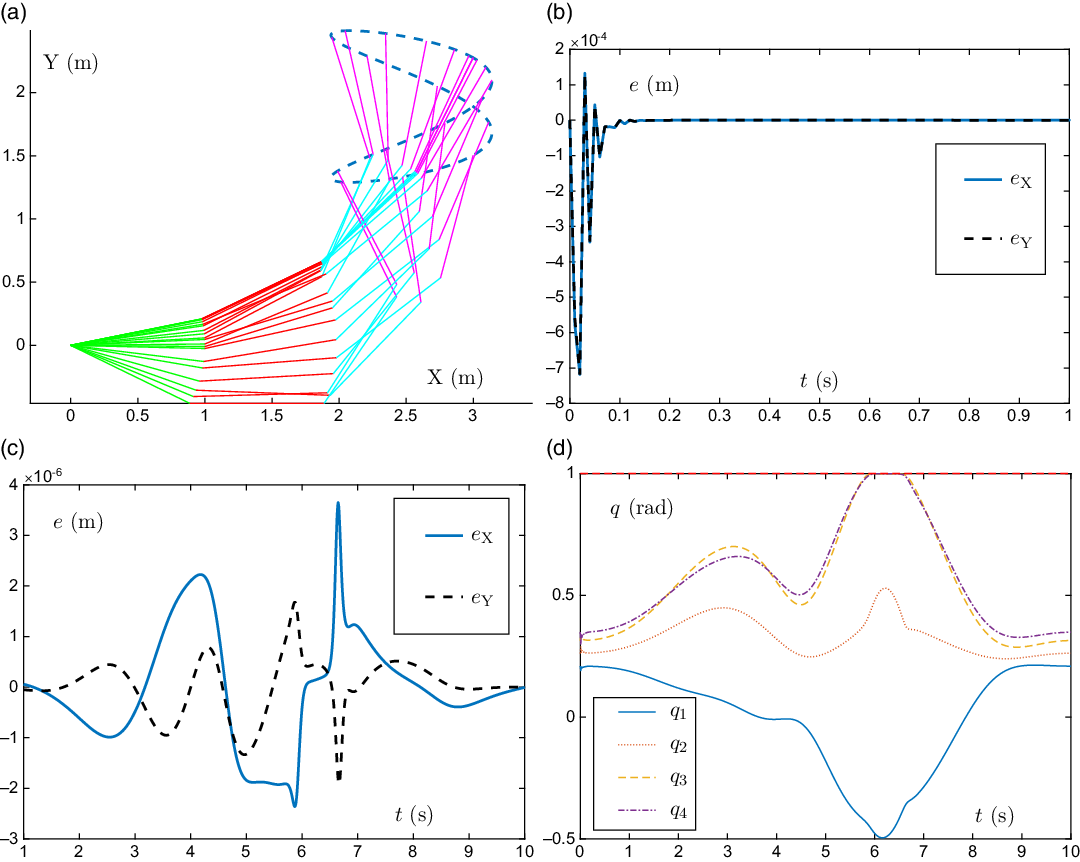
for the four-link robotic manipulator performing the Lissajous path planning task. (a) Robotic trajectory. (b) End-effector planning error within [0,1] s. (c) End-effector planning error within [1,10] s. (d) Joint angle.

Simulation results using the extended RMP scheme (18) with
 $\eta=0.01$
,
 $h=0.5$
,
 $\nu=1.0$
, and
 $\delta=0.01$
for the four-link robotic manipulator performing the Rhodonea path planning task. (a) Robotic trajectory. (b) End-effector planning error within [0,1] s. (c) End-effector planning error within [1,10] s. (d) Joint angle.

Lemma 3. In addition to achieving the RMP, the proposed RMP scheme (7) has a cube pattern in the end-effector planning precision. That is, the end-effector planning error
 $e_{k}=\phi(q_{k})-x_{\text{d}k}\in R^{m}$
is in the order of
 $O(\eta^3)$
.
Proof: When k is sufficiently large, the following result for the end-effector planning error
 $e_{k}$
is obtained on the basis of (8):
 \begin{equation*}\begin{split}e_{k}=\phi(q_{k})-x_{\text{d}k}=\phi(q_{k})-\phi(q^{*}_{k})=\phi(q^{*}_{k}+O(\eta^3))-\phi(q^{*}_{k})=O(\eta^3).\end{split}\end{equation*}
This shows that
 $e_{k}$
via the proposed RMP scheme (7) is in the order of
 $O(\eta^3)$
, thereby indicating the cube pattern of (7) in the end-effector planning precision. The proof is thus completed.
In summary, the above theoretical analysis and results verify the excellent characteristic of the proposed RMP scheme (7) for redundant robotic manipulators.
4. Extension of RMP Scheme
In this section, the proposed RMP scheme (7) is extended and studied for redundant robotic manipulators under joint constraint.
In practice, almost all robotic manipulators are constrained by joint limits [Reference Li, Jin and Mirza3, Reference Siciliano, Sciavicco, Villani and Oriolo8, Reference Guo, Li and Liao12, Reference Chaumette and Marchand40–Reference Xu, Li, Nie, Shao and Guo44]. Mathematically, the specified joint-angle limit is formulated as follows:
 \begin{equation}q^{-}\leqslant q \leqslant q^{+},\end{equation}
where
 $q^{\pm}$
denotes the upper and lower limits of q. By following ref. [Reference Xu, Li, Nie, Shao and Guo44], we can reformulate (9) as
 \begin{equation}A q\leqslant b,\end{equation}
where matrix A and vector b are given by
 \begin{equation*}A=\begin{bmatrix}I \\-I\end{bmatrix}\in R^{2n\times n},\quad\text{and}\quad b=\begin{bmatrix}q^{+} \\-q^{-}\end{bmatrix}\in R^{2n}.\end{equation*}
By introducing a nonnegative vector
 $c\in R^{2n}$
to (10), we have
 \begin{equation}A q + c = b,\end{equation}
where vector c is specifically expressed as follows:
 \begin{equation*}c=\begin{bmatrix}p^{2}_{1} \\[5pt] p^{2}_{2} \\[5pt] \vdots \\[5pt] p^{2}_{2n}\end{bmatrix}=\begin{bmatrix}p_{1}\;\;\; & 0\;\;\; & \cdots\;\;\; & 0 \\[5pt] 0\;\;\; & p_{2}\;\;\; & \cdots\;\;\; & 0\\[5pt] \vdots\;\;\; & \vdots\;\;\; & \ddots\;\;\; & \vdots \\[5pt] 0\;\;\; & 0\;\;\; & \cdots\;\;\; & p_{2n}\end{bmatrix}\begin{bmatrix}p_{1} \\[5pt] p_{2} \\[5pt] \vdots \\[5pt] p_{2n}\end{bmatrix}=Dp\geqslant 0.\end{equation*}
As mentioned in Section 2, the motion planning of redundant robotic manipulators is studied at the joint-velocity level. Accordingly, the differentiation of (11) is given by
 \begin{equation}A \dot{q} + 2D\dot{p} = 0,\end{equation}
where
 $\dot{p}$
denotes the time derivative of p. By combining (2) with (12), we have
 \begin{equation}\begin{bmatrix}J\;\;\; & 0 \\[5pt] A\;\;\; & 2D\end{bmatrix}\begin{bmatrix}\dot{q}\\[5pt] \dot{p}\end{bmatrix}=M\dot{y}=\dot{w}=\begin{bmatrix}\dot{x}_{\text{d}}\\[5pt] 0\end{bmatrix}.\end{equation}
On the basis of (13), the pseudoinverse-based motion planning approach for constrained redundant robotic manipulators is thus formulated as follows:
 \begin{equation}\dot{y}=M^{+}\dot{w}+(I-M^{+}M)\xi,\end{equation}
where
 $M^{+}\in R^{3n\times(m+2n)}$
denotes the pseudoinverse matrix of M,
 $I\in R^{3n\times 3n}$
denotes the identity matrix, and
 $\xi\in R^{3n}$
denotes the vector that is chose by optimization criteria [Reference Li, Jin and Mirza3, Reference Siciliano, Sciavicco, Villani and Oriolo8].
Being similar to (5), by adding the feedback to (14) and by selecting
 $\xi=[\mu(q_{0}-q);1_{v}]\in R^{3n}$
, we have the following pseudoinverse-based RMP scheme for constrained redundant robotic manipulators:
 \begin{equation}\dot{y}=M^{+}\left(\begin{bmatrix}\dot{x}_{\text{d}}\\[5pt] 0\end{bmatrix}-\kappa\begin{bmatrix}\phi(q)-x_{\text{d}}\\[5pt] A q + Dp - b\end{bmatrix}\right)+(I-M^{+}M)\begin{bmatrix}\mu(q_{0}-q)\\[5pt] 1_{v}\end{bmatrix},\end{equation}
where
 $1_{v}\in R^{2n}$
denotes the vector made of one. Moreover, being similar to the proposed RMP scheme (7), it follows from ref. [Reference Zhang, Qi, Li, Qiu and Yang34] that the corresponding difference formula for further discretizing (15) is given by
 \begin{equation}\dot{y}_{k}=\dot{y}(t_{k}=k\eta)=\frac{6y_{k+1}-3y_{k}-2y_{k-1}-y_{k-2}}{10\eta}+O(\eta^{2}),\end{equation}
where
 ${y}_{k}=[q_{k};p_{k}]\in R^{3n}$
. Evidently, utilizing (16) to discretize (15) yields
 \begin{equation}\begin{split}\begin{bmatrix}q_{k+1}\\[5pt] p_{k+1}\end{bmatrix}=&\frac{1}{2}\begin{bmatrix}q_{k}\\[5pt] p_{k}\end{bmatrix}+\frac{1}{3}\begin{bmatrix}q_{k-1}\\[5pt] p_{k-1}\end{bmatrix}+\frac{1}{6}\begin{bmatrix}q_{k-2}\\[5pt] p_{k-2}\end{bmatrix}+\frac{5}{3}M^{+}_{k}\left(\eta\begin{bmatrix}\dot{x}_{\text{d}k}\\[5pt] 0\end{bmatrix}-h\begin{bmatrix}\phi(q_{k})-x_{\text{d}k}\\[5pt] A q_{k} + D_{k}p_{k} - b\end{bmatrix}\right)\\[5pt] &+(I-M^{+}_{k}M_{k})\begin{bmatrix}\nu(q_{0}-q_{k})\\[5pt] \delta 1_{v}\end{bmatrix}+O(\eta^{3}),\end{split}\end{equation}
where
 $M^{+}_{k}=M^{+}(q_{k},p_{k})$
,
 $M_{k}=M(q_{k},p_{k})$
,
 $D_{k}=D(p_{k})$
, and
 $\delta \in R$
denotes a small positive constant.
Dropping
 $O(\eta^{3})$
from (17), the following RMP scheme for redundant robotic manipulators under joint constraint is thus obtained:
 \begin{equation}\begin{split}\begin{bmatrix}q_{k+1}\\[5pt] p_{k+1}\end{bmatrix}=&\frac{1}{2}\begin{bmatrix}q_{k}\\[5pt] p_{k}\end{bmatrix}+\frac{1}{3}\begin{bmatrix}q_{k-1}\\[5pt] p_{k-1}\end{bmatrix}+\frac{1}{6}\begin{bmatrix}q_{k-2}\\[5pt] p_{k-2}\end{bmatrix}+\frac{5}{3}M^{+}_{k}\left(\eta\begin{bmatrix}\dot{x}_{\text{d}k}\\[5pt] 0\end{bmatrix}-h\begin{bmatrix}\phi(q_{k})-x_{\text{d}k}\\[5pt] A q_{k} + D_{k}p_{k} - b\end{bmatrix}\right)\\[5pt] &+(I-M^{+}_{k}M_{k})\begin{bmatrix}\nu(q_{0}-q_{k})\\[5pt] \delta 1_{v}\end{bmatrix},\end{split}\end{equation}
which is the extension of the proposed RMP scheme (7), and is called the extended RMP scheme for convenience. Notably, the initialization process for the extended RMP scheme (18) is similar to that for (7), and thus omitted here. In addition, the following theoretical results are presented to show the property of (18), of which the proofs can be generalized from Section 3.
Lemma 4. The extended RMP scheme (18) is zero stable and consistent.
Lemma 5. In addition to achieving the RMP, the extended RMP scheme (18) has a cube pattern in the end-effector planning precision.
Remark 3: The main differences between this paper and our previous paper [Reference Yang, Zhang, Hu and Qiu38] lie in the following facts. First, the difference formulas utilized in such two papers are different from each other. This means that the corresponding formulations of the RMP schemes are different from each other, which making the simulation results in such two papers different. Second, the simulations in this paper are conducted on the four-link robotic manipulator (being a planar robotic manipulator), whereas the simulations in ref. [Reference Yang, Zhang, Hu and Qiu38] are conducted on the PUMA560 robotic manipulator (being a 3D robotic manipulator). The last but not the least, the RMP scheme proposed in this paper is extended to redundant robotic manipulators under joint constraint, whereas such an extension is not studied in ref. [Reference Yang, Zhang, Hu and Qiu38].
5. Simulation Comparison and Validation
In this section, comparative simulation results based on the four-link robotic manipulator with different planning examples are presented to verify the effectiveness and superiority of the proposed RMP scheme (7) and the extended RMP scheme (18). In the simulations, the length of each link for the robotic manipulator is set as
 $l_{1}=l_{2}=l_{3}=l_{4}=1$
m. Notably, only the end-effector position is considered, and thus the four-link robotic manipulator is the redundant one. Moreover, the related MATLAB codes for simulating the RMP schemes (7) and (18) are provided in Appendix B.
5.1. Validation of (7): Tricuspid path planning
In this subsection, the proposed RMP scheme (7) is simulated on the four-link robotic manipulator, where the desired end-effector planning path is a tricuspid path.
Example A.1 First, we focus on investigating the effect of parameter
 $\nu$
on the proposed RMP scheme (7). In this example, the initial joint state of the robotic manipulator is set as
 $q_{0}=[\pi/15,\pi/12,\pi/10,\pi/9]^{\text{T}}$
rad and the planning duration is set as
 $T=10$
s.
Figure 1 presents the simulation results by using the proposed scheme (7) with
 $\eta=0.01$
,
 $h=0.5$
and
 $\nu=0$
, where time
 $t\in \{0,0.01,0.02,\cdots,10\}$
s. As shown in Fig. 1(a) and (b), the end-effector of the four-link robotic manipulator effectively finishes the tricuspid path planning task, where the maximal planning error is
 $4.812\times 10^{-6}$
m. It is also worth mentioning that there does not exist the divergence problem in the end-effector planning error, as presented in Fig. 1(b). This verifies the necessary of the feedback introduction to (7). However, Fig. 1(c) shows the nonrepetitive phenomenon in the solution of
 $q_{k}$
computed by (7) with
 $\nu=0$
. That is, the final joint state
 $q_{T}$
does not return to its initial state
 $q_{0}$
. The joint error between
 $q_{0}$
and
 $q_{T}$
is
 $|q_{0}-q_{T}|=[0.0192,0.0333,0.0040,0.0343]^{\text{T}}$
, showing that
 $q_{0}$
and
 $q_{T}$
do not match well with each other. These results indicate that the proposed scheme (7) would be ineffective in achieving the RMP when setting
 $\nu$
to be a zero value.
By using the proposed RMP scheme (7) with
 $\eta=0.01$
,
 $h=0.5$
and
 $\nu=0.5$
, the corresponding simulation results are shown in Fig. 2. As presented in Fig. 2(a) and (b), the end-effector of the four-link robotic manipulator also successfully completes the desired path planning task, where the maximal planning error is
 $4.653\times 10^{-6}$
m and no error divergence problem arises. Figure 2(c) shows the repetitive phenomenon in the solution of
 $q_{k}$
computed by (7) with
 $\nu=0.5$
in terms of
 $q_{T}$
returning to
 $q_{0}$
. In addition, the joint error between
 $q_{0}$
and
 $q_{T}$
is
 $|q_{0}-q_{T}|=[6.2481,3.1964,8.1486,7.2514]^{\text{T}}\times 10^{-9}$
, showing that these two joint states match well with each other. These results indicate that the proposed scheme (7) is effective in achieving the RMP when
 $\nu>0$
.
In summary, the above simulation results verify the effective performance of the proposed RMP scheme (7) on the four-link robotic manipulator.
Example A.2 Second, we focus on investigating the effect of sampling gaping
 $\eta$
on the proposed RMP scheme (7). In this example, the initial joint state of the four-link robotic manipulator is set as
 $q_{0}=[\pi/10,\pi/12,\pi/15,\pi/18]^{\text{T}}$
rad and the planning duration is set as
 $T=10$
s.
Figure 3 presents the simulation results by using the proposed RMP scheme (7) with
 $\eta=0.01$
,
 $h=0.6$
, and
 $\nu=0.5$
. As shown in Fig. 3(a) and (b), the tricuspid path planning task is effectively fulfilled by the four-link robotic manipulator, where the maximal planning error is
 $6.335\times 10^{-6}$
m and there does not exit the error divergence problem. As presented in Fig. 3(c), the solution of
 $q_{k}$
computed by (7) shows the repetitive phenomenon in view of that the final joint state
 $q_{T}$
returns to its initial state
 $q_{0}$
. Furthermore, the joint error between
 $q_{0}$
and
 $q_{T}$
is
 $|q_{0}-q_{T}|=[7.3917,3.9349,8.2542,6.5918]^{\text{T}}\times 10^{-9}$
. Evidently,
 $q_{0}$
and
 $q_{T}$
are close to each other (since their error is in the order of
 $10^{-9}$
). These results indicate that the RMP of the four-link robotic manipulator is successfully achieved by the proposed scheme (7).
By changing the value of
 $\eta$
from
 $0.01$
to
 $0.001$
, the proposed RMP scheme (7) is studied, and the corresponding simulation results are presented in Fig. 4. Evidently, Fig. 4 shows that the end-effector trajectory of the four-link robotic manipulator matches well with the desired end-effector path with a small planning error (i.e.,
 $6.434\times 10^{-9}$
m). Figure 4(c) denotes the repetitive phenomenon in the solution of
 $q_{k}$
computed by (7). These results verify again the effective performance of the proposed RMP scheme (7). Besides, by comparing Fig. 3(b) with Fig. 4(b), the end-effector planning error is reduced by 1000 times (i.e., from
 $10^{-6}$
to
 $10^{-9}$
) with
 $\eta$
decreasing by 10 times. It follows from this comparison that the end-effector planning error is in the order of
 $O(\eta^3)$
, thus confirming the cube pattern of (7) in the end-effector planning precision. This finding also coincides with the theoretical results given in Section 3. Notably, the joint error between
 $q_{0}$
and
 $q_{T}$
is
 $|q_{0}-q_{T}|=[7.4102,3.9779,8.2406,6.5701]^{\text{T}}\times 10^{-13}$
. Evidently, the joint error is also reduced considerably, when the value of
 $\eta$
decreases. These observations indicate that the sampling gap
 $\eta$
is an important fact to improve the performance of the proposed RMP scheme (7).
In summary, the above simulation results substantiate the effectiveness and superiority of the proposed RMP scheme (7) on the four-link robotic manipulator.
Example A.3 Third, we focus on investigating the effect of step size h on the proposed RMP scheme (7). In this example, the initial joint state of the four-link robotic manipulator is set as
 $q_{0}=[\pi/12,\pi/12,\pi/12,\pi/12]^{\text{T}}$
rad and the planning duration is set as
 $T=10$
s.
Figure 5 presents the simulation results by using the proposed RMP scheme (7) with
 $\eta=0.01$
,
 $h=0$
, and
 $\nu=0.5$
. As shown in Fig. 5, the RMP of the four-link robotic manipulator is achieved (where the joint error is in the order of
 $10^{-6}$
), but the end-effector planning error is relatively large. These results indicate that the proposed RMP scheme (7) may be less effective in the four-link robotic manipulator when setting h to be a zero value.
By simulating the proposed RMP scheme (7) with
 $\eta=0.01$
,
 $\nu=0.5$
, and different h, the corresponding results are shown in Fig. 6. Note that the robotic trajectory and joint angle are quite similar to those in Fig. 5, and are thus omitted here. By comparing Fig. 5(b) with Fig. 6, a nonzero value of h can increase the end-effector planning precision (i.e.,
 $10^{-4}$
versus
 $10^{-6}$
). Moreover, Fig. 6 verifies again the effectiveness and superiority of (7) in terms of a small end-effector planning error (and a small joint error between the initial and final joint states). These results show that the performance of the proposed RMP scheme (7) can be further improved by increasing the value of h, thus indicating the importance of h to (7).
-
(1) The RMP parameter
$\nu$
is used to ensure the RMP property of the proposed scheme (7) for redundant robotic manipulators. It must be a positive value. Changing
$\nu$
would have a direct influence on the joint-angle repetitive precision, but generally do not influence the end-effector planning precision. -
(2) The sampling gap
$\eta$
is used to ensure the end-effector planning precision and joint-angle repetitive precision via the proposed scheme (7) for redundant robotic manipulators. In addition, by using (7), the end-effector planning precision will change in the manner of
$O(\eta^3)$
. That is, the planning precision increases by 1000 times when
$\eta$
decreases by 10 times. This is the major benefit of the proposed RMP scheme (7). -
(3) The step size h is used to ensure the non-divergent end-effector planning error and the end-effector planning precision via the proposed scheme (7). It must be a positive value. Increasing h within an suitable range will further increase the end-effector planning precision.


On the basis of the above observations, a nonzero value of
 $\nu$
, a small value of
 $\eta$
, and a relatively large value of h will lead to the proposed RMP scheme (7) with high end-effector planning precision and joint-angle repetitive precision.
In summary, the above simulation results substantiate the effectiveness and superiority of the proposed RMP scheme (7) on the four-link robotic manipulator.
5.2. Validation of (7): Lissajous and Rhodonea paths planning
In this subsection, the proposed RMP scheme (7) is simulated on the four-link robotic manipulator, where the desired end-effector planning paths are a Lissajous path and a Rhodonea path. In the ensuing simulations, the initial joint state of the robotic manipulator is set as
 $q_{0}=[\pi/10,\pi/10,\pi/10,\pi/10]^{\text{T}}$
rad and the planning duration is set as
 $T=10$
s.
Figures 7 and 8 present the simulation results by using the proposed RMP scheme (7) with
 $\eta=0.01$
,
 $h=0.5$
, and
 $\nu=0.5$
. As shown in such two figures, the end-effector trajectories of the four-link robotic manipulator match well with the desired end-effector paths (i.e., the Lissajous and Rhodonea paths) with a small planning error, thus indicating the effective performance of (7). Figures 7(c) and 8(c) also show the repetitive phenomenon in the solution of
 $q_{k}$
computed by (7). These results denote that the proposed scheme (7) enables the RMP for the four-link robotic manipulator.
In summary, the above simulation results further substantiate the effectiveness and superiority of the proposed RMP scheme (7).
5.3. Validation of (18): Tricuspid, Lissajous, and Rhodonea paths planning
In this subsection, the extended RMP scheme (18) is simulated on the four-link robotic manipulator, where the desired end-effector planning paths are the tricuspid, Lissajous, and Rhodonea paths and the planning duration is set as
 $T=10$
s. In addition, for the four-link robotic manipulator, the initial joint state is set as
 $q_{0}=[\pi/15,\pi/12,\pi/10,\pi/9]^{\text{T}}$
rad, and the joint-angle limit is set as follows:
 \begin{equation*}q^{+}=-q^{-}=[1.0,1.0,1.0,1.0]^{\text{T}}\;\text{rad}.\end{equation*}
Figure 9 shows the simulation results by using the extended RMP scheme (18) with
 $\eta=0.01$
,
 $h=0.5$
,
 $\nu=1.0$
, and
 $\delta=0.01$
. As presented in Fig. 9(a)–(b), the tricuspid path planning task is effectively fulfilled by the four-link robotic manipulator, where the maximal planning error is
 $3.495\times 10^{-6}$
m and there does not exit the error divergence problem. As shown in Fig. 9(d), the solution of
 $q_{k}$
computed by (18) presents the repetitive phenomenon in view of that the final joint state
 $q_{T}$
returns to its initial state
 $q_{0}$
with the joint error
 $|q_{0}-q_{T}|=[2.1262,3.1511,2.0977,5.5852]^{\text{T}}\times 10^{-4}$
. That is, the RMP purpose is successfully achieved by using (18). Furthermore, Fig. 9(d) shows that the solutions of the third and fourth joints (i.e.,
 $q_{3}$
and
 $q_{4}$
in the figure) reach their upper limits. Evidently, because the handling of the joint-angle limit is considered in (18), the corresponding joint-angle solution computed by (18) will not exceed its limit. These results indicate that the extended RMP scheme (18) is effective in the four-link robotic manipulator under joint constraint.
By changing the value of
 $\eta$
from
 $0.01$
to
 $0.001$
, the extended RMP scheme (18) is studied, and the related simulation results are shown in Fig. 10. Evidently, Fig. 10(a)–(c) presents that the end-effector trajectory of the four-link robotic manipulator matches well with the desired tricuspid path with a small planning error (i.e.,
 $3.611\times 10^{-9}$
m). Figure 10(d) denotes that the solution of
 $q_{k}$
computed by (18) is repetitive, and is kept within the specified limit. These results verify the effective performance of the extended RMP scheme (18) on the four-link robotic manipulator, though the joints are constrained. Besides, by comparing Fig. 9(c) with Fig. 10(c), the end-effector planning error is reduced by 1000 times (i.e., from
 $10^{-6}$
to
 $10^{-9}$
) with the value of
 $\eta$
decreasing by 10 times. This comparison indicates that the end-effector planning error is in the order of
 $O(\eta^3)$
, thereby confirming the cube pattern of (18) in the end-effector planning precision (which coincides with the theoretical results given in Section 4). Thus, the sampling gap
 $\eta$
is an important fact to improve the performance of the extended RMP scheme (18).
For further investigation, we simulate the extended RMP scheme (18) with
 $\eta=0.01$
,
 $h=0.5$
,
 $\nu=1.0$
, and
 $\delta=0.01$
for the constrained four-link robotic manipulator performing the Lissajous and Rhodonea paths planning tasks. The corresponding simulation results are presented in Figs. 11 and 12. As shown in these two figures, the end-effector trajectories of the four-link robotic manipulator match well with the desired Lissajous and Rhodonea paths with small planning errors (being in the order of
 $10^{-5}$
or
 $10^{-6}$
m). In addition, the repetitive phenomenon exists in the solution of
 $q_{k}$
computed by (18), and the
 $q_{k}$
solution does not exceed its limit (though the third and fourth joints reach their upper limits). These results denote that the extended scheme (18) enables the RMP for the four-link robotic manipulator under joint constraint.
In summary, the above simulation results substantiate the effectiveness and superiority of the extended RMP scheme (18) on the constrained four-link robotic manipulator.
6. Conclusion
In this paper, the RMP of redundant robotic manipulators is further studied by proposing the new RMP scheme (7). Such a scheme is developed from the discretization of an existing RMP scheme (5) by utilizing the difference formula (6). It is then theoretically shown that such a scheme has the cube pattern in the end-effector planning precision. That is, the planning precision via (7) is in the order of
 $O(\eta^3)$
. Moreover, an extension of the proposed RMP scheme (7) is presented, and the extended RMP scheme (18) is studied for redundant robotic manipulators under joint constraint. Comparative simulation results based on the four-link robotic manipulator with different examples further verify the effectiveness and superiority of the proposed RMP scheme (7) and its extended one (18).
On the basis of this paper, the continuing work can be the practical application of the proposed RMP scheme (7) and its extended one (18) to actual redundant robotic manipulators. In addition, as for the RMP of redundant robotic manipulators, one future work can be the research of developing new schemes with higher end-effector planning precision. Another future work can be the research of developing new RMP schemes for redundant robotic manipulators in the noisy environment.
Acknowledgements
This work is supported by the Science and Technology Planning Project of Guangzhou City under Grant 202102080350, and by the Innovation and Entrepreneurship Project of Guangzhou Railway Polytechnic under Grant 2021SCSYS002. We thank the editors and reviewers for handling this paper and providing the suggestions to improve the presentation and quality.
Appendix A
For better understanding, the selection of z in the RMP scheme (4) [Reference De Luca, Lanari and Oriolo20] is presented in this appendix.
To realize the RMP of redundant robotic manipulators, the following joint error needs to be zero:
 \begin{equation}\varepsilon = q - q_{0}\in R^{n}.\end{equation}
That is, the RMP requirement is satisfied if and only if the error
 $\varepsilon =0$
. To make
 $\varepsilon$
converge to zero, we utilize the dynamic formula [Reference Guo, Li and Stanimirovic45] as follows:
 \begin{equation}\dot{\varepsilon} = -\mu \varepsilon,\end{equation}
where
 $\dot{\varepsilon}$
denotes the time derivative of
 $\varepsilon$
. Substituting (19) into (20) leads to
 \begin{equation}\dot{q} = -\mu (q - q_{0}).\end{equation}
Notably, (3) is a velocity-level scheme and z in (3) represents the nullspace projection [Reference Li, Jin and Mirza3, Reference Siciliano, Sciavicco, Villani and Oriolo8]. On the basis of (21), z is selected as follows:
 \begin{equation*}z = -\mu (q - q_{0}) = \mu (q_{0} - q).\end{equation*}
Thus, the RMP scheme (4) [Reference De Luca, Lanari and Oriolo20] is obtained for redundant robotic manipulators.
Appendix B
In this appendix, the main MATLAB codes for simulating the proposed RMP scheme (7) and its extended one (18) on the four-link robotic manipulator are provided.
For the four-link robotic manipulator, its kinematic equation and the Jacobian matrix are determined by the following two user-defined functions.


Then, the function for the desired tricuspid, Lissajous, and Rhodonea paths is presented as follows, where the value of parameter “r” for each path is defined by users.

On the basis of the above functions, the following code is presented for simulating the proposed RMP scheme (7) on the four-link robotic manipulator without joint constraint. Notably, the values of parameters “eta”, “h”, “nu” (which correspond to
 $\eta$
, h,
 $\nu$
in (7)), planning duration “T”, and initial joint state “q(:,1)” are defined by users.

The functions “iRMPscheme” and “RMPscheme” are almost the same as each other, of which the details are presented as follows.

On the other hand, the following code is presented for simulating the extended RMP scheme (18) on the four-link robotic manipulator under joint constraint. In addition to the aforementioned parameters, the values of “delta” (which corresponds to
 $\delta$
in (7)), “qmax”, “qmin”, and “p0” are defined by users.

Similarly, the functions “iERMPscheme” and “ERMPscheme” are almost the same as each other, of which the details are provided as follows.

In summary, by using the above MATLAB codes, the proposed RMP scheme (7) and its extended one (18) are simulated for the four-link robotic manipulator performing different path planning tasks. The simulation results are thus obtained to indicate the effectiveness and superiority of (7) and (18).