INTRODUCTION
The question of how saying something counts as doing something is arguably the central concern not just of conversation analysis but also of linguistic pragmatics and of the philosophy of language. ‘Doing things with words’, as Austin so brilliantly put it, is at the heart of our collective concerns. It is also a matter of basic importance in our everyday lives. Consider the following observed case.
-
(1) A one-way street going west. At a T-intersection a truck has pulled over headed west and the driver is unloading from the back. A hydro van (headed east, so going the wrong way) has pulled over on the other side of the street. Traffic cannot pass so the hydro van moves ahead creating enough space for a car to fit through. The truck driver addresses the driver of the hydro van.
Truck driver: You know it's one way eh?
Hydro: Huh?
Truck driver: YOU KNOW IT'S ONE WAY!
Hydro: Yeah, we have an exemption so just relax.
Truck driver: I'm just asking – you fucking relax!
Hydro: What?
Truck driver: You fucking relax! I'm just asking!!
I consider this example in more detail below. For now, I note only that the question of just what the truck driver was doing in saying, “you know it's one way eh?” emerges as a matter of some consequence for these participants.
I have, so far, purposefully spoken of ‘doing things’ rather than of ‘action’ because I believe that there is an important, indeed crucial, distinction to make here—one that has been almost universally glossed over in the analysis of interaction. ‘Doing things’ is, of course, ubiquitous, but not everything we do is ‘action’ or, even more obviously, ‘an action’ in the singular. This observation leads us to ask a question parallel to the one that Austin posed—not how saying something counts as doing something but, rather, how doing something counts as an action.
It has been noted before that progress in this area has been remarkably slow (Levinson Reference Levinson, Sidnell and Stivers2012). Figuring out just how saying something counts as doing something in interaction has turned out to be a much more complicated problem than might have initially been imagined. Part of the problem, I contend, arises from the puzzling facts of the reflexivity of action.Footnote 1 We not only do things by saying things (and through aspects of embodied conduct), we also sometimes say what we are doing (or are not doing, or meant to be doing, etc.). And another wrinkle here resides in the fact that when we say what we are doing, we very often do something in addition to or instead of the thing that we say we are doing!Footnote 2 Another obvious yet likely important point to note is that we do many things without having a description of them. Anyone who has ever attempted the ultimately impossible task of naming or labeling all of the actions in even a brief stretch of transcript or conversation will acknowledge that we lack a vernacular description (or indeed a technical term) for the majority of things done in interaction. This does not, however, imply that action descriptions (along with action names, labels, formulations, and so on) are irrelevant to the organization of interaction. Indeed, I suggest in what follows that our ideas about action are quite intimately connected with the ordinary language we use to describe it, and that the ever-present possibility of action description actually plays a crucial role in the way our doings are organized.
I make this argument in a series of steps between which I hope the logical connections will be relatively clear. I begin by clarifying the nature of the problem focusing specifically on a few cases in which it is rather difficult, for various reasons, to say just what a speaker is doing. I then turn to briefly consider the theory of descriptions, as was developed by Elizabeth Anscombe (Reference Anscombe1957, Reference Anscombe1958a, Reference Anscombe1958b, Reference Anscombe1979). This leads to the question of how action descriptions are actually done in interaction. It is clear that action descriptions vary along a number of dimensions, but of these, one is of particular concern for present purposes. What can be called the vehicular structure of talk in interaction provides for a particular form of alternative description exemplified by the case with which I began; ‘You know it's one way!’ can be described, on the one hand, in terms of the action it is understood to perform (a ‘complaint’ here about someone knowingly driving the wrong way) or, on the other, in terms of the vehicle that is used to do this (a ‘question’). My point in all of this is to suggest that by describing some swatch of conduct as the performance of an action participants in interaction thereby hold one another accountable. I focus here on cases in which the author of the conduct him- or herself employs an action description either to avow what is being done (e.g. ‘just asking’) or to disavow a possible interpretation of what is being done (e.g. ‘not asking you to come down’). Thus what I argue here is that ‘action’ as we typically understand it is conduct under a description and that it is by means of such descriptions that persons are held accountable for what they do.Footnote 3
DOING THINGS IN INTERACTION
Most attempts to grapple with the problem of action in interaction have focused on a very small slice of the things people do. Indeed, attempts to theorize the domain have been almost completely restricted to the analysis of those action types recently described as ‘recruitments’ (e.g. Couper-Kuhlen Reference Couper-Kuhlen2014; Enfield Reference Enfield, Couper-Kuhlen and Drew2014; Kendrick & Drew Reference Kendrick and Drew2016; Sidnell & Enfield Reference Sidnell, Barnes, Enfield, Enfield, Kockelman and Sidnell2014).Footnote 4 A focus on these action types to the exclusion of others can quite easily lead one to conclude that the problem is a much simpler one than it actually is. This is because the forms of conduct that have been described as ‘recruitments’ have particularly robust and singular consequences for subsequent conduct, consequences that must be managed by the participants. For instance, requests or offers often involve the subsequent transfer of an object, the doing of a service, or response with a promisory agreement.
Moreover, in cases where the question of who is to do what for whom is relevant to the participants—which importantly is not always the case (see Sidnell & Enfield Reference Sidnell, Barnes, Enfield, Enfield, Kockelman and Sidnell2014 on offer-request ambiguity)—they may convey this through either explicit or implicit construal. For instance, they may append prepositional phrases such as ‘for me’ or ‘for you’, which implicitly construe who is to benefit from what is to be done or they may preface what they do with a projective description such as ‘Can I ask that…’ or ‘Can I request that….’ (see Clayman & Heritage Reference Clayman, Heritage, Couper-Kuhlen and Drew2014). The analyst may be tempted by this to suppose that such construal reflects an underlying typology, a categorization of actions into, for instance, ‘for me’-requests on the one hand and ‘for you’-offers on the other. Whatever this has to recommend it, the problem remains that we are dealing with only a tiny slice of the things that persons do in interaction. To take these action types as a proxy for action in general is simplistic at best and potentially misleading at worst. Finally, it should be noted that, even within this domain, actual cases routinely resist easy categorization. In the first place, there are practices of speaking that are specifically designed to recruit the agency of another while at the same time avoid construal as ‘requests’ (Rossi & Zinken Reference Rossi and Zinken2016 on impersonal deontic statements). There is also the well-known case of persons using a troubles-telling to, effectively, request assistance by encouraging the recipient to offer (see Sidnell Reference Sidnell, Enfield and Kockelman2017). But, more importantly, there is the troubling fact that individual instances, examined on a case-by-case basis, often raise many more questions than they answer. To illustrate this I now turn to discuss a few well-known examples from the standard CA corpus.Footnote 5
In the first of these, Bea and Rose are nurses. Bea has called Rose to ask if she would be interested in working as a caregiver for a woman who has suffered a ruptured aneurism. Rose declines the offer and after quite a bit of talk related to the particular case and the work of nursing in general, the participants turn to discuss their current efforts to reduce their professional commitments. Rose concludes by suggesting that she only works as much as she does for the money and that she “could occupy herself very well every day of the week”. This leads her to remark at line 6 that she has a house and a ‘big garden’ presumably as evidence of the fact that she has much to keep her occupied (i.e. maintain house and garden). Having mentioned where she lives and her generously sized garden, she goes on to say, seemingly as an afterthought, “Why don't you come and see me sometimes” (line 8).Footnote 6
-
(2) SBL:l:l:lO:R
-
1 Rose: ↓No. Uh: the only reas'n ↑I: work et a:ll is becuz: of
-
2 the money hhh uh: I could (.) occupy myself very well
-
3 he[euh ev'ry day of the ↑week.
-
4 Bea: [Mm hm,
-
5 Bea: Mm hm,
-
6 Rose: You know I have[a hou:se a big gahd’n=
-
7 Bea: [↓Ye:s.
-
8 Rose: → hh ↑Why ↑don't'chu come'n ↑↑see[me ↓so:me[t i : m e s. ↓]
-
9 Bea: [ hh [I would l i]:ke
-
10 ↓to:.
-
11 Rose: I would like[ih to e < let m[e j st]
-
12 Bea: [ hh [I: do]n't know jus'whe:re thi-
-
13 ih th:is address ↑i[:s:.
-
14 Rose: [Well u-↑whe:re d-uh which part'v town
-
15 dih you ↓l[ive.
-
16 Bea: [ hh
-
17 Bea: I live et fhi:ve twelve East Is↓ley.
-
18 (1.0)
-
19 Rose: t hh We:ll < you don't ↓live very fa:r ↓from me.↓ (0.2)
-
20 If ↑yiu go on the Sta:te (0.8) u-High (0.6) u-No: if you go
-
21 out past th’ mission,
-
22 Bea: Yeah.=
-
In (3), sisters Lottie and Emma have been talking about riding bicycles in the beach-front community where they spend much of their time and are apparently moving towards the closing of the phone call. At lines 4–5, Emma remarks, “Well honey I'll probably see you one of these days”.
-
(3) NB:1:6:4, 4:15
-
1 Lottie: °Oh I ↓love tuh gee I ride mine all[th’ ti:me.°
-
2 Emma: [°Ye:ah.°
-
3 Lottie: I love it.
-
4 Emma: → hhh WELL honey (.) Ah:ll (.)
-
5 pob'ly SEE yih one a'these da:y[s,
-
6 Lottie: [Oh: Go:d yeah[(ah wish)]=
-
7 Emma: [ ehh huh ]=
-
8 Lottie: =But I c- I jis‘[couldn’ git do:wn ()
-
9 Emma: [Oh-ü
-
10 ↓Oh I ↓know=
-
11 Emma: =I'm not as[kin’ yih tih c'm dow- ]
-
12 Lottie: [J e e : z i z I mean ]I jis (0.2)
-
13 I didn’ have five minutes yesterday.
-
14 Emma: Ah don’ know how yih do i:t.
-
15 (0.3)
-
16 Lottie: Ah don’ kno:w. nh huh
-
17 Emma: You wuh: work all day tihda:y.
-
Finally, in (4), Debbie has called her friend Shelley at work and after a ‘switchboard’ type of interaction, Shelley answers at line 12 with “district attorney's office” (Shelley is apparently an assistant district attorney). By responding with an upwardly intoned production of Shelley's name, Debbie thereby reframes the call as personal rather than professional and invites Shelley to confirm the identification. After Shelley does this by a reciprocal, upwardly intoned first name (echoing in intonation Debbie's turn), Debbie launches into the business of the call with “What is the deal”.
-
(4) Debbie and Shelley
-
12 Shelley: distric attorneys office.
-
13 Debbie: Shelley:?,
-
14 Shelley: Debbie?,=
-
15 Debbie: → ↑what is tha dea::l.
-
16 Shelley: whadayou ↑mean.
-
17 Debbie: yuh not gonna go::?
-
18 (0.2)
-
19 Shelley: well -hh now: my boss wants me to go: an: uhm finish
-
20 this > stupid < trial thing,u[hm
-
21 Debbie: [<its not causeuh:m (0.5)
-
22 Mark's not going.
-
23 Shelley: no- well that wuz initially and then I'm like no:
-
24 I'll just go and then uhm yaknow this- this tow
-
25 bandit (·) thing that I have, that were doing, [he w] a:nts
-
26 Debbie: [mmhm]
-
27 Shelley: me: I- >I don't know if I tol’ you this,< he wants us
-
28 to come out to his house and do:, ’hh like spend a whole
-
29 day o:n putting everything together cause we don't get
-
30 the shit done while were at work=
-
31 Debbie: =[mm hm
-
Focusing on the arrowed lines, how can we go about determining what action is being accomplished?
-
(5) a. hh ↑Why ↑dont'ehu come'n ↑↑see me ↓so:meti:mes.↓ (ex. (2), line 8)
The first case in (5a) is widely cited in the literature as an example of an invitation. In many ways it does indeed fit what we commonly think of as an invitation—one person seems to be suggesting that the other would be welcome to visit her. But even an apparently straightforward case like this raises some problems. So, for instance, while with the utterance the speaker does seem to be proposing a visit, the exact time when this is to happen is left open. More than that, and this is crucial, it is not a single visit that is being proposed. Rather, the speaker quite clearly says “sometimes”. This plural marker is the kind of thing that an action-labeling approach is likely to ignore, but it is important we recognize that, in the most general terms, speakers do not say things that they do not mean. And of course it is obvious that participants in conversation attend to the details (such as whether someone says “sometime” or “sometimes”) of a given turn at talk. They may choose to disattend those details, but this is a choice they can make only if they are in a position to do so.
Notice that the speaker explicitly refers to the time in a nonspecific way. After all, she might have said, “Why don't you come and see me” leaving the matter of when wholly inexplicit. Secondly, she uses the plural (“sometimes”) here to indicate that she is not proposing a single visit. Rather she is suggesting multiple occasions. This, then, is not an invitation in the way “Why don't you come over for dinner tomorrow night?” is an invitation. We may still choose to call it an invitation, but this misses something crucial in the design of the turn (not to mention the consequences that commitment would have, i.e. multiple visits). Once we stop trying to force this utterance into some particular action type or category, it becomes rather obvious what the speaker is doing—she is proposing a change in the current relationship, a change, that is, from something like ‘acquaintances’ to something like ‘friends’. The speaker is conferring on the recipient an entitlement to ‘come and see me’. In this sense the utterance is creative (one could say performative) in a way that does not generally characterize invitations. Invitations may be expressive of pre-existing social relations but they need not be creative, or transformative the way this one is. This is the kind of crucially important detail that glossing the talk as an invitation is likely to obscure.Footnote 7
In (5b), the action being performed is rather less clear. This has been discussed elsewhere so I will not spend too much time repeating all the possibilities here (see Sidnell & Enfield Reference Sidnell, Barnes, Enfield, Enfield, Kockelman and Sidnell2014). Let us just note that although the utterance has all of the features of what Schegloff & Sacks (Reference Schegloff, Lerner and Sacks1973) called a ‘possible preclosing’, it nevertheless comes across as a complaint or perhaps an accusation and indeed this seems to be how Lottie hears it. In response to Lottie's response, that is, in third position, Emma goes on to disavow that what she was doing was asking Lottie “to come down”. So what is it? Possible preclosing? Complaint? Accusation? Or request/invitation? Of course, at a certain level, it is none and all of these things. But ultimately I contend that the ‘what action is it?’ question is just the wrong question to ask.
The third case in (5c) has also been discussed at some length elsewhere (see e.g. Sidnell Reference Sidnell2016; Enfield & Sidnell Reference Enfield and Sidnell2017). Here Debbie has reached Shelley at her workplace and, after recognition has been achieved, launched immediately into the question “What is the deal”. There are various aspects of the turn's design that allow us and Shelley to hear this as an accusation of wrong-doing. Here I simply want to note that with “what do you mean” Shelley denies not that she has done the thing that she is being accused of (which as it turns out involves ditching her girlfriends for a guy), but rather that she can resolve the reference of “the deal”. “What do you mean” denies the existence of the common ground that Debbie's question presupposes.
What, the reader may well be wondering, do these three cases have in common besides the apparent ambiguity in the action that is being accomplished by the arrowed turns? Before I attempt to answer this question, I want to consider one other small set of cases.
The following instances exhibit a form of conduct that might be described as ‘informing’ or as ‘tattling’ but the first is insufficiently precise whereas the second obviously ‘formulates’ what is being done in a nonneutral, evaluative manner. They might also be described as complaints but this does not register their triadic character (i.e. each involves one child describing the conduct of another to a supervising adult).Footnote 8 These examples are drawn from a corpus of video recordings that capture interaction among groups of three children in the presence of a supervising but, for the most part, nonparticipating adult.
-
(6) Kids_JKT1_21:55
-
1 Tina: Well Jude. You have to share.
-
2 Erica: Yeah Jude. You have to share.
-
3 (Tina): (we could make.)
-
4 (0.6)
-
5 Jude: I'm [a
-
6 Erica: → [Jude gra::bbed a block from me::. When I was-
-
7 →When I was grabbin’ o:ne.=
-
8 Adult: Oh dear. Well there's lots of blocks.
-
-
(7) Kids_JKT1_42:48
-
1 Erica: → Jude said boys only allowed bein’ the leader.
-
2 (0.4)
-
3 → that what he said.
-
4 (.)
-
5 Adult: We:ll th[at
-
6 Erica: [That's not very nice Ju::de.
-
7 Adult: Well I don't think it's right is it,
-
8 (.)
-
9 Erica: [Yeah
-
10 Adult: [Is that how it works in your class,
-
11 I don't think so.
-
12 Tina: No sometimes girls are the [leaders
-
13 Adult: [Sometimes girls sometimes boys.
-
-
(8) Kids_G2_T1_16:35
-
1 Alex: It's not what I'm goi:n’ after.
-
2 Cathy: He:::y.
-
3 Alex: hah
-
4 Cathy: → Alex too:k my stu::ff.
-
5 (0.2)
-
6 Alex: I only took th[ree:.
-
7 Adult: [Isn't there any more,
-
8 Cathy: Not a lot.
-
In these examples, the turns in question are first-positioned utterances transparently occasioned by something that one of the other co-present children has done.Footnote 9 They elicit second-positioned responses from the adult to whom the turn is addressed as in (6) and (7), the child about whom the complaint has been lodged, or both as in (8). Let us take stock of the common features across these three cases.
-
(9) a. Jude gra::bbed a block from me::. (ex (6), line 6)
In each case, one child refers to another by use of a name which, in English, construes the one so referenced as a nonparticipant in the immediate interaction. Consequently, these utterances involve a significant transformation of the interaction from one in which the children are playing (or talking) together and the adult is observing (or disattending) to one in which the adult is a participant. Second, the remainder of the turn formulates some just prior action as a complainable matter (Schegloff Reference Schegloff2005). Thus Jude is described as having “grabbed” a block “from me”; Jude is described as having said something for which he has no authority and which is gender-discriminating; and Alex is described as having “taken” “my stuff”.Footnote 10
The responses these turns elicit also share a number of features. Specifically, in each case the adult attempts to redress the problem. In (6) and (8), where the complaint involves the ownership of playthings, this involves pointing to the availability of other items. In (7), the complaint is also addressed, though in this case that involves questioning whether what Jude has been reported as saying is in fact true.
So here we have a form of conduct that can be identified across a number of otherwise diverse cases. Once identified, it is possible to describe what is being done in terms of recurrent, stable features of turn-design and sequence position. Now, we can gloss these utterances as ‘tattles’ despite the unfortunate fact that this term conveys a decidedly nonneutral stance (to ‘tattle’ on someone is to do something untoward), but whether we use the term or not, the crucial thing to notice is that these utterances, or the doings that these utterances embody, are built directly out of the details of this particular setting. Specifically, these actions involve one child characterizing the action(s) of another child (referring to him/her by name) in talk that is directed to an adult. Thus, a central constitutive feature of this practice is a particular configuration of participants organized in terms of a specific set of relevant social relations. One peer talks about another peer, characterizing their just prior conduct as the violation of an implicit rule, to a person of authority. The thing is, you cannot have this practice without this particular set of relations.Footnote 11 If you take those relations away, or substitute some other set of relations, you are left with something glossable as an ‘informing’, a ‘complaint’, and so on, but not a ‘tattle’.Footnote 12
What we can see here with unusual clarity is actually something totally general about social interaction—conduct is built out of the details of the particular social settings in which it is occasioned and, in so far as it accomplishes anything, it is intimately tied to the way in which the participants are related to one another (under at least one possible construal/description). And so we can go back and consider the earlier cases and see how they too are built out of the particulars of the social settings in which they occur, including the social relations between the participants. Taking these in reverse order, in (4) Debbie has certain expectations of Shelley by virtue of their relationship as ‘friends’ and specifically as ‘girlfriends’, and these expectations form the backdrop against which ‘what is the deal’ is hearable as an accusation. So later in the conversation, when Debbie is explaining herself, she says “don't ditch your girlfriends just for some guy”. In (3), Emma's “guess I'll see you one of these days” does what it does against a normative backdrop of expectations about duties of care and regard between sisters—for instance, that they should see each other regularly, that they should “be there for one another”. And as I have already suggested above, the “sometimes” in “Why don't you come and see me sometimes” conveys that its speaker is proposing a development of the relationship from mere acquaintances to friends who visit one another.
It is precisely this constitutive backdrop of relations, these details of the setting out of which the conduct is built, that action labels such as ‘invitation’, ‘accusation’, and so on gloss over. To summarize what has been said so far:
-
(i) Whatever gets done in interaction is built out of the particular, constituent features of actual settings.
-
(ii) Any action label or description is, at a certain level, merely a gloss, one that highlights some features and obscures others.
CONDUCT ‘UNDER A DESCRIPTION’
What I have said so far seems to leave a rather small place for action descriptions (i.e. standard action labels such as, for example, invitation, offer, request, and so on) since, for the most part, participants in interaction get along pretty well without them and doing things is not in any way dependent on one's being able to describe the things being done as ‘actions’. But this is just one side of a much more complex story. The importance of action descriptions resides in the fact that accountability attaches not to what we do in some bare, obvious or ‘brute’ sense but rather to what, if it comes down to it, we can be described as doing—accountability, that is to say, attaches to conduct under a description or, in a word, to ‘action’.
Anscombe made this point in a rather different way in so far as she noted that intentional actions ‘are the actions to which a certain sense of the question “Why?” is given application’ (1957:§9). According to Anscombe, application of the question is rejected by answers such as ‘I didn't know I was doing it’ and ‘I knew I was doing X, but only because I observed that I was’. So if I ask why you are blocking my view, you can reply with ‘rejection’ by saying that you did not know I was behind you. Alternatively, you can allow for application by replying that you wanted to prevent me from seeing something particularly unpleasant.
Importantly, Anscombe's analysis applies to actions under a particular description. An action under one description will allow for application of the ‘why’ question, whereas under another description it will not. Thus, if I ask not why you are blocking my view but rather why you are behaving in a way that reminds me of my mother, you may well say that you did not know you were doing that. It is the very same conduct but under one description it is intentional and allows for application of ‘why?’, and on another it is not intentional and does not allow for such an application. One of Anscombe's examples involves a man pumping water:
‘Why are you moving your arm up and down?’ - ‘I'm pumping’. Why are you pumping?’ - ‘I'm pumping the water-supply for the house’… moving his arm up and down with his fingers round the pump handle is, in these circumstances, operating the pump; and, in these circumstances, it is replenishing the house water-supply; and, in these circumstances, it is poisoning the household. So there is one action with four descriptions. (Anscombe Reference Anscombe1957:38, 46).Footnote 13
In this case, the action is intentional under the descriptions, ‘moving his arm up and down with his fingers round the pump handle’, ‘operating the pump’, and ‘replenishing the house water-supply’, but not under the description ‘poisoning the household’.Footnote 14
The important point, I think, is that, in very general terms, what Anscombe calls an intentional action is one for which you can be held accountable. And in this respect, there is a remarkable parallel between her argument and that of Sacks (Reference Sacks1995:vol. 1, p. 4), who suggested that, ‘what one does with “Why?” is to propose about some action that it is an “accountable action”. That is to say, “Why?” is a way of asking for an account’. In this case, Sacks was considering the use of ‘why?’ in second position where it requests an account for the doing of a just previous action in conversation (as in ‘why are you asking me that?’). However, the use of ‘why’ to request an account is not limited to such contexts (see here Bolden & Robinson Reference Bolden and Robinson2011). As Sacks says later in the lectures, ‘why’ generally casts an action as an accountable act (1995:19) and further ‘(w)here one wants to get, from the person one is talking to, an account of something—why they did something or why they have something—one way you can do it is by saying “Why?”’ (1995:21).
So, again roughly speaking, we can say that persons in interaction are (treated as) accountable for the actions that they are understood as having done intentionally.Footnote 15 Persons are accountable for intentional action and intentional action is always, as we have just seen, conduct under a particular description and not under some other description for which it is not intentional, that is, the difference between ‘preventing me from seeing something’ and ‘behaving in a way that reminds me of my mother’. Consider in this light the examples from interaction among children that we looked at earlier.
-
(10) a. Jude gra::bbed a block from me::. (ex. (6), line 6)
What the child does in each case is to describe what another has done as an intentional action and therefore something for which he or she is accountable. We can see then that describing actions is itself a form of conduct, a thing that participants do (see on this topic, Sacks Reference Sacks1963; Schegloff Reference Schegloff1988; Sidnell & Barnes Reference Sidnell, Barnes, Hayashi, Raymond and Sidnell2013). Participants use action descriptions to exercise accountability in interaction. Before turning to ask how this works we should first consider just how these descriptions are composed.
COMPOSING ACTION DESCRIPTIONS
It is useful to think of the composition of action descriptions in terms of a set of dimensions along which they vary. A particularly obvious dimension of contrast is that between analysts’ descriptions and participants’ descriptions. So on the one hand, there are descriptions such as ‘possible preclosing’ and ‘other initiated repair’, and on the other, ‘asking for clarification’ and ‘inviting’. Relatedly there are descriptions that implicate ‘action’ proper as opposed to those that implicate other types of organization, for example, ‘taking a turn’, and so on. In what follows, I focus exclusively on participants’ action-implicating descriptions.
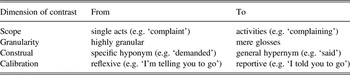
Even within this more narrowly specified domain there are several important dimensions of contrast. So for instance, action descriptions vary in terms of scope. We find descriptions of single acts (like ‘complaint’), but we also find descriptions of over-arching activities (like ‘complaining’). A related dimension of contrast has to do with the relative granularity at which conduct is described (see Schegloff Reference Schegloff2000; Drew Reference Drew1998). In a case discussed by Drew (Reference Drew1998), Shirley relates to Geri an encounter with an underage drinker at the bar where she is a server:
So I walked up to Cathy en I said, ‘OH, you drinking a Coke, can I have a sip?’ So I took a sip of it, EIGHTY PROOF. I couldn't believe it. Jimmy pours Bacardi and Coke. She had some guy go get it for her. So I looked, I took the drink, and I drank out of it. And I looked at her. I said ‘Cathy’, I said, ‘you must think the people who work here are really stupid’.
Action descriptions vary along this dimension from the highly granular example above to those in which what happened is merely glossed (e.g. ‘I spoke to her’ or ‘I told her off’, both of which might have accurately glossed what Shirley did; see also Jefferson Reference Jefferson1985). Many descriptions lie somewhere between the two extremes, often with just one added component beyond the mere naming of the action. For instance, in the following case, Ron is reporting to Lesley what happened in his church at a service after a young man was killed.
-
(11) F:SO88(II):2:2:1
-
1 Ron: =[of course]an’ they all came the following Sundee which
-
2 happ'n t'be our ha:rvest so I had about twenty sobbin:g=
-
3 Lesley: =.tch Ah::aw::,[hh
-
4 Ron: [teenage[rs in: th’ church [situation ]=
-
5 Lesley: [.hh- [Ah:oh:-:-:]=
-
6 Lesley: =[uhh
-
7 Ron: =[and so I had to[sort of hheh .hhh[hh
-
8 Lesley: [.hhhhhh [hhh=
-
9 Ron: =turn[to th'm ‘n try to]say a word f'r th[e:m:,.t.hhh=
-
10 Lesley: [e h h h e h heh] [.hhhhh
-
11 Lesley: =Ye[s.
-
12 Ron: [An’ then at the fun'r'l uh- th'following Frida:y,
-
13 the twenty ni:nth, the church w'z ab,solutely (.) packed.
-
14 Lesley: eYes[:.
-
Here Ron, in describing what he did, remarks “I had to sort of turn to them and try to say a word for them”. By including in the description a mention of having to ‘turn to them’ Ron marks this as a special, bracketed and specifically addressed part of his sermon to the congregation.
A third dimension of variation can be thought of in terms of construal. What I mean to point to here is the fact that a given swatch of conduct can be described as, for instance, ‘John said, “Go!”’, ‘John told her to leave’, ‘John ordered her to leave’, ‘John demanded that she leave’, and so on. And, finally, action descriptions vary in terms of what I call calibration, that is, the temporal relation between the described action and the describing action. So we find cases of reflexive calibration such as ‘I'm coming!’ and ‘I bet’ as well cases of reportive calibration exemplified by the example from Shirley above.Footnote 16 These possibilities are summarized in Table 1.
Dimensions of contrast in action descriptions.

We can also identify various occasions and sequential contexts for explicit action-description. One such context is third-position repair (see Schegloff Reference Schegloff1992). In the repairing third-position turn, the speaker may name the action that they meant to be doing (e.g. ‘I say it's really great’) or disavow that they were doing the action that the response has treated them as having done (e.g. ‘I'm not asking you to come down’, ‘I'm not criticizing’).
VEHICULAR STRUCTURE OF ACTION
I have proposed that accountability attaches not to what we do per se, not, that is, to conduct in an objective or ‘brute’ sense but rather to what we can be described as having done—accountability, that is to say, attaches to conduct under a description, to ‘action’.Footnote 17 Now, as we have already noted, a single bit of conduct can be described in various ways: it can be brought, that is, under various action descriptions. In many cases this possibility is the direct result of what I call, drawing on the work of Schegloff, ‘the vehicular structure of action’. By this phrase I mean to register the fact that very often conduct in interaction is composed of a vehicle and the ‘action’ that vehicle implements. Thus Schegloff & Lerner (Reference Schegloff and Lerner2009:103) in speaking of nonstraightforward responses to wh-questions write:
One basic way of understanding such conduct hinges on recognizing that questions (although not questions alone) can serve as vehicles for other actions whose implementation they format. That is, in addition to or instead of the request for information that is commonly the overt action being done, some other action(s) may be implicated, and/or may be understood by the recipient to be implicated. Their recipient, in such cases, inherits two sets of contingencies to manage: One is dealing with the action that has been implemented, the other is the format through which it has been formatted (Schegloff Reference Schegloff2007:73–78).
In Sequence organization Schegloff (Reference Schegloff2007:9) proposes, ‘a single TCU [turn constructional unit] can embody more than one action, and, indeed, some actions which a TCU implements are the vehicle by which other actions are implemented’. Schegloff goes on to develop an analysis of several cases in which questions serve as the vehicle for ‘offering’, for ‘requesting’, and for ‘posing a dilemma’. Later in the same work, Schegloff (Reference Schegloff2007:73) goes on to argue that:
Some types of first pair part can function doubly, both as actions in their own right and as vehicles or formats for other actions. For example, assessments are a type of turn which can constitute a first pair part, making agreement or disagreement relevant next … but assessments can also be the vehicle or format for such other actions as self-deprecations, …, or compliments.
In addition, Schegloff (Reference Schegloff2007:74) proposes that tellings ‘can be first pair parts in their own right’, making particular responses relevant (e.g. shared noticing, assessment) but that at least some tellings (2007:74) ‘are the vehicle for other actions’. As he notes, ‘You're standing on my foot’ is not simply a telling, it is a complaint. And thus, to respond to such an utterance with ‘oh’ and thereby to register only its status as a telling of information is interactionally inadequate (see Sidnell Reference Sidnell, Sidnell and Stivers2012:95–96). Usefully summarizing many of these points, Schegloff (Reference Schegloff2007:169) writes:
We have already had occasion to register the fact that some turn types may do ‘double duty’, both enacting their own action (questioning, assessing, telling) and serving thereby as the vehicle or instrument for another action. The same utterance (or, more technically, TCU) which does questioning can be doing requesting, or offering, etc. The same utterance which does telling can, by what is told or how, constitute a complaint. The TCU which conveys an assessment can thereby accomplish a compliment or an insult.
The point of all of this then is that we can locate across various kinds of cases a recurrent structure in which one ‘action’ serves as the vehicle for another. In the interests of clarity, in what follows, I call the first action the vehicular action and the second the derived action.
I want to propose that this vehicular structure of action has important implications for the organization of accountability. Returning now to the example with which I began, we begin to see how this works.
-
(12) Presented as (1) above
Truck driver: You know it's one way eh?
Hydro: Huh?
Truck driver: YOU KNOW IT'S ONE WAY!
Hydro: Yeah, we have an exemption so just relax.
Truck driver: I'm just asking – you fucking relax!
Hydro: What?
Truck driver: You fucking relax! I'm just asking!!
Here the truck driver's “You know it's one way eh?” is targeted for repair with “huh?” (already a sign of possible trouble) and eventually repeated at increased volume and with a generally more exaggerated prosody. The response to the repeated version treats it as a complaint or accusation of some kind. Notice in this respect that the hydro driver builds this response as an explanation or justification for the behavior that “you know it's one way” appears to identify as complainable or problematic. Further, by adding, “just relax” the hydro driver addresses an aspect of the initiating turn that is not captured by a description of it as ‘a question’. So we have here a case in which, whether intended by the speaker or not, a question is treated as the vehicle for a derived complaint. To be clear, the labels ‘question’ and ‘complaint’ are used here as merely heuristic devices without implying anything about an underlying ontology of action.
In what follows, the speaker (the truck driver) brings what he has done under the action description of ‘asking’, and he does this in order to address the issue of what he is accountable for having done. The hydro driver has implied, by the design of his response, that what the truck driver is doing is ‘complaining’.Footnote 18 By saying, “I'm just asking – you fucking relax”, the truck driver is rejecting that understanding and bringing his action under an alternate description. So here the vehicular action is asserted or avowed and the derived action is, by the inclusion of “just” conveying “asking and no more”, denied or disavowed.Footnote 19 We can see a roughly similar pattern in the following case from Debbie and Shelly (the opening of this conversation was discussed as example (4)).
-
(13) Debbie and Shelley
-
1 Debbie: awright well, we'll jus- yaknow don't worry about it
-
2 ’s no big dea:l
-
3 Shelley: no I know well I called Jay Tee and I said I: do:n't
-
4 know: [now.
-
5 Debbie: -[I just don’ want you do it jus because Mark's
-
6 not going cause th[at's just
-
7 Shelley: [Oh I know.=
-
8 Debbie: =that=
-
9 Shelley: >°I know°<=
-
10 Debbie =its jus’ like you- yaknow:, if you don't wanta do
-
11 something with like a gi:rlfriend jus’ cause th's guy:’s
-
12 not goin[g it] would piss me o:ff.
-
13 Shelley: [no:.]
-
14 Shelley: give me a break.
-
15 Debbie: -well Shelley: that's how it sou::nds.=
-
16 Shelley: =w'll a-=
-
17 Debbie: → =I mean I'm jus telling you how it sou:[nds.
-
18 Shelley: [I understand that
-
19 bu- ya I- I mean it's not- it's not just tha:t I mean I wa- I w-
-
20 I was excited to go befor:e and I still wanna go its jus I
-
21 mean I don't wanna spend the money: and I know I have other
-
22 responsibiliti:es:an,
-
Here at line 1, Debbie seems prepared to let Shelley ‘off the hook’ and to accept her excuse for not going on the trip they had planned together saying “don't worry about it”, and “it's no big deal”. However, when Shelley responds to this with “no I know”, thereby treating what Debbie has apparently said out of graciousness as what is expected in this situation, Debbie renews her complaint, making explicit the grounds for it by saying first “I just don't want you (to) do it just because Mark's not going” and subsequently “if you don't want to do something with like a girlfriend just cause this guy's not going it would piss me off”. Shelley, reasonably I think, hears in this a complaint about her and her behavior, replying by rejecting this implication with “give me a break”. In response, Debbie suggests “that's how it sounds” and, finally, in line 17, “I mean I'm just telling you how it sounds”.Footnote 20
So here again we find that in the immediate wake of a displayed understanding of the prior talk as a possible complaint, the speaker asserts the vehicular action in this case by describing it as ‘telling’. In both instances, it may be noted, the speaker prefaces the action description by ‘just’ (i.e. ‘just asking’, ‘just telling’), thereby orienting to the fact that what they have done is open to other or additional understandings (e.g. as ‘complaining’).
So far we have seen that the speaker can assert the vehicle—this is the ‘I'm just saying’ or ‘I was only asking’ type of case. In other instances, it is the derived action that is asserted or avowed. A particularly common form this takes involves an assertion that the speaker was ‘joking’, ‘kidding’, or ‘teasing’. These are cases of third-position repair in which what is apparently meant as a joke engenders a response that treats it as said in earnest; this then leads to repair in third position (see Schegloff Reference Schegloff1992 for further discussion). So, for instance, in the following case Ava apparently means to be cueing an inside joke in lines 7–8. Bee, however, does not recognize this and talks in such a way as to show she is trying to respond to the question as a serious inquiry. She first initiates repair with a repeat and when this understanding is confirmed, she indicates, by asking “Whe:re.”, that she will need more information in order to answer the question as posed. After an initial, apparently still joking response to this question (“Oh just anyplace”), Ava abandons this course of action and in so doing asserts, via action-description, what it was she was trying to do—“I was just kidding you”. So here, where Bee's responses imply an understanding of what Ava is doing as serious inquiry, Ava asserts the derived action of ‘joking’.
-
(14) TG –
-
4 Bee: hHowuh you:?
-
5 Ava: Oka:::y?hh=
-
6 Bee: =Good.=Yihs[o u:nd ] hh
-
7 Ava: [<I wan]’dih know if yih got a-uh:m
-
8 wutchimicawllit. A:: pah(hh)khing place °th's mornin’.˙hh
-
9 Bee: A pa:rking place,
-
10 Ava: Mm hm,
-
11 (0.4)
-
12 Bee: Whe:re.
-
13 Ava: → t! Oh: just anypla(h)ce? I wz jus’ kidding yuh
-
In the following case from a radio interview, the interviewee (MJ), who is an advocate for the deregulation of dairy farming and trading, is being questioned about his hopes of ‘riding on the coat-tails of the wheat board changes’. He responds to this suggestion by remarking that ‘they didn't give us inside information about the wheat boards’ which is apparently meant to imply that the interviewer (FJ) is assigning rather more intrigue to these proceedings than is warranted. FJ, however, responds without any acknowledgement of the possible nonserious character of this turn. This then prompts MJ to assert the derived action saying, “I am teasing”.
-
(15) Current Dairy Board
-
1 MJ: uh-our farmers are a:ging (.) .h u:h how do we pass
-
2 that o:n.or do we jus- (.) keep shrinking the number
-
3 of farms.=
-
4 FJ: =.h now your timing is interesting because this does
-
5 come in the midst of thuh: Harper government gutting.
-
6 The powers. of the wheat boa:rd.uhm an’ in favour of
-
7 a more free market approach < how hopeful are you of
-
8 riding on the coat-tails of the wheat board ch[anges=
-
9 MJ: [.hh
-
10 =well I ca- uh uh they didn’- they didn't give us
-
11 inside information about the wheat boards so we ha[d
-
12 FJ: [NO
-
13 [but > it's in been in the ne[ws.<=
-
14 MJ: [we [.h
-
15 → =it is- no I am teasing but in a way I kn(h)ow
-
16 (there)’s u:h uh serendipity in the way thet that
-
17 ha:ppened h. uhm (0.2) uhh I I don't know. I do
-
In a third and rather more complicated case, TV talk show host Ellen DeGeneres introduces guest Rashida Jones by inviting her to tell the audience about ‘this hilarious show’, completing the turn with “It's Parks and Recreation an’ you and Amy Poehler, how great is that”. The last part of this turn is hearable either as an idiomatic assertion and assessment (implying, ‘it's great’) or as a ‘degree’ question (parallel with such obvious degree questions as ‘how tall is that?’, ‘how big is that?’, and so on). Jones's initial response appears to treat DeGeneres's talk as the latter. Thus she recycles the word ‘great’ from DeGeneres's turn but substitutes the degree adverb ‘pretty’ (from the scalar series ‘slightly’ – ‘pretty’ – ‘very’, etc.) for the question word ‘how’. Responding this way, however, implicates what is hearable as self-praise and she repairs her talk by inserting “experientially for me”, thereby casting herself as a beneficiary of the state of affairs she has characterized as “pretty great”. Now in lines 9–13, DeGeneres produces a third-position repair that, among other things, includes a characterization of what she had done with “how great is that” as saying rather than asking.Footnote 21 Thus, here again the derived action is asserted.
-
(16) Rashida Jones (RJ) on Ellen DeGeneres (ED); 04, 2009
-
1 ED: Al:right tell people about this hilarious
-
2 show. It's Parks and Recreation an’ you
-
3 an’ Amy Poehler how- How great is that.=
-
4 RJ: =It's pretty great=
-
5 ED: =mm mh[m.
-
6 RJ: [It's- uhm- it- I just mean it- ek-
-
7 experientially for me it's pr(h)etty
-
8 [gr(h)ea(h)t(h) [heh heh ha ( )
-
9 ED: [yeah. [no. an’ but I mean it's
-
10 → a- I ah- know what you mea[nt. But I: say
-
11 RJ: [hih huh ha hah ha
-
12 [huh huh .hh hah
-
13 ED: [it's really great. The two of you.=
-
14 RJ: nyeah.
-
15 ED: yeah. [an’ it's about,
-
16 RJ: [(it is)
-
In the final set of cases to be considered here, the derived action is denied or disavowed. So, for instance, in a case from the group therapy sessions studied by Sacks (and discussed in Schegloff Reference Schegloff1992), therapist Dan is telling the group that one of the co-present members, Al, feels it necessary “to pull in one or two individuals on his side”. Although Al seems initially set to respond to (and perhaps challenge) this description of his psychological profile, it is Roger who ends up articulating an objection, saying, somewhat ironically, “Well so do I”. With this he is clearly aligning with Al as a co-patient and opposing the authority of the therapist. This prompts Dan to clarify “I'm not criticizing” thereby disavowing the action that Roger's response implies his talk was implementing.
-
(17) GTS (cited in Schegloff Reference Schegloff1992:1307)
-
1 Dan: … See Al tends, it seems, to pull in one or two
-
2 individuals on his side (there). This is part of
-
3 his power drive, see. He's gotta pull in, he can't
-
4 quite do it on his own. Yet.
-
5 Al: W'l-
-
6 Roger: Well so do I.
-
7 Dan: → Yeah. [I'm not criticizing, I mean we'll just uh=
-
8 Roger: [Oh you wanna talk about him.
-
9 Dan: =look, let's just talk.
-
10 Roger: Alright.
-
And finally, in an example that we considered earlier (see also Sidnell & Enfield Reference Sidnell, Barnes, Enfield, Enfield, Kockelman and Sidnell2014), Emma appears to be moving towards closing the call with “Well honey I'll probably see you one of these days”. While hearable as a possible preclosing, Lottie responds to it as a complaint/accusation. Specifically, she offers an excuse for not having seen Emma, saying, “I just couldn't get down”. In the present context, what is of particular interest is Emma's disavowal of the possible derived action of requesting—“I'm not asking you to come down”.
-
(18) NB:1:6:4
-
1 Lottie: °Oh I ↓love tuh gee I ride mine all[th’ ti:me.°
-
2 Emma: [°Ye:ah.°
-
3 Lottie: I love it.
-
4 Emma: hhh WELL honey (.) Ah:ll (.)
-
5 pob'ly SEE yih one a'these da:y[s,
-
6 Lottie: [Oh: Go:d yeah[(ah wish)]=
-
7 Emma: [ ehh huh ]=
-
8 Lottie: =But I c- I jis‘[couldn’ git do:wn ()
-
9 Emma: [Oh-ü
-
10 ↓Oh I ↓know=
-
11 Emma: → =I'm not as[kin’ yih tih c'm dow- ]
-
12 Lottie: [J e e : z i z I mean ]I jis (0.2)
-
13 I didn’ have five minutes yesterday.
-
14 Emma: Ah don’ know how yih do i:t.
-
15 (0.3)
-
16 Lottie: Ah don’ kno:w. nh huh
-
17 Emma: You wuh: work all day tihda:y.
-
So we have cases in which the vehicular action is asserted ((12) and (13)), those in which the derived action is asserted ((14), (15), and (16)) and those in which the derived action is denied ((17)). Perhaps, not surprisingly, we do not have cases in which the vehicular action is denied (although they do almost certainly exist).Footnote 22
Across all of these cases we see the participants managing accountability for what they can be understood as having done, and this, I contend, is where ‘action’ in the way that it has typically been conceived plays an important role in the organization of conduct in interaction. Specifically, in responding to prior talk participants in interaction need not formulate what has been done, need not sort the stream of conduct into action categories as has often been proposed and even more frequently assumed. This is a good thing too since what someone is doing in interaction is never a straightforward matter and a labeling exercise, the possibility of which is implied by such a theory, is doomed to fail. However, accountability for what is done is an ever-present possibility, and, when accountability is enforced, this typically involves description of conduct in terms of the ‘action’ it is understood to implement.
CONCLUSION
To summarize the main points of the preceding argument, I initially suggested that, in the vast majority of cases, participants in interaction do not categorize conduct into action types and that responding to a prior utterance does not require categorization in relation to a pre-existent inventory of actions (see also Sidnell & Enfield Reference Sidnell, Barnes, Enfield, Enfield, Kockelman and Sidnell2014). I went on to propose that conduct in interaction—the things people do in interaction—draws on the details of the particular situation within which they find themselves operating. Drawing on Anscombe and Sacks, I then argued that action is conduct under a specific description. Next, I went on to argue that descriptions play a key role in the organization of interaction because accountability attaches not to what someone does in a ‘brute’ or ‘raw’ sense but only to what they can be said to have done, that is, it attaches to conduct under a description or action. Finally, I considered what can be called the vehicular structure of action and specifically cases in which participants in interaction manage accountability for what they do either by avowing or disavowing a derived action (e.g. ‘I say it's really great’, ‘I'm not asking you to come down’) or by avowing a vehicular action (e.g. ‘I'm just telling you how it sounds’), thereby bringing their own conduct under a particular description or denying that a possible description applies. The article thus seeks to resolve some of the most recalcitrant problems in our thinking about action in interaction. In particular I have here developed an analysis of the way conduct in interaction becomes accountable action and, at the same time, have proposed one way we can think about the reflexive relation between conduct and its description.
APPENDIX: TRANSCRIPTION CONVENTIONS
- [ ]
-
overlapping speech
- =
-
latched utterances
- (1.0)
-
silence, represented in tenths of a second
- (.)
-
‘micropause’, ordinarily less than 0.2 of a second
- .
-
falling, or final, intonation
- ?
-
rising intonation
- ,
-
‘continuing’ intonation
- :
-
prolongation or stretching of the sound
- -
-
cut-off or self-interruption
- word
-
emphasis, by either increased loudness or higher pitch
- WOrd
-
especially loud talk
- °
-
following talk is markedly quiet or soft.
- °word°
-
markedly softer
- _:
-
inflected falling intonation on the vowel
- :
-
inflected rising intonation
- ↓ ↑
-
sharper rises or falls in pitch
- > <
-
compressed or rushed talk
- < >
-
markedly slowed or drawn out talk
- <
-
talk that is ‘jump-started’, i.e. sounds like it starts with a rush
- hh
-
hearable aspiration
- .hh
-
inhaled aspiration
- ( )
-
inaudible talk