1. INTRODUCTION
A satellite navigation system is not only an important component of the national information infrastructure but also a crucial part of the basic strategic resources for the national security of a country. With the completion and operation of the GPS and GLONASS systems as well as COMPASS and GALILEO which are under construction. The development of the Global Navigation Satellite System (GNSS) is entering a new and unprecedented era. The system time provided by a satellite navigation system serves as a reference for time services and its accuracy, stability and controlled precision compared to UTC are decisive factors for the system's positioning, navigation and timing (PNT) and high accuracy services.
GPS system time (GPST) is generated and maintained by the time reference system located in Colorado, US, and traces UTC of the US Naval Observatory through GNSS common-view and Two-Way Satellite Time Frequency Transfer (TWSTFT) links (Cheng et al., Reference Cheng, Cai, Wen, Wang, Yao and Wang2009). GPST is also monitored and evaluated in a timely manner in accordance to UTC.
COMPASS/Beidou system time (BDT) is generated and maintained by the time-frequency system of a master control station. It adopts the length of a second in international atomic time as its basic unit and uses the continuous counting method with ‘week’ and ‘second of the week’. BDT is broadcast in the navigation message files. The starting point of BDT is at 00:00 UTC Jan 1st, 2006, and there is no leap second in the BDT system (China Satellite Navigation Project Centre, 2009).
This paper first introduces comparison links adopted for evaluating the performance of BDT. Then tests on the performance assessment of BDT are carried out, and preliminary results of the frequency accuracy and frequency stability of BDT relative to UTC(NTSC) are presented.
2. A METHOD FOR PERFORMANCE EVALUATION OF BDT
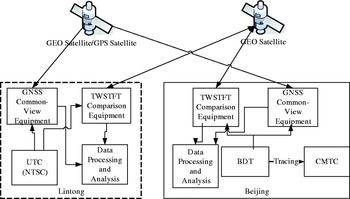
The performance evaluation system for BDT is mainly composed of a time-frequency system and comparison links, as shown in Figure 1.
System diagram for the structure of the performance evaluation of BDT.

The time-frequency system consists of BDT, military standards of UTC (CMTC) and UTC (NTSC). Both BDT and CMTC are located in Beijing and BDT also traces to CMTC. While NTSC, i.e., the UTC set, maintained by the National Time Service Centre of CAS, is located in the Lintong District, Shaanxi Province and is traced to international UTC by means of TWSTFT and GPS Satellite Common-View etc.
The comparison links between Beijing and Lintong consist of GPS common-view links, two-way time frequency comparison links of C-band satellites and BEIDOU common-view links. Observation data from the comparison equipments at both sites are separately recorded and the relative clock offset between BDT and NTSC is obtained using data exchange and time comparison processing. Figure 1 presents the detailed structure diagram of the performance evaluation system of BDT.
2.1. The Method of Two-Way Satellite Time Frequency Transfer (TWSTFT)
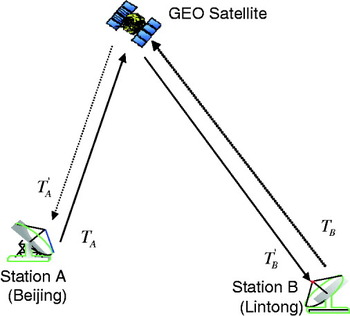
In the evaluation of BDT performance, two-way satellite time frequency transfer equipment, driven by BDT and NTSC respectively, were set up in Beijing (Station A) and Lintong (Station B). The two stations transmit signals (namely the enabling signals of their time counters) to each other, and the sending moments, according to their own clocks, are assumed to be T A (corresponding to coordinate time t 0) and T B (corresponding to coordinate time t 0+ΔT AB) respectively. The signals, reaching a GEO (geosynchronous orbit) satellite at coordinate times t S and t′0 respectively, will be further forwarded to the other station. Suppose Station A receives the signals (at this moment known as the closing signals) sent from Station B at T′A according to its own clock (corresponding to coordinate time t′A), while the moment the signals are received at Station B is T′B (t′B in coordinate time). In this way, two separate time delays, R A and R B, can be obtained. Then the two stations exchange their recorded data so the relative clock offset can be calculated. The sketch map of the two-way satellite time frequency transfer method is shown in Figure 2.
Diagram for the TWSTFT method.

In the TWSTFT method, the two stations simultaneously send signals to the same satellite and receive the signals that are from the other station and forwarded by the satellite, the travel paths of the signals are basically the same. Hence, measurement errors caused by the position errors of the satellites and the ground stations, the ionospheric and the tropospheric delays can be either eliminated or significantly reduced by this method.
The basic model for time comparison (Liu, Reference Liu2004) of radio signals using the TWSTFT method is:

where ΔT AB denotes the relative clock offset between the two stations; R A=T′A−T A is the reading of the counter at Station A and R B=T′B−T B is that at Station B; t AS, tSB, tBS and t SA are the time delay of the signals between the stations and satellites and they are expressed as:
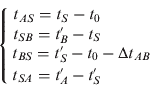
In Equation (1), the first term on the right side is the difference between the two measured time delays and the second term is the difference between the signal transmission time delays of the two stations. The second term included in this model is mainly for obtaining an accurate relative clock offset. The detailed models and formulae can be found in (Liu, Reference Liu2004).
2.2. The Method of Common-View of a GPS Satellite
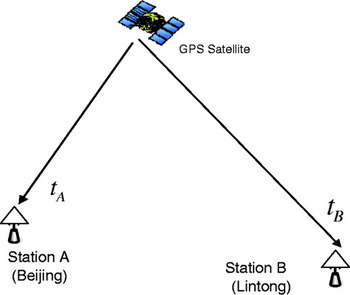
The method of common-view of a GPS Satellite can either eliminate or reduce the common errors of the GPS observations from the two stations, thus the accuracy of time offsets can be significantly improved (Allan et al., Reference Allan and Barnes1981; Weiss, Reference Weiss1985). Currently, it is the most widely used method in many time systems including International Atomic Time. Its principle is: GPS receivers at two different stations simultaneously track the same satellite using the global GPS common-view chart provided by BIPM. Then the clock offset of the two stations can be obtained based on the clock offsets of the two stations relative to the same GPS satellite (Wang et al., Reference Wang and Gao2000; Yang, Reference Yang2003). Refer to the diagram in Figure 3.
Diagram for the method of common-view of a GPS satellite.

If the receivers at both Stations A and B are GPS common-view receivers, the clock offsets of the two stations relative to the GPS satellite, namely Δt Aj and Δt Bj respectively, can be obtained using
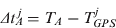
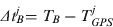
where T A – the receiver clock offset at Station A; T B – the receiver clock offset at Station B; T GPSj – the clock offset of the observed GPS Satellite (PRN j).
Then the relative clock offset of the two stations can be obtained by:

It is noted that if the receivers are of high accuracy geodetic grade, the relative clock offset of the two stations can be also obtained from the pseudorange measurements.
Suppose the pseudorange measurements between the observed GPS satellite (PRN j) and the two stations received at t A and t B are ρ Aj(tA) and ρ Bj(tB) respectively, then:


where c is the velocity of light; τ Aj(tA) is the time delay between GPS satellite (PRN j) and Station A; τ Bj(tB) is the time delay between GPS satellite (PRN j) and Station B.
The relative clock offset of the two stations can be obtained using:

The last three terms in Equation (8) are the error corrections related to the satellite, space propagation and user receiver respectively, and the detailed model can be found in reference (Liu, Reference Liu2004; Yang, Reference Yang2003). The relative clock offset of Station A and B, which is also the relative clock offset of BDT and NTSC can be obtained after the relevant errors are deducted.
It should be noted that the method of common-view of a GEO satellite is also applicable to BeiDou GEO satellites.
3. FREQUENCY ACCURACY AND FREQUENCY STABILITY OF BDT
3.1. Frequency Accuracy
The frequency accuracy is likely to be affected by the frequency stability and measurement errors and a long sampling period of data is usually adopted. Thus the frequency accuracy and stability based on this data is considered reliable. In addition, the frequency stability of the sampling period should be either one order higher than or above 1/3 that of the frequency accuracy (Yang, Reference Yang2003; Military Training Material Editing Work Committee of PLA General Armament Department, 2004).
Let the relative clock offset ΔT AB at a series of epochs be x i, where i=1, 2, …, n 1, and n 1 is the total number of sampling epochs. These clock offsets can be obtained from Equations (1), (5) and (8), the fitting results can be obtained by the Least Squares (LS) estimation method (Military Training Material Editing Work Committee of PLA General Armament Department, 2004; Guo, 2006).
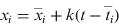
where
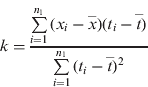
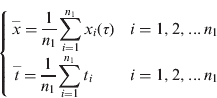
If there are some outliers, then a robust estimation method can be used instead (Yang et al., Reference Yang, Cheng, Shum and Tapley1999, Reference Yang, Song and Xu2002; Yang, Reference Yang1999, Reference Yang2001).
Based on Equation (9), clock offsets of a day can be fitted, and the fitted value  at the epoch time 00:00 can be obtained. Then the relative frequency offset of BDT and NTSC, namely the frequency accuracy, is calculated using:
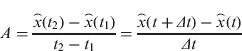
where Δt is the time period of sampling, and Δt equals 7 in this research. Based on all epochs  , the statistical values for the time series, including the average, minimum, maximum as well as the value of the frequency accuracy under the 95% confidence level, can be calculated.
3.2. Method for Calculation of Frequency Stability
The models that are commonly adopted for estimating the frequency stability of the GNSS time system are the Allan variance, the Hadamard variance (Allan, Reference Allan1966; Baugh, Reference Baugh1971) and their modified models (Guo, 2006). The Allan variance is likely affected by linear frequency drift. However, the Hadamard variance is insensitive to linear frequency drift, it uses third-order difference of the time difference data (Guo, 2006), the equivalent variance of its estimation is also reduced. In view of the unobvious BDT frequency drift, the Allan variance can be used for calculating frequency stability of BDT relative to NTSC, and the formula is:
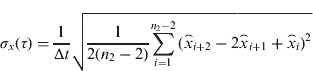
where Δt is the time period of sampling (Δt=7 in this research) and n 2 is the total number of the sampling epochs.
4. TEST RESULTS AND ANALYSIS
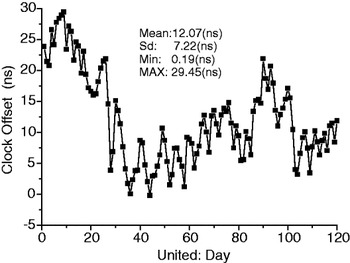
In order to monitor the operation of BDT and assess the frequency accuracy, the frequency stability of BDT as well as the difference between BDT and UTC, common-view links of both GPS and GEO satellites, and two-way time frequency comparison links were established for tests of the performance evaluation of BDT. A large amount of data was acquired and the calculated results demonstrated the stability in the operation of BDT. Moreover, results from the three types of comparison links all show good consistency between BDT and NTSC. Due to the similarity of the results from different types of links, only the results from the GPS satellite's common-view for the period of Jun 12th to Oct 8th, 2010, are given in Figures 4 to 6.
Clock Offset of BDT relative to NTSC.

Frequency accuracy of BDT relative to NTSC (7-day observations).

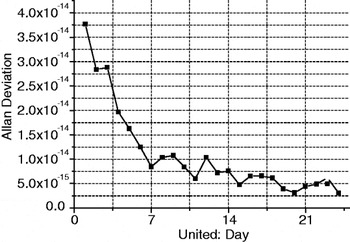
Frequency stability of BDT relative to NTSC.

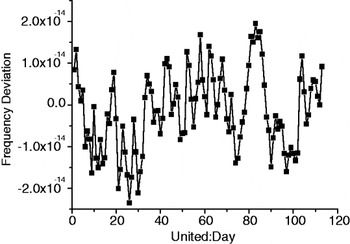
The frequency accuracy and frequency stability of BDT, and the time difference between BDT and NTSC are shown in Table 1. It can be seen from Figure 4 that, compared with UTC, the BDT relative time offset is about 7 ns. The frequency accuracy of BDT for the 7 days is shown in Figure 5. It is concluded from these results that:
• Figure 4 and Table 1 show that BDT is continuously stable, with the time difference relative to NTSC (maintained by NTSC, CAS) varying from 26·31 ns under 95% confidence level to 29·45 ns in the maximum. In other words, the relative time offsets can be controlled under 30 ns.
• Figure 5 and Table 1 show that the frequency accuracy of BDT relative to NTSC in the 7 days is 1·50×10e-14 under 95% confidence level, with the maximum and minimum values of 1·94×10e-14 and −2·35×10e-14 respectively.
• Figure 6 and Table 1 show that the frequency stability of BDT relative to NTSC is in the order of 10e-15 and the frequency stability in the 7 days is better than 8·47×10e-15.
Statistical results of the clock offset, frequency accuracy and stability of BDT relative to NTSC.

5. CONCLUSION
The BEIDOU satellite navigation program is expected to provide continuous and stable PNT and short message communication services for the Asia-Pacific region in and around 2012. As the BDT performance is crucial for the accuracy of timing services, research on the methods for the BDT performance evaluation and relevant tests were carried out. The results indicate that BDT can operate stably and continuously. The relative time offset between BDT and NTSC is under 30 ns, while the time frequency accuracy and frequency stability of BDT are in the orders of 10e-14 and 10e-15 respectively. These results meet the system design requirements and therefore, it can be expected that the BEIDOU satellite system can provide reliable and good quality timing services in the future.