CHD in the paediatric population is individually unique, with similar heart lesions having varied clinical significance depending on anatomical morphology. Even after surgical repair, CHD is a lifelong condition requiring long-term monitoring for complications and eventual transition of care to a provider specialised in adult care. Reference Hoffman, Kaplan and Liberthson1–Reference Hays3 Unfortunately, approximately half of adolescents do not successfully transfer to adult CHD care resulting in suboptimal outcomes. Reference Yeung, Kay, Roosevelt, Brandon and Yetman4
Patients frequently cite a lack of knowledge about their heart disease and the need for long-term follow-up by an adult congenital cardiologist as the reason for gaps in care. Reference Reid, Irvine and McCrindle5,Reference Burström, Bratt and Frenckner6 Previous research has also correlated readiness for transition and psychosocial quality of life with increased medical knowledge. Reference Stewart, Chahal and Kovacs7,Reference Uzark, Smith and Donohue8 Medical knowledge of CHD, however, is difficult to impress upon young patients. Cardiologists often use hand drawn pictures to help explain CHD. However, CHD is inherently a 3D condition, and these methods rely on an individual’s ability to use 2D images to imagine and reconstruct a mental model of a complex 3D heart. Reference Kappanayil, Koneti, Kannan, Kottayil and Kumar9,Reference Kim, Hansgen, Wink, Quaife and Carroll10
Research with paediatric trainees has demonstrated the ability for 3D to improve spatial understanding of complex, patient-specific cardiac conditions. Reference Loke, Harahsheh, Krieger and Olivieri11,Reference Loke, Krieger and Sable12 Using 3D models to educate patients and families remains a relatively new concept, but early studies show promising results. Biglino et al used patient-specific 3D-printed heart models to teach patients and family members, showing improvement in medical comprehension and high user satisfaction. This study used 3D-prints which can have high cost and long processing times. Reference Biglino, Capelli and Wray13,Reference Lau, Wong and Yeong14
Tele-education has been utilised for children with chronic diseases, including CHD. However, in previous studies, review of patient-specific CHD anatomy was done in-person. Reference Jaglal, Haroun and Salbach15–Reference Mackie, Rempel and Kovacs17 More recently, advances in web-based technologies allow for anatomical teaching to occur remotely. Reference Pather, Blyth and Chapman18 Remote visits can improve access to education and are more reliably attended. Reference Burke and Hall19–Reference Tenforde, Iaccarino and Borgstrom21 Furthermore, in light of the novel coronavirus-19 pandemic, patients are being encouraged to utilise telemedicine visits to avoid possible exposure to the coronavirus-19 virus. Reference Basu, Phillips, Phillips, Peterson and Landon22,Reference Bashshur, Doarn, Frenk, Kvedar and Woolliscroft23 Utilising digital 3D heart models during remote visits may help maintain patient engagement and help patients to better visualise their anatomy.
The aim of our study is to examine the feasibility of combining digital patient-specific 3D heart models with tele-education to improve medical knowledge for adolescents with CHD.
Methods
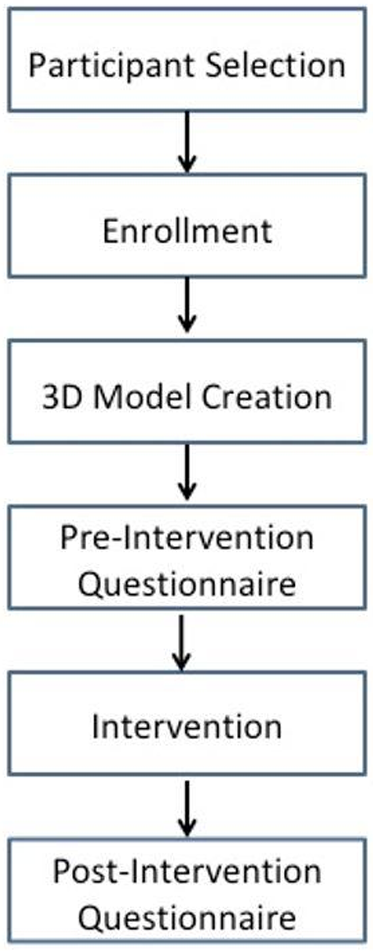
This was a prospective pre-post study that was performed at a tertiary paediatric care centre with approval from the Institutional Review Board. Written informed consent/assent was obtained for each patient. The overall work flow of the study is depicted in Figure 1.
Study design.

Patient selection
Patients, aged 13–18 years old, with a history of CHD and previous cardiac MRI imaging were eligible. Patients with select comorbidities including moderate/severe developmental delay and specific genetic syndromes were excluded. Due to resource limitations, language services could not be hired and thus adolescents who did not speak English were also excluded.
Enrollment
Eligible patients were recruited either through direct referral from paediatric cardiologists or through self-referral. After consenting to the study, patients were scheduled for a 30-minute tele-education session with a designated paediatric cardiologist.
3D model creation
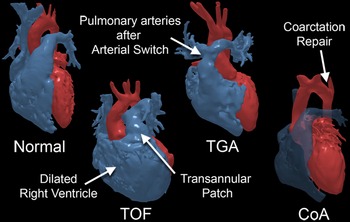
3D datasets obtained from prior MRI imaging were imported into Mimics (Materialise; Leuven, Belgium), a commercially available 3D segmentation software. The relevant cardiac anatomy was segmented and processed into digital 3D heart models per lab standards. Reference Loke, Harahsheh, Krieger and Olivieri11 The models were exported as two separate stereolithography files representing the separate pulmonary (systemic veins, right atrium, right ventricle, pulmonary arteries) and systemic circulation (pulmonary veins, left atrium, left ventricle, aorta). Figure 2 demonstrates representative CHD anatomy in this study.
3D examples of CHD included in study, in comparison to a structurally normal heart (far left).

Pre-intervention questionnaire
The medical knowledge and baseline characteristics of the adolescents were assessed. This was done via a two-part questionnaire, having adolescents describe, in free-text format, their cardiac defect (“What is the name of your heart disease?”) and their cardiac surgery (“What is the name of your heart surgery?”). Additionally, baseline quality of life of the patients was assessed using a clinically validated Paediatric Cardiac Quality of Life Index questionnaire. Reference Marino, Tomlinson and Wernovsky24,Reference Marino, Drotar and Cassedy25
Intervention
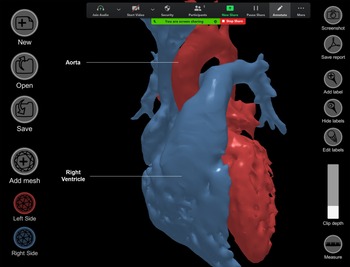
Educational sessions with patients and designated paediatric cardiologist occurred at prearranged times using web-conferencing software (Zoom, Zoom Communications Inc). Parental participation was optional. To maintain consistency of the tele-education session, the same paediatric cardiologist (YHL) led all sessions in the study. Display of the digital 3D heart model was performed using the interactive software Cardiac Review 3D (Indicated Inc.), which has been previously used for medical trainees and nurses. Reference Olivieri, Zurakowski and Ramakrishnan26 The patient was able to see the cardiologist and view the digital 3D heart model simultaneously. Figure 3 depicts the combination of software used for the session.
Conventional web-conferencing software was combined with cardiac display software via share screen function to display 3D heart model during education session.

A standardised educational curriculum was created and followed for each session (Supplementary Materials, Table E1). The curriculum contains dedicated time for learning normal cardiac anatomy and patient-specific cardiac anatomy including previous heart surgeries. Time was also reserved for discussing transitioning to adult-centred care and patient wellness. No specific clinical recommendations were made during the education sessions. Questions regarding anatomy and surgery were encouraged, but any patient-specific questions related to clinical management were referred to the patient’s primary cardiologist.
Following the session, patients were mailed a USB drive that contained a video of their 3D heart model and the digital stereolithography files that could be used to print a 3D model of their heart.
Post-intervention questionnaire and qualitative feedback
Immediately following the web-conferencing session, patients completed the same two-part questionnaire regarding their cardiac defect and cardiac surgery. A free-text response option was included to allow patients and family members to provide qualitative feedback.
Medical knowledge scoring
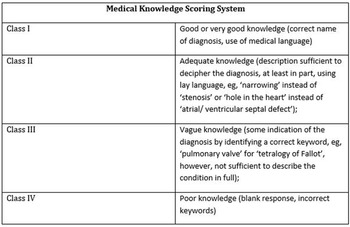
Answers to patients’ questionnaires were scored into “classes” of medical knowledge by two attending paediatric cardiologists (AC, LO) who were blinded to whether the questionnaires were completed before or after the educational intervention. Scoring was completed using the same schema developed by Biglino et al. Reference Biglino, Capelli and Wray13 Scoring rubric displayed in Figure 4.
Schema used to score level of medical knowledge.

Statistical analysis
A weighted Cohen’s kappa statistic was used to determine inter-rater reliability for the medical knowledge scoring. Inter-rater reliability was interpreted as follows: 0.01–0.20 as none to slight, 0.21–0.40 as fair, 0.41–0.60 as moderate, 0.61–0.80 as substantial, and 0.81–1.00 as almost perfect agreement. Reference McHugh27,Reference Cohen28 A Wilcoxon signed rank test was calculated to determine the statistical difference in medical knowledge before and after the educational intervention. p-Values < 0.05 were considered statistically significant. Reference Whitley and Ball29
Results
Demographics
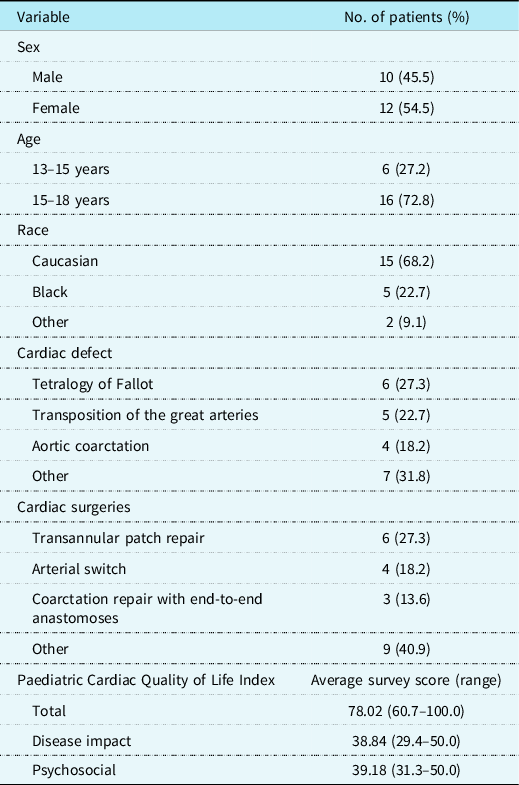
A total of 22 adolescent patients were enrolled in the study and completed the pre-intervention questionnaire, educational session, and post-intervention questionnaire. The average age of patients was 16.0 years old with a standard deviation of 1.5 years. Forty-six percent of patients identified as male and 54% identified as female. Table 1 shows additional demographic characteristics of patients.
Characteristics of patients

Patients had a variety of different cardiac defects and surgeries. The most common defects included tetralogy of Fallot, transposition of the great arteries, and aortic coarctation. Additional defects listed as “other” in Table 1 included hypoplastic left heart syndrome, tricuspid atresia, Ebstein anomaly, pulmonary stenosis, ventricular septal defect, and atrial septal defect. Additional surgeries listed as “other” in Table 1 included Fontan palliation, pulmonary balloon valvuloplasty, valve replacement, patch repair of ventricular septal defect, and trans-catheter device closure of atrial septal defect.
Three patients in the study reported comorbidities, including nephrolithiasis, short stature, lymphedema, scoliosis, and mild developmental delay. There were two patients with Noonan syndrome and one patient with DiGeorge syndrome.
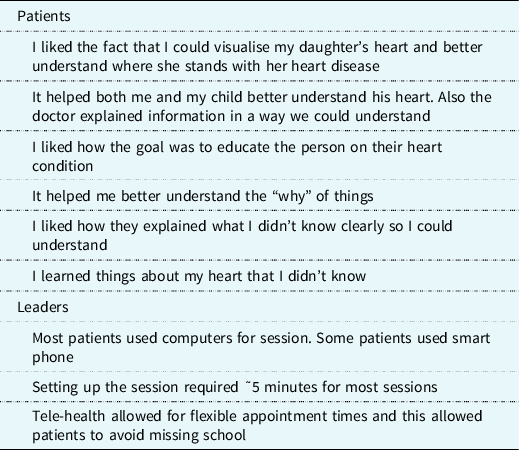
Most patients used a computer for the tele-education session. In addition to the 30-minute allotted time, approximately 5 minutes was required to set up the session (such as re-emailing the web-conferencing link or troubleshooting the connection). The sessions were often scheduled on a weekend or late afternoon to accommodate the adolescent’s school and activity schedule.
Medical knowledge
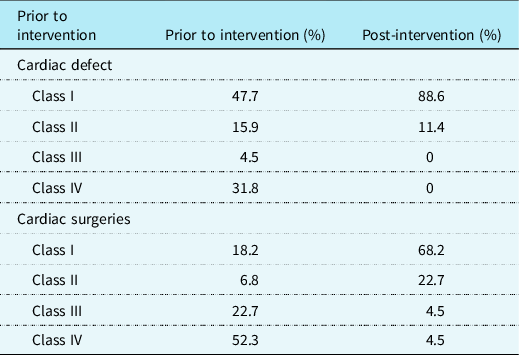
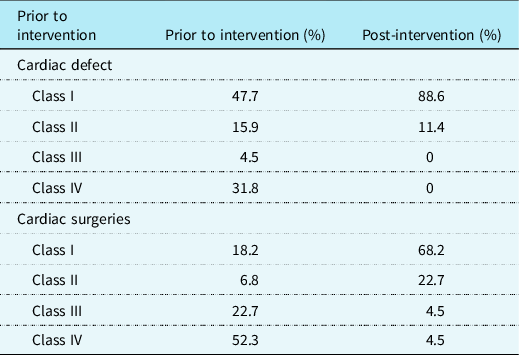
Table 2 displays the medical knowledge scoring results for the patients pre and post the tele-education intervention. The median post-test ranks were statistically significantly higher than the median pre-test ranks for both cardiac defects (median post versus median pre respectively, p < 0.01) and cardiac surgeries (median post versus median pre respectively, p < 0.01). Prior to the intervention, 47.7% of patients were scored having a class I understanding of their heart defect and 18.5% had class I understanding of their surgical history. Post-intervention, this increased to 88.6 and 68.2%, respectively.
Medical knowledge
Inter-rater reliability
There was substantial overall agreement between the two evaluators for cardiac defect knowledge classification, with a linearly weighted kappa score of 0.75 [0.60–0.90]. There was also substantial overall agreement between the two evaluators for cardiac surgeries knowledge classification with a linearly weighted kappa score of 0.74 [0.62–0.86].
Qualitative comments
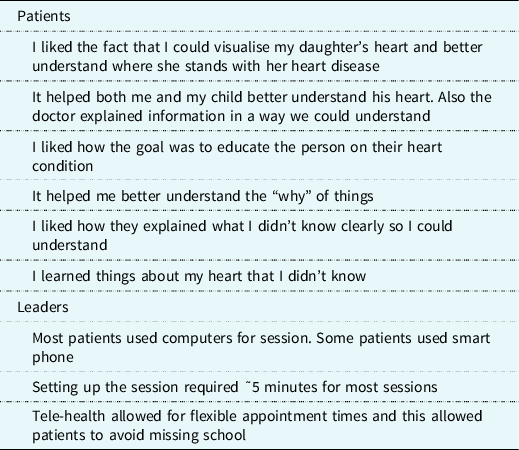
Comments were collected from patients following the intervention and are reported in Table 3. In general, patients and family members appreciated the ability to visualise the CHD of the patient.
Qualitative comments
Discussion
This study focused on using patient-specific digital 3D heart models as a means to improve medical knowledge and therefore enhance engagement in care in adolescents with CHD. The study group included patients with a diverse range of cardiac defects and surgeries. After a 30-minute web-conferencing session using 3D models, medical knowledge scores demonstrated statistically significant improvement. This result demonstrates the feasibility of combining novel tele-education and 3D modelling to teach adolescents about CHD.
While previous studies have shown that printed 3D heart models are helpful for teaching patients and families, this study demonstrates that digital models are also effective. Reference Biglino, Capelli and Wray13 While digital 3D models cannot allow patients to touch a heart model, our results show that the tactile benefit of a 3D printed model may not be necessary for patients. One chief benefit that likely remains with the use of digital 3D models is that they can improve learner satisfaction. Reference Loke, Harahsheh, Krieger and Olivieri11 Compared with printed models, digital models can be easily shared virtually and are significantly more cost-effective. Reference Lau, Wong and Yeong14
To our knowledge, this is the first study that combines two technologies of tele-conferencing and 3D modelling. Most patients receive education about their heart conditions during face-to-face encounters with their physician. Reference Veldtman, Matley and Kendall30 However, time is limited during clinic visits to provide this teaching. Separating these encounters maximises the benefit of both modalities. Qualitative comments from this study highlight the value of the virtual teaching sessions and relative ease which families were able to set up and participate.
There is previous literature to support that improved medical knowledge and self-efficacy improves psychosocial quality of life. Reference Uzark, Afton, Yu, Lowery, Smith and Norris31 We intended to assess the effect of this intervention on psychosocial quality by assessing Paediatric Cardiac Quality of Life Index results 6 months following the intervention; however, this portion of the study was suspended by the emergence of the coronavirus-19 pandemic, which would have likely confounded the results. Reference Ping, Zheng and Niu32
There were several limitations involved in this study. First, this study focused on feasibility and thus has a small number of patients without a control group. This study also demonstrated immediate improvement in medical knowledge but did not test patients for long-term knowledge retention. Due to financial constraints, we were unable to provide interpreter services for non-English speaking patients and thus excluded an important group of potential patients. In addition, our sessions required patients to have computer or phone with internet access, likely excluding patients without this resource.
Future studies will include a larger number of patients and a control group to compare tele-education sessions with and without 3D digital heart models. In addition, the patient questionnaire should be expanded to test patient’s understanding of their disease management and the lifestyle implications of their CHD. Additional studies should also explore the potential for tele-education interventions with patient-specific 3D heart models to improve psychosocial quality of life.
In summary, the novel approach of combining patient-specific, digital 3D models with tele-education is a feasible method of teaching for adolescents with CHD. This method has the potential to improve medical knowledge and may subsequently increase readiness and likelihood of successful transition into adult-centred care.
Supplementary material
To view supplementary material for this article, please visit https://doi.org/10.1017/S1047951121003243
Acknowledgements
None.
Financial support
This research received no specific grant from any funding agency, commercial, or not-for-profit sectors.
Conflicts of interest
None.
Ethical standards
The authors assert that all procedures contributing to this work comply with the ethical standards of the relevant national guidelines on human experimentation (Belmont Report) and with the Helsinki Declaration of 1975, as revised in 2008, and have been approved by the institutional committees (Children’s National IRB).