INTRODUCTION
Atlantic Canada consists of four provinces with relatively small populations. In total, ~90 children between birth and 14 years of age are diagnosed with cancer annually in Atlantic Canada (Centre for Chronic Disease Prevention and Control, 2007). Although childhood cancer is rare, it is of significant public health importance according to the Canadian Cancer Society (Canadian Cancer Society, 2007). Fortunately, the survival rate for children with cancer has increased dramatically over the last decade. Despite these improvements, the psychological and sociological impact of the disease on families can be extreme (Canadian Cancer Society, 2007). Understanding parents' coping strategies is important in order to offer suitable assistance at this difficult period in their lives. Appropriate coping strategies may be essential for the short- and long-term well-being of the entire family, and timely health care interventions may help to avoid a complete coping breakdown.
BACKGROUND AND CONTEXT
Pediatric cancer is often different from cancer in adults because the entire family, particularly the parents, are intimately involved in the child's illness (Patterson et al., Reference Patterson, Holm and Gurney2004; Canadian Cancer Society, 2007). It begins with the difficult time around diagnosis when “waiting and not knowing” is reported to be very stressful (Clarke-Steffen, Reference Clarke-Steffen1993). Once the child has been diagnosed, the family is often overwhelmed with knowledge of the life-threatening disease, treatment options and their side-effects, as well as the ultimate prognosis, and all of this may have a huge impact on the day-to-day functioning of the family. In some cases family members have reported suffering from post-traumatic stress disorder from their child's cancer experience (Hobbie et al., Reference Hobbie, Stuber, Meeske, Wissler, Rourke and Ruccione2000; Langeveld et al., Reference Langeveld, Grootenhuis, Voute, de Haan and van den Bos2003). Siblings also have reported feeling lost and ignored when so much attention is focused on the sick child; this can lead to behavioral challenges in the siblings (Clarke-Steffen, Reference Clarke-Steffen1997; Sloper & While, Reference Sloper and While1996).
In addition to the emotional and intrafamily stress, families describe financial hardships due to a variety of reasons including, but not limited to, long travel distances for families living in rural parts of Canada, and related expenses such as lodging, time off work, and the cost of medical supplies, when caring for a child with cancer (Mercer & Ritchie, Reference Mercer and Ritchie1997). In one study, 37% of families reported that they needed to borrow money to cover the extra costs related to their child's illness (Dockerty et al., Reference Dockerty, Skegg and Williams2003). The enormity of stress creates a climate where effective coping is essential to the health of the parents and family unit as a whole (Clarke-Steffen, Reference Clarke-Steffen1993).
In a previous study, three of the authors (BM, RH, and JE) examined the coping strategies of young adult cancer survivors using the coping theoretical framework of Lazarus & Folkman (Lazarus & Folkman, Reference Lazarus and Folkman1984; Miedema et al., Reference Miedema, Hamilton and Easley2007). However, as Laura Clarke-Steffen (Clarke-Steffen, Reference Clarke-Steffen1993) has pointed out, these coping strategies apply to the individual cancer patients and not to family members. Coping strategies for pediatric cancer patients almost always involve the entire family. In some cases the patients are so young that they are not fully cognizant of what is happening to them, yet in other cases the children are aware of their illness and also struggle to cope with its impact (Latulippe, Reference Latulippe2007). Nevertheless, for pediatric cancer patients, the parents are often suddenly forced to contend with what is described by some as a “new normal.” The “new normal” includes coping and action strategies to manage all the information about the disease, treatment, and prognosis that is given. The “new normal” may also include reorganizing the roles of the various family members and often involves changing priorities and strategies to manage the demands of the illness (Clarke-Steffen, Reference Clarke-Steffen1997).
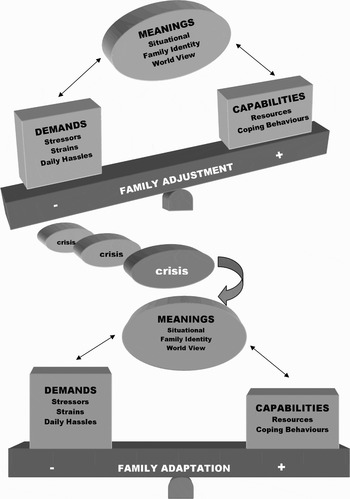
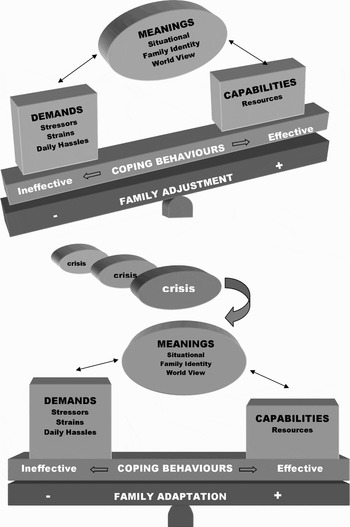
Researchers have suggested various models to describe parental coping strategies when dealing with a child that has cancer. In 1988, Joän Patterson developed a model, the Family Adjustment and Adaptation Response Model (FAAR model) to explain how families adjust and adapt to crises (Figure 1) (Patterson et al., Reference Patterson, Holm and Gurney2004). Families balance demands and capabilities in response to the environment (i.e. cancer of a child).
In the FAAR model, individual and family outcomes are conceptualized as the result of a process whereby a family balances their demands (cumulative stressors and strains coming from individual, family and community sources) with family capabilities, which include resources (from individual, family and community sources) and coping behaviors. This balance (i.e. ratio) of capabilities to demand is influenced by the interpretations and meanings the family gives to their circumstance. These meanings can focus on the demand or resources a family is experiencing, as well as their worldview or perspective about life (Patterson et al., Reference Patterson, Holm and Gurney2004, p. 392).
Families will make an effort to balance the demands with their capabilities. If there is incongruence between the family's demands and the family's abilities to cope with these demands, the balance will be disturbed and the family may move into a crisis phase. Over time, families may go through several cycles of imbalance, crisis, and adjustment. Patterson (Reference Patterson1988) argues that coping behaviors enhance the family's abilities to deal with the demands. In this paper we will focus on one aspect of the family's adjustment and adaptation to the “new normal”: the coping strategies.
The FAAR model.Footnote 1

We have used the coping categories outlined in the FAAR model, discussed previously by Lazarus & Folkman (Reference Lazarus and Folkman1984) as the starting point for our analysis. We will describe our study results in relation to the FAAR model and its congruence and incongruence with the model for families who cope with a child with cancer (Patterson et al., Reference Patterson, Holm and Gurney2004). Our study results will expand the knowledge regarding the various coping behaviors and contribute to advancing the model.
STUDY SETTING
Situated on the East Coast of Canada, New Brunswick and Newfoundland & Labrador are two Atlantic Canadian provinces that are geographically large with relatively small populations. The total population of these provinces combined is 1.25 million people and accounts for just over half of the population in Atlantic Canada. Approximately fifty percent of the population in New Brunswick and Newfoundland & Labrador is rural. Because of the small population base and the rural nature of these provinces, most parents of children with cancer are required to travel long distances for treatment and follow-up cancer care. Most of New Brunswick's pediatric cancer patients are treated out-of-province. Newfoundland & Labrador parents can seek treatment at a children's hospital in the provincial capital, but many parents are required to travel long distances given the geographic expanse of the province.
METHOD
Because of the relatively small number of pediatric cancer patients in the two provinces, we have chosen a qualitative research method. This enabled us to study social and cultural phenomena in the context of people's day-to-day lives from the point of view of the participants, as a way of addressing the uniqueness of this group of parents (Creswell, Reference Creswell1997).
Research Ethics Board Certification
The research protocols were reviewed and approved by the River Valley Health Research Ethics Committee, the Memorial University and the Université de Moncton Research Ethics Boards. There were no conflicts of interests for any authors. Inclusion criteria required participants to be parents or caregivers of children who had been diagnosed with cancer within the last 10 years and were ≤19 years at the time of the diagnosis.
Recruitment
In New Brunswick, staff members at the Canadian Cancer Society-New Brunswick Division (CCS-NB) mailed a letter to parents of children who had participated in summer camps for children with cancer. The parents, if interested, could directly contact the study team for more information and set up an interview. Participants were also recruited through newspaper articles and other French and English media. In Newfoundland & Labrador the participants were recruited with the assistance of Candlelighters Canada – Newfoundland & Labrador division, a childhood cancer support foundation. In total, 9 Anglophone and 12 Francophone parents in New Brunswick and 7 Anglophone parents in Newfoundland & Labrador were recruited to participate in this study (28 families in total).
The Interview
A semi-structured format was used to guide the interviews. The interview questions were all open-ended. The interview guide started with some general questions regarding the time of the diagnosis and moved to questions about social support, the impact of cancer on the child and family, and specific questions on the economic impact of cancer. Most interviews took place in the participants' homes, although a few took place in a research office. The interviews lasted between one and two hours. All participants agreed to have their interviews audiotaped. After the interview was completed the participants were asked to fill out a sociodemographic form asking information about their background, income, age, age of child, and other information related to the cancer experience.
Analysis of the Data
All interviews were transcribed verbatim. The English interviews were transcribed in English and the French interviews were transcribed in French. Eight of the 12 French interviews were translated into English by an official translation agency. Four interviews were coded in French, using the English coding scheme, by a bilingual researcher.
We employed a rigorous constant comparative thematic analysis. In a thematic analysis, researchers identify themes and common patterns among the experiences of the participants (Hawthorne, Reference Hawthorne1997; Thorne, Reference Thorne2000). Three researchers and their assistants read the same six transcripts representing the three distinct interview groups: English New Brunswick; French New Brunswick (translated transcripts); and English Newfoundland & Labrador. All six researchers coded these transcripts independently. The researchers convened for a two-day team meeting to discuss the codes. Most codes were easily agreed upon; in cases where there was disagreement, team discussions ensued to arrive at a consensus about the code. A coding scheme was developed and all three sites used this English coding scheme to analyze the remaining transcripts. The coding scheme was slightly revised and updated during two subsequent teleconferenced team meetings.
Although not the initial focus of the research, coping strategies emerged from the data as being very important to the experiences of the parents. Hence, the coping theme was further analyzed and related to the literature with a particular focus on the work by Patterson et al. (Reference Patterson, Holm and Gurney2004) that also examined parental coping strategies in response to a child being diagnosed with cancer. We focused on the coping section of the Patterson et al. model and examined the congruence (or incongruence) of our results with the Patterson et al. FAAR model (Patterson et al., Reference Patterson, Holm and Gurney2004). The FAAR model consists of appraisal-focused coping, problem-focused coping, and emotion-focused coping (Patterson et al., Reference Patterson, Holm and Gurney2004). Hence, we examined and analyzed the various behaviors as described by the parents in our study in relation to the FAAR model.
Confidentiality
Given the relatively small number of pediatric cancer cases and the small population in the two provinces represented in this study, we have chosen to disclose as few personal details about the parent participants as possible, to protect their identity and the identity of health care workers.
RESULTS
Profile of Study Population
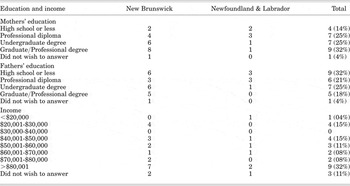
Of the 28 participant families, 5 had children that were still in active treatment, 3 children had died, and the rest were in the follow-up care stage of the cancer care continuum. Just over half (57%) of the families lived in rural areas and almost three-quarters considered themselves to be religious (68%) at the time of the interview. The majority of the parents were married with an average of two children, had postsecondary education and good incomes (see Table 1). In New Brunswick, the child's average age at time of diagnosis was 6 and in Newfoundland & Labrador it was 10.
Parents' income and education

Coping Strategies
Appraisal-, problem-, and emotion-focused coping strategies were all used by the parents in our study. Each of these coping strategies was composed of behaviors ranging from being positive and using humor to being an advocate for the child. We will describe each of the coping categories independently in the following sections.
Appraisal-Focused Coping
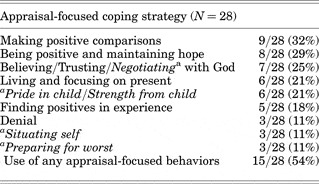
All of the appraisal-focused strategies are outlined in Table 2 and discussed below.
Appraisal-focused coping behaviors by parents of children with cancer
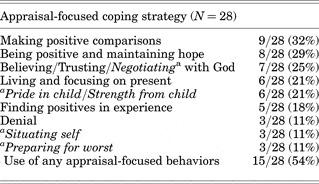
aBehaviors not part of original FAAR model.
Being positive, maintaining hope, and making positive comparisons were important appraisal-focused strategies for participants. One of the parents described how using comparisons helped her to stay positive in the following way:
I tell myself, that's the way life goes. I still have my two arms and my two legs. I'm lucky that I still have my daughter. I thank God and I appreciate what He's giving me because I tell myself, some people aren't that lucky. When a child hangs himself, it's done. So I tell myself that I'm still lucky and I try to be positive. If you lose your child in an accident, then there's no hope. I still have hope. (Interview 1)
Some parents were still in denial about their child's illness, in the hope that it would just go away. For example, one mother did not want to accept the diagnosis of cancer, because she felt that she was not talking to the “right doctor.” The “right doctor” would tell her that the diagnosis of cancer was not correct. She said:
I guess you just don't want to believe that that's the diagnosis maybe. You're just thinking in terms of you know, well it's a neurosurgeon I need to talk to. He's the guy that's going to make this better and make it go away. Like not the oncologist. (Interview 3)
In addition to the appraisal coping behaviors identified in the FAAR model, and confirmed in our study, we also identified additional coping behaviors that were not listed in the FAAR coping model. These are:
1) negotiating with God,
2) deriving strength and being proud of the stricken child,
3) situating the self, and
4) preparing for the worst.
As Patterson et al. (Reference Patterson, Holm and Gurney2004) identified, parents turn to God to get through the difficult times, but as we have identified, some parents negotiated with God. One parent described how she negotiated with God and also forced her husband to do so. She said:
… I said to him, “[name of husband], you can do one of two things.” I said: “We can either both get on our knees and ask for our son's life, or, I said, you can continue not to believe that there's anything other than us here.” So, ah, you know and he, two of us went to the chapel and wept, oh my dear, it was a sad scene… . (Interview 4)
Several parents reported that they derived pride and strength from how their child dealt with the difficult situation brought on by the cancer and its treatments.
[Daughter's name] was fine. I was the basket case. And driving home, [daughter] said: “Mom, if I get leukemia again, I just got to go through it again.” She said “there's nothing I can do about it.” She said, “I don't know why you're upset.” Thirteen years old now saying, “If I got to go through it again, I'll go through it again.” (Interview 5)
Two other appraisal-focused coping behaviors we identified were “situating self” and “preparing for the worst.” Situating the self in adverse conditions may involve thinking abstractly about the experience and how it fits into one's life, or as Patterson et al. describe it, “giving meaning.” One parent described “situating the self” as follows:
… I can not go back to being the same person I was. Sometimes you go through so much that it just changes your personality… (Interview 6)
The last coping behavior under the appraisal-focused coping strategy we identified was “preparing for the worst”; although few parents described this behavior, it is still significant. These parents were trying not to get “caught off guard” by future bad news. They were so stricken by the bad news of the unexpected diagnosis of cancer in their child, that they needed to brace themselves further. One parent said:
I always tried to think about the worst-case scenario, so that, if things weren't quite that bad, I felt better. (Interview 7)
We found that more than half of the parents in our study used appraisal-focused coping strategies. We were able to confirm the use of all of the coping behaviors mentioned by Patterson et al. under the appraisal-focused coping umbrella. We were also able to build on coping behaviors such as “negotiating with God”, and uncover additional appraisal-focused strategies including taking pride and strength from the child and preparing for the worst.
Problem-Focused Coping
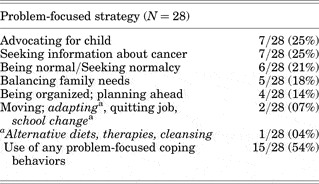
Problem-focused coping behaviors are more “action” oriented than appraisal-focused behaviors, which are largely cognitive. Parents relying on problem-focused coping strategies often wanted to get involved or do things to alleviate the distress they were feeling. Patterson et al. in the FAAR model (2004) identified five problem-focused coping behaviors, and we have been able to build on these by identifying two additional behaviors and discovering a new problem-focused coping behavior (see Table 3).
Problem-focused coping behaviors by parents of children with cancer

aBehaviors not part of original FAAR model.
The most prevalent problem-focused coping behavior, as mentioned by the parents and consistent with Patterson et al., was being the child's advocate. In particular, a mother who was experiencing frustration with the doctor responsible for her child's care discussed her feelings about advocating for her child as follows:
“We think we know him a little better than you [doctor] do” … but to not back down and quiver in the corner and say, “O.K. well she's a doctor so let's bow down and say she's right – no. You kind of gain confidence. So you kind of have to go lobby for your own kid's health. (Interview 12)
A problem-focused coping behavior as stated by the parents was to seek as much information as possible regarding the cancer and its prognosis and treatment. Other parents felt overwhelmed by the information they received and chose not to learn more about the illness, its treatment and prognosis than was necessary. One parent said:
So I went … to the little library room I guess you'd call it a resource room and I read … and it said this can be fatal. And that's all I had to see and I slammed the book. I said: “I don't want to read anymore.” (Interview 5)
Maintaining a level of “normalcy” and balancing family life were also problem-focused coping behaviors. One parent described maintaining normalcy as follows:
We just want to hear [child] laughing and having fun. The normality to go up on the weekend and have too many beers with your friends and while your son's on the trampoline or in the water with five other kids and just talk about politics and what normal people talk about, that's been our salvation. (Interview 9)
Other problem-focused coping strategies used by parents included changing jobs, work hours, or role at work to better accommodate the schedule of the sick child. One family placed the siblings of the sick child in a private school that was close by and more convenient. The mother described it as follows:
I had two children in school, we pulled them all out. [There] was a private school [next door] and so we put them in … they continued going to school. [Sick child] would pop in every now and then if her blood count was good. Any child in the school, which probably encompassed about five or six kids, with a cold would wear a mask. So she [sick child] never felt that she was the one that had to always adjust. (Interview 10)
Overall, we identified 15 out of the 28 families that used problem-focused coping behaviors to deal with their child's cancer. Our findings regarding problem-focused coping behaviors were consistent with those of Patterson (Reference Patterson1988) and fell into nearly the same order of frequency of use.
Emotion-Focused Coping
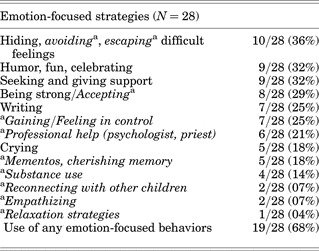
Emotion-focused coping, is intended to regulate “the overwhelming emotions” created by the child's illness. The FAAR model identified six types of behaviors as part of the emotion-focused coping strategy. All of these behaviors were identified by participants in our research. However, we have identified an additional six emotion-focused coping behaviors that were not described by Patterson et al., which emerged out of our data. These behaviors were: avoiding and escaping difficult feelings, accepting the situation, feeling in control, seeking professional help, creating memories, substance (ab)use, reconnecting with children, and empathizing (see Table 4).
Emotion-focused coping strategy behaviors by parents of children with cancer

aBehaviors not part of original FAAR model.
The most commonly described emotion-focused behavior was trying to avoid or escape difficult feelings. One parent described her avoidance strategy after the death of her daughter as follows:
… it was difficult for me to spend time with people who were my supporters because now there they are with all of [daughter's] cousins that were her age and she's not here. So I avoided them. I avoided everybody with kids because I couldn't deal with it. And so I made friends with, I sort of re-established friendship with single friends I had. That's what I did. Running away? I don't know… . I just I thought that if I can't cope with it, why put myself through it? Why put them through it? And you know, just do whatever works. (Interview 3)
Another participant described the importance of protecting herself from certain thoughts and feelings during her child's treatment. She said:
I didn't know if I could handle it. If I could handle her dying, which I knew she was. But you don't think about it. You can't. You can't think about it because if you do, you'd never live and you'd never enjoy your life. (Interview 2)
Others used humor and celebrations as distractions to cope with their emotions. Parents described the activities that they would arrange for their sick child just before the chemotherapy so the entire family could have some fun together. A mother said:
…we would always try to do something like that weekend like maybe go to a movie have a friend in for an evening and treat them to pizza or that type of thing. (Interview 6)
Other parents coped by supporting other families who were in the same situation. One couple got involved with the Children's Wish Foundation. The mother said:
So I've been involved a lot and [husband] and I have both, at Children's Wish, we'll go sell tickets and serve breakfast and stuff like that. (Interview 4)
Some participants talked about using writing as an emotion-focused coping behavior. Writing was seen as an outlet for the strain and pressure that the participants were experiencing. A parent talked about writing as an outlet in this way:
For me, writing was therapeutic. I wrote all the time when [child] was sick, and it helped me a lot. That's why I was able to give you such precise details, because I wrote everything down. (Interview 11)
Keeping mementos of the experience was also an emotion-focused coping behavior described by several families. These mementos served to either keep the memory of the cancer journey or of the child alive. These mementos facilitate the process of creating meaning in difficult circumstances. One parent talked about mementos of her daughter who died and described the following:
And even now I mean, like we have her ashes in our house. It wasn't my decision it was a family decision. We didn't bury her. I have her ashes. … I collect angels in memory of her… (Interview 2)
Some parents used substances, such as alcohol and tobacco to cope with the stress associated with their child's cancer diagnosis and treatment. Some parents deemed this strategy to be effective while for others it caused additional problems. One father described the use of alcohol as an emotion-focused coping behavior.
We drink a lot more than we used to. I don't remember seeing [my wife] ever having more than three beers until recently… It's not something I'm proud of but it's something that's true. I would say there is an increase in the consumption of alcohol. We would never have even considered having anything to drink unless it was a weekend but I'll find ourselves on a Tuesday night having a few beers or a bottle of wine in the wintertime, or a couple of really good hits of rum… (Interview 9)
Overall, 19 families out of the 28 interviewed discussed some behaviors that we classified as emotion-focused coping strategies. Emotion-focused coping strategy was the most frequently mentioned compared to appraisal- and problem-focused coping strategies. A major incongruence between the FAAR model and our analysis is that the FAAR model has not fully considered the impact of ineffective coping behavior such as alcohol abuse and avoidance coping. In several cases these types of coping behaviors actually added to the family stress rather than help alleviate it.
Ineffective Coping
It is apparent from our study that not all coping behavior is positive and in fact some behaviors serve to add to more demands on the family without increasing the family's ability to deal with those that already exist. In some cases the parents' coping behaviors resulted in negative consequences for them regardless of whether they were appraisal-, problem-, or emotion-focused. For example, despite being classified as an emotion-focused coping strategy, consuming too much alcohol resulted in additional issues which further unsettled the struggle to retain balance between demands and capabilities. The mother whose husband developed an alcohol dependence as a coping mechanism described the following:
So I call Dr. X … and then the door to the bedroom bursts open. This is my husband. He's loaded. Now he thinks I'm having secret phone calls with a man. And this is what he's yelling while I am on the phone with Dr. X … And then the phone is taken out of my hand because he throws it and I'm, I, I want to kill him… . (Interview 3)
Participants also discussed having breakdowns in their ability to cope. Some parents identified situations where they felt that they could no longer cope. When such a breakdown occurred, the parents felt guilty because they felt they let their sick child down. One mother explained it as follows:
[Daughter] knew that I had cried and I guess [support worker] told her that we had to let your mom go for a little while and then take care of herself for a little while. And I kind of got a little bit upset. I didn't want her to know that I had the breakdown right. But, um, and that was my worst one. The rest I kind of cried and went through. But I just lost it that day. I just, I couldn't, I just felt like I couldn't go on anymore, she was so sick. (Interview 5)
In some cases these coping breakdowns progressed and some parents were diagnosed with depression including suicide ideation. The coping resources required for the situation were simply inadequate thereby resulting in the development of significant negative psychological symptoms and distress. One participant described her suicidal ideation as follows:
So by Christmas I was thinking dark thoughts all the time. It was to the point where if I was driving my car, I had to fight with myself to not drive into the oncoming traffic. And I would keep telling myself, well okay stupid, you're not the only one that's going to die. Whoever is driving the other car is going to be hurt. And what about X [other child]? But it's like I wasn't in control of it. It was the weirdest feeling. So that's when I finally agreed to take the medication. (Interview 3)
Among parents using the emotion-focused coping strategy, ‘avoidance’ was used more often than any other strategy. However, using avoidance as a coping strategy worked for some but was a significant failure for others. For some, avoiding strong feelings, letting time pass, and gathering emotional strength before dealing with the psychological demands of their child's cancer seemed to be effective. For example, some of these parents focused on day-to-day issues rather than thinking too much about the future. In the meantime they gathered strength from family and friends before facing all the difficult psychological demands that are part of caring for a child with cancer. In other cases ‘avoidance’ simply served to delay the onset of the psychological demands because the parents were unable to gather strength over time. Hence, the onset of the psychological stress was precipitated by psychological resources becoming further depleted by the demands of supporting their sick child, to the point where they experienced a coping breakdown. The increased demands of a negative prognosis, combined with depleted coping resources and unaddressed issues led a number of parents to feel depressed and/or contemplate suicide.
DISCUSSION
Parents who care for a child with cancer develop coping behaviors (Folkman, Reference Folkman1984). The FAAR model developed by Patterson et al. (Reference Patterson, Holm and Gurney2004) identified behaviors that comprise three coping strategies that are cognitive, behavioural, and emotional (appraisal-, problem-, and emotion-focused coping). In the analysis of our data, we have found congruence with these behaviors, and we have also identified additional behaviors that enhanced the list of coping strategies. One incongruence between the two studies is that in our study more parents used emotion-focused coping behaviors (68% vs. 56%). The difference would be even more pronounced if we had included the three families that did not talk about coping strategies at all. In the Patterson et al. study, parents used appraisal-focused coping strategies most often (78%) compared to our sample of parents (54%). The second most frequently used coping strategy for the Patterson et al. parents was problem-focused coping strategies (73%), whereas our group of parents used the strategy 54% of the time.
Another, and perhaps the most significant, incongruence between the Patterson et al. findings and our findings is that we have identified ineffective coping strategies that actually unbalance the demand and the capabilities of the family further and drive them deeper into crisis. Patterson et al. argue that coping behaviors enhance the families' abilities to deal with the demands; however, we argue that some of these coping strategies may add to the imbalance between the demands and the families' capabilities to deal with these demands (Patterson, Reference Patterson1988). A number of studies have shown that parents are at an increased risk for depressive and post-traumatic stress symptoms as a function of using negative or avoidant coping strategies (Greening & Stoppelbein, Reference Greening and Stoppelbein2007). We believe that ineffective coping is an important concept for the health care providers to understand, so that families receive appropriate advice and assistance.
Although substance abuse was a coping behavior used by a relatively small group of parents (14%), it requires significant attention. This coping behavior is dangerous and not only increases personal stress, but may endanger the entire family. In addition, it may lead to feelings of shame and guilt for the perpetrator and may create marital problems in addition to the difficulties that already exist (Leonard & Senechak, Reference Leonard and Senechak1993).
In the adjusted FAAR model (Figure 2), using the term “ineffective coping behaviors”, we have indicated that coping can add to stress and may unbalance the family further, and that this may increase the family's risk of moving into a crisis phase. The stronger and more effective the coping behaviors that are used, they more they can be considered capabilities.
The adjusted FAAR model.

Emotion-focused coping techniques were the most widely used coping strategies among the parents in this study. We do not have a good explanation for this, but we speculate that for most parents there was a profound sense of loss of control and the feeling that they are unable to “protect” the child from such a significant challenge. Therefore, parents may struggle with feelings of guilt and anger that in turn may exacerbate parents' sense of powerlessness. In order to cope with these feeling, parents have used emotion- focused strategies to stay balanced and adjusted for the sake of the family.
STUDY LIMITATIONS
One of the limitations of this study is the lumping together of various diagnoses and prognoses. The severity of the diagnosis and the long-term prognosis likely has an impact on the stresses and strains of parents. For instance, in the present study, parents who relied largely on an avoidance coping strategy and had a child die, were faced with a myriad of issues, strains, and emotional traumas. These parents were largely ineffective in coping with the demands, at least initially. This experience is quite different from that of a parent using an avoidance strategy and having a child survive the experience and return to “normalcy”. Future research may wish to explore in greater depth the type and level of success of different coping strategies/behaviors in a range of diagnoses and outcomes.
CONCLUSION
Parents employ a number of strategies to cope with their child's cancer. These strategies can be appraisal-, problem-, and emotion-focused. Parents in our study relied most heavily on emotion-focused strategies. We have confirmed many of the findings of research by Patterson et al. and have further strengthened the FAAR model by considering that some coping behaviors can actually be detrimental to achieving family adaptation and balance.