In early June 1980, Canadian prime minister Pierre Trudeau arrived at 10 Downing Street on a constitutional mission. Through a quirk of history, Ottawa in the 1980s still had to seek permission from London to amend its constitution—the British North America Act, 1867. Because the Canadian federal and provincial governments had been unable to agree on an amending formula before the Statute of Westminster was ratified in 1931, Britain had consented to retain the act indefinitely.Footnote 1 Over the next five decades, a succession of prime ministers, including Trudeau, had sought unsuccessfully to forge a domestic political consensus upon which to request full legal separation from Britain, a process dubbed “patriation” in Canada.Footnote 2 But following Quebec's failed referendum on independence in 1980, Trudeau embarked upon his first official meeting with Margaret Thatcher, determined to initiate the legal chain of events that would finally bring the constitution home. In the end, he would need the British Parliament to pass one final amendment to the act, devolving its powers to Canada.Footnote 3
While agreeable to Trudeau's request, Thatcher worried about the unintended consequences of this seemingly procedural issue. She feared that patriation could become politically complicated in Britain, distracting from or even undermining her own legislative agenda.Footnote 4 Over lunch at their June tête-à-tête, she told Trudeau that to limit the scope for disruption, she would restrict her ministers from meeting with Canadian lobbyists opposed to his plans. “If, for example, queues of Indians knocked on the door of No. 10,” Thatcher added casually, “the answer would be that it was for Canada to decide her future and not HMG.” In return, Trudeau vowed that he “would try to make things as easy as possible.”Footnote 5
In these offhand comments about the specter of “Indians” on her doorstep, Thatcher tacitly recognized that Indigenous activism in Britain was neither unusual nor unexpected.Footnote 6 For centuries, the center of empire featured as an entangled space of Indigenous protest and resistance in what the historian Coll Thrush has called an “unbroken tradition of Indigenous political journeying.”Footnote 7 But Thatcher's reference to “queues of Indians” also demonstrated at least some appreciation for the tense domestic political situation in Canada. In the 1970s, representatives of dissenting provinces, separatist movements, and Indigenous nations had questioned the very nature of the Canadian confederation and their place within it, nearly tearing the country apart.
As these divisions persisted into the early 1980s, Trudeau suggested he might patriate the constitution unilaterally, without first seeking the consent of the provinces or Indigenous peoples. While this threat goaded his critics, the final provocation was his request to Thatcher to insert a written “Charter of Rights and Freedoms” into the British legislation that would devolve to Canada as part of the constitution. Decrying this codified bill of rights as a federal power grab by stealth, aggrieved representatives—notably from Indigenous nations and provincial governments—flocked to London in a bid to persuade British lawmakers to thwart Trudeau's patriation.Footnote 8 Far from making the process easy for Thatcher, in the estimation of the young Tory MP Jonathan Aitken, Trudeau had “export[ed] Canada's constitutional crisis to Westminster.”Footnote 9
Many Indigenous leaders opposed Trudeau's patriation because they believed it threatened to nullify their historic bilateral treaties with the British crown, including the Royal Proclamation of 1763 and the Treaty of Niagara of 1764—the agreements that had established nation-to-nation relationships between Indigenous peoples, the British government, and, later, its settler colonies. They argued that these treaties constituted a “trust relationship” by affirming Indigenous sovereignty and rights as existing well before the arrival of Europeans. Indigenous activists never agreed upon a single vision of a postcolonial future.Footnote 10 But as the independent nation-state was a political nonstarter, many held to the general principle of asserting Indigenous sovereignty from within Canada.Footnote 11 They argued that Indigenous peoples, as one of the three founding parties of Canadian Confederation, should be considered legally on par with the provinces.Footnote 12
But Indigenous peoples also mobilized because of their declining socioeconomic standing, including in 1980 an unemployment rate of 68 percent, an average life expectancy ten years shorter than that of other Canadians, and a three times higher chance of dying a violent death.Footnote 13 For one activist, the blame for Indigenous peoples’ low standard of living was not difficult to assign; they had been poorly treated “since the Canadian hicks took over trying to administer her mother's, Britain's, obligations towards our people.”Footnote 14 Such was the raw deal they had received from Ottawa since confederation in 1867 that by the early 1980s many Indigenous leaders viewed a continuing relationship with Britain as their best chance of achieving some measure of self-determination and a better life. In the early 1980s, Indigenous activists took this alternative vision of decolonization to the streets of London and the halls of Westminster to push for sovereignty and rights. Maintaining the link with Britain thus became an essential part of some Indigenous peoples’ political toolkit of decolonization.
This story of Indigenous activism usefully challenges our assumptions about the end of the British Empire. Over the past few decades, historians have described decolonization as a series of linear political transitions from colony to nation-state, all ending in the late 1960s.Footnote 15 This body of work attuned our discussions of Britain to the changing geopolitical contexts of the postwar era, from its declining global standing to the Cold War. But in their enthusiasm to ascribe an end date to the British Empire, these historians marginalized the ongoing struggles for sovereignty that carried on well past the 1960s, especially in contexts where the goal of a discrete nation-state proved unattainable.Footnote 16 Decolonization became synonymous with nationalism and the nation-state, a framework inadequate to explicate the complicated political and cultural expressions of this period. As a result, late colonial crises in the 1970s and 1980s were dismissed as outliers to the prevailing trend.Footnote 17
This article considers the position of Indigenous peoples, especially in British Columbia, who deviated from the “colony to nation-state” script and timeline of decolonization.Footnote 18 It follows the work of historian Frederick Cooper, who implores scholars to reconsider the imagined political futures beyond the nation-state that motivated activists, including the many “openings, closures, and new possibilities” inherent in the moment of decolonization.Footnote 19 A greater distance from the 1960s and, with that, the ongoing declassification of documents, help to demonstrate that decolonization was contested and contextual, meaning different things to people in different places. It was (and is) an ongoing struggle, not a moment or event fixed in time.Footnote 20
Beginning with a discussion of why Indigenous people perceived the relationships with the crown as a “sacred trust,” this article then tracks one specific activist campaign organized by the Union of British Columbia Indian Chiefs (UBCIC). Nicknamed the “Constitution Express,” this protest unfolded in two phases: first, in a cross-country train journey in November 1980 to pressure the Canadian government; and second, in November 1981, a swing through Western Europe, culminating in activism in London. In an effort to safeguard their relationship with the crown, ordinary people on the Constitution Express went to Britain with a pragmatic strategy in mind: to lobby any group with the capacity to offer substantive political support to their cause. In the process, they adeptly navigated the splintered political landscape of Thatcher's Britain, one riven by deep political, ideological, and ethnic divisions, perhaps more so than at any time since 1945. Maneuvering around the nuances of British political and cultural difference, they articulated and exercised their own vision of decolonization, pursuing continued ties to the United Kingdom as the guarantor of Indigenous sovereignty and rights in a federal Canada.
“The King's Law”
For 250 years, the Royal Proclamation of 1763 has been the cornerstone of Indigenous peoples’ trust relationship with the crown. In the aftermath of the Seven Years’ War, the victorious British government attempted to make peace with Indigenous leaders, the bulk of whom had allied with its enemy, France. Unlike the French, the British had never conquered the Indigenous nations, and the onset of Pontiac's War in May 1763 served to confirm their fears about the imminent threat to the exposed North American colonies. Peace became a military and strategic imperative.Footnote 21 As a result, in the Royal Proclamation—which dealt primarily with the logistics of the postwar transfer of French and Spanish colonies to Britain—King George III declared that Indigenous peoples “who live under our protection, should not be molested or disturbed.”Footnote 22 The proclamation thus recognized the sovereignty of Indigenous nations, already connected to the crown by diplomatic and trading relationships built up over time.Footnote 23 It also prohibited settlers from seizing Indigenous lands west of a boundary line in the Appalachian Mountains unless those lands had been formally sold or ceded by treaty. Only then would Indigenous title to land and resources be considered extinguished. Moreover, the provisions of the Royal Proclamation were drafted to apply generally to all unceded Indigenous territory.Footnote 24
In 1764, at the behest of the British government, Indigenous leaders representing nations from the northeast and the Great Lakes region of North America signed the Treaty of Niagara, which translated the promises of the Royal Proclamation into a formal diplomatic agreement.Footnote 25 As proof of Indigenous peoples’ own understanding of the treaty as affirming their sovereignty, it was concluded only after chiefs exchanged with British officials a “Two Row Wampum,” an intricate white and purple beaded belt depicting two boats progressing down a river. These vessels signified the sovereign jurisdictions of two allied nations, Indigenous peoples and the British—happily parallel, but separate.Footnote 26 Wampum retained great significance to Indigenous nations centuries later, even as Patrick Madahbee, an Ojibwa chief from the Union of Ontario Indians, visited the Foreign and Commonwealth Office in London in November 1980. He brought with him a wampum belt that he said “signified the covenant between the British and Indian nations” as old allies. According to one civil servant, Madahbee's “inference was of course that [the British] should now support our Indian friends in the conflict against another Frenchman, Pierre Trudeau.”Footnote 27
All subsequent treaty making in Canada was concluded on this initial legal foundation.Footnote 28 For the Cree political activist and writer Harold Cardinal, the treaties with Britain represented an “Indian Magna Carta.”Footnote 29 And in British Columbia, where UK officials engaged in treaty making only in their initial contact zone on Vancouver Island, the Royal Proclamation remained especially important to Indigenous conceptions of sovereignty on unceded land.Footnote 30 According to Kukpi7 (Chief) Wayne Christian of the Splatsin nation in central British Columbia, allusions to the “King's Law,” deriving from the Royal Proclamation, had filtered west and retained a central place in his nation's oral histories as representative of Indigenous peoples’ nation-to-nation relationship with Britain. When British officials made their way onto the interior plateau of British Columbia in the nineteenth century, they gave local leaders maces topped with reproductions of the crown itself. These staffs, which were passed down alongside oral testimony, came to represent the commitments spelled out in the Royal Proclamation.Footnote 31 In 1980, Louise Mandell, a young lawyer employed by the UBCIC, articulated the feelings of many ordinary Indigenous people. “Great Britain,” she wrote, “was, and continues to be, under a sacred trust to the Indian people, their lands, and their governments from the onslaught of more powerful countries.”Footnote 32
But while Indigenous peoples closely safeguarded knowledge of the Proclamation and of Niagara down the generations, British officials had lost sight of the importance of these treaties by the mid-nineteenth century. This shift reflected changing European strategic imperatives on the North American continent, as Indigenous nations lost their ability to leverage their position on the “middle ground” between competing empires.Footnote 33 American and British officials went from considering Indigenous peoples within a military calculus to one centered on dispossession and settlement.Footnote 34 In 1867, the British North America Act officially created the Canadian Confederation; its Section 91(24) devolved “exclusive legislative authority” over “Indians and Lands reserved for the Indians” to the federal government.Footnote 35 And in 1876, Ottawa passed the Indian Act, which extended federal legislative control to Indigenous peoples in all parts of Canada—including determining the very definition of who could claim status as an Indian.Footnote 36
Over a century later, because Pierre Trudeau sought to patriate only the British North America Act without the Royal Proclamation, Niagara, and other long-standing treaties, Indigenous peoples had no guarantee that Ottawa would honor the rights enshrined in these treaties after the connection to the United Kingdom had been severed. One of the first well-publicized opportunities for Indigenous leaders to articulate their grievances and a political imaginary of decolonization came at the Russell Tribunal in Rotterdam in November 1980, which took up the case of exploited Indigenous peoples in the Americas. The UBCIC submitted evidence that argued that Britain's role in decolonization was in “strengthening its colonies to a position of full statehood.”Footnote 37 Such was the justified process in Canada, with the development of national, provincial, and municipal systems of government. The UBCIC, however, argued that Britain had “legal and equitable obligations to Indian Nations” dating back to the eighteenth century.Footnote 38 With Britain as trustee, Indigenous peoples could work toward strengthening their communities as autonomous political units, operating within Canada but on an equal status with the federal government and provinces. This political development was what the UBCIC called “Indian Government.”Footnote 39 For the activist Arthur Manuel, the ultimate goal was clear. “A decolonized person,” he argued, “is a person who is formerly colonized but has since attained the maturity to take his or her place amongst the community of men who have no masters and have respect for the human dignity of all mankind.”Footnote 40
For its part, the British government attempted to distance itself from the situation in Canada by arguing that it had devolved its responsibility for Indigenous peoples to Ottawa by 1867, and certainly by 1931. But how could Britain's obligations in a diplomatic treaty be devolved to a third party—Canada—without first seeking the consent of the other signatory—Indigenous peoples? This question drove the legal arguments upon which Indigenous activists took their case to Ottawa, and then later to Westminster.
By contrast, the Canadian federal government's true position was best articulated in an October 1980 letter from Trudeau to Del Riley, president of the National Indian Brotherhood, the body representing status Indians.Footnote 41 Trudeau insisted that he was “personally convinced that [Indigenous peoples] will lose nothing in this act of patriation,” because afterward, “Canadians, with new-found pride in their own Constitution and in their new maturity as a country, will be more than ever generous in considering the needs and wishes of our first citizens.” In a typical refrain, the prime minister argued that aboriginal rights were as of yet undefined. “It will be your task to come to a full and common understanding of the collective rights you have claimed by virtue of your treaties and your aboriginal standing,” Trudeau told Riley. “You will have to persuade the Governments of Canada that the special rights you claim are reasonable and that they should be guaranteed in the Constitution.”Footnote 42
According to Trudeau's timeline, Indigenous rights would only be secured in the constitution after patriation—a process not subject to Indigenous consent or even consultation. Indigenous peoples would then bear the task of persuading a paternalistic federal government that they deserved a carve-out for their sovereignty and rights. And in the end, all of this would hinge on the Canadian public's generosity. Trudeau had redeployed Ottawa's classic argument that Indigenous peoples were wards of the state, not the agents of their own national futures.
“The Beginning of the People's Government”
Trudeau's patriation smacked of a controversy that had swept through Indigenous communities over a decade earlier. In 1969, after just a year in office, Trudeau, supported by his trusted minister of Indian affairs, Jean Chrétien, published an infamous white paper that proposed repealing the Indian Act and abolishing Indian status altogether.Footnote 43 In this policy, the assimilationist goals of the Canadian state merged with Trudeau's liberal politics. He believed that no subsection of Canadians should hold a special status or exclusive rights, arguing that all citizens must be equal under the law. “It's inconceivable,” Trudeau told a Vancouver audience in August 1969, that “one section of the society [has] a treaty with the other section of the society.” Old treaties, he argued, could not forever bind their signatories—so that Indigenous nations, he added sharply, “may be able to receive their twine or their gun powder.”Footnote 44 Assimilation was the only way to solve Canada's so-called Indian problem.Footnote 45 In response, Indigenous peoples rose up against the white paper until the Trudeau government was forced to withdraw it.Footnote 46 Out of this activism came organizations like the UBCIC that sought to channel dissent against the provincial and federal governments and to establish an ideological foundation for Indigenous self-determination.Footnote 47
In 1980, Indigenous peoples similarly organized against Trudeau's patriation, which the UBCIC's newsletter, Indian World, described as “a convenient way” to enact “the final extinguishment of all the lands and rights we have as the aboriginal people.”Footnote 48 In opposition to this agenda, Indigenous peoples had a powerful advocate in George Manuel, the prolific activist chief of the Neskonlith Nation in central British Columbia, then serving as the UBCIC's first executive president. Manuel had gained fame internationally both as a past president of the National Indian Brotherhood and as the founding president of the World Council of Indigenous Peoples. In his new leadership position, he propagated the idea of the “Fourth World,” or a global network of Indigenous solidarity working together toward true decolonization.Footnote 49 With Manuel at its helm, the UBCIC became a key voice of Indigenous opposition to patriation.
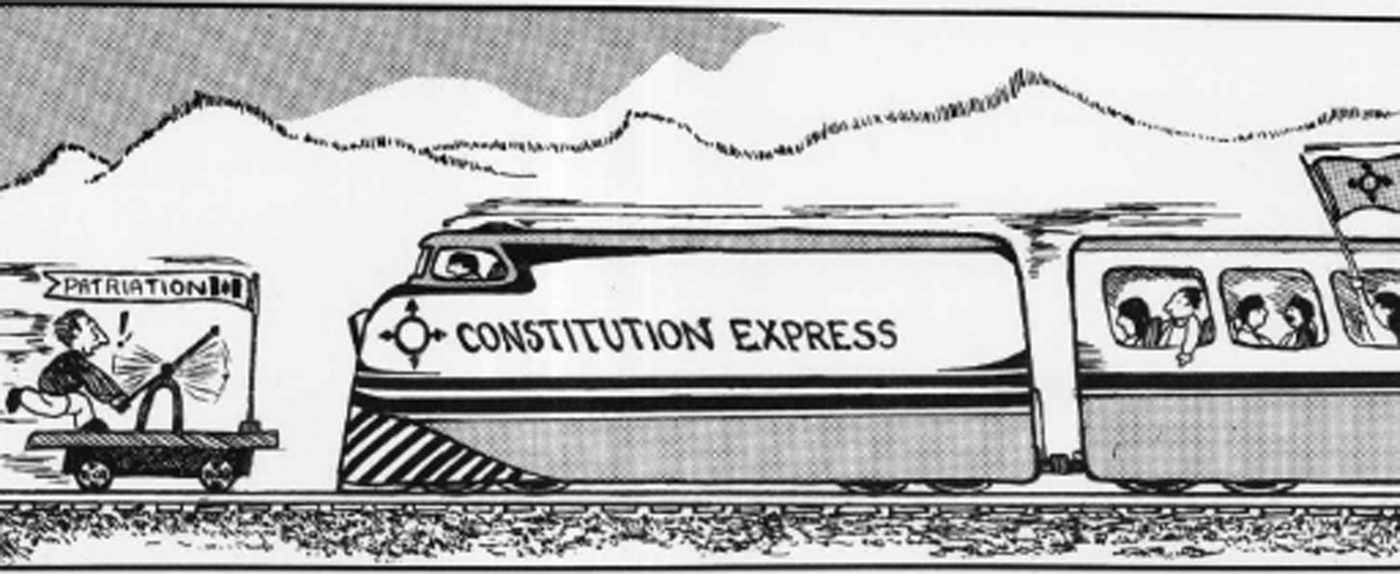
On 25 November 1980, the organization launched a highly publicized cross-country protest, dubbed the Constitution Express. They chartered a ten-carriage train to travel from Vancouver to Ottawa, where activists could put the case for proper Indigenous consultation on the constitution directly to the federal government. As hundreds of people boarded the train, the sound of drumming and singing echoed through the departures lounge at Pacific Central Station in Vancouver, the western terminus of the trans-Canada railway.Footnote 50 The railroad, once the engine of empire used to facilitate the colonization of the West, was now being co-opted as a vehicle for decolonization (see figure 1).Footnote 51
A UBCIC political cartoon of November 1980 depicts decolonization in action: the Constitution Express chasing down a diminutive Trudeau and his patriation plan. Courtesy of the Union of British Columbia Indian Chiefs.

Manuel understood the importance of the Constitution Express as a broad-based people's movement and its perception as such by the public and the Canadian press. He had witnessed the benefits of this kind of campaign just a few months earlier during the Indian Child Caravan.Footnote 52 In response to the British Columbia government's policy of placing supposedly “at risk” Indigenous children exclusively in white foster homes—what Wayne Christian called “an act of genocide”—the Splatsin community had organized a series of car convoys from around the province to bring activists to the Vancouver home of Grace McCarthy, the provincial minister of welfare. Christian was assisted in planning this protest by Jacob Marule, a South African exile and member of the African National Congress, who located the minister's house by knocking door to door in McCarthy's wealthy West Side neighborhood.Footnote 53 With hundreds of Indigenous activists on her doorstep, McCarthy agreed to work with the Splatsin nation on the jurisdiction of Indian children.Footnote 54 Proving that mass protests could work, Christian declared that the caravan “was the beginning of the people's government.”Footnote 55
The politicization that had fueled the Indian Child Caravan fed directly into the Ottawa Constitution Express. Aboard the train, staff from the UBCIC disseminated information and ran political seminars aimed at educating passengers on the basics of the constitution. Activists banned alcohol and lived communally on the journey, sharing traditional and nontraditional foods.Footnote 56 They paid their respects to the elders who traveled with them. The UBCIC also provided its own security with a group of specially trained people tasked with guarding against any infiltrators or agitators.Footnote 57 Prevented from traveling with the group by a chronic heart condition, George Manuel followed the progress of the now well-publicized Constitution Express from an Ottawa hospital bed. He believed that the protest gave Indigenous peoples the opportunity to exercise self-government under the full gaze of Trudeau, the provinces, and the public. In this concerted way, the Constitution Express became a moving space of Indigenous sovereignty, bound for Ottawa.
In anticipation of the Express, the Trudeau government cordoned off Parliament Hill with riot-control barriers, a move in stark contrast to the peaceful intentions of the planned Indigenous protests. The government's overreaction helped win public sympathy for the Indigenous cause.Footnote 58 Based on five straight nights of prime-time national news coverage, Manuel congratulated the Express for “crawl[ing] into the homes of over 20 million Canadians.”Footnote 59 But while the journey brought Indigenous peoples’ grievances to the forefront of the constitutional debate, it failed in its main endeavor to gain equal participation and Indigenous consent in the ongoing constitutional discussions between Ottawa and the provinces.
As a result, Christian gathered a select group of about fifty activists who boarded a chartered bus for the United Nations.Footnote 60 In New York, they delivered a “Bill of Particulars” to Secretary General Kurt Waldheim, calling on the body to act as a mediator between Indigenous peoples, Ottawa, and the British government.Footnote 61 Small groups then met separately with the representatives of some fourteen diplomatic missions, many of them former colonies now sitting as independent members of the Special Committee on Decolonization, including stalwarts of the Non-Aligned Movement like India, Cuba, and Tanzania.Footnote 62 Indigenous activists delivered statements at these diplomatic missions, outlining Indigenous positions on sovereignty, land title, and rights.
These short briefings surprised most delegations, previously enamored of a romantic vision of Canada as a wealthy, genial country with a good track record on human rights. “I don't think they ever gave much thought to how the wealth of Canada comes from the resources,” Christian later noted of the string of UN meetings, “and we never surrendered those resources.”Footnote 63 This successful foray onto the global stage provided a taste of true international recognition and a further opportunity to exercise Indigenous sovereignty. It spurred activists’ desire for more.Footnote 64
“To Fight by Any Means, and at Any Cost”
A month later, the Constitution Express's lobbying of former colonies at the UN seemed to be paying off. On a tour of “third world” countries to promote his pet project, ending the so-called North-South divide in the distribution of global wealth, Trudeau deplaned in Lagos, Nigeria. But instead of finding Nigerian president Shehu Shagari on the tarmac as expected, Trudeau was treated to a spectacle of “bright-costumed dancers and fierce drumming.”Footnote 65 The Nigerian leader failed to appear for bilateral meetings the next day, and when Trudeau finally tracked him down, Shagari bluntly cast doubts on the sincerity of the West's interest in global wealth inequality.Footnote 66
For George Manuel, who maintained deep and enduring connections to sub-Saharan Africa through his contacts at the World Council of Indigenous Peoples, Shagari's actions were proof that the Indigenous message about Trudeau's duplicity was beginning to filter into international consciousness. In his monthly presidential statement in Indian World, Manuel wrote, “The Constitution Express sensitized third world countries into realizing that they do have third world brothers in Canada, who suffer the same type of exploitation from the same developed countries, using the same economic and political techniques to deprive our people of land and resources.” Trudeau got the message, Manuel declared, when he “was greeted not by the President but by tribal dancers to remind him that Nigerian people are aware of how Canada treats its Indigenous brothers.”Footnote 67
Manuel perceived Trudeau's trials in Nigeria as a good omen for Indigenous peoples’ international campaign against patriation. Following the operations in Ottawa and at the United Nations, he outlined two paths forward. The first required Indigenous people “to adjust, to cooperate, to be silent, to submit, to obey, to compromise,” leading to “the rewards of deprivation, poverty, and genocide”; if they took the second path, they would “fight, by any means and at any cost, to recover our pride, our dignity, our aboriginal rights.”Footnote 68 Manuel favored the latter.
In the spring of 1981, he asked Wayne Christian to organize a large delegation of ordinary people from across British Columbia to travel to London on a second Constitution Express.Footnote 69 As with the Ottawa Express, the goal would be to demonstrate Indigenous sovereignty in action, with ordinary people taking to the global stage as both diplomats and agents of their own futures. At the same time, the London Express would physically underline the argument made by Indigenous activists that the British Parliament must play the key role of trustee under the terms of the Royal Proclamation and the Treaty of Niagara.
Based on his previous experiences, Christian believed that the best way to generate support for the anti-patriation cause was first to stage a string of highly publicized visits to European capitals. “I am proposing that we walk from Germany to London, England,” Christian announced, or at least “walk into the major cities and bring our concerns to their attention.” He hoped that the extraordinary spectacle of Indigenous activists marching through cities across continental Europe would build pressure on the British and Canadian governments before the Express converged on Westminster. “If we take our people in there now,” Christian told a Special General Assembly of the UBCIC in May 1981, “there'll be no way that we can get the type of support and action that we need. We have to bring it from the outside into London.”Footnote 70
Christian and others were determined to correct the misleading narrative propagated by Ottawa that Canada was a political and economic meritocracy committed to its international role as a peacekeeping nation.Footnote 71 “Trudeau pretends to international greatness in human rights,” Indian World declared after the Ottawa Constitution Express, adding that “we will demonstrate … that he has little regard for the rights and laws of the people in his own country.”Footnote 72 In fleshing out Trudeau's hypocrisy, the leaders of the UBCIC hoped to advance their own constitutional agenda. “You have to go public on what is happening,” Christian implored his colleagues in May 1981, “[so that] we can have a direct impact internationally and on what happens in the [UK] House of Commons.”Footnote 73
To generate support for the trip to Europe, the UBCIC sought to harness the political energy of the first Constitution Express, which had swept through local communities in the winter and spring of 1980–81.Footnote 74 As Indian World noted in March 1981, “The [Ottawa] Express quickly transformed from a one-time protest event to a political movement itself.”Footnote 75 From Vancouver Island and the Lower Mainland into the BC interior, communities organized potlatches to discuss the constitution ahead of the London Express. The potlatch, a complex gift-giving ceremony, is the central political, economic, and religious institution in Indigenous communities of the Pacific Northwest.Footnote 76 More than nine hundred people attended one such meeting in Kamloops.Footnote 77 Aside from confirming popular support for political action in the United Kingdom, Christian observed that this single potlatch represented “people gathering together to talk, share, sing, dance, and generally bring back the Indian way of life.”Footnote 78
On 1 November 1981, more than two hundred activists departed Vancouver for Europe to protest Trudeau's patriation.Footnote 79 Their seventeen-day itinerary was grueling: Hanover, Göttingen, Bonn, Paris, Brussels, Amsterdam, The Hague, and, finally, London.Footnote 80 Each stop had been carefully orchestrated by small advance teams dispatched to schedule public meetings, press conferences, and marches and to secure accommodation and transportation.Footnote 81 The UBCIC sent Vera Manuel, George Manuel's daughter, to West Germany, where she spent weeks forging personal connections with local people as a way of gaining their support. In this way, the concerted efforts of fourteen people, nine of them women, created a support network and itinerary in Europe for the London Express.Footnote 82
Activists deplaned in Hanover, jetlagged and disoriented but excited. From the outset, their eighteen-hour days were filled with events. Every morning, the organizers assigned individuals to small groups and sent them to specific locations, like universities, to address interested clubs and societies. In each country, one night was reserved for a cultural gathering of singing, dancing, and drumming.Footnote 83 Through these political and cultural engagements, activists put to good use the lessons in public relations they had learned on the earlier Ottawa Express.
They achieved a significant coup when George Manuel engineered a meeting in Bonn between Wayne Christian and the former West German chancellor Willy Brandt, then serving as president of the Socialist International. Brandt and Pierre Trudeau were political confidantes, sharing an interest in issues of international development. Indeed, the previous year, the former chancellor had chaired an independent committee—the so-called Brandt Commission—to investigate the structural development issues fueling the North-South divide.Footnote 84 But after Christian carefully spelled out for Brandt his political objections to patriation and Indigenous peoples’ unenviable economic position in Canada, the former chancellor pledged to raise the matter with his good friend Trudeau.Footnote 85
In addition to the meeting with Brandt, the continental tour of the Constitution Express was successful in stirring up local press interest. In Paris, activists emerged from their temporary accommodation on a barge moored on the Seine to march from the Canadian embassy to the British embassy, escorted by the French police.Footnote 86 In connecting one embassy to the other, the Paris march provided a deliberately physical reminder that Britain still bore both a moral and legal obligation to Indigenous peoples. Christian and other key leaders then entered the British embassy to alert officials of their intentions to travel to the United Kingdom.Footnote 87 They later met with Régis Debray, the foreign policy advisor to President François Mitterrand.Footnote 88
In Belgium, while some of the activists attended International Women's Day in Brussels, most of the Constitution Express made its way to the hallowed graveyards and monuments of the First World War. As one group marched through the town of Ypres, accompanied by a local brass band, spiritual leaders led a contingent to Flanders Fields near Langemark to honor the contributions of Indigenous soldiers who served in the war.Footnote 89 While deeply emotional, this solemn tribute also highlighted the military connections between Indigenous peoples and the crown since the Treaty of Niagara.Footnote 90
Some individuals on the Constitution Express undertook their own initiatives, traveling much further afield in Europe. For example, Jerry and Dorothy Jack of the Nuxalk nation joined a demonstration by the indigenous Sami people of northern Norway against a hydroelectric dam slated to displace the local population and ruin valuable reindeer pastureland. After Jerry Jack helped to block construction equipment at the site, Norwegian police arrested him. Pictures of Jack, “spread-eagled but passive,” and the story of his subsequent deportation splashed across the front pages of Oslo's major newspapers.Footnote 91
Wherever the Constitution Express went, the group was given massive publicity and a rousing welcome. A Canadian embassy plant in the audience of one public meeting in Amsterdam telexed back to Ottawa that the hall was “packed with spectators who seemed enraptured to see so many Indians in one place.”Footnote 92 For members of the Constitution Express, engaging Europeans was an altogether different experience from dealing with many Canadians. Europeans were uninformed but not malicious or dismissive.Footnote 93 They subscribed to the common trope of Indigenous nations in North America as “vanishing peoples” who had succumbed to disease and colonialism.Footnote 94 But as Vera Manuel noted, “There was not that underlying guilt, ignorance, and disrespect shown to Indians by Canadians in our lands.”Footnote 95 This equal exchange was empowering.
Then on 5 November 1981, dramatic news from Ottawa reached the Constitution Express in Paris. Trudeau had signed an accord with seven of the eight dissenting provincial premiers, long opposed to patriation. That September, the Canadian Supreme Court had ruled that Trudeau's threat to unilaterally patriate the constitution without the consent of the provinces was legally possible but would violate political convention. The prime minister would need to carry with him a “substantial measure of consent” from provincial premiers. In subsequent negotiations, the dissenting premiers turned on their erstwhile ally, Quebec, and struck a compromise with Trudeau. He agreed to their terms on a constitutional amending formula, while the premiers supported Trudeau's Charter of Rights and Freedoms, although subject to the provinces having a legislative override on some clauses.Footnote 96
But to the great detriment of Indigenous peoples, the one section of the draft constitution that provided a baseline recognition of aboriginal rights—an agreement the federal government had struck with some (but not all) Indigenous leaders in January 1981—had been axed.Footnote 97 Though the UBCIC had not supported this January agreement, members of the Constitution Express perceived the elimination of these basic safeguards as the key issue that had brought Trudeau and the premiers together. They sensed the double-dealing that had characterized so much of the state's historical relations with Indigenous peoples.
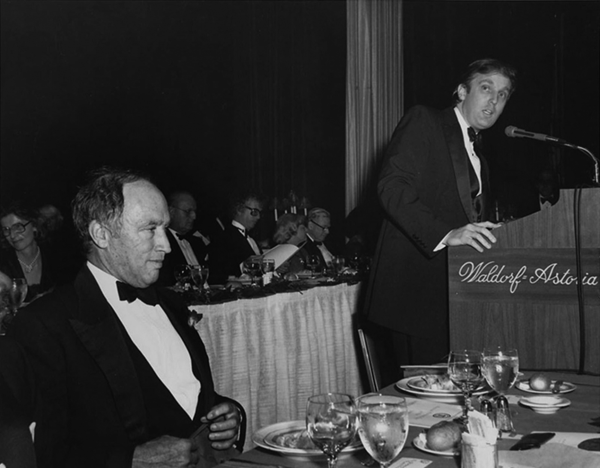
That same night, Trudeau jetted off to an exclusive gala at the Waldorf Astoria in Manhattan, where the Council of Churches of the City of New York awarded him its “Family of Man” gold medallion for services to human rights and “his appreciation of the cultural diversity of his nation.”Footnote 98 The irony in the timing of these plaudits seemed to escape everyone but Indigenous people, and especially those activists in Paris on the Constitution Express. Feted as a global defender of the politically and economically downtrodden, Trudeau received his gilded award from the event's headliner, a young New York City real-estate heir and socialite named Donald J. Trump (see figure 2).Footnote 99 Taking note of the hypocrisy of this moment, Indigenous activists vowed to pour even more energy into the Constitution Express.
Donald Trump addressing a Manhattan crowd at the Council of Churches of the City of New York's “Family of Man” awards dinner in November 1981 where Pierre Trudeau received the organization's gold medallion. Thirty-six years later, Prime Minister Justin Trudeau gave this photo to Trump, then US president, at their first official meeting. Courtesy of the Council of Churches of the City of New York.

“Not Just Some Disgruntled Ethnic Minority”
As George Manuel and Wayne Christian had intended, the tour of the Constitution Express through continental Europe had built up political pressure on Margaret Thatcher's government to recognize Britain's treaty obligations to Indigenous peoples. People across Western Europe, Britain, and Canada soon inundated British public officials with impassioned letters and petitions about the plight of Indigenous peoples.Footnote 100 “I always thought that things were slowly improving for American and Canadian Indians, but the Canadian government are wanting to destroy their country's native people,” one correspondent wrote to Thatcher. “To me and thousands of others in Britain, the Canadian government men are all modern day General Custers.”Footnote 101 Junior Foreign Office minister Richard Luce reported that by April 1982 his department had received some 9,700 pieces of mail concerning the issue of the Canadian constitution.Footnote 102 The Labour MP Bruce George, well known as an Indigenous advocate in Parliament, declared that he alone had received some 3,500 letters, only five of which had been personally abusive to him—or spoke favorably of Trudeau.Footnote 103
Despite this groundswell of popular support, the Foreign Office continued to prevent British ministers from meeting with any Indigenous representatives, falling back on Ottawa's tired justification that there was no united Indigenous opinion of patriation.Footnote 104 Instead, low-ranking career civil servants at the Foreign and Commonwealth Office would continue to meet with chiefs and activists at their request. But this policy became difficult to maintain after the 5 November accord. The gutting of Indigenous rights—an act that Trudeau later briskly referred to as “the aboriginal thing”—proved so objectionable that even the prime minister's few Indigenous supporters could not stand by it.Footnote 105 “What can I say?” remarked Charlie Watt, co-chairman of the Inuit Committee on National Issues, which had supported patriation. “Whatever rights we had protected now are gone.”Footnote 106 In November, a Foreign Office memo recorded the first British acknowledgment that Indigenous activists had formed a united front in response to the accord. Several groups had met with British civil servants, and while “the Indians [had] deployed differing arguments, [they] all point[ed] in the same general direction.”Footnote 107
Once activists from the Constitution Express arrived in London on 13 November, they were shepherded into British political and social institutions by sympathetic politicians and community leaders. In these exclusive spaces, they railed against Trudeau and spoke about the importance of Indigenous links with the British crown. Activists also recruited people to their cause, especially those with established connections to Indigenous peoples, like the Tory MP Mark Wolfson, who had once worked as a teacher among the Nisga'a in British Columbia, and his colleague Winston Churchill Jr., who claimed to have Iroquois ancestry through his paternal American grandmother.Footnote 108 Churchill “gave tea and sympathy” to six chiefs who presented him with an embroidered leather waistcoat, which he said would be perfect “for riding purposes.”Footnote 109
The majority of supportive MPs and peers were motivated by the paternalistic spirit inherent in the project of empire, believing Parliament had a moral responsibility to save downtrodden peoples like Canada's Indigenous nations. It was a sentiment that some activists were willing to exploit. “We know you are concerned for the future of those countries you release from colonial status,” read one circular sent to MPs, after presenting the full case against patriation.Footnote 110 But British politicians’ assumptions ranged from the relatively benign to the outright ignorant. In one telling exchange in the House of Lords, a peer asked an assembled group of activists where they came from. When a chief replied, “Saskatoon, Saskatchewan,” the peer was taken aback and exclaimed to his staff, “They don't speak English!”Footnote 111
After calling at Lambeth Palace, five activists successfully lobbied Robert Runcie, the archbishop of Canterbury, to commission and distribute an information briefing on patriation to the lords spiritual—the twenty-six bishops serving in the House of Lords.Footnote 112 Indigenous leaders then met the queen's representatives at Buckingham Palace to present her with a petition against patriation, along with a gold ring and pendant symbolizing the continued Indigenous bond with the crown.Footnote 113 But the most powerful and symbolic event of the Constitution Express was a potlatch at Central Methodist Hall in Westminster, which was attended by over a thousand people, including many British MPs and peers. Billed as a celebration of ties with the crown, the London ceremony contained oratory, singing, dancing, and gift giving in a demonstration of the most important social and political ritual of Indigenous peoples in British Columbia. Louise Mandell later wrote that British politicians were “invited to watch an Indian political institution in operation in Westminster,” which was particularly poignant given that potlatch had been banned by the Canadian government from 1884 to 1951.Footnote 114 But now, deep in the political center of the British Empire, the Indigenous peoples of British Columbia effectively demonstrated their desire for continued association with Britain, at the same time highlighting their well-founded distrust and defiance of the settler state. The centerpiece of the potlatch came when two Nuxalk chiefs took to the stage. In front of the transfixed crowd, Chief Lawrence Pootlass plucked two eagle feathers from the headband of his colleague, who was acting as a stand-in for Trudeau. Stepping aside, Pootlass set the feathers on fire, formally stripping the prime minister of an honorary chieftaincy bestowed upon him by the Nuxalk people in 1975. On this London stage, Trudeau had been excommunicated from the nation.Footnote 115
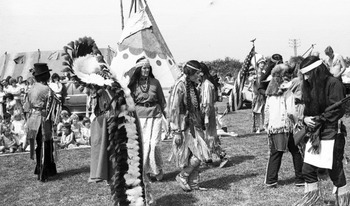
There was only one awkward moment in a potlatch that Mandell otherwise remembered as “chaotically stunning.”Footnote 116 In the 1980s, Britain boasted a sizable number of clubs devoted to celebrating North American Indigenous cultures.Footnote 117 Fueled by a growing interest in New Age religions, these groups were commonly referred to as “Red Peoples Societies.”Footnote 118 The members of one such club, the Peace Pipe Lodge from Truro, which claimed to be the “Cornish representatives of the Canadian Indians,” regularly attended local fairs in the West Country dressed in their representations of Indigenous clothing (see figure 3).Footnote 119 They erected tipis and performed mock rituals. For Christian, these people enjoyed “playing Indian.”Footnote 120 But even with their uncomfortable appropriation of Indigenous culture, they often proved to be useful local allies, penning letters and providing accommodation. They also attended the London potlatch, and though UBCIC officials specifically requested that they not “dress up” for the event, they ignored the appeal. As a result, while delivering a pointed political statement about Indigenous sovereignty at the heart of empire, the potlatch also exhibited the bizarre juxtaposition of dozens of British people dressed in the Indigenous attire of the Prairies, mingling with hundreds of actual Indigenous people in blue jeans.Footnote 121
Eight months after the London Constitution Express, members of Truro's “Peace Pipe Lodge” perform their interpretation of an Indigenous ritual in July 1983 in front of onlookers at the Helston Association Football Club Bonanza in Cornwall. Courtesy of Paul Yockney, as featured on http://cornishmemory.com/item/YOCN_5_635.

The Thatcher government realized that, now united in their opposition to the 5 November accord, Indigenous lobbyists in the United Kingdom had hit their stride. By 10 November, Richard Luce warned civil servants that “the Indians [were] putting forward an emotionally strong and appealing case.” He “hop[ed] that HMG's position [was] solid and that we are prepared with good arguments rebutting the Indians’ case when, as seems likely, MPs raise this question.”Footnote 122 Officials did not have long to wait before MPs’ inquiries began to appear. By 23 November, the Conservatives’ chief whip in the House of Commons, Michael Jopling, wrote to the British Foreign Office in search of arguments that could be deployed to calm the querulous Tory ranks: “It might prove very useful with our backbenchers if we could cite examples of earlier Independence Acts where significant groups within the territory were opposed to the proposals at the time; but legislation was, nevertheless, put through Parliament.”Footnote 123 Foreign and Commonwealth Office staff chased Jopling's request for over a month, passing research briefs among them. Belize, Antigua and Barbuda, Kiribati, Nigeria, Zambia, Uganda, and Kenya all offered hopeful comparisons to Canada. But as one minister later wrote to Jopling, the Indigenous case was unique in one key respect: that dissent toward the independence act was coming from a racial minority.Footnote 124 This significant factor intensified British MPs’ calls for Canada to respect Indigenous peoples’ rights as a minority.
But some activists bristled at the characterization of their struggle in terms of minority or civil rights.Footnote 125 Manuel's youngest son, Arthur, argued that Indigenous peoples were “not just some disgruntled ethnic minority or special interest group.” Rather, they were Canada's founders—“colonized peoples” fighting for self-determination and sovereignty.Footnote 126 This reaction goes some way to explaining why members of the Constitution Express developed few links with social-advocacy groups in London. For example, George Manuel was aware of what he called the ongoing “race riot” between “the black and English people” in Britain.Footnote 127 Dramatic scenes of violence had broken out in Brixton and Toxteth in April and July of that year. But he and Christian were leery of Indigenous protests being co-opted by these and other local social movements. “We don't want any demonstrations in London,” Christian told activists in Vancouver before departing, “because we have heard of all the problems that exist there.” He went on: “We're really trying to explain the positive aspects of what we're fighting for,” adding that “we don't want to be taken over by any right-wing or left-wing group.”Footnote 128 Instead, the members of the Constitution Express would concentrate on projecting themselves as diplomats, showcasing simultaneously their nation-to-nation relationships with Britain and Canada.Footnote 129
“Imperatives Greater than the Guidance of the Whip's Office”
The Constitution Express arrived in London at a uniquely divisive moment in Britain's postwar political history. Margaret Thatcher had received widespread support among Tories during her first months in office, but by October 1981 she had burned through her political capital. As unemployment soared, the Times touted a series of opinion polls suggesting that Thatcher was the most unpopular prime minister since polling began in 1945, with a meager 28 percent approval rating.Footnote 130 Despite pressure from her colleagues, she remained committed to supply-side economics, privileging the need to control inflation over unemployment. Her Tory rivals, whom Thatcher and her allies branded “the wets” for their attachment to a moderate brand of “One Nation” conservatism, began to plot against her leadership.Footnote 131
Christian had explained the divisions among British Conservatives, as he understood them, to his colleagues in Vancouver before setting off for Europe: “Margaret Thatcher is having a very difficult time at this point. She has got people who are pulling rank on her; they are pulling out or are ready to pull out.”Footnote 132 It was for this reason, and because other groups had already intensely lobbied the Labour Party, that Bob Manuel, George's eldest son, then serving as president of the UBCIC, decided that the Constitution Express would focus on the Tories. “It's the Conservatives we really have to work on,” he told a gathering of chiefs at the UBCIC in September 1981.Footnote 133 This strategy was a mark of the organization's pragmatic approach: members of the Constitution Express were willing to lobby almost anyone in the service of their cause.
At the same time, however, the Labour Party was riven by its own internal divisions. Insurgent MPs, led by veteran backbencher Tony Benn and backed by radical grassroots activists, sought to redirect the party toward the hard left. In response, four dissenting Labour MPs—all former cabinet ministers—engineered a dramatic split, forming the breakaway center-left Social Democratic Party (SDP).Footnote 134 As the Constitution Express campaigned in London, another hard-fought contest was taking place in the Crosby by-election outside Liverpool. Shirley Williams, a charismatic former Labour minister who had lost her seat in 1979, stood as the Social Democratic Party's candidate in the suburban constituency. To the tune of the Chariots of Fire theme song, her official campaign anthem, Williams took to the hustings and eventually overturned a seemingly unassailable Tory majority of nineteen thousand votes.Footnote 135 Henceforth, all safe seats, whether Labour or Conservative, were deemed at risk. Joining an official electoral alliance with the Liberal Party, this new third force of British politics, the SDP-Liberal Alliance, was primed for government. With Thatcher at her nadir and Labour's Michael Foot performing no better, the Alliance achieved 51 percent of voters’ support in a December 1981 opinion poll, a staggering twenty-two-point rise in the span of just three months.Footnote 136 A political sea change seemed to be in the offing. As a result, despite their stated intent to focus on the Conservatives, Indigenous activists also saw political opportunities in the divisions of the left. The success of the Social Democratic Party was an important development, Christian told colleagues, and the party was making “big inroads” in the British political landscape.Footnote 137
Amid these highly charged divisions, Indigenous activists also tuned into a familiar discourse in Britain, discovering a country equally beset by its own ongoing discussion on sovereignty and the constitution.Footnote 138 The notion of a “constitutional crisis” was especially strong in the Conservative Party. In 1974, Edward Heath had called and subsequently lost an election premised on the question of “Who governs Britain: Parliament or the trade unions?” In the years of Tory opposition that followed, party members raked over the question of the constitution, such that in 1978 alone, the annual Conservative Party Conference boasted forty proposed motions on the order paper related to the subject.Footnote 139 In a conference debate on one such motion, shadow minister Francis Pym, speaking for the party leadership, declared that “the left is hell-bent on destroying our institutions and replacing them with their own kind of direction and intimidation.”Footnote 140
Like Trudeau, Thatcher explored constitutional reform as a way to permanently enshrine her vision of society. In 1975, she directed her party's policy committee to study the feasibility of a bill of rights as a way of guarding against attacks on individual and property rights by a future Labour government, held hostage to the hard left. Fifteen months later, Sir Michael Havers presented a paper to the Conservative Shadow Cabinet, concluding that the Tories should support a bill of rights or a simple proposal to bring the European Convention on Human Rights into British law.Footnote 141 As a result, the Conservatives’ 1979 election manifesto formally committed the party to convening all-party talks on a bill of rights. When Thatcher was questioned on the subject during the campaign, she noted that it was “a proposal which deeply interests me,” though adding the caveat that “we must be careful to protect the authority of Parliament.”Footnote 142
Here Thatcher pinpointed the inherent difficulty of a codified bill of rights in a system with an unwritten constitution—one in which Parliament, not the people, was sovereign. A bill of rights would be subject to litigation in the courts, and in the end the impetus of lawmaking would shift from Parliament to the judiciary. For Lord Moran, British high commissioner to Canada, Trudeau's proposed Charter of Rights represented “a complete departure from the British concept of a sovereign parliament” and a “lurch in the direction of the American system with Supreme Court rulings overriding everything else.” He told the Foreign and Commonwealth Office that “it remains extraordinary that we should be asked to pass it.”Footnote 143 Among British MPs, Enoch Powell raised this line of argument most forcefully. Powell embodied the divisions among Conservatives like no other politician—lionized by some for his incendiary “Rivers of Blood” speech in 1968, castigated by others as a racist. “In the sense of being an entrenched and justiciable document,” he told the Commons, “a charter of liberties or a bill of rights is incompatible with parliamentary sovereignty.”Footnote 144 In his view, the Thatcher government had been woefully ignorant of the implications of assenting to a Canadian bill of rights at Westminster. The legislation would go “on our own statute book by our own legislating act,” he noted, adding that, as a result, “we are in the deepest sense concerned with our own business, with the nature of Parliament and with what the sovereignty of Parliament means.”Footnote 145 The Canadian bill of rights might nullify historic Indian treaties, but in the worst-case scenario, it might dilute the concept of parliamentary sovereignty in both countries.
After the Conservatives’ election victory in May 1979, Thatcher's true opinion of bills of rights quickly solidified, as did many of her other policy positions. At Prime Minister's Questions that December, she stated that it was “doubtful whether, having the doctrine of parliamentary sovereignty, we could ever entrench a Bill of Rights in this country.”Footnote 146 But it was likely the charged debates over the Canadian constitution that ultimately dissuaded her from allowing the party to pursue further plans.Footnote 147 In October 1980 she told two visiting Canadian ministers, “The addition of a Bill of Rights to the [patriation] legislation being passed through the Westminster parliament was likely to mean that the issue would become more controversial in this country and that, as a consequence, its passage would be more prolonged.”Footnote 148 Lord Carrington agreed, telegramming Lord Moran in Ottawa shortly thereafter that a bill of rights “would cause problems in Westminster.” MPs and peers who were expert in constitutional law “in both Houses of Parliament would have major reservations about giving swift endorsement to such a proposal which has constitutional implications for Britain.”Footnote 149 Thatcher and Carrington were both right, as MPs later took personal stands against their party lines. “There are imperatives that are greater than that of the guidance of the Whips Office,” the Tory MP Derek Walker Smith told the Commons. “Those imperatives are at the heart of the matter—the principles of constitutional propriety and the rule of law.”Footnote 150
For those backbench MPs worried about looming threats to parliamentary sovereignty, the marginalization of Canada's Indigenous peoples provided a real-time example of the dangers inherent in unpicking the fundamentals of the Westminster parliamentary tradition. The Conservative MP Sir Bernard Braine later told the Commons that Indigenous rights in the draft Canadian constitution were “vague to the point of implying that there may be no aboriginal rights at all.”Footnote 151 For Labour's Bruce George, the situation was worse given the nefarious track record of the Trudeau government on Indigenous rights, which had favored “a process of paper genocide” that could legislate Indian status out of existence.Footnote 152 The whole sordid history of the treatment of Canada's Indigenous peoples was morally indefensible, he argued, adding that Ottawa's Indigenous policies “[made] the South African Bantustan policy seem almost liberal”—a cutting reference to the apartheid regime's policy of confining Africans to so-called tribal homelands.Footnote 153
By the time the Constitution Express arrived in London, British MPs had been long engaged in their own discussions of sovereignty. These debates prepared the ground for Indigenous activists, as they attempted to translate their anti-patriation agenda to a local political audience. But once opened to scrutiny in the British Parliament, the Canadian constitution was refracted through the politics of a uniquely divisive moment. The contentious debates over the potential side effects of Trudeau's Charter did little to convince Thatcher of the merits of a codified bill of rights.
“Blood Would Be Spilled”
As they scanned the British political landscape for potential allies receptive to the message of Indigenous sovereignty, activists on the Constitution Express also took note of the resurgent nationalist divisions in Scotland, Wales, and Northern Ireland. As in Canada, the 1970s in Britain had been a decade of competing nationalisms, fueled by the Troubles in Northern Ireland, the development of North Sea oil, the relative political successes of the Scottish National Party and Plaid Cymru (the nationalist party in Wales), and calls for regional devolution. Indeed, as Francis Pym told Canada's high commissioner in London, Jean Wadds, the “extended discussions about devolution to Wales and Scotland between 1977 and 1979 had made members of all parties aware of the significance of the issues now being debated in Canada.”Footnote 154 The Scottish and Welsh debates had culminated in 1979 in failed referendums on greater home rule.Footnote 155
In London, the UBCIC worked in close collaboration with the Federation of Saskatchewan Indians, whose members had established activist networks in Scotland after discovering that their message about devolved powers within a federal system worked well in the political culture of Britain's Celtic fringe. The federation arranged public meetings at the University of Edinburgh, canvassed print and television media, and met with executives of all of Scotland's major political parties. According to the group's newsletter, the Saskatchewan Indian, activists found Scottish Liberals and Conservatives “more ready to understand our fears for aboriginal rights than their English colleagues.”Footnote 156 The same was true of Scottish Nationalists. For party president Donald Stewart, the Indigenous appeals hit close to home. “If honorable members wish to regard solemn agreements as scraps of paper, they must accept the responsibility for doing so,” he told the House of Commons. “I know what it is like for people to be moved from their land,” he said, referencing the Highland Clearances of the nineteenth century.Footnote 157 Saskatchewan chiefs made the rounds of the Scottish nobility; the venerated elder John Tootoosis visited the Earl of Balfour on his estate in northern Scotland.Footnote 158 Whereas Indigenous leaders had not engaged in extensive coalition building with social-advocacy groups in London for fear of being overtaken and associated with minority rights causes, they were willing to pursue alliances with parties in Scotland whose support for greater home rule, and even independence, mirrored their own calls for Indigenous sovereignty within Canada. It mattered little to them whether their Scottish allies identified as Labour, Liberal, Tory, or Scottish Nationalist Party.
As a result of these political operations, much of the impassioned correspondence from concerned British people writing on behalf of Indigenous peoples came from Scotland and Wales. “Having been brought up in the Western Isles of Scotland,” one woman wrote to Margaret Thatcher, “I feel I can identify with [Indigenous peoples in Canada] as we have our own culture, music, etc., different from the remainder of Britain, and would not take too kindly to someone trying to change that way.”Footnote 159 Other correspondents wrote to the Scottish press, including Janet Scott of Glasgow, whose interest was piqued by a fleeting glimpse of two men in “feathered headdresses” marching in London's annual Remembrance Day procession down Whitehall.Footnote 160 One of these men turned out to be Patrick Madahbee, the same Ojibwa chief from southern Ontario who had proudly displayed his wampum belt to civil servants at the Foreign Office.Footnote 161 Interested in the chiefs’ role in the ceremony, Scott wrote to the Scottish weekly Sunday Post to ask about these “Red Indians.”Footnote 162 The Post’s response was in the form of a full-length article. “The Indians want Britain to ensure the rights and land they hold dear will not be lost or threatened. Indeed, as well as honouring their dead at the Cenotaph last Sunday, they were silently asking us to honour our old promises to them.”Footnote 163 This simple yet elegant articulation of the Indigenous mission in Britain, translated for a popular audience, was exactly the type of public appeal that ministers feared, potentially leading ordinary people to mobilize their local MPs to slow down the legislative process.
This Sunday Post article made its way to Gwynedd in northwest Wales, where the story of Britain's obligations to Indigenous peoples elicited another passionate response conditioned by local history. “We British people are honour bound to protect the interests of the native Indians,” Chris J. Jones wrote to Margaret Thatcher, forwarding along a copy of the Post article.Footnote 164 “Incidentally, we, in this Country [Wales], mercifully enjoy relative freedom from tuberculosis,” he added in a reference to the perilous history of epidemics among Canada's Indigenous communities, “and I do hope that the Canadian Health Authorities have arrived at equal control of T.B. among their native Indians.” Jones noted that in his native Welsh, tuberculosis translated to “certain death.”Footnote 165
Like their Scottish colleagues, Welsh nationalists were equally supportive of the Indigenous cause in Britain. Indigenous peoples in North America, notably from the American Indian Movement, first established links with Plaid Cymru in the 1960s on the basis of a shared history of oppression by the forces of imperialism.Footnote 166 The party's political leverage on the Canadian issues, however, was stronger because of Westminster's continued legal connection to Canada.Footnote 167 Plaid's general secretary duly notified Trudeau's office that his party was “certain to oppose any constitutional changes which do not give adequate safeguards to Indian nations and we will advise our Members of Parliament accordingly.”Footnote 168
While easily negotiating the comparatively placid political contexts of Scotland and Wales, Indigenous activists encountered a much more complicated and volatile political situation in Northern Ireland. On 27 October, the Provisional Irish Republican Army, or IRA, planted a bomb in a hamburger shop on Oxford Street in London. Based on a tip-off, police promptly evacuated the shop, though an explosives officer was killed attempting to defuse the bomb. They also neutralized a second device at the nearby Debenhams department store. According to the IRA, this new spate of attacks signaled an expansion of their terms of engagement to include soft civilian targets.Footnote 169 As a result, the Metropolitan Police scoured the capital for five hundred pounds of gelignite explosives reportedly smuggled in by militant Irish republicans.Footnote 170
The architects of the Constitution Express took the political situation in Northern Ireland very seriously. As George Manuel explained privately to his colleagues in Vancouver, well before activists left for London, “It's the same as our struggle [and] it's getting far more publicity than we will probably ever get.”Footnote 171 Wayne Christian likewise referenced the cause célèbre of the political prisoner Bobby Sands, whose death on a hunger strike in May 1981 had led the IRA to renew its tactics of targeting civilians on the British mainland.Footnote 172 But some members of the UBCIC expressed doubts about sending activists into this violent political scene. We “will have to be very careful,” one chief, John George, warned Christian at a Chiefs Council in September where the logistics of the trip were first discussed in full.Footnote 173 Christian assured the chiefs that he would “brief our people on the first day about how different politics in Europe is.”Footnote 174
Even so, some activists found the general security situation in Europe initially unsettling. “When we got into the Hanover airport,” the activist Wilf Adam later reported to his Lake Babine nation, “there were police with submachine guns walking around. We thought they were coming for us, but they weren't.” He added, “which was a relief.”Footnote 175 In London, an activist from Williams Lake reported that, like Londoners, “we felt the fear that was constant because of the bombings and murders that have become an everyday part of life.”Footnote 176
Indigenous activists on the Constitution Express experienced this surge in violence in Britain right at the time of their own increasing exasperation with Trudeau's 5 November accord. It was hardly surprising, then, that excluded Indigenous leaders began to threaten violence in Canada in the mold of the insurgent republican campaign in Northern Ireland. “Already we are confronted with internal violence in our own community,” Chief Sol Sanderson of the Federation of Saskatchewan Indians told a London press conference on 5 November.Footnote 177 If Trudeau failed to consult Indigenous peoples before patriation, Sanderson's organization would resort to violence “like the IRA in Britain.”Footnote 178 At another London press conference a week later, Chief Roy Jimmie from the UBCIC recalled that, a year before, Indigenous leaders had declared a “state of emergency,” leading to the original Ottawa Constitution Express. But after the federal government's betrayal of Indigenous rights, he noted, “there are some Indian peoples in Canada that have declared war.”Footnote 179
For Indigenous leaders, the 5 November accord had raised the stakes of the constitutional drama significantly. Their reactions signaled the quickening pace of events, as some parts of the movement shifted toward a more militant position. The heated rhetoric would have been unacceptable to most ordinary British people, terrorized daily by the specter of IRA violence, which continued unabated with the bombing of Harrods in 1983 and the attempted assassination of Margaret Thatcher in Brighton in 1984. But the majority of reports were confined to the Canadian press. Some Indigenous leaders clearly sought to use the threat of violence as leverage against the federal government. For his part, Trudeau needed no cautionary tales about the dangers of terrorism. He had been in office during the October Crisis of 1970, when the Front de Libération du Québec kidnapped the British trade commissioner in Canada and murdered Quebec's minister of labor. Trudeau had dealt with the crisis by imposing virtual martial law in Quebec under the War Measures Act.Footnote 180 Moreover, the Canadian government already had good reason to feel uneasy about the threats of an IRA-inspired conflict in Canada. The day after the Oxford Street bombing, Ottawa's High Commission in London was evacuated after a bomb threat. While no explosives were found, staff reported that the male caller who made the threat spoke with an Irish accent, “softened by a Canadian or American twang.” He delivered a simple yet menacing threat: “This is the Canadian Liberation Army, and a bomb will go off within one hour.”Footnote 181
On 19 November, energized by the publicity of their long European tour and incensed with Trudeau, the members of the Constitution Express returned to Canada. But before dispersing to all corners of the province, many activists joined a UBCIC protest already underway in Vancouver.Footnote 182 Earlier that day, some four hundred activists had occupied the Museum of Anthropology at the University of British Columbia, a world-renowned institution containing thousands of Indigenous objects. Before hapless security guards and docents could make sense of what was happening, hundreds of people swept through the museum's front doors, hands raised and fists clenched.Footnote 183 They filled the main gallery, using it as a forum to discuss their constitutional grievances, and remained there for twenty-four hours, flanked by the towering totem poles of their ancestors.Footnote 184
Later that day, Grand Chief George Manuel addressed the assembled crowd at a reconstructed longhouse on the museum's grounds. Indigenous peoples “must be prepared to spill our own blood,” the normally moderate and measured Manuel told his audience.Footnote 185 “When your identity has been threatened, when your relationship with the only homeland you have is being exterminated through the constitution,” he passionately declared, “then the people have to take serious action to retain their identity. In the long run,” he added flatly, “it is of some value to proceed much like the Irish Republican Army.”Footnote 186 According to the Globe and Mail, one of Canada's most esteemed Indigenous elder statesmen had “exhorted violent confrontation reminiscent of Wounded Knee in 1973 and Kenora in 1974.”Footnote 187 Bob Manuel echoed his father's threats a few days later, predicting that most Canadians would empathize with Indigenous peoples. “If their land was going to be taken away, they would fight, [and] their blood would be spilled,” he declared. “We've got to be prepared for that too,” he added.Footnote 188
Whether real or rhetorical, George Manuel's threats in Vancouver to emulate the IRA, coming so soon after the Constitution Express had traveled through a bomb-ravaged London, seemed designed to raise the stakes against the federal government's continued exclusion of Indigenous peoples.Footnote 189 But the general shift in discourse shocked many and was denounced by several activist groups, including the powerful Indian Homemakers’ Association, a political organization made up of Indigenous women's clubs.Footnote 190 Even Christian recalled his own concern at Manuel's overheated rhetoric. “I didn't condone those kinds of comments,” he later noted, “because I think that would have taken our young people down a road that would not have been acting as our ancestors acted.”Footnote 191 Had Manuel's comments been reported in Britain, the reaction would have been even more explosive, alienating British MPs and the public, and likely undermining the combined efforts of the Constitution Express. As it happened, no British news outlet carried the story.
“Fuddle Duddle the Constitution”
In the days immediately following the Constitution Express's dramatic return to Vancouver, Trudeau was by chance on a three-day tour of British Columbia. Hearing that he was in the interior city of Kamloops, two hundred people representing five local Indigenous nations converged on the prime minister's downtown hotel. They carried signs emblazoned with “Fuddle Duddle the Constitution,” an allusion to a 1971 incident in the Canadian House of Commons when Trudeau allegedly mouthed the words “fuck off” to opposition members across the chamber, only later to suggest to the press that he had said “fuddle duddle or something like that.”Footnote 192
With little choice but to accede to the protesters’ demands for an impromptu meeting in the hotel parking lot, Trudeau had a cordial discussion with Chief Mary Leonard of the Kamloops nation before turning to Wayne Christian, now well known for his leadership role in Europe.Footnote 193 When Christian confronted Trudeau about the “lies” that Ottawa was spreading around the world—in other words, that Indigenous people were satisfied with their lot in the constitution—the prime minister “stiffened visibly.”Footnote 194 “What lies?” Trudeau barked, demanding to know how many people Christian represented. When he replied that he spoke for some five thousand men, women, and children, Trudeau scoffed. “Many more native leaders representing a lot more people told us in Ottawa last February what was acceptable,” he retorted, referencing the basic agreement that had recognized limited Indigenous rights in the draft constitution, only for them to be stripped on 5 November. “Settle your lies between yourselves and don't accuse me of lying,” he added before storming back inside. For Christian, Trudeau's sharp reaction was all the proof he needed that the Constitution Express had succeeded in highlighting Canada's hypocrisy on the global stage.Footnote 195
But on 26 November, pressured by the success of the Constitution Express and in the face of large-scale protests and threats of violence, the federal and provincial governments reached agreement, and the Canadian House of Commons voted to reinstate the most basic protections of Indigenous rights in the constitution.Footnote 196 Subject to the demands of several provincial governments, including British Columbia, the qualifying adjective “existing” was inserted into the section, so that it read, “The existing aboriginal and treaty rights of the aboriginal peoples of Canada are hereby recognized and affirmed.”Footnote 197 Indigenous leaders saw malicious intent behind this wording, interpreting the insertion of “existing” as an effort to freeze any definition of aboriginal rights in 1981. This vague language would ultimately enter the Canadian constitution as Section 35.Footnote 198
With all provinces save Quebec now backing Trudeau's line on patriation, it quickly became apparent to Indigenous activists that their political efforts could not prevent patriation on the federal government's terms. As a last-ditch effort, they channeled all of their energy and resources into the British court system. Though the courts ultimately rejected any British legal obligations to Indigenous peoples, Lord Justice Denning wrote his judgment in such a way as to be politically helpful in their campaigns back home.Footnote 199 Indigenous rights and freedoms were originally guaranteed by the British crown and then by the crown in right of Canada, Denning wrote. “No Parliament should do anything to lessen the worth of these guarantees,” he added. “They should be honoured by the Crown in respect of Canada ‘so long as the sun rises and the river flows.’”Footnote 200 Denning's lyric ending invoked the language of a 1794 treaty between King George III and an Indigenous chief in New Brunswick.Footnote 201
In March 1982, the House of Lords passed the final version of the Canada Act, 1982, officially devolving the powers of the British North America Act, 1867, to Ottawa. Of the thirty hours allocated for debating patriation in the British Parliament, twenty-seven of them had exclusively covered the plight of Canada's Indigenous peoples.Footnote 202 In the normally staid Lords, tempers frayed when the attending Foreign and Commonwealth Office minister tried to curtail a rogue peer's attempted filibuster. In response, Lord Morris quipped of the minister, “I am delighted that the noble Earl has at last spoken from his feet rather than from his bottom.”Footnote 203 The robust parliamentary end to the affair was a testament to the political and popular impact that the Indigenous lobby had in Britain.
Rebuffed by federal and provincial governments that refused to define the “existing aboriginal rights” in Section 35, Indigenous peoples took their efforts to the Canadian courts over the next thirty years. The legal system increasingly supported Indigenous definitions of sovereignty and rights.Footnote 204 But victories in the courtroom did not offer a panacea for the remaining political, economic, and social inequalities of the colonial state. The Indigenous struggle against colonialism remained (and remains) active and vigorous, especially in the contexts of political representation, land rights, wealth distribution, and the often overlooked epidemic of violence against Indigenous women and children.Footnote 205
The story of the Constitution Express challenges and reframes our root assumptions about British decolonization, including when it occurred and what colonized peoples imagined the end of empire to mean. Freed from the limits of a historical narrative and timeline that declared the end of the empire in the 1960s, we can consider the perspective of a colonized people for whom decolonization was not a fixed moment in time tied to the creation of a new nation-state but an ongoing struggle for sovereignty and rights. Indeed, Indigenous peoples’ deep engagement in the British political arena was part of a long history of activism in Britain dating back to the eighteenth century. George Manuel, Wayne Christian, and the Constitution Express's subsequent effort to find political allies at Westminster to scupper Trudeau's patriation laid bare Britain's sharp divisions between right and left and among competing nationalisms in the early 1980s. Indigenous activists skillfully traversed this scene to voice and implement their own contextual vision of decolonization as continued association with the British crown on a nation-to-nation basis. After years of neglect and abuse by Ottawa and the provinces, maintaining this seemingly colonial relationship with Britain offered at the time the best hope for winning genuine sovereignty and rights within Canada.