Introduction
Bermudagrass is one of the most common turfgrass species planted on golf courses, home lawns, and sports fields in the southern United States (Christians et al. Reference Christians, Patton and Law2017). Bermudagrass can tolerate a wide variety of environmental conditions. However, grassy weeds such as goosegrass, dallisgrass (Paspalum dilatatum Poir.), and crabgrass can rapidly invade turfgrass areas weakened by drought, disease, shade, traffic, insect infestation, or mechanical damage (Holm et al. Reference Holm, Plucknett, Pancho and Herberger1977). Infestations of grassy weeds often result in reduced playability, reduced aesthetics, safety issues, or water and nutrient competition for the desirable turfgrass (Beard Reference Beard2001).
POST weed control options in bermudagrass are limited, and none have been found that control mature goosegrass plants without damaging bermudagrass (Busey Reference Busey2004; Cox et al. Reference Cox, Rana, Brewer and Askew2017; Johnson Reference Johnson1975, Reference Johnson1980, Reference Johnson1996; McCarty 1991; Nishimoto and Murdoch Reference Nishimoto and Murdoch1999; Wiecko Reference Wiecko2000). Monosodium methanearsonate (MSMA 6 Plus; Drexel Chemical Co., Memphis, TN), diclofop (Illoxan; Bayer Environmental Science, Research Triangle Park, NC), metribuzin (Sencor; Bayer Environmental Science, Cary, NC), foramsulfuron (Revolver; Bayer Environmental Science, Cary, NC), sulfentrazone (Dismiss; FMC Corp., Philadelphia, PA), and topramezone (Pylex; BASF Corp., Research Triangle Park, NC) are the main active ingredients used for goosegrass control in bermudagrass (Cox et al. Reference Cox, Rana, Brewer and Askew2017). MSMA, a common herbicide, was used to control multitillered goosegrass until 2009, when its use was banned on sports fields and heavily restricted in sod production and on golf courses (Anonymous 2012; EPA 2006, 2013). Metribuzin was often mixed with MSMA to increase tillered goosegrass control (Anonymous 2018b). Diclofop registration was voluntarily cancelled at the request of the manufacturer in 2015 (EPA 2015). Products that contain foramsulfuron and/or sulfentrazone can control only seedling goosegrass (<2–3 tillers) (Anonymous 2013, 2019).
Topramezone can control goosegrass, crabgrass, and dallisgrass at any growth stage (Anonymous 2018a). Topramezone is a hydroxyphenylpyruvate dioxygenase (HPPD) inhibitor associated with whitening or bleaching symptoms on the newest tissue in sensitive plant species (Brewer et al. Reference Brewer, Willis, Rana and Askew2017; Goddard et al. Reference Goddard, Willis and Askew2010; Grossmann and Ehrhardt Reference Grossmann and Ehrhardt2007). Topramezone was initially registered in 2013 for bermudagrass and goosegrass removal from cool-season turfgrasses (Anonymous 2018a). Cox et al. (Reference Cox, Rana, Brewer and Askew2017) showed reduced rates of topramezone on bermudagrass provides high levels of goosegrass control with only transient bleaching symptoms on the desired turfgrass. Additional research showed that topramezone (6.15–12.3 g ai ha−1) mixtures combined with chelated iron at rates ranging from 0.1525 to 2.44 kg ai ha−1 did not reduce topramezone efficacy for goosegrass control (Boyd et al. Reference Boyd, McElroy, Head and McCullough2016). Complete control was achieved for the two goosegrass biotypes tested across all rates of topramezone and chelated iron (Boyd et al. Reference Boyd, McElroy, Head and McCullough2016).
Bleaching is considered unacceptable because of aesthetic changes and striking symptomology after topramezone application. However, topramezone can control goosegrass and other grassy weeds at varying levels of maturity. Therefore, if bleaching symptoms on warm-season grasses could be eliminated or reduced, topramezone would offer an effective goosegrass and other grassy weed control option in an otherwise diminishing list of herbicides for this purpose.
Previous research has shown that the addition of chelated iron or ammonium sulfate helps reduce phytotoxicity when mixed with other herbicides (McCarty Reference McCarty1991; Price Reference Price and Van Oorshot1983), but this effect with topramezone has not been tested. Ammonium sulfate increases the activity of herbicides when mixed with hard water (Flessner et al. Reference Flessner, McElroy and McCurdy2017; O’Sullivan et al. Reference O’Sullivan, O’Donovan and Hamman1981; Roskamp et al. Reference Roskamp, Chahal and Johnson2013; Zollinger et al. Reference Zollinger, Nalewaja, Peterson and Young2010). Turf pigments and paints are often used to mask phytotoxicity or turf dormancy in bermudagrass, but, to our knowledge, no research has tested these agents for the masking of HPPD-application symptoms. Bleaching symptoms are significantly reduced when topramezone is mixed with triclopyr (Turflon Ester; Dow AgroSciences, Indianapolis, IN), but injury is increased when this combination is applied to bermudagrass (Brosnan and Breeden Reference Brosnan and Breeden2013; Brosnan et al. Reference Brosnan, Breeden, Patton and Weisenberger2013; Cox Reference Cox2013; Cox et al. Reference Cox, Rana, Brewer and Askew2017). Thus, the objective of this study was to determine whether the addition of chelated iron, ammonium sulfate, triclopyr, green turf pigment, or green turf paint reduced the bleaching effect of topramezone injury on bermudagrass.
Materials and Methods
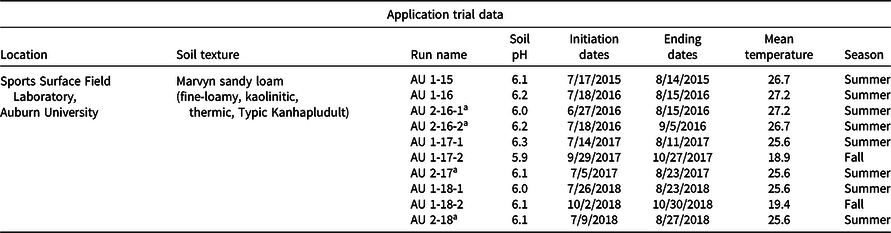
A 4-yr study was conducted at the Auburn University Sports Surface Field Laboratory in Auburn, AL (32°34ʼN, 85°29ʼW). Specific location information is found in Table 1.
Soil and site details across years for single and sequential application trials evaluating additives’ potential to reduce topramezone-associated bermudagrass bleaching in Auburn, AL.

aRun names that tested sequential instead of single treatment applications.
The bermudagrass cultivar used was ‘Tifway’ hybrid bermudagrass [Cynodon dactylon (L.) Pers. × C. transvaalensis Burtt Davy]. Treatment areas were maintained as a golf course fairway at a 2.5-cm height with scheduled mowing every 3 d during the trial. Clippings were returned during these mowing events. Normal fertilization practices for hybrid bermudagrass (36.6 kg N ha−1 per growing month) were implemented on the site to maintain a healthy, dense turfgrass canopy. Prior to treatments, bermudagrass density was observed to be 100% with equal turfgrass quality across the trial area. Mowing was withheld for 1 d before and after applications. Any excess clippings left on the plot area were removed using a backpack blower. To maintain consistency across all plots, supplemental irrigation was applied on an as-needed basis during the course of the study.
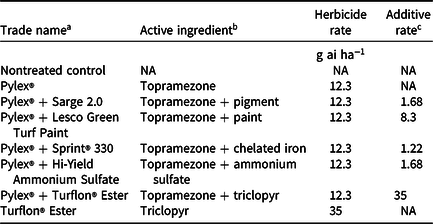
Treatments were made with a CO2-pressurized backpack sprayer calibrated to deliver 280 L ha−1 with a handheld, four-nozzle (TeeJet TP8002VS; TeeJet Spraying Systems, Roswell, GA) boom on 30.5-cm spacing. Applications were scheduled for periods when no rainfall was expected within 24 h of application timing. Topramezone was applied at 12.3 g ai ha−1 alone and in combination with triclopyr at 35 g ai ha−1, green turf pigment (Sarge 2.0; Numerator Technologies Inc., Sarasota, FL) at 1.75 kg ai ha−1, green turf paint (Lesco Green Turf Paint; Site One Landscape Supply, Roswell, GA) at 8.3% vol/vol, ammonium sulfate (21-0-0) at 1.68 kg N ha−1, and chelated iron (Sprint 330; BASF, Research Triangle Park, NC) at 1.22 kg Fe ha−1 (Table 2). Triclopyr at 35 g ai ha−1 was also applied alone as an industry standard (Table 2). Triclopyr rate was based on previous research performed by Cox (Reference Cox2013), which illustrated significant reduction in bermudagrass bleaching over a range of 30 to 75 g ai ha−1. All treatments included methylated seed oil (MSO; Alligare, Opelika, AL) at 0.5% vol/vol. A nontreated control was included for comparison. The trial area measured 12 by 12 m with individual experimental units of 1.5 by 3 m. Treatments were arranged in a randomized complete block design with four replications.
List of treatments and rates used for single and sequential applications of topramezone plus additive in trials on bermudagrass in Auburn, AL from 2015 to 2018.

a All treatments were mixed with methylated seed oil at 0.5% vol/vol in 1-L bottles.
b Abbreviation: NA, not applicable.
c Application rate units as follows: pigment, L ha−1; paint, % vol/vol; chelated iron and ammonium sulfate, kg nutrient ha−1; triclopyr, g ai ha−1.
Single applications are reported by season and designated as either summer (June/July) or fall (September/October) based on initial application date (Table 1). Single applications occurring in summer and fall allowed for the evaluation of injury a turfgrass manager would encounter after one application of topramezone. Fall applications, although irregular throughout much of the United States, are applied frequently in tropical areas such as southern Florida and Hawaii, where goosegrass perennates due to a lack of freezing temperatures (Holm et al Reference Holm, Plucknett, Pancho and Herberger1977; Uva et al Reference Uva, Neal and DiTomaso1997). Sequential applications, often needed for control of certain weed species, were applied to evaluate the injury that might occur after multiple applications. For trials receiving a single application, all treatments were applied on the initial start date, with no additional applications of herbicide, fertilizer, or fungicide. For trials receiving two applications, a follow-up application was made 21 d after the initial treatment (DAIT). Sequential application intervals were based on findings from previous research (Askew Reference Askew2012; Brewer et al. Reference Brewer, Willis, Rana and Askew2017; Brosnan and Breeden Reference Brosnan and Breeden2013; Cox et al. Reference Cox, Rana, Brewer and Askew2017).
Bermudagrass bleaching and necrosis were estimated visually according to a 0% to 100% scale, with 0% representing no bleaching and 100% being complete bleaching of all plant foliage. Necrosis percentages were defined as 0% representing no tissue death and 100% being complete tissue browning and death. Visually estimated bermudagrass symptoms of bleaching and necrosis were assessed 3, 7, 14, 21, and 28 DAIT for single applications, and 3, 7, 10, 14, 21, 24, 28, 35, 42, and 49 DAIT for sequential applications. For sequential applications, bleaching and necrosis data were collected immediately before the second (i.e., 21 DAIT) application was made.
During the 2018 season, two additional measures, clipping yield and normalized-difference vegetation index (NDVI), were added to further quantify treatment effects and to provide preliminary data for future experiments. Turfgrass clipping yield was collected at 3-wk intervals by mowing a single pass down the center of each plot. A 50.8-cm wide TruCut reel mower (DOLPHIN Outdoor Power Equipment, Pompano Beach, FL) was used to mow a single swath through each plot at 2.5-cm height. During weeks when clippings were not collected, plots were mowed using a Toro Reelmaster 3100 (Toro Co., Bloomington, MN) set at 2.5 cm. All clippings were dried for 48 h at 60 C in a drying oven. Debris found in the bags was removed before weighing the dry matter.
Turfgrass canopy spectral NDVI data across treatments were recorded weekly throughout 2018 using a handheld multispectral radiometer (Model ACS-430 Crop Circle; Holland Scientific, Lincoln, NE) that was retrofitted to mount to a walk-behind golf trolley. The device was mounted at a stationary height of 46 cm above the turf canopy. Measurements of NDVI were calculated using the following formula: NDVI = (R780 − R670)/(R780 + R670), where R780 and R670 were designated as the measured reflectance of near-infrared radiation (780 nm) and visible red radiation (670 nm) (Bremer et al. Reference Bremer, Lee, Su and Keeley2011; Trenholm et al. Reference Trenholm, Carrow and Duncan1999). Radiometer measurements started at the center edge of each plot and an average of 50 readings per 1.5 m of linear travel were collected.
Trial data were separated by run within single or sequential applications. Single applications were separated additionally by season. Runs receiving a single application were analyzed together, whereas sequential applications were analyzed as a separate group (Table 1). Data were subjected to ANOVA using PROC GLM in SAS, version 9.4 (SAS Institute, Cary, NC) and means were separated using Fisher protected LSD at α = 0.05.
Results and Discussion
Bleaching
For the most part, data followed similar trends for both the single and sequential applications, so data are discussed together. The treatment-by-run-by-season interaction was not significant (P = 0.403).There was a significant treatment-by-run interaction (P < 0.0001) and treatment-by-season interaction (P < 0.0001) for the single applications grouping. Upon further inspection, data from runs within a season followed the same general trend. Once the runs were separated by season, no significant treatment-by-run interactions were observed and data were pooled across runs within a season for analysis. Each season was analyzed separately, and the treatment main effect was significant (P < 0.0001). For sequential applications, the treatment-by-run interaction (P = 0.089) and main effect of run were not significant (P = 0.2709), whereas the main effect of treatment (P < 0.0001) was significant. Data were pooled across all runs to present the overall treatment main effect.
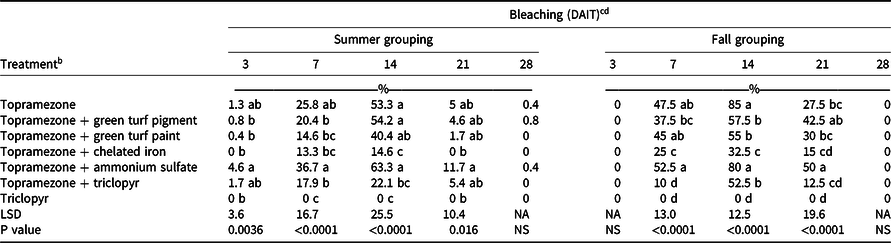
During fall and summer seasons, symptoms of bleaching occurred from 7 until 21 DAIT (Table 3). The symptoms of bleaching were more pronounced during the fall season when compared with the summer season. Averaged across treatments, bermudagrass bleaching was 36.3% in fall compared with 21.5% in summer (Table 3). The sequential application trials also reflect these findings of bleaching occurring from 7 until 21 DAIT (Table 4). After the second application, bleaching symptoms returned with the first rating at 24 DAIT but dissipated completely by 42 DAIT.
Visually estimated bleaching percentage injury to Tifway bermudagrass based on single applications of topramezone plus additive treatments, Auburn, AL.a

a Results shown are pooled over four experiments in summer grouping (2015–2018) and two experiments in fall grouping (2017–2018).
b All treatments were mixed with methylated seed oil at 0.5% vol/vol in 1-L bottles.
c Means with the same letter in the same column are not statistically different based on Tukey honest significant difference (α = 0.05).
d Abbreviations: DAIT, days after initial treatment; NA, not applicable; NS, not significant.
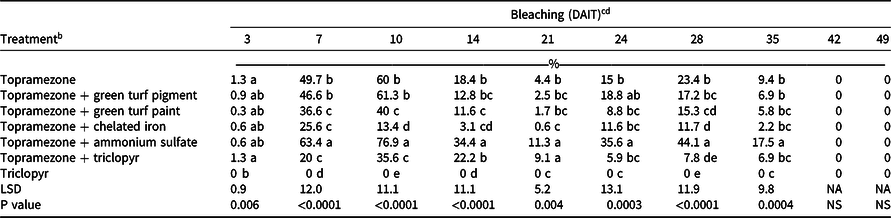
Visually estimated bleaching percentage injury to Tifway bermudagrass based on sequential applications of topramezone plus additive treatments, Auburn, AL.a

a Results shown are pooled from four experiments, 2016–2018.
b All treatments were mixed with methylated seed oil at 0.5% vol/vol in 1-L bottles.
c Means with the same letter in the same column are not statistically different based on Tukey honest significant difference (α = 0.05).
d Abbreviations: DAIT, days after initial treatment; NA, not applicable; NS, not significant.
As expected, triclopyr lacked bleaching symptomology because it is not an HPPD inhibitor and will not be discussed further as a stand-alone treatment. At 7 DAIT in summer, topramezone plus ammonium sulfate bleached bermudagrass the most and equivalent to topramezone-only treatment. Adding green turf pigment, green turf paint, chelated iron, or triclopyr to the topramezone reduced injury in comparison with topramezone plus ammonium sulfate treatment. None of the additives at 7 DAIT in summer reduced bleaching compared with topramezone-only treatment (Table 3). However, at 14 DAIT, the topramezone plus chelated iron treatment did have reduced bleaching as compared with topramezone alone and topramezone mixtures containing green pigment, green paint, or ammonium sulfate. In those treatments, bleaching continued to increase, whereas in the topramezone plus chelated iron treatment, it was not changed from that at 7 DAIT (Table 3).
In the fall, at 7 DAIT, the combination of topramezone and triclopyr had the least bleaching, equal to that of the nontreated plots. Next lowest in bleaching was bermudagrass to which topramezone plus chelated iron had been applied. No other treatment had reductions in bleaching less than that found in the topramezone-only treatment (Table 3). However, at 14 DAIT, the addition of green turf pigment, green turf paint, triclopyr, or chelated iron all reduced bleaching as compared with topramezone alone. Fall application timing resulted in increased bleaching when topramezone was applied alone when compared with bleaching observed during summer applications. Differences due to additive were largely gone by 21 DAIT, except in the topramezone plus ammonium sulfate treatment, which had greater bleaching than almost every other treatment.
Similar results were observed with the sequential trials, as observed in the single application studies (Table 4). That is, the most bleaching was often observed in the topramezone plus ammonium sulfate treatment (highest at five of 10 rating dates), and use of chelated iron often reduced bleaching as compared with application of topramezone alone (significant at four rating dates). The use of green pigment or paint was less useful for reducing bleaching, and neither of those treatments were effective (as compared with topramezone alone) after the second application (Table 4).
Our findings show that the addition of ammonium sulfate to topramezone sometimes had an additive effect on bermudagrass injury, which resulted in increased bleaching. Although bleaching was often greater when ammonium sulfate was added for the single applications, bleaching percentages were never significantly greater than with applications of topramezone alone (Table 3). However, the trials with sequential applications did have greater damage when ammonium sulfate was added, and this was observed after the first application (7, 10, and 14 DAIT) and second application (24, 28, and 35 DAIT). Symptoms of HPPD-inhibitor application appeared first on the newest growth of the plant, which would translate into higher levels of whitened tissue after a nitrogen application. Elmore et al. (Reference Elmore, Brosnan, Kopsell and Breeden2011a) reported that when topramezone and mesotrione were applied to crabgrass plants treated with (49 kg ha−1) or without urea, crabgrass biomass was reduced more for plants treated with urea than with those not treated with urea. This could be expected because the addition of nitrogen effectively increases the plant’s overall growth (Hull et al. Reference Hull and Liu2005). However, N rates were low (1.7 kg ha−1) in our study, which may have accounted for the differing effects of ammonium sulfate in our trials. Ammonium sulfate also reduces antagonism associated with spray solutions containing hard water (Zollinger et al. Reference Zollinger, Nalewaja, Peterson and Young2010). Water quality reports from the city of Auburn, AL (2015–2018) show averages of water hardness ranging from 38 to 47 ppm, which the U.S. Geological Survey categorizes as soft (0–60 ppm) (Anonymous 2020). Based on these data, hard water having an effect on the results of our trial can also be dismissed. The most likely cause of increased bleaching is an increase in herbicide uptake and translocation associated with the use of ammonium sulfate as a surfactant (Jordan et al. Reference Jordan, York and Corbain1989; Maschhoff et al. Reference Maschhoff, Hart and Baldwin2000).
Attempts at masking the bleaching effect by combining topramezone with green turf paint or green turf pigment were typically short lived and not effective. Over all trials, the application of pigment reduced bleaching only once, when compared with topramezone alone. Application of paint was only effective three times, also compared with topramezone alone. Lack of response may be due to the regular mowing of bermudagrass maintained at fairway height. Paints and pigments are most effective when used on dormant turfgrass that has stopped growing for the winter (Pinnix Reference Pinnix2014). Because these products were used on actively growing bermudagrass in the summer and fall, their effects were most likely removed via mowing within 10 to 14 DAIT.
The application of topramezone plus chelated iron was the only treatment that maintained an average bleaching percentage below the acceptable threshold of 20% for the entirety of the summer trials (Table 3). In the fall, the application of topramezone plus chelated iron often yielded the lowest observed bleaching effects, but levels of bleaching were unacceptable above the bleaching threshold of 20%. Similar results were observed in the sequential trials where topramezone plus chelated iron maintained an average bleaching percentage below 20% for most dates. To our knowledge, no previous research has used the combination of topramezone plus chelated iron, but these findings are similar to research performed using chelated iron and other herbicides to mask injury to desirable grasses (Flessner et al. Reference Flessner, McElroy and McCurdy2017; Johnson and Carrow Reference Johnson and Carrow1995; Massey et al. Reference Massey, Taylor, Chambers, Coats and Henry2006; McCullough and Hart Reference McCullough and Hart2009). It is common practice for turfgrass managers to apply chelated iron to give turfgrasses a darker green appearance. The foliar application of iron allows the plant to increase the production of chlorophyll, which occurs quickly after application. Because iron is easily bound in the soil and rendered unavailable to the plant for uptake, foliar applications are most effective using either iron sulfate or a chelated iron product (Shaddox et al. Reference Shaddox, Unruh, Kruse and Restuccia2016).
The application of topramezone plus triclopyr often reduced bleaching (compared with topramezone alone), with a significant reduction at four rating dates. However, the topramezone plus triclopyr treatment resulted in a different bleaching pattern compared with other treatments. Applications of topramezone alone resulted in heavily bleached tissue, whereas the addition of triclopyr resulted in a bronzed appearance, rather than a fully white plant. There was also more of a sunken appearance to the plots treated with topramezone plus triclopyr when compared with the other treatments. These observations were also noted by Cox et al. (Reference Cox, Rana, Brewer and Askew2017), who noted that the application of topramezone plus triclopyr caused severe stunting and bronzing of the turfgrass, with a reduction of whitening. Brosnan and Breeden (Reference Brosnan and Breeden2013) found a higher level of persistent injury when topramezone plus triclopyr was applied, similar to our results. The transient nature of the bleaching we observed in our trials corresponds with research documented by Elmore et al. (Reference Elmore, Brosnan, Kopsell and Breeden2011a, Reference Elmore, Brosnan, Kopsell, Breeden and Mueller2011b). Triclopyr effectively stunts bermudagrass, whereas topramezone whitens the newest growth (Brosnan and Breeden Reference Brosnan and Breeden2013; Brosnan et al. Reference Brosnan, Breeden, Patton and Weisenberger2013; Cox et al. Reference Cox, Rana, Brewer and Askew2017; Goddard et al. Reference Goddard, Willis and Askew2010). For this reason, bleaching in bermudagrass is effectively reduced; however, injury is increased and redistributed in the form of necrosis. These findings have also been documented by Brosnan et al. (Reference Brosnan, Breeden, Patton and Weisenberger2013) and Cox et al. (Reference Cox, Rana, Brewer and Askew2017).
Necrosis
As was observed for bleaching, results were similar for both single and sequential applications; therefore, we discuss the data collectively. The treatment-by-run-by-season interaction was not significant (P = 0.325). There was a significant treatment-by-run interaction (P < 0.0001) and treatment-by-season interaction (P < 0.0001) for the single application trials. As occurred with the bleaching response, all runs aligned with either the summer or fall season. Once runs were separated by season, no significant differences were observed for the interaction of run-by-treatment (P = 0.412), and data were pooled based on season. Each season was analyzed separately, and the treatment main effect was significant (P < 0.0001). For sequential applications, the treatment-by-run interaction (P = 0.112) and run main effect (P = 0.174) were not significant, whereas the treatment main effect was significant (P < 0.0001). Data were pooled across all runs.
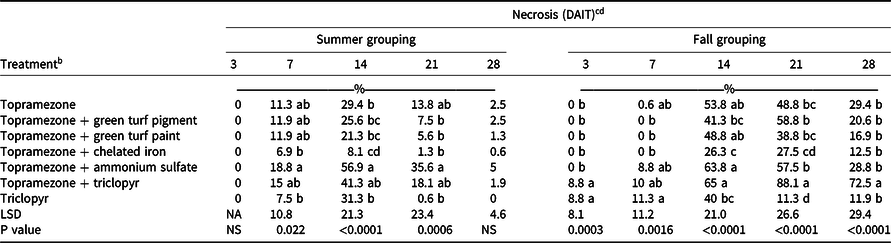
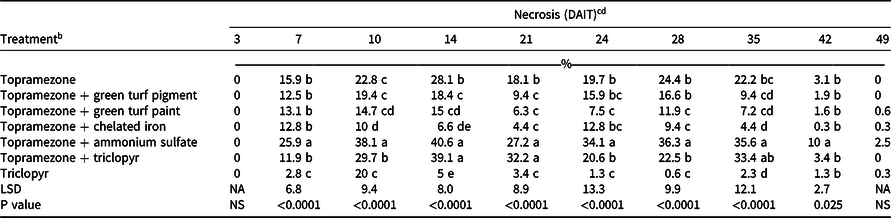
Bermudagrass necrosis was either not observed or slight at 3 DAIT, but by 7 DAIT, differences due to treatment were apparent. Greatest necrosis was observed in bermudagrass to which topramezone plus ammonium sulfate and topramezone plus triclopyr were applied (Tables 5 and 6). Application of pigment or paint rarely reduced necrosis below that observed in bermudagrass receiving only topramezone (Table 5). Exceptions were the sequential applications: the applications of pigment or paint did reduce necrosis at 14, 21 (paint only), 28 (paint only), and 35 DAIT, compared with topramezone alone (Table 6).
Visually estimated necrosis percentage injury to Tifway bermudagrass based on single applications of topramezone plus additive treatments, Auburn, AL.a

a Results shown are pooled over four experiments in summer grouping (2015–2018) and two experiments in fall grouping (2017–2018).
b All treatments were mixed with methylated seed oil at 0.5% vol/vol in 1-L bottles.
c Means with the same letter in the same column are not statistically different based on Tukey honest significant difference (α = 0.05).
d Abbreviations: DAIT, days after initial treatment; NA, not applicable; NS, not significant.
Visually estimated necrosis percentage injury to Tifway bermudagrass based on sequential applications of topramezone plus additive treatments, Auburn, AL.a

a Results shown are pooled from four experiments from 2016 to 2018.
b All treatments were mixed with methylated seed oil at 0.5% vol/vol in 1-L bottles.
c Abbreviations: DAIT, days after initial treatment; NA, not applicable; NS, not significant.
d Second application followed ratings on 21 DAIT represented by black line in table.
Bermudagrass to which topramezone plus ammonium sulfate was applied often had more necrosis, and this damage was often equal to that in plots treated with topramezone plus triclopyr. These two treatments resulted in the most necrosis at 14 DAIT (summer, single application) and at almost every application date in the sequential trials (Tables 5 and 6). The application of chelated iron often reduced necrosis below that observed in the topramezone-only treatment. Of the 20 times that ratings were taken, the mixture of iron chelate plus topramezone reduced necrosis seven times when compared with that of the topramezone-alone treatment. Those differences were more likely to be found in the sequential study (Table 6).
Our findings suggest that the combinations of topramezone plus ammonium sulfate and topramezone plus triclopyr should be avoided because of the resulting high level of necrosis. Fall applications of topramezone plus triclopyr resulted in heavily damaged bermudagrass that struggled to recover after application. If the goal of the turfgrass manager is to remove bermudagrass from an area, these combinations would be most effective.
Clipping Yield
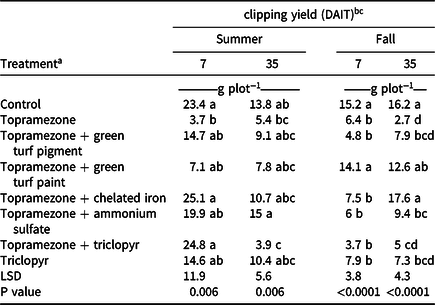
There was a significant treatment-by-season interaction (P = 0.0003) for clipping yield. The season and treatment main effects were analyzed individually by treatment (P < 0.0001) or season (P = 0.0006) (Table 7). The topramezone-only application was the only treatment to significantly reduce clipping yield, as compared with the nontreated control (7 DAIT, summer). At 35 DAIT, only the combination of topramezone plus triclopyr reduced yield, as compared with the nontreated control. Even though the symptoms of necrosis had subsided, the effects of canopy thinning were evident in this treatment.
Clipping yield of Tifway bermudagrass based on topramezone plus additive treatments in Auburn, AL, in 2018.

a All treatments were mixed with methylated seed oil at 0.5% vol/vol in 1-L bottles.
b Means with the same letter in the same column are not statistically different based on Tukey’s honest significant difference (α = 0.05).
c Abbreviation: DAIT, days after initial treatment.
More treatments affected clipping yield in the fall, with applications of topramezone, topramezone plus pigment, topramezone plus chelated iron, topramezone plus ammonium sulfate, and topramezone plus triclopyr all reducing clipping yield at 7 DAIT, as compared with the nontreated control. Some of these effects lasted for 35 d, with the applications of topramezone, topramezone plus pigment, topramezone plus ammonium sulfate, and topramezone plus triclopyr all still reducing clipping yield, as compared with the nontreated control.
Normalized-Difference Vegetation Index
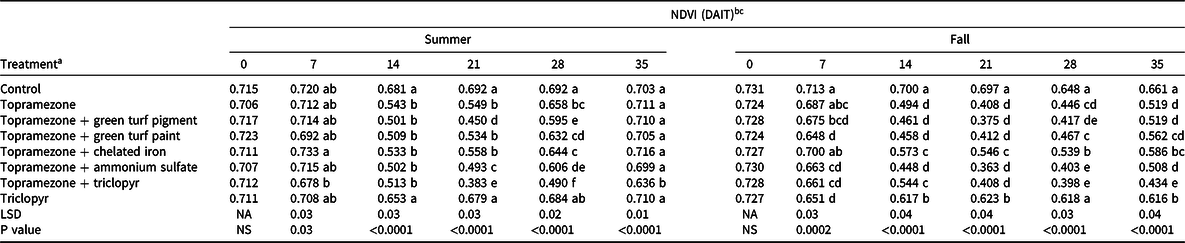
None of the interactions were significant for NDVI (P = 0.2355 to 1.000). The treatment and season main effects were significant (P < 0.0001). Therefore, treatment main effects are presented separately for summer and fall seasons (Table 8). For the summer season, topramezone plus triclopyr had the lowest NDVI ratings among all treatments at 21, 28, and 35 DAIT. This effect persisted until the conclusion of the study, indicating that the bermudagrass sustained high levels of injury from which it struggled to recover (Table 8). The NDVI ratings demonstrated a general decrease in green tissue and recovery periods across trials. Bermudagrass after topramezone-alone, topramezone plus green turf paint, and topramezone plus chelated iron treatments were quickest to recover. During the fall trial, bermudagrass treated with topramezone plus triclopyr remained the most damaged 35 DAIT, as demonstrated by NDVI measurements (Table 8). Topramezone plus chelated iron had the highest NDVI ratings 28 and 35 DAIT, indicating bermudagrass recovery. It is apparent that the bermudagrass was heavily injured by late-season topramezone applications. Although bermudagrass appeared to fully recover from the bleaching and necrosis, NDVI measurements demonstrated reduced levels of overall plant health. These reduced levels are likely attributed to the late-season slowing of growth, height reductions, and dormancy preparation. Research performed by Rana and Askew (Reference Askew2016) demonstrated that reductions in turfgrass height decreased NDVI measurements when applying methiozolin to bluegrass. Applications of topramezone to bermudagrass cause visual bleaching symptoms that are characterized by a reduction of chlorophyll and carotenoid pigments within the plant (Brewer et al. Reference Brewer, Willis, Rana and Askew2017; Brosnan et al. Reference Brosnan, Kopsell, Elmore, Breeden and Armel2011; Cox et al. Reference Cox, Rana, Brewer and Askew2017; Elmore et al. Reference Elmore, Brosnan, Kopsell and Breeden2011a, 2011b). Across all the previously mentioned trials, the symptoms associated with topramezone application were transient, which supports the findings of our study.
Spectral normalized-difference vegetative index measurements of Tifway bermudagrass based on topramezone plus additive treatments in Auburn, AL, in 2018.

a All treatments were mixed with methylated seed oil at 0.5% vol/vol in 1-L bottles.
b Means with the same letter in the same column are not statistically different based on Tukey’s honest significant difference (α = 0.05).
c Abbreviations: DAIT, days after initial treatment; NDVI, normalized difference vegetative index; NA, not applicable; NS, not significant.
Many factors contribute to topramezone efficacy and bermudagrass injury; hence, the most appropriate topramezone program will vary across regions and turfgrass management practices. Future research should evaluate other iron formulations, micronutrients, and herbicides. Additional work should also include iron application timing and effects of soil moisture.
Acknowledgments
The authors thank David Lawrence and his crew at the Auburn Sports Surface Field Laboratory (Auburn, AL) for accommodating the multiple years of research, and Kathie Kalmowitz, at BASF Corp., for the donation of topramezone and chelated iron and continued support throughout the entirety of the research. No conflicts of interest have been declared.