

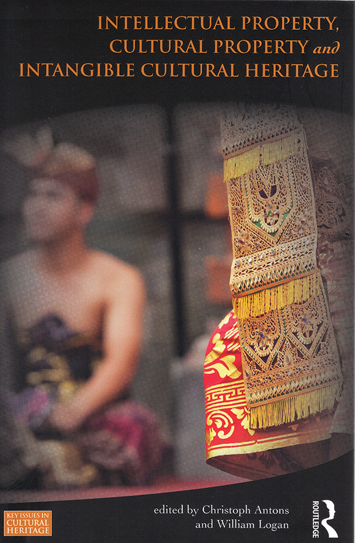
This edited volume investigates the many connections between intellectual and cultural property and the safeguarding of intangible cultural heritage. While it is genuinely international in scope, the emphasis is on the Asia-Pacific region. The case studies focus on Thailand, Indonesia, Malaysia, China, the Philippines, the Pacific Islands, Australia, New Zealand and Norway. Themes that cross-cut several chapters include commercialisation and economic development, community involvement in heritage protection and in policy and decision-making bodies, recognition of Indigenous and ethnic minority rights, human rights and social justice, sustainable development and climate change.
After an introductory chapter by the editors, the first section of this book begins with William Logan's fascinating overview of heritage philosophy and practice since the 1960s. This chapter analyses developments in UNESCO's use of terms in response to changing concepts, including a greater recognition of cultural diversity. It includes analysis of UNESCO's use of rhetoric to persuade and motivate in a situation where, as an intergovernmental agency, it has little legal power when compared to that held by State Parties. This chapter concludes with discussion of the significance of the November 2015 decision of the General Assembly of States Parties to the World Heritage Convention to adopt a Sustainable Development Policy as part of a movement within UNESCO from rhetoric to policy as part of putting principles into practice. The following chapter, Ana Filipa Vrdoljak's analysis of the participation of Indigenous peoples in the United Nations, highlights their “transformative impact on how the obligations under these instruments are defined and implemented by states” (p. 61). Christoph Antons and Lisa Rogers discuss the rise of the notion of intangible heritage, and document how elements from various UNECSO Conventions and intellectual property laws are selectively drawn upon by nation states “to construct powerful claims to cultural and intellectual property vis-à-vis neighbouring countries” (p. 80). Dennis S. Karjala and Robert K. Paterson's chapter argues against special provisions allowing Indigenous people to control Indigenous knowledge, and for the “solidly based default position that information is free” (p. 100). This chapter is a little discordant in a book that largely seeks stronger ways to recognise cultural diversity and strengthen Indigenous and ethnic minority rights over cultural heritage. A compelling chapter by Matthew Rimmer highlights the threats posed by climate change and (non-sustainable) development to the tangible and intangible cultural heritage of small island states in the Pacific. He charts an array of summits, decisions, agreements and accords relating to climate change, but concludes that there has been too little action. This chapter ends with a consideration of “the prospect of climate litigation by small island states and Indigenous communities to protect intellectual and cultural heritage as well as lands and territories if there is further climate inaction by developed countries” (p. 127).
The second section of this book focuses on the complexities surrounding the regulation of heritage and Indigenous rights. These issues are addressed in thought-provoking chapters by Kathy Bowrey and Nicole Graham on re-configuring legal landscapes to offer adequate protection to Indigenous cultural landscapes in Australia, by Gro B. Ween on the indivisibility of cultural practices and key nature practices for the Sami people of Norway, and by Leilene Marie C. Gallardo on community intellectual property rights, traditional medical knowledge and biodiversity in the Philippines. Each chapter is excellent. Taken together, they highlight the complexities inherent in the culturally appropriate protection of Indigenous intangible cultural heritage.
The third section of this book focuses on intangible cultural heritage, the law and nation building. Alexandra Denes's analysis of how Thailand's Intangible Cultural Heritage bill articulates the regulation of Thai-ness highlights the slippage that can occur between an international heritage instrument, in this case UNESCO's International Cultural Heritage Convention, and its deployment by state agencies. She concludes that “rather than decentralizing authority to communities and culture bearers, the ICH bill empowers state actors to selectively promote and represent local difference and diversity within a hierarchy of value” (p. 202) as part of an official heritage regime that defines culture in narrow nationalist terms. In relation to agricultural landscapes in Malaysia, Rajeswari Kanniah identifies three avenues for the protection of traditional knowledge: intellectual property laws, heritage laws and biodiversity laws. Each has its own strengths and limitations. In terms of the Indonesian legal system, Miranda Risang Ayu Palar argues for new measures to ensure more comprehensive and systematic protection of intangible cultural resources. While acknowledging a genuine intention to protect intangible cultural heritage in China, Jianfu Chen highlights the need for “more actual practical mechanisms or clear legal provisions capable of implementation” (p. 252). He identifies economic development, commercialisation and urbanisation as threats to intangible cultural heritage in China. He notes that commercialisation has the potential to increase protection if it has economic value to local people, and that while not enshrined in law, protection is afforded by the Chinese government's use of intangible cultural heritage in the ‘soft power’ of international politics.
While this is an excellent volume, we do have some quibbles. Given that it is dealing with such stimulating topics, it seems remarkable that there are so few images. The only chapter that contains images is Gro B. Ween's chapter on the Sami people of Norway. Also, we would be remiss not to record that the cover for the soft copy of this book became partially detached while one of us (C.S.) was perusing the review copy. We would have expected the book to prove more durable.
This volume is a significant contribution from Routledge's Key Issues in Cultural Heritage series, which aims to promote interdisciplinary debates and address the under-theorised nature of many spectrums of cultural heritage.


