Introduction:
Modern psychiatry favours a multifactorial model of personality and personality disorder stressing close interactions of neurobiological and psychosocial influences. Currently, categorical and dimensional models are being passionately discussed for revisions of diagnostics of personality disorders in future systems of classification. This revision may have important consequences.
A traditional categorical approach to study neurobiological factors in the aetiopathogenesis of personality disorder has been meeting many difficulties so far. To conceptually and methodologically differentiate character as the result of a complex process of social learning, and temperament as the neurobiological fundament of any personality may be considered a first step out of this dilemma. The well-known psychobiological model of personality by Cloninger et al. Reference Cloninger, Svrakic and Przybeck(1)) conceptualise temperament according to four basic dimensions of personality, novelty seeking, harm avoidance, reward dependence, and persistence. Individual tendencies in various dimensions may form the neurobiological underpinnings of typical personality and personality disorder. A major system of neurotransmitter has been linked to each dimension of temperament in theoretical terms leading to differential psychopharmacological hypotheses in the case of a discrete personality disorder. Although some empirical findings support some clinical utility of this model, the neurobiological hypotheses have not been empirically validated Reference Whittle, Allen, Lubman and Yücel(5)).
Another methodological approach is about to identify some endophenotypes in major dimensions of personality being linked to underlying genotypes that influence the traits and dimensions of personality disorders, as well as susceptibility to major psychiatric illnesses. Clinical dimensions of personality disorders that lend themselves to the study of corresponding endophenotypes include affective instability, impulsivity, aggression, emotional information processing, cognitive disorganisation, social deficits, and proneness to psychosis Reference Siever(4)).
Research data on the neurobiology of personality disorders:
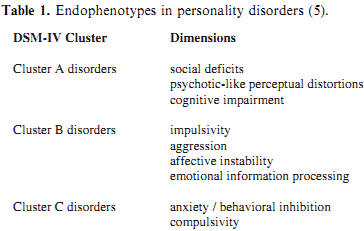
For the time being, research data on the neurobiology of personality disorders may best be presented within the framework of DSM-IV clusters of personality disorders Reference Kapfhammer(2)). Each cluster may be conceptualised in terms of discrete dimensions that might turn out as promising endophenotypes (Table 1).
Cluster A
Neurobiological research in cluster A first and foremost refers to schizotypal personality disorder within a concept of schizophrenia spectrum disorders. Here it focuses on pathological alterations within the cognitive-perceptive organisation and underlines typical socio-affective deficits, neurocognitive dysfunctions, psychotic-like disturbances of perception and thinking.
1) Patients with schizotypal personality disorders are basically hampered in the processing of important social information that essentially forms a theory of mind. Deficits in social perception can be reliably measured by neuropsychological tests. The deficits seem to be more subtle than in schizophrenic patients, but importantly
Endophenotypes in personality disorders (5).
contribute to the clinically well-known eccentricity and profound interpersonal difficulties of schizotypal patients. In various neuro-psychological performances combined with neuroimaging methods (PET, SPECT, fMRI), schizotypal patients take a medium position between normal control persons and schizophrenic patients. In tests measuring executive functions, learning or working memory, they less activate dorsolateral prefrontal cortex than control persons, but significantly stronger than schizophrenic patients, and in addition activate other areas of the anterior frontal cortex (BA 10) for compensation. They show structural reductions in the temporal lobe in an amount as schizophrenic patients do, but less pronounced reductions in the frontal cortex, whereas schizophrenic patients demonstrate major volume reductions in both cerebral regions.
2) Dopamine system may play a decisive role in the susceptibility to psychotic-like symptoms of perceptions and thoughts. Measures of HVA, the end-metabolite of dopamine in CSF positively correlate with psychometric scores of perceptual and cognitive distortions. In pharmacologic challenges, e.g. with amphetamine, schizotypal patients show a stronger response than control persons, but a less pronounced response than schizophrenic patients do. Their mitigated response may be in line with neuroimaging findings of reduced striatal volumes that are considered a protective factor against full-blown state of psychosis. Molecular–genetic investigations hint to a probably important polymorphism of COMT underlining the basic influence of dopamine system on the one hand, linking to major neurocognitive functions as working memory on the other that quite likely are regulated, however, by various other neurotransmitter systems as e.g. norepinephrine.
Cluster B
Essential characteristics of this cluster of personality disorders affect impulsivity, aggression, emotional regulation and emotional information processing. Neurobiological research is more or less exclusively based on borderline personality disorder. Affective instability and impulsivity turned out to be as basic personality dimensions in BPD demonstrating a relative stability in time. In addition, a tendency to dissociation under psychosocial stress and trauma is considered another typical personality dimension marking a special mode of emotional and cognitive information processing. Affective instability comprises an increased general emotional responsivity with reduced thresholds for emotional stimuli on the one hand, and high intensity of emotional expression and heavily reduced recovery to initial levels of affectivity on the other. Affective instability in BPD may contribute to the frequent cycles of easily escalating aversive affects combined with embarrassing feelings of interior tension, often leading to self-destructive behavioural acts as suicide attempt, self-harm, bulimic attack, episodic excess consumption of alcohol and drugs. There seems to be a close interconnection between affective instability and impulsivity.
1) Emotional dysregulation and impulsivity hint to disordered neuronal circuits of limbic over-activation and prefrontal cortical under-control. Various results from functional and structural neuroimaging studies may be interpreted under the hypothesis of a reduced “top-down” regulation or under the hypothesis of an increased “bottom-up” regulation. Both aspects of neuronal regulation may be linked to genetic predisposition and aversive and traumatic experiences during early social development as well. Various neurotransmitter systems are involved from this perspective.
2) A close relation of serotonergic dysfunction and impulsivity contributing to clinical states of anger and reactive aggression is established on several methodological levels of investigation, as e.g. neuroendocrine / neurochemical provocation tests, radio-labelled binding studies in peripheral thrombocytes, functional neuroimaging methods combined with pharmacological challenges, and molecular–genetic investigations. Serotonergic dysfunction seems to be especially related to the mode of impulsivity that mediates the significantly increased risk of suicide during the long-term course of BPD.
3) During emotional turmoil patients with BPD very often show various dissociative symptoms in an impressing way. Both the heterogeneous clinical phenomenology of dissociation and the underlying neurobiological mechanisms seem to be highly complex and are most favourably discussed within the context of trauma and post-traumatic processing.
Cluster C
Anxiousness, anxiety, harm avoidance, behavioural inhibition, and compulsivity define the core traits of cluster C personality disorders. Again, neurobiological research is primarily focused on one variant of cluster C, i.e. anxious-avoidant personality disorder, whereby the main methodological approach is in accordance with social phobia, generalized type. Implicitly, an identity of generalized social phobia and anxious-avoidant personality disorder is assumed from a nosological point of view. Besides, empirical investigations of anxiousness as a general dimension of personality seem to be of clinical relevance.
1) A general biological preparedness to anxious affects refers to a close functional interface of brain stem, limbic, and cortical structures. The amygdale seems to be the control centre of fear, panic and anxiety reactions and plays a basic role in the encoding and regulation of fear-based memories. Two neuronal circuits are at disposal to react adaptively in the face of menacing dangers. These circuits are closely interconnected differing, however, regarding velocity and cognitive differentiation of information processing. Various systems of neurotransmitters and neuropep-tides are involved in the regulation of fear and anxiety, among which the GABAergic, noradrenergic, sertonergic und glutamatergic systems play a major role. In neuroimaging findings an amygdalar over-activity with a concomitantly insufficient modulation by the prefrontal cortex is stressed. Besides, other important centres as insula (visceral-autonomic perception), anterior cingu-lated cortex (emotional evaluation) or dorsolateral prefrontal cortex (working memory, response selection, response preparation) take part in the mediation of fear reactions.
2) Molecular-genetic investigations stress some interesting links to a general disposition of anxiety. Some results identified a susceptibility gene on chromosome 4q21 that is near a locus encoding neuropeptide Y. Glutamic acid decarboxylase-gene 1, Dopamine D2 receptor gene, and a COMT-polymorphism may also play a significant role in anxiety responsivity. A significant association between the general dimensions of neuroticism and trait-anxiety on the one hand, and a short-allele variant of serotonin-transporter-gene has been stressed. Carriers of short-allele show enhanced amygdale-mediated reactions to the presentation of fearful faces in fMRI. This short-allele polymorphism may play a major role in decoupling the amygdalar circuit from important modulating influences by the prefrontal cortex and the anterior cingulated cortex. Future research projects will focus more closely on genetic dispositions and stressors of the social environment playing together in critical periods of early development.
3) In special line with the neurobiology of generalized social phobia a sensitization both of the amydalar fear/panic system and an anxiety-mediating system via the bed nucleus of stria terminalis may be important. Both reaction systems must be considered within a long-term development of a presumably genetically determined temperament of behavioural inhibition, shyness and avoidance throughout the stages of childhood, adolescence and early adulthood. From a perspective of neurotransmitter systems, major alterations in the dopamine system are involved among dysfunctions in other neurotransmitter systems.
4) So far, it is still a matter of controversy whether neurobiolog-ical findings in obsessive-compulsive disorder may directly apply to compulsive personality disorder, in direct analogy of generalized social phobia and anxious-avoidant personality disorder.
Neurobiology-based consequences for the treatment of personality disorders:
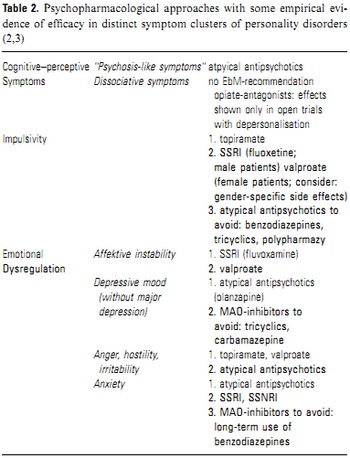
The clinical importance of results derived from neurobiological investigations of personality disorders may be assessed in some promising psychopharmacological approaches to the treatment of personality disorders. Empirical data from a series of randomized controlled trials meanwhile allow some tentative recommendations of differential psychopharmacology for the psychiatric practitioner (Table 2).
Psychopharmacolo gical approache s with some emp irical evidence of effficacy in distinct symptom clusters of personality disorders (2,3