Introduction
Alzheimer's disease (AD) is a devastating neurodegenerative disorder that affects more than 13% of individuals aged 65 years and older, and between 40% and 50% aged 80 years and older (Alzheimer's Association, 2012). Prior research suggested that many individuals with AD live in low- and middle-income countries (Sosa-Ortiz, Acosta-Castillo, & Prince, Reference Sosa-Ortiz, Acosta-Castillo and Prince2012). With the rapid aging of the Chinese population in the coming decades (Communiqué of the National Bureau of Statistics of People's Republic of China on Major Figures of the 2010 Population Census), the prevalence of AD is projected to markedly increase and substantially impact public health. As there are few available efficacious treatment options, understanding genetic and environmental components that modulate AD risk and outcome may provide useful information to help manage this devastating disease.
While the etiology of AD is unknown, success in identifying genetic factors has been notable for the highly heritable early onset form that comprises a minority (1–5%) of AD cases (Goate et al., Reference Goate, Chartier-Harlin, Mullan, Brown, Crawford, Fidani and James1991; Levy-Lahad et al., Reference Levy-Lahad, Wasco, Poorkaj, Romano, Oshima, Pettingell and Wang1995; Sherrington et al., Reference Sherrington, Rogaev, Liang, Rogaeva, Levesque, Ikeda and St George-Hyslop1995; Sweet et al., Reference Sweet, Bennett, Graff-Radford and Mayeux2010). In contrast, the genetic factors or shared environmental factors are less clear in late onset Alzheimer's disease (LOAD). Although some LOAD cases appear to be sporadic in nature, genetically mediated risk is evident from the familial aggregation of many LOAD cases (Gatz et al., Reference Gatz, Reynolds, Fratiglioni, Johansson, Mortimer, Berg and Pedersen2006; Wilson et al., Reference Wilson, Leurgans, Foroud, Sweet, Graff-Radford, Mayeux and Bennett2010). Several studies (Farrer et al., Reference Farrer, Cupples, Haines, Hyman, Kukull and Mayeux1997; Gatz et al., Reference Gatz, Pedersen, Berg, Johansson, Johansson, Mortimer and Ahlbom1997; Green et al., Reference Green, Cupples, Go, Benke, Edeki and Griffith2002; Johnson et al., Reference Johnson, Schmitz, Trivedi, Ries, Torgerson, Carlsson and Sager2006; Lee, Cheng, Graff-Radford, Foroud, & Mayeux, Reference Lee, Cheng, Graff-Radford, Foroud and Mayeux2008; Reitz, Brayne, & Mayeux, Reference Reitz, Brayne and Mayeux2011; Xu et al., 2009) have found that a family history of dementia is an important risk factor for AD, independent of apolipoprotein E (APOE). After advanced age, having a first-degree family history of LOAD, especially when a parent is positive, is the most significant risk factor for developing AD (Farrer et al., Reference Farrer, Cupples, Haines, Hyman, Kukull and Mayeux1997; Gatz et al., Reference Gatz, Pedersen, Berg, Johansson, Johansson, Mortimer and Ahlbom1997; Green et al., Reference Green, Cupples, Go, Benke, Edeki and Griffith2002; Xu et al., 2009). However, there is limited information regarding much of the genetic or family contribution to LOAD. To develop new preventative approaches for LOAD, it is important to identify persons who are cognitively intact and have high risk for developing LOAD.
Over the past 30 years, neuropsychological testing has identified the earliest, most definitive cognitive and behavioral symptoms of AD (Bennett, Wilson, Boyle, Buchman, & Schneider, Reference Bennett, Wilson, Boyle, Buchman and Schneider2012; Morris et al., Reference Morris, Heyman, Mohs, Hughes, van Belle, Fillenbaum and Clark1989; Salmon & Bondi, Reference Salmon and Bondi2009). As research has increasingly focused on earlier stages of the illness, it has become clear that biological markers of AD can precede cognitive and behavioral symptoms by many years. Amyloid and tau in the brain and cerebral spinal fluid (CSF) can be detected in vivo in asymptomatic individuals years before the onset of declining cognitive abilities (Jack et al., 2010; Perrin et al., 2009; Sperling et al., 2009). However, the recommended use of biomarkers to detect AD has been applicable mainly in clinical investigations and has yet to become standard practice. Thus, neuropsychological assessment continues to be the recommended method to provide a reliable phenotypic marker of AD that is critical for early detection.
Evidence indicates that AD symptoms begin with a deficit in memory for recent information and executive functions (Lindeboom & Weinstein, Reference Lindeboom and Weinstein2004; Storandt, Reference Storandt2008). When the process advances, impairment spreads to other cognitive domains including semantic memory, language function, and visuospatial ability (Lindeboom & Weinstein, Reference Lindeboom and Weinstein2004). Importantly, cognitive assessment is optimal for objectively documenting the degree of cognitive impairment for an individual. Hence, comprehensively examining cognitive performance in family members at high risk of AD may help them as well as their families better prepare for a later life with AD.
The primary aim of the present study was to estimate the family contribution to differences in performance on neurocognitive measures in a LOAD family-based group. We systematically examined the neuropsychological performance of non-demented members of a family with a history of LOAD that involved 9 patients across 4 generations. We hypothesized that at-risk participants from the LOAD cohort would show impaired performance in certain cognitive domains conveying the potential to prospectively develop global cognitive impairments.
Methods
Study Overview
To accomplish the study aim, we compared performance on a comprehensive neurocognitive battery between LOAD family members and a demographically matched control group of individuals without a family background of AD. This study was approved by the Institutional Review Board of the Wuhan University of Science and Technology. Participants provided written, informed consent before completing study protocol procedures.
Cases Description
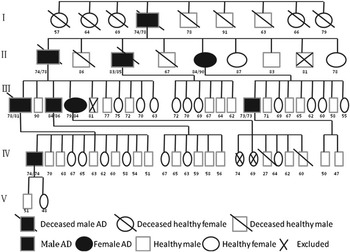
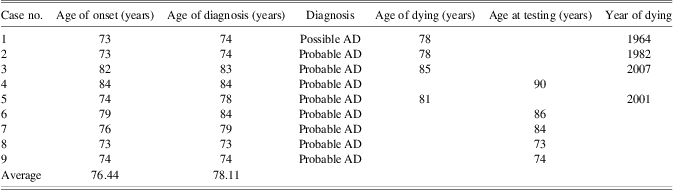
Nine patients (seven males, two females) in a single pedigree spanning four generations had been diagnosed with probable AD after age 65 by neurologists in the Wuzhi County People's Hospital in the Henan province of northern China (see Figure 1). Seven patients were diagnosed based on the Diagnostic and Statistical Manual of Mental Disorders, Fourth Edition (DSM-IV) (American Psychiatric Association, 1994). This diagnosis required the patients to have a history of cognitive decline and impairment in at least two cognitive domains, one of which must be memory (McKhann, Reference McKhann, Drachman, Folstein, Katzman, Price and Stadlan1984). The neurologists in the local hospital performed a detailed medical history through interviews with the patients and informants, and conducted physical, neurological, and neuropsychological examinations. The two other patients who passed away before 1994 were diagnosed based on a review of medical records. The neurologists examined their medical records and interviewed their family members to determine the diagnosis of AD.
Family pedigree of patient cohort. Shows the family pedigree of 9 patients with Late Onset Alzheimer's Disease (LOAD). I, II, III, IV, and V represents generations. The numbers below the boxes are the age at diagnosis (left) and the age of dying (right), the age at diagnosis (left) and the age of testing (right), or age at testing, respectively. The × in the boxes are individuals excluded from enrollment in the study. For purposes of simplicity, this pedigree does not include some healthy family members.

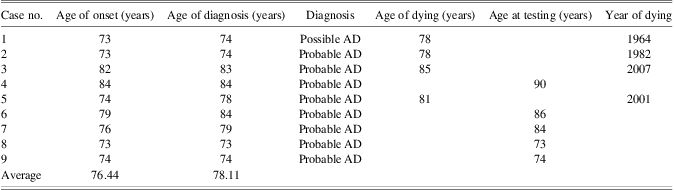
Four patients died before the study: three due to pneumonia, and one from fall complications. Five patients were seen at the time of this study. They were living in a positive family environment and were cared for by their adult children. The clinicians assessed these patients with the Chinese version of the Cognitive Abilities Screening Instrument (CASI) (Tsai, Lin, Wang, & Liu, Reference Tsai, Lin, Wang and Liu2007) and a structured neurological examination. All patients exhibited the same AD neurocognitive profile that included worsening of orientation, memory, language function, and executive function, which were more pronounced around the 73–79 age range (see detailed information in Table 1).
General information about nine cases
Participants
Participants were biologically related family members or relatives of the 9 LOAD patients from the single pedigree as mentioned above. These participants (LOAD group) were identified as family members or relatives of the LOAD patients based on the pedigree chart kept in their ancestral hall. This pedigree chart depicted all the descendants of this family's ancestor. The demographically matched control participants (control group) were recruited from four pedigrees who resided in the same county and shared different surnames with the LOAD pedigree. The control participants were age-, sex-, and education-matched with the LOAD participants. We excluded from the control group those individuals with a family history of dementia. Participants with a prior history of neurological illness, stroke, severe or unstable physical illness, and prior or current substance/alcohol abuse and dependence were excluded for the relatives of the AD patients or for controls. We screened each participant with the Clinical Dementia Rating Scale (CDRS) (Hughes, Berg, Danziger, Coben, & Martin, Reference Hughes, Berg, Danziger, Coben and Martin1982), and only those participants with a score of zero (indicating healthy) were included in the study.
Assessment of Global Cognitive Function
Trained and certified clinicians administered the neurocognitive battery to each participant. The neurocognitive battery included the Chinese version of the Mini Mental State Examination (CMMSE) (Chiu, Lee, Chung, & Kwong, Reference Chiu, Lee, Chung and Kwong1994; Folstein, Folstein, & McHugh Reference Folstein, Folstein and McHugh1975) and the Chinese version of the Alzheimer Disease Assessment Scale–Cognitive Subscale (ADAS-Cog) (Chu et al., Reference Chu, Chiu, Hui, Yu, Tsui and Lee2000). The CMMSE ranges from 0 to 30 points and assesses five cognitive domains including orientation (10 points), memory (3 points for registration and 3 points for recall), attention/calculation (5 points), language (8 points), and visuospatial abilities (1 point). The ADAS-Cog is a global cognitive measure that assesses domains of memory, language, and praxis. The error score ranges from 0 to 70 with higher scores reflective of greater cognitive impairment.
Measurement of Specific Cognitive Functions
Trained and certified psychometricians administered the neurocognitive battery to each participant two weeks after the completion of the global cognitive assessments. The battery included 8 brief subtests. The Wechsler Memory Scale-Revised (WMS-R, Wechsler, Reference Wechsler1987) Logical Memory Test was used to assess episodic memory. Attention was assessed with Part A of the Trail Making Test (Bowie & Harvey, Reference Bowie and Harvey2006) and Digit Span Forward (Wechsler, Reference Wechsler1987). Executive function was assessed with Part B of the Trail Making Test and Digit Span Backward. Semantic fluency was assessed by asking participants to name exemplars of two semantic categories (animals, vegetables) in separate 1-min trials (Wilson & Bennett, Reference Wilson and Bennett2005). The Clock Drawing Task (Quental, Brucki, & Bueno, 2009; Nair et al., Reference Nair, Gavett, Damman, Dekker, Green, Mandel and Stern2010) was used to evaluate visuospatial ability. Specifically, the participants were instructed to draw a clock face displaying the time 2:45 (Quental, Brucki, & Bueno, 2009). Prior investigations (Gladsjo et al., Reference Gladsjo, Schuman, Evans, Peary, Miller and Heaton1999, Quental, Brucki, & Bueno, 2009; Wechsler, Reference Wechsler1987; Werheid et al., Reference Werheid, Hoppe, Thone, Muller, Mungersdorf and von Cramon2002) found these neurocognitive measures to have adequate psychometric properties. Moreover, Wilson and Bennett (Reference Wilson and Bennett2005) found that change in performance on these measures has been associated with a genetic risk factor for AD. Both clinicians and psychometricians who assessed global cognitive function were masked to the nature of the study.
Statistical Analyses
The demographic data and neurocognitive scores between groups were analyzed using analysis of variance (ANOVA) models with adjustment for multiple comparisons using the Bonferroni correction technique. Chi-square statistics were used to compare frequencies of the categorical demographic data. For the neurocognitive data, we transformed raw scores to Z-scores based on reference to the mean scores of the control group. We also formed a composite measure of global cognitive function based on all 8 tests in the neurocognitive battery. Multiple regression analyses were conducted to test the family history on the relationship between age and individual neurocognitive test and composite scores. We computed correlation coefficients with corresponding 95% confidence intervals (CI) to determine the degree of relationship between measures. Analyses were conducted with the Statistical Package for the Social Sciences (SPSS Inc., Chicago, IL) for Windows (version 17.0). An alpha level of 0.05 was used to determine significance in the interpretation of all results.
RESULTS
Characteristics of Participants
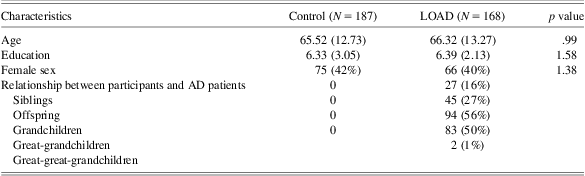
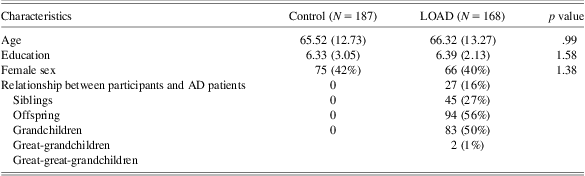
The demographic characteristics of the participants are shown in Table 2. This study recruited 168 at-risk participants from the LOAD pedigree and 187 demographically matched control participants from the other 4 pedigrees who resided in the same county. The response rate in the LOAD pedigree was 95%, while in the other four control pedigrees it was 67%. This suggested that the control families showed less interest in participating in this study. Eleven individuals in the LOAD pedigrees were excluded due to CDR score > 0 (n = 1), stroke (n = 2), diabetes (n = 5), chronic obstructive pulmonary disease (n=1), liver cirrhosis (n=1), and lupus erythematosus (n = 1). Thirteen individuals in the control pedigree were excluded due to stroke (n = 5), diabetes (n = 4), coronary heart disease (n = 3), and lung cancer (n = 1).
Demographic characteristics of the control and LOAD cohorts
Data are presented as mean and (standard deviation) or number (percentage).
LOAD = Late Onset Alzheimer's Disease; AD = Alzheimer's disease.
There were no significant differences between groups with regard to age, gender distribution, or education. The LOAD participants were 60% male (n = 102), ranged in age from 50 to 87 (mean (M) = 66.32, standard deviation (SD) = 13.27) years, and had 6.39 (SD = 2.13) years of education on average. The control participants were 58% male (n = 112), ranged in age from 50 to 87 (M = 65.52; SD = 12.73) years, and had 6.33 (SD = 3.05) years of education on average. The relationships between at-risk participants and nine patients included 45 offspring, 27 siblings, 94 grandchildren, 83 great-grandchildren, and 2 great-great-grandchildren.
Global Neuropsychological Characteristics
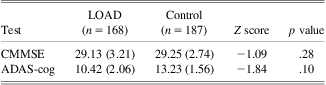
Comparisons of the CMMSE and ADAS-Cog scores of the LOAD and control groups are shown in Table 3. None of the participants scored above zero on the CDRS, thus all participants were eligible to perform the other neuropsychological measures. The LOAD and control groups showed similar performance on the CMMSE (p = .28). Although the ADAS-Cog error score was slightly higher in the LOAD relative to the control group, the difference was not significant (p = .10).
Performance of cohorts on measures of global neurocognitive performance
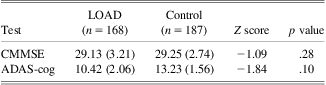
CMMSE = Chinese version of the Mini-Mental State Examination; ADAS-Cog = Alzheimer Disease Assessment Scale–Cognitive subscale; LOAD = Late Onset Alzheimer's Disease. Data are presented as mean and (standard deviation).
Performance on Specific Neurocognitive Tests
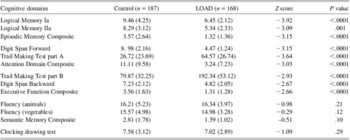
In the control group, the distribution of scores on each test was approximately within the normal range, whereas the distributions of scores in the LOAD group were below the normal range (see Table 4). As reflected in the Z-scores, the LOAD group had significant impairment in the episodic memory, attention, and executive function domains relative to the other cognitive domains. Also, the LOAD group had significantly poorer performance compared to the control group in the episodic memory (p < .0001), attention (p < .0001), and executive function domains (p < .0001).
Comparison of performance between control and LOAD cohorts on neurocognitive measures and domains

Data are presented as mean and (standard deviation).
LOAD = Late Onset Alzheimer's Disease.
Earlier studies found that some cognitive domains were more vulnerable due to the initially selective targeting of AD pathology to select cortical areas (Weintraub, Wicklund, & Salmon, Reference Weintraub, Wicklund and Salmon2012). As such, we examined for associations between the different cognitive domains. The correlations between the composite cognitive domains were low to moderate for the LOAD participants (r = 0.39 for episodic memory–semantic memory, r = 0.32 episodic memory–executive function, r = 0.32 for semantic memory–executive function, r = 0.31 for attention domain–semantic memory, all p < .0001). Conversely, the correlations between the composite cognitive domains were moderate to large for the control participants (r = 0.81 for episodic memory–semantic memory, r = 0.71 for episodic memory–executive function, r = 0.68 for semantic memory–executive function, r = 0.77 for attention–semantic memory, all p < .001).
Contribution of Age to Cognitive Performance
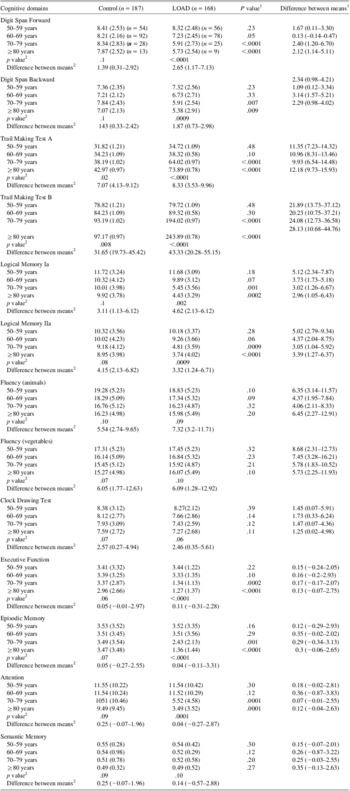
To examine the contributions of age to performance on neurocognitive measures, we used age as a subcategory within each group. Thus, the LOAD and control groups were categorized into distinct age-ranges (see Table 5). The results showed that lower cognitive scores in patients with AD relative to controls were observed only at older ages, especially in participants who were in the age range of ≥70 years. We then analyzed the difference in magnitude of the correlations between task composites in the two groups. In the LOAD group, better performance in cognitive domains was strongly associated with younger age (r = –0.67; p = .01 for episodic memory; r = –0.71; p = .01 for executive function; r = –0.61; p = .02 for attention). In the control group, there was no prominent correlation between global memory and age.
Distributional characteristics of cognitive scores by age groups

Data are presented as mean and (standard deviation). The N for each age band is provided in the second row, and second and third column respectively. Difference in means is presented as means and (95% Confidence Intervals, CIs). Figures in parentheses are 95% CIs. The p value1 indicates difference in means between LOAD group and control group. The p value2 indicates difference in means between contrast age groups (50–59 vs. 70–79 years).
LOAD = Late Onset Alzheimer's Disease.
Discussion
To our knowledge, this study marks the first attempt at documenting cognitive impairment in a single pedigree in this large sample from a Chinese community. The aim of the present study was to estimate the family contribution to the differences in neurocognitive function in a Chinese pedigree that had at least nine persons affected with LOAD across four generations. We evaluated global cognitive function as well as specific neurocognitive domains. Extended family members of the LOAD pedigree showed similar performance on measures of global cognitive function and semantic memory compared to controls, but lower scores on episodic memory, attention, and executive function measures. With recent genetic studies suggesting LOAD to be a genetically heterogeneous condition (Bertram & Tanzi, Reference Bertram and Tanzi2012; Johnson, Storandt, Morris, & Galvin, Reference Johnson, Storandt, Morris and Galvin2009; Wilson et al., Reference Wilson, Leurgans, Foroud, Sweet, Graff-Radford, Mayeux and Bennett2010), the memory impairment we observed may be a strong predictor of AD in those with a positive family history. One individual from the LOAD pedigree with a CDR score greater than 0, but short of dementia was excluded from the study. This could explain the relatively comparable performance between the LOAD pedigree and control group on measures of global cognitive function. However, it could also be indicative of some cognitive effects associated with being in the LOAD pedigree.
The ε4 allele of the apolipoprotein E gene (APOE-4) and a family history of AD are both risk factors for the development of AD (Bloss, Delis, Salmon, & Bondi, Reference Bloss, Delis, Salmon and Bondi2008; Donix et al., Reference Donix, Ercoli, Siddarth, Brown, Martin-Harris, Burggren and Bookheimer2012). Because APOE-4 accounts for only part of the genetic risk for AD, approximately 42% of persons with AD do not have an APOE-4 allele (Bird, Reference Bird2005). Thus, a positive family history of dementia, regardless of whether an individual is an APOE-4 carrier, may increase the risk for developing AD (St. George-Hyslop, & Petit, Reference St. George-Hyslop and Petit2005; Wilson et al., Reference Wilson, Barral, Lee, Leurgans, Foroud, Sweet and Bennett2011).
Importantly, poor neurocognitive performance in the LOAD group was attributable to increased age, particularly age 70 and above. All measures in our neurocognitive battery were directly associated with age. These results suggested that members of the LOAD family were at risk for developing LOAD by virtue of their family history with additive risk due to increased age. Therefore, a family history of dementia is an age-specific risk factor for AD. Interestingly, this study found no significant differences in cognitive status between younger pedigree individuals and controls, despite prior studies that showed differences in brain metabolism and neurocognitive function in unaffected younger individuals with a positive family history of AD (Bloss et al., Reference Bloss, Delis, Salmon and Bondi2008; Donix et al., Reference Donix, Ercoli, Siddarth, Brown, Martin-Harris, Burggren and Bookheimer2012), with and without APOE-4 (Bloss et al., Reference Bloss, Delis, Salmon and Bondi2008; Bookheimer et al., Reference Bookheimer, Strojwas, Cohen, Saunders, Pericak-Vance, Mazziotta and Small2000; Johnson et al., Reference Johnson, Schmitz, Trivedi, Ries, Torgerson, Carlsson and Sager2006; Small et al., Reference Small, Siddarth, Burggren, Kepe, Ercoli, Miller and Barrio2009; Trivedi et al., Reference Trivedi, Schmitz, Ries, Torgerson, Sager, Hermann and Johnson2006).
The differences in neurocognitive performance in our sample became significant only when participants were in the elderly age range (e.g., 70 years old and above). In addition, there has been inconsistent information regarding whether family history of AD is independent from APOE-4 risk (Huang, Qiu, von Strauss, Winblad, & Fratiglioni, Reference Huang, Qiu, von Strauss, Winblad and Fratiglioni2004), or whether APOE-4 is associated with the rate of progression of cognitive and functional decline in AD after its onset (Corder et al., Reference Corder, Saunders, Strittmatter, Schmechel, Gaskell and Rimmler1995; Saunders, Reference Saunders2000). The risk for developing AD can be modulated by various and rarely studied factors including possible unidentified genes, gene–gene interactions, and environmental and lifestyle contributions (Bird, Reference Bird2005). Based on the finding that the average age of onset and diagnosis of AD for 9 cases in this pedigree were at 76 and 78 years of age, it seems expected that some cognitive normal family members in this study would develop cognitive decline in their advanced age. This result may suggest that environmental, familial, and genetic factors impact cognitive functioning in the context of AD.
Our results suggest that family history influences on cognitive function are strong and grow stronger with increased age. We were unable to know if the LOAD sample would always have performed differently from the control cohort as the neurocognitive data were obtained only at one time point. Since the data were cross-sectional, we were unable to longitudinally observe change within each individual. However, from the nature of the inheritance and the relatively constant age (around 73–79 years of age) at disease onset and diagnosis within the LOAD family, participants around the mean age at onset for the family would be at high risk.
While the LOAD group was at risk for cognitive impairment, collectively, the data indicated that the LOAD group had normal performance on the majority of neuropsychological measures with the exception of episodic memory, attention, and executive function tests. The correlations between the composite cognitive domains were low to moderate in the LOAD participants, whereas the correlations were moderate to large in the control participants. These observations are consistent with prior evidence that some cognitive domains are more vulnerable to AD due to the initially selective cortical targeting of AD pathology (Weintraub, Wicklund, & Salmon, Reference Weintraub, Wicklund and Salmon2012). The earliest neurofibrillary changes that are part of the AD pathology usually occur in medial temporal lobe structures (Braak & Braak, Reference Braak and Braak1991), which interrupts the neural network critical for episodic memory function. Over time, the pathology progresses to other cortical regions that produce additional cognitive symptoms that lead to the full dementia syndrome (Braak, & Braak, Reference Braak and Braak1996a, Reference Braak and Braak1996b; Braak, Arai, & Braak, Reference Braak, Arai and Braak1999; Jack et al., Reference Jack, Petersen, Xu, O'Brien, Smith, Ivnik and Kokmen2000).
Several previous studies have suggested that the episodic memory deficit has important clinical utility for the early detection of AD (Backman, Small, & Fratiglioni, Reference Backman, Small and Fratiglioni2001; Kawas et al., Reference Kawas, Corrada, Brookmeyer, Morrison, Resnick, Zonderman and Arenberg2003; Small, Fratiglioni, Viitanen, Winblad, & Backman, Reference Small, Fratiglioni, Viitanen, Winblad and Backman2000). Evidence suggests that a subtle impairment in episodic memory often occurs before the emergence of the obvious cognitive and behavioral changes required for a clinical diagnosis of AD (Welsh, Butters, Hughes, Mohs, & Heyman, Reference Welsh, Butters, Hughes, Mohs and Heyman1991, Reference Welsh, Butters, Hughes, Mohs and Heyman1992; Welsh et al., 1994). Also, deficits in executive function occur early in the course of AD and are often evident in the mild cognitive impairment (MCI) stage (Backman, Jones, Berger, Laukka, & Small, Reference Backman, Jones, Berger, Laukka and Small2005; Baudic et al., Reference Baudic, Dalla Barba, Thibaudet, Smagghe, Remy and Traykov2006; Bisiacchi, Borella, Bergamaschi, Carretti, & Mondini, Reference Bisiacchi, Borella, Bergamaschi, Carretti and Mondini2008; Dickerson, Sperling, Hyman, Albert, & Blacker, Reference Dickerson, Sperling, Hyman, Albert and Blacker2007). Executive function deficits, in addition to difficulties with delayed memory recall, predict subsequent progression to AD dementia (Albert, Reference Albert1996; Marshall et al., Reference Marshall, Rentz, Frey, Locascio, Johnson and Sperling2011). Consistent with this possibility, many studies have found that poor performance on episodic memory and executive function measures in non-demented elderly adults predict cognitive decline and progression to AD over a time period of 1 to 6 years (Albert, Moss, Tanzi, & Jones, Reference Albert, Moss, Tanzi and Jones2001; Backman et al., Reference Backman, Jones, Berger, Laukka and Small2005; Blacker et al., Reference Blacker, Lee, Muzikansky, Martin, Tanzi, McArdle and Albert2007; Bondi et al., Reference Bondi, Salmon, Monsch, Galasko, Butters, Klauber and Saitoh1995; Bondi, Salmon, Galasko, Thomas, & Thal, Reference Bondi, Salmon, Galasko, Thomas and Thal1999; Bondi et al., Reference Bondi, Jak, Delano-Wood, Jacobson, Delis and Salmon2008; Chen et al., Reference Chen, Ratcliff, Belle, Cauley, DeKosky and Ganguli2001; Fine et al., Reference Fine, Delis, Wetter, Jacobson, Jak, McDonald and Bondi2008; Lange et al., Reference Lange, Bondi, Galasko, Delis, Salmon and Thal2002). Thus, the decline in episodic memory and executive function in members of the LOAD family may be a cognitive marker of future decline in global cognitive abilities. Given the relationship between these specific cognitive deficits and prodromal AD, clearer insight into the specific cognitive changes that occur in our sample may lead to earlier and more accurate identification of elderly adults at higher risk of developing AD. These findings indicate that the genetic influences on individual cognitive domains are different, which is important to consider when exploring the roles of genetic and environmental risk factors.
This study was strengthened by the large sample size of the extended LOAD family and by comparing their neurocognitive performance to a demographically matched control group. The neurocognitive measures included in the study were selected to comprehensively assess those neurocognitive domains found to be sensitive to and detect early cognitive changes related to AD, before the functional difficulties required for a diagnosis (Gladsjo et al., Reference Gladsjo, Schuman, Evans, Peary, Miller and Heaton1999; Quental, Brucki, & Bueno, 2009; Wechsler, Reference Wechsler1987; Weintraub et al., Reference Weintraub, Wicklund and Salmon2012; Werheid et al., Reference Werheid, Hoppe, Thone, Muller, Mungersdorf and von Cramon2002). Thus, this study provided a unique opportunity for future studies to longitudinally trace the progression across familial pedigrees. As the participants in this study were functioning at a high level in daily life without significant memory difficulties, our findings reflect very early cognitive changes in this at-risk family. The importance of the findings hinges upon the issue of the efficacy of early screening for the detection of early signs of dementia. Indeed, our results provide evidence for clinical practice to implement systematic neurocognitive evaluations at critical time points for those persons with a family history of AD.
In conclusion, we used a psychometrically sound neurocognitive battery to comprehensively assess the cognitive effects of advancing age and AD. The findings suggested that family members with the LOAD pedigree are at increased risk for developing LOAD. Thus, it is critical to develop comprehensive strategies to prevent, or at minimum minimize the decline in cognitive abilities in individuals at risk for AD. Further research is warranted to continue this important line of investigation to both determine the risk factors of LOAD, and develop cognitive remediation strategies for those extended family members who are in the young adult stage. Follow-up will be necessary to determine which individuals will ultimately develop AD. Our findings underline the importance of documenting if there is a positive family history of AD in clinical evaluations, which could serve as a significant risk factor for the prospective development of AD.
Acknowledgments
Our deepest gratitude is extended to the families who provided their invaluable time to participate in this study. This work was supported by the grant (31271199, PI: Y. Zeng) from the National Natural Science Foundation of China, as well as the Key Technology Research Programs (2013060602010278, PI: Y. Zeng) from Wuhan city, China, and in part by a grant (K23 MH087739, PI: S. McClintock) from the National Institute of Mental Health. The information in this manuscript and the manuscript itself has never been published either electronically or in print. Disclosure: No conflicts of interest exist.