As the conventions of theatre design would have it, a clock onstage is a distraction for the audience.Footnote 1 This has not always been true. Late nineteenth-century popular plays were alive with the sights and sounds of working clocks, their pointing hands, swinging pendulums, and striking bells announcing the time of significant events and actions in the fictional stage world. Visible on the mantelpiece, or audible in the town square, stage clocks in this era lent verisimilitude while heightening suspense, mirroring the broader aesthetic conventions of popular fin-de-siècle productions, in which highly realistic and detailed settings coexisted with the suspenseful plots and broad character types familiar from older melodramas.Footnote 2
But the late nineteenth-century performing clock's potent mix of illusionism and dramatic effect may have also helped theatre audiences negotiate recent changes in the temporal order itself. Circa 1900, precise, active, and individual timekeeping had become a necessity for information work within a rapidly globalizing economy, in contrast to the more passive and local modes of response to the “public call” of time at midcentury.Footnote 3 Clerks, bank tellers, and department store managers were now expected to glance frequently at the clock or their pocket watches to synchronize and adjust their activities—from following train schedules, to trading commodities futures, to coordinating with far-flung suppliers and wholesalers—in relation to a US-wide (1883) and, shortly thereafter, global (1884) set of standard time zones enforced by government and civic associations.Footnote 4 Mary Ann Doane sums up the change at the turn of the century: “no longer a medium in which the human subject is situated (it is no longer lived or experienced in quite the same way), time is externalized and must be consulted.”Footnote 5 To enable this frequent, active checking, clocks came to “saturate” public spaces to a greater degree than before or since, inaugurating what McCrossen has called the “public clock era,” which lasted until the 1930s.Footnote 6
A hallmark of the period was an obsession with the dialectics of time and its representation.Footnote 7 Ever greater efficiency requires that time be represented with ever greater accuracy, as linear, divisible, and quantifiable. But any such representation evokes its opposite, real time, beyond clocks and schedules. For instance, if the newly precise and standardized train schedule shows time as an atomistic and discontinuous progression of moments, by that very token it evokes time as indivisible flux and continuity. If public clocks impose standard time on everyone, they also conjure a heterogeneity of subjective times that escape public inscription. If the numbers on your pocket watch—widely disseminated throughout the population by the 1890sFootnote 8—dictate that time is linear, its cyclical face confesses that time is repetitive, perhaps reversible. As Doane notes, an obsession with the conundrum of representing time cut across all cultural domains by 1900, from the time–motion study, to the structure of the Freudian unconscious, to the philosophy of Henri Bergson.Footnote 9
Popular theatre deserves consideration as a significant factor in the emergence of this modern time consciousness, not least because working clocks also came to “saturate” theatre stages in this era.Footnote 10 The stage clock's doubleness—as both a representation and a stage object—creates a dialectics of time within the performance. A chiming grandfather clock in a domestic scene is a representation of time in the plot, enforcing the play's linear, rising and falling action. As an object onstage, however, it has a material presence and capacity for signification that exceeds the plot's dictates. This is true of any prop, of course, but it is especially true of working clocks, because of their independent action, which the phenomenologist theatre critic Bert States likens to the movement of other nonconscious actors onstage, like fire and water.Footnote 11 The stage clock, as a result, becomes a representation of time that simultaneously draws attention to real time, as measured out by its own, real movement and sound in front of the spectator. As “externalized” and “consulted” in theatrical performance during the public clock era, then, timepieces reflect some of the larger tensions in the drive to represent time in the culture at large, while also helping to school the audience in the habits and norms of clock-watching demanded by new forms of work.
Considered in relation to dramatic construction, moreover, the stage clock has the capacity to represent multiple times. As Brian Richardson has noted, there are “three distinct clocks” set in motion in any drama: story time (the order of the events), text time (the order in which the events appear in the narrative), and stage time (the time that it takes for the play to be performed).Footnote 12 Playwrights who seek a general adherence to the unities of time, space, and action tend to use temporal elision to fit the arc of their story into two to three hours of stage time, such as using characters and setting to announce, explicitly or implicitly, that a certain amount of time has passed in the characters’ world without being represented. However, there is always the possibility of emphasizing disjunctions among text, story, and stage time. Stage clocks can do so, since their numbered faces or pointing hands can distract the audience by referring to the “wrong” time during a scene. But the clock can also be used to achieve an acute or exaggerated form of realism by visibly synchronizing story, text, and stage time. In Marsha Norman's ’night Mother (1983), for instance, the play's hour and a half length matches exactly the hour and a half of dialogue and action between the mother and daughter, and visible working stage clocks synchronized to the time of the performance count down the minutes to the latter's suicide.
At the turn of the century, working stage timepieces were often used in this way—to visibly synchronize story, text, and stage time and to achieve a similarly extreme form of temporal unity. But popular plays at the turn of the century—unlike the “well-made play” or later kitchen sink realisms—also made use of the situational dramaturgy of melodrama, whose reliance on spectacle had a problematic relationship to the unities to begin with. The task of constructing a skillful melodrama hinges on integrating the plot with the spectacular scenic effects, which tend to stand out from the rest of the play. In temporal terms, the challenge for playwrights, directors, and performers is to integrate the very palpable stage time of the spectacular effects with the overall story time and text time. By 1900, this challenge had shifted with the vogue for realistic sets; now playwrights, directors, and performers had to integrate the stage time of minutely detailed, “real” stage pictures into the overall story. The inclusion of real clocks onstage as timekeepers within the stage picture seemingly provided the perfect means by which to do so, by having them strike or move at key plot points. But rather than merging stage time with text and story time, working timepieces visibly, and audibly, impose an external, arbitrary temporal standard on the stage picture, especially since the latter already has a weak relationship with text and story time. As a result, the very presence of a working stage clock in melodrama created a distinctive form of temporal disjunction, emancipating the stage time of the tableau from representation altogether, and linking it instead to the time of work—or “performance.”Footnote 13 This further development in the quest to represent time onstage, I argue, paved the way for the emergence of theatrical modernism. Circa 1900, as I suggest in my conclusion, the prop clock itself becomes an instrument for the innovation of time.
“Did You Kiss Me Watching the Clock?”: Timepieces in Farce and Situational Melodrama
A cursory survey of popular theatre circa 1900 would find a concern with time most clearly evident in farces and comedies, where stage timepieces often register a protest against the demands of work. In plays of this type focusing on modern life, the pocket watch could be a risible object, especially—like today's smartphone—when hauled out and glanced at nervously by a harried industrialist, businessman, or manager. In Augustin Daly's After Business Hours (1886; after Oscar Blumenthal's Sammt und Seide of that year), Bronson Howard's The Henrietta (1887), or Winchell Smith and Victor Mapes's The Boomerang (1915), consulting a watch was “a deliberate, even ritualistic act” that effectively established a new comic American stage type with a single gesture.Footnote 14 In Augustin Daly's The Big Bonanza (1875; after Gustav von Moser's Ultimo, 1873) or Bronson Howard's The Banker's Daughter (1878) characters unable to shake their mania for precision even take out their watches to time what are supposed to be transcendent emotions or events, such as transports of love or marriage proposals.
William Gillette's All the Comforts of Home (1890) takes particularly detailed aim at the overweening desire for precision and accuracy that was fast becoming a mark of the anxious middle classes. The play is a farce about a spendthrift nephew, Tom, who is charged to watch over his uncle's mansion and decides to rent out its rooms to pay his debts.Footnote 15 During his doomed attempt to run the house as a hotel—amid the love affairs, complaining tenants, and destruction of interiors and furnishings that ensues—one particular guest presents a problem. Mr. Struthers, whom we never see, keeps calling down to the front desk every half hour to ask what time it is so he can test his watch. The joke, such as it is, is on the evidently middle-class Struthers's aspirations to keep up the appearance of punctuality, thriftiness, and sobriety through his pocket watch.Footnote 16 Gillette shows that the independence associated with the possession of a watch is undermined by its wearer's anxious subservience to the external authority of the clock, highlighting the difficulty, in the public clock era, of distinguishing between the independent timekeeping expected of managers, clerks, and their ilk, and their enslavement to the essentially arbitrary authority of standard time.
In act III, Gillette satirizes the very drive itself to make time visible, legible, and public. Tom gets fed up, decides to put an end to Struthers's anxious and obsessive inquiries, and creates a public clock that he hopes will silence the pesky guest:
He picks up box, rushes up R., then, suddenly turning box so that bottom is to front, he quickly hangs it to a hook on wall near foot of stairs, and immediately rushes down and to table C., where he gets a pot of black paint and brushes, waiting for laugh, if any, on audience seeing back of box. On back of box is painted or pasted a white paper or cardboard, with an enormous clock face painted upon it, without any hands. TOM dashes up with the paint, and quickly paints from six to ten hands on the clock, these hands pointing in every direction. Footnote 17
However farcical, the clock here evokes the alternative forms of temporal experience found in memory or dream. Its challenge to legibility and representation makes it a precursor, in a vastly less sophisticated form, of Salvador Dalí’s dripping watches; or the “rundown, crazy clock” Edmund hears in the fog dripping from the eaves in O'Neill's Long Day's Journey into Night; or even the concept of relativity, which Einstein was to imagine less than a decade later, while observing a public clock in Berne. Gillette here emphasizes an unbridgeable gap between official, linear, standardized time, which can be represented, and other kinds of time—private, heterogeneous, nonlinear, and otherwise nonstandardizable—that cannot. Thus did tragicomic devices from the alarm clock–swallowing crocodile in J. M. Barrie's Peter Pan to the suspenseful sound of the tickertape in Howard's The Henrietta acknowledge, in a muted way, the gap felt by their audiences between the lived experience of time, and time as imposed by the market, the train timetable, and the standardized workday.
It is in melodrama, however, that the changes in temporal consciousness brought by the public clock era become more forcefully registered, at the level not of plot and theme, but of dramaturgy and staging. The great mid-nineteenth-century melodramas—Dion Boucicault's The Poor of New York, Augustin Daly's Under the Gaslight, George Aiken's Uncle Tom's Cabin—were known for their situational, rather than linear, construction. Success with audiences and critics hinged not on artful plotting, but on the timeless or transcendent stage pictures that precede or follow significant plot points, heightening their suspense and significance.Footnote 18 Examples include the full scene devoted to Eliza floating across the ice, escaping the bloodhounds, in Aiken's Uncle Tom's Cabin, or the victim tied to the train tracks as the train approaches in Daly's Under the Gaslight. The “situation” bridges plot and spectacle, delaying or prolonging the action and inviting the audience to linger at a moment of maximum emotional and visual impact onstage. The distinctive quality of situational dramaturgy can be envisioned by considering the traditional dramatic narrative arc, which has a smooth, linear rise and fall. Melodramatic plots, by contrast, have multiple climactic points, each representing a moment of suspense and intense emotion, conveyed by a stage tableau; they can be visualized as a triangle with, often, a jagged line of rising tension on the left and a quick, smooth resolution on the right.Footnote 19
Constructing and staging a melodrama presents the particular challenge, as I noted in the opening, of integrating the palpable stage time of the stage picture into the linear movement of the text and the story. The audience is not supposed to lose sight of the significant narrative turning point, usually a rescue or escape, as they gaze in awe at the designer's, director's, and actors’ work. But the situation tended to have a weak relationship to the larger story. In Eliza's slow-moving barge of ice, propelled by the stage technology, for instance, stage time becomes palpable, and even arguably dominates, since there is no dialogue to draw us into the story, and we generally measure the passing of time by movement.Footnote 20 As a result, the predominance of stock scenes in melodrama, especially toward the end of the nineteenth century, was frequently criticized for inducing powerful, emotional situations and spectacular effects in arbitrary, mechanical ways, at significant cost to narrative logic. At stake precisely was the way that the melodramatic situation undercut the artful elision of time dictated by the neoclassical unities—and exemplified in the well-made play—in pursuit of a transcendent experience of stage time.
As Ben Brewster and Lea Jacobs note, stage realism and melodrama were not opposites initially. With the vogue for realistic detailed sets, whole plays came to be built around situations that were themselves chosen to exploit particular aspects of a realistic mise-en-scène, often those made possible by new technologies, like the capacity to simulate earthquakes or train crashes onstage.Footnote 21 Static, detailed interiors, or even landscapes, were also used and understood to create a “situation.”Footnote 22 The stage clock, for instance, when it first appears onstage along with other objects within detailed realistic stage settings, continues to be used in ways congruent with this situational aesthetic. Its function in this regard is perhaps most directly evident when it contributes to a symbolic stage picture of the misrecognized or threatened virtue of its owner, from popular melodramas, such as Steele MacKaye's Hazel Kirke (1880), Belasco's The Return of Peter Grimm (1911), or James Herne and David Belasco's Hearts of Oak (1879; after Henry Leslie's The Mariner's Compass, 1865), to problem dramas with melodramatic elements, like Angelina Weld Grimké’s antilynching play Rachel (1916), whose opening scene features a mantel clock. The clock at such moments can be understood in relation to what E. P. Thompson has called a “propaganda of time-thrift” dating back to the industrial revolution and its literatures—the sociological essays, sermons, tracts, and problem plays that for close to two hundred years had promoted punctuality as a personal virtue.Footnote 23
In many historical melodramas, whose settings are steeped in nostalgia for a preclock world, this “propaganda” is more complex. In such plays, producers and directors harnessed the affective power of sound to create period-appropriate situations, particularly striking clocks and bells, which were intended to transport audiences to an idealized agrarian pastFootnote 24 governed by seasonal, diurnal time and conveniently free of the problems of industrial modernity. William Gillette's Civil War melodrama Secret Service, discussed below, Clyde Fitch's revolutionary war play Nathan Hale (1898) and his Civil War romance Barbara Frietchie (1899), and Belasco's The Rose of the Rancho (1906), among others, bathed the audience in antebellum, frontier, and colonial soundscapes, including the chiming of clocks, created with fanatical attention to detail by backstage personnel who also rang period fire bells, fired historically accurate rifles, and blew bugles that had seen service in past wars.Footnote 25
While such elaborate soundscapes brought home keenly felt differences between the preindustrial past and the time-conscious present, playwrights and directors generally sought to align Northern modernity with text and story time, and Southern agrarian life with the stage picture and stage time, such that the former triumphs with the denouement at the end of the play. Civil War dramas in particular are remarkably consistent in this regard, often portraying a marital union between North and South as a precursor to postwar nationhood. Typically, a crafty, technologically savvy Northern soldier or spy falls in love with a cultivated Southern belle with Confederate army connections and is pressured into using his access to help his side. The resulting conflict between romantic and sectarian loyalties is resolved in various ways, but the eventual marriage of hero and heroine symbolically resolves the political and economic catastrophe of the Civil War, whose effects still lingered into the present.Footnote 26 The nation is healed as the slow, time-obedient, communal Southern past—lovingly evoked via scenic elements, including the crinoline-draped heroine—is relinquished, through the marital and martial plot resolution, to the fast-paced, self-disciplined, and industrial Northern male present.
William C. de Mille's smash hit The Warrens of Virginia, produced by David Belasco in 1907, is a good example of this ideological schema. But it also shows how the new presence of a working clock as a stage object complicates the narrative resolution and introduces a distinctive form of temporal disjunction, by reducing the transcendent, symbolic melodramatic picture to a time-bound performance. Agatha Warren and Ned Burton are onetime sweethearts and family friends separated by war when her father becomes a Confederate general and he volunteers with the Union army. When Burton is invited to visit Agatha's home, his commanding officers order him to carry “sham dispatches” meant to be discovered by General Warren. The papers lead the general and his starving men to believe that a desperately needed supply train is going to be attacked, but by rerouting the train, they play directly into a Northern ambush. The train is destroyed, which seals the defeat of Lee's army.
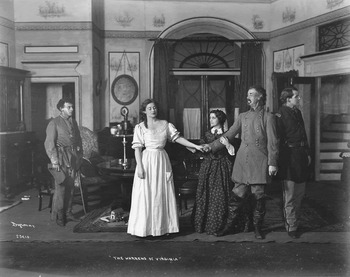
Belasco and de Mille use a clock in the hallway of General Warren's house to emphasize the conflict that besets the hero. After the sham dispatches are seized, Burton is held at the house as a prisoner but is allowed to visit with Agatha. During the visit, he surreptitiously “peers” at the clock through a door and then a window, checking it several times against his watch.Footnote 27 The scene is a classic stage situation. Torn between romantic and national loyalties, what will Burton do next? Will he declare his love to Agatha? If so, how will he cope with the guilt of having betrayed his beloved's family, which has treated him with kindness? These conflicts are conceived pictorially. The lovers are in the parlor, stage center, while the clock stands in an adjoining hall, a partly visible space deep stage left (where a portion of the stairs and the heads of people coming and going throughout the play are visible as well). The other room into which the hero's gaze travels establishes what one critic admiringly called “an overpowering suggestion of the spaciousness and solidity of the mansion” that serves as “eloquent proofs of [Belasco's] scenic power.”Footnote 28 Burton also watches the clock in a publicity photo accompanying an early review (Fig. 1). The clock's placement makes it seem like another person lurking next door, almost like a secret mistress.
Byron Company (New York, NY), Cecil B. DeMille, Charlotte Walker, Emma Dunn, Frank Keenan, and Charles D. Waldron in the stage production of William C. de Mille's The Warrens of Virginia, 1907. Billy Rose Theatre Division, The New York Public Library for the Performing Arts, Astor, Lenox, and Tilden Foundations.

The situation is resolved, and Burton finally relinquishes his anxious clock-watching behavior, when Agatha tells him he is her one and only love. He moves to kiss her, she draws away, and he kisses her again. During the kiss, the clock chimes four times, signaling 4 a.m., the time of the train's destruction. Burton sinks down white-faced onto a chair, breaking off the embrace, and the news of the train's destruction shortly arrives. The clock's strike also breaks the spell of the stage picture, bidding the lovers to move on in the plot, and, on a wider symbolic level, urging on the resolution of North and South in a future that—like that of the war—will be determined by trains and telegraphs.
As a real stage object, the clock transforms the stage time of the melodramatic situation into a performance for a nearly visible, external, and arbitrary standard, disrupting the play's temporal unity. Before Agatha's entrance, de Mille had artfully created the illusion of a seamless continuity among story, text, and stage time by having Blake, a fellow spy, declare the time to be a quarter of four, and then, later, having Burton look at his watch and declare that it is five of four. When the clock chimes, then, the effect is of the perfect alignment of the play's three clocks. Yet the illusion is simultaneously shattered by the use of a real clock to amplify the decisive moment of situational crisis, particularly since its placement in the set is also designed to draw the eye to Belasco's artistry as a scenic designer. The clock's chiming from within the depths of the hall emphasizes—by regulating—the passing of stage time, the way that a metronome might. As such, a question tearfully asked by Agatha later in the play takes on a broader significance in regard to time for the spectator. After the discovery of Burton's perfidy, she asks, anguished, “Did you love me when you came here? Did you love me when you kissed me? You've got the supply train—you've ruined the family—now tell me, did you kiss me because you loved me, or did you kiss me watching the clock?”Footnote 29 Audiences might be forgiven for indeed checking their pocket watches and wristlets during this scene, since the stage timepiece deflates the melodramatic situation, and its timeless symbolic conflict between love and duty, by turning it into a performance for the clock.
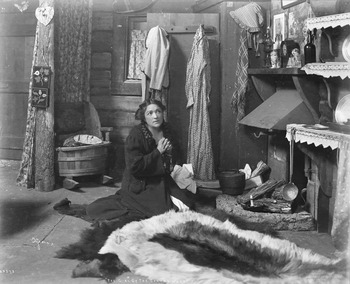
A similar transformation of the stage picture takes place in The Girl of the Golden West (1905), a frontier melodrama written, produced, and designed by Belasco, and one of his most visually alluring productions. In act II, a “very tawdry clock” stands in the center of the mantel in the Girl's one-room cabin, where she has invited for dinner her love interest, Dick Johnson (who is really the bandit Ramerrez).Footnote 30 Along with other items we see when the curtain rises, the clock tells us about the Girl's attempts at gentility and spirituality, despite her rough setting and surroundings (Fig. 2). As befits the setting, it associates her with an essential civilizing function, reinforced by contrast with the redface acting of the white actress playing the Native servant Wowkle, as well as the Girl's revelation to Johnson that, in addition to running a bar, she works as a schoolteacher. The clock declares the Girl's cabin to be ahead of its time, a forerunner of the white Protestant civility, punctuality, and thrift that, according to the tenets of Manifest Destiny, will ultimately dominate and domesticate the racially primitive—but rough and alluring—frontier.
Byron Company (New York, NY), Blanche Bates in the stage production of David Belasco's The Girl of the Golden West, 1905. Billy Rose Theatre Division, The New York Public Library for the Performing Arts, Astor, Lenox, and Tilden Foundations. Clock on mantel, stage left.

As in The Warrens of Virginia, it is the job of the clock in Girl to end a narrative impasse faced by the lovers, returning them from the situation to the narrative. Johnson is on the run from Sheriff Jack Rance (who is in fact in love with the Girl), but the Girl—who reveals in this scene that her name is Minnie—is unaware of his true identity or his predicament. Evidence of a heavy snowfall can increasingly be seen outside the windows and door; Johnson needs to leave soon if he wants to make it down the mountain and escape pursuit. After their first kiss and declaration of love, with the storm reaching a height outside, Minnie and Johnson hear the mantel clock strike 2 a.m, which, Belasco specifies, “must be heard by audience.”Footnote 31 After some more amorous dialogue, Johnson starts to tear himself away, telling Minnie, “the clock reminded me that long before this, I should have been on the way. I shouldn't have come up here at all.”Footnote 32 The play's action then proceeds on its way, moving the audience along from the situation—Johnson's hesitation between the love of a good woman and a life of crime—to a series of events culminating in his departure with Minnie for a better life.
For those at the right angle to view it, the clock's face in The Girl of the Golden West has something in common with the other lettered signs that Belasco strews around the play's extravagantly and lushly detailed rooms: like the advertisements in the saloon in act I, the clippings from fashion magazines on the wall in the Girl's cabin, and the mottos posted in the schoolroom in act III, it has a polyvalent signifying function.Footnote 33 It might be referring to plot time, but also to stage time—and not only the stage time of human actors. Just after Johnson declares his love, and just before the clock audibly chimes, the audience sees a chaotic scene taking place in the room around the oblivious lovers. “The wind blows the snow against the windows. The vestibule doors slam. The curtains of the bed flap in the wind. A small basket on the wardrobe blows down. A flower-pot topples over. The blankets in the loft flap. The lamps flicker. Suddenly the wind dies down. The clock on the mantel strikes two. …” Footnote 34 The conflict symbolically illustrated here pertains no longer to characters or historical moments, but to inanimate things. Audience attention shifts from the contending forces of duty and love, civilized West and primitive East, to chance and determinism. Where will the objects go next? Does anything govern their chaotic, fascinating, movement, or is it a pure product of chance? The clock promises to make all this blowing, slamming, flapping, and toppling meaningful by imposing story time—determined, linear, ordered.Footnote 35 But, as in Warrens, the clock's function as a timekeeper with a multivalent referentiality also deflates the meaningful narrative situation. We become highly aware that the moving objects and clock are all synchronized together by Belasco himself, as one of his perfectly timed “effects.”
Belasco's big break, the Civil War melodrama The Heart of Maryland (1895) offers perhaps the most striking example of the stage clock's effect on the melodramatic situation. This four-act play again treats the popular theme of love across sectarian lines, that between Alan Kendrick, a Northern soldier, and Maryland Calvert, a Southern belle, a role originated by Mrs. Leslie Carter. When Alan returns to visit Maryland (the girl and the state), he is captured, slated for execution, and imprisoned to wait with other unfortunates in a church near the front lines. Maryland helps him escape, but they are discovered. As Alan runs away, orders are given to ring the church's bell as an alarm. In a scene that has become notorious for its melodramatic excess, the heroine races up the ladder of the belfry thirty-five feet above the stage, where she “leaps and clings with both hands to the tongue of the bell. The bell moves higher and higher; she is dragged backwards and forwards by the swing” until the curtain falls.Footnote 36 With the ringing of the bell muffled by the heroine's body, the lover escapes, and the union of hero and heroine (along with the symbolic reconciliation of North and South) is cleared to take place against the backdrop of another pictorially conceived situation—a gradually dawning morning.
In keeping with the weak motivations of melodrama and the situational aesthetic, one could imagine this scene being extracted and performed independently. Its autonomy from the narrative would seem all but complete; all that presumably matters here is that a female body be provocatively displayed for the audience.Footnote 37 Moreover, a bell, of course, is not a clock, or not exactly. And yet, the bell is a clock, in the new sense I have been tracing; its actual functioning onstage is supposed to work within the situation to integrate the stage picture into the story, thus connecting the stage time of the female body and the masterful theatrical machinery of the moving bell with the larger narrative argument of the play. In an earlier scene, where we learn that it is usually operated by a near-deaf sexton, Belasco draws attention to the bell's traditional function in a slower, more communal and local world. This personage initially misunderstands the orders he is given to carry out in the event of a prisoner's escape. “Ring like fu-r-ry!” he is told by an officer, who “imitates pulling bell vigorously.” “Ring fer a fun'ral” the sexton replies, “All right, sir!” When the officer tries again, telling him to “ring like—Hell!” the sexton echoes back what he hears: “Ring the bell! All right, sir! I'll ring the bell. Kin’ o’ signalizin’, ain't it? Same as a fire, eh?”Footnote 38 After the officer leaves, the sexton mutters further to himself, “This is a new business, for you an’ me, ole bell. Fer more'n sixty year, we've been a ringin’ t'gether, ringin’ fer weddins, ringin’ fer christ'nins, an’ fer fun'rals; but we didn't think we'd ever ring to catch a poor devil strikin’ out fer freedom, did we?”Footnote 39 The sexton's soliloquizing is closely connected to the project of Civil War melodramas to integrate a troubled past with a rapidly changing industrial present. His mishearing places the temporal world of the play in an idealized past by emphasizing the bell's traditional function of drawing the community to important local events—what McCrossen calls the “local call” of time.
It is an important part of the play's symbolic language, then, that the bell the heroine stops is being used like a telegraph, to convey a coded signal to strangers far away, rather than for its community function of telling local time. Even though the bell is not a clock, its status as a “signalizer” associates it with one, and in particular with newly accurate and public timekeepers that, in the present-day world of the audience, were coordinating far-flung commercial activities. By preventing it from being used for modern “signalizing” purposes, Maryland's actions are symbolically fitting for her rural, preindustrial worldview. But the silence of Southern bell(e)s was also one of the reasons the North, with its superior communications technologies, won the war. In other words, the bell does double duty in relation to the narrative argument, conveying a spectacular stage picture of virtuous (and titillating) Southern obedience to the “public call” of time, but also affirming the lesson of the plot that the allure of such scenes must give way to modern temporal, individual (and Northern) self-discipline.
However, as in Girl, the clock/bell explores the possibility of a melodramatic “situation” without human actors, in such a way that its mediating function between stage time and text/story time is compromised, and the unity of the play's three clocks collapse into what we might call performance time. The bell's motion is strangely unmotivated. The sexton presumably ringing it remains unseen, and the bell has no other visible source for its movement, or at least none is recorded in the script (several yells of “Ring the bell” are supposed to come from offstage). All of this heightens the subjugation of Mrs. Leslie Carter, the actor, to the object. Her leap requires precise, acrobatic timing, and must be performed, like clockwork, night after night. When she lands each time she becomes a “human tongue,” as she put it in an interview.Footnote 40 This strange but apt phrase evokes an unsettling and visceral intimacy between human organs of speech and the clock's visual and vocal work onstage, reminding us that clocks have always been personified, at least since they began to regulate our lives intimately within the home.Footnote 41 What the moving bell and the dangling woman stage—and eroticize—is thus the subordination of the human body to the clock. Again, then, the latter's independent movement onstage undercuts melodramatic timelessness with the specter of timing—but in this case, that of a human performance compelled by a thing.
From Situation to Performance: Secret Service (1895)
As Richard Schechner notes, the boundary between “symbolic time” and “task-oriented happenings” in any performance is always malleable.Footnote 42 We can add that when the boundary between the two becomes malleable in a stage performance, theatre—especially acting—becomes visible as work, since theatre is one of the only sites in the capitalist economy at which consumers and producers confront each other face to face, and in which the labor of production is visible and precisely synchronized with the consumption of the product.Footnote 43
By the late nineteenth century, a conception of acting as a “task-oriented happening”—or, in other words, as work—was beginning to take hold in the popular theatre, especially in the United States. Beginning in the 1870s, as the country underwent the fastest industrialization of any developed nation, theatrical producers and managers sought to remake the theatre into a respectable bourgeois institution offering a commercial product. The lower classes were banished from the audience, and curtain times were standardized; in contrast to its previous variability with the season and the duration of the daylight hours, an 8 p.m. curtain became the norm, to conform to the standardization of quitting times at work.Footnote 44 Like office workers, actors now started their work—at least, the work that was visible to the audience—at the same time every day, and remained at work for a standard length of time every day. By 1900, the mainstream actor was increasingly aspiring to membership in the newly ascendant and time-thrifty professional-managerial class that also made up his or her audience.Footnote 45
These changes are especially legible in the theatre of William Gillette, the actor, writer, and manager, whose understated acting style has been heralded as a precursor of realism, and whose plays, particularly his smash hit, the Civil War melodrama Secret Service (1895), feature main characters—often played by Gillette himself—who display the ethos of professionalism that began to characterize both actors and audiences in this period.Footnote 46 Gillette was also obsessed with time, and had a notable predilection for visibly working stage clocks, as we saw in All the Comforts of Home.Footnote 47 Secret Service exhibits a fanatical precision about time in its stage directions, and the playscript dictates that its realistic interiors feature visible, working clocks, which effectively make the play itself into a giant clock that the audience can watch for the duration of the performance.
Set in Richmond while the city is under siege, the play takes up themes familiar from The Warrens of Virginia, The Heart of Maryland, and many other Civil War melodramas: espionage and misleading signals; national reconciliation through the marriage of male North to female South; conflict between love and duty; suspense, reversals, coincidences. There is a love affair between Captain Thorne, the cool and collected Northern spy, and Edith Varney, the daughter of a Southern general. There is a lavishly detailed Southern home. There is a historically accurate and emotionally evocative soundscape, particularly in the final act. As the siege on the city begins in earnest near the end of the play, the dialogue is interspersed with the thunder of cannons, the rattle of artillery, and flashes of light. Church bells are heard sounding the alarm and calling the reserves to battle. In the property plot, Gillette enjoins the production to “Get as near as possible tone of bell used for purpose in Richmond.”Footnote 48 As one reviewer approvingly noted of the stage “picture” created by the bells: “No word or action could illustrate more vividly the panic and distress of a city's whole people.”Footnote 49
However, the play's most well-known and popular “situation” involves the telegraph, communications equipment that had grown more central to daily life since the historical period documented by the play. So-called telegraph scenes had proved so popular with audiences in earlier plays—such as Boucicault's The Long Strike (1866), and James McCloskey's Across the Continent (1871)—that they were sometimes performed on their own.Footnote 50 As Christopher Grobe notes, their popularity had to do with the way telegraphing fit in with melodramatic plots, which often turned on the reception of a message. When the message arrives over the wire, it intensifies and generalizes the suspense, since unlike a letter, which must be first opened and read, the machine is present onstage and could begin ticking at any minute as characters and audience watch it together.Footnote 51 The telegraph also serves as a particularly potent example of the ways in which the predilection for minutely detailed, real stage properties could create a “situation” in ways that sidelined the actions and motivations of characters. In a situation constituted by characters who simply wait without speaking for a telegraph to speak—in contrast to, say, gesturing and calling for help while facing an oncoming train—audience attention shifts to the performance of objects.
As Thorne, played by Gillette, attempts to send a telegraph message that will enable Northern troops to break through Southern lines and take Richmond, the stage directions invoke a visual contrast between the highly functional, modern, telegraph equipment and the faded and crumbling Southern glory of its surroundings. The building has broken, discolored moldings and chipped plaster; it “was once a handsome one, but has been put to war purposes.”Footnote 52 The soundscape in this act, moreover, could evoke no nostalgia for 1895 audiences, who had just left their offices to come to the theatre: “Busy click-effect of instruments from an instant before curtain rises, and continues. After first continued clicking for a moment there are occasional pauses.”Footnote 53 Finally, Thorne's cool-headed skill at the telegraph at a crucial, tension-filled moment was more reminiscent of a late nineteenth-century clerk under pressure than a spy during wartime. His operator abilities make him as much of a soldier on the battlefield as a worker in a modern office, where new communications technologies connect distant offices and information workers clock their hours on universal standard time, allowing these locales to communicate effectively with one another.
But one of the most palpable reminders of the new working day of both audiences and actors in the play is the clock—or rather, clocks. A “practical” one sits on the mantel in the Varneys’ living room, set to 8 p.m. at the beginning of act I and to 9 p.m. at the beginning of act II. A large “office clock” occupies the telegraph office in act III, set to 10 p.m. Act IV returns to the Varney's home for the conclusion of the play, where the mantel clock now reads—surprise—11 p.m. Gillette specifies in the script that the clocks are to be working. Throughout Secret Service, then, especially given the relatively recent standardization of the 8 p.m. curtain, the clock seems very much to be representing the stage time of the play. As in ’night Mother, this would seem to be an attempt to achieve an extreme form of realism, as was praised as such by no less a critic than William Dean Howells.Footnote 54 Yet the dialectical tension between situation and plot inherent in the play's melodramatic structure achieves something of a different effect. The situation becomes transformed into a performance for the clock, which visibly imposes an external standard on its wayward stage time. Anticipating, on the theatre stage, Christian Marclay's recent synchronized film montage, The Clock, the play itself becomes a clock. The audience is virtually encouraged to check their watches against it, thus performing the characteristic gesture of the time-disciplined information worker.
But Secret Service is really better described as a giant stopwatch. A sharp-eyed audience member could presumably discover what readers of the stage directions know, namely, that story time and text time are not the same as stage time; each act is supposed to last less than an hour to perform (between twenty and forty minutes, to be precise).Footnote 55 The timepieces in the background of each scene do not correspond to the times at which, according to the audience's watches, the scenes and acts of the play begin and end, but they do provide a measure of the duration of each scene. The clocks are precise, but not accurate; they “clock” the scenes and the acts, but do not synchronize story, text, and stage time with Greenwich Mean Time after act I. Presumably, they were reset to correspond to story and text time at the beginnings of acts II, III, and IV.
The timepieces in the play also clock the characters’ and the actors’ movements. These are specified in the stage directions, the most prolix and detailed ever seen in American drama prior to Eugene O'Neill.Footnote 56 Sometimes for pages, Gillette provides extensive directions for the look of the set and the precise tone of each character's utterance; the positions of their hands and limbs (down to the use of a right hand vs. a left hand); and the speed at which they move across the stage, enter, and exit. His directions frequently designate how long these specific movements and actions are supposed to last, especially in the context of sending messages or signals. As Mrs. Varney takes a bell cord in her hand she is “motionless for four seconds” before her next line. During the situation in the telegraph office, Thorne/Gillette is supposed to telegraph silently and intently for exactly five seconds.Footnote 57 By placing a clock onstage in all four acts, Gillette offers a means to render visible the precise length of the gestures and pauses he has specified in the script. The artful task of unifying story time, text time, and stage time is displaced, as acting, writing, and directing become visible as task-oriented performance.
As in Girl and Warrens, the clock's action in the staging of Secret Service is thereby set at odds with narrative meaning. As the actors play out the acts to the clock, which doubles the times of the acts specified in the script, they visibly “perform,” in Schechner's sense of conforming to an external standard, rather than using symbols to express an inner essence. This sense of acting as a standardized activity is enhanced by the dialogue, especially Thorne's/Gillette's. His speech is marked by pauses—which become telegraphlike dashes in the text—intended to suggest unspoken and unrealized thoughts and emotions.Footnote 58 The dialogue reflects Gillette's philosophy of realist acting, in which key attention should be paid to the “behavior of eyes, nose, mouth, teeth, ears, hands, feet, etc. while [the character] does think and while he selects his words to express the thought.”Footnote 59 However, in relation to a working stage clock, which would be visibly measuring the duration of their movements, the different parts of an actor's body become “performers” not in the expressive sense, but in the task-oriented sense, and acting as work loses its human associations. A flywheel releasing energy also “performs,” as does a piece of metal under stress.
A later generation came to recognize this oddly inhuman aspect of Gillette's acting and of his emphasis on clocking the actor's bodily behavior. Arthur Hobson Quinn noted in 1925 that Gillette's goal was to “simulate … [the] gradual or sudden birth of motor impulses” prior to the emergence of a thought or idea.Footnote 60 The Washington Post, at a 1915 revival of Secret Service, likewise noted approvingly of Gillette's delivery that his “staccato reading” was “almost as metallic as the clicking of his own telegraph instruments.”Footnote 61 The scenes and situations of the play come to resemble photographic time–motion studies, simulating the objective registration of a body in action.Footnote 62
Gillette's own reliance on stage clocks and precise instructions about time in his plays sheds new light on the illegible clock in All the Comforts of Home, discussed above. The multiple pointing hands in that farce are ostensibly the opposite of the clock in Secret Service; they suggest time is inherently relative, depending on the observer, rather than absolute.Footnote 63 But clocks in Secret Service are in a sense also rendered illegible by the way they displace the entire task of unifying story, text, and stage time within the play. They become not so much expressive signs as measuring devices for clocking the duration of a given performance relative to a highly arbitrary, even despotic, standard. Acting in turn becomes less an expression of the essence of the play or the character than a paradoxically redundant instance of the skillful actor at work. In Tom's illegible, farcical clock, Gillette seems to be holding up to mockery his own social and professional anxiety about being “on” time, as a working actor, writer, and director in the public clock era.
Conclusion: The Stage Clock and the Temporality of Modernism
If there is a clock onstage, or even just referred to, in a play by Ibsen, Chekov, or Strindberg, it is most likely broken. In Ibsen's The Wild Duck, the broken timepiece with mechanical figures preserved in Ekdal's garret indicates his and his daughter's fragile fantasy world and their enslavement to the authoritarian industrialist Werle. In Chekhov's Three Sisters, Chebutykin drunkenly stumbles and smashes the clock belonging to the sisters’ late mother, his former lover, emphasizing a past that is inseparable from the present, and the devaluation of memory and family ties in a rapidly modernizing Russia.Footnote 64 In Strindberg's Ghost Sonata, the mother claims to be able to stop time by suffering and repentance, and shows it by stopping the hands of a stage clock. The clock becomes a symbol within all three plays of a fading and morally bankrupt aristocratic order.
Considered as a stage object, these broken clocks also make a point about form, announcing the European naturalist art theatre's attempt to evoke nonlinear and subjective kinds of temporality—such as dream, fantasy, or memory—within a still recognizably unified temporal dramatic structure. They further anticipate later avant-garde playwrights who would reject the neoclassical unities of play construction. As Arnold Aronson notes, the definitive modernist challenge to illusionism and embrace of theatricalism—the turn from the fourth wall to the stage as stage, as embodied, for instance, in Brechtian estrangement—was also a rejection of the long-dominant idea of the stage as an “alternative temporal reality,”Footnote 65 like the “Golden West” or the Civil War South. Instead, the stage in modernist and avant-garde drama becomes “a specialized locale within the larger theatre space shared with the audience … that … occupies the same spatio-temporal construct,” allowing for experimentation with explicit disjunctions among stage time, text time, and story time.Footnote 66
It was in relation to these developments that twentieth-century theatre critics began to adopt the convention that a clock's face should not be visible to the audience. “Even in a naturalistic play,” writes Walter Benjamin, clocks are generally avoided, lest “astronomical time … clash with theatrical time.”Footnote 67 Bert States, as I noted in the opening, argues that working stage clocks are problematic because they are “visibly obeying [their] own laws of behavior” rather than that of the play in which they appear, creating a sense of “primal strangeness” for the spectator.Footnote 68 Going even further, Jiri Veltruský suggests that an audience will perceive a clock as equivalent in subjectivity to a human actor.Footnote 69 A consideration of earlier stage conventions regarding clocks, such as I have provided above, establishes the historical coordinates of this convention. It originates in the broken or nonworking timepieces in modern drama, and in the modern dramatist's project of exploring time. This project, in turn, is incompatible with actual, working stage clocks, which were common in nineteenth- and early twentieth-century plays. Broken or nonworking stage clocks in modern drama were gestures of defiance, signaling a very particular break with the artificial “situations” of popular melodrama, with the “clockwork” of the well-made play, and with the public clock era and its temporal demands, as internalized and disseminated via popular theatre.
I would suggest, however, that the working timepiece, particularly in turn-of-the-century popular melodrama, actually paved the way for later experiments with time in modern drama. Merely by following its own “laws of behavior,” it brings the audience and stage into the same spatiotemporal reality and helps to turn expressive acting into an antimimetic, and even antiaesthetic, kind of performance. As much is suggested by one of the twentieth century's most fervent challengers to stage illusionism, who found in the original production of Gillette's Secret Service an inspiration for her work. In a 1934 lecture, Gertrude Stein describes the play as an important influence on her, and going to see it as an adolescent in San Francisco. Stein liked Gillette because she enjoyed melodramas, and her favorites were set during the Civil War. The best of these, she writes, was Secret Service, because of what she calls Gillette's “new technique” of “silence stillness and quick movement.”Footnote 70 Stein credits Gillette's emphasis on subtle bodily movements, rather than emotive speech and gesture, with helping her to rethink what plays could be, and claims him as an important American forebear for her own attempts to forge a distinctly antimimetic, highly visual, and abstract form of theatre.
Stein loved Gillette, she says, because she was “endlessly troubled” by the “syncopated time” of naturalistic plays (244). For her, the presence of actors, and by implication also the stage properties, make an immediate yet inchoate appeal to the senses. The actors, unlike the characters they portray, are “there right away,” whereas the characters, by contrast, must be gradually understood at a pace imposed by the structure of the play itself (254). These two experiences of time—the instantaneous flash of sensation and the gradual ticking forward of events and the revelation of character—correspond to two equally valid kinds of knowledge for Stein: that gained from an immediate, sensory experience of a thing, which cannot be communicated to others and stands outside of language and representation, and conceptual knowledge, which has to be learned gradually, but which can be described in language and shared with others.Footnote 71 In Richardson's terms, Stein's two forms of knowledge are instilled by any naturalistic play's three clocks: the immediate sensory experience of the actors onstage takes place in stage time, while the gradual knowledge about the character takes place in story and text time. We might then describe Stein as endeavoring to do what any naturalistic playwright tries to do—to unify stage, text, and story time—but not by artful illusion. Somehow, she wants to do this in an absolutely accurate and literal way.Footnote 72
Gillette, for her, accomplished this. After Gillette, “One was no longer bothered by the theatre” (259). But why, and how? Perhaps Gillette's innovation, from Stein's perspective, had to do with the running clock itself, which literally synchronizes the play's three clocks. Of course, we cannot be sure that the traveling production Stein witnessed followed the stage directions to run a clock through each act. But given Gillette's obsession with time, his fanatical obsession with stage details, and Stein's decision to cite this specific play as “solving” the problem of “syncopation” at the theatre, I am willing to bet that the working clock was there when she saw it. Its presence would have heightened the effects she describes, by collapsing the syncopation of expressive acting—and the three temporal schemes of any play—into the singular, but nonsymbolic, time of performance.
Of course, Stein is cultivating her homespun image in citing Secret Service for its avant-garde qualities rather than, say, figures in the Parisian literary and art world, and I cannot do justice to her complex argument here. What is important for my purposes is that she offers testimony to the importance of late nineteenth-century popular theatre in making new understandings of time broadly culturally legible. She suggests in particular that the melodramas of her adolescence translated the problem of time and its legibility, as found in venues from philosophy to time–motion studies, into popular experience via theatrical spectatorship. Perhaps Stein liked historical melodramas because, in this period, they made the difficulty of representing time, both onstage and in real life, so clear. The “real” settings created a strong impression of the separate, past, spatiotemporal reality, in which story/text time marches forward. But as melodramatic situations, they also made the audience highly aware of the stage time of the play. The “working” stage clock held out the promise of merging story, text, and stage times into one. To Stein's apparent delight, however, it did so by providing an external, arbitrary temporal standard for the stage action, displacing symbolic performance altogether.
Stein's inspiration by Gillette and by turn-of-the-century melodrama suggests, finally, that a stage object might itself have acted to shape dramatic and theatrical form—a primally strange idea indeed. By eradicating the naturalistic drama's three clocks, the working timepieces of Gillette, Belasco, and de Mille also merge the spatiotemporal reality of the stage with that of the audience, opening the way to modern and later postmodern performance practices. Perhaps, then, we owe to these long-lost plays, and to a now-taboo stage object, a considerably larger debt than it might seem.