Introduction
Political discussions about artificial intelligence (AI) innovation, as a matter of course, narrate it in terms of a winner-takes-all, global ‘AI race’, not just in the US.Footnote 1 For example, the European Commission (EC),Footnote 2 in its AI Continent Action Plan, noted a ‘global race for leadership in AI’, responding to Project Stargate, a private initiative by US tech giants aiming to raise $500 billion in investments. OpenAI, one of the firms involved, in turn, is quoted as saying, ‘(i)f the US doesn’t attract those funds, they will flow to China-backed projects’.Footnote 3 While such accounts are arguably unsuited to capture the nature of AI competition,Footnote 4 this overlooks that speech is no mere reflection of political reality, but constitutive of it. The political narratives actors tell are highly consequential, especially in forward-looking fields with deeply uncertain outcomes such as AI. AI narratives shape strategies for international AI leadership, with far-reaching implications for cooperation, competition, and conflict in the evolving global AI landscape.
This motivates the objective of this article to reconstruct the AI narratives of the US, China, and the European Union (EU). We focus on these actors, because they are widely regarded as the leading powers in global AI competition, highlighting their roles as centres of AI innovation with ambitious strategic objectives.Footnote 5 Examining the AI narratives of the three powers provides a unique window into their understanding of AI in international politics as well as their motives and strategies to pursue global AI leadership. These narratives are not simply rhetorical techniques, but instruments of foreign policy. The foreign policy stakes of AI narratives are that they are used to validate strategic AI choices, further geopolitical goals, and shape global perceptions. Emphasising these stakes underscores the necessity of scrutinising AI narratives to understand the complexities of global AI competition and cooperation.
The article complements a growing range of scholarship on the strategies of major AI powers, with a particular focus on China,Footnote 6 the US,Footnote 7 and the EU,Footnote 8 as well as a limited number of comparative studies.Footnote 9 While previous work has examined AI politics through a narrative lens,Footnote 10 our analysis advances this emerging body of research in four respects. First, we use narrative analysis as a specific discourse analytical method that allows, as we aim to show, a particularly fruitful reconstruction of AI narratives. Second, our study rests on a systematic analysis of a more comprehensive set of 84 AI-related government documents from the three powers than most existing research, enabling a holistic view on the respective AI narratives. Third, our analytical framework considers the AI narratives of the three powers in relation to each other, assessing prospects for conflict and cooperation. Fourth, our empirical results point towards the theoretical claim that global AI competition is not only driven by economic and national security concerns, but also involves status-seeking in international society. Overall, our analysis provides novel insights into how the three powers understand AI, their motivations and strategies, as well as the dynamics of global AI competition.
We present our analysis as follows. First, we introduce our narrative analytical framework and detail our methodological approach. Second, we recount the AI narratives of each power as reconstructed from the source material. Third, we present a comparative discussion of our findings, focusing on the scope for international conflict and cooperation.
Analytical framework: AI narratives as sites of meaning-making
We use a narrative analytical framework to explore how the three powers construct the meaning of global AI competition. Following a constructivist orientation, we treat narratives as sites of meaning-making, rather than mere representations of ‘objective’ facts or rhetorical tools. Narratives are performative, shaping preferences, legitimising decisions, and structuring intersubjective understandings in fast-moving technological domains. They must not be read as transparent reflections of intent, but as political acts that serve strategic purposes in domestic and international arenas. From this perspective, AI is less important as a technical artefact than a discursive arena where struggles over power, order, and recognition play out.Footnote 11 Even though AI narratives may remain contested, their political force lies in being mobilised as claims to recognition and legitimacy in international society.Footnote 12 This theoretical perspective also leads us not to impose a fixed definition or conceptualisation of the AI ‘field’. Instead, we reconstruct how the three powers themselves define and construct AI and what implications this entails for global AI competition. In this way, our narrative analytical framework reveals how AI strategies are framed, legitimised, and made meaningful through storytelling.
We conceptualise narratives as a specific form of political discourse distinguished by three interrelated elements: setting, protagonist(s), and plot.Footnote 13 Following this structural definition, narratives involve a cast of protagonists who enact a particular plot, from a beginning towards an end within a specific setting. AI narratives can be seen as ‘issue narratives’ which position actors in a particular policy field, spelling out objectives, instruments, and potential conflicts of interests. They are deeply entwined with broader ‘international system narratives’ and ‘identity narratives’ through which actors make sense of the international system and their place in that system.Footnote 14 On a spectrum between more or less sedimented narratives,Footnote 15 we situate AI narratives near the least-institutionalised end since they involve actors grappling with a radically novel and rapidly changing technological and political context. Consequently, AI narratives are relatively fluid and open to change, giving powerful narrators,Footnote 16 in particular governments, greater scope to craft them strategically with a view to shaping the emerging international AI order.Footnote 17 Internationally, AI narratives can be competitive or complementary, tightly interwoven or largely unconnected, pointing to potential AI cooperation or conflict.
From this vantage point, we argue that the meanings of AI in international politics are not determined by properties of the technology or other material facts, but constructed in political discourse and negotiated through narratives. Narratives ‘do political work’Footnote 18 and are central to the discursive construction of social and political facts.Footnote 19 Political actors make sense of the world through narratives, using narratives to develop intersubjective understandings.Footnote 20 Thus, the article aligns with efforts in IR to ‘endogenise’ technology and to move beyond older works’ technological determinism, instrumentalism, and essentialism.Footnote 21 These efforts display a constructivist openness towards alternative understandings of technology, a contingent view of technological development, and a broad perspective on technology that includes the sociotechnical systems and bodies of knowledge it is embedded in.Footnote 22
This interpretive starting point is particularly pertinent for AI. Drawing on insights from science and technology studies (STS),Footnote 23 this is because ‘emerging technologies’Footnote 24 such as AI ‘only exist in the future’.Footnote 25 By imagining a future, anticipatory practices become performative and help construct the future through shaping technological development.Footnote 26 Visions of the future are part of ‘socio-technical imaginaries’, that is, ‘collectively held, institutionally stabilised, and publicly performed visions of desirable futures’,Footnote 27 which are shared across boundaries, but also contested and multiple,Footnote 28 leaving interpretative flexibility about the meaning of technologies and how they should be designed.Footnote 29 It is precisely the future-oriented ‘emptiness’ and contestability of emerging technologies that allow actors to project their own utopias onto them.Footnote 30
From a narrative analytical perspective, this represents an ‘unsettled’ narrative situation,Footnote 31 in which widely shared intersubjective understandings of AI have yet to emerge and where the role of narratives in meaning-making is particularly powerful. AI narratives ‘fix’ the meaning of imagined AI futures and show how they can be achieved.Footnote 32 They give orientation despite uncertainty, providing a rationale and legitimising political decisions to invest and seek AI leadership. For actors placing bets on the future, AI narratives are also a mechanism to maintain ontological security.Footnote 33
Methodological approach: Reconstructing AI narratives
In our empirical analysis, we reconstructed the AI narratives through which the three powers shape the meaning of AI in the international arena. We extracted from our text corpus the representations of the narrative setting, protagonists, and plot within AI discourses in the US, China, and the EU. Based on the established ‘AI triad of data, talent, and comput[ing]’ (#36Footnote 34: 14; see also #70: 6), we also looked for three storylines focusing on the technical (‘technics’), human (‘human factors’), and normative (‘norms and standards’) dimensions of global AI competition. Storylines unfold within the overall framework set by the setting, protagonists, and plot of the main narrative, but foreground selected aspects of these narrative elements to flesh out key themes central to the main narrative. They are deeply entwined with the main narrative and do not introduce novel narrative elements, but emphasise particular priorities and preoccupations of the narrator. Storylines make sense only within the broader main narrative, which in turn relies on them to reveal its full meaning. Unlike sub-narratives or plot lines, storylines are not hierarchically subordinate to ‘grander’ main narratives nor do they form separate story trajectories.Footnote 35
Specifically, we developed a coding scheme (see Appendix 2) to unpack references to the three narrative elements in our source material. The first draft of the coding scheme was derived from the basic structure of narratives, distinguishing setting, characters, and plot, and informed by existing scholarship on AI policy in the US, China, and the EU. The categories were refined through an inductive process, involving all three authors reading a text from our source material representing each power. A final revised coding scheme, derived from a second round of readings involving all authors, was employed to code the complete set of source materials, including references to the three storylines, technics (S1), human factors (S2), and norms and standards (S3). Narrative elements were not predetermined but emerged inductively during iterative rounds of coding, allowing themes to surface from the material. Our research strategy was not to impose external or ‘objective’ meaning onto the narratives, but rather to reconstruct the narrative work done by the three powers themselves. The results were validated through intercoder reliability checks and cross-referencing with expert interviews. We operationalised dominance based on the frequency and consistency of narrative elements in our source material, noting in particular where themes recurred across different document types and timeframes.
We coded 84 documents (33 from the US, 19 from China, 32 from the EU). These documents are elite-produced texts in which high-level political and bureaucratic representatives of the three powers articulate ‘official’ AI narratives. The narratives were reconstructed across these institutional documents and do not represent singular, uncontested positions of a particular political actor. We acknowledge that alternative narratives exist within each power that may contest the ‘official’ narratives, but our aim was to examine how authoritative speakers narrate the place and ambitions of the three powers in the global AI arena to international audiences. At the same time, parts of our source material indirectly reflect perspectives beyond the ‘official’ narrators, with some documents including inputs from think tanks, academia, and the technology sector. In this sense, ‘official’ narratives do not emerge in isolation but are co-produced within dense state-industry-expert constellations – particularly in the US, where technology companies and policy networks play a central role in constructing AI narratives. Thus, while the reconstructed AI narratives are not representative of AI narratives in society, they are authoritative articulations that shape international understandings of global AI competition between the three powers.
As there is no established text corpus specific to the AI field, we selected government documents and strategy papers based on their context and relevance. For Chinese-language documents, we relied on established translations from initiatives such as DigiChina and the Center for Security and Emerging Technology. While we acknowledge that some nuance may be lost in translation, we believe that this is an appropriate ‘second-best’ solution that minimises interpretive risks. We chose 2016 as the starting point because both expert interviewees and existing scholarship identify AlphaGo’s breakthrough that year as a watershed moment, focusing unprecedented political attention on global AI competition, especially in Asia.Footnote 36 Our data collection includes documents until mid October 2023, which marked the conclusion of our analysis.
It is important to note that our analysis focuses on two states (the US and China) and one international organisation (the EU). While differing in institutional form and capabilities, we compare the three actors as political narrators whose AI narratives shape perceptions of competition and cooperation in the international arena. We argue that all three powers have actorness in the global AI arena, understood as the ‘capacity to behave actively and deliberately in relation to other actors in the international system’.Footnote 37 For our analysis, this capacity lies in the ability and ambition to articulate AI narratives at the state or supranational level and to project them internationally. This approach aligns with scholarship that highlights how both states and international organisations exercise agency through discourse and symbolic practices.Footnote 38 In particular, work on strategic narratives shows how governments and international organisations alike use storytelling to position themselves internationally and legitimise claims of leadership and authority.Footnote 39 This is straightforward for the US and China, with relatively clear central authorities, but more complex in the EU, where competences are distributed across several institutions. It should thus be easier for the US and, in particular, China to produce coherent AI narratives than for the EU. We acknowledge that this creates a somewhat ‘uneven playing field’, but it also reflects the EU’s ambition to position itself as a unitary actor with a single voice in global AI competition. At the same time, important domains, most notably the military dimension of AI, remain under the authority of member states and fall outside the scope of EU-level narratives. As for the EU, our main sources are from the EC and European Parliament, but our corpus also draws on three council documents, and many of the analysed documents explicitly recall or reference texts from other EU bodies, whose perspectives are thus partly incorporated. However, member states, in the council, have not always been aligned on AI and digital regulation. Several capitals have pushed for further simplification of EU tech rules and, at times, opposed positions of the EC, highlighting the continued importance of intergovernmental influence in EU AI policymaking.Footnote 40
The first element of our narrative analysis, the setting, can be understood as the stage on which narratives are enacted.Footnote 41 Here, AI narratives unfold against the backdrop of general worldviews and more specific AI images, establishing the broader context in which China, the US, and the EU understand AI and its implications for great power politics. Regarding general worldviews, our codebook differentiates between confrontational, competitive, and cooperative outlooks, which we do not view as strictly defined categories but as overlapping perspectives of the three powers. On the level of AI images, the codebook distinguishes between optimistic and more pessimistic views of AI, highlighting the potential benefits of technological progress or the associated risks and dangers. The codebook tracks AI’s perceived transformative potential for international relations and differentiates between images of AI as either an economic driver of competitiveness and social development or a technology with significant national security implications.
Turning to the narratives’ protagonists,Footnote 42 our codebook examines how the narratives characterise the ‘self’ and ‘others’ within the geopolitical triangle between the US, China, and the EU. Specifically, the codebook considers the motives and behaviours ascribed to the main protagonists in the respective AI narratives. This includes generic references to other international actors, for example ‘competitors’ or ‘partners and allies’ in ‘North America’, ‘Asia’, or ‘Europe’, deducing from the context whether these references point to the US, China, or the EU.
The plot of AI narratives, moreover, sets out the objectives a protagonist aims to accomplish with AI and outlines strategies to attain those objectives. It weaves together what happens in a story and scripts how the story develops from a beginning towards the end. It imparts significance to the protagonists’ actions, rendering the narrative comprehensible to the audience.Footnote 43 In our source material, we coded indications of how actors articulate their AI aspirations and the broader political goals associated with them. We also coded references to proposed and already executed strategies to realise these objectives, distinguishing between measures focused on domestic or international issues.
In the final step, the analysis brings the representations of the setting, protagonists, and plot back together to reconstruct the AI narratives by the three powers, including any of the three storylines that we found in them. We supplemented our text-based analysis with eight targeted expert interviews (see Appendix 3) to validate our findings and fill in gaps left by the documents. Experts were selected based on their professional engagement with national AI strategies, policy implementation, or international AI governance, ensuring alignment with the core themes of our narrative analysis. The following sections present the results of our analysis. We first outline the AI narratives and storylines of each power and then discuss their relationship and implications for international conflict and cooperation.
US: Maintaining global AI leadership at any cost
The US AI narrative builds on a setting that demonstrates a competitive-confrontational worldview, albeit with some cooperative elements. The setting leaves no doubt that the US wants to ‘win the AI competition’ (#68; #70; #73) which is portrayed as part of a wider geopolitical struggle (#73; #83). For the US, ‘leadership in AI is not an end unto itself; it is a necessary […] condition for the overarching goal of preserving U.S. leadership in technology’ (#73: 255). Overall, the US is engaged in ‘an AI-charged technology competition fusing national economic competitiveness, great power rivalry and a fierce contest between authoritarianism and democracy’ (#70: 6; see also #56; #57; #69; #73). This highlights how the US narrative combines nationalist leadership claims with value-based framings of democracy and freedom.
For the US, ‘AI will shape the future of power’ (#60: 9), and AI success is a precondition to global leadership (#60; #68; #69). At the same time, the setting depicts AI as a threat to US military superiority (e.g. #55; #57; #70; #77; #83), making US global AI leadership a national security priority (#60; #68). The narrative predicts that confrontation is inevitable, as the US will do everything it can ‘to ensure continued U.S. leadership in AI’ (#69: 50). The setting also speaks to some cooperative elements in the US worldview, as the US ‘cannot succeed alone’ (#56: 4). However, this is limited to selected allies (#58; #61; #68; #81), and cooperation is expected to take place under US leadership (#58; #71; #72; #82).
Moreover, the narrative setting highlights the transformational character of AI, placing the US in the ‘midst of a historic technological transformation’ (#64: foreword) which has both positive (#53; #54; #62; #63; #83) and negative (#53; #76; #83; #84) implications. While the image of AI as an opportunity for national security, society, and the economy predominates (e.g. #52; #54; #66; #67; #68; #72), the setting also references multiple dangers (e.g. #60; #71; #80; #82; #84), including social, economic, ethical, legal (#53; #79; #83; #84), and national security risks (e.g. #56; #61; #70; #83). AI is described as a ‘quintessential dual-use technology’ (#73: 7), making it difficult to disentangle its key roles for society (#52; #62; #63; #66; #83) and national security (e.g. #68; #69; #70; #73; #82).
As for the main narrative protagonists, the US views itself as the global AI leader, as evidenced by its dominance in academic publications, open-source development, and private-sector applications (e.g. #62; #69; #71; #73; #83), while also highlighting its military-technical superiority (#73) and advancements in military ethics and AI safety (#62). The narrative characterises China as the foremost strategic competitor, poised to challenge America’s military and economic dominance (#60; #69). Specifically, the narrative points to China’s objectives to become a world leader in AI (e.g. #57; #60; #65; #69) and a ‘science and technology superpower’ (#73: 225). Indeed, the US AI debate is strongly shaped by concerns about China’s technological and economic advancements (expert interview #6): ‘[f]or the first time since becoming a global power, [the US] faces a rival with the economic scale and technological prowess to challenge US leadership and ambition across military and economic spheres’ (#70: 172) and to surpass the US as the global AI leader (#73). The US narrative views China’s AI advancements as a threat to the free and open international order (#56), undermining democratic values and promoting a surveillance model that could inspire other authoritarian regimes (#60; #69). In the military field, the narrative voices the belief that ‘China sees AI as the path to offset US conventional military superiority by “leapfrogging” to a new generation of technology’ (#73: 22–23).
China’s top-down command economy is described as a precondition for China’s whole-of-government approach to AI, enabling it to subsume all data and technologies generated in the Chinese market (#61). Internationally, China is seen to increase efforts to shape global norms and standards (#69; #70), including through digital infrastructure agreements under the Belt and Road Initiative (#69) and leadership positions at international standard-setting bodies (#70) following the ‘China Standards 2035’ blueprint. China is also accused of using control over certain critical resources to influence other countries, including the US (#70), and to extract AI knowledge from the US through state-directed espionage (#60; #69). On AI research and innovation, the US narrative highlights China’s successes in enhancing the foreign and domestic talent pool (#60; #73) and patent applications (#83), raising concerns that China has created ‘the narrative that it has “won” the innovation race’ (#73: 202). At the same time, the narrative also references US-China interdependencies, such as joint research projects and interwoven supply chains (#60; #73).
Turning to Europe, according to the US narrative, the ‘EU and its 27 member states are among the US’ most important political, diplomatic, and commercial partners’ (#70: 216), recognising the EU’s AI expertise and shared values (#69). Given its differing views on regulation and data privacy (#60), however, the EU is also described as a frustrating partner. EU policies like the General Data Protection Regulation (GDPR) are seen to have global impact, with the European single market setting de facto standards for many technologies (expert interview #6). Still, the US narrative views the EU as a broadly like-minded actor with whom to discuss relevant AI topics (#71). It supports engagement through the EU-US Trade and Technology Council (TTC), showing a willingness to collaborate (expert interview #8). This aims to foster transatlantic coordination on issues like semiconductors, supply chains, and trustworthy AI (#81), and explore more research collaboration in AI applications (#84). Compared to China, Europe appears less prominently in the US narrative, however.
The plot of the US narrative defines maintaining US leadership in AI as the primary objective (e.g. #52; #54; #58; #59; #78). This is described as a national imperative (#63) and security priority (#68), serving to maintain a strategic and technological advantage over competitors and adversaries (#56; #57; #73), improve the quality of life for Americans (e.g. #55; #62; #63; #83), and ensure military superiority (#69; #77; #81). The emphasis on maintaining its leading position in AI suggests that the US sees more at play than military and economic objectives, but rather its status as global leader. The narrative wants the US to ‘defend, compete, and win in the AI era’ (#73: 4), including ‘the quests for data, computing power, and the holy grail: the rare talent to make AI breakthroughs’ (#73: 2). The US seeks to recruit the best minds from around the world (#60; #70; #82), thereby winning the international talent competition (#73). In the security field, the US is to achieve military AI readiness by 2025 (#73) and aspires to lead in military ethics and AI safety (#55; #56; #57; #62). On the international level, the plot sees the US as a beacon of democratic values (#73), leading coalitions of free and open states (#69) and building a favourable international AI order that protects its values and interests. This includes US leadership in AI standards and democratic norms (e.g. #60; #70; #77; #83; #84).
To achieve these objectives, the narrative plot proposes a range of domestic measures, centred on investments in AI research (#62; #73) and AI-related technologies (#53; #54; #55). The narrative calls for meshing government, academic, and private-sector efforts (#73) to drive technological AI breakthroughs (#63; #71). The US aims to lead global AI initiatives, supporting its AI research and innovation as well as opening markets for American industries (#71). It views cooperation with allies and partners as a strategic advantage, using bilateral and multilateral partnerships to counter the AI ambitions of its competitors and build resilient supply chains (#81; #84). The narrative looks specifically to the EU to address joint R&D challenges and advance AI research in various sectors, highlighting the TTC (#81; #84). In terms of military AI applications, the US aims to enhance military cooperation with allies and partners, including AI wargaming and pilot projects (#68). For this, the narrative prioritises the Five Eyes and NATO, while also eyeing the Indo-Pacific Quad and a potential US-India tech alliance (#68; #81).
Narrative storylines
The US AI narrative features all three storylines, revolving around technics (S1), human factors (S2), and norms and standards (S3). S1 focuses on the objective to build a national strategy and infrastructure to sustain global leadership in AI-enabling hardware (#60; #68; #70), especially semiconductors. The setting focuses on a confrontational stance towards China, using hardware to curb China’s AI progress and protect US security. At the same time, cooperation with Europe supports US semiconductor goals. Alongside empowering US researchers and boosting funding, the storyline proposes targeted measures, in collaboration with allies, against China’s semiconductor subsidies (#68) to revitalise the US industry (#69). It also backs export controls restricting competitor access to essential chip-making equipment (#69; #73) and stricter scrutiny of investments from ‘countries of special concern’ like China and Russia in security-related AI (#73).
S2 focuses on winning the ‘global war for talent’ (#64: foreword), emphasising a competitive setting. It describes AI benefits and risks for society and employment (#53; #63) and discusses measures, requiring adequate funding, to work towards an AI-skilled workforce and researchers (#58; #60; #71). This entails investing in AI education strategies for the public (#52; #60; #62; #71; #82) as well as cultivating a talent pool in the federal government (#68), for example through AI fellowship awards (#60; #70) and public-private reskilling initiatives (#60; #62). The storyline points to the need to attract and retain top international talent (#60; #70), exploring ways to enhance AI expertise through immigration (#73), for example by improving access to visa and green cards (#73; #82). It also promotes international research collaborations (#84), but simultaneously calls for enhanced visa vetting to scale back research partnerships with Chinese researchers linked to the Chinese government or military while countering foreign talent recruitment initiatives (#73).
S3 complements the overall AI objectives in the main US narrative, reflecting the competitive-cooperative nature of the US worldview. US-led cooperation with like-minded partners aims to set AI norms and standards (#68; #70; #83) based on shared values (#77), although the US and its allies are also seen ‘in a competition to shape AI norms’ (#60: 44). Global cooperation is viewed as essential for a consistent ‘set of “rules of the road” to enable market competition, preclude barriers to trade, and allow innovation to flourish’ (#59: 8). Domestically, the storyline highlights how the US addresses AI-related concerns through initiatives like the AI Bill of Rights and specific ethical frameworks within government agencies (#71; #78; #80; #84). Internationally, the US positions itself as a leader in responsible AI, contributing to common principles at the Organisation for Economic Co-operation and Development (#78) and proposing initiatives like the Digital Coalition (#60). The storyline emphasises privacy-protecting standards as key alternatives to China’s AI approach (#73) and highlights US monitoring of foreign AI standards, especially China’s, to ensure strategic alignment (#59; #78). On military AI applications, while not endorsing a global ban on AI-enabled weapon systems, citing national and international security concerns (#73), the storyline references US government guidelines for autonomous weapons and advocates for global military AI principles (#55). The US engages in forums like the Group of Governmental Experts on emerging technologies and promotes stronger international norms on nuclear weapon authorisation (#69; #73).
China: Becoming the leading AI superpower
China tells its AI narrative in a mainly competitive international setting. For China, leading developed nations are engaged in strategic AI competition to achieve a prominent position in this field (#3: 2) and to boost national competitiveness and security. China sees AI at the centre of a new competitive era in world politics marked by unilateralism, hegemonism, and protectionism (#11: 8), emphasising the need to avoid falling behind on AI. While China’s strategic mindset is driven by geopolitical considerations (expert interview #1), it understands AI as a transformative technology that changes the world and human society (#3; #5; #6; #13). AI is heralded as a ‘third wave of development’ (#7: 1), presenting a historical opportunity for China (#2). Specifically, China’s government regards AI as ‘having a major and profound impact on economic development, social progress, and international political and economic patterns’ (#10: 1). This fits the longstanding view of the Communist Party that technology is essential for modernising China (expert interview #1).
China’s narrative mainly portrays AI as an opportunity, describing it as a key technology for the economy and society (e.g. #2; #5; #6; #7; #16) which is to solve ‘actual problems of economic and social development’ (#14: 4) and brings ‘new opportunities for social construction’ (#3: 3). At the same time, military applications of AI have gained attention, beginning with the 2019 White Paper (#8). Here, China acknowledges that ‘[i]nternational military competition is undergoing historic changes’ (#8: 6) and recognises the corresponding risks of ‘disasters caused by military applications of AI to mankind’ (#13: np) and (inter)national security (#7; #13). China’s risk perception, moreover, extends to concerns with public and production safety (#14) as well as the potential ‘impact of the applications of AI systems on existing normative systems, ethics, and social order’ (#15: 16), including generative AI (#18).
This narrative setting prepares the stage for how China characterises the other two major AI powers. The EU receives little attention, apart from standard-setting, while the US is portrayed as pursuing global AI leadership as a strategic goal (#15). Chinese academic writing often views the US as China’s main rival in a race in which the EU is only occasionally mentioned (expert interview #1). In China’s narrative, the aim of the US is to increase its global competitiveness, ‘ensuring its “bellwether” status’ (#15: 1). In the economic arena, China sees a competition between dominant players, Google-TensorFlow and Meta-PyTorch, whereby American tech giants are seen to enjoy first-mover advantages in the R&D of basic algorithm frameworks (#16). In the military field China warns the US, without naming it, ‘to develop and apply AI technology [responsibly and to] refrain from seeking absolute military advantage’ (#13: np) emphasising that the ‘PLA still lags far behind the world’s leading militaries’ (#8: 6). While the EU’s international influence is perceived as limited, China still regards the EU as important in regulatory matters (expert interview #3). The EU is not seen as relevant in terms of direct geo-economic or geopolitical AI competition, however.
The plot in China’s narrative focuses on the transformative economic potential of AI against the backdrop of China’s economic rivalry with the US. AI is seen as fundamental to transforming and revitalising China’s economy and developing a smart society (#2; #3; #5), enabling the country to become a superpower in education (#5), science and technology, manufacturing, and cyber (#2) as well as a network superpower (#4). The Chinese leadership sees AI as a national priority (expert interview #1), believing it is necessary to ‘create a new growth cycle for China’s next decade or even decades of economic prosperity’ (#3: 7). AI should also promote intelligent social development, modernise social governance, and maintain social stability (#3). To harness AI’s potential and become competitive globally, China aims to create an AI industrial chain (#7) with AI clusters (#15) or brands (#3) which should become world-leading (#1; #2; #3). China seeks to ‘gain a first-mover advantage in the development of AI’ (#5: 3) and seize the strategic initiative in global science and technology competition (#3; #12). This should enable China to be ‘at the forefront of innovation-oriented countries’ in 2030 (#5: 4).
China wants to achieve its economic goals through major investments and the creation of economic clusters. Its narrative presents AI as a technology that requires government regulation and domestic development to secure national sovereignty and independence. This entails AI regulation as a fundamental component of governmental authority. Beyond domestic control, China aims to advance AI technology for worldwide application to expand its international influence via AI-driven infrastructure (expert interview #3). Although publicly cautious about military AI, its ambition for AI leadership extends beyond economics, framing AI as a marker of global status. It is important to note, however, that some Chinese AI documents are not openly accessible, especially on military AI applications. We contend that the selective presentation of material to international audiences reflects a deliberate narrative strategy that emphasises economic and societal goals and indicates sensitivity around military AI.
Narrative storylines
China’s AI narrative displays two storylines, focusing on human factors (S2) and norms and standards (S3). In S2, China mobilises research and human capital to accomplish its AI objectives, promoting ‘basic AI research and talent cultivation’ (#19: 2). This storyline is told against a competitive-cooperative setting, in which China wants to catch up, overtake, and lead in education and research (#3; #5). In the competition for talent, for example, China is developing university collaborations with institutions in the Global South, such as offering Huawei equipment at lower costs than Western competitors. It also includes cooperative elements through calls for exchange and collaboration (#3; #5). While the focus is on economic goals, technological innovation at colleges and universities is also expected to drive ‘military superiority and information superiority’ (#5: 10).
S2 indirectly characterises the US and the EU through comparison with China, for example in terms of international publications or patents (#3). Specifically, it acknowledges that ‘there is still a gap between China’s overall level of development of AI relative to that of developed countries’ (#3: 4), with China ‘lacking major original results in the basic theory, core algorithms’ (#3: 4). To skill-up its own talents, China encourages students to study in ‘countries that excel in AI’ (#5: 8–9).
In the plot of this storyline, China sets specific education and science targets for each five-year period (2020, 2025, and 2030). The objective is to bring China to the forefront of innovation-oriented countries and to lead the development of AI with a new AI talent pool (#5). The early targets are about progress in a new generation of AI theories and technologies, which is expected to lead to first major breakthroughs and world-leading technologies and applications by 2025. By 2030, China should become the world’s foremost AI innovation centre (#3). To achieve these targets, China aims to adapt its education system, making AI a separate academic discipline from elementary school to new master programs (#5). Other measures aim to attract outside talent, using existing structures such as the Silk Road Scholarship Program, with a particular focus on Belt and Road countries (#5), while encouraging foreign companies to establish AI research and development centres in China. Chinese companies, in turn, should expand their influence and compete internationally through a wide range of instruments, from cooperation to mergers and start-up investments abroad (#3). China also encourages students to study abroad, advocating for academic exchange (#5), the establishment of joint research centres (#3; #5), and cooperation with the world’s top AI research institutions (#3). As cooperation with the US becomes more restricted, European partners become increasingly attractive to China for AI research collaboration. This trend suggests that China’s interest in working with European AI researchers may grow rather than diminish (expert interview #3).
In S3, China emphasises that setting AI standards is a key factor for growing its AI industry (#4). China has to strike a balance between avoiding isolation by other competitors and relying on cooperation to spread its own standards and norms. This storyline shows a competitive approach to leadership, but also has cooperative elements. China wants to participate in the global governance of AI (#3) and commits to cooperation and exchange (#9, #17) and international agreements such as the G20 AI Principles (#15). The storyline emphasises ‘AI governance frameworks and norms based on broad consensus’ (#13: np), ‘with full respect for each country’s principles and practices for AI governance’ (#6: 4), emphasising the importance of ‘oppos[ing] the building of exclusive groups and malicious obstruction of other countries’ technological development’ (#17: np).
The storyline asserts that China has ‘taken the lead in laying out universal standards for trustworthy AI’ (#15: 26) together with foreign standards organisations. It argues that the US and EU are both highly interested in AI standardisation (#4), seeing the ‘enhancement of user trust and the development of trustworthy AI at the core of their AI ethics and governance’ (#10: preface). The EU is portrayed as ‘taking the lead in global AI regulation rules’ (#15: 19), while China’s own proposals and measures are often contrasted with US and EU activities (#7; #12).
As for China’s objectives on norms and standards, the storyline makes clear that the Chinese leadership wants to ‘establish AI ethical systems suited to [China’s] national conditions’ (#17: np). The aim is to disseminate Chinese standards globally (#1; #3) and thereby to strengthen China’s international voice (#4; #7). Along these lines, AI standardisation-building guarantees ‘that China’s AI industry will seize the lead and gain the advantage in global competition’ (#4: 54). To achieve this, China primarily relies on domestic measures, often setting targets to research key standards and establish its own AI standards system (#3; #9). Notably, the previously informal China Standards 2035 recently gained formal status, focusing on AI and other areas. China also encourages Chinese individuals and companies to participate in standard-making bodies, recognising, as the saying goes, that third-tier companies make hardware, second-tier companies make software, and first-tier companies make standards (expert interview #2). However, the storyline remains vague on external measures, limiting China to strengthening its voice by hosting conferences (#11; #12) and increasing its involvement in the standardisation work of international organisations and projects (#7).
EU: Remaining competitive through ethical and trustworthy AI
The EU narrative is situated in a setting of ‘fierce global competition’ (#22: 1; #30: 76) around AI, speaking to a competitive EU worldview (e.g. #22; #23; #24; #25; #29; #47). Already in 2018, member states collectively articulated a shared position on AI through intergovernmental cooperation (#25). This preceded and shaped later Commission-led regulatory initiatives. For the EU, AI has triggered global competition for tech leadership (#48) between the US, China, and Europe ‘all declaring ambitions to be world leaders in AI’ (#30: 76). While the EU does not aim to dominate AI alone, it seeks to be among several global leaders. The EU ascribes a geopolitical dimension to this competition (#30; #40), as AI ‘has become an element of great power competition’ (#36: 39), and ‘to be a global power means to be a leader in AI’ (#48: 61).
Moreover, the setting suggests a confrontational element in the EU’s worldview when it depicts the geopolitical rivalry between the US and China as a ‘competition between (AI-enabled) authoritarianism and liberal democracies’ (#36: 17), heralding a new era of ideological struggle (#36). However, the setting portrays the EU as a bystander to this confrontation who prioritises global economic competition for tech leadership. To this purpose, the EU narrative argues that international cooperation is sometimes required (#48), for example on international standard setting (e.g. #26; #27; #39; #40). The EU wants to lead international cooperation on AI standards (#31) to establish trustworthy AI as an EU trademark, expecting this will give it an edge in global competition. In the EU narrative, cooperation is for the most part a means to competitiveness (#34; #40).
The setting describes the transformative impact of AI as comparable to the steam engine (#21; #22) or electricity (#23; #47). According to the EU, AI ‘is likely to leave no stratum of society untouched’ (#21: 1) and has a ‘game-changing nature’. While the image of AI as an opportunity predominates (e.g. #24; #28; #31; #38; #40; #51), AI is also portrayed as a disruptive technology (#27; #34) with ensuing risks or dangers (#20; #27; #28; #38; #45), including threats to democracy (#44) and fundamental rights (#22; #35). In the eyes of the EU, the positive impact of AI is focused mainly on the economy and society (e.g. #23; #26; #29; #40; #44; #51), including the labour market (#29; #44; #48). While the EU acknowledges ‘AI as an “enabler” in the military realm’ (#36: 22), it puts little emphasis on security related aspects of AI (e.g. #20; #30; #34; #42; #50).
In terms of the protagonists, the EU narrative posits a three-way competition for AI leadership (#22; #30). In its self-description, the EU emphasises its strengths, such as talent and research (#23; #30; #48), the number of AI start-ups, and its leading position in robotics and business-to-business platforms (#23; #49). At the same time, the EU acknowledges that it lags behind the US and China in areas such as private (#22; #48) and government investment (#31; #48), as well as the manufacturing of hardware (#30). In the global AI race, the EU concludes, it ‘has already fallen behind’ (#48: 61) and ‘needs to catch up to be as competitive as the US, or increasingly China’ (#30: 34). It sees competition from the US and China as a threat ‘to undermine the strategic autonomy of European industry and thus the digital sovereignty’ (#30: 80).
As for the other two protagonists, the EU narrative gives prominence to US-China competition. It sees the US as the global AI leader (#30; #46; #47), ahead in areas ‘such as cloud computing and high-performance computing capabilities, and also when it comes to investment, attracting AI talent, research and infrastructure’ (#48: 32). Yet, China’s rapid progress is viewed as a key driver behind the 2018 US decision to establish the National Security Commission on AI (NSCAI) (#46). The EU narrative is concerned that rising Chinese military spending could ‘potentially lead to a destabilizing arms race’ (#46: 2), noting the US security community’s growing focus on China (#36). US efforts to halt China’s AI advances, for example, export controls on Chinese companies (#36) are seen to harm EU interests. In this constellation, the EU casts itself in the role ‘to help both actors avoid a (military) confrontation’ (#36: 35).
The EU narrative also depicts the US as a competitor for talents (#23; #48), keeping Europe from retaining its talent (#36; #49). It is concerned that ‘several European digital companies have been acquired by US tech giants’ (#48: 30) and laments the dominance of American research (#36: 34). It expresses scepticism about the alignment between EU and US ethical AI principles (#36), as the US continues to pursue a market-driven approach (#48). Notwithstanding these differences, the US is considered a cooperation partner on AI, for example in AI knowledge exchange and the sharing of best practices or in coordinating a common approach to China through NATO (#36).
As for China, the EU narrative expects the country to have overtaken the West by 2025 (#36) and to be the major global AI innovation centre by 2030 (#46). From the EU perspective, China benefits from the size of its own market and the lack of clear privacy regulation (#46), but also suffers from weaknesses, such as a lack of domestic AI talent and reliance on foreign semiconductors (#36). Moreover, the EU narrative emphasises that China promotes its own international standards, acting strategically in international standardisation organisations (#48). The EU sees these activities as a challenge, since China’s ‘AI technologies and in particular in relation to government surveillance and individual liberties, are not in line with human rights and EU values’ (#48: 20). Although China has presented an AI ethics code (#48), the EU notes that ethical considerations are less of a concern than in the EU, particularly regarding protecting consumers and privacy (#30; #48). The EU narrative also warns that China considers AI as a ‘leapfrog’ technology (#46) and that ‘AI technologies offer an opportunity to relaunch its military power’ (#48: 29). Overall, the EU sees China as ‘a systemic rival [but also] a cooperation partner on some topics, and an important partner in trade’ (#36: 16). The EU’s focus on cooperation in international standard-setting is less evident with China, however, given the EU’s preference for working with democracies.
The plot of the EU’s narrative aims to position the EU as a competitive international player on AI and one of several global AI leaders (#22; #23; #27; #29), preserving the EU’s technological leadership (#31; #41) and advancing its strategic autonomy and digital sovereignty (#30; #34; #48). The EU seeks a competitive edge by promoting responsible European AI systems (#20; #34; #36; #48). It aims to become ‘a global leader in the development of secure, trustworthy and ethical artificial intelligence’ (#51: 10) to gain ‘leverage and a first-mover advantage in setting international AI standards’ (#48: 30) through the world’s first regulatory framework for AI. Here, the narrative plot scripts a form of symbiosis: while the EU promotes AI policy frameworks grounded in its values of human-centric, secure, inclusive, and trustworthy AI, it also relies on the ‘AI made in Europe’ label to stay globally competitive and assert global leadership (e.g. #23; #24; #31; #35; #47; #51). AI trustworthiness is to become a ‘distinctive trademark for Europe’ (#26: 9), benefiting European citizens (#24; #30). This European brand also aims to enhance the EU’s global standing, establishing a leading status in the international AI hierarchy. Overall, the narrative plot asserts the claim that Europe becomes a ‘global rule maker on technology’ (#36: 7) which is able ‘to spearhead the development of new ambitious global norms’ (#40: 4). EU Council conclusions both strengthen and qualify this narrative by confirming the pivotal role of member states and anchoring ethical AI in fundamental rights. This approach illustrates ethical AI as a competitive strategy grounded in intergovernmental compromise (#35; #49). The EU wants to achieve these goals by creating ecosystems of excellence and trust (e.g. #31; #38; #39; #40). Corresponding measures focus on financing (excellence) and regulation (trust), aiming at a balance between the two (expert interview #8). For example, the EU has set public and private investment targets of €20 billion per year (#28; #30; #39; #40) and plans to develop a regulatory framework for acquisitions (#48). Also, a European AI infrastructure (#20) should lay the foundations for achieving the EU targets and to coordinate between national AI plans and the EC (#22; #39; #51).
Narrative storylines
The EU’s AI narrative contains two relevant storylines, highlighting the importance of human factors (S2) and norms and standards (S3). S2 focuses on strengthening the European AI research community, understanding AI’s impact on society and ‘increasing and retaining AI talent to combat brain drain and remain competitive at a global level’ (#48: 62). The storyline highlights earning the people’s trust as a precondition for exercising global AI leadership and advocates trustworthy AI as a distinct European label. It emphasises the transformative impact of AI on society (#20) and the labour market (#20; #21; #25; #29; #30), demonstrating the competitive (talents) and cooperative (society) parts of the EU’s worldview. To these ends, the storyline outlines measures in research and education, for example studies on AI’s impact on jobs (#20; #22; #30), an AI skills framework (#48), and programmes like EU Digital Opportunity Traineeships and vocational training (#48). It envisions a full-scale transformation of the European education system, from preschool to higher education (#28), including more AI teaching posts at European universities (#48) and new AI degrees (#29). Attracting foreign talent is also prioritised through tools like the EU Blue Card and a matching platform (#39; #48). The storyline commits to appropriate funding for AI research and innovation (#30; #30; #34; #48) to maintain world-class European research (#22) and enhance European competitiveness (#39).
S3 is a crucial storyline in the EU narrative, centred on building a European brand of ethical and trustworthy AI. With ‘Trustworthy AI as our north star’ (#24: 1), the EU aims to shape global AI norms and implement an AI framework for the internal market (#21; #35; #41; #43; #48). While acknowledging competition in standard setting, the storyline also highlights the EU’s cooperative worldview. The EU draws on existing legislation like GDPR (#22; #30), and charter-based principles (#35), and proposes new ones,Footnote 44 such as AI liability regulations (#33). To globalise the European model of ethical compliance, the EU plans to revise existing bilateral and multilateral agreements (#34) and actively contribute to international AI governance bodies, including the International Panel on AI, Global Partnership on AI, and AI Watch (#22; #26; #29; #39). Europe also aims for leadership in global alliances that share common values, promoting trustworthy and ethical AI (#31; #39), while working with like-minded partners (#39; #40) ‘to jointly shape the international debate on an AI framework’ (#48: 19). The EU plans to implement partnership instruments with third countries (#26) and engage in critical dialogue with countries following different governance models and AI standards (#48). Special focus is placed on transatlantic cooperation (#39; #41), particularly through the TTC, as a forum for global coordination to set ‘rules for AI and global technological standards that safeguard our common values’ (#48: 19). The storyline also projects an important role for NATO as a venue for military AI applications and standardisation (#34; #48).
Conflict and cooperation in the emerging global AI order
The AI narratives of the three powers are multifaceted, reflecting unique interests and perspectives. Each narrative contains distinctive elements that can foster cooperation, reinforce economic competition, and set the stage for potential confrontation. Our reconstruction of these narratives reveals ongoing geopolitical dynamics between the three powers. While they, to varying degrees, emphasise AI leadership in relation to economic and military factors, global AI leadership is also framed as symbolic power. AI leadership is perceived as a status to be claimed and achieved. Table 1 summarises the narrative elements that are particularly notable.
Comparative Overview: Main Narratives of the Three AI Powers.

The narratives demonstrate a similar foundational understanding of AI, with slight variations in their settings. The worldviews of the three powers all stress AI competition, but differ to the extent that they also have confrontational or cooperative elements. The competitive worldview is most dominant in China’s narrative, while the US worldview also includes significant confrontational aspects. The EU worldview displays stronger cooperative elements alongside its competitive outlook, but portrays US-China rivalry in confrontational terms. All three narratives frame AI as a transformative opportunity, but assess this potential differently: China takes the most positive view, while the US and EU share a more moderately positive outlook. All narratives also flag risks and downsides of AI, with each power emphasising different threats. Consistent with its confrontational-competitive worldview, the US stresses the threat of military AI applications by its rivals. China highlights threats to social stability, especially from generative AI. The EU gives greater prominence to concerns over individual and social rights. The different AI images also shape the scope of envisioned AI applications. While the US narrative emphasises military uses, with many AI documents coming from the Department of Defense or the NSCAI, China focuses primarily on economic applications, and the EU centres on societal impacts. However, China’s limited references to military applications may reflect restrictions in the accessible documents rather than indicate disinterest, suggesting a strategic underplaying of military AI in China’s outward-facing narratives.
Moving to the main narrative protagonists, the three powers clearly identify which other power is most relevant in global AI competition. Both the US and China view each other as the primary opponent, assigning the EU much less significance. The EU narrative attaches greater importance to the US than China and is deeply concerned about US-China rivalry. The US narrative portrays China as the main competitor and potential threat, simultaneously acknowledging scientific and economic AI ties. Nonetheless, China remains the key challenger to be restrained in global AI competition. The US sees itself as the AI leader, but recognises China has surpassed it in some areas. Conversely, the US sees the EU as a useful partner in limiting China’s AI ambitions, while it finds the partnership frustrating due to regulatory disagreements, blaming EU regulations for being too restrictive towards its tech giants. China’s narrative acknowledges US AI leadership, portraying the US as a dominant power that seeks to isolate China on AI and must be resisted. However, the narrative rarely mentions the US explicitly, focusing on China itself and how it is rapidly catching up and surpassing the US in some areas. China’s narrative indicates that China monitors EU regulations but pays little attention to the EU overall, seeing it mainly as a market for its AI companies. These mutual characterisations of the three powers point to a distinct confrontational logic of global AI competition, especially between the US and China.
This is also evident in the primary ends and means of the powers outlined in the narrative plots. The US narrative plot underscores a firm commitment to maintaining global AI leadership, highlighting strategies centred on funding, coordination, and networking, with strong collaboration between the public and private sectors in research and development, human resources, and access to datasets. Internationally, the US plot stresses curbing China’s AI ambitions through restrictions on semiconductors and data, reinforced by allied cooperation to enhance these measures while isolating China. China’s narrative plot centres on the overarching objective to achieve global superpower status, framing AI as a critical force multiplier. Drawing on advantages in domestic data collection, the plot highlights initiatives to cultivate ‘AI champions’, to assert international dominance, while avoiding international isolation through a strong presence in international forums, with a particular focus on Silk Road countries. The Silk Road is thus likely to become a focal point of global AI competition, especially if US calls for systemic democracy-autocracy AI rivalry intensify. In the EU narrative, the plot articulates ambitions to remain competitive and establish the EU as a major global player, albeit without asserting sole leadership – a claim aggressively championed by the US and consistently indicated by China. While the EU possesses strengths in various AI domains, the narrative reflects concerns over economic setbacks and a loss of digital sovereignty. To address these challenges, the plot primarily suggests a strategy to cultivate ‘ethical’ and ‘trustworthy AI’ as a distinctive European brand, supported by an ecosystem of trust and excellence.
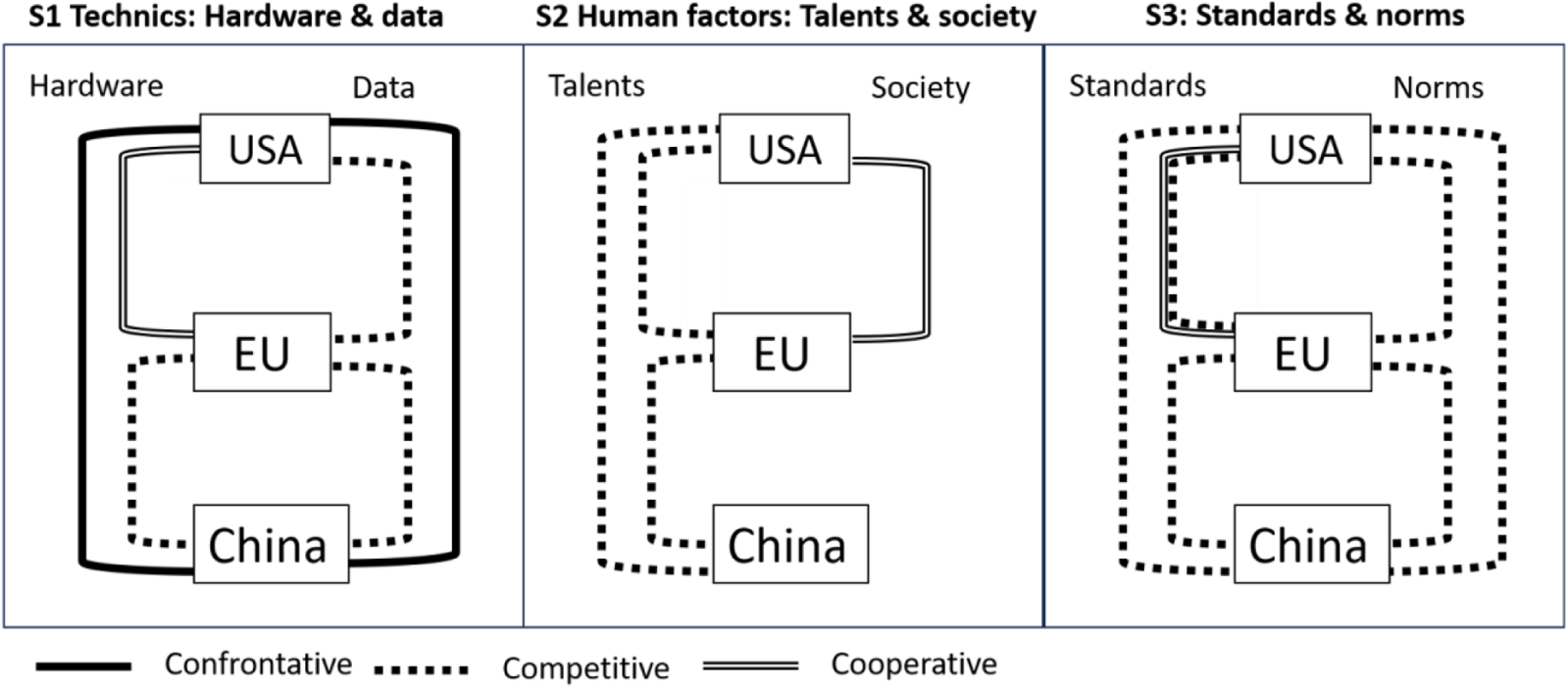
Moving on to the storylines within the main AI narratives, we categorise the relationships between pairs of powers for each storyline according to the predominance of cooperative, competitive, or confrontational elements (see Figure 1). The exceptions concern S2 where our source material does not reveal EU-China interactions and S3 where cooperation and competition in the US-EU relationship are too closely intertwined. While the storylines are tightly interwoven with the main narratives, they point to distinct opportunities, competitive dynamics, and potential risks in the relationship between the powers. The following discussion examines the scope for conflict and cooperation for each storyline.
Overview Storylines.

The greatest conflict potential exists in S1 between China and the US, driven by competition over hardware and data, especially semiconductors and specialised ‘AI chips’, which the US considers essential for mitigating China’s ascent to AI leadership. Facing persistent challenges regarding data governance, the US seeks EU cooperation to strengthen export controls, using the EU as a force multiplier against China. In S2, competition is more balanced, with all three powers vying for top AI talent, viewed as crucial for AI innovation, public readiness, and trust-building. Unlike S1, the talent domain is mainly marked by competition, not confrontation. Regarding AI’s impact on society, the storyline highlights opportunities for EU–US cooperation, for example through the TTC. S3, finally, points to a strongly contested field, particularly over military AI applications. The US resists restrictions on such applications that could weaken its position vis-à-vis China, while the EU advocates for a ban. Competition also extends to AI standards, with China pushing for greater influence in international standard-setting bodies. Although the US and EU exhibit similar approaches compared to China, their regulatory frameworks still differ. S3 is particularly central for the EU, which prioritises ethical and trustworthy AI as a unique European AI identity. For the EU, cooperation with the US therefore risks diluting the distinctiveness of its approach.
The narratives of all three AI powers show that global AI competition is indeed driven by economic and security concerns – as accounts of a ‘tech war’Footnote 45 between them suggest. They also reveal tension between nationalist claims to AI leadership and value-based, border-crossing understandings. In the US case, particularly, the democracy-versus-authoritarianism framing and the image of the US as a ‘beacon of values’ elevate AI competition to near-civilisational stakes. Such universalist framings have a licensing effect, legitimising coalition-building with like-minded states and recasting technological rivalry as a moral imperative.Footnote 46 The EU narrative likewise displays value-based understandings, but less as a universalising civilisational claim. Instead, it uses values to differentiate the EU from the US and China through principles of ethics, responsibility, and trust. In both cases, value-based framings rhetorically reinforce leadership claims, either by embedding them in democratic ideals (US) or by casting them as norm entrepreneurship (EU).
Our analysis suggests that competition for AI leadership goes beyond instrumental motivations and extends to the status as global AI leader itself. The narratives emphasise AI leadership as crucial for recognition as a leading global power. Specifically, higher status plays a key role in setting international norms and standards, a foremost arena of competition among the three powers. Status also affects the capacity to establish alliances, as evidenced by China’s endeavours to avert isolation and the US approach towards prospective partners. Thus, the narratives frame AI leadership as a status marker granting access to prestigious ‘status clubs’,Footnote 47 entwining AI competition with broader status competition in international society.Footnote 48 This puts AI in a long line of technologies, which have served as important status symbols at different points in history.Footnote 49
Conclusion
Our findings reinforce expectations of an emerging ‘AI race’ or ‘tech war’ with risks of escalation and international conflict, a development of growing scholarly concern.Footnote 50 Our approach’s strength lies in its focus on meaning-making and intersubjectivity, counterbalancing the frequently technocratic perspectives on AI in policy discussions. The AI narratives of the three powers illustrate that the primary contenders in AI competition are the US and China, pursuing the fundamentally contrasting goals of sustaining or attaining global AI supremacy. The EU positions itself as a concerned observer, seeking a leadership role in international AI standard-setting to maintain global competitiveness. While all three powers emphasise AI’s positive transformational potential, they prioritise its economic, societal, and military opportunities and risks differently. Our findings indicate that the scope for cooperation and conflict in the emerging global AI order varies across different dimensions of AI competition reflected in the different storylines, technics, human factors, norms, and standards, that unfold alongside the main AI narratives.
The article focuses on ‘official’ AI narratives that reflect how the political leaderships of the three powers aim to shape the international conversation on AI, rather than AI narratives in society. The significance of such elite political framings for international politics precisely lies in their authority and performative force. The reconstructed AI narratives of the three powers are not merely descriptive but do strategic work, legitimising AI as a central domain of geopolitical competition, justifying investments and policy choices and mobilising economic and scientific resources around political objectives. In this way, the narratives contribute directly to shaping strategy-making, economic incentives, and knowledge production in each power. The long-term implication is that the ‘battle of narratives’Footnote 51 between the powers risks entrenching head-to-head competition, amplifying escalation dynamics even in the absence of clear material advantages. At the same time, it limits possibilities for cooperative or pluralist approaches to AI governance.
While the global debate around AI carries elements of hype and anticipatory exaggeration, we argue that this is precisely what gives it political force. International actors tell such narratives not only to frame AI as a strategic and economic priority, but also to claim and defend status in the international order. Our findings suggest that AI leadership is not only an instrumental objective but also a status symbol, which may alter the trajectory of global competition. Specifically, status-driven rivalry amplifies the symbolic significance of leadership, increasing the likelihood of escalation even when tangible advantages are ambiguous. This relationship underscores the symbolic nature of AI competition, where legitimacy depends not alone on material abilities but also on global recognition.Footnote 52 Our source material shows that AI is frequently narrated in conjunction with other technologies, for example semiconductors and biotechnology, which indicates that the symbolic and political force of AI transcends the technology itself. In this way, AI narratives are mobilised to legitimise state behaviour and intervention across a broader set of emerging technologies and therefore extend competitive logics and increase tensions in international politics more broadly. Further research should examine in more depth the key narrative components of ‘AI as a status symbol’ narratives and how important status-seeking is in shaping global AI competition.
Moreover, our results suggest avenues for future research beyond the AI narratives reconstructed in this article. First, our ‘statist’ focus on the ‘official’ AI narratives of the three powers excludes critical voices from civil society or academia, and future research might examine how such non-state narratives complement, contest, or reshape AI narratives in international politics. Second, while the US, China, and the EU currently dominate the competition for global AI leadership, the battlegrounds for talent and markets are global and draw in other states. Within the EU, member states have distinct perspectives on AI, which deserve greater scrutiny. On the global level, the rising powers will be important to any emerging AI order, making it an important field for further research to analyse their AI narratives and how they make sense of AI and their relationship to the three powers. Importantly, as new actors emerge in the global AI arena, we expect established AI narratives in international politics to change. While leading AI powers may adjust their narratives to uphold their leadership claims, new actors may either develop counter-narratives that challenge these claims or adopt complementary narratives that, perhaps inadvertently, further legitimise and sustain the leadership ambitions of the major powers. In any case, AI narratives in international politics are not static, and future research should explore narrative shifts over time, for example in response to geopolitical events or major technological breakthroughs.
Supplementary material
The supplementary material for this article can be found at https://doi.org/10.1017/S0260210526101776.
Acknowledgements
We thank our expert interviewees for their time and input as well as the Deutsche Stiftung Friedensforschung for funding our research. We have presented previous drafts of the article at the 2023 SNIS Biennial Conference in St. Gallen, the 3rd Interdisciplinary Conference on Technical Peace Research (SPS23) in Darmstadt and the 2023 meeting of the International Relations Section of the German Political Science Association (DVPW) in Friedrchshafen, and we are grateful for all feedback and suggestions. Finally, we thank the anonymous reviewers and the RIS editorial team for their constructive comments and guidance throughout the review process.