1. Introduction
The notion of system signature, introduced originally by Samaniego [Reference Samaniego26], plays an important role in describing and comparing structures of coherent or mixed systems in the field of reliability [Reference Zarezadeh, Asadi and Eftekhar39]. As discussed in Kochar et al. [Reference Kochar, Mukerjee and Samaniego14], stochastic orderings of signatures lead to stochastic comparisons of related system lifetimes, which therefore have considerable practical utility in analyzing the relative merits of different structural designs of systems. Applications and extensions of system signature can be found in [Reference Navarro and Rychlik22,Reference Navarro, Samaniego, Balakrishnan and Bhattacharya25,Reference Samaniego27] and also about several different computational methods for it in Da et al. [Reference Da, Xu and Chan10]. Some similar notions have also been proposed based on different forms of systems; for example, maximal/minimal signature [Reference Navarro, Ruiz and Sandoval21], survival signature [Reference Coolen, Coolen-Maturi, Zamojski, Mazurkiewicz, Sugier, Walkowiak and Kacprzyk6], ordered system signature [Reference Balakrishnan and Volterman5], and joint signature [Reference Coolen-Maturi, Coolen and Balakrishnan7,Reference Navarro, Samaniego and Balakrishnan23,Reference Navarro, Samaniego and Balakrishnan24].
The above notions have all been discussed for binary-state systems to begin with, but extensions to multi-state systems have also been studied subsequently due to the practical application of multi-state systems. They began with multi-state systems with binary-state components; for example, multi-dimensional D-spectrum and its related notions have been developed in the content of networks [Reference Gertsbakh, Shpungin, Lisnianski and Frenkel12,Reference Levitin, Gertsbakh and Shpungin16] and a similar notion of two-dimensional signature has been proposed in reliability theory [Reference Gertsbakh, Shpungin and Spizzichino13]. Further discussions can be found in [Reference Kumar and Singh15,Reference Liu, Shi, Bai and Liu17,Reference Marichal, Mathonet, Navarro and Paroissin19]. Recently, ordered multi-state signature [Reference Yi, Balakrishnan and Cui32] and multi-state joint signature [Reference Yi, Balakrishnan and Cui35] have been introduced extending the corresponding notions for binary-state systems, and comparisons of multi-state systems of different sizes have also been considered based on these notions [Reference Yi, Balakrishnan and Cui33,Reference Yi, Balakrishnan and Li37]. As for multi-state systems with multi-state components, notions like multistate monotone system signature [Reference Da Costa Bueno8] and multi-state survival signature [Reference Eryilmaz and Tuncel11] can be found, and the latter one can be computed either by the use of a finite Markov chain imbedding approach [Reference Yi, Balakrishnan and Cui34] or by an application of a module method [Reference Yi, Balakrishnan and Li36].
Used systems and their residual lifetimes are of great interest in reliability theory. System signature and its related notions can not only be used for comparing new systems, but also for evaluating the dynamic properties of used systems and comparisons between their residual lifetimes [Reference Navarro, Balakrishnan and Samaniego20]. More specifically, Samaniego et al. [Reference Samaniego, Balakrishnan and Navarro28] introduced the concept of dynamic signature and used it to compare the reliability of new and used systems, and Mahmoudi and Asadi [Reference Mahmoudi and Asadi18] further considered some special cases with partial information about the failure status of the system. Notions like residual entropy have also been considered based on the dynamic signature for residual lifetime of a working used system [Reference Toomaj, Chahkandi and Balakrishnan29]. Some related discussions can be found for networks with links that are subject to failures according to nonhomogeneous Poisson processes [Reference Da Costa Bueno and Balakrishnan9,Reference Zarezadeh, Asadi and Balakrishnan38], and ternary-state networks with known system status and known number of failed links [Reference Ashrafi and Asadi2].
In the present work, we are interested in the dynamic properties of used multi-state systems in a life-test. For this type of systems, Yi et al. [Reference Yi, Balakrishnan and Cui32] introduced the notion of ordered multi-state system signature based on a life-test of several independent and identically distributed (i.i.d.) multi-state coherent systems with binary-state components. Here, we first generalize this notion by relaxing the assumption of identical systems and redefine it for several independent and non-identical multi-state coherent or mixed systems with binary-state components. We then introduce a new notion of dynamic multi-state system signature extending the corresponding notion of Samaniego et al. [Reference Samaniego, Balakrishnan and Navarro28] for binary-state systems, and then utilize it to study dynamic properties of used multi-state systems in a life-test through the associated notion of dynamic ordered multi-state system signature.
The concept of ordered multi-state system signature is very useful for multi-state reliability systems in a life-test. For demonstrating this, let us consider several wireless sensor network systems consisting of the same type of sensors. Lifetimes of the sensors are assumed to be i.i.d., and the state of each system depends on the number of connected parts in it. Then, in a life-test of such multi-state coherent systems, statistical inference for the lifetime distribution of sensors can be developed based on degradation data of the systems along the lines of Balakrishnan et al. [Reference Balakrishnan, Ng and Navarro3,Reference Balakrishnan, Ng and Navarro4] and Yang et al. [Reference Yang, Ng and Balakrishnan30,Reference Yang, Ng and Balakrishnan31]. Moreover, in practice, life-tests often get terminated at a certain system failure time (say,  $r\textrm{ - th}$ system failure time) to save time and cost, in the life-testing experiment involved. This results in censoring while observing. In such a situation, the ordered multi-state system signature will be quite useful and efficient, rather than the multi-state signature for developing statistical inference on the lifetime distribution of the sensors. Furthermore, the wireless sensor network systems under test need not be identical anymore with the results developed here, and the dynamic properties of the remaining surviving systems under test can also be assessed by using the notion of dynamic multi-state system signature.
The rest of this paper proceeds as follows. In Section 2, we first generalize the notion of ordered multi-state system signature from i.i.d. multi-state coherent systems to independent and non-identical coherent or mixed systems, and then establish some of its properties which help us in simplifying its computational process. Next, in Section 3, we introduce dynamic multi-state system signature for studying dynamic properties of multi-state systems and also for comparing these systems based on their system lifetimes and associated costs. In Section 4, we illustrate the theoretical results established in the preceding sections through some specific examples with the use of dynamic ordered multi-state system signature. Finally, some concluding remarks are made in Section 5.
2. Ordered multi-state system signature for independent and non-identical systems
For a multi-state coherent system with binary-state components, the multi-state system signature has been defined and studied in detail by Yi et al. [Reference Yi, Balakrishnan and Cui32]. This notion is generalized below to a multi-state coherent or mixed system with binary-state components.
Definition 2.1. Consider a multi-state coherent or mixed system with state space  $\{ 0, \ldots ,n\}$ and m i.i.d. binary-state components having a continuous lifetime distribution
 $F$. Denote the time at which the system enters states
 $n - i$ or below, namely, the system lifetime on state
 $n - i + 1$, by
 ${T_i},\textrm{ }i = 1, \ldots ,n$. Then, the multi-state system signature of the system is given by
 $$\bf{s} = ({s_{{i_1}, \ldots ,{i_n}}},1 \le {i_1} \le \cdots \le {i_n} \le m),$$
where  ${s_{{i_1}, \ldots ,{i_n}}} = P\{ {T_1} = {X_{{i_1}:m}}, \ldots ,{T_n} = {X_{{i_n}:m}}\}$ and
 ${X_{{i_1}:m}}, \ldots ,{X_{{i_n}:m}}$ are the
 ${i_1}-\textrm{th,} \ldots \textrm{, }{i_n}-\textrm{th}$ order statistics among the component lifetimes
 ${X_1}, \ldots ,{X_m}$, respectively.
Remark 2.1. As discussed in Yi et al. [Reference Yi, Balakrishnan and Cui35], the subscripts  ${i_1}, \ldots ,{i_n}$ can be relabeled as
 $1 + \sum\nolimits_{l = 1}^n {\sum\nolimits_{j = {i_{l - 1}}}^{{i_l} - 1} {\left( {\begin{array}{*{20}{c}} {m + n - l - j}\\ {n - l} \end{array}} \right)} }$ with
 ${i_0} = 1$, which would change the multi-state system signature
 $\bf{s}$ into a vector of dimension
 $\left( {\begin{array}{*{20}{c}} {m + n - 1}\\ n \end{array}} \right)$.
Based on the notion of multi-state system signature, Yi et al. [Reference Yi, Balakrishnan and Cui32] also defined and studied ordered multi-state system signature based on a life-test of several i.i.d. multi-state coherent systems with binary-state components. In fact, the assumption of identical systems is not at all necessary in this notion. Let us consider a life-test of M independent multi-state coherent or mixed systems with a common state space  $\{ 0, \ldots ,n\}$ and different numbers of i.i.d. binary-state components having a common continuous lifetime distribution F. Denote the largest number of components in the M systems by m, and assume that the systems can be divided into N groups according to their equivalent systems of size m, namely, the
 ${k_i}$ systems in each group
 $i = 1, \ldots ,N$ (labeled as systems
 $\sum\nolimits_{j = 1}^{i - 1} {{k_j} + 1} ,\sum\nolimits_{j = 1}^{i - 1} {{k_j} + 2, \ldots ,} \sum\nolimits_{j = 1}^i {{k_j}}$) have the same equivalent system with m components and a system signature
 ${\bf{s}^{(i)}} = (s_{{i_1}, \ldots ,{i_n}}^{(i)},1 \le {i_1} \le \cdots \le m)$. Note that
 ${k_i} \in \{ 1, \ldots ,M\}$, for all
 $i = 1, \ldots ,N$, with
 $\sum\nolimits_{i = 1}^N {{k_i}} = M,$ and
 ${\bf{s}^{(i)}}$
 $(i = 1, \ldots ,N)$ are different for different i. Let us denote the system lifetimes on states
 $n, \ldots ,1$ by
 $T_1^p, \ldots ,T_n^p$, for systems
 $p = 1, \ldots ,M$, respectively. Then, the definition of ordered multi-state system signature can be generalized based on a life-test of several independent and non-identical coherent or mixed systems as follows.
Definition 2.2. The ordered multi-state system signature  ${\bf{s}^{qr}} = (s_{{j_1}, \ldots ,{j_n}}^{qr},1 \le {j_1} \le \cdots \le {j_n} \le m)$ for the
 $q-\textrm{th}$ system that enters state
 $n - r$ or below
 $(q = 1, \ldots ,M,r = 1, \ldots ,n)$ is
 $$s_{{j_1}, \ldots ,{j_n}}^{qr} = P\{ T_1^p = X_{{j_1}:m}^p, \ldots ,T_n^p = X_{{j_n}:m}^p|{T_r^{q:M} = T_r^p} \} ,$$
where  $T_r^{q:M}$ is the
 $q-\textrm{th}$ order statistic among
 $T_r^1, \ldots ,T_r^M$ and
 $X_{{j_1}:m}^p, \ldots ,X_{{j_n}:m}^p$ are the
 ${j_1}-\textrm{th,} \ldots \textrm{, }{j_n}-\textrm{th}$ order statistics among component lifetimes
 $X_1^p, \ldots ,X_m^p$ for system p.
Then, along the lines of Balakrishnan and Volterman [Reference Balakrishnan and Volterman5], associated properties of ordered multi-state system signatures can be presented for these independent and non-identical multi-state coherent or mixed systems. The first of these is the most important distribution-free property, as established in the following proposition.
Proposition 2.1. The ordered multi-state system signature  ${\bf{s}^{qr}} = (s_{{j_1}, \ldots ,{j_n}}^{qr},1 \le {j_1} \le \cdots \le {j_n} \le m)$ is free of the underlying component lifetime distribution
 $F$, and is thus a distribution-free measure.
Proof. For each group  $i = 1, \ldots ,N$, assume that in all the
 ${k_i}$ i.i.d. equivalent multi-state coherent or mixed systems with signature
 ${\bf{s}^{(i)}} = (s_{{i_1}, \ldots ,{i_n}}^{(i)},1 \le {i_1} \le \cdots \le {i_n} \le m),$ there are
 ${l_{i,{i_1}, \ldots ,{i_n}}}$
 $(1 \le i \le N,1 \le {i_1} \le \cdots \le {i_n} \le m)$ of them that enter states
 $n - 1, \ldots ,0$ due to the
 ${i_1}-\textrm{th,} \ldots \textrm{,}{i_n}-\textrm{th}$ ordered component failures, respectively. Evidently, all possible combinations of these
 ${l_{i;{i_1}, \ldots ,{i_n}}}$ systems can be given as
 $${\mathscr{L}_{\bf{k}}} = \{ \bf{l} = ({l_{i,{i_1}, \ldots ,{i_n}}},\textrm{ }1 \le i \le N,\textrm{ }1 \le {i_1} \le \cdots \le {i_n} \le m):\textrm{ }\sum\limits_{1 \le {i_1} \le \cdots \le {i_n} \le m} {{l_{i,{i_1}, \ldots ,{i_n}}}} = {k_i}\textrm{ for all }i\} .$$
Then, for  $i = 1, \ldots ,N,$ as discussed in Balakrishnan and Volterman [Reference Balakrishnan and Volterman5],
 ${l_{i,{i_1}, \ldots ,{i_n}}}$
 $(1 \le {i_1} \le \cdots \le {i_n} \le m)$ are distributed as multinomial with parameters
 ${k_i}$ and
 $s_{{i_1}, \ldots ,{i_n}}^{(i)}$, with
 $1 \le {i_1} \le \cdots \le {i_n} \le m$, Hence, for
 $i = 1, \ldots ,N$ and
 $1 \le {i_1} \le \cdots \le {i_n} \le m$, we have
 $$s_{{j_1}, \ldots ,{j_n}}^{qr} = \sum\limits_{\bf{l} \in {\mathscr{L}_{\bf{k}}}} {p_{{j_1}, \ldots ,{j_n}|\bf{l} }^{qr}\prod\limits_{i = 1}^N {\left\{ {\left( {\begin{array}{*{20}{c}} {{k_i}}\\ {{l_{i,{i_1}, \ldots ,{i_n}}},1 \le {i_1} \le \cdots \le {i_n} \le m} \end{array}} \right)\prod\limits_{1 \le {i_1} \le \cdots \le {i_n} \le m} {{{[{s_{{i_1}, \ldots ,{i_n}}^{(i)}} ]}^{{l_{i,{i_1}, \ldots ,{i_n}}}}}} } \right\}} } ,$$
where  $p_{{j_1}, \ldots ,{j_n}|\bf{l} }^{qr}$ is the conditional probability that the
 $q-\textrm{th}$ system entering state
 $n - r$ or below enters state
 $n - 1, \ldots ,0$ due to the
 ${j_1}-\textrm{th,} \ldots \textrm{,}{j_n}-\textrm{th}$ ordered component failures, respectively, given a fixed value of
 $\bf{l}$, that is, given that
 ${l_{{i_1}, \ldots ,{i_n}}} = {l_{1,{i_1}, \ldots ,{i_n}}} + \cdots + {l_{N,{i_1}, \ldots ,{i_n}}}$
 $(1 \le {i_1} \le \cdots \le {i_n} \le m)$ systems enter states
 $n - 1, \ldots ,0$ due to the
 ${i_1}-\textrm{th,} \ldots \textrm{,}{i_n}-\textrm{th}$ ordered component failures, respectively. Note that
 $p_{{j_1}, \ldots ,{j_n}|\bf{l} }^{qr}$ depends on
 $\bf{l}$ only through
 ${l_{{i_1}, \ldots ,{i_n}}}$
 $(1 \le {i_1} \le \cdots \le {i_n} \le m)$, which means that it can also be denoted by
 $p_{{j_1}, \ldots ,{j_n}|{{l_{{i_1}, \ldots ,{i_n}}}, 1 \le {i_1} \le \cdots \le {i_n} \le m,} }^{qr}$. Clearly,
 $p_{{j_1}, \ldots ,{j_n}|\bf{l} }^{qr}$ can be expressed as probabilities of orderings of
 $X_{{i_k}:m}^{(k)}$, which are independent of the component lifetime distribution F. Hence, the proposition proved.
Remark 2.2. Distribution-free characteristic is an important property for a signature concept, as it can then divide performance information of a reliability system into two parts: structure of the system and the common component lifetime distribution. For this reason, it is therefore good to observe that this distribution-free property continues to hold for the ordered multi-state signature generalized to the case of non-identical systems.
As discussed above, Proposition 2.1 provides formulas for ordered multi-state system signatures  ${\bf{s}^{qr}}$
 $(q = 1, \ldots ,M,r = 1, \ldots ,n)$ for these independent and non-identical multi-state coherent or mixed systems based on their multi-state system signatures
 ${\bf{s}^{(1)}}, \ldots ,{\bf{s}^{(N)}}$. These formulas are quite simple and direct, and the main difficulty in their use is in the computation of conditional probabilities
 $p_{j|\bf{l} }^{(i:n)}$, for which some useful properties are established in the following lemma.
Lemma 2.1. The conditional probabilities  $p_{{j_1}, \ldots ,{j_n}|\bf{l} }^{qr}$ satisfy the following properties:
(1) If
 ${l_{1,{j_1}, \ldots ,{j_n}}} + \cdots + {l_{N,{j_1}, \ldots ,{j_n}}} = M$, then $p_{{j_1}, \ldots ,{j_n}|\bf{l} }^{qr} = 1$, and if
then$$\sum\limits_{i = 1}^N {\sum\limits_{1 \le {j_1} \le \cdots \le {j_{w - 1}} \le a \le {j_{w + 1}} \le \cdots \le {j_n} \le m} {{l_{i,{j_1}, \ldots ,{j_{w - 1}},a,{j_{w + 1}}, \ldots ,{j_n}}}} } = M,$$$\sum\nolimits_{1 \le {j_1} \le \cdots \le {j_{w - 1}} \le a \le {j_{w + 1}} \le \cdots \le {j_n} \le m} {p_{i,{j_1}, \ldots ,{j_{w - 1}},a,{j_{w + 1}}, \ldots ,{j_n}|\bf{l} }^{qr}} = 1;$
(2) If
${l_{1,{i_1}, \ldots ,{i_n}}} = \cdots = {l_{N,{i_1}, \ldots ,{i_n}}} = 0$, then $p_{{j_1}, \ldots ,{j_n}|\bf{l} }^{qr} = 0$, and if
then$$\sum\limits_{i = 1}^N {\sum\limits_{1 \le {j_1} \le \cdots \le {j_{w - 1}} \le a \le {j_{w + 1}} \le \cdots \le {j_n} \le m} {{l_{i,{j_1}, \ldots ,{j_{w - 1}},a,{j_{w + 1}}, \ldots ,{j_n}}}} } = 0,$$$\sum\nolimits_{1 \le {j_1} \le \cdots \le {j_{w - 1}} \le a \le {j_{w + 1}} \le \cdots \le {j_n} \le m} {p_{i,{j_1}, \ldots ,{j_{w - 1}},a,{j_{w + 1}}, \ldots ,{j_n}|\bf{l} }^{qr}} = 0;$(3)
$\sum\nolimits_{q = 1}^M {p_{{j_1}, \ldots ,{j_n}|\bf{l} }^{qr}} = \sum\nolimits_{i = 1}^N {{l_{i,{j_1}, \ldots ,{j_n}}}} ;$(4)
$p_{{j_1}, \ldots ,{j_n}|\bf{l} }^{qr} = p_{m - {j_n} + 1, \ldots ,m - {j_1} + 1|{\textrm{rev }\bf{l}} }^{(M - q + 1)(n - r + 1)}$, where $\textrm{rev}{\kern 1pt} {\kern 1pt} {\kern 1pt} \bf{l}: = ({\tilde{l}_{i,{i_1}, \ldots ,{i_n}}},\textrm{ }1 \le i \le N,\textrm{ }1 \le {i_1} \le \cdots \le {i_n} \le m)$ with ${\tilde{l}_{i,{i_1}, \ldots ,{i_n}}} = {l_{i,m - {i_n} + 1, \ldots ,m - {i_1} + 1}}.$


Proof. See the Appendix for a detailed proof.
Proposition 2.1 and Lemma 2.1 lead to some simplifications in the computation of ordered multi-state system signatures in the following manner.
Corollary 2.1. For any  $1 \le {j_1} \le \cdots \le {j_n} \le m$,
 $s_{{j_1}, \ldots ,{j_n}}^{qr} = 0$
 $(r = 1, \ldots ,n,\textrm{ }q = 1, \ldots ,M)$ if and only if
 $s_{{j_1}, \ldots ,{j_n}}^{(1)} = \cdots = s_{{j_1}, \ldots ,{j_n}}^{(N)} = 0$.
(1) For
$s_{{j_1}, \ldots ,{j_n}}^{(1)} = \cdots = s_{{j_1}, \ldots ,{j_n}}^{(N)} = 0$, the terms in the expression
can be classified into two classes: for$$s_{{j_1}, \ldots ,{j_n}}^{qr} = \sum\limits_{\bf{l} \in {\mathscr{L}_{\bf{k}}}} {p_{{j_1}, \ldots ,{j_n}|\bf{l} }^{qr}\prod\limits_{i = 1}^N {\left\{ {\left( {\begin{array}{*{20}{c}} {{k_i}}\\ {{l_{i,{i_1}, \ldots ,{i_n}}},1 \le {i_1} \le \cdots \le {i_n} \le m} \end{array}} \right)\prod\limits_{1 \le {i_1} \le \cdots \le {i_n} \le m} {{{[{s_{{i_1}, \ldots ,{i_n}}^{(i)}} ]}^{{l_{i,{i_1}, \ldots ,{i_n}}}}}} } \right\}} }$$$\bf{l} \in {\mathscr{L}_{\bf{k}}}$ such that ${l_{1,{j_1}, \ldots ,{j_n}}} = \cdots = {l_{N,{j_1}, \ldots ,{j_n}}} = 0$, the corresponding terms will all be $0$ with $p_{{j_1}, \ldots ,{j_n}|\bf{l} }^{qr} = 0$ (see Part (2) of Lemma 2.1 for details), and for $\bf{l} \in {\textrm{L}_{\bf{k}}}$ such that $\sum\nolimits_{i = 1}^N {{l_{i,{j_1}, \ldots ,{j_n}}}} \ne 0$, the corresponding terms will all be $0$ with $\prod\nolimits_{i = 1}^N {{{[{s_{{j_1}, \ldots ,{j_n}}^{(i)}} ]}^{{l_{i,{j_1}, \ldots ,{j_n}}}}}} = {[{s_{{j_1}, \ldots ,{j_n}}^{(1)}} ]^{\sum\limits_{i = 1}^N {{l_{i,{j_1}, \ldots ,{j_n}}}} }} = 0$. Then, it is clear that we have $s_{{j_1}, \ldots ,{j_n}}^{qr} = 0$ for any $r = 1, \ldots ,n$ and $q = 1, \ldots ,M$.(2) For
$s_{{j_1}, \ldots ,{j_n}}^{qr} = 0$ $(r = 1, \ldots ,n,\textrm{ }q = 1, \ldots ,M)$, we have
\begin{align*} 0 & = \sum\limits_{q = 1}^M {s_{{j_1}, \ldots ,{j_n}}^{qr}} \\ & \textrm{ = }\sum\limits_{\bf{l} \in {\mathscr{L}_{\bf{k}}}} {\left( {\sum\limits_{q = 1}^M {p_{{j_1}, \ldots ,{j_n}|\bf{l} }^{qr}} } \right) \cdot \prod\limits_{i = 1}^N {\left\{ {\left( {\begin{array}{*{20}{c}} {{k_i}}\\ {{l_{i,{i_1}, \ldots ,{i_n}}},1 \le {i_1} \le \cdots \le {i_n} \le m} \end{array}} \right)\prod\limits_{1 \le {i_1} \le \cdots \le {i_n} \le m} {{{[{s_{{i_1}, \ldots ,{i_n}}^{(i)}} ]}^{{l_{i,{i_1}, \ldots ,{i_n}}}}}} } \right\}} } \\ & = \sum\limits_{\bf{l} \in {\mathscr{L}_{\bf{k}}}} {\left( {\sum\limits_{s = 1}^N {{l_{s,{j_1}, \ldots ,{j_n}}}} } \right) \cdot \prod\limits_{i = 1}^N {\left\{ {\left( {\begin{array}{*{20}{c}} {{k_i}}\\ {{l_{i,{i_1}, \ldots ,{i_n}}},1 \le {i_1} \le \cdots \le {i_n} \le m} \end{array}} \right)\prod\limits_{1 \le {i_1} \le \cdots \le {i_n} \le m} {{{[{s_{{i_1}, \ldots ,{i_n}}^{(i)}} ]}^{{l_{i,{i_1}, \ldots ,{i_n}}}}}} } \right\}} } \\ & = \sum\limits_{s = 1}^N {\sum\limits_{{\bf{l}_s} \in {{\tilde{\mathscr{L}}}_s}} {\left\{ {{l_{s,{j_1}, \ldots ,{j_n}}} \cdot \left( {\begin{array}{*{20}{c}} {{k_s}}\\ {{l_{s,{i_1}, \ldots ,{i_n}}},1 \le {i_1} \le \cdots \le {i_n} \le m} \end{array}} \right)\prod\limits_{1 \le {i_1} \le \cdots \le {i_n} \le m} {{{[{s_{{i_1}, \ldots ,{i_n}}^{(s)}} ]}^{{l_{s,{i_1}, \ldots ,{i_n}}}}}} } \right\}} } \\ & = \sum\limits_{s = 1}^N {{k_s}s_{{j_1}, \ldots ,{j_n}}^{(s)}} , \end{align*}


since vectors  $\textrm{ }\sum\nolimits_{1 \le {i_1} \le \cdots \le ,{i_n} \le m} {{l_{i,{i_1}, \ldots ,{i_n}}}} = {k_s}\}$
 ${\bf{l}_s} \in {\tilde{\mathscr{L}}_s} = \{ ({l_{s,{i_1}, \ldots ,{i_n}}},\textrm{ }1 \le {i_1} \le \cdots \le {i_n} \le m):$
 $(s = 1, \ldots ,N)$ are distributed as multinomial with parameters
 ${k_s}$ and
 ${l_{s,{i_1}, \ldots ,{i_n}}}$ with
 $1 \le {i_1} \le \cdots \le {i_n} \le m$. Then, we clearly have
 $s_{{j_1}, \ldots ,{j_n}}^{(1)} = \cdots = s_{{j_1}, \ldots ,{j_n}}^{(N)} = 0$, as required.
Remark 2.3. For example, when  $m = 2$, consider a simple case with multi-state signatures
 ${\bf{s}^{(1)}} = (s_{1,1}^{(1)},0,s_{2,2}^{(1)})$ and
 ${\bf{s}^{(2)}} = (s_{1,1}^{(1)},0,s_{2,2}^{(1)})$; then, the corresponding ordered multi-state signatures definitely have a unified form
 ${\bf{s}^{qr}} = (s_{1,1}^{qr},0,s_{2,2}^{qr})$ with
 $q = 1,2,\textrm{ }r = 1,2$, and vice versa.
In addition to the properties established above, there are also some symmetry properties that help further simplify the computational process of the ordered multi-state system signature.
Proposition 2.2. The ordered multi-state system signatures satisfy  $\sum\nolimits_{q = 1}^M {{\bf{s}^{qr}}} = \sum\nolimits_{i = 1}^N {{k_i}{\bf{s}^{(i)}}}$ and
 $rev{\kern 1pt} {\kern 1pt} {\kern 1pt} {\bf{s}^{qr}} = {(rev{\kern 1pt} {\kern 1pt} {\kern 1pt} \bf{s})^{(M - q + 1)(n - r + 1)}}$.
(1) From the proof of Corollary 2.1, we have
which clearly leads to the fact that$$\sum\limits_{q = 1}^M {s_{{j_1}, \ldots ,{j_n}}^{qr}} = \sum\limits_{i = 1}^N {{k_i}s_{{j_1}, \ldots ,{j_n}}^{(i)}} ,$$$\sum\nolimits_{q = 1}^M {{\bf{s}^{qr}}} = \sum\nolimits_{i = 1}^N {{k_i}{\bf{s}^{(i)}}} ;$(2) From the formula of
$s_{{j_1}, \ldots ,{j_n}}^{qr}$ in Proposition 2.1 and Part (4) of Lemma 2.1, we have
which leads to the fact that\begin{align*} \tilde{s}_{m - {j_n}, \ldots ,m - {j_1}}^{(M - q + 1)(n - r + 1)} & = \sum\limits_{\bf{l} \in {\mathscr{L}_{\bf{k}}}} p_{m - {j_n}, \ldots ,m - {j_1}|\bf{l} }^{(M - q + 1)(n - r + 1)}\\ &\quad\times\prod\limits_{i = 1}^N {\left\{ {\left( {\begin{array}{*{20}{c}} {{k_i}}\\ {{l_{i,{i_1}, \ldots ,{i_n}}},1 \le {i_1} \le \cdots \le {i_n} \le m} \end{array}} \right)\prod\limits_{1 \le {i_1} \le \cdots \le {i_n} \le m} {{{[{\tilde{s}_{{i_1}, \ldots ,{i_n}}^{(i)}} ]}^{{l_{i,{i_1}, \ldots ,{i_n}}}}}} } \right\}} \\ & = \sum\limits_{\bf{l} \in {\mathscr{L}_{\bf{k}}}} p_{{j_1}, \ldots ,{j_n}|{\textrm{rev }\bf{l}} }^{qr}\\ &\quad\times\prod\limits_{i = 1}^N {\left\{ {\left( {\begin{array}{*{20}{c}} {{k_i}}\\ {{l_{i,{i_1}, \ldots ,{i_n}}},1 \le {i_1} \le \cdots \le {i_n} \le m} \end{array}} \right)\prod\limits_{1 \le {i_1} \le \cdots \le {i_n} \le m} {{{[{s_{m - {i_n}, \ldots ,m - {i_1}}^{(i)}} ]}^{{l_{i,{i_1}, \ldots ,{i_n}}}}}} } \right\}}\\ & = \sum\limits_{\bf{l} \in {\mathscr{L}_{\bf{k}}}} p_{{j_1}, \ldots ,{j_n}|\bf{l} }^{qr}\\ &\quad\times\prod\limits_{i = 1}^N {\left\{ {\left( {\begin{array}{*{20}{c}} {{k_i}}\\ {{l_{i,{i_1}, \ldots ,{i_n}}},1 \le {i_1} \le \cdots \le {i_n} \le m} \end{array}} \right)\prod\limits_{1 \le {i_1} \le \cdots \le {i_n} \le m} {{{[{s_{{i_1}, \ldots ,{i_n}}^{(i)}} ]}^{{l_{i,{i_1}, \ldots ,{i_n}}}}}} } \right\}} \\ & = s_{{j_1}, \ldots ,{j_n}}^{qr}, \end{align*}$rev{\kern 1pt} {\kern 1pt} {\kern 1pt} {\bf{s}^{qr}} = {(rev{\kern 1pt} {\kern 1pt} {\kern 1pt} \bf{s})^{(M - q + 1)(n - r + 1)}}$. Hence, the proposition proved.


Remark 2.4. The equality  $\sum\nolimits_{q = 1}^M {{\bf{s}^{qr}}} = \sum\nolimits_{i = 1}^N {{k_i}{\bf{s}^{(i)}}}$ means that multi-state system signatures have the same arithmetic average as their corresponding ordered multi-state system signatures. Also,
 $rev{\kern 1pt} {\kern 1pt} {\kern 1pt} {\bf{s}^{qr}} = {(rev{\kern 1pt} {\kern 1pt} {\kern 1pt} \bf{s})^{(M - q + 1)(n - r + 1)}}$ illustrates the relationship between the ordered multi-state system signatures of several multi-state systems in a life-test and the ordered multi-state system signatures of their dual systems.
Corollary 2.2. If all multi-state system signatures are symmetric (i.e.,  ${\bf{s}^{(i)}} = rev{\kern 1pt} {\kern 1pt} {\kern 1pt} {\bf{s}^{(i)}}$ for all
 $i = 1, \ldots ,N$), then the ordered system signature is such that
 $rev{\kern 1pt} {\kern 1pt} {\kern 1pt} {\bf{s}^{qr}} = {\kern 1pt} {\kern 1pt} {\kern 1pt} {\bf{s}^{(M - q + 1)(n - r + 1)}}$.
Proof. This can be established directly from Proposition 2.2.
Now, it will be of interest to consider comparisons of ordered multi-state system signatures by weak multivariate stochastic ordering  ${ \le ^{\textrm{st}}}$ discussed in Yi et al. [Reference Yi, Balakrishnan and Cui32]. These are briefly presented in the following two propositions. As a special case, Proposition 2.3 is obtained first.
Proposition 2.3. For any  $k = 1, \ldots ,n$, if
 $s_{{i_1}, \ldots ,{i_n}}^{(1)} = \cdots = s_{{i_1}, \ldots ,{i_n}}^{(N)} = 0$ for all
 $1 \le {i_1} \le \cdots \le {i_n} \le m$ with
 ${i_k} \ne a$, then
 ${\bf{s}^{1k}} = \cdots = {\bf{s}^{Mk}} = {M^{ - 1}}\sum\nolimits_{i = 1}^N {{k_i}{\bf{s}^{(i)}}}$.
Proof. For any  $k = 1, \ldots ,n$,
 $s_{{i_1}, \ldots ,{i_n}}^{(1)} = \cdots = s_{{i_1}, \ldots ,{i_n}}^{(N)} = 0$ for all
 $1 \le {i_1} \le \cdots \le {i_n} \le m$ with
 ${i_k} \ne a$ means
 $\sum\nolimits_{\scriptstyle1 \le {i_1} \le \cdots \le {i_{k - 1}} \le a \le \cdots \le {i_n} \le m} {s_{{i_1}, \ldots ,{i_{k - 1}},a,{i_k}, \ldots ,{i_n}}^{(1)}}$
 $= \cdots = \sum\nolimits_{\scriptstyle1 \le {i_1} \le \cdots \le {i_{k - 1}} \le a \le \cdots \le {i_n} \le m} {s_{{i_1}, \ldots ,{i_{k - 1}},a,{i_k}, \ldots ,{i_n}}^{(N)}} = 1.$ Then, all the M multi-state systems must enter state
 $n - k$ or below at the
 $a-\textrm{th}$ component failure. Now, as probabilities of orderings of the M i.i.d.
 ${X_{a:m}}$ are all equal, from the proof of Proposition 2.1, we immediately have
 $p_{{j_1}, \ldots ,{j_n}|\bf{l} }^{1k} = \cdots = p_{{j_1}, \ldots ,{j_n}|\bf{l} }^{Mk}$ for all
 $1 \le {j_1} \le \cdots \le {j_n} \le m,$ which means that
 ${\bf{s}^{1k}} = \cdots = {\bf{s}^{Mk}}.$ Then, by Proposition 2.2, we clearly have
 ${\bf{s}^{1k}} = \cdots = {\bf{s}^{Mk}} = {M^{ - 1}}\sum\nolimits_{i = 1}^N {{k_i}{\bf{s}^{(i)}}}$.
Remark 2.5. For example, when  $m = 3$, consider a simple case with multi-state signatures
 ${\bf{s}^{(1)}} = (s_{1,1}^{(1)},s_{1,2}^{(1)},s_{1,3}^{(1)},0,0,0)$ and
 ${\bf{s}^{(2)}} = (s_{1,1}^{(2)},s_{1,2}^{(2)},s_{1,3}^{(2)},0,0,0)$. Then, the corresponding ordered multi-state signatures
 ${\bf{s}^{11}},{\bf{s}^{12}},{\bf{s}^{21}},{\bf{s}^{22}}$ satisfy
 ${\bf{s}^{11}} = {\bf{s}^{21}} = [{\bf{s}^{(1)}} + {\bf{s}^{(2)}}]/2$.
(1) For any
$1 \le {q_1} < {q_2} \le M$, the ordered signatures satisfy ${\bf{s}^{{q_1}r}}{ \le ^{\textrm{st}}}{\bf{s}^{{q_2}r}};$(2) If
${\bf{s}^{{q_1}r}}{ \ge ^{\textrm{st}}}{\bf{s}^{{q_2}r}}$ for any $1 \le {q_1} < {q_2} \le M$, then there exists some $\kappa \in \{ 1,2, \ldots ,m\}$ such that $s_{{j_1}, \ldots ,{j_n}}^{(i)} \ne 0$ if and only if ${j_r} = \kappa$, for any $1 \le {j_1} \le \cdots {j_{r - 1}} \le {j_{r + \textrm{1}}} \le \cdots \le {j_n} \le m$.


Proof. See the Reference Arnold, Balakrishnan and NagarajaAppendix for a detailed proof.
Remark 2.6. Part (1) corresponds to the fact that a system that failed earlier in a life-test would have a worser structure. For Part (2), consider a simple example with multi-state signatures  ${\bf{s}^{(1)}} = (s_{1,1}^{(1)},s_{1,2}^{(1)},s_{1,3}^{(1)},s_{2,2}^{(1)},s_{2,3}^{(1)},s_{3,3}^{(1)})$ and
 ${\bf{s}^{(2)}} = (s_{1,1}^{(2)},s_{1,2}^{(2)},s_{1,3}^{(2)},s_{2,2}^{(2)},s_{2,3}^{(2)},s_{3,3}^{(2)})$. If
 ${\bf{s}^{11}} = {\bf{s}^{21}}$, then we have
 ${\bf{s}^{(1)}} = (s_{1,1}^{(1)},s_{1,2}^{(1)},s_{1,3}^{(1)},0,0,0),\quad {\bf{s}^{(2)}} = (s_{1,1}^{(2)},s_{1,2}^{(2)},s_{1,3}^{(2)},0,0,0)$ (see Remark 2.5) or
 ${\bf{s}^{(1)}} = (0,0,0,s_{2,2}^{(1)},s_{2,3}^{(1)},0),\quad {\bf{s}^{(2)}} = (0,0,0,s_{2,2}^{(2)},s_{2,3}^{(2)},0)$, or
 ${\bf{s}^{(1)}} = {\bf{s}^{(2)}} = (0,0,0,0,0,1).$ The results in Proposition 2.4 may perhaps also be true for other multi-state versions of stochastic orderings, but related discussions are omitted here since a lot of work still needs to be done first for that along the lines of Yi et al. [Reference Yi, Balakrishnan and Cui32].
3. Dynamic properties of used multi-state systems
3.1. Dynamic multi-state system signature
The notion of multi-state system signature generalized in the last section to independent and non-identical multi-state coherent or mixed systems enables us to study some dynamic properties of these systems. For this purpose, first of all, along the lines of Samaniego et al. [Reference Samaniego, Balakrishnan and Navarro28], a dynamic multi-state system signature needs to be introduced for a multi-state coherent or mixed system with binary-state components, which is done in the following definition.
Definition 3.1. Let  $\bf{s} = ({s_{{i_1}, \ldots ,{i_n}}},1 \le {i_1} \le \cdots \le {i_n} \le m)$ be the multi-state system signature of a multi-state coherent or mixed system based on m i.i.d. binary-state components having a common continuous distribution function
 $F$. Suppose the system is put into operation and, when it is inspected at time
 $t$, the event
 $\{ {T_{n - k}} \le t < {T_{n - k + 1}}\} \cap \{ {X_{i:n}} \le t < {X_{i + 1:n}}\}$, with
 $k = 1, \ldots ,n,\textrm{ }i = 0, \ldots ,m - 1$ and
 ${T_0} = 0,{X_{0:n}} = 0$, is observed (i.e., the system is in state k at time t with exactly i failed components). Of course, implicit in this assumption is the fact that
 $P({\{ {T_{n - k}} \le t < {T_{n - k + 1}}\} \cap \{ {X_{i:n}} \le t < {X_{i + 1:n}}\} } )> 0$. Then, the dynamic multi-state system signature of the system at time t is given by
 $${\bf{s}^{(k)}}(m - i) = ({s_{{i_{n - k + 1}}, \ldots ,{i_n}}^{(k)}(m - i),\textrm{ }i + 1 \le {i_{n - k + 1}} \le \cdots \le {i_n} \le m} ),$$
where
 $$s_{{i_{n - k + 1}}, \ldots ,{i_n}}^{(k)}(m - i) = P\{{{T_{n - k + 1}} = {X_{{i_{n - k + 1}}:m}}, \ldots ,{T_n} = {X_{{i_n}:m}}|{{T_{n - k}} \le t < {T_{n - k + 1}},\textrm{ }{X_{i:n}} \le t < {X_{i + 1:n}}} } \}$$
is the conditional probability that the system enters states  $k - 1, \ldots ,0$ at the
 ${i_{n - k + 1}}-\textrm{th}, \ldots ,{i_n}-\textrm{th}$ ordered component failures, respectively, given that it is in state k at time t with exactly i failed components.
In Definition 3.1, the dynamic multi-state system signature is defined under the assumption that  $P({\{ {T_{n - k}} \le t < {T_{n - k + 1}}\} \cap \{ {X_{i:n}} \le t < {X_{i + 1:n}}\} } )> 0$. To establish a relationship between the dynamic multi-state system signature and the multi-state system signature, some preliminary discussions need to be presented first.
Lemma 3.1. Let  $\bf{s} = ({s_{{i_1}, \ldots ,{i_n}}},1 \le {i_1} \le \cdots \le {i_n} \le m)$ be the multi-state system signature of a multi-state coherent or mixed system based on m i.i.d. binary-state components having a common continuous distribution function
 $F$. Denote the event that there are i failed components at time t by
 ${E_i} = \{ {X_{i:n}} \le t < {X_{i + 1:n}}\} ,\textrm{ }i = 0, \ldots ,m - 1$. Then, the conditional probability that the system is in state k at time
 $t$, given
 ${E_i}$, is
 $$P({T_{n - k}} \le t < {T_{n - k + 1}}|{{E_i}} ) = \sum\limits_{1 \le {i_1} \le \cdots \le {i_{n - k}} \le i < {i_{n - k + 1}} \le {i_n} \le m} {{s_{{i_1}, \ldots ,{i_n}}}} .$$
Proof. By the law of total probability, we have
 \begin{align*} &P({T_{n - k}} \le t < {T_{n - k + 1}}|{{E_i}} )\\ &\quad = \sum\limits_{1 \le {i_1} \le \cdots \le {i_n} \le m} {P({T_{n - k}} \le t < {T_{n - k + 1}},{T_1} = {X_{{i_1}:m}}, \ldots ,{T_n} = {X_{{i_n}:m}}|{{E_i}} )} \\ &\quad = \sum\limits_{1 \le {i_1} \le \cdots \le {i_n} \le m} {P({X_{{i_{n - k}}:m}} \le t < {X_{{i_{n - k + 1}}:m}},{T_1} = {X_{{i_1}:m}}, \ldots ,{T_n} = {X_{{i_n}:m}}|{{X_{i:n}} \le t < {X_{i + 1:n}}} )} \\ &\quad = \sum\limits_{1 \le {i_1} \le \cdots \le {i_{n - k}} \le i < i + 1 \le {i_{n - k + 1}} \le {i_n} \le m} {P({T_1} = {X_{{i_1}:m}}, \ldots ,{T_n} = {X_{{i_n}:m}}|{{X_{i:n}} \le t < {X_{i + 1:n}}} )} \\ &\quad = \sum\limits_{1 \le {i_1} \le \cdots \le {i_{n - k}} \le i < {i_{n - k + 1}} \le {i_n} \le m} {P({T_1} = {X_{{i_1}:m}}, \ldots ,{T_n} = {X_{{i_n}:m}})} \\ &\quad = \sum\limits_{1 \le {i_1} \le \cdots \le {i_{n - k}} \le i < {i_{n - k + 1}} \le {i_n} \le m} {{s_{{i_1}, \ldots ,{i_n}}}} , \end{align*}
according to the independence of event  $({{T_1} = {X_{{i_1}:m}}, \ldots ,{T_n} = {X_{{i_n}:m}}} )$ and event
 ${E_i}$.
Then, with the use of Lemma 3.1, an expression for the dynamic multi-state system signature can be derived based on the multi-state signature of that system, as presented in the following theorem.
Theorem 3.1. The multi-state dynamic system signature  ${\bf{s}^{(k)}}(m - i)$, as defined in Definition 3.1, is given by
 $$s_{{i_{n - k + 1}}, \ldots ,{i_n}}^{(k)}(m - i) = {\left( {\sum\limits_{1 \le {i_1} \le \cdots \le {i_{n - k}} \le i < {i_{n - k + 1}} \le \cdots \le {i_n} \le m} {{s_{{i_1}, \ldots ,{i_n}}}} } \right)^{ - 1}}\sum\limits_{1 \le {i_1} \le \cdots \le {i_{n - k}} \le i} {{s_{{i_1}, \ldots ,{i_n}}}} ,$$
where  $i + 1 \le {i_{n - k + 1}} \le \cdots \le {i_n} \le m$.
Proof. According to Lemma 3.1, for  $i + 1 \le {i_{n - k + 1}} \le \cdots \le {i_n} \le m$, we have
 \begin{align*} s_{{i_{n - k + 1}}, \ldots ,{i_n}}^{(k)}(n - i) & = P\{{{T_{n - k + 1}} = {X_{{i_{n - k + 1}}:m}}, \ldots ,{T_n} = {X_{{i_n}:m}}|{{T_{n - k}} \le t < {T_{n - k + 1}},\textrm{ }{E_i}} } \}\\ & = \dfrac{{P\{{{T_{n - k + 1}} = {X_{{i_{n - k + 1}}:m}}, \ldots ,{T_n} = {X_{{i_n}:m}},\textrm{ }{T_{n - k}} \le t < {T_{n - k + 1}},\textrm{ }{E_i}} \}}}{{P\{{{T_{n - k}} \le t < {T_{n - k + 1}},\textrm{ }{E_i}} \}}}\\ & = \dfrac{{P\{{{T_{n - k + 1}} = {X_{{i_{n - k + 1}}:m}}, \ldots ,{T_n} = {X_{{i_n}:m}},\textrm{ }{X_{{i_{n - k}}:m}} \le t < {X_{{i_{n - k + 1}}:m}}|{{E_i}} } \}}}{{P\{{{T_{n - k}} \le t < {T_{n - k + 1}}{{|E }_i}} \}}}\\ & = \dfrac{{\sum\nolimits_{{i_{n - k}} \le i} {P\{{{T_{n - k + 1}} = {X_{{i_{n - k + 1}}:m}}, \ldots ,{T_n} = {X_{{i_n}:m}}|{{E_i}} } \}} }}{{P\{{{T_{n - k}} \le t < {T_{n - k + 1}}{{|E }_i}} \}}}\\ & = \dfrac{{\sum\nolimits_{1 \le {i_1} \le \cdots \le {i_{n - k}} \le i} {{s_{{i_1}, \ldots ,{i_n}}}} }}{{\sum\nolimits_{1 \le {i_1} \le \cdots \le {i_{n - k}} \le i < {i_{n - k + 1}} \le \cdots \le {i_n} \le m} {{s_{{i_1}, \ldots ,{i_n}}}} }}, \end{align*}
as required.
Remark 3.1. With this result, we will be able to evaluate a used multi-state system based on its multi-state system signature and the number of surviving components in it.
3.2. Dynamic properties of used multi-state systems
Now, the concept of dynamic multi-state system signature can be used for studying dynamic properties of used multi-state systems. For example, consider a ternary-state coherent or mixed system with state space  $\{ 0,1,2\}$ and m i.i.d. binary-state components, with its multi-state system signature being denoted by
 $\bf{s} = ({s_{1,1}},{s_{1,2}},{s_{1,3}},{s_{2,2}},{s_{2,3}},{s_{3,3}})$. Then, we first make the following observations:
(1) Given that the system is in state
$1$ at time t with two failed components (i.e., $k = 1$ and $i = 2$ in Definition 3.1), if ${s_{1,3}} + {s_{2,3}} > 0$, we have its dynamic multi-state system signature at time t as ${\bf{s}^{(1)}}(1) = s_3^{(1)}(1) = 1$, which means that the system will enter state $0$ at its third-ordered component failure with probability $1$.(2) Given that the system is in state
$1$ at time t with one failed component (i.e., $k = 1$ and $i = 1$ in Definition 3.1), if ${s_{1,2}} + {s_{1,3}} > 0$, we have its dynamic multi-state system signature at time t as
which means that the system will enter state$${\bf{s}^{(1)}}(2) = (s_2^{(1)}(2),s_3^{(1)}(2)) = \left( {\frac{{{s_{1,2}}}}{{{s_{1,2}} + {s_{1,3}}}},\frac{{{s_{1,3}}}}{{{s_{1,2}} + {s_{1,3}}}}} \right),$$$0$ at its second-ordered component failure with probability ${s_{1,2}}{({s_{1,2}} + {s_{1,3}})^{ - 1}}$, or at its third-ordered component failure with probability ${s_{1,3}}{({s_{1,2}} + {s_{1,3}})^{ - 1}}$.(3) Given that the system is in state
$2$ at time t with two failed components (i.e., $k = 2$ and $i = 2$ in Definition 3.1), if ${s_{3,3}} > 0$, we have its dynamic multi-state system signature at time t as ${\bf{s}^{(2)}}(1) = s_{3,3}^{(2)}(1) = 1$, which means that the system will enter state $0$ directly at its third-ordered component failure with probability $1$.(4) Given that the system is in state
$2$ at time t with one failed component (i.e., $k = 2$ and $i = 1$ in Definition 3.1), if ${s_{2,2}} + {s_{2,3}} + {s_{3,3}} > 0$, we have its dynamic multi-state system signature at time t as
which means that the system will enter state$${\bf{s}^{(2)}}(2) = (s_{2,2}^{(2)}(2),s_{2,3}^{(2)}(2),s_{3,3}^{(2)}(2)) = \left( {\frac{{{s_{2,2}}}}{{{s_{2,2}} + {s_{2,3}} + {s_{3,3}}}},\frac{{{s_{2,3}}}}{{{s_{2,2}} + {s_{2,3}} + {s_{3,3}}}},\frac{{{s_{3,3}}}}{{{s_{2,2}} + {s_{2,3}} + {s_{3,3}}}}} \right),$$$0$ directly at its second-ordered component failure with probability ${s_{2,2}}{({s_{2,2}} + {s_{2,3}} + {s_{3,3}})^{ - 1}}$, or enter states $1,0$ at its second- and third-ordered component failures, respectively, with probability ${s_{2,3}}{({s_{2,2}} + {s_{2,3}} + {s_{3,3}})^{ - 1}}$, or enter state $0$ directly at its third-ordered component failure with probability ${s_{3,3}}{({s_{2,2}} + {s_{2,3}} + {s_{3,3}})^{ - 1}}$.


For the cases when the system is in state  $1$ at time t, though we are not able to compare the used multi-state system with the original new system, it is reasonable to consider the original new system as a better one since it is in a better state. Now, to compare the two used multi-state systems in state
 $2$ at time t with the original new system, we need to compare their dynamic multi-state system signatures
 ${\bf{s}^{(2)}}(1),{\bf{s}^{(2)}}(2)$ at time t with the multi-state system signature
 $\bf{s}$. Evidently, they are vectors of different dimensions and therefore can not be compared directly. However, using the results of Yi et al. [Reference Yi, Balakrishnan and Cui33], multi-state system signatures of their equivalent systems of size
 $3$ can be given as
 ${\tilde{\bf{s}}^{(2)}}(1) = \left( {\frac{1}{3},0,0,\frac{1}{3},0,\frac{1}{3}} \right)$ and
 \begin{align*} {{\tilde{\bf{s}}}^{(2)}}(2) & = \dfrac{{{s_{2,2}}}}{{{s_{2,2}} + {s_{2,3}} + {s_{3,3}}}}\left( {\dfrac{2}{3},0,0,\dfrac{1}{3},0,0} \right) + \dfrac{{{s_{2,3}}}}{{{s_{2,2}} + {s_{2,3}} + {s_{3,3}}}}\left( {0,\dfrac{1}{3},\dfrac{1}{3},0,\dfrac{1}{3},0} \right)\\ & \quad + \dfrac{{{s_{3,3}}}}{{{s_{2,2}} + {s_{2,3}} + {s_{3,3}}}}\left( {0,0,0,\dfrac{1}{3},0,\dfrac{2}{3}} \right)\\ & = \dfrac{1}{{3({s_{2,2}} + {s_{2,3}} + {s_{3,3}})}}({2{s_{2,2}},{s_{2,3}},{s_{2,3}},{s_{2,2}} + {s_{3,3}},{s_{2,3}},2{s_{3,3}}} ). \end{align*}
The stochastic ordering  ${ \le ^{\textrm{st}}}$ has been discussed in Theorem 2.2 of Yi et al. [Reference Yi, Balakrishnan and Cui32] for comparing the lifetimes of two multi-state systems by their multi-state system signatures. Then, the used multi-state system in state
 $2$ at time t with two failed components can be considered to be better than the original new system if
 $\bf{s}{ \le ^{\textrm{st}}}{\tilde{\bf{s}}^{(2)}}(1)$, that is,
 \[\begin{array}{l} 0 < {s_{3,3}} \le \dfrac{1}{3},\textrm{ }{s_{2,3}} + {s_{3,3}} \le \dfrac{1}{3},\textrm{ }{s_{2,2}} + {s_{2,3}} + {s_{3,3}} \le \dfrac{2}{3},\\ {s_{1,3}} + {s_{2,3}} + {s_{3,3}} \le \dfrac{1}{3},\textrm{ }{s_{1,2}} + {s_{1,3}} + {s_{2,2}} + {s_{2,3}} + {s_{3,3}} \le \dfrac{2}{3}, \end{array}\]
which can be reexpressed as  ${s_{3,3}} > 0,$
 ${s_{1,3}} + {s_{2,3}} + {s_{3,3}} \le 1/3$ and
 ${s_{1,2}} + {s_{1,3}} + {s_{2,2}} + {s_{2,3}} + {s_{3,3}} \le 2/3$. Similarly, the used multi-state system in state
 $2$ at time t with one failed component can be considered to be better than the original new system if
 $\bf{s}{ \le ^{\textrm{st}}}{\tilde{\bf{s}}^{(2)}}(2)$, that is,
 \[\begin{array}{l} {s_{3,3}} \le \dfrac{{2{s_{3,3}}}}{{3({s_{2,2}} + {s_{2,3}} + {s_{3,3}})}},\textrm{ }{s_{2,3}} + {s_{3,3}} \le \dfrac{{{s_{2,3}} + 2{s_{3,3}}}}{{3({s_{2,2}} + {s_{2,3}} + {s_{3,3}})}},\\ 0 < {s_{2,2}} + {s_{2,3}} + {s_{3,3}} \le \dfrac{{{s_{2,2}} + {s_{2,3}} + 3{s_{3,3}}}}{{3({s_{2,2}} + {s_{2,3}} + {s_{3,3}})}},\textrm{ }{s_{1,3}} + {s_{2,3}} + {s_{3,3}} \le \dfrac{{2{s_{2,3}} + 2{s_{3,3}}}}{{3({s_{2,2}} + {s_{2,3}} + {s_{3,3}})}},\\ {s_{1,2}} + {s_{1,3}} + {s_{2,2}} + {s_{2,3}} + {s_{3,3}} \le \dfrac{{{s_{2,2}} + 3{s_{2,3}} + 3{s_{3,3}}}}{{3({s_{2,2}} + {s_{2,3}} + {s_{3,3}})}}. \end{array}\]
3.3. Comparisons of used multi-state systems based on cost
Let us now introduce cost into our consideration. To compare two used multi-state systems in state 2 at time t with the original new system, a vector function can be introduced, similar to the one in Samaniego et al. [Reference Samaniego, Balakrishnan and Navarro28], as follows:
 $$\bf{m}(a,b) = \frac{{\textrm{Expected}\,\textrm{Lifetime}}}{{\textrm{Expected}\,\textrm{Cost}}} = \frac{{E(\bf{T})}}{{a + b}},$$
where a is the fixed cost of the system being used, b is the cost of all components, and  $\bf{T} = ({T_1},{T_2})$, with
 ${T_i}$
 $(i = 1,2)$ being the times at which the system enters states
 $2 - i$. Suppose the component lifetimes
 ${X_1},{X_2},{X_3}$ are i.i.d. from an exponential distribution F with
 $F(x) = 1 - {e^{ - x}},x \ge 0$. As discussed in [Reference Samaniego, Balakrishnan and Navarro28], we have expected ordered component lifetimes as
 $E({X_{1:3}}) = 1/3,E({X_{2:3}}) = 5/6$, and
 $E({X_{3:3}}) = 11/6$; see Arnold et al. [Reference Arnold, Balakrishnan and Nagaraja1].
Let us denote the cost of an individual component by c. Then, for the original new system, we have the cost of all components to be  $b = 3c$ and the expected lifetime vector to be
 \begin{align*} E(\bf{T}) & = {s_{1,1}} \cdot \left( {\dfrac{1}{3},\dfrac{1}{3}} \right) + {s_{1,2}} \cdot \left( {\dfrac{1}{3},\dfrac{5}{6}} \right) + {s_{1,3}} \cdot \left( {\dfrac{1}{3},\dfrac{{11}}{6}} \right) + {s_{2,2}} \cdot \left( {\dfrac{5}{6},\dfrac{5}{6}} \right) + {s_{2,3}} \cdot \left( {\dfrac{5}{6},\dfrac{{11}}{6}} \right) + {s_{3,3}} \cdot \left( {\dfrac{{11}}{6},\dfrac{{11}}{6}} \right)\\ & = \dfrac{1}{6}({2{s_{1,1}} + 2{s_{1,2}} + 2{s_{1,3}} + 5{s_{2,2}} + 5{s_{2,3}} + 11{s_{3,3}},2{s_{1,1}} + 5{s_{1,2}} + 11{s_{1,3}} + 5{s_{2,2}} + 11{s_{2,3}} + 11{s_{3,3}}} ). \end{align*}
For the used multi-state system in state 2 at time t with two failed components, one component will get wasted if the system enters state 1 at the first failed component with probability  ${s_{1,1}} + {s_{1,2}} + {s_{1,3}}$ and two components will get wasted if the system enters state 1 at the second component with probability
 ${s_{2,2}} + {s_{2,3}}$. This means that before a used multi-state system in state 2 at time t with two failed components is obtained, there should be
 $({s_{1,1}} + {s_{1,2}} + {s_{1,3}})s_{3,3}^{ - 1}$ systems in state
 $1$ with one failed component and
 $({s_{2,2}} + {s_{2,3}})s_{3,3}^{ - 1}$ systems in state
 $1$ with two failed components. Consequently, the cost of all components would become
 $b = ({s_{1,1}} + {s_{1,2}} + {s_{1,3}})s_{3,3}^{ - 1} \cdot c + ({s_{2,2}} + {s_{2,3}})s_{3,3}^{ - 1} \cdot 2c + 3c,$ and the expected lifetime vector can be given as
 $E(\bf{T}) = (1,1)$. Then, the used multi-state system in state
 $2$ at time t with two failed components can be considered to be better than the original new system if
 $$\frac{{2{s_{1,1}} + 5{s_{1,2}} + 11{s_{1,3}} + 5{s_{2,2}} + 11{s_{2,3}} + 11{s_{3,3}}}}{{6(a + 3c)}} \le {\left[ {a + \frac{{{s_{1,1}} + {s_{1,2}} + {s_{1,3}}}}{{{s_{3,3}}}} \cdot c + \frac{{{s_{2,2}} + {s_{2,3}}}}{{{s_{3,3}}}} \cdot 2c + 3c} \right]^{ - 1}}.$$
Similarly, for the used multi-state system in state 2 at time t with one failed component, the number of trials needed to obtain it is  ${({s_{2,2}} + {s_{2,3}} + {s_{3,3}})^{ - 1}}$, with
 ${s_{2,2}} + {s_{2,3}} + {s_{3,3}}$ being the success probability for each trial. Consequently, the cost of all components is
 $b = {({s_{2,2}} + {s_{2,3}} + {s_{3,3}})^{ - 1}}c + 2c$ and the expected lifetime vector is
 \begin{align*} E(\bf{T}) & = \dfrac{{{s_{2,2}}}}{{{s_{2,2}} + {s_{2,3}} + {s_{3,3}}}} \cdot \left( {\dfrac{1}{2},\dfrac{1}{2}} \right) + \dfrac{{{s_{2,3}}}}{{{s_{2,2}} + {s_{2,3}} + {s_{3,3}}}} \cdot \left( {\dfrac{1}{2},\dfrac{3}{2}} \right) + \dfrac{{{s_{3,3}}}}{{{s_{2,2}} + {s_{2,3}} + {s_{3,3}}}} \cdot \left( {\dfrac{3}{2},\dfrac{3}{2}} \right)\\ & = \dfrac{1}{{2({s_{2,2}} + {s_{2,3}} + {s_{3,3}})}} \cdot ({{s_{2,2}} + {s_{2,3}} + 3{s_{3,3}},{s_{2,2}} + 3{s_{2,3}} + 3{s_{3,3}}} ). \end{align*}
Then, the used multi-state system in state  $2$ at time t with one failed component can be considered to be better than the original new system if
 \[\begin{array}{l} \dfrac{{2{s_{1,1}} + 2{s_{1,2}} + 2{s_{1,3}} + 5{s_{2,2}} + 5{s_{2,3}} + 11{s_{3,3}}}}{{6(a + 3c)}} \le {\left[ {a + \dfrac{c}{{{s_{2,2}} + {s_{2,3}} + {s_{3,3}}}} + 2c} \right]^{ - 1}}\dfrac{{{s_{2,2}} + {s_{2,3}} + 3{s_{3,3}}}}{{2({s_{2,2}} + {s_{2,3}} + {s_{3,3}})}},\\ \dfrac{{2{s_{1,1}} + 5{s_{1,2}} + 11{s_{1,3}} + 5{s_{2,2}} + 11{s_{2,3}} + 11{s_{3,3}}}}{{6(a + 3c)}} \le {\left[ {a + \dfrac{c}{{{s_{2,2}} + {s_{2,3}} + {s_{3,3}}}} + 2c} \right]^{ - 1}}\dfrac{{{s_{2,2}} + 3{s_{2,3}} + 3{s_{3,3}}}}{{2({s_{2,2}} + {s_{2,3}} + {s_{3,3}})}}. \end{array}\]
4. Dynamic ordered multi-state system signature and some illustrative examples
Using all the results established in the preceding sections, we are now able to consider ordered multi-state system signatures from a life-test of several used multi-state coherent or mixed systems, which we refer to as dynamic ordered multi-state system signatures. Let us consider a life-test of M independent multi-state coherent or mixed systems with a common state space  $\{ 0, \ldots ,n\}$ and different numbers of i.i.d. binary-state components, all having a common continuous lifetime distribution F. Assume that they can be divided into N groups according to their system signatures, namely, the
 ${k_i}$ systems (labeled as systems
 $\sum\nolimits_{j = 1}^{i - 1} {{k_j}} + 1,$
 $\sum\nolimits_{j = 1}^{i - 1} {{k_j}} + 2, \ldots ,\sum\nolimits_{j = 1}^i {{k_j}}$) in group
 $i = 1, \ldots ,N,$ all have
 ${m_i}$ components and the same system signature
 ${\bf{s}^{(i)}} = (s_{{i_1}, \ldots ,{i_n}}^{(i)},1 \le {i_1} \le \cdots \le {i_n} \le {m_i})$. Note that
 ${k_i} \in \{ 1, \ldots ,M\}$, for all
 $i = 1, \ldots ,N$, with
 $\sum\nolimits_{i = 1}^N {{k_i}} = M,$ and
 ${\bf{s}^{(i)}}$ are different for different i. Let us further use
 ${E_{\bf{k}}}(t),\bf{k} = ({k_{i,j,l}},\textrm{ }1 \le i \le N,\textrm{ }1 \le j \le {m_i},\textrm{ 1} \le l \le n)$ to denote the event that there are
 ${k_{i,j,l}}$
 $(i = 1, \ldots ,N,\textrm{ }j = 1, \ldots ,{m_i},\textrm{ }l = 1, \ldots ,n)$ systems that are in state l with exactly j working components at time t among the
 ${k_i}$ systems in group i, that is, there are exactly
 ${k_0} = n - \sum\nolimits_{i = 1}^N {\sum\nolimits_{j = 1}^{{m_i}} {\sum\nolimits_{l = 1}^n {{k_{i,j,l}}} } }$ failed systems at time t, with
 $0 \le \sum\nolimits_{j = 1}^{{m_i}} {\sum\nolimits_{l = 1}^n {{k_{i,j,l}}} } \le {k_i}$ for
 $i = 1, \ldots ,N$. Then, as in Yi et al. [Reference Yi, Balakrishnan and Cui32], the notion of dynamic ordered multi-state system signature can be defined as the ordered multi-state system signature for these used systems at time t.
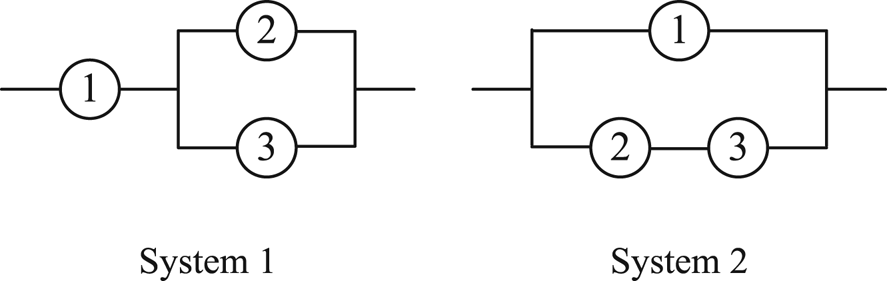
In this section, we discuss the computation of dynamic ordered multi-state system signatures for two independent coherent systems shown in Figure 1, which evidently have structure functions  ${\phi ^{(1)}}({x_1},{x_2},{x_3}) = \min ({x_1},{x_2} + {x_3})$ and
 ${\phi ^{(2)}}({x_1},{x_2},{x_3}) = {x_1} + \min ({x_2},{x_3})$, respectively, with
 ${x_i} \in \{ 0,1\}$ being state of the i.i.d. components,
 $i = 1,2,3$. Then, their multi-state system signatures can be given as
 ${\bf{s}^{(1)}} = (1/3,2/3,0,0,0,0)$ and
 ${\bf{s}^{(2)}} = (0,2/3,1/3,0,0,0)$.
Systems 1 and 2 in Section 4.

Assume that both systems are in state  $2$ at time
 $0$ and in state
 $1$ at time t, and then dynamic multi-state system signatures of Systems 1 and 2 can be given for the following cases:
Case 1: There is one failed component in each of the two systems.
Case 2: There is one failed component in System 1, but two failed components in System 2.
For Case 1, the dynamic (multi-state) system signatures of the two systems are  ${\bf{s}^{(1,2)}} = (1,0)$ and
 ${\bf{s}^{(2,2)}} = (2/3,1/3)$; and for Case 2, the dynamic (multi-state) system signatures of the two systems are
 ${\bf{s}^{(1,2)}} = (1,0)$ and
 ${\bf{s}^{(2,1)}} = 1$. Then, the dynamic ordered (multi-state) system signature of Systems 1 and 2 can be given as
 ${\bf{s}^1} = (s_1^1,s_2^1)$ and
 ${\bf{s}^2} = (s_1^2,s_2^2)$, where
 \[\begin{array}{l} s_1^1 = s_1^{(1)}s_1^{(2)} + \dfrac{5}{6}[s_1^{(1)}s_2^{(2)} + s_2^{(1)}s_1^{(2)}],\quad \textrm{ }s_2^1 = s_2^{(1)}s_2^{(2)} + \dfrac{1}{6}[s_1^{(1)}s_2^{(2)} + s_2^{(1)}s_1^{(2)}],\\ s_1^2 = s_1^{(1)}s_1^{(2)} + \dfrac{1}{6}[s_1^{(1)}s_2^{(2)} + s_2^{(1)}s_1^{(2)}],\quad \textrm{ }s_2^2 = s_2^{(1)}s_2^{(2)} + \dfrac{5}{6}[s_1^{(1)}s_2^{(2)} + s_2^{(1)}s_1^{(2)}], \end{array}\]
with  ${\bf{s}^{(1)}} = (s_1^{(1)},s_2^{(1)}) = (1,0)$ for both cases,
 ${\bf{s}^{(2)}} = (s_1^{(2)},s_2^{(2)}) = (2/3,1/3)$ for Case 1 and
 ${\bf{s}^{(2)}} = (s_1^{(2)},s_2^{(2)}) = (1/2,1/2)$ for Case 2, namely,
 ${\bf{s}^1} = (17/18,1/18),\textrm{ }{\bf{s}^2} = (13/18,5/18)$ for Case 1 and
 ${\bf{s}^1} = (11/12,1/12),{\bf{s}^2} = (7/12,5/12)$ for Case 2. It can be concluded that the two systems in Case 2 perform better than in Case 1 with
 $(17/18,1/18){ \le ^{\textrm{st}}}(11/12,1/12)$ and
 $(13/18,5/18){ \le ^{\textrm{st}}}(7/12,5/12)$, which means it will be better to choose systems in Case 2 in a burn-in test from the two choices.
5. Concluding remarks
In this paper, the ordered multi-state system signature and its properties have been studied based on a life-test of independent and non-identical multi-state coherent or mixed systems with i.i.d. binary-state components. Dynamic properties of these systems have been studied by means of a new notion, called dynamic multi-state system signature, and then some comparisons of system lifetimes have been made wherein costs have also been taken into account. Finally, the theoretical results established here have been illustrated through some specific examples to demonstrate the applicability of the dynamic ordered multi-state system signature from a life-test of used multi-state coherent or mixed systems. It is important to mention that these notions and the associated properties will all be quite useful in developing parametric/nonparametric inferential methods for component lifetimes based on data obtained from a life-test of multi-state coherent or mixed systems, along the lines of Balakrishnan et al. [Reference Balakrishnan, Ng and Navarro3,Reference Balakrishnan, Ng and Navarro4] and Yang et al. [Reference Yang, Ng and Balakrishnan30,Reference Yang, Ng and Balakrishnan31]. We are currently working in this direction and hope to report the findings in a future paper.
Acknowledgments
This work was supported by the National Natural Science Foundation of China (Nos. 72001016, 71931001, and 71722007), the Natural Sciences and Engineering Research Council of Canada (RGPIN-2020-06733), the Fundamental Research Funds for the Central Universities (buctrc202102), and the Funds for First-class Discipline Construction (XK1802-5). Thanks are also due to the Associate Editor and the anonymous reviewers for their many useful comments and suggestions on an earlier version of the manuscript, which led to this improved version.
Competing interests
The authors declare none.
Appendix. Proofs of results in Section 2
Proof of Lemma 2.1.
(1)
${l_{1,{j_1}, \ldots ,{j_n}}} + \cdots + {l_{N,{j_1}, \ldots ,{j_n}}} = M$ means that all the M multi-state coherent or mixed systems enter states $n - 1, \ldots ,0$ due to the ${j_1}-\textrm{th}, \ldots ,{j_n}-\textrm{th}$ ordered component failures, respectively, which clearly implies that the $q-\textrm{th}$ system entering state $n - r$ is among them, that is, $p_{{j_1}, \ldots ,{j_n}|\bf{l} }^{qr} = 1$. Similarly, if $\sum\nolimits_{i = 1}^N {\sum\nolimits_{1 \le {j_1} \le \cdots \le {j_{w - 1}} \le a \le {j_{w + 1}} \le \cdots \le {j_n} \le m} {{l_{i,{j_1}, \ldots ,{j_{w - 1}},a,{j_{w + 1}}, \ldots ,{j_n}}}} } = M$, namely, all the M multi-state coherent or mixed systems enter state $n - w$ due to the $a-\textrm{th}$ ordered component failure, which clearly implies that the $q-\textrm{th}$ system entering state $n - r$ is among them, that is, $\sum\nolimits_{1 \le {j_1} \le \cdots \le {j_{w - 1}} \le a \le {j_{w + 1}} \le \cdots \le {j_n} \le m} {p_{i,{j_1}, \ldots ,{j_{w - 1}},a,{j_{w + 1}}, \ldots ,{j_n}|\bf{l} }^{qr}} = 1.$(2)
${l_{1,{i_1}, \ldots ,{i_n}}} = \cdots = {l_{N,{i_1}, \ldots ,{i_n}}} = 0$ means that none of the M multi-state coherent or mixed systems enter states $n - 1, \ldots ,0$ due to the ${j_1}-\textrm{th}, \ldots ,{j_n}-\textrm{th}$ ordered component failures, respectively, which clearly implies that the $q-\textrm{th}$ system entering state $n - r$ is not among them, that is, $p_{{j_1}, \ldots ,{j_n}|\bf{l} }^{qr} = 0$. Similarly, if $\sum\nolimits_{i = 1}^N {\sum\nolimits_{1 \le {j_1} \le \cdots \le {j_{w - 1}} \le a \le {j_{w + 1}} \le \cdots \le {j_n} \le m} {{l_{i,{j_1}, \ldots ,{j_{w - 1}},a,{j_{w + 1}}, \ldots ,{j_n}}}} } = 0$, namely, none of the M multi-state coherent or mixed systems enter state $n - w$ due to the $a-\textrm{th}$ ordered component failure, which clearly implies that the $q-\textrm{th}$ system entering state $n - r$ is not among them, that is, $\sum\nolimits_{1 \le {j_1} \le \cdots \le {j_{w - 1}} \le a \le {j_{w + 1}} \le \cdots \le {j_n} \le m} {p_{i,{j_1}, \ldots ,{j_{w - 1}},a,{j_{w + 1}}, \ldots ,{j_n}|\bf{l} }^{qr}} = 0.$(3) Given the value of
$\bf{l}$, there should be $\sum\nolimits_{i = 1}^N {{l_{i,{j_1}, \ldots ,{j_n}}}}$ of the M multi-state coherent systems entering states $n - 1, \ldots ,0$ due to the ${j_1}-\textrm{th}, \ldots ,{j_n}-\textrm{th}$ ordered component failures, respectively. The same number can also be given as $\sum\nolimits_{q = 1}^M {p_{{j_1}, \ldots ,{j_n}|\bf{l} }^{qr}}$ (with $p_{{j_1}, \ldots ,{j_n}|\bf{l} }^{qr} = 1$ for the case that the $q-\textrm{th}$ system entering state $n - r$ is among the $\sum\nolimits_{i = 1}^N {{l_{i,{j_1}, \ldots ,{j_n}}}}$ systems and $p_{{j_1}, \ldots ,{j_n}|\bf{l} }^{qr} = 0$ for the case that it is not, under any possible failure ordering of the m i.i.d. components), which leads to the fact that $\sum\nolimits_{q = 1}^M {p_{{j_1}, \ldots ,{j_n}|\bf{l} }^{qr}} = \sum\nolimits_{i = 1}^N {{l_{i,{j_1}, \ldots ,{j_n}}}} .$(4) Let us consider the transformation in Yi et al. [Reference Yang, Ng and Balakrishnan31]. For any
$i = 1, \ldots ,N$, if there are ${l_{i,{i_1}, \ldots ,{i_n}}}$ $(1 \le {i_1} \le \cdots \le {i_n} \le m)$ systems that enter states $n - 1, \ldots ,0$ due to the ${i_1}-\textrm{th}, \ldots ,{i_n}-\textrm{th}$ ordered component failures, respectively, before the transformation, then following the transformation, there will be ${l_{i,m - {i_n} + 1, \ldots ,m - {i_1} + 1}}$ $(1 \le {i_1} \le \cdots \le {i_n} \le m)$ systems that do so. The $q-\textrm{th}$ system entering state $n - r$ before the transformation will be the $(M - q + 1)-\textrm{th}$ system entering state $r - 1$ after the transformation. Now, as the probability $p_{{j_1}, \ldots ,{j_n}|\bf{l} }^{qr}$ is distribution-free, we will clearly have $p_{{j_1}, \ldots ,{j_n}|\bf{l} }^{qr} = p_{m - {j_n} + 1, \ldots ,m - {j_1} + 1|{\textrm{rev }\bf{l}} }^{(M - q + 1)(n - r + 1)}$. Hence, the lemma proved.





Proof of Proposition 2.4.
(1) As discussed in Yi et al. [Reference Yang, Ng and Balakrishnan31],
${\bf{s}^{{q_1}r}}{ \le ^{\textrm{st}}}{\bf{s}^{{q_2}r}}$ if and only if for all $1 \le {k_1}, \ldots ,{k_n} \le m$,
$$\sum\limits_{{k_1} \le {j_1} \le m, \ldots ,{k_n} \le {j_n} \le m} {s_{{j_1}, \ldots ,{j_n}}^{{q_1}r}} \le \sum\limits_{{k_1} \le {j_1} \le m, \ldots ,{k_n} \le {j_n} \le m} {s_{{j_1}, \ldots ,{j_n}}^{{q_2}r}} .$$


From the proof of Proposition 2.1, we have
 $$s_{{j_1}, \ldots ,{j_n}}^{qr} = \sum\limits_{\bf{l} \in {\mathscr{L}_{\bf{k}}}} {p_{{j_1}, \ldots ,{j_n}|\bf{l} }^{qr}\prod\limits_{i = 1}^N {\left\{ {\left( {\begin{array}{*{20}{c}} {{k_i}}\\ {{l_{i,{i_1}, \ldots ,{i_n}}},1 \le {i_1} \le \cdots \le {i_n} \le m} \end{array}} \right)\prod\limits_{1 \le {i_1} \le \cdots \le {i_n} \le m} {{{[{s_{{i_1}, \ldots ,{i_n}}^{(i)}} ]}^{{l_{i,{i_1}, \ldots ,{i_n}}}}}} } \right\}} } ,$$
which means that  ${\bf{s}^{{q_1}r}}{ \le ^{\textrm{st}}}{\bf{s}^{{q_2}r}}$ if for all
 $1 \le {k_1}, \ldots ,{k_n} \le m$ and
 $\bf{l} \in {\mathscr{L}_{\bf{k}}},$
 $$\sum\limits_{{k_1} \le {j_1} \le m, \ldots ,{k_n} \le {j_n} \le m} {p_{{j_1}, \ldots ,{j_n}|\bf{l} }^{{q_1}r}} \le \sum\limits_{{k_1} \le {j_1} \le m, \ldots ,{k_n} \le {j_n} \le m} {p_{{j_1}, \ldots ,{j_n}|\bf{l} }^{{q_2}r}} .$$
As proved in Theorem 3.5 of Yi et al. [Reference Yang, Ng and Balakrishnan31], we have  $\sum\nolimits_{{k_1} \le {j_1} \le m, \ldots ,{k_n} \le {j_n} \le m} {p_{{j_1}, \ldots ,{j_n}|\bf{l} }^{{q_1}r}} \le \sum\nolimits_{{k_1} \le {j_1} \le m, \ldots ,{k_n} \le {j_n} \le m} {p_{{j_1}, \ldots ,{j_n}|\bf{l} }^{{q_2}r}}$ for all
 $1 \le {k_1}, \ldots ,{k_n} \le m$ and
 $\bf{l} \in {\mathscr{L}_{\bf{l}}}$, with
 $${\mathscr{L}_{\bf{l}}} = \textrm{\{ }\bf{l} = ({l_{{i_1}, \ldots ,{i_n}}},1 \le {i_1} \le \cdots \le {i_n} \le m):\sum\limits_{1 \le {i_1}, \ldots ,{i_n} \le m} {{l_{{i_1}, \ldots ,{i_n}}}} = l\textrm{\} }\textrm{.}$$
Based on the fact that  $p_{{j_1}, \ldots ,{j_n}|\bf{l} }^{qr}$ depends on
 $\bf{l}$ only through
 ${l_{{i_1}, \ldots ,{i_n}}} = {l_{1,{i_1}, \ldots ,{i_n}}} + \cdots + {l_{N,{i_1}, \ldots ,{i_n}}}$, we have the same inequality for
 $\bf{l} \in {\mathscr{L}_{\bf{k}}}$ instead of
 $\bf{l} \in {\mathscr{L}_{\bf{l}}}$, with
 $${\mathscr{L}_{\bf{k}}} = \{ \bf{l} = ({l_{i,{i_1}, \ldots ,{i_n}}},\textrm{ }1 \le i \le N,\textrm{ }1 \le {i_1} \le \cdots \le {i_n} \le m):\textrm{ }\sum\limits_{1 \le {i_1} \le \cdots \le {i_n} \le m} {{l_{i,{i_1}, \ldots ,{i_n}}}} = {k_i}\textrm{ for all }i\} ,$$
Then, we have  ${\bf{s}^{{q_1}r}}{ \le ^{\textrm{st}}}{\bf{s}^{{q_2}r}}$, as required.
(2) If
${\bf{s}^{{q_1}r}}{ \ge ^{\textrm{st}}}{\bf{s}^{{q_2}r}}$ for any $1 \le {q_1} < {q_2} \le M$, then clearly we have ${\bf{s}^{{q_1}r}} = {\bf{s}^{{q_2}r}}$. For any $1 \le {j_1} \le \cdots {j_{r - 1}} \le {j_{r + \textrm{1}}} \le \cdots \le {j_n} \le m$, let ${\kappa _s},\textrm{ }s = 1, \ldots ,N,$ be the smallest k such that $s_{{j_1}, \ldots ,{j_{r - 1}},k,{j_{r + \textrm{1}}}, \ldots ,{j_n}}^{(s)} > 0$ and $\kappa$ be the smallest among ${\kappa _s},\textrm{ }s = 1, \ldots ,N$. We then have
\begin{align*} 0 & = s_{{j_1}, \ldots ,{j_{r - 1}},\kappa ,{j_{r + \textrm{1}}}, \ldots ,{j_n}}^{{q_1}r} - s_{{j_1}, \ldots ,{j_{r - 1}},\kappa ,{j_{r + \textrm{1}}}, \ldots ,{j_n}}^{{q_2}r}\\ & = \sum\limits_{\bf{l} \in {\mathscr{L}_{\bf{k}}}} {({p_{{j_1}, \ldots ,{j_{r - 1}},\kappa ,{j_{r + \textrm{1}}}, \ldots ,{j_n}|\bf{l} }^{{q_1}r} - p_{{j_1}, \ldots ,{j_{r - 1}},\kappa ,{j_{r + \textrm{1}}}, \ldots ,{j_n}|\bf{l} }^{{q_2}r}} )} \\ &\quad \times \prod\limits_{i = 1}^N {\left\{ {\left( {\begin{array}{*{20}{c}} {{k_i}}\\ {{l_{i,{i_1}, \ldots ,{i_n}}},1 \le {i_1} \le \cdots \le {i_n} \le m} \end{array}} \right)\prod\limits_{1 \le {i_1} \le \cdots \le {i_n} \le m} {{{[{s_{{i_1}, \ldots ,{i_n}}^{(i)}} ]}^{{l_{i,{i_1}, \ldots ,{i_n}}}}}} } \right\}} . \end{align*}


To prove  ${\kappa _1} = \cdots = {\kappa _N} = \kappa$, let us now assume that there exists at least one
 ${\kappa _s}$ such that
 ${\kappa _s} > \kappa$. Let
 $\bf{l}$ be such that
 ${l_{i,{j_1}, \ldots ,{j_{r - 1}},{\kappa _i},{j_{r + \textrm{1}}}, \ldots ,{j_n}}} = {k_i}$
 $(i = 1, \ldots ,N)$. Then, by an argument similar to the one used in Yi et al. [Reference Yang, Ng and Balakrishnan31], we have
 $p_{{j_1}, \ldots ,{j_{r - 1}},\kappa ,{j_{r + \textrm{1}}}, \ldots ,{j_n}|\bf{l} }^{{q_1}r} - p_{{j_1}, \ldots ,{j_{r - 1}},\kappa ,{j_{r + \textrm{1}}}, \ldots ,{j_n}|\bf{l} }^{{q_2}r} > 0$, which implies an impossible result that
 $\prod\nolimits_{i = 1}^N {{{[{s_{{j_1}, \ldots ,{j_{r - 1}},{\kappa_i},{j_{r + \textrm{1}}}, \ldots ,{j_n}}^{(i)}} ]}^{{k_i}}}} = 0$, namely, there is at least one zero in
 $s_{{j_1}, \ldots ,{j_{r - 1}},{\kappa _i},{j_{r + \textrm{1}}}, \ldots ,{j_n}}^{(i)},\textrm{ }i = 1, \ldots ,N$. Thus, we conclude that
 ${\kappa _1} = \cdots = {\kappa _N} = \kappa$. As discussed above, for any
 $s = 1, \ldots ,N$ and any
 $\kappa < \kappa _s^{\prime} \le m$, let
 $\bf{l}$ be such that
 ${l_{s,{j_1}, \ldots ,{j_{r - 1}},\kappa _s^{\prime},{j_{r + \textrm{1}}}, \ldots ,{j_n}}} = {k_s}$ and
 ${l_{i,{j_1}, \ldots ,{j_{r - 1}},\kappa ,{j_{r + \textrm{1}}}, \ldots ,{j_n}}} = {k_i}$
 $(i \ne s)$, and we then have
 $${[{s_{{j_1}, \ldots ,{j_{r - 1}},\kappa_s^{\prime},{j_{r + \textrm{1}}}, \ldots ,{j_n}}^{(s)}} ]^{{k_s}}}\prod\limits_{i = 1}^N {{{({s_{{j_1}, \ldots ,{j_{r - 1}},\kappa ,{j_{r + \textrm{1}}}, \ldots ,{j_n}}^{(i)}} )}^{{k_i}{I_{\{ i \ne s\} }}}}} = 0,$$
that is,  $s_{{j_1}, \ldots ,{j_{r - 1}},\kappa _s^{\prime},{j_{r + \textrm{1}}}, \ldots ,{j_n}}^{(s)} = 0$. This implies that there is only one positive number
 $s_{{j_1}, \ldots ,{j_{r - 1}},\kappa ,{j_{r + \textrm{1}}}, \ldots ,{j_n}}^{(i)}$ in
 $s_{{j_1}, \ldots ,{j_n}}^{(i)}$
 $({j_r} = 1, \ldots ,m)$.