





Introduction
Blueberry, Vaccinium corymbosum Linnaeus (Ericaceae), is a perennial shrub native to North America (Crins Reference Crins1991). In recent years, blueberry cultivation has become increasingly important in international markets due to the human health benefits associated with its consumption (Huang et al. Reference Huang, Hutabarat, Chai, Zheng, Zhang and Dajing2020; Stull et al. Reference Stull, Cassidy, Djousse, Johnson, Krikorian and Lampe2024). This has led to an increased demand for the fruit and to an expansion of blueberry production area. Blueberry cultivation has been introduced into several countries, creating employment opportunities and generating income in regions where blueberry cultivation was unknown previously (Rodríguez-Saona et al. Reference Rodríguez-Saona, Vincent and Isaacs2019). However, this expansion of blueberry cultivation beyond its native range has brought significant pest and disease management challenges, due to the emergence of new interactions between the plant and native organisms, which can impact fruit quality and yield (Martin et al. Reference Martin, Polashock and Tzanetakis2012; Rodríguez-Saona et al. Reference Rodríguez-Saona, Vincent and Isaacs2019).
Within the complex of insect pests affecting blueberry crops, some of the most important are the blueberry maggot, Rhagoletis mendax Curran (Diptera: Tephritidae), the spotted wing drosophila, Drosophila suzukii (Matsumura) (Diptera: Drosophilidae), the cranberry fruitworm, Acrobasis vaccinii Riley (Lepidoptera: Pyralidae), the cherry fruitworm, Grapholita packardi (Zeller) (Lepidoptera: Tortricidae), and the plum curculio, Conotrachelus nenuphar Harris (Coleoptera: Curculionidae), among others (Rodríguez-Saona et al. Reference Rodríguez-Saona, Vincent and Isaacs2019; Cline and Burrak Reference Cline and Burrack2023). Recently, some species of Thysanoptera, such as Frankliniella occidentalis Pergande, Frankliniella bispinosa Morgan, Frankliniella tritici (Fitch), Scirtothrips ruthveni Shull, and Scirtothrips dorsalis Hood (all Thripidae), have also been recognised as important pests of this crop (Spiers et al. Reference Spiers, Matta, Marshall and Sampson2005; Rhodes et al. Reference Rhodes, Liburd and England2012; Panthi et al. Reference Panthi, Liburd, Sriyanka and Rhodes2020).
Scirtothrips dorsalis, commonly known as the chilli thrips, is among the most economically significant species in agriculture worldwide (Mound and Teulón Reference Mound and Teulon1995; Morse and Hoddle Reference Morse and Hoddle2006). Native to Southeast Asia, it is currently widely distributed across tropical and subtropical regions, where it can feed on as many as 241 plant species, including annual, ornamental, and fruit crops (Kumar et al. Reference Kumar, Kakkar, McKenzie, Seal and Osborne2013; European and Mediterranean Plant Protection Organisation 2025). Both larvae and adults of this species can be found in all host plant structures, although they prefer the tender tissues of leaves and fruits for feeding and laying eggs (Kumar et al. Reference Kumar, Kakkar, McKenzie, Seal and Osborne2013). Feeding and oviposition by S. dorsalis cause mechanical injury that facilitates the entry of phytopathogenic fungi, bacteria, and viruses into host plant tissues (Childers and Achor Reference Childers, Achor, Parker, Skinner and Lewis1995). Severe infestations of S. dorsalis may result in leaf distortion, fruit deformation, and complete plant wilting (Kumar et al. Reference Kumar, Kakkar, McKenzie, Seal and Osborne2013; Renkema et al. Reference Renkema, Krey, Devkota, Liburd and Funderburk2020). Moreover, this pest is an efficient vector of orthotospoviruses (Elliovirales) that affect many plant species (Riley et al. Reference Riley, Joseph, Srinivasan and Diffie2011; Rotenberg et al. Reference Rotenberg, Jacobson, Schneweis and Whitfield2015).
In 2019, S. dorsalis was detected causing damage to blueberry plantations in western Mexico (Ortiz et al. Reference Ortiz, Infante and Toledo-Hernandez2020), with subsequent reports in other locations of northern and central Mexico (Ortiz et al. Reference Ortiz and Infante2024). The presence of S. dorsalis is concerning for blueberry growers, given its ongoing expansion in Mexico. Farmers usually attack this pest with synthetic insecticides; however, intensive use of insecticides can lead to the decline of beneficial organisms and the development of resistance in the target pest (Reddy et al. Reference Reddy, Prasad and Rao1992; Seal and Kumar Reference Seal and Kumar2010; Rao et al. Reference Rao, George and Rahangadale2019; Renkema et al. Reference Renkema, Krey, Devkota, Liburd and Funderburk2020).
Temperature is a key environmental factor for the development and establishment of S. dorsalis populations in blueberry orchards. Therefore, to implement sustainable control methods for this insect, it is essential to gather information on how temperature variations influence its biology. An approach to characterising the relationship between temperature and insect development is based on degree-day theory, which allows the prediction of the developmental rate curve through simple linear regression modelling and the estimation of the lower temperature threshold and the thermal constant for development (Campbell et al. Reference Campbell, Frazer, Gilbert, Gutierrez and Mackauer1974; Shi et al. Reference Shi, Ge, Sun and Chen2011; Rebaudo and Rabhi Reference Rebaudo and Rabhi2018; Régnier et al. Reference Régnier, Legrand and Rebaudo2022). Even though the effect of temperature on the development and fecundity of S. dorsalis has been studied on some plant hosts (Tatara Reference Tatara1994; Shibao Reference Shibao1996; Chen et al. Reference Chen, Lin and Chiu2013), substantial evidence suggests that insect population parameters can be influenced by the nutritional quality of plant species (Seal et al. Reference Seal, Klassen and Kumar2010; Cao et al. Reference Cao, Yang, Wang, Li, Chen and Xie2024) and by local environmental conditions (Stacey and Fellowes Reference Stacey and Fellowes2002). The objective of the present study is to determine how the temperature affects the development, survival, and reproduction of S. dorsalis on blueberry.
Materials and methods
Biological material
Samples were collected from a blueberry orchard heavily infested with S. dorsalis, located in Zapotlán el Grande, Jalisco, Mexico (19° 42′ 3.6″ N, 103° 31′ 48.216″ W). A plot of approximately 0.5 ha was selected, and tender shoots with blueberry leaves infested with thrips were collected in plastic bags and taken to the laboratory. Once there, the plant material was washed with tap water and dried with a paper towel. A moistened cotton wrapped in parafilm was placed at the base of each leaf to prevent dehydration. The leaves were then placed in Petri dishes (100 × 15 mm) and incubated in a bioclimatic chamber at 24 °C and 80% relative humidity to promote the hatching of thrips eggs from leaf tissues. Once the larvae emerged, they were routinely fed with fresh, noninfested blueberry leaves collected from the same orchard until full development was achieved. When thrips reached the adult stage, 100 males and 100 females with typical morphological characteristics of S. dorsalis (see Kumar et al. Reference Kumar, Seal, Schuster, McKenzie, Osborne, Maruniak and Zhang2011 and Hoddle et al. Reference Hoddle, Mound and Paris2012) were selected and placed in a plastic container (20 × 12 cm) for six hours to promote mating. After this period, five groups of 20 females were placed in Petri dishes (100 × 15 mm) containing tender blueberry leaves that were not infested with thrips. Petri dishes were kept for 12 hours in a bioclimatic chamber at 24 °C and 80% relative humidity to promote oviposition. After this time, the females were removed, and each Petri dish containing leaves with thrips eggs was placed in a different bioclimatic chamber maintained at 18, 21, 24, 27, and 30 °C, respectively. Cohorts of 30 newly hatched larvae (< 12 hours old) were collected for each temperature regime mentioned above for subsequent observation.
Effect of temperature on preimaginal stages
At each temperature, individual larvae were placed in tubes containing a nonthrips–infested tender blueberry leaf as a food source. Tubes were sealed with parafilm. Thrips development and mortality of each stage were examined every six hours until individuals reached the adult stage. Blueberry leaves were replaced every three days to ensure fresh food for thrips.
The duration of the egg stage was indirectly calculated by considering the average time from placement of the blueberry leaf for oviposition until the hatching of the first-instar larvae was observed.
Prepupal data were analysed alongside second-instar larval data.
Effect of temperature on females
The effect of temperature on the pre-oviposition period, fecundity, and longevity of S. dorsalis was evaluated using the females that completed development in the above experiment. Because S. dorsalis survival differed at each temperature, we obtained the following numbers of females: at 18 °C, n = 9; at 21 °C, n = 10; at 24 °C, n = 14; at 27 °C, n = 12; and at 30 °C, n = 18. After adult emergence, females were individually paired with males for 12 hours for mating purposes. After that, males were removed, and each female was transferred to a glass vial (15 mL) containing a non-infested blueberry leaf wrapped with moistened cotton. To determine the pre-oviposition period and fecundity of each female, the blueberry leaves were changed daily. Each leaf with eggs was examined every six hours until larvae emerged. Because it was not possible to count eggs within the leaf tissue, the number of emerged larvae was used as an indirect measure of the number of eggs laid by each female.
To facilitate the handling and counting of individuals, observations were performed under a stereomicroscope (Nikon SMZ745T; Nikon Corporation, Tokyo, Japan), after placing specimens in a cold chamber for five minutes to slow their movement. The taxonomic identity of specimens that reached the adult stage was verified by mounting them on slides using Hoyer’s medium. Identification was accomplished using the specialised taxonomic keys described by Kumar et al. (Reference Kumar, Seal, Schuster, McKenzie, Osborne, Maruniak and Zhang2011) and Hoddle et al. (Reference Hoddle, Mound and Paris2012).
Data analysis
The relationship between temperature and the preimaginal development of S. dorsalis was analysed using the linear regression model [y = ax + b], where (y) is the reciprocal of development time, (x) is temperature, and (a) and (b) are regression constants. The lower temperature threshold (T min) was estimated graphically by finding the intersection of the regression line with the x-axis, and analytically using the formula T = b/a. The thermal constant (C) was calculated analytically using the formula C = 1/a (Yadav and Chang Reference Yadav and Chang2013).
Differences in preimaginal developmental time, fecundity, longevity, and pre-oviposition period among temperature treatments were tested using the Kolmogorov–Smirnov normality test. Because the data did not fit a normal distribution, we performed a Box–Cox transformation. Following this transformation, data that fit a normal distribution were analysed using one-way analysis of variance, with a post hoc analysis using Tukey’s multiple-comparison test. Data that did not fit a normal distribution after the Box–Cox transformation were analysed using the nonparametric Kruskal–Wallis test, followed by a post hoc Dunn–Bonferroni contrast test.
Mortality data from the different preimaginal stages and of female survival under the different temperature regimes were used to construct an age-specific life table (qx) and a cohort survival curve (lx), following the methodology of Carey (Reference Carey2001) for insect cohort bioassays conducted under controlled conditions.
Results
Effect of temperature on preimaginal stages
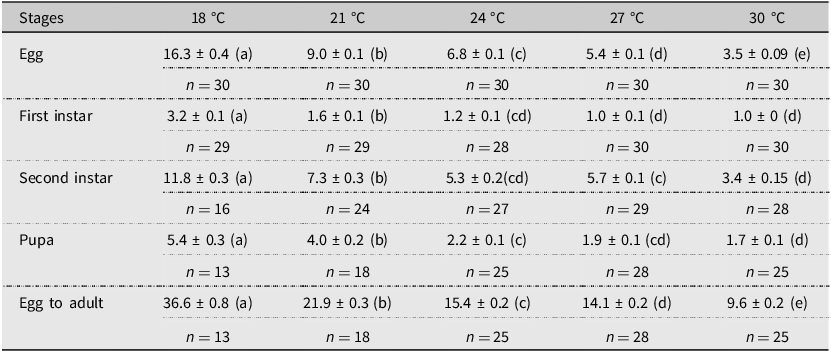
The duration of the preimaginal development and the cycle from egg to adult of S. dorsalis were significantly affected by temperature (egg: F 4, 145 = 595.93, P < 0.0005; first-instar larva: F 4, 141 = 107.56, P < 0.0005; second-instar larva: H 4 = 112.575491, P < 0.0005; pupa: F 4, 104 = 118.34, P < 0.0005; egg to adult: F 4, 104 = 885.45, P < 0.0005). The temperature effect was inversely proportional; that is, developmental time shortened as temperature increased (Table 1). Accordingly, our results showed that at 18 °C, development from egg to adult took 36.6 days, whereas at 30 °C, it took 9.6 days. The egg and second-instar larval stages had the longest durations, and the pupal and first-instar larval stages required the least time to complete development.
Development time (days) of Scirtothrips dorsalis on blueberry leaves. Data show the mean ± standard error. Means within the same rows followed by different letters are significantly different.
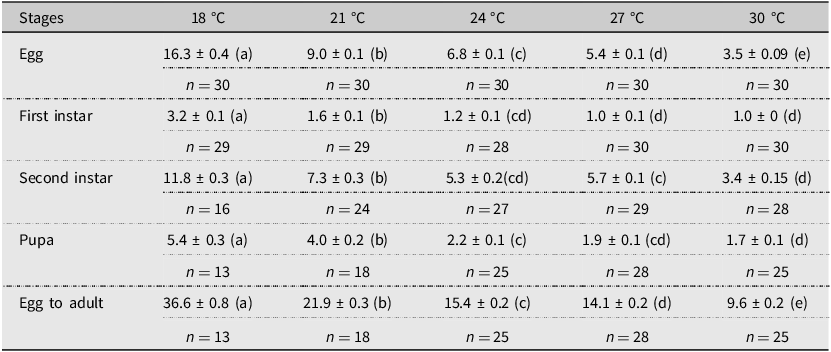
Table 1. Long description
A table comparing the duration of preimaginal development and the cycle from egg to adult of S. dorsalis at different temperatures. The table has 6 rows and 6 columns. The columns are labeled with temperatures: 18 C, 21 C, 24 C, 27 C, and 30 C. The rows are labeled with different stages: Egg, First instar, Second instar, Pupa, and Egg to adult. Each cell contains the mean duration in days with standard error and the number of observations (n). Row 1: Egg, 16.3 ± 0.4 (a), n = 30; 9.0 ± 0.1 (b), n = 30; 6.8 ± 0.1 (c), n = 30; 5.4 ± 0.1 (d), n = 30; 3.5 ± 0.09 (e), n = 30. Row 2: First instar, 3.2 ± 0.1 (a), n = 29; 1.6 ± 0.1 (b), n = 29; 1.2 ± 0.1 (cd), n = 28; 1.0 ± 0.1 (d), n = 30; 1.0 ± 0 (d), n = 30. Row 3: Second instar, 11.8 ± 0.3 (a), n = 16; 7.3 ± 0.3 (b), n = 24; 5.3 ± 0.2 (cd), n = 27; 5.7 ± 0.1 (c), n = 29; 3.4 ± 0.15 (d), n = 28. Row 4: Pupa, 5.4 ± 0.3 (a), n = 13; 4.0 ± 0.2 (b), n = 18; 2.2 ± 0.1 (c), n = 25; 1.9 ± 0.1 (cd), n = 28; 1.7 ± 0.1 (d), n = 25. Row 5: Egg to adult, 36.6 ± 0.8 (a), n = 13; 21.9 ± 0.3 (b), n = 18; 15.4 ± 0.2 (c), n = 25; 14.1 ± 0.2 (d), n = 28; 9.6 ± 0.2 (e), n = 25. The table shows that the duration of each developmental stage decreases as the temperature increases. The egg and second-instar larval stages have the longest durations, while the pupal and first-instar larval stages require the least time to complete development.
Immature mortality was higher in cohorts kept at 18 and 21 °C and lower in those kept at 24, 27, and 30 °C. Second-instar larvae and pupae had the highest mortality rates. Second-instar larvae kept at 18 °C showed mortality up to 45%, whereas those kept at 21 °C had 17% mortality. The highest mortality in pupae was observed at 21 °C (25%), followed by 18 and 30 °C (19 and 11%, respectively; Table 2). Mortality at the egg stage could not be determined because eggs are embedded in the plant tissues. A survival rate of 100% for eggs was assumed for analysis.
Specific mortality in Scirtothrips dorsalis by developmental stage at each temperature (%). Cohorts started with 30 individuals. Asterisks (*) indicate that mortality was not registered.

Table 2. Long description
A table comparing specific mortality in Scirtothrips dorsalis by developmental stage at each temperature. The table has five rows and six columns. The rows are labeled as Stages, 18 °C, 21 °C, 24 °C, 27 °C, and 30 °C. The stages include Egg, First instar, Second instar, and Pupa. The values in the table are as follows: Row 1: Stages, 18 °C, 21 °C, 24 °C, 27 °C, 30 °C. Row 2: Egg, 0*, 0*, 0*, 0*, 0*. Row 3: First instar, 3, 3, 7, 0, 0. Row 4: Second instar, 45, 17, 7, 3, 7. Row 5: Pupa, 19, 25, 4, 3, 11. Asterisks (*) indicate that mortality was not registered. The table shows that mortality rates vary significantly across different temperatures and developmental stages, with higher mortality observed at 18 °C and 21 °C, particularly in the second instar and pupa stages.
Temperature thresholds and thermal constants
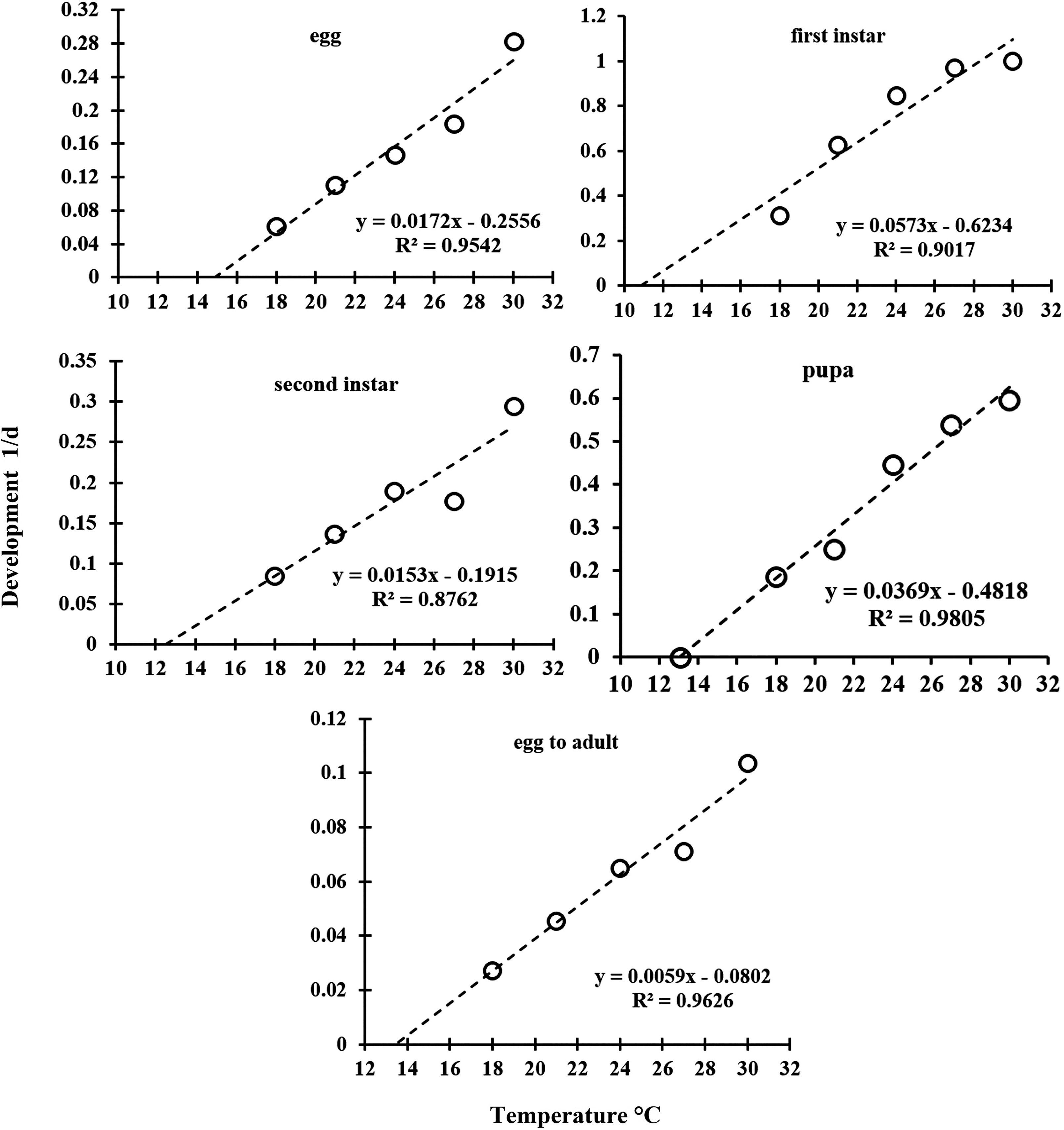
The developmental rates of the different preimaginal stages and the egg-to-adult cycle of S. dorsalis are presented in Fig. 1. The regression model equation estimated the lower temperature thresholds (T min) for the egg, first-instar larval, second-instar larval, and pupal stages to be 14.5, 10.9, 12.5, and 13.1 °C, respectively, whereas the thermal constant (C) for each stage was estimated to be 58.1, 17.5, 65.4, and 27.1 degree-days, respectively. Finally, for complete development from egg to adult emergence, the regression equation estimated a lower temperature threshold of 13.6 °C and a developmental thermal constant of 169.5 degree-days.
Linear regression describing the relationship between development and temperature in Scirtothrips dorsalis reared on blueberry leaves.
Effect of temperature on population parameters in females
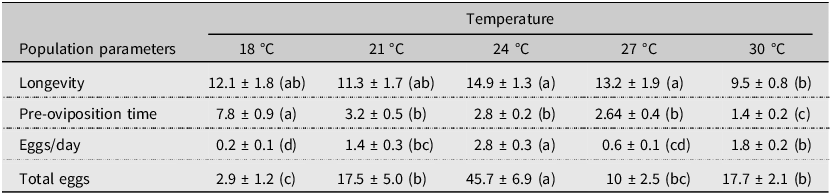
Temperature significantly affected the pre-oviposition period (F 4, 49 = 36.69, P < 0.00001) and fecundity (eggs/day: F 4, 58 = 18.59, P < 0.00001; total eggs: H 4 = 28.064, P < 0.00001) but had little effect on longevity (H 4 = 10.17, P = 0.04). Females at 24 °C lived slightly longer than those kept at 30 °C (14.9 and 9.5 days, respectively).
The pre-oviposition period decreased significantly with increasing temperature, being longer in females kept at 18 °C (7.8 days) and shorter in those kept at 30 °C (1.4 days). Likewise, females that produced the highest number of eggs per day and, consequently, the highest total number of eggs throughout their reproductive life were those kept at 24 °C, with 2.8 and 45.7 eggs, respectively. In contrast, females reared at 18 °C had the lowest average of daily oviposition and total eggs with 0.2 and 2.9 eggs, respectively (Table 3). In addition, the age at which females recorded the highest daily rate of egg production also differed. For example, when females were reared at 24 and 30 °C, their highest daily egg production rate was registered before they were five days old, whereas females reared at 18, 21, and 27 °C registered the highest daily egg production rate at nine days old.
Population parameters of Scirtothrips dorsalis females reared in blueberry leaves under different temperatures. Data show the mean ± standard error. Means within the same rows followed by different letters are significantly different.
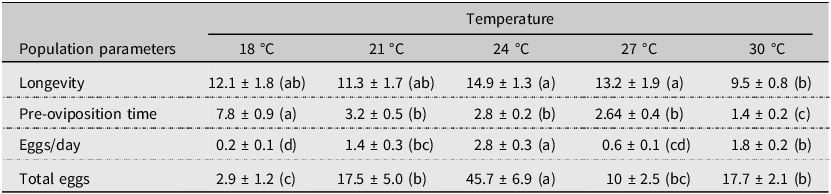
Table 3. Long description
The table presents population parameters of Scirtothrips dorsalis females reared in blueberry leaves under different temperatures. It has four rows and six columns. The columns are labeled with temperatures: 18 C, 21 C, 24 C, 27 C, and 30 C. The rows are labeled with population parameters: Longevity, Pre-oviposition time, Eggs/day, and Total eggs. The values in the table are presented as mean ± standard error. The table shows the following data: Row 1: Longevity, 12.1 ± 1.8 (ab), 11.3 ± 1.7 (ab), 14.9 ± 1.3 (a), 13.2 ± 1.9 (a), 9.5 ± 0.8 (b). Row 2: Pre-oviposition time, 7.8 ± 0.9 (a), 3.2 ± 0.5 (b), 2.8 ± 0.2 (b), 2.64 ± 0.4 (b), 1.4 ± 0.2 (c). Row 3: Eggs/day, 0.2 ± 0.1 (d), 1.4 ± 0.3 (bc), 2.8 ± 0.3 (a), 0.6 ± 0.1 (cd), 1.8 ± 0.2 (b). Row 4: Total eggs, 2.9 ± 1.2 (c), 17.5 ± 5.0 (b), 45.7 ± 6.9 (a), 10 ± 2.5 (bc), 17.7 ± 2.1 (b). The table indicates that the pre-oviposition period decreased significantly with increasing temperature. Females kept at 18 C had the longest pre-oviposition period, while those kept at 30 C had the shortest. Females kept at 24 C produced the highest number of eggs per day and the highest total number of eggs. In contrast, females reared at 18 C had the lowest average of daily oviposition and total eggs.
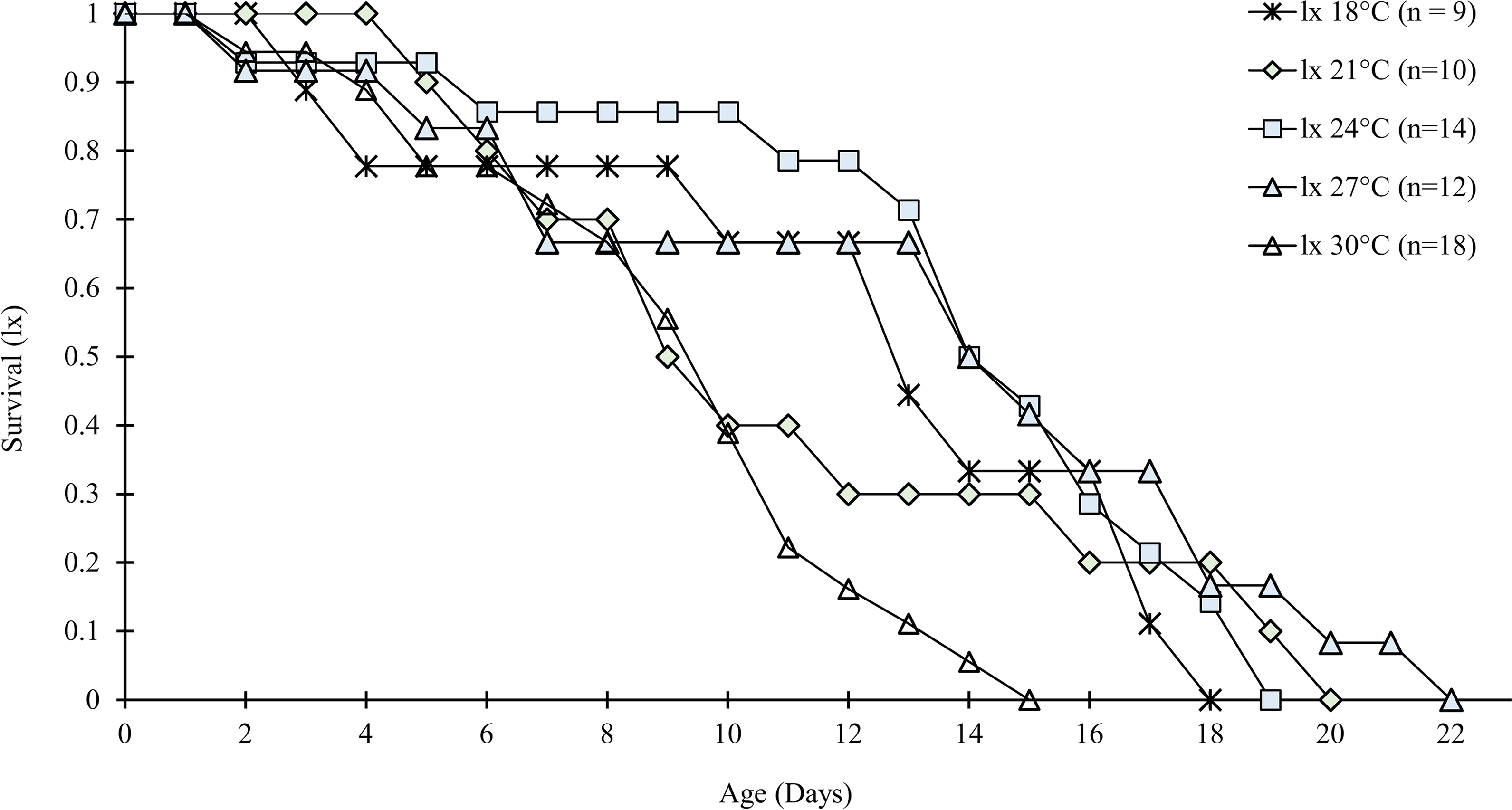
The proportion of surviving females from each cohort evaluated varied with the temperature at which they were kept (Fig. 2). During the first six days, the proportion of surviving females was greater than 0.75 at all temperatures. After that, the proportion of surviving individuals decreased dramatically, especially in those cohorts kept at 21 and 30 °C. The survival rate of females in each temperature cohort decreased by 50% at different times: for those kept at 21 and 30 °C, they decreased around the ninth day; for those kept at 18 °C, on the thirteenth day; for those kept at 24 and 27 °C, after 14 days. Finally, 100% mortality was observed on days 15, 18, 19, 20, and 22 for the cohorts kept at 30, 18, 24, 21, and 27 °C, respectively.
Survival curves of Scirtothrips dorsalis females reared on blueberry leaves and different temperature conditions.
Discussion
Variations in environmental temperature influence the development, survival, and fecundity of insects. These variations play a key role in their abundance, distribution, and colonisation of new regions (Régnier et al. Reference Régnier, Legrand and Rebaudo2022). Even though S. dorsalis is one of the most important thrips pests worldwide (Mound and Teulon Reference Mound and Teulon1995), few studies have addressed the effect of temperature on its development, survival, and fecundity. Similar to previous reports, the present study’s results indicate that temperature had an inversely proportional effect on preimaginal developmental and preoviposition period (Tatara Reference Tatara1994; Shibao Reference Shibao1996; Chen et al. Reference Chen, Lin and Chiu2013; Kang et al. Reference Kang, Lee and Kim2015). Likewise, the results showed that both the lowest and highest temperatures tested (18 and 30 °C) negatively affected S. dorsalis females’ longevity and fecundity and, consequently, their survival, similar to what has been recorded in other species within the Thripidae, such as Frankliniella occidentalis and Thrips hawaiiensis (Cao et al. Reference Cao, Yang, Li, Zhang, Wang, Li and Gao2019). Conversely, the lower temperature threshold for the entire egg–adult cycle was found to be higher (≈ 4 °C) and the developmental thermal constant lower (≈ 90 degree-days) in the present study compared to the 9.7, 8.5, 9.6 °C lower temperature thresholds and the 265-, 294.1-, 217.3-degree-day developmental thermal constants reported by Tatara (Reference Tatara1994), Shibao (Reference Shibao1996), and Chen et al. (Reference Chen, Lin and Chiu2013) when they reared S. dorsalis on leaves of Viburnum odoratissimum (Adoxaceae), Vitis labrusca “Delaware” (Vitaceae), and Mangifera indica (Anacardiaceae), respectively.
On the other hand, when we compared parameters of immature stages and adults with those of earlier studies at fixed temperatures, we found significant differences. For example, when S. dorsalis was reared at 30 °C, Tatara (Reference Tatara1994) and Shibao (Reference Shibao1996) reported preimaginal developmental times of 13.9 and 13.4 days on leaves of V. odoratissimum and V. labrusca “Delaware,” respectively, whereas in the present study, we recorded 9.6 days at the same temperature. When S. dorsalis was reared on M. indica leaves at 24 °C, Chen et al. (Reference Chen, Lin and Chiu2013) found a preimaginal developmental time of 14.8 days, which is very similar to the 15.4 days obtained in our study using the same temperature. In females, the longevity and total fecundity reported by Tatara (Reference Tatara1994) when the females were reared at 29.5 °C in V. odoratissimum (20.7 days and 33 eggs) differed significantly from the 9.6 days and 17.7 total eggs when they were reared on blueberry leaves at 30 °C in the present study. In addition, longevity and total fecundity also differed from those values reported by Kang et al. (Reference Kang, Lee and Kim2015) on Camellia sinensis Linnaeus (Theaceae): they reported 28.3 days and 52.6 total eggs at 21 °C, whereas we found longevity and total fecundity to be 11.3 days and 17.6 total eggs at the same temperature. In contrast, Chen et al. (Reference Chen, Lin and Chiu2013) reported values comparable to those obtained in the present study when females were reared on M. indica at 24 °C, with longevity and fecundity of 17.4 days and 38.4 total eggs, respectively, compared with 14.9 days and 45.7 total eggs recorded in this study at the same temperature regime.
Although differences in the developmental time and S. dorsalis fitness related to nutritional quality of food have been reported previously (Tatara Reference Tatara1994; Seal et al. Reference Seal, Klassen and Kumar2010; Cao et al. Reference Cao, Yang, Wang, Li, Chen and Xie2024), we consider that the differences in developmental time, longevity, and fecundity found in our study and those values reported by other authors are related not only to the substrate quality but also to factors such as variations in environmental conditions and the specific response of the insect to such variations. In this regard, an important aspect to consider is that S. dorsalis is a complex of at least nine cryptic species, with only two of them being highly invasive and found widely distributed in tropical regions (Dickey et al. Reference Dickey, Kumar, Hoddle, Funderburk, Morgan and Jara-Cavieres2015; Kumar et al. Reference Kumar, Xiao, Borden, Ahmed, McKenzie and Osborne2023). The occurrence of this complex of cryptic species within S. dorsalis strengthens the hypothesis that the variation in biological parameters is also due to a specific adaptation to local environmental conditions among these cryptic lineages. Similar variations in developmental rate associated with the adaptation to local conditions have been reported in populations of Thrips tabaci Lindeman and F. occidentalis from different geographical regions (Stacey and Fellowes Reference Stacey and Fellowes2002). However, in the case of S. dorsalis, we cannot confirm this hypothesis due to the lack of molecular studies confirming the species or the cryptic-species complex studied.
Finally, given that Mexico provides favourable environmental conditions for the development of S. dorsalis (de Aguiar et al. Reference de Aguiar, Alencar, da Silva and Teles2023), the insect’s recent establishment in blueberry orchards in that country is expected to affect crop productivity. The data generated in the present study provide an essential basis for the future implementation of pest management strategies that are based on phenological models that enable prediction of the population dynamics within blueberry crops.
Acknowledgements
The authors thank the Consejo Nacional Consultivo Fitosanitario of Mexico for financial support and the blueberry production company HORTIFRUT México for facilitating access to orchards and laboratory use.
Competing interests
The authors declare that they have no competing interests.




 Open access

