Introduction
Understanding the rise and fall of empires (large territorial states) is one of the most important research directions in world history. Beginning with Gibbon,Footnote 1 most theoretical efforts have been directed to the second part – the causes of imperial disintegration and fragmentation.Footnote 2 The first part of the question, however, is theoretically more challenging, because large territorial empires are a comparative rarity in the historical record before the Industrial Revolution. Thus, the really difficult question is why large agrarian states arose in the first place, controlling millions of people across millions of square kilometres. Despite some promising approaches – reviewed, for example, by Michael MannFootnote 3 – we have as yet no good account of the preconditions for the rise of such ‘mega-empires’, defined here as territorial states that controlled, at their peak, an area equal to or greater than one million square kilometres.
In this article I propose a model for one route to mega-empire. The model is based on dynamics in East Asia (more specifically, the interface between the settled farmers of East Asia and the nomads of Central Asia). It draws on recent developments from theories of cultural evolution and on previous work by anthropologists on interactions between nomads and farmers. The focus of the paper is on how and why small states scale up to mega-empires. The paper has two parts: the first develops the model, while the second surveys empirical patterns.
Imperiogenesis in East Asia
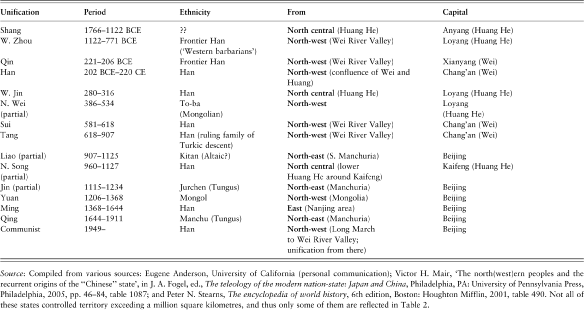
The spatial distribution of mega-empire occurrence is highly clumped. None arose in many world regions, whereas in other regions empires rose sporadically and, in a few locations, repeatedly. China is unique, in that it has seen a continuous sequence of rise and fall of empires since the Bronze Age (Table 1). Beginning with the Qin unification in the third century BCE, the periods of fragmentation between successive unifications rarely exceeded a century, although some unifications were partial.
Imperial unifications in China from the Shang era to the present.
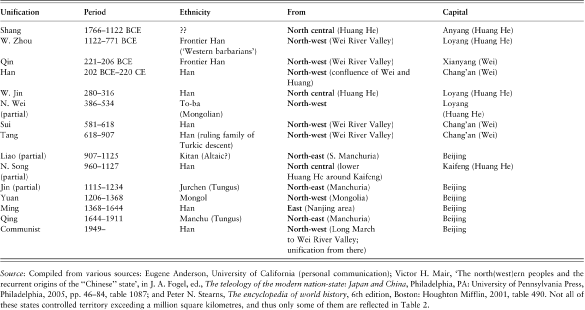
Source: Compiled from various sources: Eugene Anderson, University of California (personal communication); Victor H. Mair, ‘The north(west)ern peoples and the recurrent origins of the “Chinese” state', in J. A. Fogel, ed., The teleology of the modern nation-state: Japan and China, Philadelphia, PA: University of Pennsylvania Press, Philadelphia, 2005, pp. 46–84, table 1087; and Peter N. Stearns, The encyclopedia of world history, 6th edition, Boston: Houghton Mifflin, 2001, table 490. Not all of these states controlled territory exceeding a million square kilometres, and thus only some of them are reflected in Table 2.
Table 1 also quantifies another striking and repeatedly noted pattern.Footnote 4 All but one of the fifteen unifications – the establishment of the Ming dynasty c.1368 – originated in the north. Three began from the north-east (the Liao peninsula, Manchuria), three from the north central region (Huang He), and eight from the north-west (most often from the Wei River Valley). The importance of the north for Chinese empires is also suggested by the location of capitals (Table 1), almost all of which were in the north, even though the economic centre of China shifted south to the Yangtze valley by c.1000 CE.
Thus, the political centres of Chinese empires were located not in geopolitically safe locations but near China’s ‘perilous frontier’, to borrow the title of Thomas Barfield’s insightful book. Before the Western intrusion of the nineteenth century, serious threats to China always came from the north.Footnote 5 On those borders, there was almost continuous military pressure from Turco-Mongolian steppe dwellers in the north-west, and from the Tungusic people of Manchuria in the north-east, periodically punctuated by successful invasions that occupied northern China and, on two occasions, the whole of China. This geopolitical pressure helps to explain why northern China was such a ‘hotspot’ of imperiogenesis.
The importance of the steppe frontier in Chinese history has been examined by, among others, Owen Lattimore, Thomas Barfield, and Nikolai Kradin.Footnote 6 Barfield, in particular, argues that the scale of political organization among the nomads was directly proportional to the size of the neighbouring agrarian empires. The greatest imperial confederations of nomads in world history (the Xiongnu, the Turks, and the Mongols) arose on the steppe side of the frontier. In other words, the exceptionalism of the East Asian imperiogenesis hotspot was mirrored in the exceptionalism of repeated gigantic imperial confederations in the steppes. Furthermore, there was a striking degree of synchrony between the rise of the steppe imperial confederations and Chinese empires – Xiongnu and Qin/Han, Turks and Sui/Tang, Mongols and Song. This correlation, however, was not perfect. For example, the Mongols eventually conquered all China, extinguishing the Song dynasty.
Barfield and Kradin both argue convincingly that the political organization of pastoral nomads on a large scale requires a nearby settled society, because the nomadic society does not produce surplus in a form useable to support the state. Nomads are hard to tax, because they are skilled at fighting and can move themselves and their wealth much more easily than farmers can. Moreover, their chief product – livestock – cannot be stored easily, unlike the grain produced by agrarian economies. Thus, political organizations among nomads had to draw resources from the agrarian societies, by robbing the farmers, by extorting tribute from agrarian states, or by controlling trade routes. Kradin refers to this as xenocratic political organization (from xenos ‘stranger and kratos ‘power’).Footnote 7 This argument suggests a reason why the sizes of agrarian states and nomadic confederations are correlated. As agrarian states in East Asia grew, nomads needed to cooperate on an increased scale to continue successful raiding, to present a credible threat to extort the tribute, or to impose favourable terms of trade. Additionally, larger and richer sedentary states possessed greater wealth that nomads could extract, thus enabling larger nomadic polities. Consequently, Barfield calls the nomadic confederations the ‘shadow empires’, their size mirroring that of agrarian states.Footnote 8
Thus, Barfield and Kradin suggest that the appearance of agrarian mega-empires explains the rise of nomadic imperial confederations. This is probably correct. However, if the presence of a large agrarian state produced larger nomadic confederations, should not the presence of a large nomadic confederation have similar effects on farmer societies? Here I propose a verbal model, exploring possible consequences of such a feedback loop.
Cooperation as the basis of society
I have explored elsewhere the forces that held together agrarian states.Footnote 9 The first important point is that attempts to build a theory of society by assuming that all people behave in entirely self-interested manner, from Machiavelli and Hobbes to modern rational choice theory, have been unsuccessful.Footnote 10 The fundamental problem is that, for a society to exist and function, its members must produce public goods, the costs of which are borne by each contributor, whereas the benefits are shared evenly across all members. The rational behaviour in such situations is to ‘free ride’, benefiting from the public-good production by others while not contributing oneself.
One of the most important collective goods for small-scale societies is mutual defence. Defence is a public good, because its costs are born privately (the probability of being killed or seriously injured), while its benefits (group survival, or successful defence of the group’s territory, crops, and herds) are shared automatically among all members. Groups consisting entirely, or largely, of free riders are unable to cooperate in collective defence, and thus will not persist. However, recent research in experimental economics has shown that, although some people indeed behave as free riders, in most societies the majority is motivated not only by the prospect of gain and avoidance of punishment but also by social norms that promote cooperation.Footnote 11 Thus, groups with many ‘prosocial’ individuals will have a better chance of repelling invaders, although other factors play a role in explaining the capacity of groups for collective action.Footnote 12 Generally speaking, different groups are characterized by different degrees of solidarity and, therefore, different capacities for concerted action – in warfare as well as in other endeavours. Perhaps the greatest theorist of group cohesion was the fourteenth-century Arab sociologist ‘Abd al-Rahman ibn Khaldun.Footnote 13 The key concept of Ibn Khaldun was ‘asabiyya, which can be loosely translated as ‘group feeling’. According to Ibn Khaldun, ‘asabiyya produces ‘the ability to defend oneself, to offer opposition, to protect oneself, and to press one’s claims’.Footnote 14 Ibn Khaldun, a native of the Maghrib (north-western Africa), understood well the social interactions on frontiers between nomads and agriculturalists. However, the outcomes of this interaction in the Maghrib were different from those on the East Asian steppe frontier. There were no mighty agrarian empires similar to the Chinese ones in north-western Africa, and the scale of Maghribi states was generally smaller than those created by the Turco-Mongolian peoples.
The model
Although the starting point of the model is local communities, this is not a critical assumption. The main argument concerns the social scaling-up process from polities to ‘meta-polities’, defining a polity as any kind of independent political organization, whether community, simple chiefdom, complex chiefdom, state, or empire.
The model has two fundamental postulates. First, there is a steep gradient in average rainfall. The well-watered side of the ecological frontier is inhabited by settled agriculturalists, while pastoral nomads occupy the arid zone. Second, pastoralist nomads have both the incentive and ability to take agricultural products away from farmers by force. On the one hand, ‘pure nomads’, without even limited forms of agriculture, cannot produce necessities such as grain, which they must somehow obtain from agriculturalists.Footnote 15 On the other hand, they enjoy a preponderance of military power over farmers.
Assuming that the area is occupied by small-scale communities, nomads thus routinely rob their farmer neighbours. A nomadic community might raid around the time of the harvest, when agricultural products are most abundant, but the main booty can also be slaves and livestock, later sold or exchanged for agricultural and prestige goods. Nomads can also obtain products by trading but the possibility of violence is always present. Even if older and wealthier nomads might prefer less risky trade, pressure for raiding is generated by younger and poorer men, who wish to build up their reputation and wealth.
A successful raid can be devastating to a farming community. Not only does it lose a large part of the resources needed to survive until the next harvest but the nomads may also kill men of fighting age, and abduct women and children as slaves. Thus, raiding pressure from the steppes imposes a severe selective regime on farming communities. The less cohesive and military able communities are likely to disintegrate in the aftermath of a raid, with surviving members being accepted into surrounding, more effective groups.
Although raiding pressure should select for more cohesive and warlike communities over time, the military superiority of steppe warriors places limits on how effectively a single farming community can defend itself. The only successful way of resisting nomad pressure is for several local communities to unite into a ‘meta-community’, with a larger defensive force to offset the nomads’ military advantage.
There are at least three ways in which scaling-up can be achieved. The simplest is for the leaders of several neighbouring communities to form an alliance to coordinate defence. The concept of joint defence was broadly known within Eurasia, as attested by the common motif of the quarrelling sons and the bundle of twigs, which is found in Greek, Talmudic-Midrashic, and Indic literature, as well as in many folkloric traditions.Footnote 16 However, voluntary defensive alliances are vulnerable to free-riding. Therefore, the second route to joint defence is for one community to annex several neighbours by force, resulting in a simple chiefdom, which is better at coordinating defence because the chief can punish any subordinate community that does not contribute to the common defence. The third route is a variant of the ‘roving bandits–stationary bandits’ scenario.Footnote 17 An enterprising group of nomads moves permanently to the agricultural side of the frontier, subjugating several farming communities. With time, these nomads assimilate to the farmers’ language and culture, but the chiefly elites remain of non-native origin.
Whatever the particular mechanism adopted, the scaled-up agrarian polity shifts the balance of military power in its favour, thereby creating selective pressure for scaling up on the steppe side of the frontier. The nomad communities need to band together in order to nullify the numerical advantage of the agrarian polities. Successful raids require a mixture of cooperation and coercion, but probably with a lesser degree of coercion than on the farming side. First, there is less of an opportunity to free ride (those who do not join the raiding party do not share in the booty). Second, it is more difficult to coerce a nomadic group. It is interesting that the quarrelling sons motif appears in the Secret history of the Mongols no fewer than four times, with arrows rather than twigs bundled together to illustrate the value of cooperation.Footnote 18 Such a frequent occurrence possibly reflects the difficulty of uniting the nomads by force, and a greater emphasis on ideological means to achieve the same end.
Once scaled-up steppe polities regain their military advantage, the pressure is on the agrarian polity to scale up again, by evolving from a simple to a complex chiefdom. The initial ‘anisotropy’ in military power on the farming–steppe frontier thus sets up an autocatalytic process, resulting in a runaway evolution of polity sizes on both sides of the frontier. The process is stopped either by running out of space, or as the result of problems of logistics and costs in projecting power over distance.Footnote 19 Furthermore, once centralized agrarian states arise, the steppe nomadic confederations learn that they can extort tribute simply by threatening raids.Footnote 20 However, pressure to maintain the size of the confederation persists, owing to the need to pose a credible threat to the agrarian empire.
Application of the model to north China
The first postulate of the model, that there was a steep environmental gradient, clearly holds for north China. One needs to travel only 300 kilometres from Chang’an (modern Xi’an) to reach the Ordos desert (the homeland, or one of the homelands, of the Xiongnu), and even less from Beijing to arrive at the outskirts of the Gobi. Thus, the farming communities of northern China were within easy raiding distance for the steppe nomads. Experiments with well-fed Mongolian horses indicate that nomads could traverse 300 kilometres in less than a week, while a trans-Gobi raid, covering 1,800 kilometres, would require 25 days of travelling time.Footnote 21
The second postulate, military superiority of the nomads, also describes accurately the history of Chinese relations with the steppes, especially after the invention of mounted archery at the beginning of the first millennium BCE. Only a centralized Chinese state was able to mount successful defence against nomad raids: the periods of internal disunity in China were typically associated with increased raiding pressure from the steppes. Even with China unified, many Chinese rulers found it necessary to buy nomads off with tribute, thinly disguised as ‘gifts’.Footnote 22
One feature of the model that may strike historians of China as unrealistic is that at the starting point the area is populated by the smallest of polities, local communities. Indeed, my focus is on the advantage that the invention of mounted archery gave to pastoral nomads, and by the time this military technology spread to East Asia, the social evolution in this region had already led to the rise of complex chiefdoms and archaic states. For example, the earliest state in China probably arose during the Erlitou period (1900–1500 BCE).Footnote 23
However, the starting point is not a critical feature of the model. The main question of interest is the process leading to the end point – very large-scale polities. Moreover, the model does not imply a unilinear progression from the simplest polities all the way to mega-empires. On the contrary, the expectation is that the process will occur in fits and starts, interrupted by devolution to simpler polities. This is the pattern generated by formal mathematical models of evolution of social complexity.Footnote 24 Furthermore, nomads enjoyed some military superiority over farmers even before the rise of mounted archery. The invention of the chariot and its spread from the Great Steppe during the second millennium BCE provides one example. Even before the advent of the horse, nomadic herders had a significantly greater incentive and opportunity to practise archery than farmers, for defence of their flocks and for hunting.
Major advances in the social complexity of agrarian polities in China roughly correlated with three waves of domestic animals emanating from western Eurasia.Footnote 25 First, the arrival of cattle, sheep, and goats in the third millennium BCE coincided with the rise of Longshan culture and the first (perhaps mythical) dynasty, the Xia. Second, the beginning of the Shang period (middle of the second millennium) coincided with the appearance of the domesticated horse (as well as chariots, bronze, and writing). ‘Analysis of the dynamics of Shang civilization reveal … profound steppic connections’.Footnote 26 Finally, the arrival of horse-riding archers in the first millennium BCE was followed by the Qin–Han unification. ‘From the beginning and for three thousand years, Chinese history was intimately linked with the history of the nomads of Inner and Central Asia’.Footnote 27
An archaeologically recognizable frontier between China and its northern neighbours dates to the second millennium BCE, while a pattern of military confrontation between the Chinese and semi-nomadic herders on this frontier is evident during the Shang and Western Zhou periods (c.1500–770 BCE). In the mid seventh century BCE, the pressure on the northern frontier suddenly accelerated.Footnote 28 The Jung and Ti ‘barbarians’ on the northern Zhou frontier had been organized into relatively small sociopolitical units, but during this period they started to coalesce into larger formations.Footnote 29 For example, in 649 BCE the Jung of four different villages joined together in an attack on the Zhou capital. The Ti were able to create even larger unions: apparently, they were united in two confederations (the Red Ti and the White Ti).Footnote 30
While the Jung and the Ti were semi-nomadic shepherds and farmers, and it was relatively easy for the Zhou states to match their military power, the appearance of true nomads, the Hu, later called the Xiongnu (the first direct contact was in 457 BCE), ratcheted up the military pressure on Chinese states. During the Warring States period (475–221 BCE), the size of Xiongnu polities increased to the point where their shan-yu (‘emperor’) could field very substantial armies. In one battle, the Chinese army of General Li Mu of Chao – consisting of 1,300 war chariots, 13,000 cavalry, 50,000 infantry, and 100,000 archers – inflicted a defeat on the Xiongnu, killing ‘hundreds of thousands of men and horses’.Footnote 31 Even though the Chinese source clearly exaggerated the Xiongnu casualties, the size of Li Mu’s army indicates that, by this date, state formation in the steppes was already well advanced, and Xiongnu armies probably consisted of tens of thousands of warriors.
Although our knowledge of Ancient China is still very fragmentary, the developments on the steppe frontier during the Warring States period, as described by Di Cosmo, appear to present a good match to the dynamics predicted by the model. There are clear signs of intensifying pressure from the steppes, as well as increasingly aggressive Chinese war efforts against the north-western ‘barbarians’. The social scale of steppe polities was increasing. On the Chinese side, larger polities gobbled up smaller ones, then one of the larger polities gobbled up the rest. Furthermore, social scaling-up during the Warring States period followed on from previous, less far-reaching upward sweeps in social complexity during the Shang and the Western Zhou eras. It stands to reason that each successive attempt at state building utilized the templates established by predecessors.Footnote 32
In conclusion, the imperial confederations of Xiongnu, Turks, and Mongols were not mere ‘shadow empires’, reflections cast on the steppes by Chinese empires. The interaction between steppe confederations and agrarian empires in East Asia was characterized by feedback loops, with the causality flowing in both directions. If causality had been unidirectional, as postulated by Thomas Barfield, then the rise of steppe confederations would have followed the unifications of China with a time lag. This prediction is contradicted by the rise of the Gok-Turk Kaghanate (552 CE), which preceded Sui unification (581) by a generation. Similarly, Ming unification (1368 CE), which followed the Mongol conquest (finalized in 1279), was clearly a nativist reaction against the alien Yuan dynasty.
Furthermore, the beginning of the Xiongnu empire is traditionally dated to the rise of Mao Tun (209 BCE), a date that conveniently follows Qin unification (221 BCE). However, Mao Tun was not the first shan-yu of the Xiongnu, and Xiongnu armies of tens of thousands of steppe warriors appeared in the steppes well before Qin unification. The mirror-empires model assumes a system involving dynamic feedback in both directions, and therefore we expect a rough synchrony between agrarian and steppe empires, rather than one always following the other. Furthermore, the mechanism is an evolutionary one. This means that steppe frontiers are environments with selective pressures for increased polity size. Whether actual empires arise or not at any given point in time is not guaranteed, for it is a process with a large element of chance. As a result, model predictions are not deterministic, but stochastic.
Global patterns of mega-empire occurrence
Although the model emerged from historical dynamics in East Asia, the interactions assumed by it are generic to Afroeurasia, and it would thus be interesting to determine how well its predictions hold beyond East Asia. The empirical basis for the test is provided by a compilation of territorial dynamics of historical states.Footnote 33 My focus is on large land-based empires, both agrarian and nomadic, and not on sea-based powers, such as Athens, Venice, or the modern western European great powers. Furthermore, because the focus is on pre-industrial states, the list of empires only extends to 1800.
The statistical sample for testing model predictions is based on territorial size for two reasons.Footnote 34 First, although all quantitative data in history are measured with a substantial error, the areas of historical states typically have the least amount of error compared to other possible ways of selecting mega-empires, such as population. Thus, populations of most ancient and medieval empires are known so imperfectly that the true value could easily be double, or half, of the estimated one. Second, territorial extent is an interesting theoretical variable in its own right, as it is easier to control proximate subordinates than distant ones. Thus, a compact city state of a million inhabitants presents a much lesser theoretical puzzle than a far-flung territorial state with the same population.
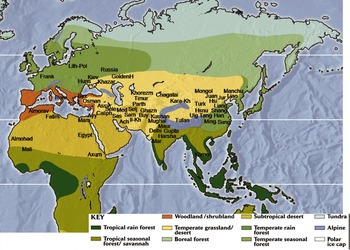
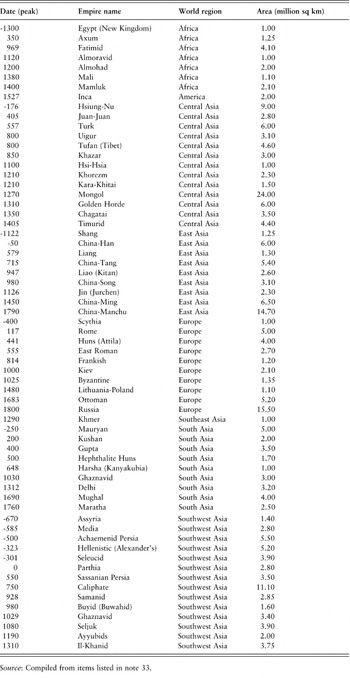
There were over sixty historical mega-empires (Table 2), and the great majority of these empires were situated in or next to the arid belt that runs through Afroeurasia, from the Sahara in the west to the Gobi in the east (Figure 1). The exceptions include one empire in Southeast Asia (Khmer), and the only empire in the Americas (Inca). There are also three European exceptions: the Roman and Carolingian empires, and perhaps Lithuania-Poland, although the latter expanded during the fourteenth century into steppe lands. In summary, the relationship between proximity to steppe and the rise of mega-empires is not deterministic but there is strong statistical regularity.
Spatial distribution of mega-empires within Afroeurasia. The approximate locations of imperial centres are indicated with codes related to empire names in Table 2. These locations are especially approximate in areas that were ‘hotspots' of imperiogenesis (e.g. East Asia), where there simply was not space to fit all names appropriately. The colours indicate the distribution of major types of ecologic communities. Of particular interest are the yellow (temperate grassland/desert) and light brown (subtropical desert).

Mega-empires in the historical record.

Source: Compiled from items listed in note 33.
The incidence of mega-empires drops off dramatically with distance from the Afroeurasian steppe belt, but this is not merely because of ecology. Arid zones are abundant on other continents and yet large states are either absent or exceedingly rare in those regions. What appears to be the important factor is proximity to pastoral societies.
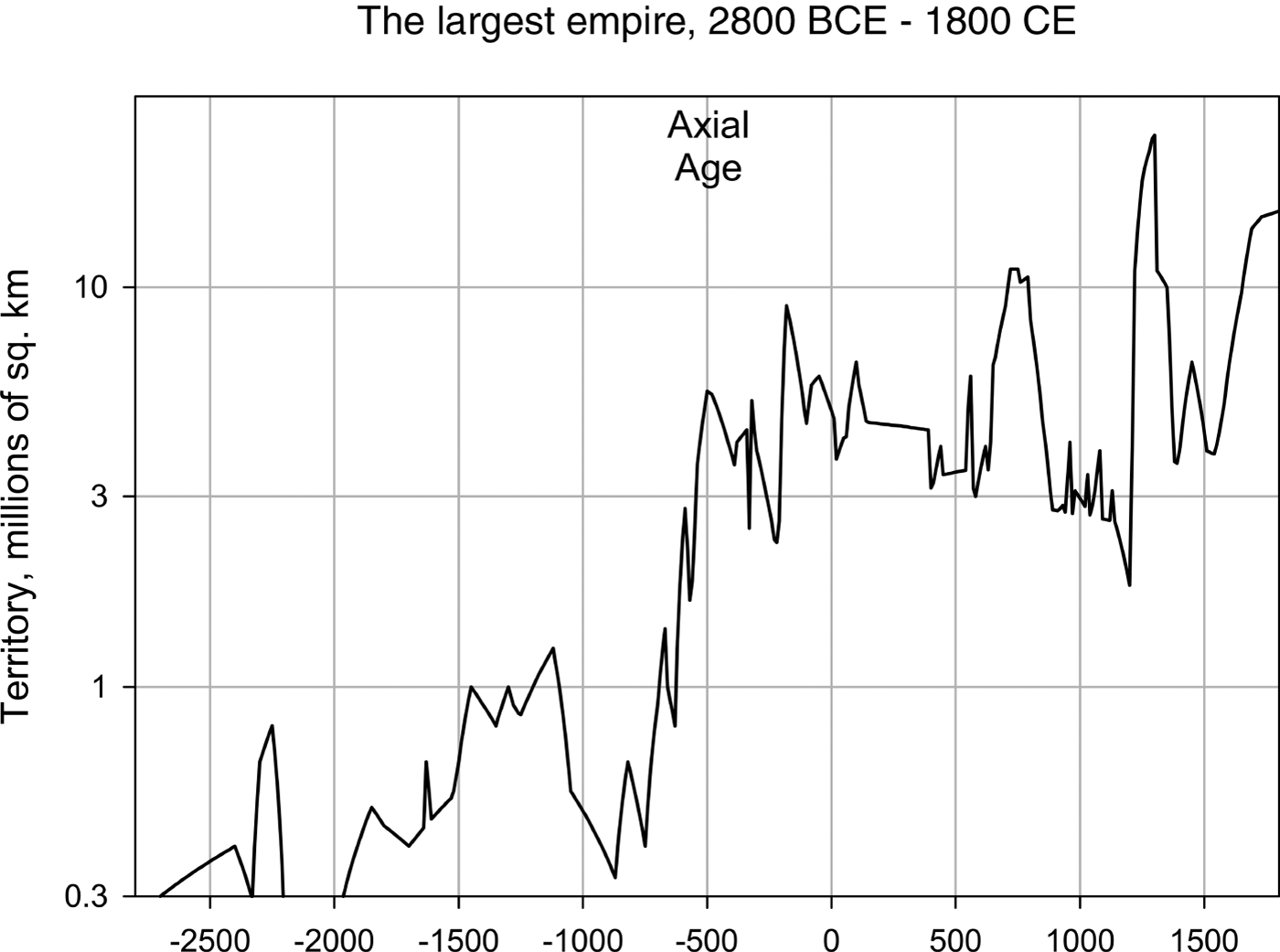
Figure 2 presents the temporal evolution of the largest empire size in the database.Footnote 35 During the third and second millennia BCE the maximum empire size fluctuated between 0.3 and 1 million square kilometres, albeit with a gradual upward trend (these were several Egyptian empires, the Akkad, and the Shang). Between 800 and 200 BCE, however, there was a rapid increase in maximum size (in million square kilometres), from 0.4 in 900 BCE to 1.4 in 670 BCE (the neo-Assyrian empire), then to 5.5 in 500 BCE (Achaemenid Persia), and finally to 9.0 in 180 BCE (the Xiongnu). It is remarkable that this dramatic upsweep in the maximum area coincided almost precisely with the Axial Age, usually dated to 800–200 BCE.Footnote 36 After the upsweep of the Axial Age, the maximum imperial size continued to increase, but at a much slower rate (Figure 2). Karl Jaspers speculated that the great religious and philosophical breakthroughs of the Axial Age were a response to political and social instability brought on by increased pressure from the nomadic steppe dwellers, which, in turn, was due to the military breakthrough of mounted archery. We know that the Scythians were instrumental in bringing the end to the neo-Assyrian empire, and that the Achaemenid struggle against them was in many ways similar to the struggle of the Han empire against the Xiongnu.
The area of the largest empire between 2800 BCE and 1800 CE. Note the log scale for territorial size.

There was a simultaneous development during the Axial Age of empire size, nomad military superiority, the rise of great world religions, and a radical increase in the world urbanization rate.Footnote 37 The model developed in this article offers one possible explanation for this remarkable pattern. As nomad military superiority forced agrarian states to scale up to resist pressure from the steppes, one cultural mechanism for holding together ethnically diverse people in new mega-empires was the presence of unifying, ‘meta-ethnic’ (supranational) ideologies, such as Zoroastrianism in the Achaemenid empire, Buddhism in the Maurya empire, and Confucianism in the Han empire.Footnote 38 Turco-Mongolian nomads (perhaps going as far back as the Xiongnu) had their own integrative meta-ethnic religion, Tengrism, although it is not usually viewed as a world religion.Footnote 39
Next I consider a sample of world regions in greater detail. Clearly, an in-depth survey can be achieved only through collaborative effort; thus, my goal in this article must be limited to identifying interesting patterns and suggesting hypotheses relating to other regions.
Regional patterns: Egypt
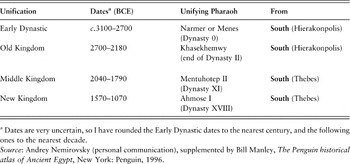
Egypt is crucial because it was one of the first regions to develop a state-level society. It also presents a puzzle: why was the New Kingdom the last great native empire to develop in Egypt? There are many similarities between China and Ancient Egypt but, whereas China was usually unified from the north, the unifying dynasties of Egypt invariably arose in the south (Table 3).Footnote 40
Unifications of Egypt by native dynasties.

a Dates are very uncertain, so I have rounded the Early Dynastic dates to the nearest century, and the following ones to the nearest decade.
Source: Andrey Nemirovsky (personal communication), supplemented by Bill Manley, The Penguin historical atlas of Ancient Egypt, New York: Penguin, 1996.
The evolution of the state in Ancient Egypt occurred in a series of steps of increasing complexity.Footnote 41 Between 3400 and 3200 BCE, regional population around Hierakonpolis coalesced into several large settlements, with the paramount one at Hierakonpolis. In the next step, Hierakonpolis annexed two adjacent chiefdoms. Then came the unification of Upper Egypt and, finally, of the whole of Egypt.Footnote 42 In addition to the four native unifying dynasties listed in Table 3, Egypt was also partially unified by the immigrant Hyksos (c.1670–1570 BCE) during the Second Intermediate Period. After the end of the New Kingdom (c.1070 BCE), Egypt was governed by a succession of foreigner rulers: Libyans, Kushites, Assyrians, Persians, Greeks, Romans, Arabs, Mamluks, and so forth. There was thus a striking macro-historical pattern of repeated unification from the south until 1000 BCE, followed by a loss of geopolitical independence.
Roughly ten thousand years ago, the Sahara started receiving significantly greater amounts of rainfall. The deserts surrounding the Nile gradually shifted to steppes (150–300 mm of annual rainfall) and savannas (300–700 mm).Footnote 43 The relative frequency of archaeological radiocarbon dates in the eastern Sahara, associated with nomadic herder groups, increase during the ninth and eighth millennia BCE, fluctuate during the next several millennia, and decline to zero during the second millennium BCE.Footnote 44 Cattle nomadism developed by the fifth millennium. During the fourth millennium, the region of Lower Nubia, just south of the First Cataract, was settled by the semi-nomadic A-group population.Footnote 45 Starting at least from the thirty-first century, Egypt and Nubia coexisted in constant cultural contact and military conflict with each other.Footnote 46 The latest A-group burials contain great wealth of Egyptian material,Footnote 47 which may have been obtained in exchange for gold, but also as a result of raiding and tribute extortion.
There are a number of similarities between the Egypt–Nubia frontier and the Chinese–steppe frontier. The economic basis of the first Nubian kingdom with the capital at Kerma (c.2500–1500 BCE) was predominantly pastoral. First, there was simply not enough agricultural land to support an agrarian state in Upper Nubia. Second, elite burials contain hundreds, sometimes thousands, of cattle skulls. Such a strong emphasis on livestock suggests a strong pastoral component in subsistence.Footnote 48 Starting with the Old Kingdom, and continuing even after Egypt lost its independence, Nubia was recurrently unified by a succession of native empires: Kerma, Napata, Meroë, Nobadia, Makuria (Dongola), and Funj.Footnote 49
Nubians were excellent archers,Footnote 50 who used the methods typical of steppe warfare. King Senwosret III (c.1850 BCE) complained about the difficulty of fighting the Nubian: ‘To answer him is to make him retreat. Attack him, he will turn his back. Retreat, he will start attacking.’ There was harsh ethnic stereotyping: Nubia was not simply Kush, but always ‘Wretched Kush’. There was even an equivalent of the Great Wall. During the Middle Kingdom, Egypt build ‘a hardened frontier’ consisting of a chain of six massive fortresses south of the Second Cataract.Footnote 51 Finally, there is direct inscriptional evidence of Nubian raiding into upper Egypt around 1575–1550 BCE,Footnote 52 coinciding with the period of the New Kingdom unification.
In addition to the Nubians, Egypt had to deal with other nomadic populations: the Medjay of the Eastern Desert and the Libyans of the Western Desert. The Libyans, for example, repeatedly assaulted Egypt during the early Old Kingdom,Footnote 53 as well as later. During the Middle Kingdom, the Medjay were organized into nomadic confederations, such as Aushek and Webtsepet. Unlike Lower Nubia, which was dropped from the Execration Texts after it was conquered, the Medjay polities continue to appear in the Execration Texts of all periods, indicating that they and Egypt were involved in continuous warfare.Footnote 54
When the Sahara dried c.1000 BCE, all these semi-nomadic and nomadic populations were pushed away. The centres of later Nubian states shifted south, first to the Dongola Reach and then to the more hospitable Sahel region. As the steppe frontier of Egypt moved away, Egypt gained dramatically in security from nomadic attacks, but it never again gave rise to a native empire.
The Maghrib
Agrarian mega-empires and large-scale imperial nomadic confederations did not form in the Maghrib, because the agrarian polities lacked the deep hinterland of China or Egypt into which they could expand. In north-west Africa, agriculture is possible only within a thin band stretching along the Mediterranean coast. As a result, agrarian states lost the scaling-up race to nomadic confederations and were conquered by them, setting up the dynastic cycles so admirably described by Ibn Khaldun. The majority of desert-originating dynasties in the Maghrib thus only reached medium size.
Only three Maghribi dynasties broke through the million square kilometres threshold for any length of time: the Fatimids, the Almoravids, and the Almohads (see Table 2). Their achievements were possible because they either started outside the Maghrib or moved their centre of gravity outside the Maghrib. Interacting with large and productive agricultural areas outside north-west Africa, they eventually moved their capital cities there. The Fatimids originated in Tunisia in 909, when local Berbers were converted to Isma‘ili Islam, but soon conquered Egypt and moved their capital to Cairo (in 969). It was Egypt’s agricultural wealth that financed further expansion into the Levant and Arabia. The Almoravids began their imperial career on the steppe frontier with West Africa’s agrarian Ghana empire, which they later conquered, and they added Moorish Spain to their domain. The Almohads defeated the Almoravids in 1144, and first conquered Andalusia before turning east to Algeria and Tunis. Their capital was moved to Seville in 1170.Footnote 55 The Wattasid (Sa‘di) dynasty of Morocco once again broke through the Saharan barrier in 1591, but its domination of the interior of West Africa was brief.
South Asia
The arid belt of Afroeurasia intrudes into India from the north-west. Indeed, the steppes surrounding the Thar desert, located south-east of the Indus, extend practically to the modern capital of Delhi.Footnote 56 South Asia is also separated from the rest of Eurasia by a ring of mountains.Footnote 57 This mountainous barrier presented a serious barrier to invading armies, with a partial exception in the north-western quarter, through which all major invasions occurred.
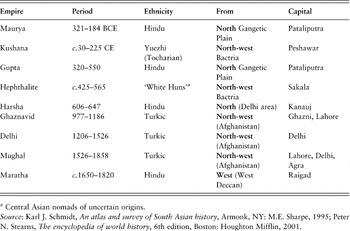
Of the nine mega-empires in South Asia (see Table 4), five originated in the north-west (Afghanistan), three in the north (the Gangetic plain, encompassing the upper and middle course of the Ganges), and one in the west. Despite the formation of numerous medium- and small-size states, no mega-empires originated in the north-east (Bengal and Assam) or central and southern India. Five empires were ruled by dynasties of Central Asian origin, while the rest were under indigenous dynasties (Table 4). Steppe origins, however, could be quite remote. If the Kushana empire was put together by steppe nomads, for the Mughals, nomadic life was many generations in the past.Footnote 58 ‘Hindu’ dynasties had the most remote steppe origins, if any – even the Maurya empire arose more than a thousand years after the Aryas allegedly moved into the Indian subcontinent.Footnote 59
Mega-empires of South Asia.

a Central Asian nomads of uncertain origins.
Source: Karl J. Schmidt, An atlas and survey of South Asian history, Armonk, NY: M.E. Sharpe, 1995; Peter N. Stearns, The encyclopedia of world history, 6th edition, Boston: Houghton Mifflin, 2001.
The geographical pattern of imperiogenesis in South Asia is thus somewhat different to that in East Asia. In India, as in China, the farther the location is from the steppe frontier, the less likely it is to be the centre of a large empire. However, whereas steppe nomads played a direct role in the rise of Chinese empires, in India this was not the case. Most frequently, South Asian empires were put together by nomadic groups who transformed themselves into the ruling elites of agrarian states. Other empires arose on the frontiers of states ruled by steppe-originating dynasties. For example, the Gupta empire arose on such a secondary frontier of the Kushana empire and the Shaka (the Western Satraps, of Scythian origins).Footnote 60
Of particular interest is the evolution of the first Indian mega-empire, that of the Maurya. During the millennium after their alleged arrival in South Asia, the descendants of Aryas established only small-scale polities. Around 600 BCE, when the frontier of the Median empire reached the Indus valley,Footnote 61 there were at least sixteen (and probably more) such statelets. After intense wars in the late sixth century, only four remained. The pressure on indigenous polities further increased with the Achaemenid conquest of the Indus plain c.500 BCE. One of the four remaining ‘Hindu’ kingdoms, Magadha, under the leadership of two capable kings in 540–461 BCE, was particularly successful in extending its territory.Footnote 62 The final stimulus was given a century later with Alexander’s campaigns in the Indus region. Profiting from the disorder after Alexander’s death, the new ruler of Magadha, Chandragupta Maurya, conquered the Indus valley from Seleucus and united northern India. His successors extended the empire to encompass most of India. The time lag between the first appearance of the Median-Persian frontier and the explosive growth of the Mauryan state was three centuries, the same as was observed in Europe.Footnote 63
In summary, South Asian mechanisms of state formation were different in some ways from those of China. Steppe influence played an indirect role, and the correlation probably arises because such influence was more easily transmitted through the Eurasian arid zone, rather than through the Himalayas or via Southeast Asia.Footnote 64 Thus, one broad pattern that South Asia shares with China was that large empires arose from the same direction as the greatest external threats.
The Middle East during the Axial Age
Because of their central location, Mesopotamia and Iran were affected by nomadic influences from multiple directions: from the Arabian or Syrian desert (the Amorites, the Arameans, the Arabs, etc), and from the Eurasian steppes (the Aryas, the Scythians, the Turks, the Mongols, etc). It would take a separate article to disentangle the complex patterns of interaction between settled farmers, nomadic herders, and hill tribes in this central region, so I focus on one period, the Axial Age (800–200 BCE), during which the dominant steppe influence was from the north.
The states of Mesopotamia and Iran experienced an intense period of interaction with Eurasian steppe pastoralists during the first millennium BCE. The sequence of events that matters to the model began in the ninth century BCE in the Eurasian steppes, with the appearance of a small, but powerful and accurate, compound bow, which could be used from horseback.Footnote 65 Towards the end of the eighth century, Iranic-speaking nomads (first Cimmerians, later Scythians) invaded the Middle East across the Caucasus mountains.Footnote 66 They destroyed the kingdoms of Van and Phrygia, and played a significant role in the destruction of Assyria.Footnote 67 During the seventh century, the Scythians established a powerful supra-tribal confederation in Azerbaijan.Footnote 68
There are certain similarities between the mirror empires on the Chinese–steppe frontier and the relationship of the Achaemenid empire (549–330 BCE) to Scythia. Most importantly, an escalation of military pressure from the steppes preceded the dramatic rise of the Median-Persian empire during the Axial Age. The pressures for unification also worked in the opposite direction. For example, Herodotus describes how the invasion by Darius into the Pontic Steppe led to the formation of a large, multi-tribal nomadic army.
It appears that the Scythians were the first nomadic pastoralists to build an imperial confederation, although it was less cohesive and stable than the next great nomadic empire, the Xiongnu, which itself was not particularly cohesive or stable. European Scythia stretched from the Danube in the west to the Don in the east, and from the Crimea in the south to the forest–steppe belt in the north. According to Herodotus and Strabo, the Scythians were at various times (but probably not continuously) united under one king. The probable capital of the fourth-century ruler mentioned by Strabo, King Atheas, is the excavated Scythian town of Kamenskoe on the Dnieper. Kamenskoe was a very substantial settlement, occupying twelve square kilometres and surrounded by extensive fortifications. The Scythians collected tribute from agricultural people living in the forest steppe west and north of the Pontic steppe. Later, they also collected tribute from the Greek cities of the Black Sea littoral, and traded with them.Footnote 69 However, the rather limited resource base of Scythia – farming communities of wooded steppe and the Greek trading towns of the Black Sea – was one reason why ancient pastoralist states in the Pontic Steppe were weaker than those in East Asia.Footnote 70
Eastern Europe
No strong agrarian state arose in eastern Europe in response to the imperial confederation of the Scythians, or the Sarmatians who replaced them. The most likely reason is that, before c.500 CE, agriculture in eastern Europe was limited to the narrow belt of forested steppe.Footnote 71 Similarly to the situation in the Maghrib, emergent agrarian polities did not have a deep hinterland into which they could expand, and so lost the scaling-up race to the nomads. The situation was transformed during the second half of the first millennium, when farming spread eastward and northward into the zone of mixed deciduous and coniferous forests.Footnote 72 The formative influence on the creation of polities in this region was exerted by Khazaria.Footnote 73
The Khazars were a Turkic tribe who settled in Daghestan (the north-eastern Caucasus), on the frontier that formed during the sixth century between the Gok Turks and Iran’s Sassanian empire. In a development paralleling the Scythian incursion of the seventh century BCE, the Khazars raided deep into Sassanian Transcaucasia.Footnote 74 When Iran was conquered by the Caliphate in 650 CE, the Arabs occupied Derbent and mountain passes of the Caucasus, whence they put increasing pressure on Khazaria. The pressure was so intense that the Khazars had to abandon their first capital of Samandar in 737, and move to Itil on the lower Volga.Footnote 75 However, their location on frontiers, first of the Sassanians and then of the Caliphate, created a sense of unity among the Turkic nomads and enabled them to build a mega-empire that unified the Pontic and Caspian steppes. The Khazars also subjugated East Slavic groups, such as the Polanians, and forced others to pay tribute.Footnote 76 Thus, by the ninth century, the Slavs inhabiting the transitional forest–steppe zone in modern Ukraine found themselves on the frontier of a steppe empire.
Two agrarian states arose on the northern Khazar frontier in the ninth century: the Kaghanates of Bulghar and Rus’, the latter also known as the Principality of Kiev.Footnote 77 Both states were ruled by alien elites – the Turkic Bulghars and the Scandinavian Varangians, respectively. An additional factor in the formation of Rus’ was the rise of a new nomadic confederation in the Pontic steppe, the Turkic Pechenegs (Patzinaks). The Pechenegs forced passage through the Volga steppes, controlled by the Khazars, in the late eighth century and immediately started raiding the lands of the budding Kievan state. In the middle of the eleventh century, the Pechenegs were displaced by another Turkic group, the Kipchaks (Cumans, Polovtsy).Footnote 78 In fact, both the Pecheneg and the Kipchak elites ruled over much of the same mixture of Turkic and Iranian tribes.
The relationship between the Principality of Kiev (880–1240) and these two Turkic confederations (c.880–1240) fits the pattern of the mirror-empires model. Although the Principality of Kiev, the first attempt at state-building in eastern Europe, had a marked tendency to fragment, the nomadic confederations also lacked cohesion. The Pechenegs, for example, were divided into eight separate hordes, each with its own kaghan (‘Great Khan’), and concerted action depended on cooperation between these leaders.Footnote 79 Kievan Rus’ thus became the first agrarian mega-empire of eastern Europe. Under Prince Sviatoslav (964–72), the Rus’ sacked the capital of the Volga Bulghars, destroyed Khazaria, and temporarily captured the capital of the Danube Bulghars.Footnote 80 Kievan Rus’ provided a template for the rise of the next, and much more cohesive, mega-empire in eastern Europe: Russia.
The rise of Muscovite Russia in many ways mirrored the trajectory of Kievan Rus’.Footnote 81 Russia also started as a tributary area on a frontier of a great steppe power, the Mongol Golden Horde. When the Horde disintegrated in the fifteenth century, the Principality of Moscow had to contend with the Horde’s successor states, the Khanates of Kazan, Astrakhan, Crimea, and Sibir, as well as the Nogay Horde. Russian lands came under intense raiding pressure from Kazan and, particularly, the Crimean Tatars. The Russian struggle with the Crimeans continued for three centuries.
The Khanate of Crimea is something of a misnomer because its Khan controlled not only the Crimean Peninsula but also a large chunk of the Pontic Steppe, from the Dniester in the west to the Don in the north-east and the Kuban in the south-east.Footnote 82 Although this region is characterized by rich soils, prior to the Russian conquest there was very little agriculture. The economic basis of the Khanate was almost purely nomadic pastoralism and the region was constantly in need of agricultural products.Footnote 83 The Khanate was a typical xenocratic state because it could survive only by raiding the agriculturalists of Russia and Ukraine. The main commodity that the Tatars aimed to capture was people, who were sold in Caffa and other Black Sea slave markets. In addition, the steppe warriors stole livestock and extorted irregular ‘gifts’ or tribute (pominki) from Russia and Poland. The Russians also periodically bought captured population back from the Tatars.
The economics of the Crimean Khanate illustrate the idea that raiding and trading are not mutually exclusive ways for nomads and agriculturalists to interact but may even be positively correlated. Port cities such as Caffa, by providing a ready market for slaves, created additional incentives for raiding. Turkic and Mongolian nomads were in a similar situation, for they raided or extracted tribute in China and traded with Central Asian merchants.Footnote 84
The steppe army of the Khan of Crimea was 40,000–50,000 strong. During especially large expeditions, when he was joined by other forces, the combined army reached 100,000 mounted warriors.Footnote 85 This was a very substantial force (for comparison, the army of Chinggis Khan numbered around 130,000). The devastation that such forces brought to the Russian economy and population could be huge. In 1521, Khan Mohammad Girey, with a 100,000-strong army, broke into the Muscovite heartland. According to one chronicle, he carried away 300,000 captives, while the Austrian envoy Sigismund Herberstein reported that the losses amounted to 800,000, some killed, others taken away to captivity. In 1600–50, the Tatars sold between 150,000 and 200,000 Russians on Crimean slave markets.Footnote 86 In 1646, the total Russian population was 4.5–5 million.Footnote 87 Because the Tatars killed at least as many people as they enslaved, their effect on the Russian population and economy was ruinous.
In the light of such devastation, it is not surprising that Russia developed as a highly centralized and militarized state. It was imperative for Russia to increase its geopolitical resources to match the power of its steppe neighbours. The Muscovite army was similar in equipment and organization to the steppe armies but it size was substantially smaller. In the 1520s, the army on the southern frontier numbered only 20,000.Footnote 88 By the 1580s, as a result of territorial expansion and population growth, its size grew to 65,000.Footnote 89 In the end, Russia evolved into one of the largest empires in history, controlling, by 1900, a territory of 15 million square kilometres and a population of 130 million.Footnote 90
Muscovite expansion was only partly due to outright military conquest. On multiple occasions, independent rulers voluntarily joined Muscovy. For example, in 1500 the princes of Novgorod-Severski, Chernigov, and Starodub entered Moscow’s service and joined their lands to Muscovy. In 1654, Ukraine similarly defected from Poland-Lithuania to Russia. Finally, the Georgians, starting in 1586, repeatedly asked to be taken under the protection of the Russian Tsar, and Georgia was finally annexed in 1800.Footnote 91 All these territories were threatened by Islamic nomads (the Crimeans) or Islamic states with steppe roots (the Ottomans). Because staying independent was not on the cards, rulers chose to submit to a co-religionist (Orthodox Christian) monarch. This pattern illustrates the integrative influence of a steppe frontier on agrarian polities.
The Great Plains of North America
The absence or paucity of large states in the Americas and Australia was arguably due to a lack of domesticated ungulates, prior to the arrival of the Europeans (Australia even lacked agriculture, another precondition of mega-empires). The only exception in the New World was the use of llamas in the Andes, the area with the only mega-empire, although this was perhaps a coincidence. The introduction of the horse into the Great Plains of North America by the Spaniards in the sixteenth century thus provides a natural experiment to test the pastoral hypothesis.
In 1598, the Spanish established a colony at Santa Fe and a ‘horse frontier’ gradually spread outward into the southern Great Plains from New Mexico.Footnote 92 Native groups quickly began acquiring horses. The most successful were the Apaches, who emerged as skilful riders and raiders by the 1650s and dominated the southern Plains by the early eighteenth century, in the process destroying rival groups such as the Jumanos of Texas.Footnote 93 However, during the 1710s another group, the Comanches, entered the Plains from the southern Rocky Mountains. Unlike the Apaches, who practised horticulture to supplement bison hunting, the Comanches developed as pure nomads, hunting bison for meat and obtaining the necessary agricultural products by coercion. This strategy served them well during their conflict with the Apaches. Apache seasonal horticultural villages were easy targets for highly mobile Comanches.Footnote 94 Additionally, the Comanches were unified, while the Apaches were split into several tribes, periodically at odds with each other. As a result, by the 1760s the Comanches replaced the Apaches as the hegemonic power of the Plains.Footnote 95
The victory of Comanches over Apaches illustrates a general mechanism operating on the steppe frontiers. Semi-nomadic populations with mixed pastoralist and agrarian economies are extremely vulnerable to highly mobile pure nomads. Usually, agriculturalists need a large and effective state to be able to resist nomadic pressure. An example of this is Russia from the seventeenth century. Russian peasants could colonize the steppe (and forest steppe) only because they had a centralized state backing them. As a result, steppe frontiers often became highly polarized between a centralized agrarian state and nomadic groups practising pure pastoralism, while any groups practising mixed subsistence were ground up between those two extremes. The disappearance of the semi-nomadic Jung and Ti prior to the joint rise of the Han and Xiongnu empires is a possible example of this dynamics. Another possible example is the disappearance of the A-group population from Lower Nubia simultaneously with the rise of Egypt’s Old Kingdom.Footnote 96
To meet the Comanches’ need for carbohydrates, the southern Plains gradually evolved a raiding and trading system, similar to that of the Pontic Steppe. They raided settled communities in Texas and northern Mexico, and traded with New Mexico. The primary targets for raiding were people and livestock. Slaves were needed in the Mexican economy to work fields and mines, while the Comanches used captives both as slave labour and to supplement their population, which was periodically devastated by Old World epidemics.Footnote 97 Comanches also extracted tribute from Spanish governors. These tributary relations were framed as a fictional vassalage to the Spanish king, in the same way that the Xiongnu ‘submitted’ to the Chinese emperor.
By the late eighteenth century, Comanchería had developed as a powerful imperial nomadic confederation, paralleling steppe confederations of the Old World, although its scale was not as grand as that achieved by Turco-Mongolian peoples. At its peak, the Comanche population was only about 40,000. However, in relative terms, the Comanches were a hegemonic power, because the total population of Spanish colonies in Texas and New Mexico was less than theirs.Footnote 98 Comanches controlled the entire southern Plains, and their raids reached deep into Mexico. On at least one occasion, they raided the city of Quéretaro, just 135 miles north of Mexico City. According to one report, the losses of Coahuila alone amounted to 1,200 dead and 400 captives, as well as 35,000 head of stock.Footnote 99 Comanche raids caused massive destruction and depopulation. By 1814, Spanish Texas was close to expiring: there was hardly any livestock left; the ranches around San Antonio had to be abandoned; and the population of Nacogdoches in east Texas dropped from four to two thousand.Footnote 100
During the nineteenth century, Comanche economic and social organization continued to evolve towards the Old-World type. For example, when bison herds were decimated by droughts and overhunting, Comanches switched to cattle ranching. It is interesting to speculate whether a centralized agrarian empire would have evolved to the south of the Great Plains had Mexico and Comanchería been left alone. What happened instead was that the Comanches were overrun by the steamroller of the United States. As the conquest of the Great Eurasian steppe by Russia and China had demonstrated, by the nineteenth century the age of nomadic empires was over.
Conclusion
The main argument in this paper is that steppe frontiers are very special places for imperiogenesis, places where very large territorial states are much more likely to arise than elsewhere. Over 90% of historical mega-empires (see Table 2) were located next to or within the Old World arid zone extending from the Sahara desert to the Gobi desert. The pattern of association between steppe frontiers and mega-empire occurrence becomes particularly striking in regions that had a steppe frontier on only one side, unlike Mesopotamia and Iran, which experienced steppe influences from multiple directions. The connection between steppe frontiers and mega-empires is not absolute – for there are exceptions such as Angkor in the Cambodian jungles – but the statistical correlation is strong. Indeed, this may be one of the strongest macro-historical regularities over the long term.
Thus, the Eurasian steppes abut China’s northern frontier, and China was almost invariably unified from the north. The arid zone enters South Asia from the north-west, and all mega-empires in this region originated here. Before 1000 BCE, southern Egypt was a steppe frontier, and all unifications of Ancient Egypt were accomplished by dynasties originating in the south. After deserts replaced steppes around 1000 BCE, no native dynasty managed to create an independent state in Egypt.
To account for this broad macro-historical generalization, I propose a model of social scaling-up process that leads to co-evolution of agrarian mega-empires and nomadic imperial confederations, facing each other across the steppe frontier. This mirror-empires model is strongly influenced by warfare theories of the origin of the state.Footnote 101 However, this influential current in anthropological theory, in my opinion, suffers from its failure to integrate the insights of Ibn Khaldun, as well as more recent developments in evolutionary theory. State formation involves much coercion and profit-seeking, but an additional key ingredient is cooperation.
The basic idea of the evolution of cooperation by group selection was clearly formulated by Charles Darwin: ‘Selfish and contentious people will not cohere, and without coherence, nothing can be effected. A tribe possessing … a greater number of courageous, sympathetic, and faithful members, who were always ready to warn each other of danger, to aid and defend each other … would spread and be victorious over other tribes’.Footnote 102 During the twentieth century, group selection first went through a period of uncritical acceptance, resulting in a great deal of bad theorizing, followed by a backlash, when the concept was completely repudiated by evolutionary biologists. Influential figures in sociobiology, such as E. O. Wilson,Footnote 103 preferred to emphasize kin selection and reciprocity as the chief evolutionary forces explaining cooperation. This rejection of group selection by evolutionary biologists was reflected in sociological literature.Footnote 104
In recent years, however, group selection has staged a comeback. The modern theory of multi-level selection emphasizes that natural selection can operate at all levels – genes, cells, individuals, and groups.Footnote 105 The role of multi-level selection in the evolution of human sociality has been supported with both mathematical models and empirical analyses.Footnote 106 As a result of these studies, we now have a good understanding of how cooperation evolved in small-scale societies. The great remaining scientific puzzle is the evolution of the human capacity to combine into huge cooperating groups, consisting of millions of unrelated individuals. This is not to say that all inhabitants of the Han empire were selfless altruists, but that the diametrically opposing view – that the Han empire was held together by force and greed alone – is equally untenable. There had to be a group of pro-social individuals, at least among the elites (following the useful distinction, provided by Anthony Smith, between lateral, or aristocratic, ethnies, in which the sense of common ethnicity is confined to elites, and vertical, or demotic, ethnies, characterized by broader ethnic feelingFootnote 107).
The huge conglomerate of humanity in Han China, at its peak, numbered more than 60 million people spread over 6 million square kilometres of territory. The contemporary Xiongnu confederation controlled an even greater area (but its population was a small fraction of that of China). It was the simultaneous rise of these two empires that motivated the elaboration of the mirror-empires model. Other plausible examples of this mechanism include Tang China and the Turks, Egypt’s New Kingdom and Nubia, and Muscovy and the Crimean Tatars.
However, the mirror-empires dynamic was not the only route to mega-empire. The empirical survey of six world regions indicates that there were significant variations of the basic scaling-up mechanism. For example, instead of the steppes and the agrarian polities achieving a rough balance, one of them could conquer the other. The paradigmatic example is the Ibn Khaldun dynamic in the Maghrib. Nevertheless, even when the end point was an empire uniting the desert and the sown, the conquering polity – nomadic or, less frequently, agrarian – first went through a period of evolution and scaling-up on the steppe frontier. Chinggis Khan’s empire, which scaled up to an imperial confederation in one person’s lifetime, may appear to be an exception, but he was building on a template developed and iteratively perfected since the time of the Xiongnu.
Another variation is Barfield’s ‘shadow-empire’ dynamic.Footnote 108 A new empire arose on the frontier of an existing one, so that, instead of mutual feedbacks, the causality was all, or largely, unidirectional. This was the main mode of imperiogenesis in India, and also in Europe.Footnote 109 Thus, the historical record reveals several variations on the basic mirror-empires mechanism. But the record also supports a broad macro-historical generalization: frontiers, and steppe frontiers in particular, were the loci where empire formation was particularly intensive.