


Introduction
In recent decades, psycho-educational, group-based and lecture-style interventions have emerged as a viable form of psychological support. These interventions are characterised by ‘high volume and low cost’, with potential utility as a sole intervention (e.g. Burns et al., Reference Burns, Kellett and Donohoe2016; Delgadillo et al., Reference Delgadillo, Kellett, Ali, McMillan, Barkham, Saxon, Donohoe, Stonebank, Mullaney, Eschoe, Thwaites and Lucock2016; Kellett et al., Reference Kellett, Clarke and Matthews2007) or as an adjunctive component to standard psychotherapy (e.g. Delgadillo and Groom, Reference Delgadillo and Groom2017). Adjunctive group treatments also differ in whether they are employed prior (i.e. pre-treatment intervention) or alongside individual psychotherapy (i.e. conjoint intervention).
Pre-treatment interventions can orient participants to key treatment concepts and guide them in the application of self-help strategies. Such interventions also serve the purpose of ‘role induction’, which helps to clarify patient–therapist roles, expectations, and to develop a sense of optimism and readiness to change (Oldham et al., Reference Oldham, Kellett, Miles and Sheeran2012). Benefits of such interventions have been shown through meta-analytic findings that pre-treatment interventions demonstrate small-to-medium effect sizes on improving therapy attendance (Oldham et al., Reference Oldham, Kellett, Miles and Sheeran2012). It is possible that the didactic ‘seminar style’ is perceived as a minimally demanding introduction to psychological intervention, which may help to engage patients who are initially anxious or ambivalent about accessing psychological therapy. In a recent quasi-experimental study, Delgadillo and Groom (Reference Delgadillo and Groom2017) developed a series of three opt-in psycho-educational seminars which served as a pre-treatment intervention for patients on a waiting list for high-intensity cognitive behavioural therapy (CBT). Patients who received seminars prior to CBT showed greater completion rates than matched (historical) controls that accessed CBT only. This finding becomes important in the context of repeated prior findings demonstrating that higher rates of attrition are associated with poorer outcomes (e.g. Cahill et al., Reference Cahill, Barkham, Hardy, Rees, Shapiro, Stiles and Macaskill2003).
The specific psycho-educational components that pre-treatment interventions include vary across interventions, as these are often designed for specific presentations (e.g. disorder-specific content for depression, phobias, panic disorder, etc.). Some interventions alternatively offer a more general or ‘transdiagnostic’ approach, covering processes that are thought to maintain a variety of common mental disorders (e.g. cognitive biases, avoidance of stressors, maladaptive behaviours, etc.). Transdiagnostic approaches have received a resurgence in popularity within the CBT field, reflected through the publication of numerous transdiagnostic CBT protocols (Barlow et al., Reference Barlow, Farchione, Fairholme, Latin, Ellard, Billis, Bentley, Boettcher and Caseillo-Robbins2017; Harvey et al., Reference Harvey, Watkins, Mansell and Shafran2004; Norton, Reference Norton2012) and meta-analyses of transdiagnostic interventions (Berle and Sakiris, Reference Berle and Sakiris2019; Newby et al., Reference Newby, McKinnon, Kuyken, Gilbody and Dalgleish2015). One of the primary reasons for this resurgance is the growth of evidence highlighting the shared etiological factors across disorders (e.g. temperament, emotion regulation; Barlow et al., Reference Barlow, Allen and Choates2004). Transdiagnostic treatments also offer various efficiencies in resources, service delivery and staff training (Barlow et al., Reference Barlow, Allen and Choates2004). Previous research indicates that transdiagnostic CBT seminars offered as a pre-treatment intervention are acceptable to patients with a broad range of diagnoses and could help to improve attendance rates (Delgadillo and Groom, Reference Delgadillo and Groom2017). This evidence, however, comes from a single service, and further replication is necessary to establish if such findings are generalizable to similar routine practice settings (Addis, Reference Addis2002). A multi-site study has, to our knowledge, not been conducted using a transdiagnostic seminar (TDS) pre-treatment intervention.
To address this gap in the literature, the present study aimed to evaluate the effectiveness and acceptability of pre-treatment TDS when disseminated across a number of clinical services offering high-intensity CBT. The study was guided by three evaluation questions. Does TDS influence treatment outcomes and attendance for patients accessing CBT? How consistent are the clinical outcomes across different services? How acceptable is TDS to patients, and does this differ according to their presenting problems? Based on the earlier study by Delgadillo and Groom (Reference Delgadillo and Groom2017), the following hypotheses were tested. (1) There will be no significant differences in TDS acceptability ratings when comparing patients with different primary diagnoses. (2) Rates of CBT completion in those accessing TDS+CBT will be superior to closely matched patients receiving only high-intensity CBT from an archival dataset. (3) The effectiveness of TDS+CBT will not be significantly different from matched patients receiving high-intensity CBT only. (4) There will be no significant differences in clinical effectiveness between participating services.
Method
Design
This study was a multi-site, quasi-experimental, routine care evaluation of a pre-treatment intervention (TDS) implemented across multiple psychological therapy services. The evaluation focused on measures of acceptability of TDS, clinical effectiveness and utilisation (attendance) of individual high-intensity CBT. The three services that participated in this study represented neighbouring boroughs of a single National Health Service (NHS) Trust serving a highly rural, socio-economically diverse and ethnically homogenous (i.e. almost exclusively white British) geographical area in Cumbria, northern England. A group of local clinicians within each participating service were recruited and trained as TDS facilitators by the intervention developer (co-author M.G.), using a highly standardised set of training and delivery materials (including presentation slides, booklets, videos, feedback and supervision framework). TDS+CBT treatment data were collected prospectively over a 12-month period between June 2015 and June 2016. This mid-year implementation point was in line with readiness for implementation for participating services. The available archival data set for patients receiving high-intensity CBT that pre-dated the implementation of TDS was between the dates of February 2013 and December 2014. These dates were in line with the available data from a subsample of a separate research study (Finegan et al., Reference Finegan, Firth and Delgadillo2020).
Setting
All participating services were part of the Improving Access to Psychological Therapies (IAPT) programme in England (Clark, Reference Clark2018). IAPT services provide psychological therapies in primary care settings, to patients experiencing a range of common mental health problems (e.g. anxiety disorders and depression). These are delivered through a ‘stepped care approach’ in accordance with clinical guidelines (National Institute for Health and Care Excellence, 2011), whereby interventions are available within ‘low’ and ‘high’ intensity formats, dependent upon patient need. Low-intensity treatments are generally brief (≤8 sessions) and are therapist guided. High-intensity treatments include a range of evidence-based protocol-driven psychotherapies (e.g. CBT, counselling for depression, interpersonal psychotherapy, eye-movement desensitisation and reprocessing) for a maximum of 20 sessions. The current study concerned patients receiving high-intensity CBT.
Recruitment
Patients who were on waiting list to access high-intensity CBT at participating IAPT services were invited through standardised letters and/or by the clinicians who had conducted initial screening appointments. A set of guiding criteria were provided to clinicians to aid identification of unsuitable patients. These criteria included: patients who (a) posed significant risk of suicide or self-harm, (b) demonstrated marked cognitive impairment, (c) could not fluently speak English, or (d) would be likely to find group situations extremely distressing. In addition, patients with a primary diagnosis of post-traumatic stress disorder (PTSD) were not included; this was for consistency with a prior study that also imposed this exclusion (Delgadillo and Groom, Reference Delgadillo and Groom2017).
Benchmarking data source
A benchmarking approach was used to allow for comparisons between participating services. Pooled service effect sizes for patients receiving TDS were computed and compared with two separate performance benchmarks. First, archival data were used for people receiving high-intensity CBT from the services participating in the current study, and prior to TDS implementation, which is a subsample of a previous study (Finegan et al., Reference Finegan, Firth and Delgadillo2020). Data were available for 4974 patients who attended at least one high-intensity CBT appointment. To improve the validity of comparisons, propensity score matching was used to identify a sub-sample of the archival data set matched on a range of available covariates (age, gender, baseline distress, past input at step 2, number of sessions). Ethical approval for the analysis of this historical data set was obtained (REC reference 15/NW/0062).
Measures
Clinical outcome measures
The Patient Health Questionnaire (PHQ-9) is a 9-item questionnaire for assessment and monitoring of depression (Kroenke et al., Reference Kroenke, Spitzer and Williams2001). The scale employs a 0–3 Likert scale for each item, yielding a total severity score between 0 and 27. The clinical cut-off for the PHQ-9 is ≥10, which has demonstrated good sensitivity (88%) and specificity (88%; Kroenke et al., Reference Kroenke, Spitzer and Williams2001). The Generalised Anxiety Disorder scale (GAD-7) is a 7-item measure of anxiety symptoms (Spitzer et al., Reference Spitzer, Kroenke, Williams and Löwe2006) which also uses a 0–3 Likert scale for each item, yielding a total severity score between 0 and 21. With a clinical cut-off set to ≥8, the GAD-7 has shown a sensitivity of 77% and specificity of 82% (Kroenke et al., Reference Kroenke, Spitzer and Williams2001). Functional impairment was measured using the Work and Social Adjustment Scale (WSAS; Mundt et al., Reference Mundt, Marks, Shear and Greist2002). The WSAS is a 5-item, self-report tool measuring functional impairment across five domains. This measure applies a 0–8 Likert scale (with 8 being most impaired), yielding a total functional impairment score between 0 and 40.
The above outcome measures were completed by all patients on a session-by-session basis, before starting each treatment session, consistent with practice across IAPT services (Clark, Reference Clark2018). Similarly, TDS participants completed these measures prior to the beginning of each seminar, and these measures were collected by the seminar facilitators and entered into routine clinical records.
Clinical pathway data
De-identified demographic information and clinical pathway information was recorded for all patients. This included: number of weeks in CBT, completion status, number of appointments attended, prior access to low-intensity treatment, and number of TDS sessions attended.
Acceptability measure
A 3-item questionnaire assessing acceptability (AQ) of TDS has previously been developed for administration immediately after each seminar (Delgadillo and Groom, Reference Delgadillo and Groom2017). Each item is rated on a 0–10 Likert scale (10 as most acceptable) rating (a) the relevance to their presenting problems; (b) perceived quality of the delivery; and (c) perceived quality of the materials. This scale has demonstrated high internal consistency (α = .80). In the present study, TDS participants completed this questionnaire at the end of each seminar.
Interventions
Cognitive behaviour therapy
High-intensity CBT delivered in these services involves structured, protocol-driven, disorder-specific interventions listed in the Roth and Pilling (Reference Roth and Pilling2008) competency framework (up to 20 sessions). High-intensity CBT was delivered by psychotherapists qualified to a postgraduate-level and whose training was based on a highly standardised national curriculum (Department of Health, 2011). Therapists practised under regular clinical supervision (equivalent of 1 hour per week).
Transdiagnostic seminars (TDS)
The TDS intervention is described in detail elsewhere (Delgadillo and Groom, Reference Delgadillo and Groom2017). It consists of three psycho-educational seminars designed based on transdiagnostic theory of common mental disorders (e.g. Harvey et al., Reference Harvey, Watkins, Mansell and Shafran2004) in order to increase their applicability across a broad range of presenting problems. The titles and focus of the seminars were as follows: (1) ‘Manage your mind’ (coping with worry and rumination); (2) ‘Cope with your feelings’ (strategies for emotion regulation); and (3) ‘Do what matters’ (promoting goal pursuit and behavioural activation). Patients were able to attend the whole series, or specific seminars that appealed to them. Seminars offered a didactic learning experience, accompanied by seminar-specific handouts. Each seminar lasted 1.5 hours. This intervention is publicly available through the website of the North West Practice Research Network (https://www.iaptprn.com/publications.html).
Statistical analysis
Cases with missing baseline data at the start of the IAPT pathway were not included. Missing data at all other time points were imputed using last observation carried forward. Completion was defined as patients who attended at least one appointment and had a collaborative ending to treatment. Premature discontinuation was defined as a unilateral treatment ending by the patient. Finally, treatment rejection was defined as patients who attended at least one TDS seminar but did not attend/declined their initial high-intensity CBT appointment. Analyses to determine the representativeness of TDS attendees who completed high-intensity CBT vs those who rejected, or prematurely discontinued CBT, was conducted. Categorical variables were assessed using chi-squared tests, while numerical variables were analysed using either Wilcoxon/Mann–Whitney test or Student’s t-test, dependent upon confirmation or violation of normal distribution using the Shapiro–Wilk test.
Statistical analyses for routine outcome measures utilised an ‘intention-to-treat’ approach. That is, all patients who attended at least one high-intensity CBT appointment were included, regardless of completion status. Outcome scores at pre-selected time points were used. These included: initial assessment within IAPT service (IAPTentry); initial TDS seminar; intial high-intensity CBT appointment (CBTstart); and final high-intensity CBT appointment (CBTend). Based on these time points, effect sizes were conducted for three periods: (1) the waiting period for CBT (IAPTentry – CBTstart); (2) the course of CBT treatment (CBTstart – CBTend); and (3) the full IAPT pathway (IAPTentry to CBTend). These effect sizes were calculated at the individual service level and also the pooled study level. Effect sizes were calculated using uncontrolled paired-samples (pre–post) Cohen’s d; with the difference between pre–post means divided by the pre-treatment standard deviation. Because of the inherent violation of independence when using paired sample tests (Cuijpers et al., Reference Cuijpers, Weitz, Cristea and Twisk2017) adjustments were made using the pre–post correlation (Pearsons’ r). This is guided by the approach advocated by Minami et al. (Reference Minami, Serlin, Wampold, Kircher and Brown2008). One-way repeated measures analysis of variance (RM-ANOVA) were performed for each outcome measure. This utilised a single within-subject factor of ‘time’ with four levels of each outcome measurement point. Normal distribution of data was assessed using QQ-plots and Shapiro–Wilk tests.
In comparing the results of the current study to the archival data set, we used propensity score matching (PSM) to identify a sub-sample of patients matched on a range of covariates (baseline depression and anxiety, age, gender, number of sessions, prior input from step 2). As a large proportion of the archival data set had missing WSAS scores, this was not included in the matching procedure. The PSM formula utilised one-to-one nearest neighbour matching with replacement and a caliper set to .25. Effect sizes for the PSM sample were compared with the TDS+CBT sample. In addition, differences in recovery rates were calculated using criteria proposed by Jacobson and Truax (Reference Jacobson and Truax1991) for reliable and clinically significant change. Reliable change indices for the study outcome measures were set to PHQ-9 ≥ 6 and GAD-7 ≥ 5, as proposed by Richards and Borglin (Reference Richards and Borglin2011).
To assess the acceptability of TDS, descriptive statistics were calculated for the AQ items. Internal consistency was assessed using Cronbach’s alpha. A high level of consistency would theoretically support the mean aggregation of AQ items into a single acceptability score. This score was then assigned to each patient and run through a one-way analysis of variance to explore differences in TDS acceptability between diagnostic groups.
Results
Sample characteristics
One hundred and six patients attended at least one TDS seminar during the data collection period. The study had a female majority (n = 63, 59.43%) with an average age of 43.90 (SD = 14.1, range 18–75). The sample was exclusively White British. This is less than the rate (0.74%) of non-White British patients who accessed high-intensity CBT across the same services over the course of a year from the archival data set. It is unfortunately possible that the exclusion criteria of ‘not speaking fluent English’ contributed to this under-representation.
Primary diagnoses were stated in clinical records for 88 patients (83.02%). Depression (n = 50, 47.2%) was the most common diagnosis, followed by generalised anxiety disorder (n = 20, 18.9%), social anxiety disorder (n = 6, 5.7%), obsessive compulsive disorder (n = 5, 4.7%), mixed anxiety and depression (n = 3, 2.8%), health anxiety (n = 2, 1. 9%), panic disorder (n = 1, 0.9%) and PTSD (n = 1, 1.9%). A breakdown of demographics and baseline clinical characteristics are presented in Table 1.
Sample characteristics

TDS, transdiagnostic seminars; CBT, cognitive behavioural therapy; SD, standard deviation, U, Mann–Whitney U; t, Student’s t-test; χ2, chi-square test; PHQ-9, depression severity; GAD-7, anxiety severity; WSAS, functional impairment. *Significant at p = < .05; aone patient with missing data removed; bthree patients with missing data removed.
Across the 106 patients, there was a total of 197 seminar attendances, with an average of 1.86 seminars per patient [SD = .90; ≥2 appointments = 55 (58.3%)]. Service A delivered the largest number of seminars (n = 108), followed by service B (n = 49) and service C (n = 40). These differences appeared to be a product of how long each service had been collecting data. Service A implemented TDS and collected data across the 12-month study period (49 weeks), whereas service B and service C were not able to begin implementation until a later point (17 and 18 weeks of collection). To our knowledge there was no systematic difference between services for who clinicians invited to attend. The modal number of seminars per patient was one (n = 51), while 36 patients attended three seminars and 19 people attended two seminars.
Data completeness
There was a high level of data completion across the three routine outcome measures (98.43%). There was a slightly higher rate of missing data for the WSAS (3.30%) than the PHQ-9 (0.70%) or GAD-7 (0.70%). Only one patient had missing data for the PHQ-9 or GAD-7 at the start of the IAPT pathway. There was a total of 144 completed AQs. The AQ was not implemented at service C. This was a decision made independently by service C based on the attitudes of staff towards employing additional questionnaires, which was felt to place excessive administrative demand on patients. The administration rate across the two services that implemented the AQ was 100% (service A) and 73.47% (service B), respectively.
Completion rates and attrition analyses
Of the 106 patients who attended at least one TDS, 93 entered high-intensity CBT. Thirteen patients who attended TDS therefore rejected CBT. Of the remaining 93 patients who entered treatment, 72 (77.42%) were classified as treatment completers while the remaining 21 patients (22.58%) were classified as having prematurely discontinued treatment. This completion rate is lower than the archival CBT data set (89.15%), the PSM sub-sample (93.02%) and the TDS+CBT benchmarks (87.8%; Delgadillo and Groom, Reference Delgadillo and Groom2017). There was no significant difference in completion rates for individual services participating in the current study included: service A (62.75%), service B (67.74%) and service C (79.17%).
Potential differences between patients who completed treatment (n = 72) and the combined sample of patients who rejected or prematurely discontinued treatment (n = 34) were explored across a range of demographic factors and clinical variables. There were no significant differences found for gender, health conditions, disability or locality. There was a significant difference between groups for age (U = 872, p = .017). Clinically, rejectors/premature discontinuers showed significantly lower functioning at IAPTentry (t 102 = .251, p = .014), and then higher depression (t 102 = 3.83, p = <.001) and higher anxiety (U = 872, p = .017) when starting CBT. From a service pathway point of view, there was no significant differences shown between completers and drop-outs for the number of days on the waiting list (U = 684, p = .548), or expectancy towards CBT (U = 714, p = .301).Footnote 1, Footnote 2
Intervention effectiveness
One-way repeated measures analyses of variance (RM-ANOVA) were conducted to explore changes between measurement points for depression, anxiety and functioning for the ITT sample (n = 88). Bonferroni adjustments were included for each model to account for the number of pairwise comparisons. The models were significant for depression, anxiety and functioning,Footnote 3 indicating time as a significant factor. All pairwise comparison t-tests were significant for depression apart from seminar to CBTstart. For anxiety, IAPTstart to seminar, and then seminar to CBTstart were not significant. Finally, for WSAS exceptions included IAPTstart to seminar, seminar to CBTstart, and IAPTstart to CBTstart.
Effectiveness – mean change
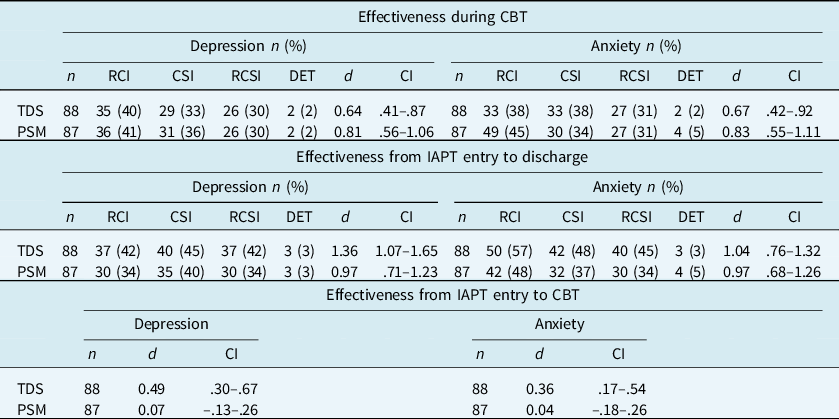
Effect sizes and recovery rates for the TDS group and the PSM group are shown in Table 2. During the waiting period, effect sizes for depression and anxiety were higher for the TDS group (depression, d = .49; anxiety, d = .36) than the PSM group (depression, d = .07; anxiety, d = .04). This was in contrast to the effect sizes shown for the period of CBT, as the PSM group (depression, d = .82; anxiety, d = .83) outperformed the TDS group (depression, d = .64; anxiety, d = .67). When looking at these periods combined (i.e. the full IAPT pathway), the effect sizes were comparable between groups for anxiety (TDS, d = 1.04; PSM, d = .97), while depression improvements were greater for TDS (TDS, d = 1.36; CBT, d = .97).
Clinical recovery rates for the current study and benchmarks

TDS, sample receiving transdiagnostic seminars; PSM, propensity score matched CBT sample; RCI, reliable change index; CSI, clinically significant change index; RCSI, reliable and clinically significant change index; DET, deterioration rate; d, Cohen’s d effect size; CI, confidence interval.
Effectiveness – recovery
Analyses included patients who did not score within the clinical range at baseline (IAPTentry/CBTstart). Across the full IAPT pathway there were greater rates of recovery (RCSI) shown for the TDS group across both depression (TDS = 42%, PSM = 34%) and anxiety (TDS = 45%, PSM = 34%). Chi-squared tests showed that neither of these findings were significant (depression, χ2 = 1.134, p = .287; anxiety, χ2 = 2.375, p = .123). Recovery rates for the period of CBT only were comparable between groups for both anxiety and depression.
Effectiveness between participating services
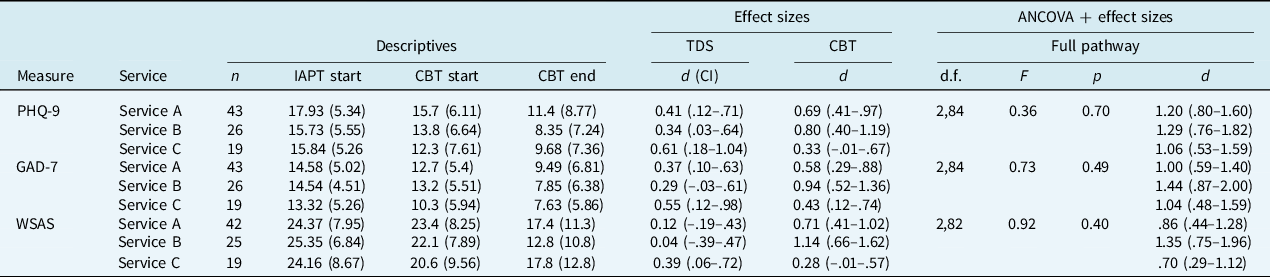
A one-way ANCOVA was used to compare effectiveness between the three services that participated in the current study (see Table 3).Footnote 4 There were no significant differences between services for depression (F 2,84 = .36, p = .70), anxiety (F 2,84 = .730, p = .485) or functioning (F 2,82 = .092, p = .40). For the waiting period (i.e. TDS), service C showed greater effectiveness than services A or B for depression (C, d = .61; A, d = .41; B, d = .34), anxiety (C, d = .55; A, d = .37; B, d = .29) and functioning (indicated by the WSAS; C, d = .39; A, d = .12; B, d = .04).
ANCOVA between participating services and effect sizes

Acceptability
There were 144 seminars with completed AQ forms. Mean ratings of the AQ domains were comparably high for each seminar (range 7.28–8.3; Fig. 1). Like the Delgadillo and Groom (Reference Delgadillo and Groom2017) study, there was high internal consistency shown through Cronbach’s alpha (α = .76). Using aggregated acceptability scores, a one-way analysis of variance found there to be no significant difference in mean AQ scores between diagnosis groups; F 4,118 = 1.58, p = .18.
Acceptability ratings for each AQ domain across the three seminars.

Discussion
Main findings
This practice research network study evaluated the effectiveness of TDS, a newly implemented pre-treatment intervention across three separate IAPT services. Compared with the PSM group, adding TDS as part of routine care demonstrated elevated rates of effectiveness (mean change and recovery) for depression and comparable effectiveness for anxiety during the full treatment pathway. Enhanced recovery rates, although encouraging for TDS, were not statistically significant. Perhaps the most important finding is that there were superior effect sizes (albeit still small) shown for the TDS group during the period of waiting for CBT. There were no significant differences between the three services that participated in the current study, supporting consistency of TDS effectiveness. Attendance rates were not found to be enhanced with TDS. TDS as an intervention was evaluated as acceptable, with no differences between diagnostic groups. Overall, this new evidence indicates that offering access to TDS helps participating patients to attain some symptomatic relief while they are on a waiting list to access CBT.
Implications and relation to prior research
The finding that supplementing CBT with TDS did not lead to greater effectiveness of CBT was consistent with the previous study by Delgadillo and Groom (Reference Delgadillo and Groom2017). Similarly, the present study found consistent and comparable levels of TDS acceptability ratings across patients with different primary diagnoses, supporting the notion that transdiagnostic interventions can be useful for patients with heterogeneous clinical presentations. However, there are some discrepancies between these two studies. In the present sample, CBT completion rates were not improved. Furthermore, we found evidence that TDS led to symptomatic improvements before accessing CBT, whereas no evidence for this effect was found in the former study. It is possible that unidentified and unmeasured differences in service delivery (e.g. waiting list duration, time between TDS and CBT) could account for some of these differences across studies. An alternative explanation is that the samples in this study were somewhat larger than the former study, providing greater statistical power. That said, the current sample size remained limited, which may explain why the trend of TDS showing greater recovery rates was not found to be significant. The finding that recovery rates were not statistically significant provides additional evidence that services should strive to reduce the amount of time patients wait for CBT. This could be achieved through increasing the availability of therapists through expanding the CBT workforce. The finding that completion rates were greater in the CBT only sample was unexpected. It is possible that overlap between TDS and step-3 CBT could have led to patients feeling they had improved and were ready to discontinue treatment at an earlier point. This is, however, inconsistent with the Delgadillo and Groom (Reference Delgadillo and Groom2017) study, which found greater completion rates in their TDS sample.
No significant differences in effectiveness were found between different services participating in the present multi-service study, indicative of consistency. This suggests that TDS as a pre-intervention can be implemented across services with comparative levels of effectiveness. Observation of confidence intervals showed that service C fared poorly during CBT but was superior during the waiting period. In other words, service C made the most therapeutic change during TDS and the least change during CBT. One potential reason is unique factors associated with service C. Service C serves a population that is characteristically more socio-economically deprived than the other two services. Negative associations between socioeconomic deprivation and therapeutic effectiveness have been reported in the literature (e.g. Finegan et al., Reference Finegan, Firth and Delgadillo2020). Consistent with this notion, the current study found smaller overall effect sizes (IAPTstart – CBTend) for service C, compared with A or B for depression, anxiety and functioning. It is unknown as to what the effectiveness for service C would have been without TDS; future research should systematically explore differences in pre-treatment intervention rates between patients varying in socioeconomic deprivation.
Strengths and limitations
The present study was able to assess the effectiveness and acceptability of the TDS intervention in a large, multi-service study, implementing a novel TDS intervention in a different setting and by different therapists. The large and naturalistic design also confers advantages in terms of generalisability to a routine care population, and adequate statistical power to compare the effects of adding TDS to a treatment pathway relative to PSM matched patients receiving CBT only. A number of limitations should also be taken into consideration. A notable limitation is that the current evaluation did not collect information on the number of patients who were invited to attend TDS. Subsequently we are unable to comment on what level of uptake the intervention offers. Future replications should endeavour to incorporate this important aspect of utilisation. Second, although the study was able to source data from matched historical controls, these were not contemporaneous cases or randomised to either CBT-only vs TDS+CBT. As such, we cannot rule out the possibility that changes in workforce, policy or practice over time may introduce confounding in the results. Furthermore, the current study ceased outcome measurement following completion of CBT, which means that the longer-term effects of these interventions and treatment pathways are largely unknown. Finally, all services that participated in this study are northern IAPT services. As such, the generalisability of these findings to other regions of England or service contexts (e.g. secondary care, in-patient care) is unknown. In particular, the exclusively White British demographic of the current sample, although largely representative of the high-intensity CBT throughput for this geographical region, is not representative of other more ethnically diverse samples/regions. In addition, further research and practice of TDS should strive to overcome the limitation of under-representation by ensuring that greater efforts are made to ensure fair access and adaptation to non-White British individuals (BME Positive Practice Guide; IAPT, 2019). One example of this would be to support access of individuals who do not speak fluent English. Finally, regarding recruitment, although clinicians were provided with guiding criteria to ascertain who to offer TDS, the degree to which this was adhered to was not evaluated during the study. It was further not recorded as to how many people were actually offered TDS. Future research would benefit from a standardised approach to monitoring TDS uptake in order to determine the relevance of TDS to IAPT services. Following from this quasi-experimental study, future research is needed under more closely controlled conditions (i.e. randomised controlled trial).
Conclusions
Overall, this large multi-service study demonstrated that the implementation of a transdiagnostic intervention was equally acceptable to patients with various presenting problems and led to a degree of symptomatic improvements while they waited to start CBT. Furthermore, these findings were comparable across different services. Given the quasi-experimental nature of this design, future evidence is required through a randomised controlled trial.
Acknowledgements
None.
Financial support
None.
Conflicts of interest
One of the authors of the current manuscript was the individual who previously developed the intervention.
Ethical statement
Formal ethical review was not required for this current study. The project was registered as a service evaluation with the host NHS Trust research (evaluation identifier is SER-20-009). Ethical approval for the benchmarking data used in this project is described in the Method section.
Data availability
Study data are available from the corresponding author. Requests to access these data will be considered by the research team.
Supplementary material
To view supplementary material for this article, please visit: https://doi.org/10.1017/S1352465821000114





Comments
No Comments have been published for this article.