


Introduction
Emergency Life-Saving Technicians (ELSTs) in Japan practice within a legal framework that allows selected advanced procedures only under real-time physician instruction through medical control.Reference Tanigawa and Tanaka1 Diagnostic ultrasound remains outside the independent scope of ELST practice.Reference Suzuki, Nishida, Suzuki, Kobayashi and Mahadevan2 As a result, prehospital focused assessment with sonography for trauma (FAST) by ELSTs faces both technical and regulatory barriers.
Widely used in trauma care, FAST can rapidly identify intraperitoneal or pericardial free fluid.Reference Rozycki, Ochsner, Jaffin and Champion3–Reference Bøtker, Jacobsen, Rudolph and Knudsen5 Previous studies of transport ultrasound have largely involved physicians or highly experienced operators.Reference Partyka, Coggins and Bliss6–Reference Scharonow and Weilbach10 In addition, ambulance-based telemedicine studies have shown that real-time remote assessment during transport is technically feasible and can provide clinically useful information for prehospital decision making.Reference Yperzeele, Van Hooff and De Smedt11 Studies of other procedures performed during ambulance transport, such as cardiopulmonary resuscitation, also suggest that vehicle motion can meaningfully affect procedural performance and therefore warrants direct evaluation.Reference Foo, Chang and Su12
This issue is particularly relevant in Japan, where rural emergency care settings and limited physician availability increase interest in prehospital diagnostic tools that may support triage and hospital selection.Reference Nakahara, Nagao, Nishi and Sakamoto13 A previous simulation study showed that structured FAST training improved ELST performance under stationary conditions.Reference Ohira, Maki and Ageta14 However, whether ELSTs can maintain technical performance during ambulance motion has not been well characterized.
The objective of this pilot innovation study was to evaluate the feasibility of ELST-performed FAST in moving ambulances in a controlled manikin setting. Specifically, this study aimed to assess technical performance across three ambulance speed conditions, to identify site-specific challenges, and to descriptively evaluate an integrated monitoring system for remote observation.
Methods
This prospective observational pilot study was conducted on March 3, 2025, at Okayama City Fire Department Education and Training Center in Okayama Prefecture, Japan. The overall experimental validation protocol is summarized in Figure 1. The study protocol was approved by the Ethics Committee of Okayama University Graduate School of Medicine, Dentistry and Pharmaceutical Sciences (OKU 2407-050). All participants provided written informed consent.
Schematic Representation of the Experimental Validation Protocol.

Twenty actively practicing ELSTs were recruited from fire departments across Okayama Prefecture. In Japan, ELSTs are non-physician prehospital providers who perform approved advanced procedures under physician-directed medical control. Participants completed a two-phase training program consisting of standardized e-learning followed by a 40-minute hands-on workshop led by board-certified emergency physicians. All participants initially completed a standardized two-week e-learning program delivered through an online learning platform; the full curriculum, including module content and duration, is provided in Supplementary Material Additional File 1. Before the hands-on session, participants were required to complete a 15-item knowledge assessment covering the legal framework, telemedicine, ultrasound fundamentals, image interpretation, and clinical decision making. Because current regulations prohibit ELSTs from independently performing ultrasound on living subjects without physician authorization, all training and testing were conducted using standardized FAST/ER FAN manikins (Kyoto Kagaku; Fushimi-ku, Kyoto, Japan). The hands-on workshop covered the standardized 4P-FAST protocol, advanced scanning techniques, and completion of the pre- and post-training questionnaires.
All examinations were performed using VScan Air portable ultrasound devices (GE HealthCare; Chicago, Illinois USA). An integrated monitoring system transmitted live ultrasound video, global positioning system location data, wide-angle front-camera footage of the ambulance interior, and an audio communication channel. During each trial, the participant performed FAST using a handheld ultrasound probe on a torso manikin positioned on the stretcher, while vehicle speed was monitored and real-time images were displayed on a monitor for remote review. The monitoring system was evaluated descriptively as a platform for remote observation in a controlled training setting.
Each participant performed FAST under three fixed-order conditions: (1) stationary with the engine running (STOP); (2) at 15km/hour on a 250-m circular course; and (3) at 30km/hour on the same course. A 250-m circular training track was employed because the use of a public roadway for non-operational experimental ambulance testing was not permitted by the Okayama City Fire Department. The study was therefore conducted within the training facility under controlled conditions. The study vehicle was an operational ambulance routinely used in Kibichuo Town, Japan. During the motion trials, the vehicle was driven by an ambulance crew member with routine responsibility for ambulance driving. Safety procedures during scanning in the moving ambulance followed standard operational safety practices. Pre-defined route and fixed speed conditions were used to maintain a controlled environment and reduce avoidable risks. A fixed sequence was selected for operational safety because immediately exposing novice operators to the highest speed first could have increased the risk of probe instability or motion discomfort.
The primary outcome was total Task-Specific Checklist (TSC) scores (0-24 points), which assessed technical performance across the four FAST views. The TSC was adapted from a previously validated instrument.Reference Ziesmann, Park and Unger15 The full modified TSC scoring rubric is provided in Supplementary Material Additional File 2. Secondary outcomes were examination time, site-specific TSC subscores, and a descriptive assessment of transmitted image quality across five practical domains: landmark identification, communication delay, image stability, diagnostic information content, and overall practicality. Two physicians independently reviewed blinded video recordings and scored each examination using the TSC. Inter-rater agreement was assessed using the weighted kappa coefficient.
The noninferiority margin was set at two points on the 24-point TSC scale. Standard deviation (SD) was estimated as 2.1 points based on a prior simulation study.Reference Ohira, Maki and Ageta14 With a one-sided alpha of 0.05 and 90% power, the required sample size was estimated to be 11 participants. Twenty participants were enrolled to allow for possible withdrawal related to emergency duty obligations.
Statistical analysis was performed using Python 3.11.11 (Python Software Foundation; Wilmington, Delaware USA). Descriptive statistics are presented as mean (standard deviation). One-sided noninferiority testing was used to compare total TSC scores in each moving condition with the STOP condition. Welch’s t-test was used for examination time comparisons between speed conditions. The primary noninferiority analysis was pre-specified for the total TSC score. Secondary analyses, including examination time comparisons, site-specific TSC subscore comparisons, and remote image-quality assessments, were considered exploratory. Because no formal multiplicity adjustment was pre-specified for these secondary outcomes, confidence intervals (CIs) for these outcomes were not adjusted for multiplicity and are presented for estimation and exploratory interpretation only.
Results
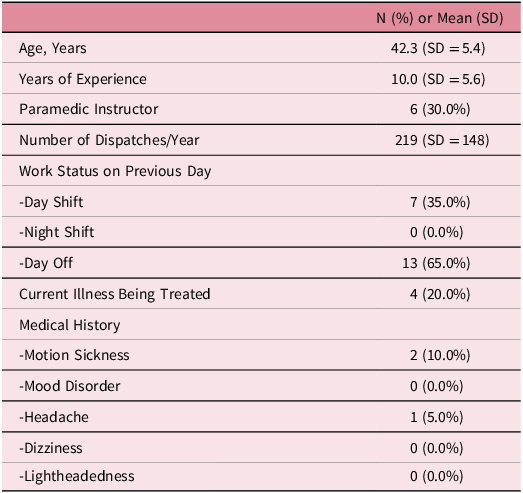
All 20 enrolled ELSTs completed the study procedures and were included in the analysis (Table 1).
Participant Characteristics

Table 1. Long description
A table summarizing participant characteristics in a study. The table has 11 rows and 2 columns. The columns are labeled ‘N (%) or Mean (SD)’ and contain various participant attributes. Row 1: Age, Years, 42.3 (SD = 5.4). Row 2: Years of Experience, 10.0 (SD = 5.6). Row 3: Paramedic Instructor, 6 (30.0 percent). Row 4: Number of Dispatches/Year, 219 (SD = 148). Row 5: Work Status on Previous Day. Row 6: Day Shift, 7 (35.0 percent). Row 7: Night Shift, 0 (0.0 percent). Row 8: Day Off, 13 (65.0 percent). Row 9: Current Illness Being Treated, 4 (20.0 percent). Row 10: Medical History. Row 11: Motion Sickness, 2 (10.0 percent). Row 12: Mood Disorder, 0 (0.0 percent). Row 13: Headache, 1 (5.0 percent). Row 14: Dizziness, 0 (0.0 percent). Row 15: Lightheadedness, 0 (0.0 percent).
Note: Percentages were calculated using the total sample size (n = 20).
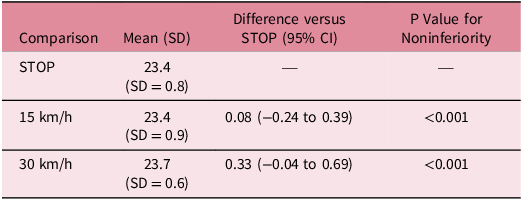
Mean total TSC scores were 23.4 (SD = 0.8) in the STOP condition, 23.4 (SD = 0.9) at 15km/hour, and 23.7 (SD = 0.6) at 30km/hour (Table 2). Compared with the STOP condition, the mean difference in total TSC score was 0.08 points (95% CI, −0.24 to 0.39; P for noninferiority < 0.001) at 15km/hour and 0.33 points (95% CI, −0.04 to 0.69; P for noninferiority < 0.001) at 30km/hour. Both moving conditions met the pre-specified noninferiority criterion relative to the STOP condition.
Total Task-Specific Checklist (TSC) Scores by Speed Condition and Pre-Specified Comparisons with the STOP Condition

Table 2. Long description
The table presents data on total task-specific checklist (TSC) scores across three conditions: STOP, 15 kilometers per hour, and 30 kilometers per hour. It has four rows and four columns. The columns are labeled Comparison, Mean (SD), Difference versus STOP (95% CI), and P Value for Noninferiority. The rows detail the mean scores and their standard deviations, the differences compared to the STOP condition with 95% confidence intervals, and the P values for noninferiority. The STOP condition has a mean score of 23.4 with a standard deviation of 0.8. The 15 kilometers per hour condition has a mean score of 23.4 with a standard deviation of 0.9 and a difference of 0.08 compared to STOP, with a P value for noninferiority of less than 0.001. The 30 kilometers per hour condition has a mean score of 23.7 with a standard deviation of 0.6 and a difference of 0.33 compared to STOP, with a P value for noninferiority of less than 0.001.
Note: Data are presented as mean (SD) unless otherwise indicated. All speed conditions were assessed in the same 20 participants. Confidence intervals are shown for the prespecified comparisons of the primary outcome against the STOP condition.
Abbreviation: TSC, Task-Specific Checklist.
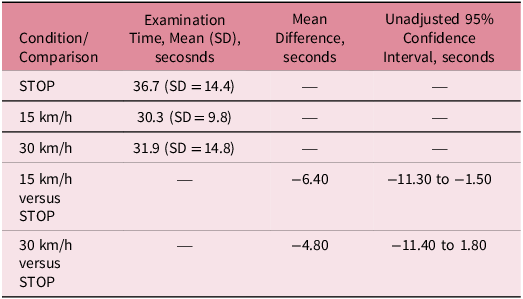
Mean examination times were 36.7 (SD = 14.4) seconds in the STOP condition, 30.3 (SD = 9.8) seconds at 15km/hour, and 31.9 (SD = 14.8) seconds at 30km/hour (Table 3). In exploratory comparisons, examination time was shorter at 15km/hour than in the STOP condition (mean difference, −6.40 seconds; 95% CI, −11.30 to −1.50 seconds), whereas the 30km/hour condition was not significantly different from the STOP condition (mean difference, −4.80 seconds; 95% CI, −11.40 to 1.80 seconds).
Examination Times by Speed Condition and Exploratory Comparisons with the STOP Condition

Table 3. Long description
A table with four rows and three columns comparing examination times across different speed conditions. The columns are labeled Condition/Comparison, Examination Time (Mean SD), Mean Difference (seconds), and Unadjusted 95% Confidence Interval (seconds). The rows are labeled STOP, 15 km/h, 30 km/h, 15 km/h versus STOP, and 30 km/h versus STOP. The examination times are 36.7 (SD 14.4) seconds for STOP, 30.3 (SD 9.8) seconds for 15 km/h, and 31.9 (SD 14.8) seconds for 30 km/h. The mean differences are -6.40 seconds for 15 km/h versus STOP and -4.80 seconds for 30 km/h versus STOP. The unadjusted 95% confidence intervals are -11.30 to -1.50 seconds for 15 km/h versus STOP and -11.40 to 1.80 seconds for 30 km/h versus STOP.
Note: Data are presented as the mean (SD) unless otherwise indicated. All speed conditions were assessed in the same 20 participants. Confidence intervals for secondary outcomes were not adjusted for multiplicity and should be interpreted as exploratory.
Exploratory site-specific analyses suggested greater technical difficulty in the pelvic view than at some other FAST views. Inter-rater agreement for TSC scoring was moderate, with a weighted kappa coefficient of 0.56 (95% CI, 0.41 to 0.70).
As a descriptive system-level assessment, two specialist physicians rated transmitted image quality favorably across five domains on a five-point scale. Mean ratings were 5.0 for landmark identification, 5.0 for communication delay, 4.5 for image stability, 4.0 for diagnostic information content, and 5.0 for overall practicality. These findings should be interpreted as descriptive system-level impressions rather than validated operator-performance measures. In this controlled setting, the monitoring system generally supported remote review of image acquisition during vehicle motion.
Discussion
This pilot innovation report suggests that trained ELSTs can maintain high FAST technical performance in a controlled moving ambulance-manikin setting, while an integrated monitoring system can support remote physician observation of image acquisition. Mean total TSC scores remained close to the maximum under all tested conditions, and both moving conditions met the pre-specified noninferiority criterion relative to the stationary condition. The descriptive remote review findings further suggest that real-time transmission and observation were feasible in the tested setting.
These findings extend prior transport ultrasound literature, which has mainly involved physicians or highly experienced operators.Reference Simmons, Mack, Cronin, Monti, Perreault and Ahern9,Reference Scharonow and Weilbach10 They are also broadly consistent with ambulance-based telemedicine studies demonstrating the feasibility of remote assessment during transport and with studies of other procedures performed in moving ambulances showing that vehicle motion can affect procedural performance.Reference Yperzeele, Van Hooff and De Smedt11,Reference Foo, Chang and Su12 In contrast, the present study focused on ELSTs, a provider group with more limited ultrasound experience and a distinct legal scope of practice in Japan. In this context, the findings provide preliminary support for the feasibility of ELST-performed FAST under physician-directed remote observation in a controlled training environment. If validated in clinical settings, such an approach may help support triage and hospital selection in settings where physician availability is limited, including some rural areas in Japan.
The speed comparisons should be interpreted cautiously. The fixed sequence of STOP, 15km/hour, and 30km/hour was selected for safety and practicality, but learning effects may have influenced later performance. The shorter examination time at 15km/hour compared with STOP may reflect increasing familiarity with the protocol rather than a beneficial effect of motion itself. For this reason, the speed-related findings are best interpreted as preliminary feasibility data rather than a definitive estimate of the isolated effect of vehicle motion.
The present findings may also inform the development of staged training and future validation studies. In settings where regulatory or operational constraints limit clinical training opportunities, manikin-based FAST training in a moving ambulance environment may provide a practical intermediate step between classroom education and future clinical evaluation. The integrated monitoring system may support supervised skills development by allowing remote observation of image acquisition in real time. However, these implications should be considered preliminary until validated under more realistic clinical and operational conditions.
Limitations
This study has several limitations. First, the fixed sequential design does not allow complete separation of learning from motion effects. Second, the use of standardized manikins in a controlled training environment limits generalizability to real patients, whose body habitus, respiratory motion, pain, and hemodynamic instability may affect image acquisition. Third, the 250-m circular course does not reproduce the full range of accelerations, turns, road irregularities, and operational demands encountered during routine ambulance transport. Fourth, the study was conducted at a single training center with ELSTs from a single prefecture. Fifth, participants performed FAST without concurrent patient-care tasks. Sixth, the remote image quality assessment was descriptive and system-level in nature rather than a validated measure of operator performance. In addition, the exploratory site-specific comparisons did not account for within-subject correlation. Secondary outcome analyses were exploratory, and confidence intervals for these outcomes were not adjusted for multiplicity; accordingly, these findings should be interpreted as exploratory rather than confirmatory. Overall, these results are best viewed as preliminary estimates to inform future validation studies and implementation planning.
Conclusions
This controlled manikin-based pilot innovation study suggests that ELST-performed FAST during ambulance motion is feasible after structured training and that remote physician observation is technically achievable in a controlled setting. If validated in clinical settings, this approach may help support triage and hospital selection in parts of Japan where physician availability is limited. Further clinical and operational studies are required before routine implementation.
Supplementary Materials
To view supplementary material for this article, please visit https://doi.org/10.1017/S1049023X26109194
Availability of Data and Materials
The datasets generated and analyzed during the current study are available from the corresponding author on reasonable request, subject to ethical approval and participant privacy protection.
Acknowledgements
The authors thank the Okayama City Fire Department and all participating fire departments across Okayama Prefecture for their support and cooperation. They are grateful to the ELSTs who volunteered their time to participate in this study.
Author Contributions
KA: Investigation, Data curation, Conceptualization, Methodology, Writing – original draft.
CK: Methodology, Data curation, Resources, Writing – review and editing.
AO: Data curation, Writing – review and editing.
HO: Investigation, Validation, Resources.
JM: Project administration, Funding acquisition, Writing – review and editing.
TM: Formal analysis, Methodology, Statistical analysis, Writing – review and editing.
JS: Project administration, Funding acquisition, Writing – review and editing.
YM: Supervision, Project administration, Funding acquisition, Writing – review and editing.
Competing Interests
The corresponding author is affiliated with the Endowed Chair, Department of Regional Healthcare DX Promotion, at Okayama University Hospital, which is supported by funding from Kibichuo Town. The other authors declare no competing interests.
Funding Statement
This work was supported by the Research Project on Development and Establishment of Advanced Services by the Cabinet Office, Government of Japan, FY2024.
Use of AI Statement
A generative artificial intelligence tool was used to assist with English language editing and refinement during manuscript preparation. All scientific content, interpretations, reference verification, and final editorial decisions were reviewed and approved by the authors, who take full responsibility for the content of this manuscript.



 Open access

