INTRODUCTION
To speak of ectoparasites may give a misleading sense of homogeneity to an extremely diverse group of organisms. They are, in reality, united by little more than the fact that they live for at least part of the life cycle on the outside of a larger host and depend on that host for survival. An ectoparasite may preferentially infect a restricted range of hosts or display relatively little host specificity. The period of contact with the host may vary from minutes to weeks or even months; the food they need to obtain from the host varies from blood components to wound exudate to the commensal organisms and detritus of the skin. They may penetrate the skin, infest wounds or graze the skin without producing much overt damage. As a consequence of these interactions they may stimulate immune responses by the host in which immediate hypersensitivity or allergic reactions are frequently obvious. These immune responses may be detrimental to the ectoparasite, leading to acquired resistance, or they may have little apparent deleterious effect. All these factors are critical to the subject of this review, namely the feasibility and strategy of developing a vaccine against an ectoparasitic species.
Given the diversity of host-ectoparasite relationships, what is to be gained by attempting to review them as a group? The fact is that today we lack even a basic understanding of some of the most studied of the host-ectoparasite relationships, namely ticks and their hosts, and for others it is a matter of piecing together our knowledge of the biology with the outcomes of a limited number of vaccination experiments. The need to look for cross-species themes derives principally from the limitations of our current knowledge.
This review will focus on ectoparasites that have a significant, direct effect on the host: ticks, mites, myiasis flies and some biting flies. Those whose major impact is through their capacity as vectors of disease, in particular major vectors of human disease, will be discussed only very selectively, where a piece of information seems to add significantly to our general understanding of vaccination against ectoparasites.
Progress in the development of vaccines against a number of ectoparasites has been reviewed over recent years. For example, vaccination against ticks has been reviewed by Willadsen (2004) myiasis flies briefly by Otranto (2001), blowfly by Tellam and Bowles (1997), Psoroptes by Smith et al. (2001) and ectoparasites in general by Pruett (1999a, 2002).
THEORETICAL AND PRACTICAL ASPECTS OF VACCINE EFFICACY
The question of vaccine efficacy, the way that it is measured and the way it translates into an improvement of health, productivity and survival in the field is critically important but rarely, if ever, systematically addressed. The difficulties of doing so are considerable. In principle, considerations of minimum efficacy standards should drive vaccine development but the real-life situation is often so complex that the question seems academic. The situations are, as well, exceedingly diverse. In some circumstances, ectoparasites are almost exclusively important as vectors of disease, for example tsetse flies or some ticks. In others, and this applies to most tick species, the direct effect of the parasite as well as the diseases it transmits are both relevant. In some situations, it is only the direct effect of the ectoparasite that is important. Myiasis flies are examples, although wound formation may also be accompanied or followed by bacterial infection.
In practice, for most economically important ectoparasites, experience with chemical pesticides can suggest a de facto standard of performance, although vaccines and pesticides are likely to have quite different effects on the parasite. Comparison of vaccine performance with acaricide usage was critical to the commercial development of the current tick vaccine (Willadsen et al. 1995). Field performance has been examined subsequently (Cobon, 1997; Jonsson et al. 2000) and comparison with acaricide usage remains one useful measure of vaccine efficacy. In detailed studies (Valle et al. 2004), retrospective analysis of the consequences of introduction of the vaccine GAVAC against Boophilus microplus in Cuba showed an 87% reduction of acaricide treatments, an 82% reduction in the national consumption of acaricides and an overall reduction in the incidence of clinical babesiosis. Analysis was complicated by such factors as a change in target level of tick control and some differences in cattle breed, but the large number of cattle involved – in excess of half a million – allowed the authors to be confident in interpreting the impact of the vaccine on both ticks and babesiosis.
Such analyses can only be undertaken retrospectively, after the investment of an enormous amount of money and effort. It leaves unresolved the question of predicting the way in which a laboratory- scale assessment of efficacy would translate into field performance. This is likely to be critical in the development and registration of a vaccine and important to the commercial assessment of the desirability or practicality of vaccine research. Modelling vaccine impact may provide a partial answer but good models require sound biological data. There is no easy solution.
STRATEGY OF VACCINATION
Historically the study of the immunology of the host-parasite interaction has focused on the responses acquired by the host after repeated parasite infection. For ticks, for example, such research began at least as early as the 1930s. As a consequence, the literature for all ectoparasites is substantial. It will not be reviewed here. Briefly, though, both humoural and cellular responses are commonly induced. Allergic and inflammatory reactions tend to be a feature of responses to ectoparasites. In terms of vaccine development, the important question is whether such acquired immunological responses result in partial or complete immunity to reinfestation and, if so, whether duplication of such responses through artificial vaccination is desirable.
Whether immunological responses lead to resistance is unpredictable. A common observation is that immunity, if it occurs at all, is only partial. For Hypoderma infections, larval survival fell from 68% on first infection to 40–43% in subsequent years (Pruett and Kunz, 1996). In the case of myiasis by the sheep blowfly Lucilia cuprina, although there is substantial recruitment of neutrophils, eosinophils, and lymphocytes of various classes to the site of larval feeding, that is there is a strong acquired immunological response, there is no effect on larval growth (Colditz et al. 1994, 1996). There is no evidence for acquired immunity to Chrysomya bezziana infections. The situation with ticks is more complex. Effective immunity is observed, though most frequently in laboratory animals, while partial immunity in a repeatedly infested host is common. The case of B. microplus is typical. Repeated infestation leads to a decline in the proportion of ticks completing the life cycle from 20–40% initially to 1–20%, depending on cattle breed. This is due, at least in part, to an immediate hypersensitivity reaction to tick larvae (Willadsen, 1980). Serious losses of cattle productivity still occur. Recently, particularly with Rhipicephalus sanguineus, there has been renewed emphasis on delayed hypersensitivity responses (Ferreira et al. 2003; Szabó et al. 2003) and their possible link to the presence or absence of acquired immunity in different host species.
In general then, although naturally acquired immunity may or may not occur, only exceptionally is it sufficiently strong to prevent parasite reinfestation. Nor should this be surprising. The interactions between parasite and host are a complex web of response and counter-response. Some of these complexities have been well described for arthropod saliva and its role in blood feeding (Ribeiro and Francischetti, 2003). Moreover, immunity frequently involves allergic reactions which may themselves be deleterious to the host (for example, through the stimulation of excessive grooming). Is it then worthwhile to replicate this immunity through an artificial vaccination? The question is particularly relevant to work with Psoroptes (see below).
An alternative approach, the use of concealed antigens was popularized from 1988 onwards (Willadsen and Kemp, 1988). For most ectoparasites, the need to ingest large quantities of blood or serous exudate means they are exposed to host immunoglobulins and some other components of the immune system e.g. complement. This immunoglobulin has the potential to interact with a whole range of internal parasite targets, the concealed antigens, that are not normally exposed to the host during a natural infestation. The term has been useful in bringing attention to the possibility of thus extending the range of vaccine targets and successfully led to a commercial recombinant vaccine against B. microplus (to be discussed). Polarization of a debate into pro/con concealed antigens is however unproductive. There is likely to be overlap with naturally acquired immunity (see, for example, Trimnell, Hails and Nuttall, 2002). The emphasis should be on the efficacy or otherwise of the antigen. The distinction remains important though in that immunity to concealed antigens, being induced solely through vaccination, may require regular boosting. A vaccine relying on the antigens of natural parasite infestation may be boosted by repeated infestation. Since no such vaccine yet exists, the point is moot.
VACCINATION AGAINST TICKS
Vaccination against ticks was recently reviewed (Willadsen, 2004). The area will be covered only briefly here, with an emphasis on more recent advances.
Despite an extended history of investigation into naturally acquired immunity in a range of tick species and hosts, the practical breakthrough came from the ‘concealed antigen’ approach with B. microplus. An extended series of protein fractionations, coupled to vaccination trials in cattle, led to the identification of the Bm86 antigen (Rand et al. 1989, Willadsen et al. 1989) that has been localized to the microvilli of the tick gut digest cells (Gough and Kemp, 1993). As both a native antigen and a recombinant protein, it is able to stimulate immunity. Antibody to Bm86, on ingestion by feeding ticks, leads to lysis of the digest cells that line the tick gut. Complement may be required for, or at least enhance, lysis.
The biochemical function of the antigen remains unknown. The process of developing a commercial vaccine from this discovery has been briefly described (Willadsen et al. 1995). The efficacy of the antigen in other isolates of B. microplus, the current status of our understanding of sequence variation as well as experience to date on heterologous cross-protection between Bm86 and other tick species have been summarized (Willadsen, 2004).
The list of characterized tick antigens has continued to grow, particularly over recent years. To date, about 20 proteins have been shown to be antigens that, when expressed as recombinant proteins, induce measurable protection. These represent a significant diversity in probable biochemical function (summarized in Willadsen, 2004) though for only very few can the function be assigned unequivocally. It has been shown that for the concealed antigen approach, tissue locations other than the gut are possible. The Bm91 antigen for example, a tick homologue of angiotensin converting enzyme, is primarily in the salivary gland (Riding et al. 1994; Jarmey et al. 1995). The range of antigens has been expanded in other tick species. For Haemaphysalis longicornis recombinant antigens as diverse as a troponin-I like protein (You, 2005), two serpins (Sugino et al. 2003; Imamura et al. 2005) a salivary gland antigen with similarity to extracellular matrix proteins (Mulenga et al. 1999a) and a smaller salivary protein (Tsuda et al. 2001) have been shown to be effective.
Another interesting, even puzzling antigen, is 64P. Originally isolated from Rhipicephalus appendiculatus, the gene encodes for a 15 kDa protein with a number of glycine-rich repeats (Trimnell et al. 2002) and similarity to keratin and collagen. A number of partial or complete sequences have been expressed and give significant protection against not only R. appendiculatus but also Ixodes ricinus in guinea pigs and rabbits respectively (Trimnell et al. 2005). Effects included a reduction in engorgement weight, egg laying and increased tick mortality. Under some circumstances, localized skin inflammatory reactions were seen but did not seem to be related to anti-tick effects. Gut pathology was observed. Cross-reactivity of antisera with Amblyomma variegatum and B. microplus was observed but these tick species were not used in challenge experiments. In addition to these papers, glycine-rich proteins that probably constitute cement components have been shown to be common in R. appendiculatus cDNAs (Nene et al. 2004), expressed abundantly in B. microplus (Untalan et al. 2005), to be immunogenic (Bishop et al. 2002) and partially protective (Mulenga et al. 1999a).
A very different approach was described by Weiss and Kaufman (2004). They identified two proteins, one of 16·1 kDa, the other of 11·6 kDa, that are separately inactive but that together stimulate female engorgement as well as salivary gland degeneration and partial development of the ovary. This engorgement factor they named ‘voraxin’. The proteins were identified from 28 differentially-expressed, feeding-induced genes, expressed as recombinants in a baculovirus system and bioassayed in groups through injection of virgin females. Subsequent measurement of weight, fluid secretory competence and ovarian weight followed tick removal. When normal mated females were placed on a rabbit which had been immunized with recombinant voraxin, after two weeks mean weight was reduced by 72% and more significantly three quarters of the ticks did not engorge at all. The result is exciting since it represents a very different approach to vaccination against ticks and a novel target for immune interference in the tick's physiology.
As best as one can judge, the most efficacious single antigen remains Bm86. Nevertheless, efficacy of commercial, Bm86-based vaccines in the field should desirably be improved, suggesting that the other, less effective vaccine candidates may be inadequate as single antigen vaccines. Increased efficacy through the use of dual antigen mixtures has been shown once (Willadsen et al. 1996) but needs to be convincingly demonstrated in other situations. This will be discussed subsequently.
PSOROPTES
Psoroptes ovis is an important ectoparasite of cattle and sheep, causing an exudative dermatitis leading to self grooming by cattle and sheep. Histologically lesions are consistent with allergic dermatitis with marked oedema, and an accumulation of eosinophils and mast cells. Innate responses may be involved. (Pruett et al. 1998 and references therein; Van Den Broek et al. 2004).
The status of vaccine development was summarized in 2001 (Smith et al. 2001). Vaccination with a partially purified fraction of P. ovis soluble proteins was partially successful (in 8 of 14 calves) in preventing the development of palpable lesions (Pruett et al. 1998). It was suggested that vaccination elicited an immediate hypersensitivity reaction that led to self grooming of mite infestations and prevention of clinical scabies. Progressive purification of the extract improved the immunogenicity (Pruett et al. 1998). Early and late phase hypersensitivity responses were found, the latter leading to tissue destruction. Finally, a 16 kDA allergen related to other known mite allergens was isolated. It induced only an immediate response and so was proposed to be a potential vaccine candidate (Pruett et al. 1999b). The allergen, designated Pso O II, has been cloned (Temeyer, Carmen Soileau and Pruett, 2002). Subsequent attempts to identify protective antigens have produced variable results. Partial protection, though with considerable animal to animal variability, was reported for partially purified fractions (Smith and Pettit, 2004). Tropomyosin, paramyosin and an apolipophorin homologue have been identified as major allergens (Huntley et al. 2004).
The possibility of a ‘concealed antigen’ approach to P. ovis has also been suggested. Ovine IgG was detected in an homogenate of repeatedly washed parasites. While some of it was degraded, significant amounts were intact. Similar results were obtained with Psoroptes cuniculi feeding on rabbits (Pettit et al. 2000).
INSECT PARASITES
Ectoparasitic insects include the myiasis flies and the haematophagous insects, including haematophagous flies and mosquitoes. Mosquitoes, principally important as vectors of disease, will not be discussed here.
The myiasis flies are an important group of ectoparasites. They include the blowflies (Calliphoridae), the fleshflies (Sarcophagidae) and the botflies (Oestridae). The adverse impact of blowflies derives from the feeding of the larval stages on superficial wounds, thereby enlarging them leading to tissue destruction, blood and fluid loss and bacterial and other infections. Curiously of course, these same larvae have seen limited use in the healing of human wounds because of their ability to clean up damaged tissue effectively. Major livestock pests include Lucilia species (e.g. sheep blowflies) and the Old World and New World screwworm flies, Chrysomya bezziana and Cochliomyia hominivorax, respectively, although Otranto and Stevens (2002) list a large number of significant species.
The species on which most attention has been focused from the point of view of immunological responses, acquired immunity and vaccine development is the sheep blowfly, L. cuprina. There is little evidence for naturally acquired immunity. Such immunity as is acquired is variable between animals and insufficient to prevent loss of productivity (Sandeman et al. 1986; Colditz et al. 1996).
As with other ectoparasites, attempts to vaccinate have taken two directions, that of utilizing antigens naturally present or secreted into the feeding lesion, often with attempted manipulation of the immunological response, and that of utilizing gut or ‘concealed’ antigens. The topic has been reviewed (Tellam and Bowles, 1997). There is a long history of study of the larval feeding lesion and, in particular, the role of proteases and the induced immune response (see, for example, Sandeman et al. 1986, 1991; Bowles, Carnegie and Sandeman, 1988; Young, Meeusen and Bowles, 1996). Some of the proteases have been well characterized (Casu et al. 1994, 1996) but vaccination with these proteins failed to induce significant protective immunity (Tellam, Eisemann and Pearson, 1994). Far more encouraging results were obtained with four antigens identified using supernatants from cultures of antibody secreting cells. These antigens were reported to reduce strike rate and larval survival dramatically, when injected in a conventional adjuvant supplemented with recombinant IL1β (Bowles et al. 1996). This initial observation has not resulted in further reported development.
Validity of the concealed antigen approach was established early when it was shown that vaccination of sheep with membrane material retarded larval growth in vivo and in vitro, with increased larval mortality. Effects were strongest for larvae feeding in vitro, that is on serum from vaccinated sheep incorporated into an artificial medium (Eisemann et al. 1991). A culture system was established to produce quantities of peritrophic membrane, the semi-permeable membrane that lines the larval midgut and that, in Lucilia, is continuously synthesized and secreted. Vaccination with this membrane, and fractions derived from it, was also effective in inhibiting larval growth (East et al. 1993). The mechanism appeared to be inhibition of feeding through blockage of the peritrophic membrane by ingested ovine antibody, that bound to antigens located within the peritrophic membrane itself (Willadsen, Eisemann and Tellam, 1993; Tellam and Eisemann, 1998). As a consequence, considerable effort was expended in isolating and characterizing major proteins from the peritrophic membrane and assessing them as vaccine candidates. This was done firstly with native proteins, though their isolation required strongly denaturing conditions, and subsequently with recombinant antigens. Antigens thus characterized included peritrophin-55 (Tellam et al. 2003) peritrophin-95 (Casu et al. 1997) peritrophin-48 (Schorderet et al. 1998) and peritrophin-44 (Elvin et al. 1996) (PM55; PM95; PM48 and PM44, respectively). There was great similarity of effect following vaccination with these antigens. Using in vitro feeding on sera from vaccinated sheep and an artificial medium, strong inhibition of larval growth and limited mortality was seen. In sheep in vivo, the same effects were also found, though the inhibition of growth was typically much less and the effects on mortality negligible. The strength of effect was dependent on concentration of specific anti-peritrophin antibody, though attempts to raise the antibody concentration to levels where high mortality was found were unsuccessful.
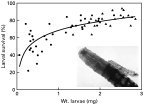
The peritrophins as a class of proteins are characterized by common structural elements (Tellam, Willadsen and Wijffels, 1999). Their synthetic pathway has been studied in some detail (for example Eisemann, Wijffels and Tellam, 2001; Wijffels et al. 2001). Unsurprisingly therefore, their presence has been described in other species (Wijffels et al. 1999; Vuocolo et al. 2001) and their usefulness as vaccine antigens in other species has been explored. In general, preliminary observations with C. bezziana mimicked those with L. cuprina, in terms of effective inhibition of growth and some mortality of larvae feeding on sera from sheep vaccinated with peritrophic membrane material (Fig. 1; Sukarsih et al. 2000a). Vaccination with individual, recombinant antigens was ineffective (Sukarsih et al. 2000b). In limited trials, peritrophins failed to protect against Haematobia irritans exigua (Wijffels et al. 1999).

Fig. 1. Effect of growth inhibition on the survival of C. bezziana in vitro for larvae fed on control serum ([utrif ]) or serum from sheep vaccinated with material from the peritrophic membrane or cardia ([bull ]). The inset shows larvae feeding on normal (left) and vaccinate serum.
As has been noted for ticks, the distinction between naturally exposed and concealed antigen vaccines, while perhaps still a useful mental construct, is one that blurs at the boundaries. There is evidence that the major excretory/secretory protease from L. cuprina is also a gut digestive protease (Casu et al. 1996) while PM95, though only isolated in the laboratory after vigorous extraction of the peritrophic membrane under strongly denaturing conditions, is also regurgitated or excreted by feeding larvae in a soluble form that stimulates an antibody response in sheep naturally exposed to the parasite (Tellam et al. 2000).
Less research has been reported for biting flies though Bautista et al. (2004) recently reported that vaccination of cattle with gut antigens from the horn fly Haematobia irritans irritans reduced egg production by between 11 and 29% in flies fed on the blood of vaccinated animals, the difference depending on adjuvant and/or antibody titre. In addition, vaccination of cattle and rabbits with recombinant thrombostatin, a thrombin inhibitor, reduced blood uptake by flies feeding on hosts sensitized by prior exposure to the parasite as well as inhibiting egg development (Cupp et al. 2004). In both cases, vaccination effects were quite slight.
COMMON THEMES IN VACCINE DEVELOPMENT
A survey of existing literature across a number of ectoparasite species rapidly identifies a number of recurrent issues. Several of these will be briefly discussed, minimizing the species differences and seeking instead some generalities from our current fragmentary information. The issues include the usefulness of proteinases/peptidases and their inhibitors as vaccine antigens, the importance of glycosylation to protective immunity and hence the constraint that places on vaccine development, the impact that genomics is having on the way we approach vaccine development, the use of ectoparasite vaccines to control vector-borne diseases and finally the feasibility and utility of developing multi-component vaccines.
PROTEINASES AS VACCINE ANTIGENS
Proteinases, peptidases and their inhibitors have long been a focus of research into ectoparasites. The interest continues. Most ectoparasites need to achieve some degree of tissue penetration or destruction as part of their normal biology while the haematophagous parasites commonly control haemostasis as well. The importance of this group of enzymes and inhibitors therefore seems obvious. From a practical research perspective, they are ubiquitous and relatively easy to study biochemically. This has undoubtedly played a part in generating the considerable volume of published literature.
As an indication of the information that has become available in recent years, the tick literature is a good example. For the proteinases, we have the description of two H. longicornis cathepsin L-like cysteine proteinases (Mulenga et al. 1999b), a cubilin-related serine proteinase (Miyoshi et al. 2004a,b), three midgut proteinases from R. appendiculatus (Mulenga, Onuma and Sugimoto, 2003), a metalloproteinase from I. scapularis (Francischetti, Mather and Ribeiro, 2003) and a vitellin-degrading cysteine proteinase from B. microplus (Seixas et al. 2003). Proteinase inhibitors that have been characterized include haemaphysalin, an inhibitor of the plasma kallikrein-kinin system from H. longicornis (Kato et al. 2005), two novel thrombin inhibitors from H. longicornis (Iwanga et al. 2003), four serpins from R. appendiculatus and five from H. longicornis (Mulenga et al. 2001) and trypsin inhibitors from B. microplus (Andreotti et al. 2002). Certainly, this list is not comprehensive. Other ectoparasite groups each have a set of similar observations.
Our understanding of the roles of proteinases and inhibitors in these parasites has increased substantially. The role for excretory/secretory proteinases is perhaps most obvious for the myiasis flies where significant wounds are likely to result from feeding. For example, the role of these enzymes in wound establishment and egg hatching has been examined in L. cuprina (Sandeman et al. 1990; Young et al. 1996, 1997, 2000). The example of Hypoderma has already been mentioned. Much recent attention has focused on manipulation of the host's haemostatic mechanisms and immune responses. The role of proteinases in counteracting the host's immune response has been particularly discussed in relation to Hypoderma spp. (Otranto, 2001). To return to the example of ticks, the strategies ticks use to exploit their blood-feeding environment have been reviewed (Mans and Neitz, 2004) as has the acquisition of the blood-meal (Mulenga et al. 2002). More and more novel and specific roles for proteinases are being discovered. For example, inhibition of angiogenesis through specific α5β1 integrin degradation catalyzed by a tick metalloproteinase has recently been demonstrated (Francischetti et al. 2005a).
What is the relevance for vaccination? Probably half of the recently published papers speculate that the proteinases or inhibitors may be useful as vaccine antigens. The suggestion has been specifically made with respect to tick serpins (Mulenga et al. 2001). In support of this, sensitivity of some ectoparasites to inhibition of their proteinases is well established. For example, inclusion of soybean trypsin inhibitor in the diet of H. irritans exigua reduced fecundity and increased mortality (East et al. 1995). The effects of a range of inhibitors have been described for L. cuprina (Reed, Chandler and Sandeman, 1999).
In practice, experience with the use of proteinases in vaccination has been mixed. Most research has been with three Hypoderma proteinases, hypodermins A, B and C, the first two trypsin-like enzymes, the third chymotrypsin-like, all apparently collagenolytic. All have been sequenced (Moiré et al. 1994). A variety of immunosuppressive effects due to depletion of complement component C3 and inhibition of the proliferation of peripheral blood mononuclear cells have also been reported, especially for hypodermin A (reviewed by Otranto, 2001). Vaccination with hypodermin A was initially reported to protect naïve calves significantly (Pruett, Fisher and Temeyer, 1989) but other trials with alternative adjuvants were unsuccessful (Chabaudie, Villejoubert and Boulard, 1991).
The failure of well characterized or recombinant proteinases from L. cuprina to induce protection has been mentioned above. Proteinases from Chrysomya bezziana have been purified and partially characterized (Muharsini et al. 2000). Vaccination of sheep with affinity-purified proteinases led to reduced growth rate of larvae on sheep, but no discernible effect when larvae were fed on immune cf. control serum in vitro (Riding et al. 2000). This would be consistent with a direct effect in the feeding lesion on sheep, though this has not been proven.
Literature on vaccination against ticks using proteinases or their inhibitors has been recently reviewed (Willadsen, 2004). Very briefly, an aspartic proteinase precursor from B. microplus eggs can confer partial protection (Da Silva Vaz et al. 1998). In experiments with expression library immunization using cDNA from I. scapularis, one of the two unique cDNAs with putative function which gave some protection was an endopeptidase (Almazán et al. 2003a). From the perspective of vaccine development, the most intensively studied proteinase is a membrane-bound carboxydipeptidase from B. microplus (Bm91) with sequence similarity to the mammalian angiotensin converting enzymes and striking similarities in biochemical specificity (Riding et al. 1994). The enzyme is located principally in the tick's salivary gland and in vaccination trials was effective as a native protein and, as a recombinant, in further increasing the efficacy of a recombinant Bm86 vaccine (see below) (Willadsen et al. 1996).
There have been more vaccination experiments using inhibitors of proteinases. Double-headed serine proteinase inhibitors from B. microplus have been characterized (Tanaka et al. 1999). There is experimental evidence that these offer some immunoprotection against B. microplus larvae (Andreotti et al. 1999, 2002). Trypsin inhibitors, isolated by affinity chromatography and used to vaccinate cattle, led to 68% reduction in the number of engorging female ticks and a corresponding reduction in the total egg weight. The vaccination ‘antigen’ contained at least two protein species, as would be expected from older literature. There has been speculation that the serpins, a family of high molecular weight serine proteinase inhibitors, could be target antigens (Mulenga et al. 2001). Recently a conserved serpin amino acid motif was used to clone and express a 378 amino acid polypeptide from H. longicornis that had high sequence similarity to several known serpins. Transcription was induced exclusively in tick midguts following feeding. Vaccination of rabbits with recombinant protein induced 44% and 11% mortality in feeding nymphs and adults respectively (Sugino et al. 2003). More recently, Imamura et al. (2005) evaluated a second serpin from H. longicornis as an anti-tick vaccine. The serpin-2 gene (HLS2) was sequenced and shown to code for a 44 kDa protein. It was expressed in nymphs and adults but not larvae, in partially and fully fed ticks but not unfed ones and in the haemolymph but not midgut and salivary gland. Recombinant protein produced in E. coli was found to inhibit activated partial thromboplastin time as well as isolated thrombin. Vaccination of rabbits with recombinant protein followed by tick challenge showed a number of significant effects: increases in nymphal and adult mortality, a slight increase in the duration of feeding, and decreases in both engorgement weight and in the percentage of ticks ovipositing. The effect of vaccinating cattle and rabbits with recombinant thrombostatin, a thrombin inhibitor from the fly H. irritans irritans, has already been described (Cupp et al. 2004).
In summary, there have been successful attempts to use both proteinases and proteinase inhibitors to vaccinate against ectoparasites though as antigens they suffer the same problems as most others: lack of consistent effect and, more importantly, insufficient efficacy to guarantee a practically useful vaccine on their own.
A number of factors may mitigate against success, in particular the large number of proteinases encoded in the known genome. The Drosophila genome for example potentially codes for about 400 serine proteinases. Not all may be expressed. In parasites only a fraction are likely to be critical for the host-parasite interaction. Nevertheless, some redundancy in function is probable, making their use as immunological targets problematic unless there is broad immunological cross-reactivity between multiple proteinases.
Proteolytic enzymes and inhibitors are part of a parasite's defence against host immunity and agents in the natural host-parasite interaction, as described in part in this and other reviews. Digestive proteinases have an additional, specific impact on the concealed antigen approach to vaccination. This approach depends on the uptake and retention of effective antibody. Rapid enzymatic degradation of antibody must limit vaccine efficacy. For example, although host IgG can be detected in the haemolymph of H. irritans exigua in low amounts (Allingham et al. 1992) the concentration of IgG in the midgut falls by 50% one hour after a single blood meal, while antigen-specific activity decreases by 70% in the same time (Allingham et al. 1998).
GLYCOSYLATION
A majority of the better characterized ectoparasite antigens studied so far are exposed to inhospitable environments, either at the host-parasite interface or within the parasite's gut or digestive system. All are likely to be proteolytically active environments. Unsurprisingly therefore, a number of the antigens are glycosylated. The importance of this glycosylation to protective immunity is difficult to determine, though critically important, given our very limited capacity to generate specific glycosylation patterns.
For the Bm86 antigen, the glycosylation, which may represent about a third of the native protein, is highly immunogenic but appears not to be important for protective immunity (Willadsen and McKenna, 1991). Certainly, recombinant Bm86, whether expressed in E. coli, insect cells or Pichia pastoris appears to be about as efficacious as native antigen (Tellam et al. 1992). For the Bm91 antigen, the evidence is more fragmentary. Native, glycosylated Bm91 is a protective antigen when used alone (Riding et al. 1994). Recombinant Bm91 produced in insect cells or E. coli seemed to lack that protective activity on its own (Cobon and Willadsen, unpublished) though in combination with Bm86, overall efficacy increased (Willadsen et al. 1996). Since the recombinant protein from insect cells was enzymatically active, and hence the polypeptide tertiary structure was presumably native or near native, the most likely interpretation is that the protective antigenicity of the native protein was a combination of contributions from both polypeptide and oligosaccharide. For another antigen identified by Lee and Opdebeeck (1991) the destruction of protective activity by periodate treatment strongly suggests that all protection was due to carbohydrate epitopes (Lee, Jackson and Opdebeeck, 1991).
For myiasis larvae, the potential importance of oligosaccharide as an antigenic target is implied in experiments that describe the effect of feeding Lucilia cuprina larvae on serum-free medium containing lectins with a variety of specificities (Eisemann et al. 1994). Wheatgerm lectin for example inhibited growth by 50% at 2 μM concentration and resulted in 100% mortality at 25 μM. The effects were attributed to starvation, induced by several mechanisms. In the case of L. cuprina, the peritrophic membrane-associated antigen PM95 is glycosylated. Antibodies to PM95 block the membrane, strongly inhibiting larval growth (Casu et al. 1997). It was found that sera from sheep vaccinated with the native PM95 strongly inhibited the growth of Lucilia larvae, while those raised against recombinant proteins produced either in E. coli or an insect cell system were notably less effective, despite the fact that the product from the insect cell expression system was probably correctly folded. Further experimentation demonstrated that strong antibody responses were produced to both polypeptide and oligosaccharide and that both antibody specificities contributed to the anti-larval effects (Tellam et al. 2001).
In short, the importance of glycosylation to protective antigenicity must be assessed on a case-by-case basis. However, based on limited evidence, it seems likely to be an important constraint to our ability to develop vaccines. Of course, one way round such complexities would be to use a stable parasite cell line as vaccine ‘antigen’. Nevertheless, despite early work by Wikel and the existence of a number of tick cell lines at least, this avenue has not been much explored. It is known that vaccination with the IDE8 cell line from I. scapularis induces partial protection in mice (Almazán et al. 2003a).
IMPACT OF GENOMIC TECHNOLOGIES
In the last decade, a cluster of new technologies applicable at the level of the genome, gene or gene product has increased the rate of data acquisition by orders of magnitude and hence generated enormous data resources. This revolution, a combination of new biology and sophisticated engineering, is impacting all areas of biology, including vaccine development. Although ectoparasites are commonly low priority organisms, compared with the emphasis placed on mammalian biology or major human pathogens, we are already seeing a great increase in the available molecular data. The difficulty is how best to use that resource.
Progress is being made in the sequencing of two tick genomes, those of I. scapularis and B. microplus. Work on I. scapularis is most advanced (Hill and Wikel, 2005). The sequencing of this genome is underway; a significant event for tick biologists and, as the first member of the subphylum Chelicerata to be sequenced, of interest to a broader community as well. It is a collaborative effort between the tick research community, the National Institutes of Health and the NIAID Microbial Sequencing Centers. The eventual aim is to obtain a 6-fold coverage of the genome through random shotgun sequencing, sufficient to give a draft assembly. Currently the project is engaged in large scale EST sequencing and the complete sequencing of about 40 BAC clones, providing information that will be a prelude to full sequencing.
A proposal has been submitted for the sequencing of the B. microplus genome (Guerrero et al. 2006) and assembly of useful resources, such as a BAC library and EST collections, has already occurred. There are two related challenges to obtaining tick genome sequence. The first is the large size of the genomes that are comparable to or even larger than mammalian genomes (Palmer et al. 1994; Ullmann et al. 2005). The second is the preponderance of highly repetitive sequences in those genomes. The genome of Ixodes scapularis for example is reported to be an estimated 2·1×109 bp with 27% highly repetitive DNA, 39% moderately repetitive and 34% unique. For B. microplus the estimates are 7·1×109 bp and, respectively, 31% and 38% for highly and moderately repetitive DNA and 30% unique. As Ullman et al. note “the most that can be predicted from the three tick genome measurements made to date (Amblyomma americanum has been examined previously) is that tick genomes will be large, highly variable in size and consist largely of moderately repetitive DNA” (Ullman et al. 2005).
EST resources continue to accumulate and much of the information is available through the TIGR website (http://www.tigr.org/tdb/tgi). For example, an analysis has been published of over 20000 ESTs from a normalized B. microplus library that was itself derived from multiple tick stages and multiple acaricide-susceptible and -resistant strains (Guerrero et al. 2005). There are collections of cDNA sequences for H. longicornis (Nakajima et al. 2005) and Amblyomma variegatum (Nene et al. 2002). More targeted EST sequences have been obtained from salivary gland cDNA libraries from I. pacificus (Francischetti et al. 2005b) and I. scapularis (Valenzuela et al. 2002a). Progress in definition of the ‘sialome’ of ticks has been reviewed (Valenzuela, 2004).
Other ectoparasites are less well served, though the availability of genome sequences for Drosophila melanogaster and mosquitoes plus an enormous amount of additional genomic information are of great utility. Partial transcriptome information is available for a range of other ectoparasites, particularly those that are vectors of human disease. These include, for example, Anopheles gambiae (Francischetti et al. 2002), Anopheles darlingi (Calvo et al. 2004), Anopheles stephensi (Valenzuela et al. 2003), Aedes aegypti (Valenzuela et al. 2002b), Culex pipiens quinquefasciatus (Ribeiro et al. 2004a) and Rhodnius prolixus (Ribeiro et al. 2004b). To these parasite resources must be added the much greater mammalian genomic resources. These are important if the intention is to study e.g. the functional genomics of the ectoparasite–host interaction through microarray experiments.
Quantitative PCR and, in particular, RNAi have become critical to the study of gene function. The first published demonstration of the utility of RNAi in ticks showed the effect of down-regulation of the histamine binding protein gene in A. americanum (Aljamali et al. 2003). Success has since been achieved in silencing a cubilin-related proteinase in H. longicornis (Miyoshi et al. 2004b), the anticoagulant Salp 14 of I. scapularis (Narasimhan et al. 2004) and synaptobrevin and cystatin of A. americanum (Karim et al. 2005). The isac gene of I. scapularis codes for a novel anticomplement factor (Valenzuela et al. 2000). It too has been successfully silenced (Soares et al. 2005) as have a number of potential antigens in I. scaplularis (de la Fuente et al. 2005) in each case with the demonstration of phenotypic effects. The last of these publications described a series of experiments with some of the cDNA pools used for cDNA expression library immunization (ELI) vaccination experiments as well as the individual 4D8 and 4F8 cDNAs (discussed below). They were used to prepare double stranded RNA (dsRNA) for RNAi experiments (de la Fuente et al. 2005). The results obtained on injection of I. scapularis were generally concordant with the results from ELI, leading to the suggestion that such RNAi experiments could be used as a relatively high throughput method of antigen identification. While the value of RNAi in clarifying the functional importance of a gene is unquestionable, it cannot of itself identify a protein that is both accessible and susceptible to immunological attack. Much use has been made of RNAi in Drosophila so one would expect it to be very useful in examining targets from a range of dipteran ectoparasites, but reports are lacking.
The application of proteomics to ectoparasites has been much slower. In part, this may be because of the lack of good genomic data: in the absence of that, or large catalogues of protein sequence information derived in more conventional ways, the interpretation of e.g. limited N-terminal sequence information is difficult. A start has however been made, for example in proteomic analysis of abundantly expressed proteins from unfed B. microplus larvae (Untalan et al. 2005).
How might these resources be best used to facilitate vaccine development? At one extreme, the concept of reverse vaccinology has been put forward, arguing that the starting point for new vaccine development should be the pathogen's genome. With that resource and the application of predictive bioinformatics, a list of candidate protective antigens would be generated, expressed and subjected to further filtering e.g. by immunological screens to identify the final, effective antigens (Fraser and Rappuoli, 2005). So far, the concept has been applied to bacterial pathogens with some, though apparently limited, success (e.g. Ross et al. 2001; Wizemann et al. 2001; Ariel et al. 2003). Given the greater complexity of ectoparasites and our limited understanding of what makes a good protective antigen, it is hard to see a major focus on reverse vaccinology in this field in the near future.
The central problem is that although genomic technologies have vastly increased the availability and rate of acquisition of data relating to potential or ‘putative’ antigens, our ability to evaluate them lags far behind. The issue is one of prioritization. EST collections have apparently led directly to a number of worthwhile vaccine papers through what was probably a subjective process of trialing gene products that looked relevant. More systematically, genes that might be involved in biological processes have been identified through differential expression, either by comparison of cDNA libraries or, more recently, microarray experiments. Quite targeted techniques are possible (Lambson et al. 2005). Most commonly, such approaches have been used to search for genes related to pathogen transmission (for example, Nene et al. 2004). In at least one paper, it has been suggested the approach should be used for the identification of antigens for anti-ectoparasite vaccines (Xu, Bruno and Luft, 2005) though this has not yet led to vaccine experiments.
The most coordinated use of new technology to identify novel antigens has come from the work of de la Fuente and co-workers. They initially used ELI coupled with EST analysis (Almazán et al. 2003a,b). The ELI library was constructed using cDNA from an I. scapularis cell line. In a mouse model, 351 cDNA clones were identified that influenced larval development. There were several striking features about this result. The first is the large number of genes that seemed to have some effect; the second the fact that a considerable number of them appeared to facilitate feeding. One advantage of the ELI procedure was clear. It is noticeable that, of the tick antigens identified so far using conventional means, major biochemical classes of potential targets such as the transmembrane receptors or ion channels are absent (Willadsen, 2004). This may be due principally to the difficulty of either purifying or expressing them. To a degree, ELI circumvents this problem and such genes as a chloride channel fragment are in the list of effective candidates. There were curious and unexpected effects. For example, ribosomal sequences had some inhibitory effect on tick infestation while vaccination with a pool of ESTs representing fragments of a vacuolar proton pump ATPase-facilitated feeding (Almazán et al. 2003b). The generality of these observations needs to be established but the results, even as they stand, pose some challenging biological questions.
Subsequently, injection of dsRNA from both pools of cDNA, as used in ELI experiments, as well as from three of the most efficacious single cDNAs was shown to result in down-regulation of gene expression as well as measurable effects on tick weight and egg laying (de la Fuente et al. 2005). Three antigens, 4F8, 4D8 and 4E6 were further characterized, their expression profiles and cross-species conservation examined and significant protection using recombinant antigen shown for larval tick infestations in mice (Almazán et al. 2005a). The same antigens were also used to vaccinate sheep and shown to have effects on the ability of adult I. scapularis to engorge and lay eggs (Almazán et al. 2005b).
MULTICOMPONENT VACCINES
A broad overview of the literature on vaccination against ectoparasites highlights one common theme. A good number of antigens have been identified that induce measurable but partial protection. With very few if any exceptions, ectoparasite antigens, particularly in recombinant forms, have much less than 100% efficacy; 50% or less is typical. The Bm86 antigen under optimal conditions achieved 90% efficacy, sufficient for a useful vaccine in an integrated parasite management system. It is commonly suggested other antigens of much lower efficacy may be useful in multicomponent formulations. The assumption is that multicomponent vaccines will be more efficacious than single antigen ones; an assumption that has become an important, though little discussed aspect of vaccine research. It seems intuitively reasonable and is supported by the observation that partially purified antigen mixtures may work better than single antigens purified from those mixtures. This was, for example, found during the purification of Bm86 (Willadsen et al. 1988 cf. Willadsen et al. 1989). Other factors such as antigen presentation may also play a role.
The benefit of multiantigen mixtures need to be determined experimentally, though such experiments are expensive in animal resources and little has been done. A recent report described vaccination of sheep with three I. scapularis recombinant or synthetic antigens, 4D8, 4F8 and 4E6 alone and in combination. All three antigens separately had significant effects: the combination of all three was not clearly superior (Almazán et al. 2005b). The only more detailed study of mixtures of two antigens was that of the two B. microplus antigens Bm86 and Bm91 where an approximately two-fold increase in efficacy over Bm86 alone was found (Willadsen et al. 1996). It was also shown that the addition of Bm91 did not affect antibody production to the Bm86 antigen.
In postulating the benefits of multi-antigen vaccines, it is important to be clear about the assumptions involved. Firstly, the multiple antigens must demand the same kind of immunological response for protection or at least be able to use a delivery system that elicits all necessary immune responses without simultaneously eliciting countervailing ones. Secondly, even in the absence of competition, there is no reason to expect mixtures of two or more antigens will be synergistic or even additive. It is easy to imagine a variety of scenarios. Clearly, for such a vital question, more experimentation is needed.
IMPACT OF VACCINATION ON VECTOR-BORNE DISEASES
Attempts are being made to develop vaccines against ectoparasite-transmitted diseases, ranging from malaria and other mosquito-transmitted diseases to the viruses, protozoa and bacteria transmitted by ticks. To complement this approach, vaccination against vector antigens themselves has the potential to affect vector-borne diseases in a variety of ways. Firstly, an anti-vector vaccine, through reduction in the vector population, may limit disease incidence. Historically, control of vector-borne disease has most commonly been via control of the vector. The relationship between vector density and disease incidence may be complex when the establishment of endemic stability is an issue, but the general principle holds. Secondly, it is increasingly evident that such diseases often rely on the environment created by the vector–host interaction for successful transmission. For example the role played by tick modulation of host immunity in pathogen transmission has been reviewed (Wikel, 1999) as has the role of tick saliva (Nuttall and Labuda, 2004). A vaccine that disrupts that environment may also inhibit disease transmission.
As yet there are few examples but they are encouraging. For Leishmania major, it is known that salivary gland homogenate from the sand-fly vector Phlebotomus papatasi enhances transmission when coinoculated with L. major but that this is abolished by prior vaccination with salivary gland homogenate or prior exposure to the vector (Valenzuela et al. 2001). Vaccination of mice with a 15 kDa salivary protein produced intense immediate and delayed reactions on parasite infestation and reduced the lesions and, to a more minor degree, the parasite load resulting from L. major infection (Valenzuela et al. 2001). Ticks are the most important vectors of livestock diseases and significant vectors of human pathogens as well, arguably second only to mosquitoes. The large number of viruses transmitted by ticks has been described by Labuda and Nuttall (2004). They have also shown, using the 64P antigen described above, that vaccination of mice with recombinant 64P or a fragment of that antigen followed by challenge with tick-borne encephalitis virus-infected I. ricinus resulted in increased mouse survival and reduced virus transmission to co-feeding ticks (Labuda et al. 2002). There is evidence that the use of a Bm86 vaccine, developed against B. microplus, to control infestations of B. annulatus also prevents the transmission of Babesia bigemina and reduces the frequency or severity of disease due to Babesia bovis (Pipano et al. 2003). This may be attributed to the fact that with this tick species, in contrast to B. microplus, the engorgement of both larvae and nymphs, the stages that transmit these diseases, is severely affected by the vaccine. This does not however mean that use of a Bm86 vaccine against B. microplus would have no effect on the incidence of babesiosis. Valle et al. (2004) have reported that introduction of the vaccine reduced morbidity due to babesiosis in Cuba, though the result was confounded by changes in cattle management practice and hence the generation of endemic stability to the disease.
In short, there is already fragmentary but sufficient evidence that anti-vector vaccination can be a viable part of the control of vector-transmitted diseases.
ECTOPARASITE VACCINES– THE BALANCE SHEET
It is interesting to draw up a balance sheet of ectoparasite vaccine development as it exists today.
On the positive side, a recombinant, single antigen vaccine, namely that against B. microplus, has been developed, commercialized and shown to be effective in the field. Despite the imperfections of the current vaccine, that is a worthwhile achievement when compared with the time, money and talent that have been invested in other parasite vaccines, and many non-parasite vaccines as well. It is also a positive that, despite the infrequency with which strong immunity to ectoparasite infestations is acquired, it has been possible to demonstrate with a number of parasites that vaccination with both native and recombinant antigens can lead to at least partial protection. Thus the foundation for improvement or future development has been laid.
Secondly, the collection of technologies we label ‘genomics’ is already greatly increasing our understanding of the ectoparasite–host interaction and the molecules critical to it. This new scientific capacity allows us to identify candidate antigens with a speed and at a level of detail that was not achievable even a few years ago.
The negative side of the balance sheet is however daunting. Ectoparasites have an exquisite ability to manipulate the host and its response to infection, an ability that is being clarified as it grows steadily more complex.
Technically, the development of drugs has been greatly facilitated by the fact that the overwhelming majority of efficacious drug targets fall into a very restricted number of biochemical classes. That is, the search for a novel target at least starts with considerable background knowledge that allows helpful prioritization of the options that must be considered. Despite the number of ectoparasite antigens already characterized, we do not yet have such a predictive capacity. We have, simply, too many choices.
Expression of fully effective antigens remains an issue. In particular, there is evidence that for a number of the most effective native antigens, glycosylation is immunogenic and the induced immune reactions important to effective vaccine protection. We have little or no ability to reproduce that specific glycosylation. There is currently no easy way around that block, other than to continue to identify a larger portfolio of antigens, seeking those for which glycosylation is not critical.
An expanded portfolio of antigens is desirable for this and other reasons. Arguably, the rate limiting step in identifying these antigens is the bottleneck of evaluation in animal trials. RNAi for example may be used to show that a gene product is necessary for a parasite's success but the demonstration that the gene product is useful for a vaccine requires a vaccination experiment. Given that most ectoparasites have restricted host ranges, the process of evaluating antigens rigorously is likely to be laborious and expensive. In most cases, it is also not the kind of research that produces high profile scientific papers. It is at least in part for that reason that we already have a list of recombinant parasite proteins that are potentially valuable antigens but that have not been evaluated as such. To do so with a reasonable number of these candidates would be extremely valuable.
Given that most if not all ectoparasite antigens are only partially protective, we make the core, if often implicit, assumption that combinations of two or more antigens will have efficacy that is greater than that of the components and sufficiently good to make a practical product. This could be experimentally verified but there has been little attempt to do so.
These are some of the scientific issues. The commercial ones have been discussed briefly with respect to anti-tick vaccines (Willadsen, 2004). Briefly, the process of developing, manufacturing, registering and marketing a vaccine is very expensive, costing millions or tens of millions of dollars for a veterinary vaccine for use in Western countries. The economic benefits of such a vaccine are obtained by farmers, vaccine manufacturers, consumers and the components of commercial chain that leads eventually to the consumer. The proportion of the economic benefit that is eventually retained by the manufacturer, on whom the initial costs of development and registration fall, is variable and may be low. In short, the economic incentive to produce such vaccines is likely to be slight and worthwhile only for the largest markets. Such was the case for B. microplus. Few parasites share the same characteristics of trans-continental distribution and major economic impact. In theory, the economic case could be altered in a number of ways, but this would require a significant re-think of the way in which vaccine production is performed and funded.