Introduction
An increasing prevalence of infertility has become a prime reproductive health concern in India. In developing countries women, and particularly those from the rural areas, often do not consider infertility as a disease requiring medical attention. Primary infertility is when a woman has never conceived and secondary infertility is when a woman has conceived once but not subsequently, despite efforts to become pregnant. Hence, primary infertility is defined as childlessness, while secondary infertility is considered the inability to have an additional live birth after subsequent cohabitation. Also, some rural people believe that infertility is caused by female factors only (Van Balen & Inhorn, Reference Van Balen, Inhorn, Inhorn and van Balen2002). In her study in rural India, Pujari (Reference Pujari2008) found religious and superstitious explanations of infertility. Research in the United States has shown that women’s perceptions of the causes of infertility are directly associated with their levels of reproductive health knowledge (Lundsberg et al., Reference Lundsberg, Pal, Gariepy, Chu and Illuzzi2014).
It is also evident that appropriate knowledge of menarche, the menstrual cycle and the fertile period can ease the process of getting pregnant by allowing women to take proper and timely actions (Narayan et al., Reference Narayan, Srinivasa and Pelto2001; Hammarberg et al., Reference Hammarberg, Setter, Norman, Holden, Michelmore and Johnson2013), i.e. an awareness of age at menarche and the most fertile days of the menstrual cycle are important for early conception, and delayed conception can be avoided through practising menstrual hygiene. Furthermore, awareness of the risk factors of secondary infertility, such as reproductive tract infections (RTIs), sexually transmitted infections (STIs) and pelvic inflammatory diseases, and knowledge of infertility treatment, can significantly reduce the prevalence of secondary infertility (Ombelet et al., Reference Ombelet, Cooke, Dyer, Serour and Devroey2008; Verma et al., Reference Verma, Kumar Meena and Banerjee2015). Prior knowledge of reproductive tract damage due to stillbirth, miscarriage or unsafe abortion, the side-effects of contraceptive use and polycystic ovary syndrome (PCOS), for instance, may be useful to avoid complications in conceiving (Stone & Waszak, Reference Stone and Waszak1992; Cresswell et al., Reference Cresswell, Schroeder, Dennis, Owolabi, Vwalika and Musheke2016). Hence the reproductive health knowledge of women plays a significant role in conception (World Health Organization, 1995).
In India, infertility prevalence has been found to be higher among rural than among urban women (IIPS, DLHS 2007–08). Lack of information, inadequate infertility services and having RTIs or STIs have been shown to result in rural women experiencing delays in receiving treatment (Unisa, Reference Unisa1999). Moreover, most help for infertility sought by rural women has been shown to be either traditional or low-cost, rudimentary health care (Chhabra et al., Reference Chhabra, Srujana and Annapurna2012). Hence, there is need to better understand rural Indian women’s level of reproductive health knowledge and how they cope with their infertility problems.
The three specific objectives of this study were: i) to assess the level of reproductive health knowledge of rural infertile women; ii) to study the perceived causes of infertility according to the level of reproductive health knowledge of women; and lastly, iii) to examine the association between level of reproductive health knowledge and coping strategies for infertility.
Methods
Study design
The study used primary data collected in 2014–15 from the high infertility prevalence districts of West Bengal – an Indian state with a low fertility rate. Complete mapping and household listing were carried out to identify eligible respondents. In this sample survey, a location map, along with its entire boundary, was drawn first followed by the household listing operation. This showed the location of every household with at least one eligible resident. Women who had ever conceived and had ever experienced problems getting pregnant were selected based on the following eligibility criteria: aged 20–49 years, currently married, residing with their husband and had ever experienced infertility and received treatment. A total of 159 eligible women aged 20–49 years were interviewed. The estimated response rate was 92.44% (159×100/172), where 172 was the total number of identified eligible respondents and 159 was the total number of respondents who completed the interview.
Information was collected through structured and semi-structured questionnaires. Both forced-choice and open-ended type questions were asked to collect information on respondents’ perceptions of infertility and their treatment-seeking behaviours. Questions included: (Q) ‘Do you agree with the statement: Usually the man is the cause of infertility (Agree/Disagree), Usually women are the cause of infertility (Agree/Disagree), Either one can be the cause of the problem (Agree/Disagree)’; (Q) ‘For a woman what age is too old to bear a child? (open-ended)’; (Q) ‘Why do you feel so? (open-ended)’; (Q) ‘Do you know why abortion or miscarriage occur? (Yes/No); If yes, why do they occur? (open-ended)’; (Q) ‘There are many ways that a childless couple may have a child. Do you know what those are? (By medical treatment/By adopting a child/Through surrogacy/Other [specify])’. Information collected through the open-ended questions was first coded based on certain categories and then the quantitative analysis was done.
The Reproductive Health Knowledge Index
A Reproductive Health Knowledge Index (RHKI) was computed for the respondents (Pujari, Reference Pujari2008). The variables used to construct the index were: knowledge of the male and female reproductive organs (none ‘0’, at least one ‘1’, at least two ‘2’), knowledge of age at menarche (yes ‘1’, no ‘0’), knowledge of the length of the menstrual cycle (yes ‘1’, no ‘0’), knowledge of the most-fertile period (yes ‘1’, no ‘0’), knowledge of the early signs of pregnancy (no knowledge ‘0’, at least one sign ‘1’, at least two signs ‘2’), knowledge of exact place in a woman’s body where a baby grows (yes ‘1’, no ‘0’) and knowledge of abortion (yes ‘1’, no ‘0’). The question scores were added up and the total RHKI score ranged from ‘0’ to ‘11’. Respondents were divided into three categories based on their RHKI score: 0 to 2 was ‘no/low’ knowledge, 3 to 6 was ‘medium’ knowledge and 7 and above was ‘high’ knowledge. One-way analysis of variance (ANOVA) was applied to assess whether there was a significant relationship between the various socioeconomic factors and RHKI scores. A p-value of 0.05 was taken as the maximum level of significance.
Background variables
Other background variables representing the socioeconomic characteristics of the respondents and their categories were: respondent’s age (<30, 30–35 and >35 years); respondent’s level of education (illiterate/uneducated, primary [1–4 years], middle or upper primary [5–8 years] and secondary and above [>8 years]); husband’s level of education (as for the respondents); respondent’s media exposure (not exposed and exposed, i.e. whether she had received any information on fertility and treatment-related issues from any kind of media); respondent’s work status (never worked and ever worked); respondent’s caste (Scheduled Caste [SC], Scheduled Tribe [ST] and Other Backward Class [OBC] and General/Open); income level in rupees (≤5000, 5001–10000, 10001–15000, >15000), Wealth Index (poor, middle and rich) and religion (Hindu and Muslim).
Statistical analyses
Bivariate and multivariate analyses were performed. Principal Component Analysis (PCA) was carried out to create the Wealth Index. This is a composite index based on information on household ownership of assets, amenities, fuel use and other wealth. The first principal component generated by PCA was used to assign the weights for these assets. The reliability of the index was tested by Cronbach‘s alpha values (0.896), which suggested that the computed index was reliable. The value of the composite index was divided into three equal parts (low, medium and high) for subsequent analysis. The significance of the Chi-squared test was shown by Pearson’s Chi-squared test value. For the ANOVA, post hoc tests were done by LSD to identify the source of variance.
Results
Profile of respondents
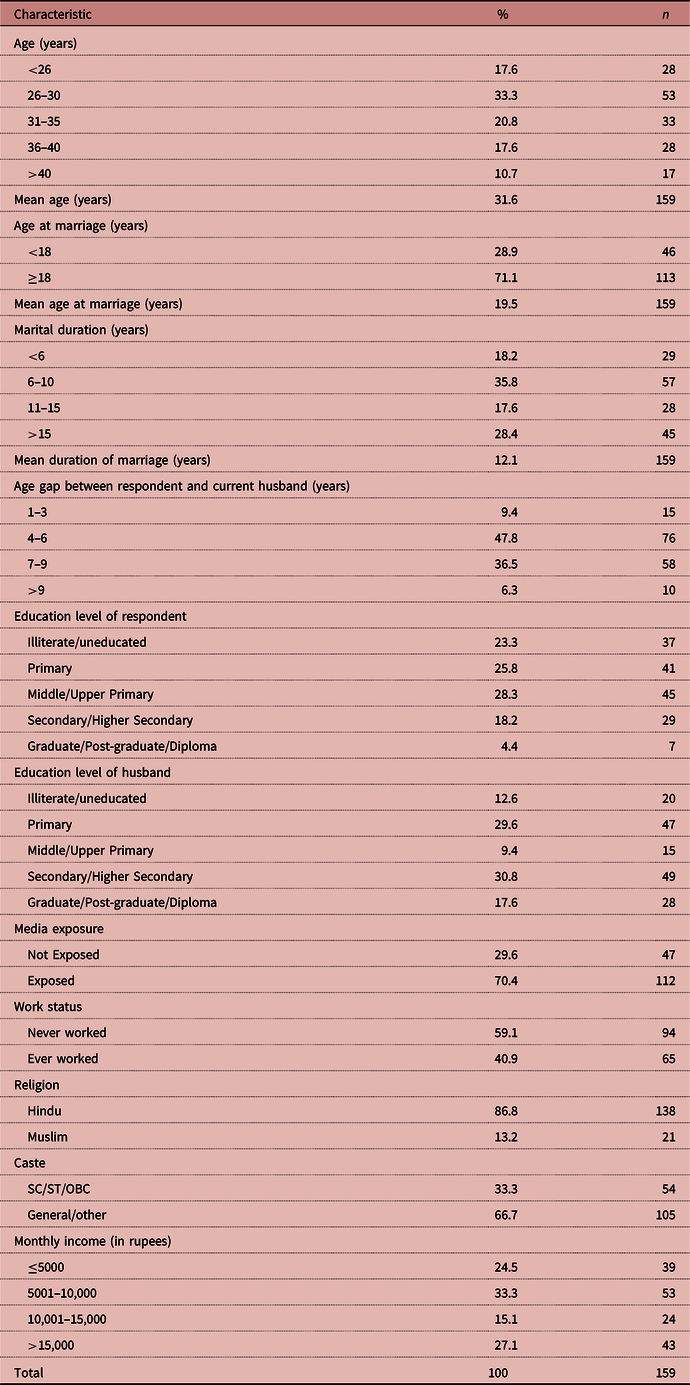
Table 1 shows the socioeconomic profile of the respondents. One-third were aged between 26 and 30 years, and their mean age was 32 years. About 29% were married below the age of 18 (i.e. the legal age at marriage). The estimated mean age at marriage was 19.5 years. A considerable proportion of the respondents (28%) had a marital duration for more than 15 years.
Percentage distribution of respondents by background characteristics

Respondents’ RHKI by background characteristics
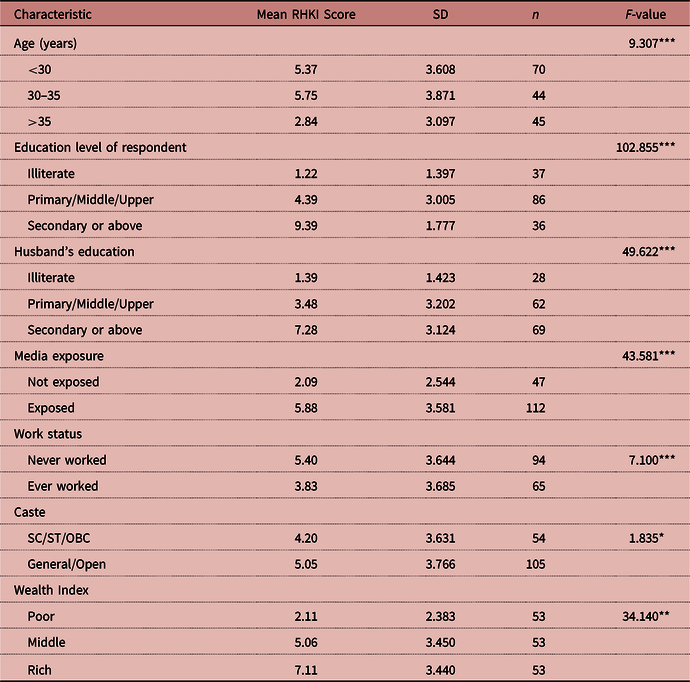
Table 2 shows the respondents’ mean RHKI scores by their background characteristics. The mean RHKI score was lower (2.84, p<0.001) among women in the age group 36 years and above than in younger women. The highest mean RHKI was observed among women with secondary education level and above (9.39, p<0.001) and those whose husbands were more highly educated (7.28, p<0.001). On the other hand, women with no education and those with uneducated husbands had low RHKI scores (1.22 and 1.39 respectively, p<0.001). Similarly, women who were not exposed to any media (2.09, p<0.001) and who had ever engaged in any work (3.83, p<0.001) had low RHKI scores. Women with a poor Wealth Index (2.11, p<0.01) and those from SC, ST and OBC communities (4.2, p<0.05) also had lower RHKI scores than their counterparts.
Respondents’ mean reproductive health knowledge (RHKI) score by background characteristics

Significance levels shown by one-way ANOVA: ***p<0.001; **p<0.01; *p<0.05.
Perceived causes of infertility by RHKI
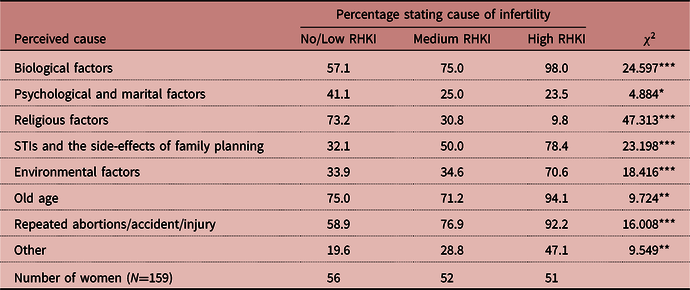
Table 3 shows the perceptions of respondents of the causes of infertility by their level of reproductive health knowledge (Table 3). More than 90% of women with a high RHKI score gave biology (98.0%, p<0.001), old age (94.1%, p<0.001) and repeated abortions/accident/injury (92.2%, p<0.001) as reasons for infertility, and over 70% mentioned STIs and the side-effects of family planning (78.4%, p<0.001) and environmental factors (70.6%, p<0.001) as causes of infertility. Only 10% (p<0.001) of women with a high level of health knowledge mentioned religious causes of infertility. On the other hand, more than 70% of women with no or low health knowledge gave religion (73.2%, p<0.001) and old age (75.0%, p<0.01) as causes of infertility.
Percentage of respondents stating perceived causes of infertility by RHKI

*** p <0.001; ** p <0.01; * p <0.05.
Coping with infertility and first treatment taken by RHKI
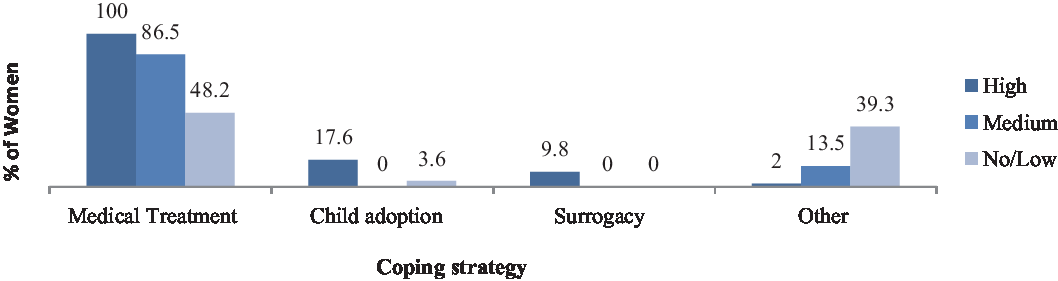
Figure 1 shows respondents’ infertility coping strategies by their level of reproductive health knowledge. Of respondents with a high RHKI score, all (100%) opted for medical treatment, 17.6% opted for child adoption and 9.8% considered surrogacy as means of coping with their infertility problem. On the other hand, those with a low level of reproductive health knowledge (39.3%) opted for other coping strategies, such as putting their faith in God and other religious/superstitious gestures, spending time with small children, losing hope and wanting to remain infertile or childless.
Coping strategies of women with infertility by RHKI score category.

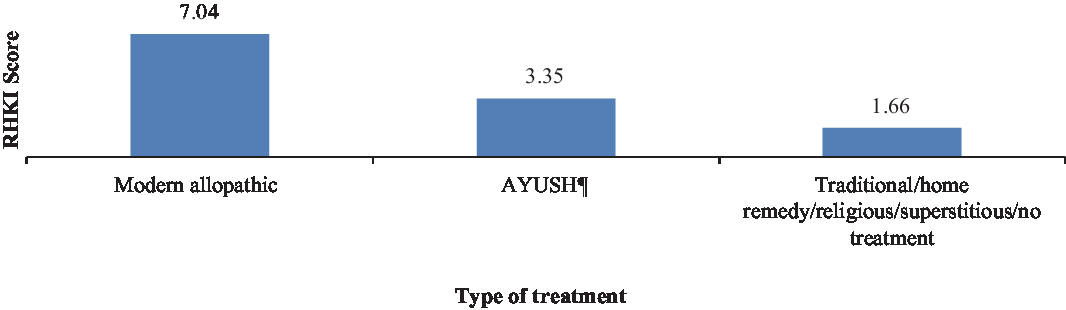
Figure 2 shows type of treatment taken for infertility for the first time by the level of reproductive health knowledge of the respondents. Women who opted for modern allopathic treatment had a higher mean level of reproductive health knowledge (RHKI=7.04, p<0.001), and those who had opted for traditional, religious or superstitious remedies, or who had not sought any treatment for their infertility, had a very low level of mean reproductive health knowledge (RHKI=1.66, p<0.001). Those who used Indian Traditional Medicine (Ayurveda, Yoga, Unani, Siddha and Homoeopathy, abbreviated as AYUSH) had a medium level of reproductive health knowledge (RHKI=3.35, p<0.001) (Fig. 2).
Women’s first type of infertility treatment by RHKI score. AYUSH (Ayurveda, Yoga, Unani, Siddha and Homoeopathy) is the Indian Traditional Medicine System. F-value 55.109; p<0.001 (One way ANOVA).

Discussion
Greater knowledge of the factors affecting fertility may help to decrease the incidence of infertility by allowing couples to avoid certain risk factors (Abolfotouh et al., Reference Abolfotouh, Alabdrabalnabi, Albacker, Al-Jughaiman and Hassan2013). Appropriate knowledge of reproductive health and the causes of infertility among women has been shown to reduce the rate of infertility in rural areas of India (Jha et al., Reference Jha, Baur, Haldar and Dasgupta2014). Furthermore, a couple’s treatment-seeking behaviour has also been shown, using data from South Africa, to be guided by their level of reproductive health knowledge and infertility (Dyer et al., Reference Dyer, Abrahams, Hoffman and van der Spuy2002). The results of the present study confirm these findings among rural women in India.
Women’s level of reproductive health knowledge has been shown to vary according to their socioeconomic characteristics. In their study in Pakistan, Ali et al. (Reference Ali, Sophie, Imam, Khan, Ali and Skaikh2011) found that women’s reproductive health knowledge was very poor among those from disadvantaged backgrounds. However, younger women, those with a higher level of education, those with media exposure and those belonging to the General Caste and from affluent families had higher levels of reproductive health knowledge.
Moreover, women’s perceptions of the causes of infertility have also been found to vary by level of reproductive health knowledge (Dattijo et al., Reference Dattijo, Andreadis, Aminu, Umar and Black2016). Ali et al. (Reference Ali, Sophie, Imam, Khan, Ali and Skaikh2011) found that women in Pakistan with a higher level of reproductive health knowledge were more likely to indicate that biological factors were responsible for their infertility, whereas women with a low reproductive health knowledge were more likely to give religious factors. Furthermore, the type of treatment sought by women for their infertility problem had been shown in South Africa to be largely guided by their level of knowledge (Dyer et al., Reference Dyer, Abrahams, Hoffman and van der Spuy2002). In the present study in India, women with higher reproductive health knowledge were more likely to receive allopathic treatment for infertility, whereas those with low reproductive health knowledge tended to opt for traditional, superstitious or religious treatments. Women with a medium level of RHK had opted AYUSH to treat their infertility problem. Hence, this study demonstrates that reproductive health knowledge is important if women in India are to receive modern infertility treatment for infertility.
The present study has identified barriers to receiving treatment for infertility among rural women in India, including illiteracy or low level of education, lack of awareness of the risk factors of infertility, poor knowledge of human reproduction, poor knowledge of a woman’s most fertile period and the menstruation cycle, poor menstrual hygiene and lack of access to, and unaffordability of, diagnostic and treatment facilities. Some of the sample women were unaware of the biology of conception, and many often overestimated the chances of conceiving during ovulation, had low awareness of the period when they were most fertile and had a poor understanding of the steep decline in female fertility after the age of 34. Knowledge about the specific risk factors for lower fertility (STIs, menstruation disorder, increased age at first birth) was limited (Patra & Unisa, Reference Patra and Unisa2017).
The majority of the study respondents received information on reproductive health from the media or family members, and not through formal education. Awareness of the natural age-related decline in female fertility among the respondents was low. In addition, their low level of knowledge may increase their risk of infertility. Knowledge and attitudes of rural women in India towards abortion services are important in their decision to access to reproductive health care services.
Though the early acquisition of knowledge of human reproduction and awareness of the causes of infertility can reduce the risk of infertility, it is evident that some of the couples who have experienced infertility have a better knowledge of the risk of infertility and its possible treatments than others. This may be due to the problems they have experienced, the treatment process they have gone through and the physicians and the health workers who have treated them. Furthermore, apart from level of education and exposure to media, the information provided by health care providers influences respondents’ knowledge levels. Hence, it can be assumed that a lack of knowledge of fertility among the respondents may partly reflect the role of health care providers, who might not fully explain the problems and treatment options to couples.
The spread of awareness of the risk factors for secondary infertility and more infertility diagnosis facilities at rural health centres are needed in India. The promotion of alternative infertility coping strategies, such as child adoption and surrogacy, could help couples experiencing infertility, so relevant information and legal support could be provided through public–private collaboration. Health education, medical counselling and low-cost traditional treatments could be integrated into infertility management in an effort to deal with infertility among rural women in India.
Acknowledgment
This study formed part of Dr Shraboni Patra’s PhD research work.
Funding
This research received no specific grant from any funding agency in the public, commercial or not-for-profit sector.
Conflicts of Interest
The authors have no conflicts of interest to declare.
Ethical Approval
Prior approval for conducting this research was received from the Student Research Ethics Committee of the International Institute for Population Sciences (IIPS). Informed consent was obtained from the respondents before interview. The purpose of the study was explained to the respondents and confidentiality of the collected information assured. Complete anonymity was maintained while collecting and analysing the data.