The “ten theses” or “ten dogmas” (shi lun 十論) are almost always presented as the earliest core of Mozi's 墨子 (Master Mo) thought. Confucius' first challenger, Mo Di 墨翟 (c. 479–381 bce) is said to have promoted among his earliest disciples ten novel ideas presented in catchy two-character phrases:Footnote 2 to elevate the worthy (shang xian), to conform upward (shang tong), to care for all (jian ai), to condemn military aggression (fei gong), to moderate expenses (jie yong) and burials (jie zang), to acknowledge the will of Heaven (tian zhi) and the percipient ghosts (ming gui), and to condemn music (fei yue) as well as fatalism (fei ming). Like the majority of Chinese scholars, Yang Yi 杨义 considers the ten theses “a very broad and clear pre-Qin intellectual system”.Footnote 3 Another recent expression of this common view is Ian Johnston's claim that it presented “a coherent body of doctrine articulated in a strikingly systematic way”, namely in the Core chapters, “embodying the statements of the fundamental doctrines of Mohism”.Footnote 4 However dominant in contemporary academia, this consensus appears to have been non-existent in the early Chinese corpus, namely in late Zhou and Han texts: to my knowledge, none of them attributes to the Mohists the invention or promotion of this set of ten ideas. The sole source of information about the ten theses is the book Mozi itself, and more specifically, two clues contained in it.
Our first clue is a short but well-known conversation recorded in one of Mozi's Dialogue chapters, “Lu wen” 魯問 (Lu's questions). When the master was travelling around, Wei Yue 魏越 asked him what advice he would give to rulers. He said:
Whenever you enter a state, you must select a task and work on it. If the state is in disorder, expound to them “elevating the worthy” and “conforming upward”; if the state is impoverished, expound “moderation in expenditure” and “moderation in burial”; if the state overindulges in musical entertainment, expound “condemning music” and “condemning fatalism”; if the state is dissolute and indecorous, expound “revering Heaven” and “serving ghosts”; if the state is devoted to aggression and intimidation, expound “inclusive care” and “condemning [military aggression”. Therefore], I say: select a task and work on it. 凡入國,必擇務而從事焉。國家昏亂,則語之尚賢尚同; 國家貧,則語之節用節葬,國家說音湛湎,則語之非樂非命; 國家淫辟無禮,則語之尊天事鬼; 國家務奪侵凌,則語之兼愛非[攻。故]Footnote 5曰擇務而從事焉 (49: 114/7–10).Footnote 6
In this succinct response Mozi's theses are expressed in five pairs of short mottos and nicely presented in what sounds like a summary of Mozi's political doctrine.Footnote 7 This suggests that at least the author(s) of this fragment must have thought of Mohism in terms of these ten slogans.
The second clue for the existence of the ten theses are the titles of the so-called Core chapters, namely chapters 8–37, of which 23 are still extant. The description of Mozi in the Hanshu suggests that in the Han dynasty, these originally 30 chapters were probably already part of the book;Footnote 8 they are organized in ten sets of three, called “triplets” or “triads” in Western academia. Each chapter in the triplet carries the same two-character title, namely of one Mohist thesis: “Shang xian” 尚賢 (chapters 8–10), “Shang tong” 尚同 (11–13), “Jian ai” 兼愛 (14–16), “Fei gong” 非攻 (17–19), “Jie yong” 節用 (20, 21, with 22 missing), “Jie zang” 節葬 (25, with 23 and 24 missing), “Tian zhi” 天志 (26–28), “Ming gui” 明鬼 (31, with 29 and 30 missing), “Fei yue” 非樂 (32, with 33 and 34 missing), and “Fei ming” 非命 (35–37). The three chapters within each triplet are further distinguished as, respectively, shang 上 (upper), zhong 中 (middle), and xia 下 (lower).
These two clues together have largely convinced the scholarly community that Mo Di was a philosopher who principally preached ten central ideas against the established values of the ruling elite, and that his disciples wrote them down in ten triplets, with the three versions representing either rival sects or consecutive periods in the Mohist community.Footnote 9 The intention of this paper is not to deny the possibility of this scenario, but rather to dissolve the rigidity of its consensus by looking at the texts with an open mind, and by questioning some presuppositions that underlie the general portrayal of early Mohism. My search first turns to the book Mozi itself to show that its support for the ten dogmas is relative: not only are the two clues somewhat questionable in themselves, but the rest of the book shows a remarkable ignorance of Mozi's full-blown set of ten theses. Then I will try to trace the gradual emergence of the Mohist theses in the book Mozi, followed by an exploration of the best known and probably oldest among them, namely the injunction to “care for others (inclusively)”. The remainder of the paper then moves on to the other late Zhou and Han sources asking two simple and slightly overlapping questions: whenever Mo Di, Mozi or the Mohists are mentioned, are they associated with “inclusive care” or any other of the ten theses? And, conversely, whenever “inclusive care” pops up in these sources, is it then associated with Mo 墨 or with other masters? These two principal questions involve a host of other insights not just about early Mohism but also about: early Chinese sources in general, authorship, chapter titles, intellectual affiliations and modern academic expectations toward those texts.
1. The ten theses in the Mozi
The two clues for the Mohist promotion of ten theses rely on presuppositions which should be further analysed. First, the record of Mozi's tenfold policy advice for rulers has gained authority from the belief that it reflects Mo Di's own words. But if it is considered to be the opinion of one of the Mozi's later authors, its value as an authentic testimony would be somewhat jeopardized. And second, the Core chapters' ten titles enjoy the prestige that is generally attributed to titles, but that may be unwarranted in the case of Warring States sources. My argument in both cases is not that the common presuppositions are definitely wrong, but that alternative options are both plausible and worth exploring. The following reflections are based on earlier research on the Mozi undertaken at the University of Leuven.Footnote 10
The first clue for the ten early Mohist dogmas, the well-known record of Mozi's tenfold policy, occurs in “Lu wen”, one of the Dialogue chapters (chs 46–50). Since they contain anecdotes and conversations between Mozi and rulers, disciples or opponents, these chapters have more than any other part of the Mozi contributed to the impression of a real-life Mo Di travelling around and defending his ideas. Analogous with the Lunyu, which contains sayings attributed to Confucius, the Dialogues have been called Moyu 墨語 and considered by some to be the oldest parts of the book, a view that has now been largely abandoned.Footnote 11 Nowadays, different scholars date the Dialogues somewhere between the middle of the fourth century bce (e.g. Chris Fraser) and the Han dynasty (e.g. Ding Sixin); Taeko Brooks pins the “Lu wen” chapter down on the year 262 bce.Footnote 12 While a relatively late date for this chapter would weaken the real-life record hypothesis, a more important consideration is the mixed and uncertain historicity of records in ancient Chinese sources named after a master (or master persuader, zi 子Footnote 13): they may to some extent be the record of a master's sayings or deeds, but at the same time expressing the ideas and concerns of their authors. The actual master may have been selectively remembered and quoted, or his words heavily edited; but often, as Mark Lewis has argued, he was also (re)created as the source and legitimation of valuable insights.Footnote 14 I will not try to determine to what extent Master Mo is the creation of a community of successive authors attributing statements to him, and thus providing expression and legitimation for their own concerns and views. But the idea that Mozi created the ten theses may very well have been a creation of the Mohists: the answer about ten policies for rulers in “Lu wen” may have been attributed to him as a succinct presentation of his thought at some point during the last four centuries before the beginning of the common era.Footnote 15
Since the ten mottos ascribed to Mozi in the first clue largely coincide with the titles of the Core chapters, the two clues are probably somehow connected. The Core chapters are generally considered the oldest part of the Mozi, beginning in the early fourth century bce and finished before the end of the Zhou dynasty (e.g. Fraser) or in the Han (e.g. Watanabe Takashi). Their titles are often assumed to be as old as the chapters and to reflect their content, like the title of a paper written by a contemporary scholar. However, recent research has shown that unearthed manuscripts from the Warring States period often did not carry titles. As Lin Qingyuan put it: “Warring States texts about thought often have no titles and the formation of titles does not yet seem to have turned into strict rules”.Footnote 16 It is thus possible that the Core chapters did not carry any titles at an early stage. Lin also pointed out that “texts about thought” discovered with a title tend to carry one that reflects their general content, as opposed to other types of manuscripts.Footnote 17 The titles of the Core chapters seem indeed to do this and have certainly been perceived as such – hence, for example, the established association of the “Will of Heaven” chapters with Mohist views on the will of Heaven. But at what point in the composition of the triplet was this title chosen, by whom and why?Footnote 18 William Boltz and Eric Maeder have, respectively, shown that early Chinese sources in general, and the Mozi in particular, are the result of the collection and (re-)editing at various moments of textual fragments or “building blocks” circulating among a group of like-minded people. Such editors are not the “strong authors” that we tend to ascribe to texts, but rather “scholar-editors” or “bricoleurs”, who, for their own reasons, gave the book and its various chapters their current composite structure.Footnote 19 And finally, recent research on the Core chapters has suggested that their earliest authors may not have been aware of the titles that would later be attached to them: not only does the expression of the title seldom occur in the very chapter, but sometimes the content of the chapters does not seem to match exactly the title. The “Will of Heaven” triplet, for instance, seems to be more about righteousness (義 yi) than the will of Heaven.Footnote 20 Only by reading the chapters while suspending their titles does this diversion between content and title become apparent. Even though the “Lu wen” fragment clearly postdates the oldest parts of the Core chapters, it could very well have predated and inspired their titles as well as their final formation.
These initial reflections about the reliability of the two clues concerning Mozi's ten theses are less provocative than they might appear. First, it is not my intention to deny that the “Lu wen” record might contain the master's own words; nor do I mean resolutely to reject the possibility that the Core chapters were written by a disciple who began his endeavour with the titles as summaries of a clear content – perhaps a lecture given by Mo Di or fragments thereof. Second, I have neither the ambition nor the confidence to replace the current narrative(s) about Mozi and his disciples with an alternative story about the man and his book. Such attempts often rely on an assumption about the historicity of early masters founded on a wide variety of sources, as if these sources merely reflected the recorded facts and not the views of their various authors. Third, our increased knowledge about ancient Chinese sources, their compilation, their authorship, the status of chapter titles, and their ideological affiliations, has naturally led to further uncertainty. While some scholars may consider this a pity, it does offer new glimpses into the complexity and multiple layers of the book, or into the variety of insights contained in the early sources. Approaching a text without the constraints of its (possibly later added) title, for instance, allows the reader to discover more easily discontinuities in that chapter, in the triplet, and between the title and the text. A fourth and final remark is that acknowledging the bewitchment of the two clues may liberate us from the modern concerns that have propelled them to the foreground: compared to other dialogues in the Mozi, the short fragment with our first clue (which counts just a few lines) has since the late Qing dynasty received exceptional attention in academia, probably due to its supposed portrayal of a consistent philosophy, a summary of Moh-“ism”.Footnote 21 The titles have also been respected as the fountainhead of their chapters' content and the summary of Mo Di's novel insights.
For these reasons I suggest that we allow at least some doubt about the significance (not the existence) of the two unique clues for Mozi's ten dogmas in the early Chinese corpus. These two clues – when ever they were added during the composition of the Mozi – are indeed important testimonies of a view that was held at some point in time by some Mohist authors or editors. But it is equally important to see that neither the remainder of the book nor any other early source confirms the existence of this specific set of ten. My hypothesis is that the attribution of ten theses to Mozi was, first, a view that may have gradually taken shape along with the creation of the book and, more specifically, the editing of the Core chapters; and second, that in the Zhou and Han corpus it was not as current and widely accepted as it is in contemporary academia.
2. The emergence of mottos in the Mozi
The two clues for Mozi's ten theses not only support each other but are also slightly at variance. On the one hand, the “Lu wen” fragment confirms the importance of the Core chapter titles against the evidence from the text itself, since, except for this one fragment, many parts of the Mozi do not seem to be aware of the titles' importance as mottos of early Mohist thought. But on the other hand, the “Lu wen” fragment also attests to the existence of slightly alternative slogans, which gain greater support from the rest of the book than do the current titles.
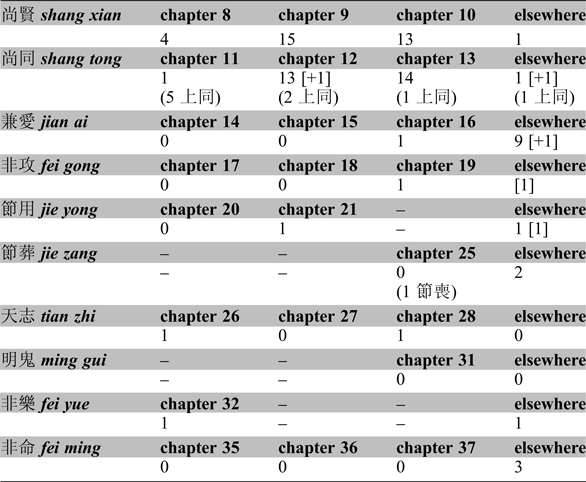
What makes the shared suggestion of the two clues somewhat precarious is the remarkable absence of these slogans in the triplets named after them: for example, the expression ming gui 明鬼 does not occur in the extant “Ming gui” chapter, nor does fei ming 非命 in the “Fei ming” triad. I do not mean to deny the close connection between the titles and the content of the Core chapters: nobody would argue that these titles were given arbitrarily and without any ground. In chapter 31, for instance, ming and gui are indeed discussed in relation to each other, even though the motto ming gui does not occur in the text. The same holds for the three “Fei ming” chapters praising those who deny (fei) the existence of fate (ming). The absence of the slogans from the chapters themselves may be explained by the fact that the concise phrases making up the titles functioned more as mottos than as running text, especially in the “fei X” (against X) constructions. But their absence in the text does suggest that a relatively early author of the Core chapters (or of its older textual building blocks) may not yet have considered the titles as catchy slogans for the Mohist doctrine. As Table 1 shows, the same holds for all but the two first triplets: the expression of the title occurs once or twice in the triplet named after it, which amounts to once or never in each of the relevant chapters.Footnote 22 This is, however, in stark contrast to the “Elevate the worthy” and “Conform upward” triplets, which contain the expressions shang xian 尚賢 and shang tong 尚同/上同 so often – 22 and 36 times respectively – that their final author or editor must have been aware of the titles being mottos representing their content.
The occurrence of the Core chapter titles in the Mozi (with the titles excluded from the count). Alternative characters are added in parentheses. Numbers between square brackets indicate the number of occurrences that are not in the Daozang edition but reconstructed by modern editors.

Despite the darkness surrounding the editorial history of these Core chapters, the variance between the two first triplets and the other eight is remarkable and suggests a different awareness and use of the ten phrases now considered representative of early Mohism. Probably only in “Shang xian” and “Shang tong” did the author finalize the chapters in full knowledge of their titles.Footnote 23 In “Fei gong”, “Fei yue”, “Fei ming” and perhaps also “Ming gui” there is enough terminological resonance suggesting that the titles may have steered the content or vice versa. In the remaining Core chapters it is difficult to understand why he would have constructed a text, possibly from older fragments, while hardly making use of the motto (or its terminology) that was chosen as title.Footnote 24 This absence of awareness of the ten Mohist set phrases is not confined to the triplets named after them, but also appears in the other parts of the extant Mozi. Even the expressions shang xian and shang tong seem to be unknown or irrelevant to its authors outside of the two respective triplets. Aside from the “Lu wen” cluster of ten mottos quoted above, most of these mottos simply do not occur in the entire received Mozi, with the exception of “inclusive care”.Footnote 25
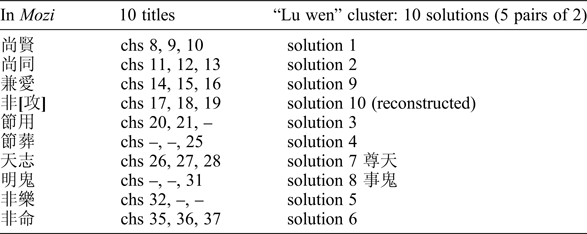
Despite the tension between the two clues on the one hand and a textual body which largely ignores them on the other, there is also some support for the gradual emergence of mottos as representative of Mo Di's thought. And that support in turn creates a small rift between the two clues, because the few clusters of slogans contained in the Mozi text tend to confirm the only two mottos from the “Lu wen” fragment that happen to differ from the Core chapter titles, namely zun tian 尊天 and shi gui 事鬼, while their corresponding triplet titles are “Tian zhi” 天志 and “Ming gui” 明鬼 (see Table 2). The eight other chapter titles correspond perfectly with the long cluster of ten mottos ascribed to Mozi in the “Lu wen” fragment (one of which has been reconstructed by modern scholars). His response consists of five pairs of solutions for particular political situations, the fourth being “if the state is dissolute and indecorous, expound ‘revering Heaven’ and ‘serving ghosts’”. All the clusters of mottos to be found in the Mozi – eight in total – contain precisely these two mottos: zun tian paired with shi gui (or shi guishen 神).Footnote 26
The two clues in the Mozi for the ten theses.
(– are missing chapters in the received Mozi)
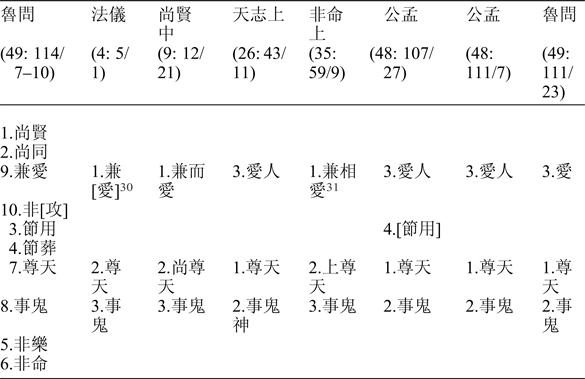
After this set of ten in “Lu wen”, the next longest cluster in the Mozi gathers three or four mottos: in chapter 48 Gongmengzi asks Mozi why Confucius was never made Son of Heaven despite his broad knowledge of the Odes and Documents. Mozi explains that this type of knowledge is not enough: “A wise person must revere Heaven (zun tian) and serve the ghosts (shi gui), love others (ai ren), and moderate expenditures (jie yong). The combination of these makes one wise” 夫知者必尊天事鬼,愛人[節用].Footnote 27 合焉為知矣 (48: 107/27). This answer clusters at least three mottos and perhaps a fourth one resembling “care for all (jian ai)”, namely “care for others (ai ren)”. There are three more cases in the Mozi where the two religious phrases from the “Lu wen” fragment are followed by the injunction to “care for others” and not to “care for all”. In the “Will of Heaven, Upper”, for instance, it is said that the sage-kings from antiquity “in their work, above revered Heaven, in the middle served the ghosts, and below took care of men” 其事上尊天,中事鬼神,下愛人 (26: 43/11). In “Gongmeng”, Mozi explains that he does not mind a lack of humaneness as long as one duly “reveres Heaven, serves the ghosts, and cares for others” 尊天事鬼愛人 (48: 111/7). And in “Lu wen”, he advises the lord of Lu “above to revere Heaven and serve the ghosts and, below, to care for and benefit the people” 上者尊天事鬼,下者愛利百姓 (49: 111/23). The occasional appearance of these clusters in the Mozi may attest to the emerging association of Mohism with some catchy phrases (see Table 3).Footnote 28 Judging from the received Mozi, the alternative expressions zun tian and shi gui were more widespread in early Mohism than the two actual Core chapter titles “Tian zhi” and “Ming gui”, even though they too hardly occur in the relevant triplets.Footnote 29 Another conclusion is that “caring for others” was perhaps also used as a relatively fixed expression, even though it did not end up as a title.
Motto clusters in the Mozi.
(Numbers indicate the order of appearance of the motto in the cluster)
3. The first Mohist motto: from “care for others” to “inclusive care”
The topics covered by the ten theses are of course fully attested in the book Mozi, but my search is restricted to their formulation as set phrases or mottos, such as the ten theses now firmly associated with early Mohist philosophy. How to demarcate such mottos from running text? In the absence of quotation marks or capitals in early Chinese sources, they do not stand out in the original source as they often do in translation. My tentative search for such mottos has been determined by the following five criteria. First, mottos are catchy phrases of two (or exceptionally three) characters, in which either an author endorses a view or others attribute it to him. These views promote or reject a habit or policy, such as “elevating X” (shang 尚/上), “installing X” (li 立), “practising X” (wei 為), “valuing X” (gui 貴), or “rejecting X” (fei 非). Since mottos should sound as if they possibly come from the relevant master, they are neutral or positive; I have excluded labels that clearly slander or criticize one.Footnote 32 Second, while the whole motto can be presented as the object of a verb – “to discuss XX” (yi議, e.g. in Lunheng 67) or “to originate XX” (zuo 作, e.g. in Zhuangzi 33) – it is usually immediately attributed to a master without extra verb. Mencius' claim that “Mr Yang is for oneself” 楊氏為我 and “Mr Mo cares for all inclusively” 墨氏兼愛 (Mencius, 3B9) contains two such examples: wei wo and jian ai. Third, mottos often come in clusters hanging together (as in Mozi quoted above) or in lists of various masters, as in Shizi: “Mozi valued inclusiveness, Kongzi valued the public good, Huangzi valued wholeness, Tianzi valued evenness, Liezi valued tenuousness, Liaozi valued non-restriction” 墨子貴兼,孔子貴公,皇子貴衷,田子貴均,列子貴虛,料子貴別囿 (1.10: 10/4).Footnote 33 A fourth characteristic is that mottos are somewhat fixed so that they can be (almost) literally repeated. The expressions “care for each other” 相愛 and “care for others” 愛人, for instance, often recur in the Mozi and other sources, but only count as mottos if they are repeatedly quoted as representative of a master's opinion, often (but not exclusively) in clusters or lists.Footnote 34 I will refer to phrases or expressions that come close to mottos but do not qualify according to these criteria as “labels” (short) or “slogans” (longer). This set of criteria shows how fluid the category of mottos is. I have therefore, as a fifth criterion, restricted my search to those that can be somehow related to the ten Mohist theses, since they are the object of this investigation; I have not tried to identify all possible existing Mohist mottos in the corpus of Zhou and Han texts.
Returning to the Mozi, there is another indication that Mo Di's thought was gradually being discussed in terms of mottos, aside from the clusters mentioned above. This is most apparent in the Dialogues, where the master is confronted with opponents or disciples questioning the ideas that he promotes. And, interestingly, it only happens with the topic of “care” (ai): none of the other ten theses are explicitly attributed to Mozi either by himself or by his interlocutors by means of a motto. In one Dialogue chapter, “Geng Zhu”, Wumazi confronts Mozi with the following claim:
You care for everyone in the world but cannot quite be said to benefit them; I do not care for everyone in the world but cannot quite be said to harm them. Since neither of us has had any effect, why do you consider yourself alone right and me wrong?
子兼愛天下,未云利也; 我不愛天下,未云賊也。功皆未至,子何獨自是而非我哉? (46: 100/20–21)
In the same chapter he also tells Mozi: “I differ from you master: I am not able to inclusively care for all” 我與子異: 我不能兼愛, explaining that he cares more for those in his own vicinity (46: 102/24). The mention of jian ai as a firm conviction defended (shi 是) by Mozi, in opposition (fei 非) to others, confirms the function of “inclusive care” as a motto for his thought. I believe, however, that the expression jian ai was not at the very outset part of the Mohist conviction, but only gradually emerged as the result of ongoing reflection and debates, an evolution that can be traced in the book Mozi.
By far the most current expression containing ai in the Mozi is not jian ai (10 times)Footnote 35 but ai ren (48 times) as in various clusters quoted above. Other expressions are “caring for each other” (xiang ai 相愛 and jiaoxiang ai 交相愛) – often complemented by “benefitting each other” (jiaoxiang li 交相利) – “caring for each other inclusively” (jian xiang ai 兼相愛), “caring for the people” (ai baixing 愛百姓) and, at a later stage “caring thoroughly” (jin ai 盡愛), and “caring all around” (zhou ai 周愛).Footnote 36 Mo Di is quoted in a Dialogue chapter proudly identifying “caring” 愛 and “respect” 恭 as his own two “hooks and clamps” 鉤強 to catch people, because he is deeply convinced that “to care for each other and respect each other is just like benefitting each other” 交相愛交相恭猶若相利也 (49: 115/18–9). “Care” in various combinations – not all identifiable as mottos – seems to be more representative of Mozi than the relatively rare expression “inclusive care”. It is the current bewitchment with jian ai that makes scholars read Mohist claims about “care” as referring unequivocally to “inclusive care”.Footnote 37 The fluidity of the expressions with “care” and the minor portion occupied by “inclusive care” among them suggest that perhaps the enthusiastic promotion of ai was Mo Di's original contribution and “inclusive care” a later specification, most probably developed by some of his followers.Footnote 38
As I have argued elsewhere, it is very possible that Mohism started out with a not terribly controversial plea to care for others (ai ren), which gradually evolved into the more demanding ideal of “care for all” or “inclusive care”. This evolution merely began in the three consecutive “Jian ai” chapters and was completed in the “Will of Heaven” triplet. As Yoshinaga Shinjirō has pointed out, the first and oldest “Jian ai” chapter can be seen as a disciple's attempt to explain what his master meant when he insisted that “we must encourage people to care for others” 不可以不勸愛人 (14: 24/22).Footnote 39 This disciple's interpretation is that instead of “caring for oneself” 自愛 we should “care for each other” 相愛, in and beyond relationships of traditional reciprocity, as between father and son, ruler and minister, older and younger brother, but also among high ministers and feudal lords. The second “Jian ai” chapter then urges people to “inclusively care for each other and mutually benefit each other” 兼相愛 交相利 and explicitly expands the scope of caring to the weak, the poor, the vulgar and the simple of mind. In the last chapter of the triplet, the motto jian ai makes its appearance, while people are urged yet more specifically to feed the hungry, clothe the cold, support the sick and bury the dead. As the scope of caring expands, the importance of reciprocity weakens, and the ideal of “inclusive care” is associated with the model of Heaven, who cares equally for everybody without expecting anything in return. This full-fledged ideal of jian ai finds its completion in a slightly later triplet, namely “Will of Heaven” (chs 26–8), in which the expression jian ai regularly occurs. In its first chapter, Heaven is quoted praising the sage kings because “all those whom I care for they also inclusively care for, and all those whom I benefit they also inclusively benefit. Their care for others is expansive and their benefit to others is most substantial”. 此之我所愛、兼而愛之,我所利、兼而利之。愛人者此為博焉,利人者此為厚焉. (26: 43/11–12). In chapter 28 the expression jian ai occurs four times when Mozi explains that what Heaven expects from us is to “care for all the people in the world” 兼愛天下之人 (28: 48/4), since Heaven itself behaves exactly like that. As this summary of my earlier argument shows, I do not believe that Mohists from the very beginning set out with a strict command to “care inclusively” or “love universally”, but that they grew into it.Footnote 40 One inspiration for this view was reading the chapters without the constraints of their titles and hence without the presupposition that they all three discussed “inclusive care” to begin with. I admit that my alternative hypothesis is not hereby indisputably proven, but even less are the assumptions and declarations “that the main content of the ten doctrines was more or less shared by all the Mohists of the mid-fourth century, and the extant texts were derived from that common origin”.Footnote 41
The Mohist promotion of “care” is also important in the rest of the Mozi, beginning with the remaining Core chapters, followed by the Dialogues and the Mohist canon (Mojing 墨經 chs 40–5) and, finally, by what can be termed the Opening chapters (chs 1–7).Footnote 42 Some Core chapters occasionally mention it, and one Opening chapter, “Fa yi” (Standards and norms) launches a fierce promotion of “inclusive care”, much in line with the “Will of Heaven” triplet.Footnote 43 In the Dialogues and the canon – as far as the latter chapters are comprehensible and their textual reconstructions reliable – there is an increased reflection on the nature of “inclusiveness” and of “care”, its possible divergence from “benefit”, the importance of good intentions despite failing success, the implications of making one's view on care public, the division of tasks in caring for others, the inclusiveness of the expression “caring for others” as opposed to “riding horses”, and so on. But these evolutions are not the focus of my inquiry.Footnote 44 What counts is that, of the ten Mohist dogmas, only jian ai is relatively well attested in the Mozi, although not well in the triplet named after it.Footnote 45 Its emergence as the oldest Mohist motto is clear, especially if we include slightly variant expressions such as “jian xiang ai” (care for each other inclusively), and “jian er ai” 兼而愛 (to care while being inclusive).Footnote 46 But an important and more current expression in the Mozi is ai ren, not only in the running text but also in what appear to be short clusters of mottos representing Mohist thought. We conclude that, aside from the two clues discussed above, the book Mozi contains no more than a growing awareness of its ten mottos, headed by “care for all”.
4. From “jian ai” to Mo, and from Mo to “jian ai”: two opposite testimonies
One of the topics that the masters discussed were other masters: what do others promote? How do they behave? What is their problem? Why are they wrong? From critical comments such as Mozi's “Fei Ru” 非儒 (Against the Ru) and Mencius' complaints about heretics, there emerged a tendency to list the views of other master-persuaders in signature phrases or short mottos, followed by an evaluation. We find such treatment in books such as Guanzi, Xunzi, Zhuangzi, Hanfeizi, Lüshi chunqiu, Huainanzi and Shiji, before it evolved into bibliographical catalogues, such as Hanshu, “Yiwenzhi”.Footnote 47 It will be interesting to see how Mozi is characterized by these fellow masters, and which motto, if any, he is associated with. Conversely, we will also check references to what I have identified as Mo Di's oldest motto of the ten, namely jian ai, and see how explicitly or consistently this expression is being linked with him.
As for the Mozi itself, the one chapter that contains even more debate and controversy than the Dialogues discussed above, is “Fei Ru” (ch. 39), which holds an ambiguous position between the Core chapters and the Dialogues.Footnote 48 As the title suggests it criticizes the Ru (the classicists or Confucians), and does so in a sharp tone that is exceptional in the Mozi.Footnote 49 If Mozi was first and foremost a defender of “inclusive care” against the “graded love” of the Ru, one would have expected this chapter to contain critical remarks on that topic. But “Fei Ru” does not mention care at all. The earliest source that explicitly associates jian ai with Mo, and Mo with jian ai, is Mencius; and the most remarkable source, that does neither, is Xunzi. I believe, however, that the former has been so deeply impinged into our minds that it has determined our interpretations of all other textual evidence; the latter has been largely neglected or somewhat distorted to fit the expectations. These two opposite testimonies will be presented before we turn to the other sources.
Mencius about jian ai and Mo
The book Mencius contains the sayings of Master Meng (c. 371–289 bce), recorded or attributed to him by his disciples and edited by Zhao Qi (d. 201 ce). It has two fragments referring to jian ai: both are highly critical and relate it exclusively to Mo Di as its propagator. Mencius' criticism of Mozi for promoting “inclusive care” in opposition to the egotism of Yang Zhu, is so well attested that it hardly needs repetition. Almost every current textbook of ancient Chinese thought tells its students about Mencius' lamenting that:
The claims of Yang Zhu and Mo Di fill the world. All claims made in the world either revert to Yang or to Mo. Mr. Yang is for oneself, which amounts to having no lord; Mr. Mo cares for all, which amounts to having no father. To have neither a lord nor a father is something for beasts.
楊朱墨翟之言盈天下. 天下之言不歸楊, 則歸墨. 楊氏為我,是無君也;墨氏兼愛,是無父也. 無父無君. 是禽獸也.
(Mencius, 3B9)The second record resembles the first in identifying the two heretics with exactly the same mottos: Yang with wei wo versus Mo with jian ai:
Yangzi chooses “for oneself”: even if he could benefit the world by pulling out one hair, he would not do it. Mozi for “inclusive care”: if by rubbing his head bald and showing [the flesh of] his heels he could benefit the world, he would do it.
楊子取為我: 拔一毛而利天下,不為也. 墨子兼愛: 摩頂放踵利天下, 為之.
(Mencius, 7A26)Did these two mottos firmly exist in Mencius' time or has he contributed to their creation? Yoshinaga believes that Mencius' criticism itself is an indication of the currency of the slogan jian ai in his days.Footnote 50 Some scholars have suggested that Mencius' characterization of Yang Zhu's thought was an unfair invention, inspired by his own aversion, and formulated so as perfectly to contradict the other heretic, Mo Di.Footnote 51 His characterization of Mozi, however, has been more generally accepted, probably thanks to the two clues provided in the book Mozi itself.Footnote 52 However, neither the “Lu wen” fragment nor the Core chapter titles have been firmly dated, and thus might postdate the record in Mencius. While the Mohists are unquestionably the principal promoters of caring for all, we cannot exclude the possibility that Mencius may have contributed to or significantly promulgated the identification of jian ai as their motto.
Aside from these two records, Mo is mentioned in two further Mencius fragments: once in yet another reflection on the competition between the followers of Mo, Yang and Ru (Mencius, 7B26), and once in a discussion between master Meng and a Mohist (墨者). Even though the expression jian ai does not occur in either of these fragments, it seems to be implicitly present, especially in the latter case, where the Mohist interlocutor appeals to the authority of the ancients whose “care had no gradations” 愛無差等 (Mencius, 3A5). He hereby suggests that the sages of antiquity admired by the Ru were also in favour of inclusive care.
Thus, both references to jian ai in the Mencius explicitly and exclusively ascribe it to Mozi, and present it as a threat to the Ru. The two extra references to Mo also describe the Mohists as a challenge to the Ru, the latter fragment more specifically in terms of the scope of one's caring. Other reflections in the Mencius about “being inclusive” (jian) and “caring” (ai) confirm the shared interest of the authors of the Mozi and the Mencius in this topic.Footnote 53 Apparently ai was in the air, but given the uncertainties about dating the various layers of both books, the relationhip between them was probably more complex and interactive than the Mencius simply quoting a completely pre-existing Mozi. While I would not suggest the opposite either – namely the whole Mozi being thoroughly influenced by Mencius – it remains interesting to see who else was influenced by Mencius' take on Mohism. Xunzi certainly was not.
Xunzi on jian ai and Mo
The book Xunzi was probably mostly written by Xun Qing (c. 298–238 bce) and edited by Liu Xiang (79–8 bce) in the Han dynasty. As opposed to Mencius, it makes no connection whatsoever between “Mo” and “inclusive care”. What is more, “inclusive care” is considered positive and used as an uncontested expression in running text. In the whole book, the expressions jian ai and jian er ai (兼而愛) each occur once. In “Fu guo” 富國 (Enriching the State) Xunzi argues that the people's welfare is the ruler's responsibility:
As for inclusively protecting them, inclusively caring for them, and inclusively regulating them, to make sure that even in times of a failed harvest, floods and drought the people escape the disasters of cold and hunger, this is the task of the sagely lord and his worthy chancellor.
若夫兼而覆之,兼而愛之,兼而制之,歲雖凶敗水旱,使百姓無凍餒之患,則是聖君賢相之事也 (10: 44/17–18).Footnote 54
In a later chapter, “Cheng Xiang” 成相 (Working Songs), the treatment of jian ai is equally positive and even more embedded in a Mohist atmosphere.Footnote 55 The sage kings are praised for “benefitting everywhere and inclusively caring, so that their moral influence spread out equally” 氾利兼愛德施均. Moreover, when Yao resigned, Shun “elevated the worthy and promoted moral influence so that the world was ordered” 尚賢推德天下治 (25: 121/8). John Knoblock was so puzzled to find this Mohist talk in the Xunzi – not just jian ai, but also shang xian (elevate the worthy) and great enthusiasm for li (benefit) – that he declared this section “at variance with the views expressed elsewhere in Xunzi's works” and speculated that the Ru master may have indulged “in the conventional rhetoric” or made “a significant change in his views”.Footnote 56 But perhaps Xunzi did not consider these expressions as evidently and exclusively representative of Mohist thought. Masayuki Sato has recently remarked that “at no point in Xunzi's argument can we find any criticism of jian'ai. This shows a sharp contrast with Mencius's criticism, which mainly focused on that doctrine, whether or not he correctly understood it”.Footnote 57 Indeed, but for a master persuader who does not shun disagreement, it is all the more remarkable that Xunzi never explicitly states his disagreement with Mencius, neither on the value of “inclusive care”, nor on its exclusive identification with Mo Di. Mencius' view on this matter was perhaps not known in those days, or not sufficiently important for Xunzi to take issue with it.Footnote 58
Even when Xunzi criticizes Mozi and his clique for all the vulgarity and misconceptions in the world,Footnote 59 he does not once mention jian ai. Mozi is of course often opposed to the Ru – except to the vulgar ones 俗儒 (su Ru)Footnote 60 – for failing to exalt rituals and righteousness (ch. 8), failing to unify people and make them rich (ch. 10), failing to divide the work (ch. 11), failing to appreciate music (ch. 20),Footnote 61 for focusing too much on utility (ch. 21), and so forth.Footnote 62 Labels and slogans (not necessarily mottos) seem to appear when various masters are critically evaluated by Xunzi. Some used for Mozi coincide exactly or vaguely with his own theses. In “Fei shi er zi” 非十二子 (Against the twelve masters), for instance, the Mohists are criticized for “elevating merit and utility” 上功用, “making much of frugality and temperance” 大儉約, and “neglecting gradations and rankings” 僈差等 (6: 21/19), but these (especially the last one) sound more like Xunzi's labels for Mozi than Mohist mottos.Footnote 63 In “Fu guo” – where he referred positively to jian ai without mentioning the Mohists – Xunzi accuses them of their stand “against music” 非樂 and in favour of “moderating expenses” 節用, which are said to cause great injury to the world (10: 45/6–7). Aside from these two mottos, which happen to coincide with two of the Mohist theses, others catch the same meaning but differ in phrasing: in the same chapter Xunzi identifies the Mohist techniques with “elevating frugality” 尚儉 and being “against fighting” 非鬥 (10: 46/2), two expressions that have not been preserved as Mohist mottos. The following examples may contain slogans or labels given by a critical rival rather than presenting the Mohists' own mottos: in “Jie bi” 解蔽 (Dispelling Blindness) Mozi is the first of six masters accused of partiality: “Mozi is blinded by utility and insensitive to good form” 墨子蔽於用而不知文 (21: 103/8); and in the final section of “Tian lun” 天論 (About Heaven) he is said to “have insight into equalizing, but not into deformity” 墨子有見於齊,無見於畸 (17: 83/4). Knoblock translates this somewhat puzzling characterization of Mozi as “Mozi had insight into ‘uniformity’ but none into ‘individuation’”.Footnote 64 For readers who fail to understand this line, he explains that “Xunzi refers to such Mohist doctrines as Solidarity with Superiors and Universal Love”.Footnote 65 Considering Xunzi's own positive use of the expression jian ai, he himself might not have endorsed this comment. But, then, Xunzi had not taken a contemporary class on ancient Chinese philosophy. Contemporary scholars presenting Xunzi's supposedly strong opposition to jian ai do not quote his positive remarks on care for all, but (heavily) interpret other statements where the expression does not occur.Footnote 66 If even Knoblock, Xunzi's great Western translator, was steered in his interpretation by preconceptions about a distinctive Mohist philosophy, how much more then Knoblock's readership. It almost seems as if Mencius was holding Knoblock's pen when working on the Xunzi. On early Chinese authors, however, Mencius' influence was far less dominant.
5. Which mottos did early Chinese sources associate with Mo?
We have asked two slightly overlapping questions about the books Mencius and Xunzi: which mottos do they associate with Mo? And who is being associated with jian ai? In this and the following part these two questions will, respectively, be asked of the other early sources. The search for mottos associated with Mo in early texts is tentative and cannot lead to an unambiguously clear-cut set of data, especially if it turns out that these mottos were used much less exclusively and consistently than suggested in current textbooks. While preserving a focus on those fragments in which Mo Di, Mozi or the Mohists in general are characterized, often along with other masters, we now turn to the corpus of late Zhou and Han sources. We saw that neither Mozi's “Fei Ru” chapter nor Xunzi's many critical listings of masters associate Mo with jian ai. But Mencius, from his perspective, does it with much conviction. What do the other sources say? Some express no opinion whatsoever about the Mohists (e.g. Shang junshu, Liji, Chunqiu fanlu), while others do not refer to mottos in their characterization. For instance, Hanfeizi's well-known “Xian xue” 顯學 (Eminent Learning) chapter, which describes and criticizes the Ru and Mo of his days, does not associate the early Mohists with any motto, nor does it make any reference to their promotion of care.Footnote 67 But among those sources that do seem to attribute one or more mottos to Mohism, we can distinguish four major tendencies: first, when there is an undisputable and exclusive association between Mo and jian ai as in the Mencius; second, when Mo is associated with jian ai among other mottos, as in Mozi's “Lu wen” fragment; third, when it is associated with another set of mottos excluding jian ai, as in the various Xunzi listings; and finally, when the text does not exactly mention jian ai but is nevertheless interpreted as doing so by modern editors or scholars, as Knoblock did with the fragment in Xunzi's “Tian lun” (About Heaven).
As regards the first category, aside from those sources which literally repeat Mencius' complaint about the threat of Yang and Mo to the Ru of his days,Footnote 68 I have found only one text exclusively associating Mo with jian ai. In “Dao Zhi” 盜跖 (Robber Zhi), a relatively late Zhuangzi chapter, someone inspired by Yang Zhu's ideas rejects his interlocutor's moralist plea for distinctions and hierarchy by presenting him with a list of exemplary figures from the past who did not respect them either, including Yao and Shun, Tang and King Wu, Wang Ji and the Duke of Zhou. The list closes with “the Ru's specious phraseology and Mohists' inclusive care” 儒者偽辭,墨者兼愛, all being effective counterarguments to the moralist's plea (29: 89/16).Footnote 69 Far from siding with Mencius, this unique fragment differs from it in various ways: Mozi's portrayal is not crucial to the argument, nor is it particularly negative. On the contrary, Greedyguts Grabitall (Man gou de 滿苟得) seems to enjoy these exemplars' disregard for distinctions. But most of all, Mozi is here presented in a list along with the Ru and not opposed to them. In the same chapter, the moralist quotes Zhongni 仲尼 and Mo Di 墨翟 together as exemplars of people who are respected by the nobles despite their poverty. Moreover, this chapter does not seem to be very respesentative of the book Zhuangzi.Footnote 70
Second, there are more fragments associating Mo with jian ai along with some other mottos. One Huainanzi chapter, “Fan lun xun” 氾論訓 (Boundless Discourses), presents a succession of four disagreeing masters in the following order: Kongzi, Mozi, Yangzi and Mengzi. Each is typified with a set of slogans, Mozi being said to set up a plea for (li 立): “inclusive care, elevating the worthy, supporting ghosts, and against fatalism” 兼愛上賢右鬼非命 (13: 123/21). Three out of the four are known as Mohist theses, the fourth, you gui, resembles closely enough the Core chapter title “Ming gui” and the “Lu wen” expression shi gui to be recognized as a Mohist core idea, although its meaning is disputed.Footnote 71Hanshu, “Yiwenzhi” by Ban Gu (ad 32–92) also characterizes Mohism with six mottos: the strength of Mohism is said to lie in “valuing frugality” 貴儉, “inclusive care” 兼愛, “elevating the worthy” 上賢, “supporting ghosts” 右鬼, “being against fatalism” 非命, and “conforming upward” 上同. But it is blinded in its rejection of rituals and its incapacity to distinguish between kin and non-kin (30: 1738).Footnote 72 Aside from four well-attested Mohist theses, we encounter again you gui (as in the Huainanzi) and a slogan referring to the Mohist appreciation of frugality 儉 (as in two of Xunzi's lists). This last point, together with the accusation of being blinded (蔽) by its opposition to rituals, is reminiscent of Xunzi's evaluation. The last source in this category, “Xiao Cheng Huangdi ji er” (Annals of Emperor Xiao Cheng, II) of the (Qian) Hanji (前)漢紀, written by Xun Yue 荀悅 (ad 148–209), closely resembles Ban Gu's portrayal of the Mohists: “elevate frugality” 尚儉, “support ghosts and spirits” 右鬼神, “inclusive care” 兼愛, “elevate the worthy” 尚賢, “against fatalism” 非命, and “conform upward” 尚同 (25: 3b). Of all the clusters that I have encountered in early sources, this one most resembles the Mozi, the minor difference with Hanshu being that it writes 尚賢 and 尚同 instead of 上賢 and 上同. All three sources (Huainanzi, Hanshu and Qian Hanji) with relatively long clusters of Mozi slogans date from the Han dynasty. The mottos are partly identical with the ten theses and partly identifiable with them.
The third category of mottos, identified with Mo but excluding jian ai, has shorter clusters than the previous one. There is one questionable instance (because it lacks jian ai) in the last chapter of the Zhuangzi, where the author describes Mo Di and Qin Guli as follows:
They originated “Against music” and named it “Moderate expenses”. When alive they did not sing, and for the dead they did not wear mourning. Mozi cared for everyone, benefited them all, and was against fighting. His way was not to get angry.
作為非樂,命之曰節用. 生不歌,死無服. 墨子泛愛兼利而非鬥. 其道不怒. (33: 98/7)
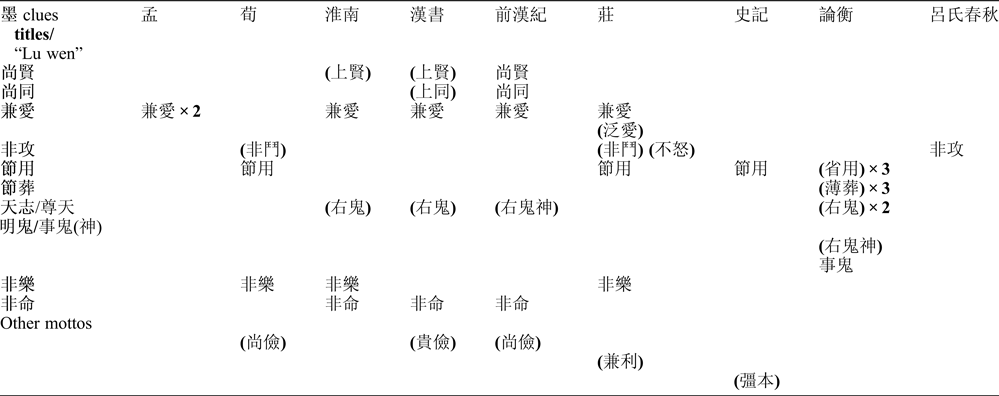
Although it is not totally clear what is meant by “originating fei yue”, and even less how they named this very creation jie yong, the two are clearly mottos attributed to the Mohists.Footnote 73 The next four slogans, fan ai (泛愛),Footnote 74jian li (兼利), fei dou (非鬥) and bu nu (不怒), do not literally coincide with the ten theses, but can unmistakeably be appreciated as alternative expressions of the same or related ideas. The author's evaluation of Mohism is very mild, but he does fear that this teaching will not ensure care for others (ai ren), and that this behaviour will certainly not allow one to care for oneself (ai ji 愛己) (33: 98/13). The mildness towards Mohism and the interest in its teaching is exceptional for the whole Zhuangzi and probably only characterizes its last author(s):Footnote 75 for much of the book, Mo is mentioned along with the Ru, Yang and others for their endless quibbling, their futile debates (in terms of “shi fei 是非”), and their busying around, all signs and causes of decline; but here the author himself takes part in the evaluation and shows interest in what Mozi argues for, not just the fact that he argues.Footnote 76 A shorter cluster in this category is Sima Tan's (c. 165–110 bce) evaluation in the concluding chapter of the Shiji (Records of the scribe), finished by his son, Sima Qian (c. 145–c. 86 bce): “The Mohists are frugal and hard to obey. Hence their enterprises cannot be generally followed. But their strengthening the basic and moderating expenses should not be abandoned”. 墨者儉而難遵. 是以其事不可徧循. 然其彊本節用,不可廢也 (130: 3289). The Simas' vision of Mohism seems to be mainly economic. Of the two slogans qiang ben 彊本 and jie yong, only the latter has ended up as a Mohist thesis, but the former can also be identified with Mohism.Footnote 77 It is interesting to see that the Simas find fault with Mohism mainly for being too difficult and demanding, a criticism that was uttered by Mozi's first opponents quoted in the last two chapters of the “Jian ai” triplet, and that apparently remained a soft spot.Footnote 78 Moreover, the Simas' economic vision is also apparent from the single line devoted to Mo Di in the biographies, where he is associated with one motto: “moderating expenses” 節用.Footnote 79 In the Huainanzi, the Mohists are usually opposed to the Ru for their short mourning period (ch. 11) and their objections to complicated rituals and excessive expenditure during mourning (ch. 21). But the only motto seems to occur in “Shui shan xun” 說山訓 (Mountain of Persuasions), where Mozi is characterized as being “against music” 墨子非樂 (16: 163/14),Footnote 80 listed among two Ru masters, one “taking his stand on filial piety” and the other “taking his stand on incorruptibility”.Footnote 81 In the Lüshi chunqiu, a Mohist teacher is explicitly identified with the “condemnation of military aggression” 非攻.Footnote 82 Wang Chong (ad 27–c. 100), finally, has much to say about Mozi and Mohism,Footnote 83 and occasionally does it by quoting mottos: “supporting ghosts and spirits” 右鬼(神) (chs 20, 67, 83) as in Huainanzi, Hanshu, and (Qian) Hanji, “serving ghosts” 事鬼 (ch. 84) as in the “Luwen” fragment and the combination of “simple burials” (bao zang 薄葬) with “saving on utilities” (sheng yong 省用) (chs 20, 67, 83), hitherto unattested in earlier sources, but also easily identifiable as Mohist concerns. Perhaps Wang Chong stresses the mottos here because he discusses two convictions that, in his eyes, are contradictory: if one supports ghosts, then one cannot plead for simple burials, because that would anger those very ghosts.Footnote 84 We see thus that the third category increases the variety of mottos attributed to Mozi by various authors; this may have been related to these authors' own different interests and to the flexibility with which Mohist ideas were being discussed, namely the absence of clear and distinct mottos. On the basis of Mencius, Xunzi and these three categories of later sources, the distribution of the mottos associated with Mozi is shown in Table 4.
Mottos associated with Mo in early Chinese sources. Between parentheses are mottos that do not literally coincide with the two clues, being the Mozi titles (in bold) and the “Lu wen” phrases (not bold).
Finally, the fourth category may be considered a further indication of the original variety, somewhat hidden by scholarly emendations or interpetations; these are inspired by the urge to interpret as jian ai what is not literally presented as such, an urge that is not necessarily wrongheaded or unfounded. Three variations in this last category are: emendation of the text; addition by interpretation; and adaption by interpretation. An example of the first variation occurs in the chapter “Bu er” 不二 (No duality) of the Lüshi chunqiu: the author warns the ruler against listening to a multitude of people because they all come up with a different policy; then follows a list of ten master-persuaders all with their own motto:
Lao Dan values softness, Confucius humaneness, Mo Di incorruptibility, Guanyin purity, Master Liezi tenuousness, Chen Pian equalizing, Yang Sheng oneself, Sun Bin strategic position, Wang Liao going first, and Ni Liang going last.
老耽貴柔, 孔子貴仁, 墨翟貴廉, 關尹貴清, 子列子貴虛, 陳駢貴齊, 陽生貴己, 孫臏貴勢, 王廖貴先, 兒良貴後. (17/7.1)
The claim that 墨翟貴廉 is usually considered problematic, and hence inspires two scholarly moves: first, some suggest the emendation of 廉 to 兼 because the original does not make enough sense;Footnote 85 and then, some add the explanation that jian really means jian ai.Footnote 86 The latter step illustrates the second variation, namely addition by interpretation, as is also the case in the Shizi fragment quoted earlier: “Mozi valued inclusiveness, Kongzi valued impartiality, Huangzi valued wholeness…” 墨子貴兼, 孔子貴公, 皇子貴衷 … (1.10: 10/4). Commentators hasten to add that 貴兼 here means “to consider ‘inclusive care’ valuable”. They explain that: “inclusive refers to inclusive care. Inclusive care is the representative opinion in Mozi's academic thought”. 以‘兼愛’為貴. 兼, 指兼愛. 兼愛是墨子學術思想的代表主張.Footnote 87 And finally, adaptation by interpretation also applies to those cases where caring for everybody is not expressed by the expression jian ai, as for instance the bian ai 徧愛 rejected by Mencius (7A46), fan ai 泛愛 mentioned in Zhuangzi's last chapter, jin ai 盡愛 and zhou ai 周愛 discussed in the Mojing, and even ai ren. Footnote 88 All of these cases may well have referred to that same idea of caring for everybody, but their expression was not restricted to the use of one motto, a fact that tends to disappear by emendations, interpretations and translations in terms of the Mohist dogma jian ai.
To conclude, the admittedly tentative search for mottos explicitly associated with Mo in early sources leads to a flexible set of data. Nobody seems to have followed the two Mozi clues in identifying Mohism with ten central ideas; nor does anybody agree – or bother to disagree – with Mencius' one-to-one identification of Mo and jian ai. The longest clusters resembling the two clues are from Han shu and (Qian) Han ji (with six mottos) or perhaps Zhuangzi with one long cluster of possibly six somewhat variegated mottos (in ch. 33). Many more conclusions could be drawn from Table 4 – e.g. the total absence of tian zhi and zun tian, the dominant interest in ghosts and economy, and the differences between the various sources – but that would lead us too far. Although the demarcation of mottos from running text remains tentative, the extant sources show no awareness of a finite set of ten Mohist theses, only of shorter and looser clusters of mottos. Other criteria for mottos than the ones used here might bring to light new Mohist mottos, but that would only confirm the need for flexibility in characterizing early Mohism. The mottos proposed in various sources are never explicitly contested, despite their variety, even by Xunzi, who could not disagree more with Mencius' exclusive identification of Mo with the motto jian ai. This could suggest that a fixed Mohist philosophy or ideology was neither perceived nor expected: not only were a variety of mottos associated with Mo, but these mottos were just as easily and without much ado used in running text or associated with other masters (as in the Xunzi). This will be our final investigation, and will focus exclusively on the expression jian ai.
6. The occurrence of jian ai in early Chinese sources
We have seen that, in the book Mozi, the expression jian ai was in pole position for becoming the principal Mohist motto: not only does it occur among the Core chapter titles and in the “Lu wen” fragment, as do the other theses, but it was also included in shorter clusters and sometimes explicitly attributed to Mozi in the Dialogues. In the Mencius, “inclusive care” was presented as the foremost Mohist orthodoxy. But what happened then? Xunzi seems unaware that the expression was being reserved for one of his rivals and, as we will see, so were most of the other authors. Their uses of jian ai can again be divided into four categories: first, its use in relation to Mozi alone; second, the expression being ascribed to Mozi and other masters together; third, its attribution to masters other than Mozi; and finally, its use without any explicit association.
Since the first category coincides with the first two categories above – the association of Mo with jian ai alone, or in a longer cluster – it is not repeated here. The second category contains one fragment: in the Hanfeizi, the expression jian ai is ascribed to the vague category “Ru Mo”. The author complains that “the Ru and Mo of today all praise the early kings for practicing inclusive care toward the whole world and hence they look at the people as parents do” 今儒墨皆稱先王兼愛天下, 則視民如父母. Parental love, he points out, is no guarantee of order; respect for the law would be much better (49: 146/20).Footnote 89 This is the only mention of jian ai in the entire book and it is – with no sign of challenge or controversy – attributed to the Ru Mo.
The third category attributing “inclusive care” to masters other than Mozi likewise contains only one fragment, namely from the Zhuangzi: when visiting Lao Dan in the royal library at court, Confucius identifies the gist of his own ideas as “humaneness and righteousness” 仁義. Urged by Lao Dan, Confucius specifies:
To have your inner heart at ease, to care inclusively and lack bias: this is the essence of humaneness and righteousness. 中心物愷,兼愛無私: 此仁義之情也.
Says Lao Dan: “Wow, that is dangerous, the last part of what you said: this ‘inclusive care’ is that not far off the mark? And to lack bias is in fact some sort of bias”. 老聃曰:意,幾乎後言! 夫兼愛, 不亦迂乎. 無私焉乃私也 (13: 36/14–15).Footnote 90
While Zhuangzi contained the only fragment aside from Mencius exclusively associating Mozi with “inclusive care”, it also holds the only fragment exclusively attributing it to Kongzi, and doing so much more explicitly. The author is, of course, ridiculing Confucius here, but he is not in the habit of doing this by attributing indisputably Mohist ideas to the Ru master. Perhaps “inclusive care” was not yet considered so indisputably Mohist after all.Footnote 91
Finally, the last category in which the expression jian ai is used without any specific attribution to any master or persuader appears to be by far the most dominant. While a small minority of texts attribute the policy of caring for all to some unnamed and wrong-headed advisers, the large majority of texts seem to be part of a general consensus about the positive impact of “inclusive care” on the people, just as was Xunzi. The only unambiguous example of the former trend is “Li zheng” 立政 (Installation of Government) in the Guanzi, and its commentary chapter, “Li zheng jiu bai jie” 立政九敗解 (Explanation of the Nine Ways of Failure in Installation of Government). The authors identify nine types of persuasion causing political failure, the second being “if talk of inclusive care prevails, then troops will not go to war” 兼愛之說勝, 則士卒不戰 (4: 9/23). Since no persuaders are named, Rickett understandably attributes this view to the Mohists. Some of the eight following persuasions are characterized as being from those who “privately criticize others and value themselves”, those who “form partisanships and factions”, and those interested in “gold, jade, goods and wealth”, or in “pleasure and enjoyment”.Footnote 92 The fact that most of these persuasions cannot be attributed to an identified school of thinkers shows perhaps that the view attributable to Mohists was not seen as a very consistent theory either. Lastly on the negative view on “inclusive care”, we could tentatively add Hanfeizi criticizing a list of (in his view) perverse but dominant persuasive definitions, among them those who “[…] (claiming to) care for all in the world, are called sages […]” 言汎愛天下謂之聖 (45: 136/2).Footnote 93 In another instance he accuses “the learned of the day counselling the ruler, for all rejecting the profit-seeking heart and for setting out on the way of mutual care” 今學者之說人主也皆去求利之心,出相愛之道, a view that he considers immature, deceitful and fallacious (46: 137/25).Footnote 94 Even though the two last examples do not explicitly mention jian ai, they further illustrate the small minority of negative views on a policy promoting care on a large scale.Footnote 95
Against this minor trend, there is an abundance of positive, unattributed and uncontroversial references to jian ai. We find it in Guanzi “Ban fa” and its commentary chapter “Ban fa jie”, notwithstanding the negative view from Guanzi quoted above;Footnote 96 also in Shizi Footnote 97 and the Lüshi chunqiu,Footnote 98 in Sui Caozi,Footnote 99 in the Mawangdui text “Jingfa”Footnote 100 and the Shanghai manuscript “Cao Mo zhi chen”,Footnote 101 in Xinshu,Footnote 102Da Dai Liji,Footnote 103Wenzi,Footnote 104Chunqiu fanlu,Footnote 105Taixuanjing,”Footnote 106Qianfulun,Footnote 107Simafa,Footnote 108 and Hanshu,Footnote 109 and probably in many more sources, especially if we consistently include very similar expressions such as jian er ai X and jian X er ai. It suffices to summarize some characteristics of this majority trend treating jian ai positively despite the different affiliations and contexts of the various sources. “Inclusive care” is relatively uncontroversial, occurs only once or twice in each source, and is advised to the ruler in his relation to the people. It is often associated with “humaneness” (ren) and “having no bias” (wu si), as in Gongsun Hong's advice to Emperor Wudi: “Your servant heard that humaneness is care” 臣聞之, 仁者愛也. He specifies that “Bringing about benefit and removing disaster, to care inclusively and have no bias, we call this humaneness” 致利除害, 兼愛無私, 謂之仁 (58: 2616).Footnote 110 Contemporary scholars reading these sources identify the expression jian ai with the Mohists while at the same time indicating the increasing absorption of Mohist ideas in late Zhou and Han thought.Footnote 111 Indeed, the notions of “eclecticism” and “syncretism” are never far off when discussing the imperial period. But these labels suggest that there first existed a clear-cut philosophy that later became mixed with others. The search for “inclusive care” in early Chinese sources shows, however, that it was never unanimously considered a clear token of one specific philosophy. Perhaps early Mohist mottos were not originally conceived as clearly distinguished entities, at least not as clearly as in today's academic world.
Conclusion
When early Chinese masters discussed other masters, they usually considered them as rivals or – towards the Han dynasty – as partial possessors of the Way. One fashion in discussing others was by identifying them with “mottos”, which I have demarcated as catchy phrases usually of two characters, and which endorse or reject a policy, have a relatively fixed form, are explicitly attributed to a master or claimed by him, or otherwise appear in clusters (of one master) or lists (of various masters) and, in the case of Mohism, are related to the ten theses. Admittedly these criteria do not procure us with an indisputable set of data; there are indeed some slogans, labels or other expressions that we might consider including on top of those that have been selected here.Footnote 112 Even though this approach through mottos is very narrow compared to a full investigation of early Mohist thought, it offers one specific entry into the material and allows some tentative conclusions about early Mohism as well as about ourselves. Without rejecting the textbook presentation of early Mohism as being wrong, a very close focus on these data seems to offer an advantage, namely a temporal liberation from the bewitchment of more abstract things such as general theories, undisputed wisdom and titles. The least we can say is that there is a remarkable difference between two “epochs” in the understanding of early Mohism: its emerging image in the last centuries bce versus the contemporary textbook presentations. Both interpretations deserve our attention.
Some Mohists were undoubtedly the inventors and promoters of the ten theses: the book Mozi attests to this. I believe, however, that they did not start out with the ten core dogmas all at once but eventually grew into them. The two major clues (the Core chapter titles and the “Lu wen” fragment) and some minor indications (shorter clusters and explicit ascriptions) in the Mozi show how some basic ideas attributed to Mo Di began to take shape among a group of like-minded authors, perhaps in interaction with others (e.g. Mencius), beginning with “inclusive care”, “respect for Heaven” and “serving the ghosts”. But what does all this mean? How did the Mohists relate to those ten central ideas? There seems to have been relatively little awareness of the ten dogmas in the book Mozi itself, and less awareness still in the other sources: nobody ever praises, debates, challenges or even mentions them as a set of ten. The mottos associated with Mo dispersed here and there in the corpus number from one (in Mencius) to six (in Hanshu), and differ in various sources. The textual evidence of the mottos in the early sources suggests that neither Mo Di himself, the master conventionally identified as the original spokesperson of Mohist thought, nor most of his followers, nor indeed any other author in early China, identified early Mohism so exclusively and consistently with the ten mottos as do our textbooks. Jian ai was probably the Mozi's first motto, merging from a pool of related slogans or expressions such as ai ren and xiang ai. Tracing “inclusive care” through the corpus of early texts, we see that it was sometimes associated with Mozi (but seldom exclusively), with others (the Ru and Kongzi), but that it was most often used enthusiastically in a host of texts of different affiliation (e.g. the Xunzi), to express support for a ruler's ample concern for his people. Although this may be explained as the increasing acceptance of Mohist ideas to the point of their disappearance into mainstream thought, one wonders how clearly and distinctly this was perceived as a Mohist idea to begin with and how soon it disappeared (cf. jian ai in Xunzi).
And this leads to the second set of conclusions: what can we learn about ourselves from the Mohist mottos? Using Xunzi's metaphor, we could perhaps describe current scholarship as “blinded 蔽” by some authors (e.g. Mencius) and some expectation (e.g. of theoretical distinction) when attributing ideas to early masters. Even though Mencius' characterization of Mozi in terms of “inclusive care” had little impact on Zhou and Han thinkers, he has influenced us all the more, partly through the revaluation of his thought in the Song, and partly through the modern promotion of the masters as “philosophers”, meaning strong defenders of distinctive theories. Of all the early Chinese books attributed to masters, the Mozi might indeed best answer these expectations, notwithstanding some textual corruption, superfluous repetition, and incomprehensible fragments. The book clearly defends some novel ideas, but the mottos themselves are only emerging. This could perhaps be explained on linguistic or chronological grounds, but it is striking that the other masters too fail consistently to attribute a set of ideas to Mozi, as we so easily do: Mencius alone identifies him with “inclusive care” exclusively, Wang Chong focuses on the contradiction between supporting ghosts and defending simple burials, some find the Mohists too demanding, and others take issue with ideas that are not necessarily expressed in mottos. It is also remarkable that other masters express their thoughts in terms of a so-called Mohist thesis, in this case “inclusive care”, without mentioning the provenance of the expression, neither explicitly claiming it for themselves nor insisting on their own interpretation. The recurrence of jian ai in the early corpus of texts seems relatively widespread and unproblematic. Thus, both the inconsistent attribution of mottos to Mozi and the uncontested use of “inclusive care” by others suggest that mottos representing specific ideas were perhaps of less importance. The ten Mohist theses are not well attested in the early sources because they were not considered to be of crucial importance, certainly not as the most representative and exclusive core of early Mohism.
To conclude, I would put forward three broader suggestions in our reading of early Chinese masters such as the Mozi. All three concern a tension between unity and variety. First, the variety of sources should be taken seriously: we cannot simply search for all the views expressed about Mo or the facts told about his life in the various sources and combine them into one unitary narrative about his life and thought.Footnote 113 Since these sources were written by different authors at different times and in various places, one aspect of the sources' historical grounding lies in their reflection of these authors' own concerns and views, and not merely in their recording facts about the supposed master Mo. Even in the book Mozi itself, we should look out for such evolutions and differences. Second, the books of masters contain ideas but not necessarily a very consistent set of core ideas, not even the most rational among them, Mozi. This is not only because of their complex and uncertain formation at the hands of various authors, but also because theoretical consistency was perhaps not their major preoccupation, though it was not totally absent either. As Michael Nylan put it, these early masters might have been “slightly less interested in absolute consistency than social scientists brought up in another tradition”.Footnote 114 Hence the relatively short, mild and inconsistent presentations of Mohism in early sources, the absence of a debate on its mottos or theories (nobody bothers to argue what the Mohists really stood for), the apparent unawareness of its ten theses, and the easy adoption of its ideas. And a third tension between unity and variety relates to the evaluation of masters by others: despite rivalry and opposition, these masters were also treated as being similar. For instance, the whole Zhuangzi, except for its last (and probably also later) chapters, sees the Mohists like all the other masters as wasting time and energy on futile debates. Mohists are not always praised or blamed for what they defended, but for the fact that they defended something and how they did this. Early evaluations of Mohism are usually not about the mottos, only occasionally about their inconsistency between ideas and actions (e.g. Huainanzi 16), or between different ideas (e.g. Lunheng), but more often about their predicament, dedication, behaviour and aspirations. In that respect Mozi and his followers are mainly discussed along with other masters (even when in opposition to them). This unity among the masters tends to be overlooked when focusing on the presumed distinctive content of their philosophy. Whether praised for their dedication, courage and integrity, or criticized for their continuous debates, partial insights, and wrong-headed solutions, they are considered much alike.Footnote 115 In this threefold tension between unity and variety, and compared with the textbook presentations of Mohism, I would argue in favour of a greater appreciation of the variety of sources, an acceptance of the fragmentation and inconsistencies of ideas, and a stronger empathy for the shared predicament of the early Chinese masters.