Introduction
The increasing popularization of unmanned aerial vehicles (UAVs; also referred to as drones), in both the recreational and industrial sectors, has paved the way for rapid developments in drone capabilities, such as increased range, speed, payload capacity, new control and coordination methods, the use of hydrogen power, autonomous recharging, and artificial intelligence (AI) piloting capability. Reference Pledger1–Reference Hambling4 While the positive utilities of drones are well-documented in the military, industrial, and medical sectors, this maturing technology is also providing a novel attack methodology for terrorist organizations. Reference Pledger1,Reference Rosser, Vignesh, Terwilliger and Parker5
Unmanned aerial vehicles are widely available and easily obtainable, they can be repurposed and modified for nefarious use without sophisticated tools or expertise, and they can be operated at low cost. As a result, there are mounting and credible concerns that this attack type will be the next terrorism strategy, particularly with the advancement of AI capability, enabling drones to operate autonomously and modify attack profiles without human intervention. Reference Tin, Kallenborn, Hart, Hertelendy and Ciottone2,Reference Hambling4
Agricultural UAVs designed to spray pesticides have the potential to be re-tasked and used as delivery systems in chemical weapons attacks, and UAVs have been identified as a potential and concerning opportunity for terrorists to carry out complex, coordinated, multi-modality attacks with over-the-horizon capability. Reference Tin, Hart, Hertelendy, Kallenborn and Ciottone6 Furthermore, drone swarming technologies currently under development are creating more efficient and lethal coordinated weapons, prompting discussions around establishing counter-drone networks and more robust legislations around this emerging technology. Reference Williams7,Reference Kallenborn8
The imminent threat of UAVs used by terrorists has been recognized by specialists in Counter-Terrorism and Counter-Terrorism Medicine (CTM), as well as other fields, but there are limited data on the extent and characteristics of drone use by terrorist groups. Reference Tin, Kallenborn, Hart, Hertelendy and Ciottone2,Reference Laksham9 Nonetheless, several grey literature and media reports have reported on a number of attempted drone attacks. For example, the Aum Shinrikyo cult in Japan attempted to use a remote-controlled helicopter to spray sarin in 1994, but tests failed as the helicopter crashed. In 2011, a physics graduate and model hobbyist from Massachusetts (USA) was accused of planning to launch small drones with bombs against the Pentagon and the Capitol (Washington, DC USA). Reference Warrick10 In 2014, the Islamic State began using commercial off-the-shelf and homemade UAVs during military operations in Iraq and Syria, and in August 2018, two GPS-guided, explosive-laden drones were used in a failed attempt to assassinate Venezuelan President Maduro. Reference Warrick10,Reference Watson11 The Houthi movement in Yemen launched a UAV attack on oil processing facilities in Saudi Arabia in 2019, and a recent United Nations report in March 2020 documented the first ever AI-based autonomous drone strike during the military conflict in Libya. Reference Majumdar Roy Choudhury, Aoun, Badawy, de Alburquerque, Majane and Wilkinson12–14
Although terrorist groups have already begun using UAVs to conduct and coordinate attacks, there is no systematic understanding of intended targets, weapon and attack types, the use of chemical weapon delivery by UAVs, and injury and death rates of drone attacks. This study seeks to identify and provide an epidemiological breakdown of all documented terrorist attacks using UAVs reported to the Global Terrorism Database (GTD; University of Maryland; College Park, Maryland USA) from 1970-2019.
Methods
A retrospective database search of the GTD was performed by using the Preferred Reporting Items for Systematic Reviews and Meta-Analyses (PRISMA) standard. The GTD is an open-source database containing over 200,000 global terrorism incidents that occurred in the period from January 1970 through December 2019. 15 It is maintained by the National Consortium for the Study of Terrorism and Responses to Terrorism (START) at the University of Maryland, USA and is part of the US Department of Homeland Security’s (Washington, DC USA) Centre of Excellence. 16 The GTD defines a terrorist attack as “the threatened or actual use of illegal force and violence by a non-state actor to attain a political, economic, religious, or social goal through fear, coercion, or intimidation.”
The full dataset of the GTD was downloaded and searched for terrorist attacks with the use of drones. The year 2020 was not yet available at the time of the study. The following search terms were used: “drone,” “unmanned,” “aerial,” “piloted,” “UAV,” “UAS [Unmanned Aircraft System],” and “RPAS [Remotely Piloted Aircraft System].” Incidents were included if drones were used to execute a terrorist attack. Cases in which there was insufficient information were further explored by reviewing grey literature found on search engines such as Google (Google; Mountain View, California USA). If information remained insufficient, the cases were subsequently excluded. Lastly, incidents coded by the GTD as “Doubt Terrorism Proper” were also excluded. These are incidents in which there was doubt if they qualify as pure acts of terrorism.
Data collected per incident included temporal factors, location (country, world region), target type, attack and weapon type, related attacks, number and type of drones used, successfulness of the attack, and the number of deaths and injuries. The GTD codebook defines a “successful” attack by the tangible effects of the attack and whether or not it took place. 16 It is not defined by the (larger) goals of the perpetrators, and the definition has variations depending on the attack type. For the purpose of this article, related attacks were approached as individual events, as listed by the GTD.
All collected data were exported into Excel spreadsheets (Microsoft Corporation; Redmond, Washington USA) and analyzed descriptively. Ambiguous events (this field is only systematically available with incidents occurring after 1997) were excluded when there was uncertainty as to whether the incident met any of the criteria for GTD inclusion as a terrorist incident. Attacks met inclusion criteria if they fulfilled the following three terrorism-related criteria, as set by the GTD.
These criteria are determined within the database and not by the authors:
-
- Criterion I: The act must be aimed at attaining a political, economic, religious, or social goal;
-
- Criterion II: There must be evidence of an intention to coerce, intimidate, or convey some other message to a larger audience (or audiences) than the immediate victims; and
-
- Criterion III: The action must be outside the context of legitimate warfare activities (ie, the act must be outside the parameters permitted by international humanitarian law, particularly the admonition against deliberately targeting civilians or non-combatants).
Results
The database listed 209 UAV-related events from 1970 through 2019.
The word “drone” was recorded in 186 events, “aerial” in 15 events, “unmanned” in seven events, “piloted” in one event, and “UAV” and “RPAS” in zero events.
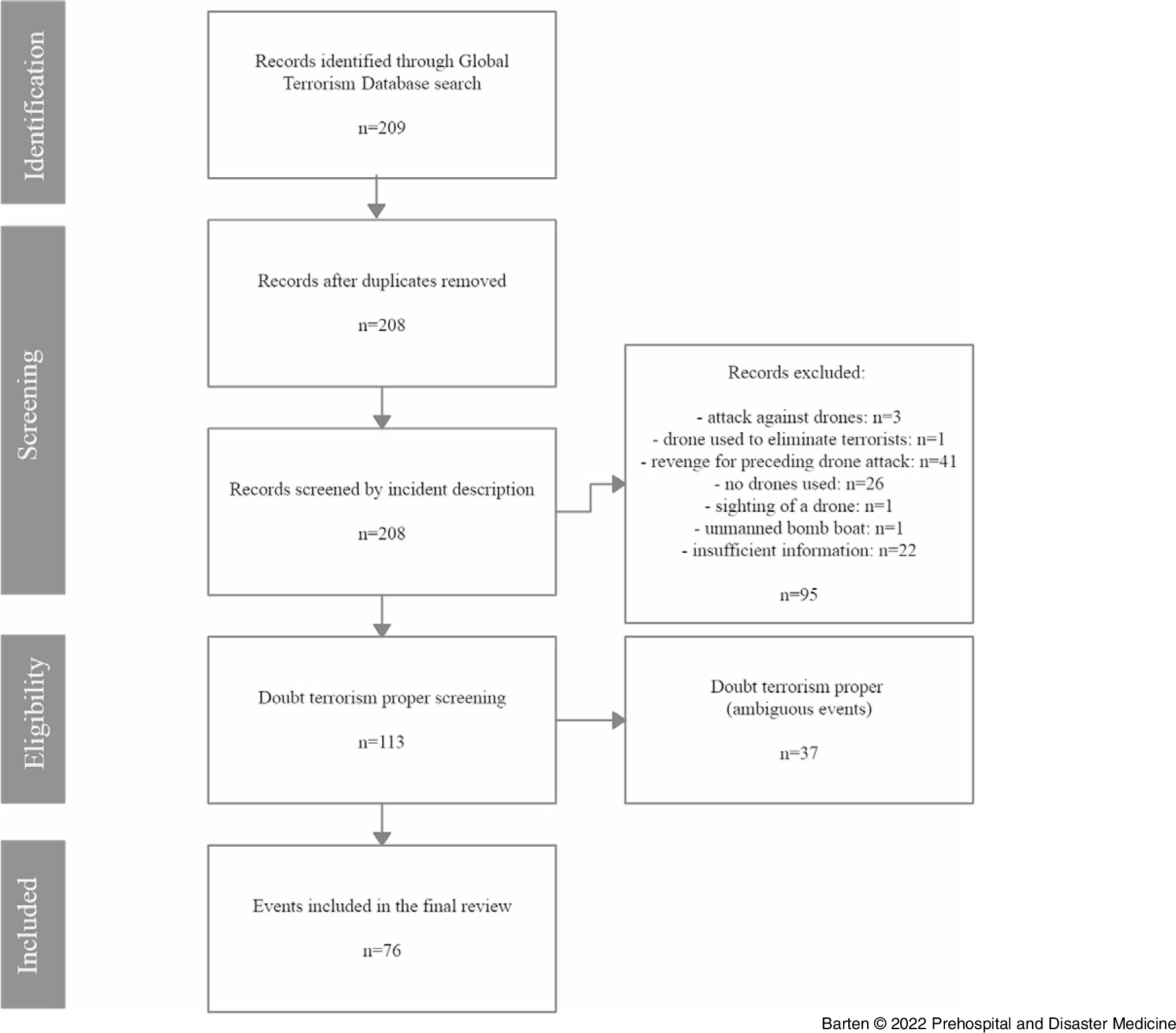
The following events were excluded: three events described attacks against drones, one event used a drone to eliminate terrorists, 41 events were revenge attacks for a preceding drone attack, 26 events recorded “no drones used.” One event described the sighting of an UAV, one event concerned an unmanned bomb boat, 22 events had insufficient information, and one event was duplicated. Thirty-seven events were classified as “Doubt Terrorism Proper” and were also excluded. This left 76 events which met the inclusion criteria (Figure 1).
Study PRISMA Flow Chart.
Abbreviation: PRISMA, Preferred Reporting Items for Systematic Reviews and Meta-Analyses.

Forty-seven of the 76 attacks (70%) were successful. All unsuccessful attacks were foiled by defense forces. A total of 50 deaths and 132 injuries were recorded as a result of these events. This equated to 1.09 deaths (range: 0-6) and 2.89 injuries (range: 0-20) per successful attack, and to 0.66 deaths and 1.74 injuries if the unsuccessful attacks are also included.
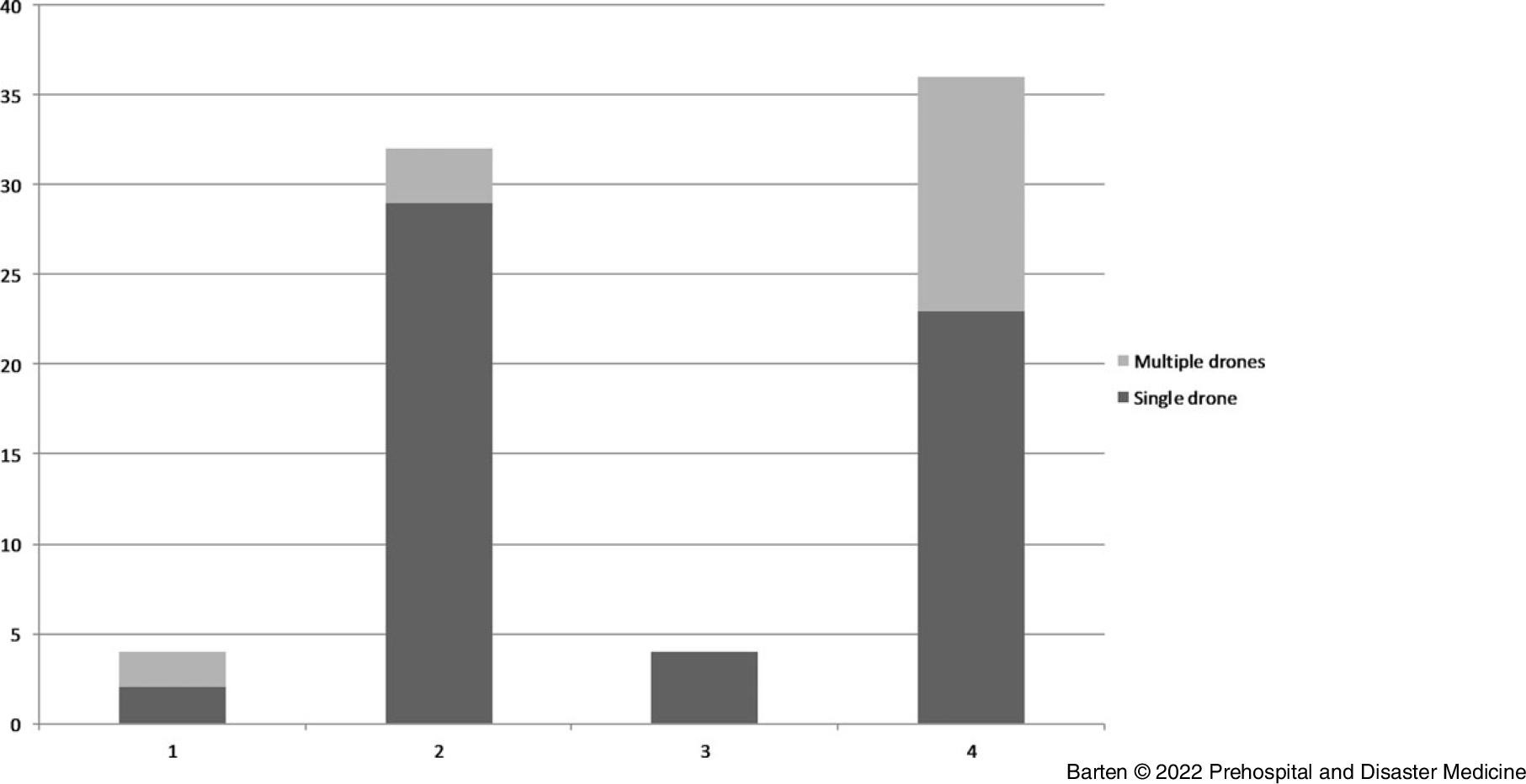
Twenty-seven individually listed events (36%) were related and part of nine coordinated, multi-part incidents. The first drone attack was observed in 2016, and the number of attacks per year varied considerably (2016: four events; 2017: 32 events; 2018: four evens; and 2019: 36 events; Figure 2). The number of UAVs used was unknown in eight attacks. There were 88 drones used in the remaining 69 attacks, which equates to a mean of 1.28 per attack (range: 1-5). Multiple UAVs were used in 17/69 (22%) attacks, but the exact number was unknown in seven attacks (GTD reported “multiple drones;” Figure 2).
Single versus Multiple Drone Attacks.

The mean number of UAVs used in the remaining 10 attacks was 2.9 (range: 2-5). Death and injury rates were not associated with the number of UAVs used.
The type of UAV used was unknown in 67 attacks. A Qasef-2K drone was used in eight attacks and a Samad-2 long-range UAV in one attack.
All of the 76 UAV attacks concerned bombing/explosions. In one of the events, the weapon type was classified as chemical but the incident description lacked further information. Remote trigger weapons were used in 59 events, projectiles in four events, grenades in two events, and dynamite/TNT and “other explosive” was used once.
The UAV attacks targeted private citizens and property (45%); airports and aircraft (14%); unknown (13%); business (9%); military (5%); government (4%); utilities (more specific gas/oil installations; 4%); nongovernmental organizations (3%); terrorist/non-state militia (1%); and police (1%). One of the targets was classified as “business/medical unit.”
Ninety-seven percent of the attacks (74 events) occurred in the world region “Middle East & North Africa,” including Iraq (37 events), Saudi Arabia (27 events), Yemen (five events), and Syria (four events). There was one attack in Myanmar (world region “Southeast Asia”) and one attack in Afghanistan (“South Asia”). Perpetrators were linked to Islamic State of Iraq and the Levant (ISIL) in 38 attacks and to Ansar Allah in 33 attacks.
Discussion
The use of UAVs as a novel delivery platform for conventional weapons is on the rise. Their relative ease of use and low cost of purchase, coupled with an ability to be remotely operated and evade detection, makes UAVs an ideal platform to deliver deadly payloads from the air. While the use of UAV-related explosives appears less lethal than traditional explosive attacks (0.66 deaths and 1.74 injuries per UAV attack versus 1.54 deaths and 4.35 injuries per conventional explosive attack), advancing technologies and increasing ability to carry larger payloads over further distances will likely improve UAV lethality over time. Reference Tin, Margus and Ciottone17
Automation and swarming technologies, as well as built-in AI, have the potential to significantly augment the ability for UAVs to create complex coordinated attacks, disrupt medical emergency responses, and inflict higher death tolls. Reference Hambling4,Reference Hambling18,Reference Kallenborn19 Furthermore, the latest generation of hybrid drones can simultaneously operate in air, on ground, and underwater and can be modified and used as a mobile hacking tool in order to execute cyberattacks. Reference Chamola, Kotesh, Agarwal, Gupta and Guizani20,Reference Chen21
While this study only recorded one UAV-related chemical event, previous studies have shown that terrorist use of chemical and biological weapons inflicted significantly higher injury tolls than conventional weapons, and the potential use of UAVs to deliver chemical, biological, radiological, and nuclear (CBRN) weapons is also a discussed concern amongst CTM specialists. Reference Tin, Kallenborn, Hart, Hertelendy and Ciottone2,Reference Kallenborn and Bleek22
Despite advances in counter-drone technologies, hardened targets such as military personnel and critical infrastructure such as airports and health care facilities are likely more vulnerable to UAV attacks than conventional human/car delivery systems which can often be effectively countered by simple boulder installations, security check points, and roadblocks. Reference Tin, Hart and Ciottone23
While drone detection (radio frequency analysis, acoustic sensors, optical sensors, and radar) and counter-drone technologies (geofencing, radio frequency jamming, net guns, and birds of prey) are also rapidly emerging, a foolproof system does not currently exist. Reference Chamola, Kotesh, Agarwal, Gupta and Guizani20,Reference Sayler24,25
From a clinical perspective, drone strikes were associated with more severe (mainly amputation) injuries and more additional surgeries than injuries caused by other explosive weapons. Reference Heszlein-Lossius, Al-Borno, Shaqqoura, Skaik, Melvaer Giil and Gilbert26 Furthermore, the use of drone-released novel munitions such as Dense Inert Metal Explosives has created new and devastating injury patterns rarely seen previously. Reference Haq27–Reference Hambling29
The UAVs offer terrorist organizations a low cost, high success rate platform to inflict harm that can, with advancing technologies, potentially significantly disrupt and also target emergency responses. This has led to urgent calls to prioritize the review of UAV technologies and health care risk mitigation strategies.
Limitations
The GTD is a comprehensive record of global terrorist events. It is maintained by the National Consortium for START and is the basis for other terrorism-related measures, such as the Global Terrorism Index. Reliance wholly on the GTD is partially mitigated by confirmation with other lay sources and searches for other online searches, but if there are incidents not reported in the GTD, this could limit the veracity of the findings. Furthermore, the lack of a universally agreed definition of the term terrorism can create inconsistencies between databases in the labelling of such events. Reference McCann30 It is also worth noting that state-endorsed attacks do not fall under the definition of terrorism in the GTD.
Conclusion
The use of UAVs as a novel delivery platform for conventional weapons is on the rise. Seventy-six terrorist attacks using drone technology were recorded, killing 50 and injuring 132 people. While the use of UAV-related explosives appears less lethal than traditional explosive attacks, advancing technologies, increasing ability to carry larger payloads further distances, and the possibility of UAVs to disperse CBRN weapons will likely increase UAV lethality in the near future, raising concerns amongst CTM specialists.
Conflicts of interest
The authors declare no competing interests.