Introduction
Awareness can be defined as “a reasonable or realistic perception or appraisal of a given aspect of one's situation, functioning or performance, or of the resulting implications, which may be expressed explicitly or implicitly” (Clare et al., Reference Clare, Rowlands, Bruce, Surr and Downs2008). The Levels of Awareness framework (Clare et al., Reference Clare, Markova, Roth and Morris2011) considers awareness as operating at four levels of increasing complexity: sensory registration, performance monitoring, evaluative judgment, and meta-representation. The first of these, sensory registration, reflects the capacity to direct attention to an object, leading to an appraisal and/or a behavioral response. Awareness at this sensory and perceptual level can be observed in the form of responses to internal (e.g. pain), social (e.g. being touched by another person), and environmental (e.g. noise) cues. Preserved reactions to sensory stimuli of this kind are evident in people with very severe dementia (Norberg et al., Reference Norberg, Melin and Asplund1986; Asplund et al., Reference Asplund, Norberg, Adolfsson and Waxman1991; Magai et al., Reference Magai, Cohen, Gomberg, Malatesta and Culver1996).
The extent to which such reactions are expressed, and observed by others, is likely to be influenced by environmental factors. Many care settings offer non-stimulating environments with a lack of activity and occupation (Ballard et al., Reference Ballard2001), while extraneous noise and activity may render other settings over-stimulating. Exposure to environments that are either over- or under-stimulating could result in self-withdrawal and reduced responsiveness (Norberg et al., Reference Norberg, Melin and Asplund1986; Magai et al., Reference Magai, Cohen, Gomberg, Malatesta and Culver1996). Greater responsiveness has been documented where care staff played familiar music or sang to residents while providing morning care (Götell et al., Reference Götell, Brown and Ekman2003), and training staff to be sensitive to non-verbal emotional signals in people with dementia resulted in short-term improvements in positive affect for residents (Magai et al., Reference Magai, Cohen and Gomberg2002). Thus, the way in which care staff interact with residents may impact on residents’ responsiveness.
Care staff tend to distinguish between residents according to whether they are viewed as responsive or non-responsive to interpersonal interactions (Magai et al., Reference Magai, Cohen, Gomberg, Malatesta and Culver1996), and those seen as non-responsive may receive less contact, hence reinforcing a decline in expressive behavior.
Enabling care staff to identify signs of awareness and responsiveness in the most severely impaired residents, and provide appropriate stimulation, should both enhance the extent to which care staff are able to meet residents’ needs and encourage greater responsiveness in the residents, hence improving resident well-being. The present study aimed to establish whether training care staff to observe and identify signs of awareness at the sensory and perceptual level in residents with severe dementia resulted in improved quality of life for residents. Evidence from staff training studies suggests that to be effective, training needs to include both instruction aimed at development of skills and support for the practical implementation of these skills (Kuske et al., Reference Kuske, Hanns, Luck, Angermeyer, Behrens and Riedel-Heller2007). Therefore, a combination of instruction, group supervision, and individual support was used, and staff carried out their own observations of residents between sessions using the AwareCare observational measure that was developed in a prior phase of this project (Clare et al., Reference Clare, Woods, Whitaker, Wilson and Downs2010; Reference Clare2012).
Methods
Design
This was a pilot cluster randomized controlled trial (for protocol see Clare et al., Reference Clare, Woods, Whitaker, Wilson and Downs2010) involving eight privately owned care homes in North Wales, UK, six specializing in dementia care and two providing care for a mixed group of older people. The care homes were randomized in pairs of similar size and type to either intervention or control conditions. In the intervention condition, care staff received training and supervision, and observed selected residents according to a pre-defined schedule using a structured observational measure. Care homes in the control condition received no input; however, a shorter version of the training was offered once all trial procedures and assessments had been completed. Ethical approval was provided by the appropriate University and National Health Service ethics committees. The trial was registered with Current Controlled Trials, reference ISRCTN59507580.
Power calculation
A sample size of eight care homes with ten residents per home included in the study was selected in order to achieve 90% power to detect an intra-class correlation (ICC) of 0.3 under the alternative hypothesis for the measure development study (Clare et al., Reference Clare2012) when the ICC under the null hypothesis is zero using an F-test with a significance level of 0.05 (Walter et al., Reference Walter, Eliasziw and Donner1998; Hintze, Reference Hintze2004). This proposed sample size would be sufficient to yield estimates of the standardized effect size of the change from baseline in either arm of the trial with a 95% confidence interval of ±0.3.
Participants
Participants were residents with severe dementia and staff caring for these residents. Care homes were eligible for inclusion if they offered the potential to recruit 10 people with severe dementia and up to 10 members of the care staff. Inclusion criteria for participants were that they should have severe dementia, meeting criteria for stage 6 or 7 on the Functional Assessment Staging (FAST; Reisberg, Reference Reisberg1988), and no, or only very limited, verbal communication, indicated by an inability to clearly verbally communicate needs and wishes, with speech either very circumscribed and limited to single words or phrases, or completely absent. Potential participants were identified, and relatives notified, by care home managers. As participants were unable to provide informed consent on their own behalf, in each case a relative was approached by the research team to act as a personal consultee as outlined in the provisions of the UK Mental Capacity Act (2005), advising on whether or not the resident should be included in the study. Inclusion criteria for care staff were that the staff member should be a permanent employee, working 15 hours or more per week, who had been in post for at least two months. Recruitment took place between 14 July 2010 and 25 July 2011. Data collection was completed on 16 November 2011.
Measures
All measures were administered at baseline and at follow-up assessment. The primary outcome measure was quality of life for the person with dementia. This was assessed with the Quality of Life in Late-stage Dementia scale (QUALID; Weiner et al., Reference Weiner, Martin-Cook, Svetlik, Saine, Foster and Fontaine2000). Quality of life was rated independently by a family member (where available) and by a member of the care staff.
Secondary outcomes for the person with dementia were:
• Well-being, assessed by the Positive Response Schedule (PRS; Perrin, Reference Perrin1997).
• Cognitive functioning, assessed by the Guy's Advanced Dementia Schedule (GADS; Ward et al., Reference Ward, Dawe, Procter, Murphy and Weinman1993).
• Behavior, assessed by the self-care, sensory ability, and mobility sub-scales of the Behavioural Assessment Scale of Later Life (BASOLL; Brooker et al., Reference Brooker, Sturmey, Gatherer and Summerbell1993). In the measure development phase of the project, these proved to be the relevant and informative sub-scales and hence these sub-scales were selected for the current study.
Secondary outcomes for the staff member were:
• Well-being, assessed by the Maslach Burnout Inventory (MBI; Maslach et al., Reference Maslach, Jackson and Leiter1996).
• Psychological distress, assessed with the General Health Questionnaire, 12-item version (GHQ-12; Goldberg, Reference Goldberg1992).
• Attitudes toward people with dementia, assessed by the Approaches to Dementia Questionnaire (ADQ; Zimmerman et al., Reference Zimmerman2005a; Reference Zimmerman2005b).
At the level of the care home, the secondary outcome of quality of care was captured by the Dementia Care Practitioner's Assessment (DCPA; Lintern et al., Reference Lintern, Woods and Phair2000).
The researchers made field notes throughout the course of their work in the homes. Blinded researchers carrying out post-intervention assessments made field notes documenting their current impressions in relation to what they had observed when conducting initial assessments in the same homes. Prior to unblinding, the researchers were asked whether they could detect which homes were in the intervention condition and, if so, to say which they thought these were and why they thought this was the case.
Intervention
The intervention took place over an eight-week period in each care home. In weeks 1 and 2, care staff in each home participated in two 90-minute training sessions led by an accredited trainer. In these sessions, staff were encouraged to consider the nature of residents’ awareness, were introduced to, and instructed in the use of, the AwareCare observational measure of awareness in severe dementia (Clare et al., Reference Clare2012), and were given guidance on developing their skills in communicating with severely impaired residents. Staff practised using the measure between the two sessions. In session 2, staff members were each given an individualized schedule for observing during weeks 3 to 8 a small number of designated residents who were participating in the study. Each staff member was asked to carry out six 10-minute observations per week according to this schedule (a total of 36 observations over the six-week period), in public areas of the home while residents were awake, and to participate in fortnightly group supervision sessions. Individual support was offered weekly between sessions and where staff members were unable to attend scheduled sessions. In the final meeting at the end of the intervention period, the researchers asked the participating care staff about their perceptions of the intervention, and recorded responses in their field notes. These responses were later collated and examined to identify common themes. In some cases, responses could be linked to comments made at an earlier stage and recorded in the field notes, demonstrating changes in staff perceptions over the course of the intervention.
Procedure
In the baseline assessment, residents were assessed with the GADS and observed for two 30-minute sessions with the PRS. Wherever possible a relative of the resident was interviewed to provide background information about the resident and proxy ratings on the QUALID. In each case, a staff member was interviewed to obtain ratings on the BASOLL and the QUALID. Staff members also completed the ADQ, MBI and GHQ-12. Care practice was observed for 6 hours in each home using the DCPA. Paired block randomization was carried out independently of the investigators by the trials unit, using Excel, on completion of the baseline assessments in each pair of homes. Blinding was maintained as follows: the researcher conducting follow-up assessments was blind to condition; family members were not informed of the allocation; the trainer and the care staff were not blinded; and the statistician conducting data analyses was blind to condition until blinded results had been approved by the investigators. Following randomization, the allocation was communicated to one of the study researchers, who then coordinated the implementation of the intervention in the intervention home, and triggered the follow-up assessment in both homes when this was completed. This follow-up assessment, in which all measures were repeated, was conducted by another, blinded researcher. Once all follow-up assessments were completed, a shortened version of the training was offered to homes in the control condition.
Data analysis
Resident outcomes were assessed using analysis of co-variance (ANCOVA) adjusting for baseline score, age, gender, length of time in the care home, and severity of dementia as indicated by FAST stage (6 vs. 7). Staff outcomes were assessed using ANCOVA adjusting for baseline score, age, gender, qualification level, and first language (English/Welsh vs. other). Care home outcomes were assessed using ANCOVA adjusting for baseline score. Staff engagement with the intervention was indexed by the number of resident observations that each staff member recorded. Significance at 5% and Cohen's d effect sizes are reported. Means and standard deviations or medians and ranges are quoted as appropriate for the degree of skew observed in the variable. ICCs were calculated for resident and staff measures. In the protocol (Clare et al., Reference Clare, Woods, Whitaker, Wilson and Downs2010), we proposed to conduct a confirmatory factor analysis to test the hypothesized factor structure emerging from the prior measure development phase; however, during the development of the AwareCare measure (Clare et al., Reference Clare2012) it became clear that the structure of the data required a different approach than the anticipated exploratory factor analysis and reliability study, and hence neither the factor analysis nor the planned calculation of the specified ICC (an index of the reliability found in the measurement study) were conducted in the current study. An additional assessment not specified in the protocol was made, and is reported, calculating ICCs to measure the effect of within-home clustering on scores for each measure reported, for the purpose of assisting power calculations if the AwareCare measure were to be used in a future cluster randomized trial.
Results
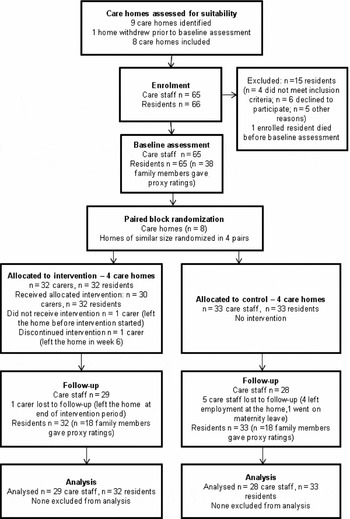
Eight care homes participated, involving a total of 66 residents and 65 care staff members; one enrolled resident died before baseline assessment. Four care homes were allocated to the intervention and four to the control condition. This resulted in 32 residents and 32 staff taking part in the intervention, with 33 residents and 33 staff allocated to the control condition. All 65 of these residents remained in the study at follow-up. In three instances, particular resident measures were not administered, resulting in missing scores for the GADS and PRS. Estimates for these measures were imputed as other measures were available at that time-point. In all other cases, all the relevant resident or staff measures were administered, and no individual items of data were missing. In total, eight staff members were lost to follow-up. In the intervention group, three staff members left employment at the home, one before the intervention started, one in week 6 and one at the end of the intervention but prior to the follow-up assessment. In the control group, four staff members left employment at the home and one went on maternity leave. These eight staff members were not included in the analysis, leaving a total of 57 care staff, 29 in the intervention and 28 in the control condition, for the follow-up assessment. Proxy ratings of quality of life were provided at both time-points by 38 family members, 18 for residents in the intervention condition and 20 for residents in the control condition. A CONSORT chart is shown in Figure 1.
AwareCare CONSORT chart.

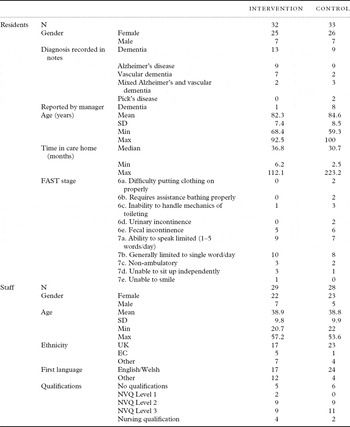
Table 1 gives descriptive details of the residents and care staff. A chi-square test indicated that the two resident groups differed significantly in terms of numbers at FAST stages 6 and 7 (χ 21 = 5.30, p = 0.021), with the intervention group more severely impaired. This was taken into account in subsequent analyses.
Descriptive information about the participating residents and care staff

FAST = Functional Assessment Staging; NVQ = National Vocational Qualification.
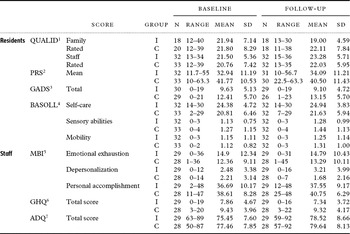
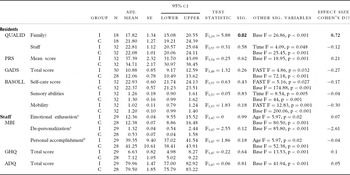
Raw scores on resident and staff measures at each time-point are summarized in Table 2. ANCOVA results are shown in Table 3. For the resident measures, ANCOVA adjusting for baseline score, age, gender, length of time in the care home, and FAST stage (6 vs. 7) yielded a significant improvement at follow-up in family-rated (F1,29 = 5.88, p = 0.022, effect size 0.72), but not staff-rated (F1,57 = 0.31, p = 0.58), quality of life in the intervention but not the control condition. There were no other significant differences. For the staff measures, ANCOVA adjusting for baseline score, age, gender, qualification level, and first language revealed no significant differences at follow-up. For both resident and staff measures, baseline score was a key predictor of outcome. ICCs for resident measures ranged from 0.06 for PRS to 0.11 for family-rated QUALID. ICCs for staff measures ranged from 0 for MBI sub-scales and ADQ to 0.06 for GHQ.
Unadjusted descriptive statistics for the resident and care staff measures at baseline and follow-up

Higher scores indicate: 1 = poorer quality of life; 2 = greater frequency of responses; 3 = better cognitive function; 4 = greater difficulty in given area; 5 = greater degree of relevant factor; 6 = poorer health; 7 = more positive attitude.
QUALID = Quality of Life in Late-stage Dementia scale; PRS = Positive Response Schedule; GADS = Guy's Advanced Dementia Schedule; BASOLL = Behavioural Assessment Scale of Later Life; MBI = Maslach Burnout Inventory; GHQ = General Health Questionnaire, 12-item version; ADQ = Approaches to Dementia Questionnaire; I = intervention; C = control.
ANCOVA model incorporating baseline score, age, gender, length of time in care home and FAST stage for residents, and baseline score, age, gender, qualification level and first language for staff

†Small sample size; not all participants had family members. ††Negative indicates effect in favor of control.
a Square root transformation used. bSquare transformation used.
QUALID = Quality of Life in Late-stage Dementia scale; PRS = Positive Response Schedule; GADS = Guy's Advanced Dementia Schedule; BASOLL = Behavioural Assessment Scale of Later Life; MBI = Maslach Burnout Inventory; GHQ = General Health Questionnaire, 12-item version; ADQ = Approaches to Dementia Questionnaire; FAST = Functional Assessment Staging; I = intervention; C = control; Base = baseline score for that measure.
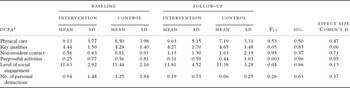
Raw scores on the DCPA are summarized in Table 4. ANCOVA adjusting for baseline score did not indicate any significant differences at follow-up.
Summary of DCPA scores at baseline and follow-up for intervention and control homes, and ANCOVA results covaried with baseline score

a Higher score indicates greater frequency of observed behavior or quality. DCPA = Dementia Care Practitioner's Assessment.
The number of observations recorded by each of the 29 care staff ranged from 3 to 36 (median 25). The extent to which observations were completed varied across the four homes. The median number of observations completed by each staff member was 8 by the 5 staff in Home 1 (range 3–14), 22 by the 8 staff in Home 2 (range 10–29), 27 by the 9 staff in Home 3 (range 12–36), and 35 by the 7 staff in Home 4 (range 30–36).
On completion of the intervention, care staff gave their views on the training sessions and observational work. Three key issues emerged. First, the training was felt to be informative and educational, and enabled some carers to feel more effective in their role:
“I feel I can do my job better now through learning how to observe individuals.”
“I have become more observant towards clients. I have worked in the care sector for 15 years and the training has made me become more aware of things.”
Second, staff found it beneficial to spend time with residents in this way as it allowed for greater understanding of their behavior and responses:
“I enjoyed having more one-to-one time with the residents.”
“I'm always very busy and so it was nice to have some time with the residents. I have enjoyed having the opportunity to sit and observe residents properly and to be able to pick up on little things about the residents.”
Third, staff who had previously viewed residents as non-responsive learned that it was possible to detect a range of responses. One staff member, when given her observation schedule during initial training, commented “Oh no, I've got to observe [resident] but she doesn't do anything, that's gonna be well boring.” At the final meeting at the end of the intervention, the same staff member described how she could now tell that this resident showed awareness:
“Well, when I was giving [resident] her breakfast the other morning, she didn't like it. . . her facial expression, I could tell she wasn't keen.”
Similarly, another staff member who commented initially “Oh, I've got a boring one [resident], look” spoke of this resident as follows in the final meeting:
“She does respond. . . A lot of eye movements and turning her head, and if you suddenly touch her and she hasn't seen you she jumps. . . She is very aware.”
The blinded researchers, on completion of the post-intervention assessments, surmised correctly which homes had been allocated to the intervention, based on the observations recorded in their field notes. They provided examples of positive changes, whether in the behavior of participating carers, the responses of participating residents, or in the environment generally, that they had observed in the intervention homes:
“The staff appear to be working more flexibly and trying different techniques.”
“[Carer] appeared to spend more time having conversations with the residents than at baseline. He also appeared to be very sensitive towards the residents’ behaviour.”
“There were several new textured cushions around the home which staff would give residents to hold. . . there were more ‘activity’ objects dotted around the rooms.”
“[Carer] commented that [resident] is more aware than people think.”
“[Resident] was given a textured cushion and a soft toy to hold. . . [resident] was given a magazine to hold and look through. . . when she had the magazine she was more alert.”
Observations about the control homes were less positive:
“There were no observable changes in this home. Care staff still had very little time to spend interacting with the residents.”
“[Resident] was frequently shouting out and the staff told her to be quiet and asked her why she was shouting.”
“[Carer] was observed on several occasions actively ignoring residents. . . only when absolutely essential did he communicate with the residents.”
Discussion
This is the first intervention study to address staff perceptions of residents’ awareness and examine the implications for resident quality of life. Care staff received training in identifying signs of awareness and responsiveness in people with severe dementia, and carried out structured observations of residents in order to develop their skills in this domain, supported by group supervision. The findings demonstrate that family members perceived an improvement in resident quality of life where residents were involved in the intervention, with a medium effect size (Cohen, Reference Cohen1988), although staff perceptions of resident quality of life did not change. No other changes were identified in resident or staff measures or in general care practices within the homes. Nevertheless, care staff were able to make effective use of the AwareCare measure (Clare et al., Reference Clare2012) to observe residents and identify signs of awareness, and staff who participated in the intervention completed on average over 20 ten-minute observation sessions, felt that they benefited from the training, appreciated the opportunity to devote time to observing and interacting with individual residents, and gained a greater understanding of residents’ behavior and responsiveness.
An important question is why family members perceived an improvement in resident quality of life while care staff did not. Evidence shows that resident, staff, and observer perspectives on resident quality of life are distinct, and possibly unique, and are influenced by different factors (Edelman et al., Reference Edelman, Fulton, Kuhn and Chang2005). Family members were blind to group allocation, but it is possible that some family members when visiting their relative saw that the observations were taking place, and hence felt their relative was receiving more attention from staff; family members may also have found that care staff spoke more positively about their relative. Staff in the intervention group did demonstrate an altered view of some residents, commenting on how they had learned to identify the way in which individual residents expressed awareness, but this did not translate into improved ratings of quality of life. Possibly staff members did not see their own increased sensitivity as contributing directly to resident quality of life, instead giving more weight to other factors which were not addressed by the intervention. It has been suggested that staff may be unable to make accurate estimates of residents’ quality of life as they become more impaired and less able to communicate verbally, and that the criteria on which staff base their judgments may not be those that are most salient from the point of view of residents (Edelman et al., Reference Edelman, Fulton, Kuhn and Chang2005) or indeed family members. Each perspective can be seen as independent and unique (Crespo et al., Reference Crespo, de Quiros, Gomez and Hornillos2012). This intervention appears to have addressed factors that are salient for family members.
Blinded researchers reported positive changes in the homes that had been intervention homes, but the observed changes in the intervention homes were not reflected in improvements in secondary outcomes. It is possible that the outcome measures were not sufficiently sensitive to the kinds of changes brought about by the intervention. It is also possible that the intervention would need to be more potent, more extensive in duration and scope, in order to impact significantly on the well-being of participating staff members or on the overall quality of care provided by the whole staff group for the full complement of residents.
There are many challenges associated with conducting research in residential care settings (Moniz-Cook et al., Reference Moniz-Cook1998; McCabe et al., Reference McCabe, Davidson and George2007), and this study was not exempt from these. One home had to withdraw just before the baseline assessments were scheduled as the manager and staff learned that the home was to be sold, and a replacement home had to be found. Within the four homes allocated to the intervention, the extent of engagement with the intervention differed considerably. In Home 1, despite initial appearances, management support proved to be lacking; some staff were keen to participate, but few were able to engage effectively, and few observations were conducted. Absence due to illness affected the involvement of some participating staff, and other changes in the homes, unrelated to the study, may have had an impact. Despite considerable differences between the homes, the ICCs for the outcome variables were low, indicating that variability in individual scores was attributable only to a limited extent to the differences between the homes. These data will be of use in the design of future cluster randomized trials in care home settings, as they give a good indication of how large a design effect will be required to account for clustering in the sample size and power calculations.
A number of limitations must be taken into account. First, this was a pilot study involving only eight care homes. While the target number of homes was achieved, the number of residents and staff participating in the study within these homes was lower than initially intended. Care home managers were readily able to identify residents who met inclusion criteria for the study, but it was sometimes difficult to contact family members living at a distance and to identify a personal consultee. Some of the participating residents did not have a family member who visited regularly and who could complete the QUALID; nevertheless, there was a significant effect of intervention on this measure, even when the predictive nature of the baseline score was accounted for, which suggests the effect is robust. Residents in the control group were significantly less impaired than those in the intervention group, and this may have affected the extent to which change could be identified in the intervention homes, although severity of impairment was included as a covariate in the statistical analyses in order to control for this. While all residents initially recruited into the study remained in the study on completion, there was some attrition among the care staff, reflecting the sometimes transient nature of employment in care settings (Donoghue, Reference Donoghue2010); however, the overall attrition rate of 12% was not unduly high for this kind of study (Zimmerman et al., Reference Zimmerman2005b; Visser et al., Reference Visser, McCabe, Hodgson, Buchanan, Davison and George2008). Although the researchers were blind to group allocation, their observations during the follow-up assessment enabled them to surmise correctly which homes had been allocated to which condition; nevertheless, this does not appear to have introduced a positive bias into their ratings.
The study has demonstrated that care staff are able to use the AwareCare measure effectively as a practice tool, and that they feel this is useful in enabling them to identify and understand residents’ responses. The study has further shown that where this is done, family members perceive an improvement in the quality of life of their relatives. Enhancing quality of life of people with dementia should be a central goal for all involved in dementia care, and represents a particular challenge with regard to residential care settings. It is hoped that future research will build on the findings of this pilot study to further examine ways of improving perceived quality of life for people with severe dementia in residential care settings.
Conflict of interest
None.
Description of authors’ roles
L. Clare contributed to study concept, study design, project leadership and management, interpretation of data, and drafting of the manuscript. R. Whitaker contributed to study design, oversight of data management and statistical analysis, reporting of results, and review of the manuscript. R. T. Woods contributed to study design, identification of care homes, interpretation of data, and review of the manuscript. C. Quinn carried out trial management, identification of care homes, data collection, support for intervention in allocated homes, interpretation of data, and review of the manuscript. H. Jelley carried out data collection, support for intervention in allocated homes, and review of the manuscript. J. Woods carried out staff training and supervision and review of the manuscript. Z. Hoare contributed to randomization, data analysis and reporting, and review of the manuscript. M. Downs contributed to study design and review of the manuscript. B. A. Wilson contributed to study design and review of the manuscript.
Acknowledgments
We would like to thank all the residents, family members, and care staff who participated in this study, and the managers of the care homes for their invaluable assistance. Particular thanks are due to Tracey Lintern, David Ingledew, Vivienne Davies-Quarrell, Marilla Pugh, Helen Hughes, Ann Chapman, Mike Higgins, and Shaun Morrissy for their contributions to the project advisory group and expert panel. This study was funded by the Medical Research Council (UK) grant 85327.