General factors are found in the measurement of many human traits. Although these factors have most frequently been found in measures of cognitive ability, they are not limited to cognitive ability. They have been observed in such diverse content domains as assessment center ratings, emotional intelligence, personality, psychomotor performance, beliefs and attitudes, occupation and work, and leadership. In addition to general factors, specific factors (s) may be present. They are indicators of reliable variance that is not shared with other tests or measures. If the nongeneral variance is shared with another test or measure, it is called a group factor (Gorsuch, Reference Gorsuch1983; Spearman, Reference Spearman1927).
For about a century, the phenomenon of general factors has been observed and described with reference to “positive manifold.” Spearman (Reference Spearman1904) observed that when he gave tests of several different kinds of cognitive ability, the correlations among the scores were positive. He called this effect “positive manifold.” The definition of positive manifold comes from mathematics, particularly topology, and Euclidean space. The general factor (g) leads to positive manifold among cognitive test scores. Positive manifold among cognitive tests implies that scores from a mathematics test, for example, will correlate positively with those from tests assessing other cognitive abilities such as reading comprehension, spatial reasoning, or vocabulary. As a result, it does not matter which particular tests are used to assess general cognitive ability (g) because they will be highly correlated despite differences in content. Spearman (Reference Spearman1923) termed this the “indifference of the indicator.” This has implications for the interpretation of scores both operationally and as constructs.
The measurement of g has been well established, as well as the greater predictiveness of g for educational, training, and work outcomes compared with the predictiveness of specific abilities (s); see, for example, Jensen (Reference Jensen1998). Ree, Teachout, and Carretta (Reference Ree, Teachout, Carretta, Svantek and Mahoney2013) recently summarized the empirical evidence surrounding the ongoing debate of the measurement of g and s and their prediction of educational, training, and work outcomes. Ree et al. (Reference Ree, Teachout, Carretta, Svantek and Mahoney2013) concluded that (a) g is pervasive—it can be measured consistently, accurately, and routinely across a wide range of tests, situations, and methods, whereas s cannot; (b) the amount of g measured in test batteries is frequently 50% or more of the reliable variance, whereas the amount of s is usually much less than 10%, and when considered, the relative magnitude of g is often 5 times greater than s; and (c) g is the predominant source of predictiveness in cognitive ability tests (e.g., Jensen, Reference Jensen1998), with s often adding little to no prediction of educational, training, and job performance outcomes (e.g., Brown, Le, & Schmidt, Reference Brown, Le and Schmidt2006; Ree & Earles, Reference Ree and Earles1991a, Reference Ree and Earles1992; Ree, Earles, & Teachout, Reference Ree, Earles and Teachout1994).
Purpose
The purpose of this article is to expand on previous research by documenting the prevalence of general factors beyond that of cognitive ability, across a variety of human abilities and psychological constructs, and to explore reasons why this may be so. The term dominant general factor (DGF) is introduced to represent the magnitude of general factors within numerous content domains. Usually the developers of measures seek to assess several unique or independent characteristics but instead create DGFs. The finding of general factors extends to almost all areas of measurement.
DGFs are not limited to ability testing but are pervasive throughout the measurement of human characteristics. We address fundamental questions that emerge about the explanations for DGFs and about why they appear to be so prevalent. Finally, we identify future research needs and implications for practice.
Constructs
Constructs should be measureable, interpretable from empirical observation, and distinguishable from other constructs. Construct validity (Cronbach & Meehl, Reference Cronbach and Meehl1955) is concerned with the extent to which an instrument measures what it purports to measure. We often identify specific factors as the constructs in which we are interested, but this ignores the arguably more important role of DGFs.
Factor analysis is frequently used to detect and interpret factors in measured human characteristics. Factors are often interpreted as measuring the construct. Often the naming of these factors is subjective and is dependent on the apparent content. This naming on the basis of apparent content is frequently supported by consensus rather than by empirical evidence. For example, retranslation procedures (Smith & Kendall, Reference Smith and Kendall1963) are often used, whereby subject matter experts match items or questions to constructs on the basis of their content. Even when empirical evidence is presented, interpretation frequently depends on judgments or consensus.
In the naming of factors, emphasis is given to specific content. As has been pointed out before (Ree & Carretta, Reference Ree, Carretta, Cooper and Robertson1998), the verbal factor in cognitive test batteries is a combination of a specific verbal and a DGF, in this case g. In all cases studied, the proportion of variance accounted for by the specific factors is very small, and the proportion accounted for by the general factor is very large. This may lead to misinterpretation of factors and their relation to constructs. The role of specific factors may be overemphasized, and the role of general factors may be under emphasized.
What Is a Dominant General Factor?
Once we have defined the domain of interest, it is important to determine the extent to which a DGF accounts for the variances in and relationships among the various specific factors or constructs subsumed within the domain. Two criteria must be met to define a DGF. First, a DGF must come from the largest source of reliable variance. Second, every variable measuring the construct must be influenced by the DGF. A DGF accounts for more variance than does any other factor and influences each observed variable. A DGF is different from a group factor (Carroll, Reference Carroll1993; Thurstone, Reference Thurstone1938) because it influences all variables, whereas a group factor does not influence all variables.
It is important to note that a DGF does not mean that only a single factor is present. A DGF does not imply a single-factor solution, nor does it imply that the instrument measures only one factor. In a factor analysis, the DGF might be accompanied by several other factors. These specific factors usually account for small proportions of the variance. The presence of a DGF means that the general factor is the dominant source of variance.
Artifacts in a study that reduce variance such as unreliability and range restriction can have the effect of reducing the apparent magnitude of a DGF. It is likely that many of the estimates of DGFs to follow are downwardly biased because of unreliability and range restriction that reduces reliable variance.
Evidence Supporting the Prevalence of DGFs in Human Characteristics
Taxonomy of human performance
As a point of departure, we used Fleishman's taxonomy of human performance (Fleishman, Quaintence, & Broedling, Reference Fleishman, Quaintance and Broedling1994). Fleishman (Fleishman et al., Reference Fleishman, Quaintance and Broedling1994) proposed that this taxonomy be used in lieu of developing unique ability labels in order to improve interpretation of results and communication among researchers and practitioners. Taxonomies have driven research and practice for decades and have contributed to the content fallacy (Murphy, Reference Murphy2009a). It is interesting to note that Fleishman's taxonomy did not include any general factors. Further, when used as a basis for job or task analysis, these taxonomies do not include general factors, and general factors are therefore not found in the results of the job or task analysis. In addition, we consider personality, leadership, and other domains not included in Fleishman et al. (Reference Fleishman, Quaintance and Broedling1994).
Content and labels
It is important that the content and labels used also represent the underlying meaning once the data have been analyzed. If the analytic results support the label and content, then the construct validity of the measures is supported. If the analytic results do not support the label and content, then the construct validity of the measures is not supported and the researcher(s) should reexamine the underlying theory and substance of the measures.
Clearly, the labels used to represent content and content validity are not necessarily a reliable indicator of what is being measured (Murphy, Reference Murphy2009a, Reference Murphy2009b), nor are the labeled constructs valid indicators of the source of prediction of performance (Murphy, Deckart, Kinney, & Kung, Reference Murphy, Deckart, Kinney and Kung2013). When developing a new construct, few researchers look for a general factor (Drasgow, Nye, Carretta, Ree, Reference Drasgow, Nye, Carretta and Ree2010; Kyllonen, Reference Kyllonen1993; Stauffer, Ree, & Carretta, Reference Stauffer, Ree and Carretta1996). Evidence suggests they should. The labeling of factors should match what the data say. The labeling should be consistent with the magnitude of the sources of variance contributing to the factor.
Estimating DGF Percentages
DGFs can be identified via an eigenvalue analysis of the correlation or covariance matrix by comparing “variance accounted for” and confirming that the factor influences all of the variables. For example, if we were considering 10 variables and the common factor accounted for more variance than did any other factor, a plurality of the variance, this factor satisfies the first criterion to be considered dominant. If the common factor also influenced all of the variables, then it satisfies the second criterion to be considered general. (See Jackson, Reference Jackson2003, Table 17.4, p. 397). Further, Jackson (Reference Jackson2003) went on to demonstrate that the extraction of unrotated principal components is the optimal method for explaining variance.
The use of principal components posits no model but is an orthogonal decomposition that will reproduce the correlation and covariance matrix perfectly. There can be no issue of model accuracy. Several methods of estimating a DGF converge on the same values (Ree & Earles, Reference Ree and Earles1991b; Reeve & Blacksmith, Reference Reeve and Blacksmith2009).
As the average correlation among the scores increases, the magnitude of the general factor increases. It is primarily through the off-diagonal covariances that the DGF emerges. In order to create a general factor, the sum of the covariances must be large.
Examples of Constructs With a DGF
DGFs are found in many constructs. Although the labeling of constructs may improve communication, it reinforces the idea that the constructs are independent. Three detailed examples with DGFs are psychomotor ability, job performance, and personality.
Psychomotor Ability
Over decades, Fleishman and his colleagues (Fleishman, Reference Fleishman1964, Reference Fleishman and Singer1972, Reference Fleishman1975; Fleishman et al., Reference Fleishman, Quaintance and Broedling1994) developed a detailed taxonomy of human abilities that could be used in research and practice involving human characteristics. The intent was to provide standardized definitions and labels for these abilities, to facilitate communication and interpretation of results. For example, Fleishman and his colleagues identified several psychomotor abilities in terms of control, precision of movement, and speed. These are arm–hand steadiness, control precision, finger dexterity, manual dexterity, multilimb coordination, rate control, reaction time, response orientation, speed of limb movement, and wrist–finger speed.
Researchers have examined the construct validity of several psychomotor constructs from Fleishman's taxonomy. Despite a desire to measure specific abilities, careful specification, and expert agreement, in each case a DGF for psychomotor ability was found that accounted for between 39% and 42% of the variance (Carretta & Ree, Reference Carretta and Ree1997; Ree & Carretta, Reference Ree and Carretta1994a; Wheeler & Ree, Reference Wheeler and Ree1997). In no instance did the specific abilities account for as much variance as the DGF, and most of the remaining variance was accounted for by unreliability.
Job Performance
Campbell, McHenry, and Wise (Reference Campbell, McHenry and Wise1990) proposed a multidimensional theory of job performance. Eight dimensions that were considered to be broad and generalizable across jobs were proposed. These are job-specific task proficiency, non-job-specific task proficiency, written and oral communication task proficiency, effort demonstration, personal discipline maintenance, peer and team performance facilitation, supervision/leadership, and management/administration. Campbell, McCloy, Oppler, and Sager (Reference Campbell, McCloy, Oppler, Sager, Schmitt and Borman1993) described these as the highest order factors that could be useful and did not include a general factor of job performance.
Contrary to the assertion of Campbell et al. (Reference Campbell, McCloy, Oppler, Sager, Schmitt and Borman1993), several studies have provided evidence for a general factor of job performance (Carretta, Perry, & Ree, Reference Carretta, Perry and Ree1996: Lance, Teachout, & Donnelly, Reference Lance, Teachout and Donnelly1992; Viswesvaran, Schmidt, & Ones, Reference Viswesvaran, Schmidt and Ones2005). DGFs were found that accounted for between 59% and 92%, with a meta-analytic finding of 60% (Viswesvaran et al., Reference Viswesvaran, Schmidt and Ones2005).
Personality
Personality researchers have arrived at the consensus that traits can be organized reliably into five broad domains called the Big Five (Costa & McCrae, Reference Costa and McCrae1992). These are Neuroticism, Extraversion, Openness, Agreeableness, and Conscientiousness. Recently, several studies have demonstrated the existence of a broad general factor of personality that accounts for between 43% and 50% of the variance in Big Five measures (Mathias, Reference Mathias2011; Musek, Reference Musek2007; Rushton & Irwing, Reference Rushton and Irwing2008). Just (Reference Just2011) and Rushton and Irwing (Reference Rushton, Irwing, Chamoroo-Prernuzic, von Stumm and Furnham2011) have provided reviews of the literature regarding the existence of a general factor of personality in normal personality. A general factor of personality also has been observed in psychopathology (Caspi et al., Reference Caspi, Houts, Belsky, Goldman-Mellor, Harrington, Israel and Moffitt2014).
Additional Examples
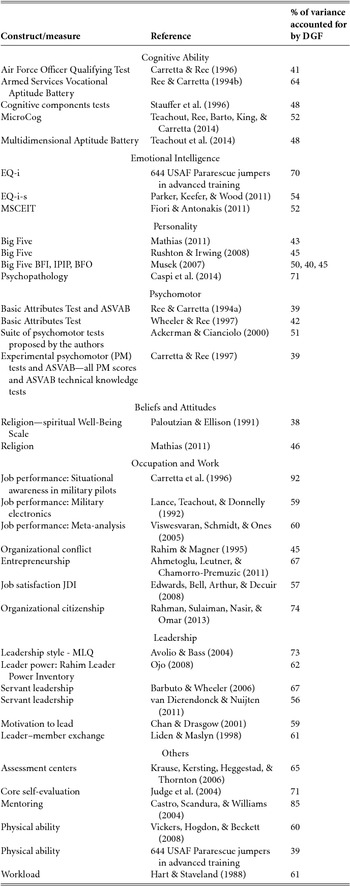
Table 1 contains results of studies across a broad range of constructs, including cognitive ability, emotional intelligence, personality, psychomotor performances, beliefs and attitudes, occupation and work, and leadership. We examined each study to determine the extent to which the measures used had a DGF. The DGF values in the table range from 38% to 92%. They tend to be underestimates because most studies did not correct for unreliability and range restriction. It should be noted that we found several other studies for other constructs (e.g., political attitudes) in the literature, in which a DGF was reported. They are not included here because data were not available to allow us to estimate the proportion of variance accounted for by the DGF.
Examples of Studies Finding a Dominant General Factor

Note. The percentage of variance accounted for by the dominant factor may be underestimated because of reliability and range restriction artifacts. ASVAB = Armed Services Vocational Aptitude Battery; BFI = Big Five Inventory; BFO = Big Five Observer; DGF = domain general factor; EQ-i = Emotional Quotient Inventory; EQ-i-s = Emotional Quotient Inventory – short form; IPIP = International Personality Item Pool; JDI = Job Descriptive Index; MSCEIT = Mayer-Salovey-Caruso Emotional Intelligence Test; MLQ = Multifactor Leadership Questionnaire; USAF = United States Air Force.
Why DGFs Exist
The finding of general factors extends to almost all areas of measurement. Usually the developers and constructors of these measures seek to assess several unique or independent characteristics but instead create DGFs. Fundamental and overarching questions emerge: Why, when we want to measure several different factors, do we wind up measuring a strong general factor with much weaker specific factors? What causes the DGFs, and why are they so pervasive? There are several potential answers to these questions.
Possible Reasons for DGFs
The possible reasons for DGFs can be considered to fall into two broad categories. Some are methodological or statistical, whereas others rely on psychological theory. We present examples from both categories and recognize that other reasons may exist. All of these reasons may contribute to positive manifold.
As defined earlier, positive manifold means that all of the variables are positively correlated. It can be argued that a group of measures in a battery does, in fact, reflect several facets of performance that can and should be distinguishable, despite the fact that the facets are intercorrelated. However, positive manifold guarantees a general factor, although not always a dominant one.
Methodological or statistical reasons for DGFs
We discuss two reasons that may contribute to the observance of DGFs. These are the reliance on coefficient alpha and the common method variance.
Reliance on coefficient alpha
The use of Cronbach's coefficient alpha contributes to the production of DGFs. Maximizing coefficient alpha requires strong correlations among items. (Cortina, Reference Cortina1993; Crocker & Algina, Reference Crocker and Algina1986; Cronbach, Reference Cronbach1951; Stanley, Reference Stanley and Thorndike1971). If we rely on methods of estimating reliability that place an emphasis on having strong correlations among items, this will increase general factor strength within the set of items on that measure. Parallel forms (Stanley, Reference Stanley and Thorndike1971) do not require high item intercorrelations and therefore would be preferable for measures expected to have notable contributions from specific sources of variance.
Coefficient alpha also can play a role in increasing the dominance of a DGF in multiple aptitude batteries. For example, increasing coefficient alpha in each subtest of a multiple aptitude battery of cognitive tests would lead to a stronger dominant factor (g) for the entire battery. A similar result is likely for measures of other “multidimensional” constructs.
Common method variance
The most accepted definition of the phenomenon is that some aspect of the measurement process causes the correlations or causes the correlations to be inflated between measures. Less often the construct of common method variance has been investigated within single measures. If method variance exists, it must exist in the scores of the measure even when the measure is not being correlated with other measures.
Podsakoff, MacKenzie, Lee, and Podsakoff (Reference Podsakoff, MacKenzie, Lee and Podsakoff2003) reviewed common method variance models and offered solutions for estimating the magnitude of the effects and either eliminating or mitigating them. Recognizing the potential for common method variance should not be reason for discounting the existence of DGFs.
If common measurement method affects one source of variance in scores (tests, questionnaires, or other measures), it should affect all sources. That is, each source of variance should show the effects of measurement method. A study investigating the effects of measurement method on all sources of score variance, including the common factors, group factors, and specific factors should be performed. Failure to find measurement method variance in group or specific factors casts doubt on its influence.
Finally, the logical fallacy of affirming the consequent might play a role. This fallacy can be explained in these statements:
1. Common method variance causes DGFs.
2. A DGF is found.
3. Therefore, common method variance must be the cause.
Statements 1 and 2 are true but the conclusion, Statement 3, is not necessarily true. The conclusion can be false even when Statements 1 and 2 are true. This is because common method variance was not asserted to be the only sufficient condition for the DGF. There may be other causes for the DGF. Only a properly conducted study with appropriate statistical methods and corrections of artifacts can reveal the real cause or causes.
Psychological theory reasons for DGFs
There also are several psychological explanations for the occurrence of DGFs. These include the halo effect, the impression management process, the theory of mutualism, the use of cognitive constructs and conceptual structure, and the construct development process.
Halo effect
The well-known halo effect can be considered. According to this effect, the evaluation of one construct influences (covaries with) the evaluation of another. This has been evident in ratings since Thorndike (Reference Thorndike1920). The halo effect would give rise to a DGF as the covariances among the evaluations become nonzero. Asch (Reference Asch1946) demonstrated the effect of one personality trait on overall ratings. This would give rise to the halo effect. His work was clarified by Mensh and Wishner (Reference Mensh and Wishner1947), who showed that context had an effect on ratings and thus on the halo effect. Cooper (Reference Cooper1981) noted that the magnitudes of the intercategory correlations are due to both true intercorrelations between categories and illusory theories held by raters regarding the extent to which categories are related to one another. Cooper identified several cognitive distortions that increase the perseverance of illusory covariance theories. These include the confirmatory bias in hypothesis testing, the relative ease of making “same” or “similar” judgments as opposed to “different” judgments, the tendency to discount information that is inconsistent with existing impressions, and the failure to adequately attend to hit rates.
Impression management
Impression management is the process by which people try to influence the perceptions that others have of them. This includes social settings (Goffman, Reference Goffman1959) and the workplace (e.g., Giacalone & Rosenfeld, Reference Giacalone and Rosenfeld1989; Rosenfeld, Giacalone, & Riordan, Reference Rosenfeld, Giacalone and Riordan2002). Impression management may contribute to DGFs in situations in which surveys or subjective measures are used. For example, subordinates’ impression management may influence performance ratings through supervisors’ liking of and perceived similarity to subordinates (Wayne & Liden, Reference Wayne and Liden1995). When impression management tactics are successful, the behavior is more likely to be perceived as consistent. Therefore, the relationships among dimensions of behavior are greater and the DGFs are more likely.
The theory of mutualism
A reason advanced for the production of positive manifold that leads to DGFs is expressed in the theory of mutualism (Raijmakers, Reference Raijmakers2006; van der Maas et al., Reference van der Maas, Dolan, Grasman, Wicherts, Huizenga and Raijmakers2006). According to the theory of mutualism, specific intellectual abilities exist in the developing human, but with growth and maturation, the use of these specific abilities causes them to merge, thereby giving rise to positive manifold. Positive manifold in other human characteristics such as attitudes, values, personality, psychomotor ability, leadership, or job performance have not been included in the mutualism theory. The theory remains untested by rigorous methods, and the truth or falseness of the theory does not change the existence of positive manifold in people from childhood to adulthood.
Cognitive constructs and conceptual structure
Several theories have been proposed concerning the way people organize ideas and concepts. According to prototype theory (Rosch, Reference Rosch1975) and exemplar theory (Nosofsky & Stanton, Reference Nosofsky and Stanton2005), people make judgments to place new ideas and objects into categories by comparing them with examples already stored in memory. These theories rely on the same general cognitive process in which a new stimulus is encountered, a concept in memory is triggered, a judgment of similarity occurs, and a categorization decision made. Prototype theory suggests that a new stimulus is compared with a single prototype in a category, whereas exemplar theory suggests that the new stimulus is compared with several exemplars. It could be that only a few things are important in the way an individual categorizes new ideas and objects and that these few important concepts associate our responses to concepts related to them. There seems to be a process tying apparently separate beliefs together.
Construct development process
Why do we often observe that theoretically independent dimensions of a construct are, in fact, correlated? In the development of a construct such as job satisfaction, containing several dimensions in which each dimension is related to the construct, we should expect these dimensions to be correlated. We often overestimate the distinctions among related dimensions and constructs and underestimate their overlap or relatedness. This presents a dilemma because we intend the dimensions to be distinct while at the same time being part of the broader construct. As suggested earlier, the results of the data analysis should determine the relative extent to which the measures are consequences of the general or specific sources of variance.
Implications of Prevalence of DGFs
Interpretation of factors
An important implication is the interpretation of factors and, by extension, the value of these factors for theory and practice. Ree and Carretta (Reference Ree, Carretta, Cooper and Robertson1998) noted that factors are frequently named for a small source of variance and interpreted as that source exclusively. This misinterprets the supporting evidence and the meaning of the measures.
Validity
Consider a situation in which a researcher wants to test the theory that verbal ability adds to spatial ability in the prediction of job performance. Tests called Spatial Reasoning and Verbal Ability were administered to an appropriate sample, and a measure of job performance was obtained for that sample. Next, two regression equations were estimated. The first equation would be consistent with the theory that specifies that spatial ability predicts job performance, and the second equation specifies that spatial ability and verbal ability predict job performance. Finding a difference in the predictiveness of these two equations could lead to the conclusion that verbal ability incremented spatial ability in the prediction of job performance. This, in most instances, would be incorrect. The increment in validity could be due to the added reliable variance of the DGF, which contributes to both spatial reasoning and verbal ability (Ree & Carretta, Reference Ree and Carretta2011).
Profiles
The interpretation of profiles (a combination of abilities and other characteristics) is made more difficult by the presence of DGFs. It is most problematic in a sample when the DGF is large and the specific sources of variances are small and when there is reduction in reliability (Gulliksen, Reference Gulliksen1950: Eq. 5, p. 124) because of restriction of range.
In personality profile interpretation, the difference between scores is usually evaluated. For example, a high value in a particular facet of personality and a low value of another facet may be consistent with a specific personality type. Using several differing regression equations to predict job performance in job families is similar. Differences in profiles and differences in regression equations may be due to interpreting the differences in reliability and variances in the measurement of the DGF rather than the measurement of specific characteristics.
Risks of Ignoring DGFs
Ignoring DGFs poses risks and potential problems for both theory and practice. For theory, ignoring DGFs may place an overemphasis on the magnitude, influence, and importance of the specific factors. The specific factors make a relatively small contribution, once the DGF is removed as a source of variance. It may also mislead researchers on the substance and meaning of constructs as the labels for specific constructs continue to be used. This leads to the pursuit of more research evidence to support the existence of specific factors and their role as either predictors or criteria in organizational research and practice. At the same time, an underemphasis or, worse, the omission of the DGF diminishes its value and misses opportunities for better understanding of psychological constructs. Comparison of constructs that are mostly the same DGF (e.g., a verbal measure versus a quantitative measure) is misleading and perpetuates poor procedures.
In practice, analyses that fail to seek DGFs support the myth of the importance of narrow constructs compared with more general constructs. Because they contain more reliable variance than specific factors, DGFs are likely to act like the general factor in cognitive ability and have greater predictiveness than specific factors. Valuable resources may be expended trying to develop or use specific measures that are likely to be less predictive than DGFs are.
Whereas research on cognitive ability and the evidence presented here demonstrates the veracity and pervasiveness of the DGF, there has been less deliberate research in other content domains that illustrate these points. One exception over the last decade is in the area of core self-evaluations. Judge, Erez, Bono, and Thoresen (Reference Judge, Erez, Bono and Thoresen2002, Reference Judge, Erez, Bono and Thoresen2003) developed and tested the validity of a 12-item measure called the Core Self-Evaluation Scale, which is based on four specific, well-known traits: self-esteem, generalized self-efficacy, locus of control, and emotional stability. Results indicated a reliable single factor, termed a core factor, with validity for predicting job satisfaction, job performance, and life satisfaction equal to an optimal weighting of the four specific traits. Further, in a review of research on core self-evaluations (Judge, Van Vienen, & De Pater, Reference Judge, Van Vianen and De Pater2004), evidence suggested that the four core traits are highly related; are loaded on a single unitary factor; and, it is important to note, “have dubious incremental validity controlling for their common core” (p. 325). Essentially, Judge et al. (Reference Judge, Erez, Bono and Thoresen2002, Reference Judge, Erez, Bono and Thoresen2003) created a DGF using four reliable, related traits about “the self.” Although we have provided substantial evidence on the existence, prevalence, and importance of DGFs, a concerted research effort is needed to further examine the implications and consequences of DGFs for theory building and practice.
Conclusions
DGFs are common in our field and are well represented by the first unrotated principal component. As discussed, a variety of methodological and statistical factors and psychological mechanisms contribute to the existence and influence of DGFs. Research that ignores DGFs by treating correlated facets of a domain as if they were distinct and uncorrelated can lead to a number of errors and misinterpretations.
A most important need is the investigation of data for the existence of DGFs. What remains after a DGF has been estimated is the specific reliable variance and error. If this analysis is not conducted, then we use different labels and descriptions for each of the dimensions. This leads to using each dimension as a predictor or criterion in various aspects of research and practice. In contrast, a large DGF and small specific factor for each of the dimensions potentially changes the underlying theory and meaning of the measures. Any construct thought to be multidimensional should be investigated for the presence and magnitude of a DGF. Doing so would facilitate understanding of the construct or measurement instrument.
If a DGF has been found, it is important to determine whether the DGF is the source of all or part of the relationship between the instrument and the dependent variable. In both bivariate and multiple correlation/regression, the reliable variance is weighted by the regression coefficient. The weight is based on the relationship or partial relationship of the independent variable(s) with the dependent variable. The major source of variance in the independent and dependent variables has a great influence on the sign and magnitude of the weight. Often the prediction is wrongly attributed to the specific source of variance. For example, when a test of verbal ability is used to predict job performance, it is the specific verbal source of variance that is frequently given credit for prediction. However, it is very likely that the DGF is predictive and not the specific verbal factor (Jensen, Reference Jensen1998; Ree & Earles, Reference Ree and Earles1991a, Reference Ree and Earles1992; Ree et al., Reference Ree, Earles and Teachout1994). Studies to determine the predictiveness of DGFs compared with specific factors should be conducted across a wide variety of constructs and content areas.
Efforts to develop multidimensional measures require that the causes of DGFs be determined so that developers can act on these causes, to either increase or decrease their influence. This requires a concerted effort to evaluate the reasons for DGFs from among those offered or those that are due to other causes.
Further, we must temper our understanding of the nature of multidimensionality to reflect DGFs. If we name factors taking into account only the specific variance, we sow the seeds of confusion and misunderstanding. To advance the scientific understanding of constructs, we should strive for clarity of the sources of variance and clarity of meaning.
Finally, developers of tests and other measurement instruments ought to recognize the sources of variance for the constructs measured by the instrument. Inferences and claims about what is being measured should be consistent with the sources of variance. These inferences and claims should be presented proportionally to the magnitude of the sources of variance.