


Introduction
The experience of having a child diagnosed with type 1 diabetes mellitus (T1DM) can negatively impact on the parents’ well-being and trigger posttraumatic stress symptoms in the parents. For example, Landolt et al. (Reference Landolt, Ribi, Laimbacher, Vollrath, Gnehm and Sennhauser2002) reported that 24% of mothers and 22% of fathers to met criteria for PTSD 6 weeks after their child was diagnosed with T1DM, according to symptoms on a self-report scale (PDS; Foa, Cashman, Jaycox and Perry, 1997). A further study used the Structured Clinical Interview for Diagnosis (SCID; Spitzer, Williams, Gibbon and First, Reference Spitzer, Williams, Gibbon and First1990) PTSD module to assess mothers up to 5 years after their child's diagnosis and found that, at the time of the interview, 15% of participants still met criteria for a partial diagnosis of PTSD and 10% met criteria for the full diagnosis (Horsch, McManus, Kennedy and Edge, 2007). T1DM has much in common with other chronic conditions, such as cancer, which have been reported to trigger posttraumatic stress disorder (PTSD) (e.g. Best, Streisand, Catania and Kazak, Reference Best, Streisand, Catania and Kazak2001; Kazak et al., Reference Kazak, Stuber, Barakat, Meeske, Guthrie and Meadows1998; Manne, DuHamel, Gallelli, Sorgen and Redd, Reference Manne, Du Hamel, Gallelli, Sorgen and Redd1998; Manne, DuHamel and Redd, Reference Manne, DuHamel and Redd2000; Manne et al., Reference Manne, Du Hamel, Ostroff, Parsons, Martini and Williams2004).
Landolt et al. (Reference Landolt, Ribi, Laimbacher, Vollrath, Gnehm and Sennhauser2002) argue that PTSD is a viable model for understanding the impact of a child's T1DM diagnosis on their parents and that diabetes-related events have the potential to meet Criterion A-1 (DSM-IV-TR; APA, 2000) for the diagnosis of PTSD (see Horsch et al., 2007 for a detailed discussion). First, the very onset of T1DM may be traumatizing, as the child often becomes acutely ill and may be hospitalized in an intensive care unit. In such cases parents may be confronted with the threatened death of their child. Second, diabetes may be associated with morbidity, such as episodes of hypo- or hyperglycemia with a potential risk of coma, the possibility of severe long-term medical problems, and shortened life expectancy. Third, parents may be traumatized as a consequence of being responsible for administering injections that are painful for the child and which they may perceive as a threat to the child's physical integrity. The difficult experience of witnessing one's child undergoing aversive medical procedures can result in both acute and persistent PTSD in parents (Manne et al., Reference Manne, DuHamel, Nereo, Ostroff, Parsons and Martini2002). Horsch et al. (Reference Horsch, McManus, Kennedy and Edge2007) looked in detail at what mothers identified as their specific traumatic stressor and found that, although mothers identified a range of different diabetes-related events as the traumatic stressor, the most commonly identified (55% of participants) was the moment when they first heard about their child's diagnosis. The second most frequently reported traumatic stressor was their child having a bad hypo (hypoglycaemia), which can be viewed as an acutely life-threatening event and which could potentially occur at any point in time and repeatedly.
To date, only one study has examined the role of non-cognitive factors in predicting the occurrence of PTSD in parents of children diagnosed with diabetes. In their prospective questionnaire study, Landolt, Vollrath, Laimbacher, Gnehm and Sennhauser (Reference Landolt, Vollrath, Laimbacher, Gnehm and Sennhauser2005) found that the number of preceding life events and PTSD symptoms at 6 months predicted PTSD at 12 months in mothers, whereas in fathers, PTSD severity at 6 months was the only predictor of PTSD severity at 12 months. However, in the broader PTSD literature it has been shown that both non-cognitive variables (trauma severity, psychiatric history, and social support) and cognitive variables (negative cognitive appraisals and dysfunctional cognitive appraisals) predict PTSD in traumatized populations (see Ehlers and Clark, Reference Ehlers and Clark2000 for a review). The current study therefore aimed to investigate the relationship of both non-cognitive and cognitive variables with PTSD in mothers of children recently diagnosed with diabetes. The evidence relating to each of these variables is briefly reviewed below.
“Trauma severity” has been reported to be the most influential predictor of PTSD (e.g. Breslau, Reference Breslau and Yehuda1998). A “dose-response relationship” has often been reported whereby high stressor intensity was associated with higher PTSD rates (e.g. Johnson and Thompson, Reference Johnson and Thompson2008; Ai, Peterson and Ubelhor, Reference Ai, Peterson and Ubelhor2002). However, other studies have failed to find this association (e.g. Ehring, Ehlers and Glucksman, 2006; Kleim, Ehlers and Glucksman, 2007).
A second important non-cognitive factor associated with the risk of developing PTSD after exposure to a traumatic event is the individual's “psychiatric history”; a history of depression, anxiety, substance misuse, personality disorder, childhood physical or sexual abuse, family instability or having a parent who survived the Holocaust have been associated with PTSD (Bremner, Southwick, Johnson, Yehuda and Harney, Reference Bremner, Southwick, Johnson, Yehuda and Harney1993; Engel et al., Reference Engel, Engel, Campbell, McFall, Russo and Katon1993; King, King and Foy, Reference King, King and Foy1996; Solomon, Kotler and Mikulincer, Reference Solomon, Kotler and Mikulincer1988). A third non-cognitive predictor is the degree of “social support”, which has been shown to be negatively correlated with the development and maintenance of PTSD (e.g. Brewin, Andrews and Valentine, 2000).
Given that the development of PTSD cannot be reliably predicted from the severity of the trauma itself (e.g. Ehring et al., Reference Ehring, Ehlers and Glucksman2006), cognitive models of the disorder have been proposed to identify cognitive variables that may help to explain the variability in response to traumatic events. Ehlers and Clark's (2000) cognitive model proposes that PTSD is maintained by a sense of current threat. The model suggests that both negative cognitive appraisals (relating to the trauma and its sequelae) and dysfunctional cognitive strategies contribute to the sense of current threat. The role of negative appraisals in the maintenance of PTSD has been demonstrated in several studies, in both non-medical (e.g. Ehlers and Steil, Reference Ehlers and Steil1995; Dunmore, Clark and Ehlers, 2001; Ehlers, Mayou and Bryant, 2003; Fairbrother and Rachman, Reference Fairbrother and Rachman2006; Mayou, Ehlers and Bryant, Reference Mayou, Ehlers and Bryant2002), and medical contexts (e.g. Agar, Kennedy and King, 2006; Kangas, Henry and Bryant, Reference Kangas, Henry and Bryant2005; Field, Norman and Barton, Reference Field, Norman and Barton2008). Furthermore, some studies reported negative cognitive appraisals to predict more variance in PTSD outcomes than trauma severity variables (Dunmore, Clark and Ehlers, Reference Dunmore, Clark and Ehlers1999; Ehlers, Mayou and Bryant, Reference Ehlers, Mayou and Bryant1998; Steil and Ehlers, Reference Steil and Ehlers2000; Ehring et al., Reference Ehring, Ehlers and Glucksman2006; Ehring, Ehlers and Glucksman, 2008). With regard to dysfunctional cognitive strategies (e.g. thought suppression, cognitive avoidance, and rumination), Ehlers and Clark (Reference Ehlers and Clark2000) suggest that such strategies maintain the sense of current threat in PTSD by directly producing symptoms, preventing change in negative appraisals and preventing change in the nature of the trauma memory. Several studies have demonstrated the role of dysfunctional cognitive strategies in predicting PTSD (e.g. Clohessy and Ehlers, Reference Clohessy and Ehlers1999; Dunmore et al., Reference Dunmore, Clark and Ehlers2001, Ehlers et al., Reference Ehlers, Mayou and Bryant2003, Michael, Ehlers, Halligan and Clark, Reference Michael, Ehlers, Halligan and Clark2005).
The current study used questionnaire measures to investigate the relationship between both non-cognitive and cognitive factors and PTSD symptoms in mothers of children who were diagnosed with T1DM in the last 5 years. We hypothesized that trauma severity and psychiatric history would be positively correlated, and that social support would be negatively correlated with PTSD symptoms. It was also hypothesized that negative appraisals and dysfunctional cognitive strategies would explain variance in PTSD symptoms over and above that contributed by trauma severity, psychiatric history and social support.
Method
Participant consent and recruitment
The sample is the same as reported in Horsch et al. (Reference Horsch, McManus, Kennedy and Edge2007). One hundred and fifty mothers of children under the age of 16 who had been diagnosed with T1DM for at least one month and up to 5 years were identified by consultant paediatricians at two hospitals over a 9 month period. In line with NHS ethical procedures, participants were invited to “opt-in” to the study by contacting the researcher if they were interested in participating in the study.
Measures
The Posttraumatic Stress Diagnostic Scale (PDS; Foa, Reference Foa1995; Foa et al., Reference Foa, Cashman, Jaycox and Perry1997). The PDS is a widely used self-report measure of PTSD symptoms that provides a measure of PTSD symptom severity as well as a diagnosis according to DSM-IV criteria. The PDS has been shown to have high internal consistency (α = .92) and good test-retest reliability (α = .74) (Foa et al., Reference Foa, Cashman, Jaycox and Perry1997). In the present study, participants were specifically requested to rate their current PTSD symptoms in relation to the diabetes-related traumatic stressor that had been identified in the clinical interview (see Horsch et al., 2007 for a detailed description of how the stressor was identified). They were asked to rate how often they experienced each of the PTSD symptoms in the past month, using a 4-point Likert frequency scale ranging from 0 “not at all or only one time” to 3 “five times per week or almost always”. Total scores range from “mild” (≤ 10), “moderate” (≥ 11–20), “moderate to severe” (≥ 21–35) to “severe” (≥ 36). A symptom was rated as present when the item corresponding with the symptom was rated 1 or greater (Foa et al., Reference Foa, Cashman, Jaycox and Perry1997).
Posttraumatic Cognitions Inventory (PTCI; Foa, Ehlers, Clark, Tolin and Orsillo, 1999). The PTCI is a 33-item questionnaire measuring negative cognitive appraisals of a trauma and its sequelae on three subscales: Negative Cognitions about Self (21 items); Negative Cognitions about the World (7 items); and Self-blame (5 items). Each statement is rated according to the extent of agreement ranging from 1 “totally disagree” to 7 “totally agree”. The PTCI has good factor congruence, internal consistency, reliability, convergent and criterion-related validity and sensitivity and specificity (Foa et al., Reference Foa, Ehlers, Clark, Tolin and Orsillo1999). Participants were specifically instructed to complete the PTCI in relation to the previously identified diabetes-related traumatic stressor.
Responses to Intrusions Questionnaire (RIQ; Clohessy and Ehlers, Reference Clohessy and Ehlers1999; Ehring, Frank and Ehlers, Reference Ehring, Frank and Ehlers2007). The RIQ is a 17-item questionnaire measuring the use of dysfunctional cognitive strategies in response to intrusive memories of a trauma that has been validated in previous studies and shown to have good psychometric properties (Ehring et al., Reference Ehring, Ehlers and Glucksman2006; Kleim et al., Reference Kleim, Ehlers and Glucksman2007). Participants completed the PTCI in relation to the previously identified diabetes-related traumatic stressor. The RIQ consists of three subscales: Thought suppression (e.g. “I try to erase the memory of the event”) (items 1–6); Rumination (e.g. “I dwell on how the event could have been prevented”) (items 7–14); and Numbing (e.g. “I drift off into a world of my own”) (items 15–17). Participants rated the extent to which they utilized each of the strategies in the last week from 0 “never” to 3 “always”. A sum score was calculated for the total scale and mean scores for the subscales.
Social Provisions Scale (SPS; Russell and Cutrona, Reference Russell, Cutrona, Jones and Perlman1987). The SPS is a 24-item questionnaire measuring perceived social support according to the model of social support by Weiss (Reference Weiss and Rubin1974) and consists of six subscales: Guidance (advice or information); Reassurance of Worth (recognition of one's own competence, skills and value by others); Social Integration (a sense of belonging to a group that shares similar interests, concerns and recreational activities); Attachment (emotional closeness from which one derives a sense of security); Nurturance (the sense that others rely upon one for their well-being); and Reliable Alliance (the assurance that others can be counted upon for tangible assistance). The extent of agreement with each of the statements is rated from 1 “strongly disagree” to 4 “strongly agree”. The SPS has been shown to have good validity and reliability (Russell, Cutrona, Rose and Yurko, Reference Russell, Cutrona, Rose and Yurko1984).
Demographic and medical information
Demographic information was collected as part of the interview, and medical information in relation to the child with diabetes was obtained from medical notes as an index of “severity” of the traumatic stressor. The medical information used was (i) the number of days the child spent in hospital at the time when traumatic stressor occurred and (ii) the HbA1C (Glycosylated haemoglobin A1C) index, which reflects integrated diabetic control over the 6–8 week period before traumatic stressor occurred. HbA1C test results are expressed as percentages, with 3.0% – 6.5% considered as normal.
Analysis
Non-parametric analyses were used when the data violated the assumptions of parametric tests. The hypothesis that cognitive factors predicted unique variance in PTSD symptoms over and above that contributed by non-cognitive factors was investigated using a hierarchical multiple linear regression analysis. Following the regression, the standardized residuals were checked for normality using a one-sample Kolmogorov-Smirnov test and for equality of variance using scatterplots.
Results
Sample characteristics
Size and response rate. Of the 150 mothers contacted, 64 (42.4%) responded to the initial letter indicating an interest in the study and, of these, 60 fulfilled the inclusion criteria and participated in the study. Four were excluded because more than 5 years had elapsed since the diagnosis of their child's diabetes.
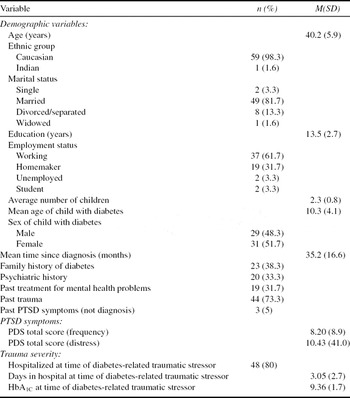
Demographic characteristics. Table 1 shows demographic characteristics and prevalence of PTSD symptoms based on the PDS. The number of weeks between the time of diagnosis of diabetes and the time of the interview was not related to PDS score (r = .046; p = .726). As discussed in Horsch et al. (Reference Horsch, McManus, Kennedy and Edge2007), all participants fulfilled Criterion A-1 and 57 (95%) fulfilled Criterion A-2 in relation to the diabetes-related traumatic event (based on SCID). Participants who did not meet Criterion A did not receive PTSD diagnosis, their symptoms on the PDS were not counted, and they were not included in the analyses (n = 57).
Participants’ demographic characteristics, scores on the Posttraumatic Diagnostic Scale (Foa, Reference Foa1995), and trauma severity indices

Relationship between non-cognitive factors and posttraumatic stress symptomatology
Trauma severity, psychiatric history, history of trauma and past treatment. Table 1 shows demographic data describing trauma severity, psychiatric history (including history of trauma) and past treatment for mental health problems. Whether hospitalization was necessary at the time of trauma did not significantly relate to PTSD symptoms (Mann-Whitney test: U = 253.500; p = .261). Neither the number of days the child spent in hospital at the time of the trauma nor the HbA1c score at the time of trauma were significantly correlated with PTSD symptoms (Pearson correlation: r = .096; p = .233 and r = − .160; p = .111 respectively). Furthermore, no associations between current PTSD symptoms and history of psychiatric problems (U = 331.50; p = .18), history of trauma (U = 289.00; p = .15) or past PTSD symptoms before the child was diagnosed with diabetes (U = 64.00; p = .25) were found.
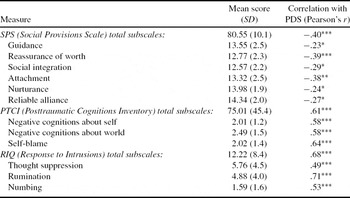
Social support. The mean total and subscale scores of the Social Provisions Scale (SPS) are listed in Table 2. PTSD symptoms were significantly negatively correlated with the SPS total score (r = − .40; p = .001) as well as all SPS subscale scores.
Mean scores (standard deviations) for the Social Provisions Scale (Russell and Cutrona, Reference Russell, Cutrona, Jones and Perlman1987), Posttraumatic Cognitions Inventory (Foa, Ehlers, Clark, Tolin and Orsillo, 1999) and Responses to Intrusions Questionnaire (Clohessy and Ehlers, Reference Clohessy and Ehlers1999), and their correlations with PTSD symptom levels (as measured by the Posttraumatic Diagnostic Scale; Foa, Reference Foa1995)

*p < .05, **p < .01, ***p < .001.
Relationship between cognitive factors and posttraumatic stress symptomatology
Negative cognitive appraisals. The mean total and subscale scores on the PTCI are listed in Table 2. Current PTSD symptoms were significantly correlated with the PTCI total score (r = .61; p < .001) as well as with all PTCI subscale scores.
Dysfunctional cognitive strategies. The mean total and subscales scores on the RIQ are listed in Table 2. Current PTSD symptoms were significantly correlated with the total dysfunctional strategies score as well as all subscale scores of the RIQ.
The role of cognitive factors in explaining variance of posttraumatic stress symptomatology
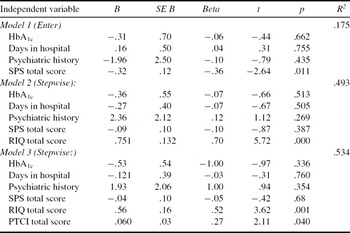
A hierarchical multiple linear regression analysis was carried out with PTSD symptoms as the dependent variable. The following variables were entered in two blocks. The first block consisted of trauma severity variables (days in hospital and HbA1c at time of traumatic stressor), psychiatric history, and social support (SPS total score). The forced entry method was used to ensure that all these non-cognitive variables were included in the analysis and controlled for. The second block consisted of negative cognitive appraisals (PTCI total score) and dysfunctional cognitive strategies (RIQ total score). Here, the stepwise method was used to ensure that only variables that significantly improved the predictive power were included (Tabachnick and Fiddell, Reference Tabachnick and Fidell1989).
For block one, when the non-cognitive variables were entered, perceived social support (SPS total) (t = −2.64; p = .01) produced a significant model (R2 = 0.18, F = 2.807, p = .035). With block two, the RIQ total score (t = 3.62; p < .001) and the PTCI total score (t = 2.105; p = .040) entered as significant predictors and produced a significant model (R2 = .53, F = 9.73, p < .001). SPS total score was no longer a significant predictor (t = −.42, p = .68) (see Table 3).
Summary of hierarchical multiple linear regression analysis for variables predicting PDS severity (n = 57)

Discussion
Negative cognitive appraisals and dysfunctional cognitive strategies were significantly associated with PTSD symptoms. In contrast, of the non-cognitive variables only social support was significantly (negatively) associated with PTSD symptoms. Moreover, the regression analysis showed that the cognitive variables explained variance in PTSD symptoms over and above that contributed by the non-cognitive variables. This provides support for the role of negative appraisals and dysfunctional coping strategies in the maintenance of PTSD, as outlined by Ehlers and Clark's (2000) cognitive model, and is in line with several other studies reporting negative cognitive appraisals to predict equal or more variance in PTSD than trauma severity variables in relation to non-medical (e.g. Ehring et al., Reference Ehring, Ehlers and Glucksman2008) as well as medical trauma (Agar et al., Reference Agar, Kennedy and King2006). The PTCI scores obtained in this study are comparable to the ones reported by Agar et al. (Reference Agar, Kennedy and King2006).
The finding that trauma severity was not associated with PTSD symptoms is consistent with findings from other studies that failed to find an association between injury severity and PTSD (e.g. Landolt et al., Reference Landolt, Ribi, Laimbacher, Vollrath, Gnehm and Sennhauser2002; Ehring et al., Reference Ehring, Ehlers and Glucksman2008) or assault severity and PTSD (Kleim et al., Reference Kleim, Ehlers and Glucksman2007). Similarly, the finding that social support was negatively associated with PTSD symptoms is consistent with previous reports highlighting social support as a protective factor with regards to the development of PTSD (e.g. Brewin et al., Reference Brewin, Andrews and Valentine2000). In the present study, psychiatric history (past psychiatric treatment, history of trauma and past PTSD symptoms) was not significantly associated with PTSD symptoms, as has been the case in some other studies of PTSD samples (e.g. Speed, Engdahl, Schwartz and Eberly, Reference Speed, Engdahl, Schwartz and Eberly1989; Ursano et al., Reference Ursano, Fullerton, Epstein, Crowley, Kao and Vance1999).
While the current study has advantages over previous studies in using a larger sample size and demonstrating the role of cognitive factors in PTSD in parents of children diagnosed with serious illness, it also has significant limitations. First, the relatively low response rate (42.4%), compared with other studies in this area (e.g. Landoldt et al., 2005: 65%; Landoldt et al., 2003: 75.7%) may limit the generalizability of the findings and variance in the sample. The lower response rate is likely due to the opt-in method used for recruitment in the current study, as stipulated by the ethics committee. Second, the cross-sectional design of the study limits the conclusions that can be drawn regarding causality and there is a need for longitudinal studies to confirm the role that cognitive factors play in the development of PTSD in parents of children diagnosed with serious illnesses. Third, the use of a self-report questionnaire to measure symptoms of PTSD is a limitation, as this can lead to over-reporting of symptoms.
However, findings of the present study highlight the importance of integrating medical and psychosocial services for the families of children diagnosed with chronic illnesses. It may be helpful to assess mothers in the early weeks after their child has been diagnosed to establish the need for psychological support, or at least to provide them with information about how to contact services at a later date if they feel it necessary. Another focus of assisting mothers of children with diabetes to adapt to the stress of the illness might be to ameliorate social isolation. This could be achieved by either encouraging mothers to use already existing sources of support, or by providing mothers access to more formal sources of support. The majority of mothers in the study reported that they would value receiving support from other parents of children with diabetes (e.g., a buddy system).
Early detection of PTSD symptoms is important to prevent the development of persistent or chronic PTSD (Ehlers and Clark, Reference Ehlers and Clark2003). The findings of the current study illustrate the importance of negative cognitive appraisals and dysfunctional cognitive strategies in the development of PTSD. This is promising clinically as it indicates that variables that are open to modification (i.e. negative appraisals, dysfunctional strategies) explain variance beyond that explained by unchangeable aspects (e.g. past history, trauma severity), and thus suggests opportunities for intervention. It could also inform a possible screening tool to detect those at highest risk, which could be routinely administered to mothers of children who were recently diagnosed with T1DM and then evaluated for its effectiveness in identifying mothers at risk of developing PTSD.
Future research should not only assess mothers but also fathers of children with T1DM to examine whether a child's illness has a comparable impact on both parents. Furthermore, it would also be useful to examine the broader impact on the family system and to examine the relationship between the parents’ and child's adjustment to the illness; it is probable that better adjustment to the illness in either party is likely to benefit the other, particularly in terms of improved treatment adherence and wellbeing.
Acknowledgements
We would like to thank all participants, and Drs Julie Edge and Raymond Brown for help with recruitment.



Comments
No Comments have been published for this article.