INTRODUCTION
Russia’s medieval history is not supported by a great wealth of written sources. Only a small number of the most significant events appear within historic accounts, and they are barely adequate to support archaeological dating of the many events of the period. Russian archaeology has well-established typological examples, including ceramics and other artifacts, which facilitate the dating of settlements and burials to within a few centuries (Classification in Archaeology 2013). Depending on the kinds of objects (coins, for example) such dating can be even more tightly defined—to within decades. For more precise dating, the dendrochronological method (using tree rings from wooden structures) stands out for its relative accuracy (Chernykh Reference Chernykh and Chernykh2005). Unfortunately, wooden structures are usually only preserved in areas of damp or wet soil in the cultural layer of medieval cities. This makes dendrochronology an unsuitable tool for dating the majority of medieval sites (Chernykh Reference Chernykh and Chernykh2005).
The destruction of Russian cities (fall 1237–spring 1238) as a result of the campaigns of the Batu Khan army was one of the key events in Russian history, to which many archaeological publications are devoted (Karger Reference Karger1958; Darkevich Reference Darkevich1974; Tolochko Reference Tolochko1983). In recent decades, there have appeared a number of critical articles related to the interpretation of archaeological sources that had previously been associated with the Mongol invasion. In some of these (Makarov and Chernetsov 2003; Ivakin and Komar Reference Ivakin and Komar2016; Tomsinskiy Reference Tomsinskiy2016; Waugh Reference Waugh2017) archaeologists raise the question of whether dating based on a typology of ceramics and other items is sufficiently accurate for attributing the destruction of a city to the Mongol invasion, as opposed to later events related to princely strife in the 13th–14th centuries. That is why the possibility of more accurately dating medieval archaeological cultural layers in general, and specifically, the period of the invasion of the Batu Khan army, is highly relevant.
Establishing dates for such sites logically requires not only traditional archaeological methods, but other techniques such as radiocarbon (14C) dating. 14C dating has not gained great popularity in Russia for dating medieval sites. One reason for this is the inaccuracy associated with the methodology during this time period, in which the calibrated ages for the late medieval span several centuries due to plateaus in the calibration curve (Reimer et al. Reference Reimer, Baillie, Bard, Bayliss, Beck, Blackwell, Bronk Ramsey, Buck, Burr, Edwards, Friedrich, Grootes, Guilderson, Hajdas, Heaton, Hogg, Hughen, Kaiser, Kromer, McCormac, Manning, Reimer, Richards, Southon, Talamo, Turney, van der Plicht and Weyhenmeyer2009). Another reason is that the liquid scintillation counting (LSC) technique, widely used in Russian archaeology, gives a less accurate result with greater uncertainty in comparison with 14C dating by accelerator mass spectrometry (AMS), and even some traditional archaeological/typological dating methods. Our work will demonstrate that accurate and precise dates for the Russian medieval period can be obtained, first by using the AMS technique, and second, by applying Bayesian chronological modeling to develop accurate and precise age estimations.
The primary aim of the paper is to conduct AMS dating of human and animal samples from the mass burials of Yaroslavl. The event associated with this grave has an historical date originating from reliable written sources and can be well verified by classical archaeological methods based on the typologies of the artifacts from Yaroslavl. Comparing these two datasets will highlight the reliability of carbon dating for archaeological sites of the medieval period.
Objects Studied
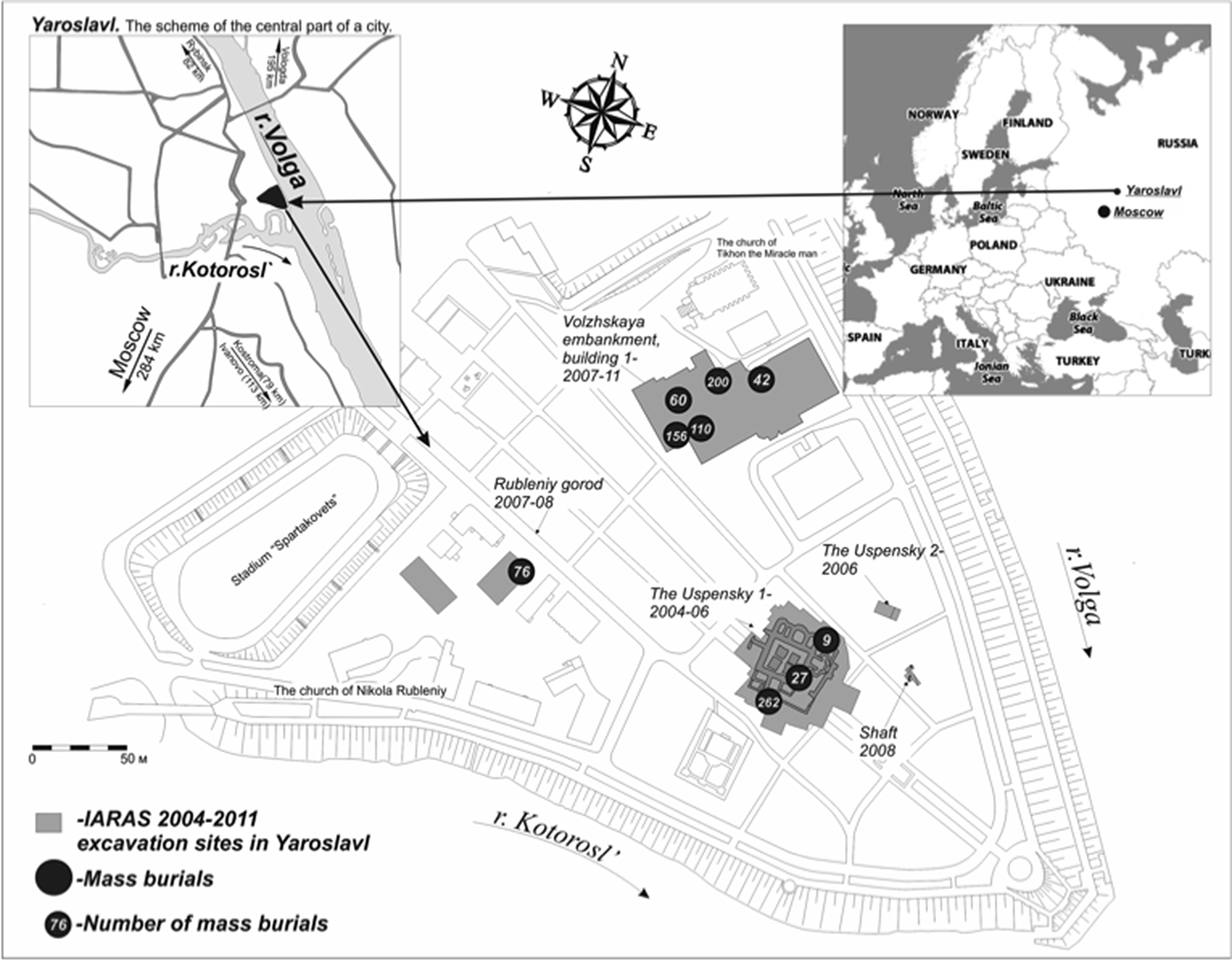
Materials used in this analysis originate from the central district of Yaroslavl, a Russian city in the central part of the country, located 280 km north of Moscow, at the confluence of the Volga and Kotorosli Rivers. The city was founded in the 11th century AD (Figure 1).
Scheme of the Strelka (Confluence) area in Yaroslavl showing the mass burials.

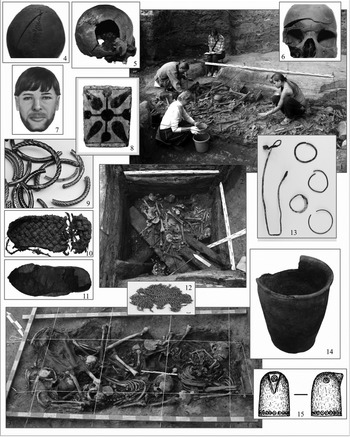
From 2004 to 2017, the Institute of Archaeology of the Russian Academy of Sciences, headed by Dr. A. Engovatova, conducted excavations in different parts of Yaroslavl. During the course of this work, excavations revealed a cataclysmic military defeat: 9 mass graves (Figures 1 and 2) contained the remains of 263 people with numerous stab and hack wounds on their extremities and skulls (Engovatova et al. Reference Engovatova, Osipov, Goncharova and Buzhilova2010, Reference Engovatova, Dobrovolskaya, Antipina and Zaitseva2013; Engovatova Reference Engovatova2019). The Laurentian Chronicle listed Yaroslavl as one of numerous Russian towns that suffered devastating attacks over the winter months of 1238. These manuscript sources provide no further details of the attacks. The poor Chronicle records mention only the Mongol campaign in Yaroslavl (Laurentian Chronicle Reference Chronicle1997: 464). Despite this evidence, other researchers argue that the burials could have been the result of local wars between Russian city-states, typical for Russian history in the 13th–14th centuries. (Laurentian Chronicle Reference Chronicle1997: 490)
Archaeological evidence of the ravage of Yaroslavl in the early 13th century AD: 1–3—collective burials in the course of excavations; 4, 6—traces of saber blows on the cranes from mass burials; 5—traces of blows inflicted with a heavy contact weapon on the cranes from mass burials; 7—the reconstruction of the face of a Yaroslavl citizen from the early 13th century. Finds from the filling of collective burials: 8—stained glass; 9—fragments of glass arm rings; 10—bast shoe; 11—felt insole; 12—fragment of wool fabric; 13—temple rings; 14—ceramic glass; 15—bone chessman/pawn.

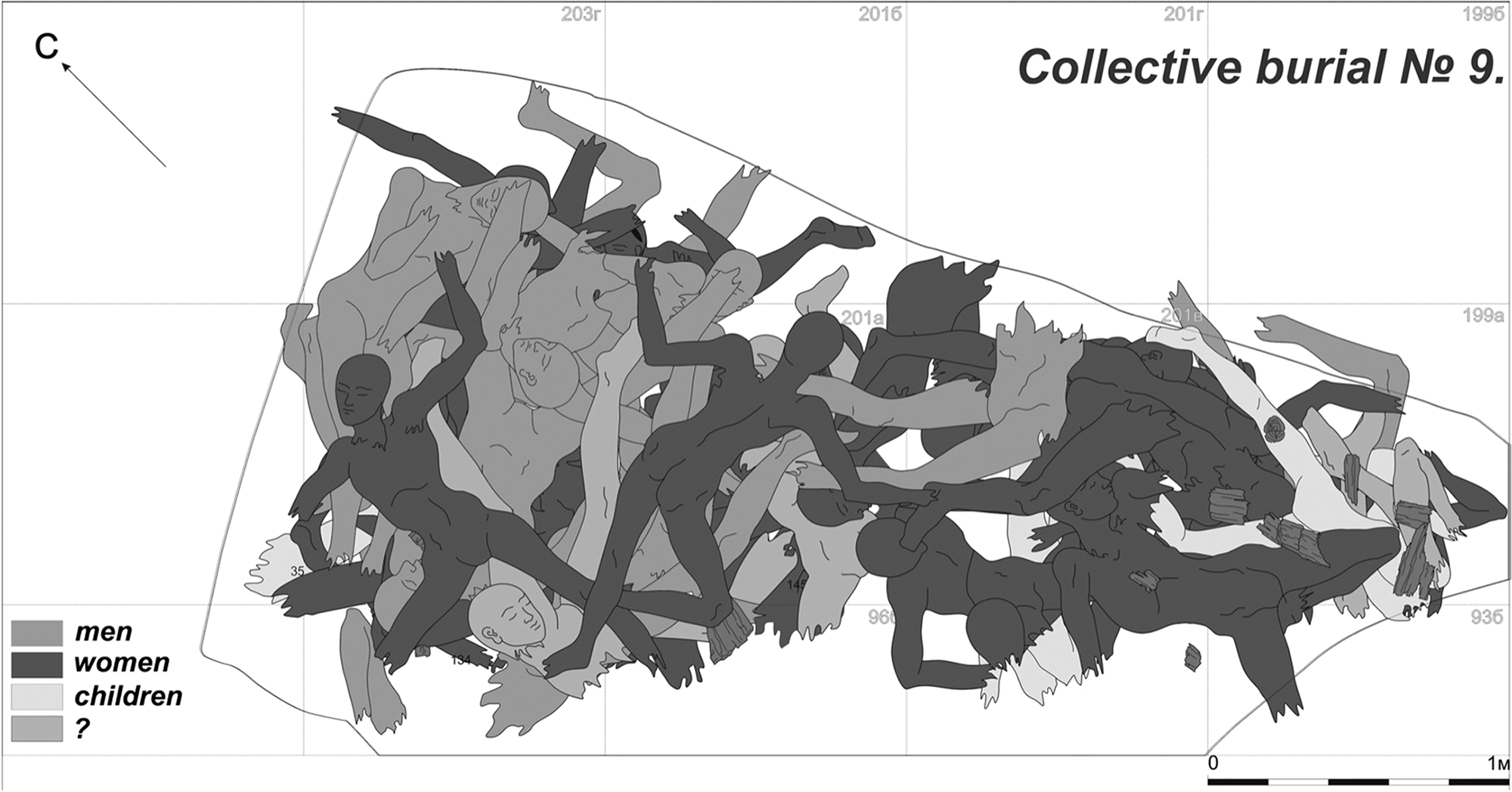
The anthropological study argues that the remains of 263 people were confined in those 9 burials. The number of individuals within each mass grave ranges from 9 to 110, with most bones belonging to adult men (n=95). The number of women and children is also significant: 81 and 67, respectively. The cultural affiliation of the remains could not be determined due to their extensive fragmentation. The remains of all victims, which included men, women, and children, bore signs of violent death—contusions, slash wounds, and blows from blunt weapons (possibly clubs or maces). The women and children in particular showed signs of fatal blows to the skull. According to anthropological reports (Buzhilova et al. Reference Buzhilova, Goncharova and Engovatova2008; Buzhilova and Goncharova Reference Buzhilova and Goncharova2009) almost all of the deaths had been inflicted by metal weapons: sabers, arrows, and spears. Blows from above had caused the majority of the injuries. It seems that the city’s watchmen did not wear helmets, as most had died of fatal head injuries (Engovatova et al. Reference Engovatova, Osipov, Goncharova and Buzhilova2010, Reference Engovatova, Dobrovolskaya, Antipina and Zaitseva2013). The victims remained where they fell for 2–3 months before the partially dismembered bodies were gathered up (Engovatova Reference Engovatova2019). Many of the burials were in the basements of burnt-out buildings, while others were disposed in pits and even a water well (Figure 3). The victims were thrown into graves in complete disorder, with numerous individuals in each burial, along with the remains of livestock and domestic animals including horses, oxen, pigs, and even deer and birds for falconry (Engovatova et al. Reference Engovatova, Dobrovolskaya, Antipina and Zaitseva2013). This exemplifies the disordered and unsanitary conditions of the burial sites.
Yaroslavl, common burial No. 9 (reconstruction).

Analysis of the objects buried with the people, such as personal jewelry, glass, and metal beads, window glass, fragments of masonry, as well as ceramics and stratigraphy studies, helped to establish they had been buried no later than the first part of the 13th century. Traces of a conflagration were discovered in all excavated areas of Yaroslavl, which date to this same period (Engovatova et al. Reference Engovatova, Zaitseva, Dobrovolskaya and Burova2012). More exact dating was established by dendrochronological analysis of timbers of the burnt-out buildings used for the burials. Those buildings had been built no later than the late 1220s: a well (#110) dated to 1228 and building #200 dated to 1217 (see Figure 1) (Karpukhin et al. Reference Karpukhin, Solovieva and Engovatova2011). When looking at the dendrochronology, we should keep in mind the relatively short use-lives of such wooden buildings in medieval Russia. Proceeding from this, we may conclude that the extermination of Yaroslavl probably took place somewhere at the end of 1220s or the beginning of 1250s AD. The only written source describing an attack by the Mongolian warlord Batu Khan was the later insert in the Laurentian Chronicle (Laurentian Chronicle Reference Chronicle1997). According to that manuscript, Yaroslavl was stormed in February 1238. It is notable that among the personal items found in the mass graves were fur hats and woolen clothes, further circumstantial evidence of winter as the time of the attack.
Several individual remains were in better condition and allowed for a robust series of 14C samples per individual. This is beneficial to establish more reliable statistics. An analysis of a large series of 14C dates for each mass burial and other data obtained for these less fragmented burials will allow us to determine more accurately the time of their death and to find out how close it is to the historical event under consideration. In turn, it is possible to reveal whether all the burials were the results of one event, or multiple different episodes in the city’s history.
SAMPLES AND METHODS
Samples for 14C dating (charcoal, human, and animal bones) were taken from each mass burial site. Six of the mass burial sites were analyzed using both LSC and AMS techniques, although no single samples were analyzed by both methods. As has been already mentioned, animal bones were found in all 9 mass graves. A comprehensive study of these osteological materials, including an assessment of the integrity of the skeleton and bones and traces of impact, showed that all samples discovered should be divided into two groups. The first group includes whole bones of different species of animals that make up the full skeletons or their significant parts. They define the category of the remains of animals that died synchronically with people during the defeat of Yaroslavl or died from wounds and starvation in an empty city. When restoring the city’s living space, animal corpses were also buried along with the remains of people near whom they were found. Such animal remains were found in 4 burials. The second group consists of separated bone fragments of various types—so-called kitchen remains. Bone remains from this category were found in all mass burials.
14C dating by LSC was conducted by LSC laboratories in Kiev (lab index Ki; Conventional Radiocarbon Dating Service Laboratory, Kiev) and St. Petersburg (lab index Le; Institute for the History of Material Culture Russian Academy of Sciences, IHMC RAS). A total of 26 samples were analyzed: 24 human bone samples, 1 cow bone sample, and 1 charcoal sample. The charcoal sample was subjected to the standard methods described in the literature (e.g., Arslanov Reference Arslanov1987; Taylor and Bar-Yosef 2014) as follows. Visible contaminants (e.g., roots, sand, small stone, and other) were removed. Following this, contaminations caused by carbonates and humic acids were removed using the acid-alkali-acid treatment. This process consists of boiling individual samples in 3% HCl, washing and boiling in 3% NaOH for 1 hr, and finally treating with 3% HCl a second time. Then, the samples were washed and dried to obtain pure charcoal. The bone samples were crushed and treated with 3% HCl at 0ºC until softened, then the samples were rinsed with distilled water and treated with 1% NaOH for 24 hr at 0ºC. After that the samples were rinsed with distilled water and heated in slightly acid solution until completely dissolved, then the solution was centrifuged and evaporated to obtain collagen.
14C dating by AMS was conducted at the Center for Applied Isotope Studies at the University of Georgia in Athens, GA, USA (lab index UGAMS). A total of 40 bone samples were analyzed by AMS: 22 human bones, 12 cow, 4 horse, 1 pig, and 1 deer. Samples were prepared as follows. Each bone was cleaned by wire brush and washed, using an ultrasonic bath. After physical cleaning, the dried bone was gently crushed to small fragments. The crushed bone was treated with 1N HCl at 4ºC for 24 hr. The residue was filtered, treated with 0.1N NaOH on the filter to remove humic acid contamination, and rinsed with deionized water. The demineralized bone was heated at 80ºC for 6 hr under slightly acid condition (pH=3) to dissolve collagen and leave humic substances in the precipitate. The collagen solution was then filtered to isolate pure collagen and freeze dried. The dried collagen was combusted at 575ºC in an evacuated/sealed Pyrex ampoule in the presence of CuO (Cherkinsky Reference Cherkinsky2009). The resulting carbon dioxide was cryogenically purified from the other reaction products and catalytically converted to graphite using the method of Vogel et al. (Reference Vogel, Southon, Nelson and Brown1984). Graphite 14C/13C ratios were measured using the CAIS 0.5 MeV accelerator mass spectrometer. The sample ratios were compared to the ratio measured from the Oxalic Acid I (NBS SRM 4990). The sample 13C/12C ratios were measured separately using a stable isotope ratio mass spectrometer and expressed as δ13C with respect to PDB, with an uncertainty of less than 0.1‰. The quoted uncalibrated dates are given in radiocarbon years before 1950 (years BP), using the 14C half-life of 5568 years. The uncertainty is quoted as one standard deviation and reflects both statistical and experimental errors of the sample preparation, graphitization and long-term variability of the AMS system. The dates have been corrected for the natural isotope fractionation.
RESULTS
Twenty-four human bone samples, 1 cow bone sample, and 1 charcoal sample were analyzed by LSC technique. All dates, measured by the LSC technique, were in the range from 1060 ± 60 to 730 ± 60 14C yr BP (see Table S1 in Supplemental Materials). The standard deviation for LSC measurements exceeds ±50 years, with exception of the charcoal sample, which was measured with precision ±30 yr. The calibration of these ages (Figure 4) shows that only about half of the results are within the range of the expected historical date (Engovatova et al. Reference Engovatova, Zaitseva, Dobrovolskaya and Burova2012), however the range itself is quite wide. This could be the result of the small collagen sample sizes, which did not allow for precise measurements, as well as potentially some systematic discrepancy in the laboratory.
Calibration of the LSC dates.

Forty bone samples analyzed by AMS technique at CAIS were in the range from 881±19 to 748 ± 20 14C yr BP with exception of 1 horse bone, which was dated to 332 ± 19 14C yr BP (see Table S2 in Supplemental Materials). The AMS dates were significantly more consistent compared to LSC dates; however, the range of the age distribution was still relatively wide. The AMS results significantly narrowed the possible dating period for the burial event. It is possible that the horse sample was buried later or was a result of missampling. The dates were obtained by LSC in the St. Petersburg laboratory are in good agreement with the dates obtained by AMS at CAIS. The samples dated by LSC in the Kiev laboratory are systematically older that dates from CAIS.
Bayesian Modeling
Bayesian statistical tools are now routinely used by archaeologists who wish to formally, and coherently, incorporate a priori knowledge, a formal model, and suitable data to arrive at (a posteriori) inferences based on all three. Initially, attention focused on the calibration and interpretation of 14C data. However, soon it became clear that the framework was ideally suited to the integration of chronological information from a range of different sources—in particular stratigraphic sequences and historical or absolute evidence (Buck et al. Reference Buck, Cavanagh and Litton1996). It is possible to devise Bayesian version of traditional serial models, thus allowing a priori relative chronological information to be incorporated into the data interpretation process.
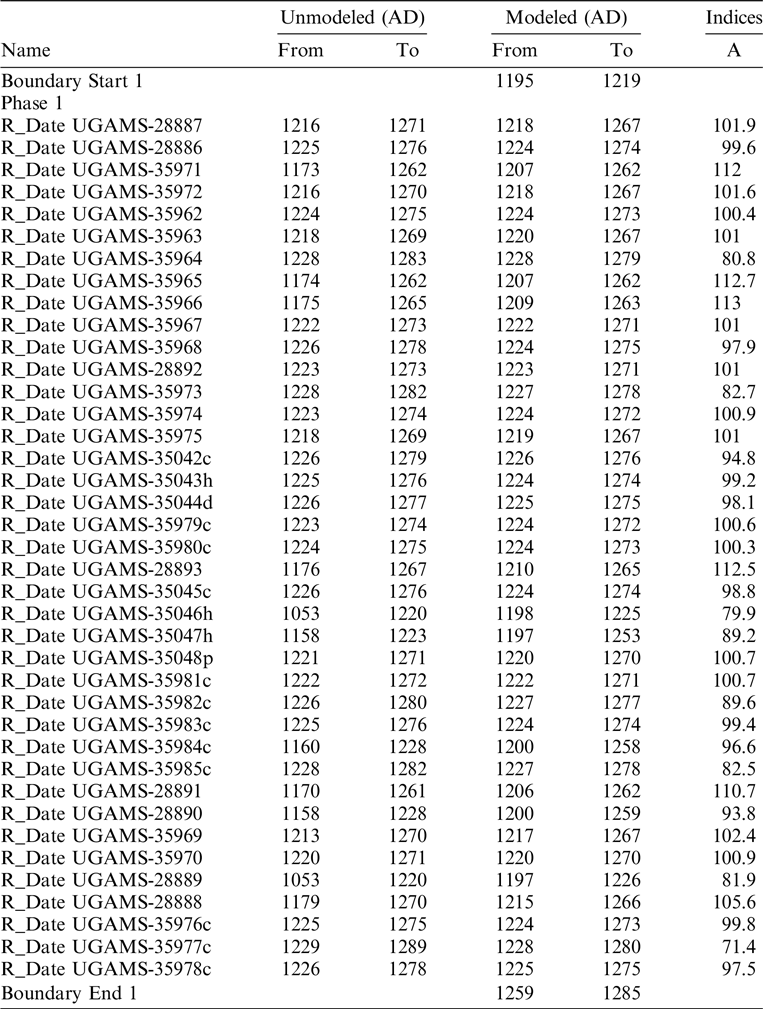
To narrow the date range further, we modeled the AMS 14C dates with a Bayesian chronological model (Table 1 and Figure 5) using the latest-available version (4.3) of OxCal (Bronk Ramsey Reference Bronk Ramsey2017). A frequently used and conservative assumption is that the group of dated events are randomly sampled from a phase, i.e., a uniform distribution between a start boundary and an end boundary. Following this logic, the dates from the mass burials were modeled as a single phase (Figure 5). The phase model had an overall agreement index of 84.6, indicating acceptable agreement between the model and the data. The model significantly narrows the range of the ages compared to the unmodeled calibrated dates. The maximal range for unmodeled ages is from 1053 to 1289 cal AD. The modeled start boundary for the phase is 1195–1219 cal AD, with an end boundary of 1259–1285 cal AD (both represent 95.4% probability ranges). However, the modeled ages for individual samples are in the range 1197–1280 AD cal years, with a mean of 1238.5 AD. The mean is very close to the historical date mentioned in the Laurentian Chronicle, which listed Yaroslavl as one of numerous Russian towns that suffered devastating attacks over the winter months of 1238.
The unmodeled and modeled ages of AMS dates represent 95.4% probability.

Bayesian model of AMS dates, represent 95.4% probability ranges: light grey—unmodeled ranges, and dark grey—modeled.

While this quite substantial dataset is fully consistent with the historically documented date of 1238, we note that even the best chronological modelling can never fully confirm the calendar date of an individual historical event. All we can ever say is the dates are very consistent with, or very supportive of this particular theory. In combination with the other historical information, it may be deduced that it is “almost certain,” but this can never be stated categorically. Nonetheless, we suggest that the multiple AMS dates, interpreted within a Bayesian framework, resulted in an age estimate consistent with the historical record, demonstrating the potential for 14C dating to contribute to chronology building in Russian medieval archaeology.
CONCLUSIONS
The comparison of the LSC and AMS techniques has shown that latter allows researchers to achieve higher measurement precision in general, with a significantly narrower range of dates for the event in question, compared to the LSC technique. Coupled with the Bayesian approach to interpreting AMS dates, we were able to narrow the temporal range of the event from 1053–1289 cal AD (unmodeled) to 1197–1280 cal AD (modeled), which includes the historical record date of the extermination of Medieval Yaroslavl by the Batu-Khan army in the winter of 1238 AD. The mean of this range is 1238.5 AD, which is very close to the historical date mentioned in the Laurentian Chronicle listed Yaroslavl as one of numerous Russian towns that suffered devastating attacks over the winter months of 1238.
The mass graves of Yaroslavl find direct analogies with other cases discovered during excavations in cities that were severely defeated by the Mongols, including Kiev (Khvoiko 1908; Ivakin and Komar Reference Ivakin and Komar2016), Old Ryazan (Darkevich and Borisevich Reference Darkevich and Borisevich1995: 372), and many others. In our case, pairing extensive dating with Bayesian modeling resulted in a relatively narrow interval. Thus, even in the absence of more specific dating (e.g., dendrochronology), 14C dating can be used to establish a robust chronological framework for medieval archaeology.
ACKNOWLEDGMENTS
We thank all those who helped with fieldwork. We also acknowledge the advice and assistance of Carla Hadden, and Matthew Colvin for help in editing the text. We are grateful to the staff of the LSC and AMS laboratories for the preceeding analyses.
Supplementary material
To view supplementary material for this article, please visit https://doi.org/10.1017/RDC.2020.137