


Highlights
-
Patients from Winnipeg are more likely than patients from non-metropolitan Manitoba to get intravenous thrombolysis.
-
Patients from Winnipeg are more likely than patients from non-metropolitan Manitoba to get inpatient stroke rehabilitation.
-
Mortality after an ischemic stroke does not differ between patients from Winnipeg and non-metropolitan Manitoba.
Introduction
In 2023, stroke was the fourth leading cause of death in Canada, and previous studies have shown that with an aging population of the country, the incidence of ischemic stroke is rising, with an estimated one ischemic stroke occurring every 5 minutes in Canada. Reference Holodinsky, Lindsay, Yu, Ganesh, Joundi and Hill1 Mortality and disability experienced after an ischemic stroke are largely affected by both hyperacute treatment such as intravenous thrombolysis (IVT) and endovascular thrombectomy (EVT), as well as post-stroke rehabilitation. Timely access to acute stroke treatment is critical, as treatment of stroke is time-sensitive, with every minute delay leading to decreased odds of functional independence. Reference Singh, Almekhlafi and Bala2,Reference Emberson, Lees and Lyden3 Further, access to timely rehabilitation also plays a significant role in improving long-term outcomes. Reference Li, He, Wang and Rezaei4 Thrombolysis and stroke rehabilitation both lead to better outcomes for patients, Reference Emberson, Lees and Lyden3–Reference González, Furie and Goldmacher6 but existing barriers, including travel distance, lack of access to minimum required imaging and specialist consultation, Reference Dwyer, Rehman and Ottavi7–Reference Turner, Dennis, Barber and Macleod9 may prevent patients from accessing these treatments.
In Canada, access to ischemic stroke treatment differs based on geography. Given the vast geography of the country with nearly 20% of the population living in rural areas, 10 several barriers result in delays in diagnosis, treatment and rehabilitation for individuals who do not live in metropolitan cities. Previous research from Ontario has demonstrated that individuals residing in rural areas have less access to acute stroke intervention and neurologist consultation and reduced access to long-term stroke rehabilitation. Reference Koifman, Hall and Li11
In 2023, 42.5% of Manitoba’s population resided outside Winnipeg, the province’s capital. Winnipeg is the location of the only two tertiary hospitals in Manitoba, as well as the only long-term stroke inpatient rehabilitation center, yet the province itself spans over 650,000 square km. 12 Given the vast geography of the province, it is possible that individuals who reside in rural or remote locations may have reduced access to hyperacute stroke interventions such as IVT and EVT, as well as delayed or limited access to post-stroke rehabilitation services. Geographic inequities in healthcare access have been shown to contribute to worse functional outcomes and higher mortality among patients with stroke in rural regions compared to those in urban centers. Reference Koifman, Hall and Li11,Reference Yan, Hu and Alcock13 Understanding these disparities within Manitoba’s unique healthcare landscape is critical to inform equitable system-level improvements in stroke care delivery. The purpose of this study was to examine the effect of geographical residence on healthcare utilization, including length of stay (LOS), thrombolysis administration and stroke rehabilitation, and outcomes, specifically mortality, after an ischemic stroke for patients living in Manitoba over the last 4 years.
Methods
Setting
The study includes patients with ischemic stroke from Manitoba, the fifth most populous province in Canada. The province of Manitoba is divided into five healthcare regions: approximately 57% of the population resides in the Winnipeg health region, 12% within the Prairie Mountain health region, 9% within the Interlake-Eastern health region, 16% within the Southern health region and 5% in the Northern health region. 14 The two tertiary care centers in Manitoba, St. Boniface Hospital and Health Sciences Centre, are in the Winnipeg health region. There is one provincial inpatient center specializing in stroke rehabilitation, Riverview Health Center, which is also in Winnipeg. Health Sciences Centre is the only site that offers both thrombolysis and endovascular treatment in Winnipeg, as St. Boniface does not provide reperfusion therapy. The distance from the most northern health center included in our data, Thompson Manitoba, to HSC is over 1000 km, and patients from Thompson can only access services in Winnipeg via plane for acute care (travel time over 6 hours).
In addition to the Winnipeg-based centers, there are eight thrombolysis-capable hospitals located across the other health regions. Based on the provincial stroke referral pathways, patients are typically transported to the nearest stroke-ready hospital from the area in which they reside. Therefore, we assume that patients presenting to hospitals in Winnipeg or in non-metropolitan Manitoba generally reside in those respective regions. This assumption does not fully apply to patients requiring EVT, as all EVT procedures are centralized at the Health Sciences Centre in Winnipeg. Therefore, patients who reside in all rural locations who require EVT based on imaging findings will have been transferred to Winnipeg and thus will have been incorrectly coded as residing within Winnipeg. However, this represents only a subset of the stroke population, as previous research from the rates of EVT in Manitoba has shown that only 22.6% of patients who get EVT (which is a minority of patients who present with acute ischemic stroke) reside more than 50 km from HSC. Reference Yan, Hu and Alcock13 Among this subset, the majority of patients first present to their nearest stroke-ready hospital, undergo initial imaging and are then transferred to Winnipeg for EVT. Thus, for the purposes of our analysis, the assumption that patients present to hospitals near their residence holds true for the majority of cases.
Data source and study sample
This study is a population-level analysis using the Discharge Abstract Database (DAD) from Manitoba. The database includes all patients who received care in any hospital within Manitoba for ischemic stroke between April 1, 2019, and March 31, 2023. The following variables were extracted from the DAD: date of birth; sex; the presence of comorbidities such as atrial fibrillation, chronic kidney disease, heart failure, hypertension, diabetes mellitus and coronary artery disease; the facility where the patient initially presented; admission date; discharge date; acute stroke interventions that were administered; location of patient transfer; and discharge disposition. ICD codes used for each of these diagnoses are provided in the Supplemental Material.
Outcomes
The primary outcomes examined in this study were the percentage of patients from both Winnipeg and non-metropolitan Manitoba who were discharged home after an acute ischemic stroke.
Secondary outcomes include hospital LOS, whether they received IVT, in-hospital mortality, discharge disposition and whether they were transferred to an inpatient stroke rehabilitation center (Riverview Health Centre).
Stroke trends over the 4-year study period were also analyzed in terms of the number of stroke presentations per year, as well as the incidence of stroke presentations to the hospital, both in Winnipeg and non-metropolitan Manitoba.
Statistical analysis
Patients who presented to a healthcare facility outside of the Winnipeg Health region were coded as residing in “non-metropolitan Manitoba,” while those who presented to a healthcare facility within the Winnipeg health region were coded as residing in “Winnipeg.” Demographic data on age and comorbidities were analyzed descriptively using parametric and nonparametric tests for normal and non-normal distributions, respectively. Both unadjusted and adjusted analyses were performed for all outcome analysis patients with stroke presenting to the non-metropolitan Manitoba versus the Winnipeg region.
For LOS, linear regression analysis was performed, adjusting for age, sex and comorbidities (atrial fibrillation, hypertension, diabetes, chronic kidney disease, heart failure and coronary artery disease). Logistic regression analyses adjusting for the same variables were performed to compare mortality, thrombolysis, discharge home and transfer for stroke rehabilitation. Further, the absolute number of patients presenting with a diagnosis of ischemic stroke and stroke incidence was calculated for each year. P-value of <0.05 was considered to be significant for all analyses.
Annual stroke presentation data from April 2019 to March 2023 were analyzed for Winnipeg, non-metropolitan Manitoba, and the province of Manitoba overall. Population estimates for each year were obtained from Statistics Canada. Incidence rates were calculated per 100,000 population for each region and year. A linear regression model was used to assess trends in stroke incidence over time in Manitoba. To compare regional differences, an independent samples t-test was conducted between Winnipeg and non-metropolitan Manitoba incidence rates. All analyses were performed using IMB SPSS: Advanced Statistics.
Results
Demographics comparing patients presenting with stroke to Winnipeg versus non-metropolitan Manitoba
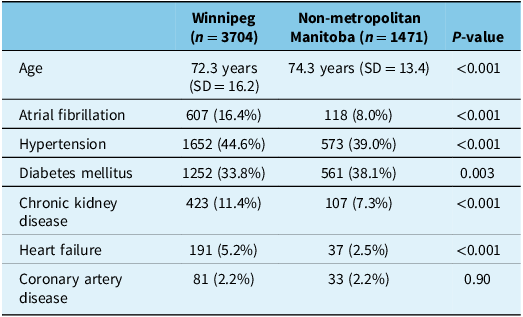
A total of 5175 patients were admitted to any Manitoba facility with a diagnosis of ischemic stroke between April 1, 2019, and March 31, 2023. Of these, 3704 (71.6%) patients were admitted to a hospital located in Winnipeg, and 1471 (28.4%) patients were admitted to a hospital located in non-metropolitan Manitoba. Patients presenting to Winnipeg were significantly younger at stroke presentation compared to patients from non-metropolitan Manitoba (mean age 72.3 vs 74.3 years). In addition, patients presenting to Winnipeg had significantly higher rates of diagnosed atrial fibrillation, hypertension, diabetes, chronic kidney disease and heart failure compared to patients from non-metropolitan Manitoba (Table 1).
Demographics of patients living in Winnipeg versus non-metropolitan Manitoba

Outcomes comparing patients presenting with stroke to Winnipeg versus non-metropolitan Manitoba
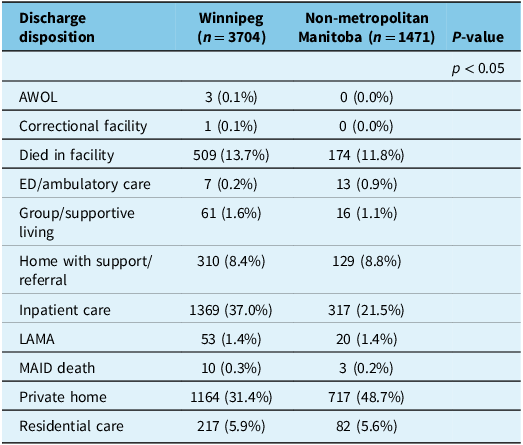
Patients presenting with stroke to Winnipeg had a shorter mean LOS as compared to patients presenting with stroke to non-metropolitan Manitoba (16.1 days vs 18.4 days, respectively), significant on both unadjusted (coefficient −0.38, 95% CI −3.89 to −0.63, p = 0.0141) and adjusted analyses (coefficient −0.05, 95% CI −4.54 to −1.27). Patients from Winnipeg were significantly less likely to be discharged home compared to those from non-metropolitan Manitoba (39.8% vs 57.5%, adjOR 0.47, 95% CI 0.41–0.53) (Table 2). However, patients from Winnipeg were significantly more likely to be transferred for inpatient stroke rehabilitation compared to patients from non-metropolitan Manitoba (adjOR 3.46, 95% CI 2.64–4.54) (Table 2). A detailed analysis of specific discharge disposition for patients from Winnipeg versus non-metropolitan Manitoba can be found in Table 3.
Outcome measures of patients living in Winnipeg versus non-metropolitan Manitoba

LOS = length of stay.
† Beta coefficients with 95% CI.
‡ Odds ratio with 95% CI.
Discharge disposition of patients living in Winnipeg and non-metropolitan Manitoba

AWOL = absent without official leave; ED = emergency department; LAMA = left against medical advice; MAID = medical assistance in dying.
From a healthcare utilization perspective, rates of IVT were significantly higher among patients presenting to Winnipeg as compared to those presenting to non-Metropolitan Winnipeg (adjOR 5.13, 95% CI 3.85–6.84). There were no statistically significant differences observed in in-hospital mortality between patients from Winnipeg versus non-metropolitan Manitoba.
Secular trends of stroke admissions over 4-year period
The number of stroke presentations in Manitoba between April 1, 2019, and March 31, 2023, is shown in Table 4. Between April 1, 2019, and March 31, 2020, the number of stroke presentations in Winnipeg and non-metropolitan Manitoba remained stable. However, during the next year-long period (April 1, 2021–March 31, 2022), the number of stroke presentations decreased in Winnipeg but increased in non-metropolitan Manitoba. Throughout the next year-long period (April 1, 2022–March 31, 2023), stroke presentations increased back to the original amount seen in 2019 and 2020 in Winnipeg, while remaining relatively stable with a slight decrease in non-metropolitan Manitoba. In total stroke presentation numbers in Manitoba, there was an increase between April 2019 and March 2022 and then an increase between April 2022 and March 2023. There was a higher incidence of stroke in Winnipeg compared to non-metropolitan Manitoba (F-statistic 23.84, p = 0.0028). These results are statistically significant and are demonstrated in Figure 1.
Stroke incidence rates per 100,000 population

Visual representation of stroke presentations in Winnipeg and non-metropolitan Manitoba by year-long period. There was a statistically significant difference in stroke incidence between Winnipeg and non-metropolitan Manitoba over the 4-year period (F-statistic 23.84, p = 0.0028).

Discussion
The results of this multiyear province-wide study demonstrate that, in comparison to individuals who reside in Winnipeg, patients who present with ischemic stroke in non-metropolitan Manitoba are less likely to receive IVT, have longer hospital stays, are more likely to be discharged back home and are less likely to be transferred for inpatient stroke rehabilitation. Our findings are congruent with previous research, both from Canada Reference Koifman, Hall and Li11 and from other countries Reference Dwyer, Rehman and Ottavi7,Reference Leira, Hess, Torner and Adams15,Reference Gonzales, Mullen, Skolarus, Thibault, Udoeyo and Willis16 that have found disparities in ischemic stroke treatment between rural and urban residents.
The finding that patients in non-metropolitan Manitoba are significantly less likely to receive IVT reflects a geographical barrier to acute stroke treatment. This is significant because evidence has demonstrated that patients with ischemic stroke treated with IVT have better clinical outcomes than those who are not. Reference Lin, Zuo and Jin17 There are several reasons why geography poses a barrier to acute stroke intervention in Manitoba. First, a patient must present to a thrombolysis-capable site within 4.5 hours of symptom onset to be eligible. 18 This limited timeframe poses a barrier for all patients presenting with acute ischemic stroke, especially for those living in rural locations, as thrombolysis-capable centers may be spread out, which leads to longer transfer times.
A geospatial analysis from 2017 demonstrated that only 87.6% of Manitobans live within a 4.5-hour driving distance to the nearest acute stroke center. Reference Eswaradass, Swartz, Rosen, Hill and Lindsay19 That means that 12.4% of Manitobans are automatically unable to receive IVT just due to their location of residence. An additional barrier to receiving IVT for individuals who present to non-metropolitan Manitoba is the fact that CT scanners, which are necessary to rule out hemorrhage, are not uniformly available in rural areas. Reference Fleet, Bussières and Tounkara20 Overall, the farther an individual lives from a thrombolysis-capable and CT-capable, the more potential barriers they will face in receiving thrombolysis.
Our study also demonstrated significant differences in discharge disposition between patients from Winnipeg versus non-metropolitan Manitoba. Specifically, we found that patients from Winnipeg were more likely to be transferred to an inpatient care unit and were less likely to be discharged home. There are several possible explanations for this finding, including patient preferences, desires to reduce separation from support networks for rural patients and less access to rural inpatient care. While this finding may be interpreted in a positive light as a fundamental goal of stroke care is to get patients back to their home environment, it is possible that rural patients are prematurely discharged home to reduce tertiary care strain and because their rural communities simply do have low-acuity units to support them in. This could be supported by the fact that our data found an almost analogous discrepancy in the rate of transfer to other inpatient wards for patients residing within Manitoba, who were also likely discharged from a tertiary care site to reduce strain to a lower acuity center for ongoing management.
The longer LOS observed in patients in non-metropolitan Manitoba may be connected to the increased rate of discharge home, as healthcare providers may want to monitor an individual’s health status for a longer period if they are not going to be discharged to somewhere with ongoing monitoring. However, the longer LOS may also reflect worse clinical outcomes requiring a longer duration of treatment for patients in non-metropolitan Manitoba compared to Winnipeg. Additionally, the longer LOS may also be related to less rehabilitation available in rural communities, which means patients must stay in acute care rural hospitals to receive intensive rehabilitation.
Our study found that patients in Winnipeg were more likely to be transferred for inpatient stroke rehabilitation. This finding is significant because post-stroke rehabilitation has been shown to lead to better long-term functional outcomes, Reference Bisevac, Lazovic, Nikolic, Mahmutovic, Dolicanin and Jurisic-Skevin21 and therefore, rural patients may experience worse outcomes because they do not have access to this rehabilitation. This discrepancy likely reflects the fact that the only facility that offers inpatient stroke rehabilitation, Riverview Health Centre, is located within Winnipeg. This finding is in line with previous literature on barriers to stroke rehabilitation for rural patients that illustrates that geographic constraints, as well as socioeconomic and financial barriers, lead to less stroke rehabilitation for rural residing patients. Reference Li, He, Wang and Rezaei4,Reference Koifman, Hall and Li11 While home-based rehabilitation services have shown to be effective for rural residents in Ontario, Reference Allen, McIntyre and Janzen22 there are currently minimal or no home-based stroke rehabilitation programs of similar intensity for rural Manitobans.
Our study did not find any significant difference in in-hospital mortality between patients presenting in Winnipeg versus non-metropolitan Manitoba. Previous research from Canada on mortality after stroke between rural and urban patients has found mixed results. Some studies have shown that rural residence is associated with higher stroke mortality rates; Reference Kapral, Austin and Jeyakumar23 however, there are conflicting data Reference Koifman, Hall and Li11
Finally, we examined stroke incidence throughout a 4-year period. We found a decreased incidence of stroke presentations in Winnipeg in 2021–2022. One possible explanation for the decrease in stroke presentations in 2021–2022 is the effects of the COVID-19 pandemic, which resulted in patients being less likely to present with healthcare concerns. Several studies have demonstrated decreased rates of hospital presentations in the height of the COVID-19 pandemic, both for overall emergency room presentations Reference Stowell, Henry and Pugsley24,Reference Tan, Liu and Fan25 and stroke presentations. Reference Tan, Liu and Fan25 This has been suggested to be due to several factors, including increased COVID screening measures and hesitancy to go to the hospital over fears of COVID-19 infection. Reference Tan, Liu and Fan25 Interestingly, our results only show a substantial decrease for patients from Winnipeg and not for patients from non-metropolitan Manitoba. This may reflect a lower pre-COVID threshold for Winnipeg residents to present to hospital care, potentially influenced by fewer geographical barriers to care. The higher number of rural stroke presentations may also reflect patients being less willing to present to crowded urban sites but more willing to present to less crowded rural sites in order to reduce transmission risk and abide by capacity requirements. An additional explanation could include a decrease in rural to urban patient transfers to abide by capacity regulations.
Future directions
Our study highlights important differences in healthcare utilization between patients with ischemic stroke who present in Winnipeg versus non-metropolitan Manitoba. These differences highlight the need to improve access to both acute stroke treatment and rehabilitation for patients in non-metropolitan sites. The increasing use of virtual medicine in the healthcare landscape offers a promising route to improve these discrepancies. Reference Rubin and Demaerschalk26 To provide additional context, Manitoba is a geographically large province with a population of approximately 1.8 million people, distributed across vast rural and remote regions. The province has one Comprehensive Stroke Centre (CSC) located in Winnipeg, which serves as the central hub for acute stroke care. Outside of Winnipeg, there are eight CT-capable hospitals across rural Manitoba, situated between 68 and 760 km from the CSC. Recognizing the geographic barriers to timely stroke treatment, the Manitoba TeleStroke Program was established under the 2011 Provincial Stroke Strategy to expand access to IVT and specialist stroke consultation. Between 2014 and 2019, seven TeleStroke sites were implemented using a hub-and-spoke model guided by the Donabedian structure–process–outcome framework. The hub, based at the provincial CSC, includes 10 neurologists with stroke expertise who provide 24/7 coverage via telehealth using a real-time video assessment for all stroke codes at telehealth sites. Consultations are conducted using fixed telehealth systems during business hours and portable telehealth laptops after hours, allowing neurologists to assess patients remotely, review imaging in real time and guide IVT administration.
Winnipeg currently does not have any operating mobile stroke units (MSUs). While the implementation of MSUs in rural or remote sites without on-site CT capability could theoretically reduce delays in IVT by expediting access to imaging and diagnosis, Reference Shuaib and Jeerakathil27 the high operational costs, staffing requirements and large geographic spread make an MSU model less feasible and potentially not cost-effective in Manitoba. Moreover, most existing evidence on MSU efficacy originates from international programs in Europe, the United States and Australia, Reference Fatima, Saqqur, Hussain and Shuaib28–Reference Navi, Audebert, Alexandrov, Cadilhac and Grotta30 where healthcare infrastructure, population density and prehospital logistics differ substantially from the Canadian context. Thus, findings from these settings may have limited generalizability to Manitoba’s rural and remote landscape. The provincial TeleStroke network remains a more practical and sustainable strategy for equitable access to acute stroke care. Reference Alcock, Ayroso and Leung31 This needs to be further studied using modeling analysis.
While our study did demonstrate discrepancies in rates of IVT administration and rates of inpatient rehabilitation, we did not investigate whether this discrepancy correlates with clinical outcomes such as mortality, functional status (modified Rankin Scale) or cognitive status. Future studies should be done to assess whether these demonstrated discrepancies in healthcare utilization correlate with discrepancies in clinical outcomes for patients in urban versus rural areas.
Limitations
There were several limitations to this study. First, we assume that patients presenting to hospitals in Winnipeg or in non-metropolitan Manitoba generally reside in those respective regions. This assumption does not fully apply to patients requiring EVT, as all EVT procedures are centralized at the Health Sciences Centre in Winnipeg. Therefore, patients who reside in all rural locations who require EVT based on imaging findings will have been transferred to Winnipeg and thus will have been incorrectly coded as residing within Winnipeg.
However, recently published data from the Manitoba TeleStroke Registry over the last 8 years indicate that only 9.6% of all stroke patients presenting outside Winnipeg are subsequently transferred to Winnipeg for tertiary care. Of all patients who receive thrombolysis, around 20% are transferred to Winnipeg for EVT. Reference Alcock, Ayroso and Leung31 This suggests that while transfer for endovascular therapy (EVT) or complex management does occur, the majority of stroke patients are managed locally within their regional health authority. Thus, for the purposes of our analysis, the assumption that patients present to hospitals near their residence holds true for the majority of cases.
Second, we did not include data regarding rates of EVT. We did not include this data as, at the beginning of the study period, it was a relatively new treatment option in Manitoba, and data collection was not consistent. However, this would have been an important outcome to study, given that previous research from Manitoba has found a discrepancy in EVT access and time-to-groin puncture time between individuals based on their geographic residence. Reference Yan, Hu and Alcock13
Third, detailed clinical data, including stroke severity scores and imaging findings, were not available within the administrative discharge database and would require manual chart review. While the Health Sciences Centre maintains electronic records, documentation of symptom onset and imaging findings is inconsistent, and many rural hospitals lack electronic health records. This limitation may reduce the granularity of clinical comparisons across regions.
Finally, there are several potential confounding variables that may have influenced the data. In Manitoba, most indigenous communities are located rurally, and while geographic distance to care may certainly still be a barrier they face, these communities face well-established additional barriers to care that are not related to rural location. These barriers include mistrust of the healthcare system, socioeconomic barriers, lack of health education, a lack of culturally competent care for healthcare providers and systemic discrimination, among others. Reference Nguyen, Subhan, Williams and Chan32 Therefore, while our results do show a discrepancy in healthcare utilization that may reflect a geographical cause, it is important to acknowledge that there are additional barriers that may be contributing to these findings that are irrespective of geography.
Conclusions
Our study demonstrates a discrepancy in healthcare utilization between patients with acute ischemic stroke who present in Winnipeg versus non-metropolitan Manitoba. Specifically, we found that patients presenting in non-metropolitan Manitoba are less likely to receive thrombolysis, are more likely to be discharged home as opposed to inpatient care and are less likely to receive inpatient stroke rehabilitation. Future research should focus on investigating whether these demonstrated discrepancies correlate with discrepancies in long-term functional outcomes.
Supplementary material
The supplementary material for this article can be found at https://doi.org/10.1017/cjn.2026.10533.
Author contributions
AB: Analysis and interpretation of data, drafting and revision of manuscript. NS: Conception and design of study, analysis and interpretation of data, edits and approval of the final version of the manuscript. ZS: Edits and approval of the final version of the manuscript. BA: Edits and approval of the final version of the manuscript. RN: Edits and approval of the final version of the manuscript. EG: Edits and approval of the final version of the manuscript. AW: Edits and approval of the final version of the manuscript. NA: Edits and approval of the final version of the manuscript. CCR: Edits and approval of the final version of the manuscript. CV: Edits and approval of the final version of the manuscript. NK: Edits and approval of the final version of the manuscript. AT: Edits and approval of the final version of the manuscript.
Funding statement
There is no funding source to disclose.
Competing interests
There are no competing interests to disclose.






Target article
Geographic Differences in Healthcare Utilization Outcomes in Ischemic Stroke: A Population-Level Study from Manitoba
Related commentaries (1)
Reviewer Comment on Buchel et al. “Geographic Differences in Healthcare Utilization Outcomes in Ischemic Stroke:A Population-Level Study from Manitoba”