Implications
Heat stress negatively affects animal welfare and productivity, creating challenges for appropriate nutritional management to alleviate these negative effects. Observed changes in feed sorting in favour of forage particles during heat stress have broad implications for managing dairy cows in heat stress. First, these results imply that preference for ration components changes corresponding with physiological responses to increasing heat load. Further, these results reveal the importance of considering increased feed sorting, in combination with other challenges associated with nutritional management, during heat stress. There is a need for further investigation of feed sorting management during periods of heat stress.
Introduction
Management of cattle in heat stress conditions is a topic of concern in both beef and dairy industries today, due to a range of negative impacts of heat stress on production and welfare. As heat load, body temperature and respiration rate increase (Brown-Brandl et al., Reference Brown-Brandl, Eigenberg, Nienaber and Hahn2005), milk yield and feed intake decrease (Mitlöhner et al., Reference Mitlöhner, Morrow, Dailey, Wilson, Galyean, Miller and Mcglone2001; Ominski et al., Reference Ominski, Kennedy, Wittenberk and Moshtaghi Nia2002). Further, other behavioural changes consistent with mitigating heat load are exhibited, such as increased standing time which exposes increased surface area for cooling (Cook et al., Reference Cook, Mentink, Bennett and Burgi2007; Tucker et al., Reference Tucker, Rogers and Schütz2008) and motivation to seek shade (Schütz et al., Reference Schütz, Cox and Matthews2008).
Nutritional management is of key concern for heat-stressed cattle. In addition to reduced feed intake, heat-stressed cattle ruminate less (Soriani et al., Reference Soriani, Panella and Calamari2013), and have lower ruminal pH and altered gut microbiota (Mishra et al., Reference Mishra, Martz, Stanley, Johnson, Campbell and Hilderbrand1970; Tajima et al., Reference Tajima, Nonaka, Higuchi, Takusari, Kurihara, Takenaka, Mitsumori, Kajikawa and Aminov2007). Nutritional recommendations to mitigate negative effects of heat stress on intake and metabolism have focussed on ensuring constant availability of feed and adjustments to ration formulation to maintain energy density without lowering effective fibre to the point of increasing acidosis risk (West, Reference West1999; Baumgard et al., Reference Baumgard, Abuajamieh, Stoakes, Sanz-Fernandez, Johnson and Rhoads2014). While ration formulation is critical, cattle are known to sort their feed when provided a total mixed ration (TMR), altering nutrient composition of the ration (Leonardi and Armentano, Reference Leonardi and Armentano2003; Miller-Cushon and DeVries, Reference Miller-Cushon and DeVries2009). In a group-feeding scenario, the typical pattern of selecting in favour of smaller higher-energy particles reduces the nutritive value of the ration over the course of the day (DeVries et al., Reference DeVries, von Keyserlingk and Beauchemin2005). Feed sorting behaviour should be of concern in heat stress conditions when a balanced intake of nutrients is particularly critical for maintaining health and production, yet the impact of heat stress on feed sorting behaviour has not been well explored.
Given that heat-stressed cows have increased maintenance requirements but reduced voluntary intake, it has been suggested that increased intake of concentrate relative to forage would facilitate cows consuming sufficient energy (Beede and Collier, Reference Beede and Collier1986) and would reduce metabolic heat production and lower heat load (West, Reference West1999). Intake of high-forage diets decreases in heat stress conditions more rapidly than intake of lower-forage diets (Beede and Collier, Reference Beede and Collier1986), suggesting that cattle may selectively reduce forage intake possibly due to increased heat production from fibre fermentation (Coppock, Reference Coppock, Flatt, Moore and Stewart1964). On the other hand, cattle increase selection of forage particles, with increased rumen buffering capability compared to concentrate, when rumen pH is low (Keunen et al., Reference Keunen, Plaizier, Kyriazakis, Duffield, Widowski, Lindinger and McBride2002; DeVries et al., Reference DeVries, Dohme and Beauchemin2008), as can occur in heat stress. It is therefore possible that feed sorting during heat stress may shift in favour of longer forage particles in response to changing rumen environment. It might be expected that any changes in feed sorting may depend on duration of exposure to heat-stress conditions; physiological adaptation to heat stress varies between acute and chronic exposure (Beede and Collier, Reference Beede and Collier1986) and, further, the ability to modify feeding behaviour in response to physiological conditions may depend on time to acquired learned associations between patterns of dietary selection and post-ingestive feedback (Provenza, Reference Provenza1995).
Since nutrition and management challenges are associated with heat stress, it is essential to determine how, and if, cows change their sorting behaviour when experiencing heat stress. The objective of this study was to assess the individual feed sorting behaviour of cows exposed to both acute and chronic heat stress conditions typical of the Southeast United States in summer, and cows exposed to evaporative cooling. We hypothesized that heat stress would influence the extent of feed sorting, with cows either decreasing intake of long, forage particles, possibly to maintain energy intake in compensation for reduced feed intake and minimize metabolic heat production from fibre digestion, or, alternatively, increasing selection of long particles, possibly to mitigate the reduced rumen pH which can occur in conditions of heat stress. Further, we expected that the magnitude of this effect would depend on duration of exposure to heat stress.
Material and methods
Animals and housing
Lactating Holstein dairy cows (n = 32; parity = 2.8±1.2; mean±SD, min = 2, max = 5), were used in the study. Cows were group-housed in a free stall barn at the Dairy Research Center of the University of Georgia (Tifton, GA, USA) and were managed with all procedures approved by the University of Georgia Animal Care and Use Committee.
This experiment was conducted as part of a larger trial investigating the physiological responses of cows exposed to heat stress, and detailed methods regarding the management of the animals are provided by Weng et al. (Reference Weng, Monteiro, Guo, Li, Orelana, Marins, Bernard, Tomlinson, DeFrain, Wohlgemuth and Tao2018). In brief, the cows were milked 3×/day at 0800, 1600 and 0000 h, and fed individually using the Calan Broadbent feeding system (American Calan Inc., Northwood, NH, USA) with ad libitum access to TMR, provided 1×/day at 1300 h. Feed was pushed up at 1800, 2200, 0800 and 1000 h. Cows were milked three times (0800, 1600 and 2400 h) each day.
Experimental design and data collection
Cows were assigned to treatments balanced by days in milk and parity and, beginning at 186±60 days in milk, were exposed to either: heat stress conditions (HT; n = 15), with no supplemental cooling provided at the feedbunk, or evaporative cooling conditions (CL; n = 17), consisting of misters and fans over stalls and the feed bunk to alleviate heat stress. The number of replicates required per treatment was determined through power analysis (Morris, Reference Morris1999) for the primary response variable of feed sorting. Estimates of variation were based on previously reported values (DeVries et al., Reference DeVries, Dohme and Beauchemin2008; Miller-Cushon and DeVries, Reference Miller-Cushon and DeVries2009 and Reference Miller-Cushon and DeVries2010). It was determined that at 80% power, treatment differences of ~5% could be detected using a sample size of 15 cows per treatment. An additional two cows were available for enrolment on the CL treatment and were included in the data set.
Data were collected during a 4-day baseline period, in which all cows were cooled (starting 18 days before altering environmental conditions to induce heat stress), and two 4-day experimental periods: starting at 10 days after exposing HT cows to heat stress conditions (considered as acute heat stress), and at 62 days after exposing HT cows to heat stress conditions (considered as chronic heat stress). Barn air temperature and relative humidity were monitored by Hobo Pro Series Temp probes (Onset Computer Corp., Pocasset, MA, USA) every 15 min throughout the experiment, and temperature–humidity index (THI) was calculated based on THI = (1.8×T+32)–[(0.55–0.0055×RH)×(1.8×T–26)], where T = air temperature (°C; Dikmen and Hansen, Reference Dikmen and Hansen2009). To confirm that HT cows were experiencing heat stress, respiration rate was counted 3×/week at 1500 h, based on visual inspection by trained observers (number of breaths per minute), and vaginal temperature was monitored every 5 min for 4 consecutive days using an ibutton (Mouser Electronics, Mansfield, TX, USA) attached to a blank controlled internal drug release. Respiration rate and temperature data were averaged across days corresponding to the 4-day experimental periods. Milk yield was recorded at each milking (Alpro; DeLaval, Kansas City, MO, USA).
Individual feed intake was measured daily based on offered and refused amounts. The amount of feed offered to each cow was adjusted daily to target approximately 20% orts. Orts from each feeding were removed from the feed bunk before the subsequent feed delivery. For determination of feed sorting and dry matter intake (DMI), fresh TMR and orts samples were collected daily from individual cows and immediately frozen for later analysis. Samples for particle size separation were separated using the three-screen (19, 8 and 1.18 mm) Penn State Particle Separator (PSPS; Kononoff et al., Reference Kononoff, Heinrichs and Buckmaster2003) which separates the particles into 4 fractions: long (>19 mm), medium (<19, >8 mm), short (<8, >1.18 mm) and fine (<1.18 mm) particles. All sample processing was performed by a single, trained member of the research team. To verify quality and consistency of sample processing, samples were initially separated twice and Pearson correlation coefficient was calculated to verify intra-observer reliability ⩾0.80. After separation, the dry matter (DM) of each separated fraction (as well as total sample) was determined by oven drying at 55°C for 48 h.
To determine nutrient content of the TMR, fresh TMR total samples and particle size fractions were sent to Cumberland Valley Analytical Services Inc. (Hagerstown, MD, USA) for analysis of DM (1358C; method 930.15 (AOAC International, 2000)), ash (5358C; method 942.05 (AOAC International, 2000)), ADF (method 973.18 (AOAC International, 2000)), NDF with heat-stable α-amylase and sodium sulphite (Van Soest et al., Reference Van Soest, Robertson and Lewis1991) and CP (N×6.25; method 990.03 (AOAC International, 2000); Leco FP-528 Nitrogen Analyzer; Leco, St. Joseph, MI, USA). The ingredient composition and chemical composition of the TMR are provided in Table 1, and the particle size distribution and nutrient content of particle size fractions is reported in Table 2.
Composition and particle size distribution (mean±SD) of total mixed ration (TMR) provided to lactation dairy cows

DM = dry matter; NFC = non-fibre carbohydrates.
1 Values obtained from chemical analysis of TMR samples. NFC = 100–(%CP+%NDF+%fat+%ash).
Particle size distribution and nutrient content of the particle fractions of the total mixed ration (TMR) provided to lactating dairy cows

DM = dry matter; NFC = non-fibre carbohydrates.
1 Particle size determined by Penn State Particle Separator, which has a 19-mm screen (long), 8-mm screen (medium), 1.19-mm screen (short) and a pan (fine).
2 Values obtained from chemical analysis of TMR samples. NFC = 100–(%CP+%NDF+%fat+%ash).
Calculations and statistical analysis
Sorting activity (for each fraction of the PSPS) was calculated as the actual intake of each particle size fraction expressed as a percentage of the predicted intake of that fraction (Leonardi and Armentano, Reference Leonardi and Armentano2003). The predicted intake of each particle size fraction was calculated as the product of total DMI multiplied by the DM percentage of that particle size fraction in the offered TMR. Values equal to 100% indicate no sorting,<100% indicate selective refusals (sorting against) and >100% indicate preferential consumption (sorting for). To test whether sorting occurred, sorting activity for each fraction of the PSPS was summarized by treatment and period (baseline, acute heat stress and chronic heat stress) and tested for a difference from 100 using t-tests (Proc t-test; SAS v9.4; SAS Institute Inc., 2012; see model 1 in Supplementary Material S1).
To test if sorting activity, intake, milk yield, respiratory rate or body temperature differed between treatments during the period of acute and chronic heat stress for HT cows, data were summarized for each cow and analysed using the MIXED procedure of SAS (see model 2 in Supplementary Material S1). The model included the fixed effects of treatment (CL or HT), period (acute or chronic heat stress), the interaction between treatment and period, parity as a covariate, and the random effect of cow within treatment. For data subject to a treatment by period interaction, the Tukey–Kramer adjustment was used in testing for differences between individual treatments and periods. In the analysis of feed sorting, sorting values for individual cows obtained during the baseline period were included in the model as a covariate to assess whether sorting before implementing treatments was a significant predictor of sorting behaviour during the experimental periods.
Further, to evaluate the relationship between individual physiological response to heat stress and feeding behaviour, the unconditional associations between respiratory rate and body temperature and sorting of each particle size fraction were evaluated across all animals by period using the MIXED procedure of SAS (see model 3 in Supplementary Material S1). We also analysed the unconditional associations between milk production and sorting, to evaluate the extent to which individual differences in feed sorting behaviour within treatment were related to milk production.
For all analyses, preliminary screening of the data (using UNIVARIATE procedure of SAS) revealed that dependent variables were normally distributed. Homogeneity of variance was confirmed using Levene’s test (using GLM procedure of SAS). All values reported are least squares means. Significance was declared at P < 0.05 and trends reported if 0.05⩽P < 0.10.
Results
The average THI in the barn during the experimental period was 77.6. Cooling provided to CL cows effectively reduced respiration rate compared to HT cows (62.0 v. 73.0 breaths/min; SE = 2.2; P < 0.001) with no effect of period or interaction between period and treatment (P = 0.28). Similarly, body temperature was lower for CL cows than HT cows (39.0°C v. 40.0°C; SE = 0.060; P < 0.001), and was also subject to a treatment by week interaction (P = 0.017), increasing marginally between the period of acute and chronic heat stress for HT cows but remaining stable for CL cows. Feed intake was also greater for CL cows compared to HT cows (29.4 v. 22.1 kg DM/day; SE = 0.57; P < 0.001) with no effect of period (P = 0.63) or interaction between period and treatment (P = 0.38). The percentage orts did not differ between treatments (17.8% v. 19.0%, CL v. HT; SE = 0.89; P = 0.43).
Milk yield was greater for CL cows compared to HT cows (36.1 v. 27.7 kg/day; SE = 1.0; P < 0.001), and differed between periods (decreasing by 7 kg on average; P < 0.001) without a significant treatment by period interaction (P = 0.22). Milk yield was not associated with sorting of any particle size fraction within either treatment in any period (P > 0.40).
During the baseline period when all cows received cooling, both treatments sorted against medium particles (87.7 v. 89.3; HT v. CL; SE = 1.7; P = 0.51) and short particles (93.5 v. 94.6; HT v. CL; SE = 1.1; P = 0.50) and did not sort for or against long particles (99.1 v. 98.2; HT v. CL; SE = 1.5; P = 0.64).
During both acute and chronic heat stress, HT cows sorted in favour of the long particle fraction more than CL cows (Table 3). Sorting of medium and short particles were subject to treatment by period interactions: in the period of acute heat stress, HT cows sorted more than CL cows against medium (P = 0.007) and short particles (P = 0.002), whereas in the period of chronic heat stress, sorting of HT cows did not differ from CL cows (P > 0.9; Table 3). Neither HT nor CL cows sorted significantly for or against fine particles in either period. Sorting behaviour during the baseline period was included in the model to assess the influence of previous sorting on the outcomes observed; however, it was not a significant predictor of sorting of any particle size fraction in either experimental period (P > 0.26). Parity was similarly not associated with sorting outcomes (P > 0.27).
Effect of exposing lactating dairy cows to acute and chronic heat stress on sorting (%)1 of particle size fractions2

a,bValues within rows with different superscripts differ (P < 0.01).
1 Sorting % = 100 ×(actual particle size fraction dry matter (DM) intake/predicted particle size fraction DM intake). Sorting values equal to 100% indicate no sorting, <100% indicate selective refusals (sorting against), and >100% indicate preferential consumption (sorting for). Particle size determined by Penn State Particle Separator, which separates the particles in 4 fractions: long (>19 mm), medium (<19, >8 mm), short (<8, >1.18 mm) and fine (<1.18 mm).
2 Treatment (T): HT = cows not provided cooling, CL = cows provided misters and fans; Period (P) = acute heat stress (10 days immediately following removal of evaporative cooling for HT cows) and chronic heat stress (62 days following removal of evaporative cooling for HT cows). Data are averaged across 4 days per period for 15 HT cows and 17 CL cows.
* P < 0.001: difference in sorting values from 100%.
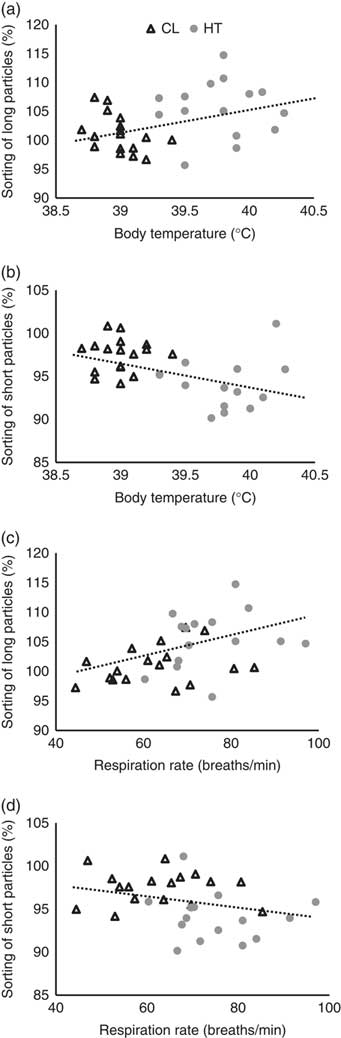
During the period of acute heat stress, body temperature across both treatments was positively associated with the extent of sorting for the long particle size fraction (sorting for long particles (%) = 3.7×body temperature (oC)–41.4; P = 0.030; Figure 1a), and negatively associated with the extent of sorting for medium (sorting for medium particles (%) = −5.9×body temperature (oC)+323.7; P = 0.011), and short particles (sorting for short particles (%) = −3.0×body temperature (oC)+214.1; P = 0.007; Figure 1b). Body temperature was not associated (P = 0.31) with sorting for the fine particle fraction during the period of acute heat stress. During the period of chronic heat stress, sorting for long particles tended to be associated with body temperature (sorting for long particles (%) = 2.9×body temperature (oC)–10.9; P = 0.06) but sorting of all other fractions was not associated (P > 0.3) with body temperature.
Associations between body temperature and sorting of long particles (a) and short particles (b), and between respiration rate and sorting of long particles (c) and short particles (d). Data are summarized across 4 days of data collection for 32 cows, exposed to either evaporative cooling (CL, n = 17; black triangles) or no cooling mechanisms other than shade (HT, n = 15; grey dots).

We observed similar associations between respiration rate and feed sorting. During the period of acute heat stress, respiration rate across both treatments was positively associated with the extent of sorting for the long particle size fraction (sorting for long particles (%) = 0.17×respiration rate (breaths/min)+91.84; P = 0.010; Figure 1c), and negatively associated with the extent of sorting for medium (sorting for medium particles (%) = −0.21×respiration rate (breaths/min)+104.6; P = 0.015), short (sorting for short particles (%) = −0.086×respiration rate (breaths/min)+ 101.7; P = 0.043; Figure 1d) and fine particles (sorting for fine particles (%) = −0.10×respiration rate (breaths/min)+107.2; P = 0.019). During the period of chronic heat stress, respiration rate was not associated (P > 0.20) with sorting of any particle size fraction.
Discussion
Cattle exhibit behavioural and physiological responses to increasing heat load, including reduced feed intake and altered rumen metabolism (Mitlöhner et al., Reference Mitlöhner, Morrow, Dailey, Wilson, Galyean, Miller and Mcglone2001; Ominski et al., Reference Ominski, Kennedy, Wittenberk and Moshtaghi Nia2002). Nutritional approaches to mitigate negative effects of heat stress through ration formulation are well-documented (Beede and Collier, Reference Beede and Collier1986). Given that effective implementation of nutritional management requires consideration of individual feed sorting behaviour (Miller-Cushon and DeVries et al., Reference Miller-Cushon and DeVries2017a), we aimed to evaluate the response of feed sorting behaviour to heat stress in lactating dairy cows.
As expected, providing evaporative cooling reduced body temperature and respiration rate, whereas cows on the heat-stressed treatment were experiencing a THI of 77.6 with no evaporative cooling. Increased respiration rate (>70 breaths/min) is consistent with previous studies describe high-producing dairy cows in subtropical conditions (Kadzere et al., Reference Kadzere, Murphy, Silanikove and Maltz2002). Based on physiological and production parameters, including milk production and respiration rate, a THI index of 68 is considered the threshold for heat stress in dairy cows (Zimbelman et al., Reference Zimbelman, Rhoads, Rhoads, Duff, Baumgard and Collier2009). Changes in behaviour are also observed at a THI above 68, with cows increasing standing time (Allen et al., Reference Allen, Hall, Collier and Smith2015). Consistent with previous findings (Ominski et al., Reference Ominski, Kennedy, Wittenberk and Moshtaghi Nia2002), we observed reduced feed intake in cows experiencing heat stress.
We observed consistent differences in feed sorting behaviour between cows provided evaporative cooling and those experiencing heat stress. In both acute and chronic heat stress, cows not provided cooling sorted for long ration particles, whereas cows receiving evaporative cooling did not sort for or against that fraction. The effects of heat stress may be explained by changes in behaviour based on feedback from the rumen environment. Whereas dairy cows commonly sort a ration in favour of smaller particles and against long particles (reviewed by Miller-Cushon and DeVries, Reference Miller-Cushon and DeVries2017a), it is well established that this behaviour is modified when rumen environment is disrupted: cattle experiencing a bout of acidosis will increase selection for forage (Keunen et al., Reference Keunen, Plaizier, Kyriazakis, Duffield, Widowski, Lindinger and McBride2002) and sorting for long particles within the diet (DeVries et al., Reference DeVries, Dohme and Beauchemin2008), suggesting that the performance of this behaviour is closely tied to feedback from the rumen environment. Heat stress reduces rumen pH and alters rumen bacterial communities (Tajima et al., Reference Tajima, Nonaka, Higuchi, Takusari, Kurihara, Takenaka, Mitsumori, Kajikawa and Aminov2007), and sorting for longer particles may help increase microbial diversity (Belanche et al., Reference Belanche, Doreau, Edwards, Moorby, Pinloche and Newbold2012) and generate saliva through chewing to help buffer the rumen in response to the changing environmental temperatures. We encourage further work to characterize the association between rumen pH and feed sorting during conditions of heat stress.
Whereas no work to our knowledge has previously explored effects of heat stress on feed sorting behaviour of dairy cows, there has been speculation that increased heat production from fibre fermentation would limit forage intake more than concentrate in conditions of heat stress (Coppock, Reference Coppock, Flatt, Moore and Stewart1964). High-fibre diets have been considered a factor contributing to heat stress (West, Reference West1999) and reducing ration forage content during heat stress has been a common approach to allow cows to maintain nutrient requirements when feed intake is reduced (Beede and Collier, Reference Beede and Collier1986; Renaudeau et al., Reference Renaudeau, Collin, Yahav, de Basilio, Gourdine and Collier2012). For example, Cummins (Reference Cummins1992) describe that total DMI was greater for cows provided lower ADF diets (14% v. 20% DM) during hot weather. Reducing dietary roughage content during the dry period has also resulted in increased milk yield and greater calf birth weights in heat stress conditions (Kanjanapruthipong et al., Reference Kanjanapruthipong, Homwong and Buatong2010). Interestingly, our results suggest that cows are motivated to maintain forage intake when experiencing heat stress, a finding which is somewhat at odds with current viewpoints on nutritional management of dairy cattle during heat stress. Concerningly, increased sorting in favour of the long particle fraction, which is higher in NDF and lower in NFC (Table 1), may exacerbate challenges associated with reduced DMI and energy intake in heat-stress cows. Further, this finding suggests that an approach to mitigating the effects of heat stress by increasing energy density of the ration (Renaudeau et al., Reference Renaudeau, Collin, Yahav, de Basilio, Gourdine and Collier2012) may not be highly effective, potentially causing other challenges associated with feed sorting. For example, increased feed sorting in group-housed cows will result in greater variability in ration formulation throughout the day, with subordinate animals being more likely to access the previously sorted ration (Miller-Cushon and DeVries, Reference Miller-Cushon and DeVries2017a). One approach may be to thwart feed sorting through dietary additives, but commonly discussed approaches, such as water addition, do not have consistent effects (e.g. reduced DMI and increased sorting has been observed when water is added to a ration; Miller-Cushon and DeVries, Reference Miller-Cushon and DeVries2010). We encourage further research to broaden understanding of how feed sorting responds to heat stress in cattle provided different types of diets.
We speculated that changes in feed sorting in response to heat stress may depend on the duration of exposure. Minor changes in the extent of sorting over time were observed, with HT cows against medium and short particles to a greater extent than CL cows during the period of acute heat stress, but not during the second time period after chronic exposure. Further, associations between the extent of sorting for different particle fractions and respiration rate and body temperature were clearly observed during acute heat stress (Figure 1), whereas we only observed a tendency for an association between sorting for long particles and body temperature during chronic heat stress. This suggests that feed sorting is not likely responding specifically to these physiological changes, at least over a longer-time frame. Other work relating heat stress to changes in feeding behaviour is limited. However, Hahn (Reference Hahn1999) describes that steers had more frequent, smaller meals in hot environments, suggesting that cattle may adjust other aspects of their feeding behaviour in response to increasing body temperature and corresponding metabolic changes.
We observed some individual variability in the extent of sorting for different particle size fractions (as evident in Figure 1), which is frequently reported in observations of feed sorting. For example, considerable variability in sorting of long forage particles in cows under similar management has been previously described (Leonardi and Armentano, Reference Leonardi and Armentano2003; Miller-Cushon and DeVries, Reference Miller-Cushon and DeVries2017b) and potential causes of this individual variability could include both previous experience and internal feedback mechanisms (as reviewed by Miller-Cushon and DeVries, Reference Miller-Cushon and DeVries2017a). There are effects of prior dietary exposure on feed sorting patterns in developing calves and heifers (Miller-Cushon et al., Reference Miller-Cushon, Bergeron, Leslie, Mason and DeVries2013 and Reference Miller-Cushon, Vogel and DeVries2015), suggesting that individual variability of feed sorting in adult cows could depend on previous experience. However, in the present study, we did not find that sorting during the baseline observation period was a significant predictor of sorting during subsequent data collection periods. In addition to changes in feed sorting in response to rumen pH, feed sorting may also respond to physiological demands, such as those associated with lactation (DeVries et al., Reference DeVries, Holtshausen, Oba and Beauchemin2011). In the present study, we did not find associations between sorting and milk yield, although there is evidence of associations between group-level sorting and milk yield (Sova et al., Reference Sova, LeBlanc, McBride and DeVries2013). In general, more work is needed to better understand causes of individual variability in feed sorting.
In conclusion, we found that exposure to heat stress resulted in increased sorting of long forage particles, both in a period of short-term exposure to heat stress, and over a longer time period of 2 months. Whereas nutritional management for dairy cows in conditions of heat stress typically involves increasing ration energy density to compensate for reduced feed intake, these results suggest that cows are motivated to maintain forage intake. We speculate that this response in feed sorting may relate to a reduction in rumen pH during heat stress.
Acknowledgements
The authors thank the staff of the Dairy Research Center of the University of Georgia (Tifton, GA, USA) for assistance collecting feed samples, and undergraduate research assistants (Callie Ward, Samantha Sakdipanichkul and Brianna Yaffe) at the University of Florida (Gainesville, FL, USA) for their assistance processing feed samples for analysis. This project was conducted with funding support from Zinpro Corporation (Eden Prairie, MN, USA) to ST and from the Department of Animal Sciences, University of Florida. Preliminary results from this experiment have been previously published in abstract form (Dayton et al., Reference Dayton, Monteiro, Weng, Tao and Miller-Cushon2016).
Declaration of interest
No conflicts of interest to report.
Ethics statement
Animals were managed with all procedures approved by the University of Georgia Animal Care and Use Committee (protocol number A2014 10-003-Y1-A0).
Software and data repository resources
No official repository.
Supplementary material
To view supplementary material for this article, please visit https://doi.org/10.1017/S1751731118003762