Introduction
At least since the Weimar Republic's descent into fascism, scholars have assumed that low levels of citizen support can pose serious problems for democracies (Lipset, Reference Lipset1959; Powell, Reference Powell1982, Reference Powell1986).Footnote 1 As a result, researchers have devoted considerable energy to understanding beliefs about the political system, producing extensive literatures on system support – also variously referred to as political trust, confidence, legitimacy beliefs, and consent. Based on Eastonian notions of the importance of system outputs, as well as ideas about procedural and outcome fairness in the production of those outputs, scholars have concluded that these attitudes are shaped by what political systems are and do – their institutions, processes, and performance – and how people come to form beliefs about these – that is, individuals’ experiences with, and their perceptions and beliefs about, the system. As a consequence, people are said to extend greater legitimacy to political systems that produce superior outcomes (economic, political, and the like), and that do so fairly in citizens’ eyes (Tyler, Reference Tyler1990).
Fundamentally, such explanations of political consent are based on a bottom-up model of legitimacy rooted in a principal-agent conception of democracy, where citizens as principals evaluate the performance of state institutions and choose to bestow legitimacy on them or withhold it. The literature on system support that has grown up around this conception is broad and deep, and it has focused mostly on whether various kinds of performance indicators – such as the economy or political outcomes – affect people's views of the political system. Typically missing from such accounts of legitimacy, however, are explanations that involve a degree of agency on the part of political elites rather than citizens. This is a curious and critical omission, given the importance that students of democratic stability have frequently assigned to the actions of political elites (e.g. Weingast, Reference Weingast1997; Geddes, Reference Geddes1999; Bunce, Reference Bunce2003; Przeworski, Reference Przeworski2005).
This paper seeks to bring elites back into the study of system support through including political parties. While citizens frequently take a dim view of partisan politics and how it affects the functioning of democracy (Hibbing and Theiss-Morse, Reference Hibbing and Theiss-Morse1995), few political scientists would dispute that political parties continue to play a crucial role in organizing democratic politics. In fact, democracy may be unworkable (Aldrich, Reference Aldrich1995), if not unthinkable, save in terms of parties (Schattschneider, Reference Schattschneider1942). In this study, we examine how the central actors in democratic politics – political parties – contribute to political legitimacy and the ways in which political parties and partisanship jointly shape people's views about the political system. We argue that the goals parties pursue shape their supporters’ views via the messages they communicate about the desirability of the political system. Thus, parties signal to their supporters their position on the functioning of the political system, and partisans are motivated to adopt their party's position on whether the political system is worth their support.
These arguments have important normative implications for how we view the underpinnings of democratic legitimacy. Instead of bubbling up from below through people's sovereign evaluations of the political system's functioning, our argument implies the active mobilization of partisan consent from above. In this way, political parties and the state on which they depend for resources and which they help guide are actively capable of mobilizing biases (or to use a more neutral term, heterogeneity) in citizens’ views (Schattschneider, Reference Schattschneider1960; see also Sniderman and Hagendoorn, Reference Sniderman and Hagendoorn2007). In fact, some parties are motivated to express support for the existing order to promote their own organizational success. This also implies that legitimacy is more partisan and more elite driven than is often portrayed in the literature.
To test our arguments, we combine and analyze mass survey data alongside data on parties’ goal orientations and policy positions in a broad set of established democracies. Our results show that parties whose primary goal is to win office take more positive positions with regard to the status quo of the political regime. Moreover, we find that partisans of parties with more positive positions toward the system report higher levels of political support than those of parties that take more negative positions. These findings suggest that political parties play an active role in shaping citizens’ views of the political system and office-seeking parties in particular foster regime support among sizable segments of democratic electorates by communicating more positive opinions about the political system to their partisans than policy-seeking parties do.
Explaining system support
Over the years, students of political trust and system support have documented significant variation – across countries and over time – in citizens’ views toward democratic governance (Fuchs and Klingemann, Reference Fuchs and Klingemann1995; Klingemann, Reference Klingemann1999). Speaking broadly, they have sought to explain this variation by focusing on how system performance and political context matter for people's opinions about the political system. For example, citizens in countries whose economies perform better also typically have more positive views about the political system (e.g. Clarke et al., Reference Clarke, Dutt and Kornberg1993). Furthermore, studies have found that political systems whose characteristics enhance procedural and outcome fairness, and that do a better job representing citizens’ views in the policy process, engender more positive attitudes about government among citizens (Miller and Listhaug, Reference Miller and Listhaug1999). Specifically, people support institutions that are fair, transparent in their policy-making, as well as open to competing views (Tyler, Reference Tyler1990; Levi, Reference Levi1997; Dalton, Reference Dalton1999; Levi and Stokes, Reference Levi and Stokes2000). Further, individuals in systems with more durable and less corrupt governments and governments that respect people's political rights are more supportive of the existing political arrangements (Harmel and Robertson, Reference Harmel and Robertson1986; Mishler and Rose, Reference Mishler and Rose1997, Reference Mishler and Rose2001; Anderson and Tverdova, Reference Anderson and Tverdova2003).
Taken together, these findings paint a rich picture of how political institutions and the consequences they produce affect legitimacy beliefs. Their contribution to how we think about legitimacy is particularly notable for providing explanations for cross-national and cross-temporal differences in levels of system support. This focus on cross-national differences has created an empirical and theoretical imbalance in the literature on political support, however. At the empirical level, what remain underexplored (and virtually ignored) are high levels of variation within countries among similarly situated citizens. While some relatively static demographic or socioeconomic characteristics of individuals – age, education, income, class, and gender – are consistently correlated with political support, much of its within-country variation remains unexplained (see, for instance, Orren, Reference Orren1997; Newton, Reference Newton1999; Newton and Norris, Reference Newton and Norris2000).
The focus on cross-national differences in macro-political contexts as explanations of public support has produced a theoretical imbalance as well. Existing literature takes either a very macro- (or system-) focused view of why legitimacy varies, or it searches for the causes of this variation in individual citizens themselves. We argue that missing from existing explanations is the connective tissue of political parties and partisanship – politics, so to speak. Findings from empirical studies that have considered parties indicate that the availability of opportunities to express discontent – for example, because of the existence of minor protest parties – can enhance system support (Miller and Listhaug, Reference Miller and Listhaug1990). Similarly, citizens in countries with moderate multi-party systems as well as those with more proportional electoral rules exhibit higher levels of confidence in the functioning of political institutions (Norris, Reference Norris1999).
Yet, as is the case with existing scholarship on legitimacy generally, these explanations focus squarely on differences across political systems rather than on variation within systems. Below, we argue that a more comprehensive explanation of the role that political parties play requires a systematic examination of differences in the party-voter connection within countries as well, and that partisan attachments constitute the crucial link between parties, voters, and legitimacy beliefs.
The missing link: parties and partisans
Our model of citizen attitudes toward the political system involves two important elements – political parties and their supporters – that are connected via partisanship. First, we argue that parties vary in the goals they pursue, and this leads them to take different positions about the desirability of existing political institutions. Second, we argue that party identification is the channel that allows parties to communicate their positions to partisan supporters effectively. Because parties differ in their positions regarding the efficacy and desirability of existing political institutions and arrangements, and communicate these to their supporters, we expect significant heterogeneity in partisans’ views of the political system within countries.
Partisanship
Since the behavioral revolution in political science, partisanship (or partisan attachment, partisan identification) has been a fundamental organizing concept for understanding political behavior. More specifically, it is a major factor in shaping people's attitudes about politics and, subsequently, their behavior. Following The American Voter, party identification typically has been conceptualized as an individual's enduring affective attachment to a political party that is the product of early socialization experiences (Campbell et al., Reference Campbell, Converse, Miller and Stokes1960, Reference Campbell, Converse, Miller and Stokes1966; Hess and Torney, Reference Hess and Torney1967; Franklin and Jackson, Reference Franklin and Jackson1983; Franklin, Reference Franklin1984).Footnote 2 As a kind of social identity, this conceptualization is rooted in reference group theory and reflects that individuals often define aspects of the self in terms of secondary groups in society, including political parties (Campbell et al.,Reference Campbell, Converse, Miller and Stokes1960: Ch. 6; Green et al., Reference Green, Palmquist and Schickler2002).
Because partisanship is assumed to reflect a psychological attachment to a political party, the conceptualization of individuals as partisans does not require their official membership in a party or other behavioral outcomes, such as voting for a particular party, although these may all be highly correlated with one another (Miller and Shanks, Reference Miller and Shanks1996). Critical for our purposes, however, is the idea that partisanship, once acquired, subsequently shapes how new political information is interpreted. It thus acts as a so-called ‘perceptual screen through which the individual tends to see what is favorable to his partisan orientation’ (Campbell et al., Reference Campbell, Converse, Miller and Stokes1960: 133).
We expect partisans to be motivated to accept the political status quo, including the political regime (its institutions and processes). Compared with non-partisans, partisans should therefore express higher levels of support for the role of political parties in a democracy, the party system they constitute, and the political order in which they are embedded (Miller and Listhaug, Reference Miller and Listhaug1990; Holmberg, Reference Holmberg2003). Put simply, partisans like parties, and they care enough about politics to maintain an expressed attachment to them and the political system in which they operate (cf. Paskeviciute, Reference Paskeviciute2009).
A number of scholars assume that this connection between partisanship and system support exists, and that it is of direct relevance to, and in fact an indicator of, the health of democratic political systems (Budge et al., Reference Budge, Crewe and Farlie1976; Dalton, Reference Dalton1996, Reference Dalton1999; Miller and Shanks, Reference Miller and Shanks1996; Torcal et al., Reference Torcal, Gunther and Ramon Montero2002; Holmberg, Reference Holmberg2003). In fact, because of the strong relationship between party identification and support for the political system, some worry that weakening partisan attachments might erode faith in democratic politics. The oft-decried decline in partisan attachments across Western democracies, so the argument goes, could turn out to be contagious and herald a disengagement from politics amongst voters and a decline in support for party-based democracy more generally (Dalton, Reference Dalton1999: 66; see also Holmberg, Reference Holmberg2003). Similarly, the lack of strong partisan attachments in newly democratic states is seen as providing only a weak foundation for system support and regime stability (Dalton and Weldon, Reference Dalton and Weldon2007).
Party goals and partisan support for the political system
Viewed from the traditional partisanship perspective, partisan attachments should lead to higher levels of political support generally, regardless of the specific partisan identifications. After all, even parties outside of the political mainstream signal some allegiance to the rules of the democratic game, because they organize themselves as parties and contest elections. However, we argue that such a view oversimplifies reality by overlooking that partisanship can have a variety of effects on how people view the political system. Specifically, we posit that parties differ significantly in the positions they take concerning the political system, and that partisans are motivated to adopt these positions as their own. Not all parties are equally fond of the political status quo, and their supporters’ views reflect this variation as a result.
We theorize that this variation in parties’ positions regarding the desirability and efficacy of existing institutional arrangements stems from the kinds of goals they pursue – parties’ goal orientations. Parties typically pursue a mix of goals, most prominently among them the pursuit of legislative and government office as well as a set of policy goals. According to Strøm's (Reference Strøm1990) behavioral theory of competitive parties, party leaders often find themselves in a position of having to trade off one goal – say, office – for the other – say, policy. This does not assume that they inherently value one more than the other, but it does mean that parties often cannot maximize on both dimensions (Erikson and Romero, Reference Erikson and Romero1990; Strøm, Reference Strøm1990; Müller and Strøm, Reference Müller and Strøm1999; Adams, Reference Adams2001).Footnote 3 Depending on how party leaders resolve this trade-off, parties can be categorized as pursuing primarily policy goals (policy-seeking parties), winning and maintaining office (office-seeking parties), or a mix of the two.
We argue that these goal orientations affect parties’ positions on the existing political structure in the country. Because office-seeking parties are less encumbered by party activists’ policy preferences and are therefore freer to maximize (re-)election (Strøm, Reference Strøm1990), they also are more likely to be electorally competitive, actually get elected to office, and implement their preferred policies. In fact, because office-seeking parties are more likely to become parties in parliament and government, they are also more likely to write the rules of the game and enforce them than parties outside of government or parliament. As a consequence, they are also more likely to benefit from the status quo of a political system.
Because they are the parties most deeply embedded in the state structure and responsible for its design and administration, we expect office-seeking parties to take more positive positions toward the existing system than policy-seeking parties.Footnote 4 Although Laver and Hunt's (Reference Laver and Hunt1992) expert survey of party goals does not identify any parties as purely office-seeking to the exclusion of all other goals, examples of parties that give high priority to office over policy include the Center Democrats and Social Democrats in Denmark, the Independence Party in Iceland, and the Liberals as well as the Progressive Conservatives in Canada.
This should differ starkly from policy-seeking parties. According to Strøm's schema, these parties are more dependent on party membership as a resource, less likely to compromise their views and therefore less likely to gain elective office or enter governments. In addition, the very fact that a party is driven primarily by policy considerations rather than the desire to win office implies that involvement in the current political structure is less important to them than achieving political change, including perhaps institutional changes that would make it easier for such parties to be successful. Good examples of policy-seeking parties are the (now defunct) Vlaams Blok in BelgiumFootnote 5 and the Reformed Political Party in the Netherlands. This does not imply that only policy-seeking parties ever propose institutional changes or that office-seeking parties never do – a good example of the latter is Britain's Labour Party and its push for devolution – but it does imply that there is a general and long-standing tendency for office-seeking parties to be more supportive of the existing political system than parties that primarily pursue goals other than office.
These expectations about differences between types of parties are only the first part of our story, however. The important second part is our contention that parties’ positions about the state and existing institutions will be reflected among party identifiers. Specifically, because the functioning of the political system is complex and often arcane, and because voters are known to be cognitive misers, partisanship is the channel by which individuals are motivated to adopt partisan political orientations. As a result, the positions parties take about the political system signal to partisans how and how well the system works. In basic terms, if a political party takes a more positive position toward the system, its supporters will also. Conversely, political parties that assume negative positions about the political regime in their country are also more likely to produce more cynicism among their partisans. In this way, parties’ positions (and messages) about the political system form the mechanism that links parties’ organizational goals and their partisans’ views of the desirability of the political regime.
In short, we argue that partisanship plays a crucial role in linking political parties and citizens in shaping their legitimacy beliefs, and hypothesize two mechanisms by which party identification influences people's attitudes toward the political system: (1) the traditional view, according to which partisanship should increase people's support for the political system regardless of the opinions parties express about the existing political system and (2) the party persuasion view, according to which positive party positions about the system should contribute positively to the legitimacy beliefs of their partisans.Footnote 6
Our argument implies that parties’ positions are exogenous to their supporters’ views: that is, the causal arrow is expected to run from parties’ messages to partisans’ views, rather than the reverse. We cannot completely rule out that some individuals may develop a partisan attachment to parties whose positions on the political system they already agree with. However, we believe that our argument can be justified on a number of grounds. First, our expectations about the role of partisanship as a mover of attitudes about the political system are plausible and consistent with considerable amounts of research into the role of partisanship in shaping political behavior. Among these, the Michigan-based conception of party identification as an ‘unmoved mover’ supports this interpretation: most citizens develop partisan attachments early in life, and these attachments are strongly resistant to change (Campbell et al., Reference Campbell, Converse, Miller and Stokes1960; Miller and Shanks, Reference Miller and Shanks1996; see also Green et al., Reference Green, Palmquist and Schickler2002). And while we acknowledge that the stability of party identification is sometimes less than perfect, we also wish to note that partisanship is a robust mover of people's opinions regardless of its stability at the individual level,Footnote 7 and that research on panel data consistently reveals partisanship to be causally prior to attitudes.Footnote 8 Taken together, existing studies suggest that we are on safe ground in expecting that partisan attachment increases the odds that voters rely on party positions as a guide for political orientations, and that strong partisanship augments the persuasive power parties have for their supporters (Jacoby, Reference Jacoby1988; see also Zaller, Reference Zaller1992). As a consequence, our model of party positions, partisanship, and legitimacy beliefs implies variable effects of partisanship on support depending on, and set in motion by, parties’ positions on the legitimacy and desirability of the existing democratic regime.
Data and measures
To test our hypotheses about the potential heterogeneity in partisans’ views of the political systems we combined and analyzed data collected at the level of individuals and political parties. Specifically, we combine survey data collected as part of the Comparative Study of Electoral Systems (CSES) project (Module 1, 1996–2000) to measure partisanship and system support at the level of citizens with data on political parties from Laver and Hunt's (Reference Laver and Hunt1992) expert surveys and the Comparative Manifestos Project (CMP) (Klingemann et al., Reference Klingemann, Volkens, Budge, Bara and McDonald2006) to measure parties’ goal orientations and their positions about the political system. The relevant survey and party indicators were available for 116 political parties in a broad set of established democracies (Australia, Belgium, Canada, Denmark, Germany, Iceland, Israel, the Netherlands, New Zealand, Norway, Portugal, Spain, Sweden, Great Britain, and the United States).Footnote 9 The key individual-level variables are partisanship and system support, while the key party-level variables are party goal orientations and parties’ positions about the political system.
Voters
System support
We use two measures from the CSES surveys to gauge citizen support for the political system – satisfaction with democracy and external efficacy (attitudes about system responsiveness). Widely used, both tap citizen evaluations of the performance of the political system at the regime level (cf. Norris, Reference Norris1999). Satisfaction with democracy is an indicator of system support measured at a low level of generalization (Fuchs et al., Reference Fuchs, Guidorossi and Svenson1995: 330; Anderson and Guillory, Reference Anderson and Guillory1997). While not without its critics, it is commonly acknowledged to measure support for regime performance (Klingemann, Reference Klingemann1999), as it focuses on people's responses to the actual process of democratic governance and their attitudes toward a country's ‘constitutional reality’ rather than democracy as an ideal (Fuchs et al., Reference Fuchs, Guidorossi and Svenson1995: 328; Linde and Ekman, Reference Linde and Ekman2003; Anderson et al., Reference Anderson, Blais, Bowler, Donovan and Listhaug2005: 41). The relevant survey measure asked citizens whether they are very satisfied, fairly satisfied, not very satisfied, or not at all satisfied with the way democracy works in their country. The variable ranges from 0 to 3, with higher values indicating a more satisfied response.
Political efficacy refers to ‘the feeling that individual political action does have, or can have, an impact upon the political process … the feeling that political and social change is possible, and that the individual citizen can play a part in bringing about this change’ (Campbell et al., Reference Campbell, Gurin and Miller1954: 187). Research distinguishes between internal and external efficacy and defines the former as an individual's sense that he or she can personally affect the political process and the latter as beliefs about the responsiveness of the political system to the electorate (Lane, Reference Lane1959; Balch, Reference Balch1974; Miller and Listhaug, Reference Miller and Listhaug1990; Anderson et al., Reference Anderson, Blais, Bowler, Donovan and Listhaug2005: 42). External efficacy is particularly useful for our purposes because it measures citizens’ perceptions of the system's performance on a normatively desirable dimension (responsiveness to citizen demands). Two survey items of whether politicians know and care what ordinary people think were used to construct this variable.Footnote 10 The resulting indicator ranges from 0 to 8, with higher values on this index indicating a greater sense of external efficacy (see the Supplementary Appendix for details).Footnote 11
Party identification
Students of electoral politics have long debated the conceptualization and measurement of party identification (Campbell et al., Reference Campbell, Converse, Miller and Stokes1960; Budge et al., Reference Budge, Crewe and Farlie1976; Fiorina, Reference Fiorina1981). In a comparative context, the focus of contention has been whether the construct is applicable in countries outside the United States, and, if so, how it should be measured to obtain cross-nationally comparable indicators. Both experimental and cross-national studies suggest that respondents should be given a clear opportunity to register a ‘non-identity’ (Johnston, Reference Johnston1992; Blais et al., Reference Blais, Gidengil, Nadeau and Nevitte2001; Sanders et al., Reference Sanders, Burton and Kneeshaw2002). Such a question is available in the CSES data. Specifically, survey respondents were asked: ‘Do you usually think of yourself as close to any particular party?’ Response categories were coded dichotomously, with 1 indicating a positive answer and 0 otherwise (no or do not know).Footnote 12 This measure has been shown to be applicable not only in two-party systems, as in the United States, but also in multi-party systems, and it has been shown to be valid across countries with variable partisan traditions and political institutions (Budge et al., Reference Budge, Crewe and Farlie1976; Holmberg, Reference Holmberg1994, Reference Holmberg2003).
Parties
Goal orientations
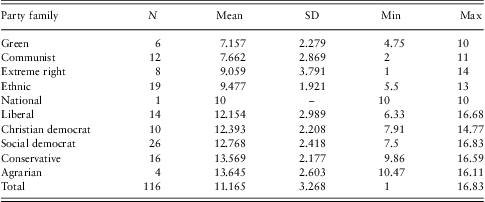
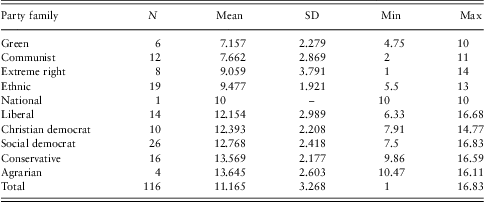
Our measure of party goals is based on Laver and Hunt's (Reference Laver and Hunt1992) expert surveys and indicates the extent to which parties prioritize office over policy. Specifically, experts were asked to evaluate each party on a 20-point scale using the following question: ‘Forced to make a choice, would party leaders give up policy objectives in order to get into government, or would they sacrifice a place in the government in order to maintain policy objectives?’ The response categories range from 1 to 20, with higher values indicating a greater office-seeking party orientation.Footnote 13 Using responses from multiple experts, Laver and Hunt calculated an average value for each party's relative priorities (for details, see Laver and Hunt (Reference Laver and Hunt1992); and the Supplementary Appendix).Footnote 14Table 1 reports the average scores on the office orientation measure by party family;Footnote 15 it reveals that conservative and agrarian parties are the most office-oriented parties with the average scores above 13, while green and communist parties are least likely to trade their policy goals for office (with the average scores of 7.157 and 7.662, respectively).
Party office orientation by party family
Party position toward the political system
To measure party positions toward the political system, we relied on the CMP data collected immediately prior to the CSES survey. Based on content analyses of party platforms by human coders, the CMP is the only cross-national data collection project that includes indicators of party views toward the political system. Our reading of the original documents that the CMP data are based on revealed that statements coded under the rubric of ‘constitutionalism’ provide the most appropriate indicator of a party's stance vis-à-vis the political system because they clearly reflect party positions about the fundamental rules of a political regime and maintaining its status quo.Footnote 16
There are two categories of statements: first, ‘Constitutionalism: positive’, which represents the extent to which a party supports specific aspects of the constitution, uses constitutionalism as an argument for policy, as well as generally approves of the constitutional way of doing things; and second, ‘Constitutionalism: negative’, which reflects just the opposite. The statements in these categories commonly included proposals for institutional changes, such as creating a presidency with substantial powers (proposed by the Australian Labor Party in its 1996 manifesto), or resisting changes in the existing constitutional order on the basis that it is ‘the product of hundreds of years of knowledge, experience and history’ (as the UK's Conservative Party proclaimed in its 1997 manifesto).Footnote 17
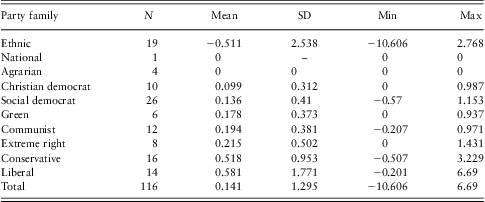
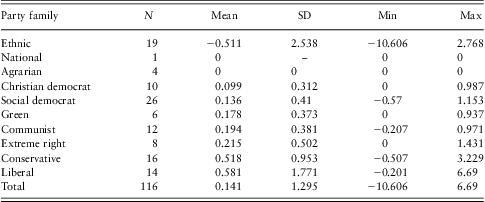
In reading the manifestos, we found that parties often express support for some aspects of the constitutional order while criticizing others. Thus, to capture overall party positions toward the country's institutional structure, we created a combined constitutionalism index by subtracting the percentage of ‘Constitutionalism: negative’ statements from the percentage of ‘Constitutionalism: positive’ statements.Footnote 18 The resulting variable ranges from −10.61 (Bloc Quebecois in Canada) to 6.69 (the Liberal Party in Canada) in our sample, with higher values indicating a more positive party position toward the political system.Footnote 19 Looking at party scores on the constitutionalism index by party family (shown in Table 2) reveals that ethnic parties express the most negative positions about the desirability of existing political institutions and arrangements while liberal parties take the most positive positions (the average scores are −0.511 and 0.581, respectively; the overall mean for 116 parties in our sample is 0.141).
Party position toward the constitutional status quo by party family
Recent efforts to assess various approaches to measuring party policy positions have questioned the extent to which the CMP data reflect party policy positions as opposed to the relative salience of those policies (e.g. Benoit and Laver, Reference Benoit and Laver2007; Lowe et al., Reference Lowe, Benoit, Mikhaylov and Laver2011).Footnote 20 Conflating salience with positions poses a problem for studies of party competition that often seek to assess the extent of a genuine policy change in party positions over time using party locations on various policy dimensions – particularly the left–right continuum – derived from the CMP data.Footnote 21
A closer look at the debate, however, reveals few grounds for concern for the purposes of our analysis. The CMP data is indeed grounded in the saliency theory (Robertson, Reference Robertson1976; Budge and Farlie, Reference Budge and Farlie1977; Budge et al., Reference Budge, Klingemann, Volkens, Bara and Tanenbaum2001). According to this theory, parties take up positions by emphasizing certain policy areas on which their positions are more credible while deemphasizing other policy areas. As a consequence, policy changes usually take place when parties de-emphasize previous priorities and take up new ones (Budge, Reference Budge1994: 455). This perspective is designed to accommodate the fact that, while parties can take opposite positions on some issues, this is not possible with respect to valence issues (Stokes, Reference Stokes1963), such as environmental protection or corruption to which no direct counter-position is feasible (Volkens et al., Reference Volkens, Bara and Budge2009).
The measures derived from the CMP data, however, have rarely been interpreted as indicators of policy saliency for political parties. Specifically, Lowe et al. (Reference Lowe, Benoit, Mikhaylov and Laver2011) argue that, according to the saliency theory, parties should endorse only single sides of each issue, while the CMP's coding scheme makes numerous practical concessions to the fact that many issues are two-sided, such as positions on free trade, or on attitudes toward European integration.Footnote 22 What is more, Benoit et al. (Reference Benoit, Laver and Mikhaylov2009: 500) note that all CMP coding categories (except one, a seldom used category of economic goals) are explicitly positional in their definitions, as they refer to ‘favorable mentions of…’, ‘need for…’, etc., and have been treated as indicators of policy positions rather than saliency by most researchers. In light of this discussion and the fact that our measures – ‘constitutionalism: positive’ and ‘constitutionalism: negative’ – are also based on the bi-polar coding scheme of the CMP data, we believe it is safe to interpret them as indicators of party positions toward the political system rather than saliency.
Analysis
Do office-seeking parties express more positive opinions about the political system than policy-seeking parties? And do partisans of parties that communicate positive views about the constitutional status quo express more support for the political system in their country than citizens who identify with parties with negative views? Figures 1 and 2 offer some preliminary evidence at the aggregate level of the connections between party goals, party positions on the political system, and citizens’ legitimacy beliefs.
Party support for constitutional status quo and party goals in 15 established democracies.

Political system support among nonpartisans and partisans of parties with high, medium, and low support for the constitutional status quo in 15 established democracies.
To examine whether parties’ goal orientations are related to their positions on the desirability of the political system, we calculated the average score on the constitutionalism index for parties with different goal orientations (Figure 1).Footnote 23 Our calculations show that, on average, political parties with a preference for office over policy take more positive positions regarding the constitutional status quo than other parties. In contrast, policy-seeking parties on average are more likely to take a negative position, with parties that balance between policy and office expressing a mild endorsement of the existing political order. The scores on the constitutionalism index for office- and policy-seeking parties are +0.414 and −0.606, respectively, while parties that balance between policy and office take a more neutral position on the political system (+0.146).
To examine whether party statements about the political system are linked to citizens’ legitimacy beliefs, we compared democracy satisfaction and external efficacy between non-partisans and partisans of parties with high, low, and medium levels of support for the constitutional status quo (Figure 2).Footnote 24 The data reveal patterns strongly consistent with our theoretical priors. Citizens’ attitudes toward the functioning of the political system vary according to party views about the existing political order. Figure 2 shows that about 88% of respondents who feel close to parties with high scores on the constitutionalism index are fairly or very satisfied with the democratic process in their country, while only 58% of partisans of parties with low scores and 75% of identifiers with parties with medium scores express such views. In comparison, 72% of non-partisans report being satisfied with democracy, which places them above partisans of parties with low support for the constitutional status quo, but below partisans of parties with medium and high support for the political system.
A similar pattern emerges when we look at external efficacy, with partisans of parties with high constitutionalism scores expressing the most positive attitudes about the responsiveness of the political system: 71% of these partisans scored high on the external efficacy scale, while the numbers for partisans with medium and low constitutionalism values were 63% and 55%, respectively. In comparison, non-partisans report the lowest levels of external efficacy with 53% agreeing that the political system is responsive. Taken together, citizens who identify with parties that adopt positive views about the constitutional status quo express significantly more optimistic attitudes about the functioning of the political system than partisans of other parties and non-partisans. And while a lack of partisanship clearly undermines external efficacy beliefs, the pattern is less clear cut with respect to satisfaction with democracy, where partisans of parties with negative positions express even more negative views than non-partisans.
To establish how sizable and robust these relationships are once other factors are controlled for, we sought to estimate multivariate models of support for the political system. As discussed above, existing research provides strong reasons to expect the causal arrow to run from parties’ messages to partisans’ views, rather than the reverse. However, in devising a proper estimation strategy, we sought to account for possible endogeneity by employing a two-stage instrumental variable (IV) approach (Baum, Reference Baum2006; for application in political science, see Gabel and Scheve, Reference Gabel and Scheve2007). Instrumental variable estimation purges the potentially endogenous regressor – in our case party positions toward the constitutional status quo – of variation that is not a function of exogenous variables.Footnote 25 IV estimation is not a costless solution, however: IV estimates are less efficient compared with ordinary least squares and can be biased if the assumptions of the model are violated. We therefore needed to identify instruments that are valid, that is, have a significant partial correlation with party positions toward the constitutional status quo, controlling for all other exogenous determinants of citizens’ support for the political system, while being uncorrelated with the error term in the model of citizens’ support for the political system.
We posit that party goal orientation and party seat-vote disproportionality can be used as such instruments. As we argued above, office-seeking parties adopt more positive positions toward the existing political system than policy-seeking parties. Office-seeking parties are less encumbered by party activists’ policy preferences, are freer to maximize (re-)election (Strøm, Reference Strøm1990), and therefore are more likely to be electorally competitive, get elected to office, and implement their preferred policies. Moreover, because office-seeking parties are more likely to become parties in parliament and government, they are also more likely to write the rules of the game and be in charge of enforcing them than parties outside of government or parliament. As a consequence, they are also more likely to benefit from the status quo of a political system, and hence express more positive views about it than policy-seeking parties.
Parties with a larger share of legislative seats than their share of votes can be similarly expected to express stronger support for the political system than parties that received a smaller percentage of seats in comparison to their votes in national elections. Translation of votes into seats has been shown to play an important role in shaping party strategies and behavior, including party efforts to push for constitutional changes, especially in electoral systems (Benoit, Reference Benoit2004, Reference Benoit2007; Colomer, Reference Colomer2005). And while institutional changes and vote-seat disproportionality have traditionally been studied at the level of countries rather than parties, the underlying assumption of agent-based models of institutional change is that parties adopt different positions toward the status quo of the political system, in large part driven by party perceptions of how much they are advantaged or disadvantaged by existing political institutions.
While office orientation and party seat-vote disproportionality matters for how parties evaluate the political system, we know of no studies arguing that these factors directly influence citizens’ legitimacy beliefs. Thus, we have theoretical and empirical reasons to justify the selection of our instruments; however, we still need to demonstrate that our instruments meet the assumptions for the IV approach to provide consistent estimates. The assumption that the instruments are statistically independent from the disturbance process cannot be verified in the data directly (Baum, Reference Baum2006: 191). However, since our model is over-identified we can provide evidence that instruments are adequate by reporting test statistics below.Footnote 26
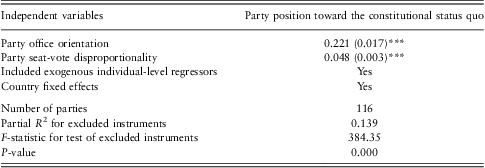
We report the results of two-stage IV estimations in Tables 3 and 4. The first stage is designed to predict party positions toward the constitutional status quo using our instruments – party office orientation and party vote-seat disproportionality (measured by subtracting the percentage of party votes from the percentage of party seats in the previous national election) – while controlling for all variables specified in the model of citizen support for the political system and country fixed effects, and estimating our models using robust standard errors (see Arceneaux and Nickerson, Reference Arceneaux and Nickerson2009).Footnote 27 The second stage employs instrumented party position toward the constitutional status quo as an independent variable in the model of citizen support for the political system, controlling for other determinants of people's attitudes toward their political system, including country fixed effects and using robust standard errors (see the Supplementary Appendix for detailed information on variable coding).
Predicting party support for constitutional status quo in 15 democracies
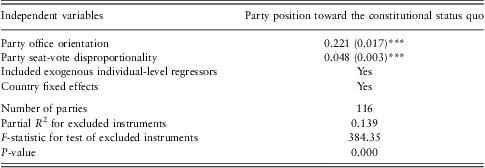
Note: The results are two-stage least squares first-stage coefficient estimates (using Stata's ivreg2 command) and their robust standard errors (in parentheses): *P < 0.05, **P < 0.01, ***P < 0.001.
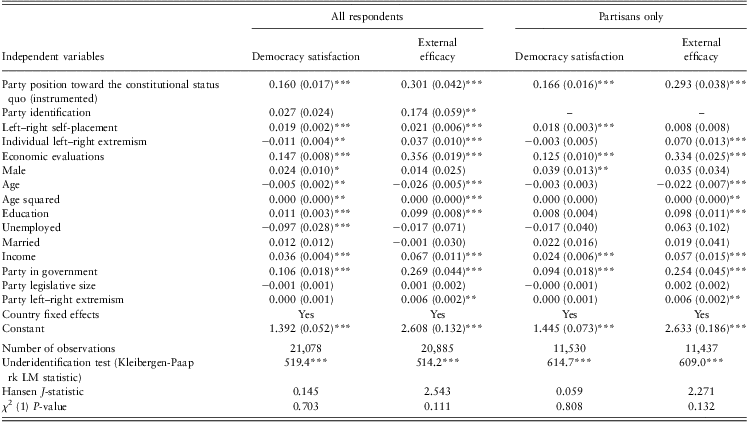
Predicting citizen support for political system in 15 democracies, 1996–2002
Note: The results are two-stage least squares second-stage coefficient estimates (using Stata's ivreg2 command) and their robust standard errors (in parentheses): *P < 0.05, **P < 0.01, ***P < 0.001. Party position toward the constitutional status quo is instrumented using party office orientation and party seat-vote disproportionality.
The first stage of the IV estimations, reported in Table 3, indicates that both instruments have the anticipated signs and are significantly correlated with party support for the constitutional status quo. We find that, controlling for all predictors of citizen support for the political system as well as country dummy variables, political parties with office orientations report more support for the political system in their manifestos than policy-seeking parties. Similarly, parties that enjoy a higher share of legislative seats than the proportion of votes they received in the previous national election express more positive views about the constitutional status quo than parties who received fewer seats than they deserved given their vote share.
To systematically assess the validity of our instruments, we rely on several test statistics. First, the F-statistic for testing excluded instruments is equal to 384 and the F-statistic is significant at less than 0.001, indicating that our instruments are jointly significant. Furthermore, the Hansen J-test statistic in all models reported in Table 4 is statistically insignificant, indicating that the instruments are appropriately uncorrelated with the error term in the second-stage estimations. Taken together, the results show that the selected instruments are relevant and statistically independent from the disturbance process, satisfying the key requirements for valid instruments in the IV approach.
Table 4 presents the results of the second-stage estimations that employ the exogenously derived measure of party position toward the political system to explain citizens’ views about the political system. We provide two sets of results: first, we report the findings for all respondents. We do so to test two mechanisms by which partisanship can be expected to influence citizens’ attitudes toward the political system: (1) the traditional view, according to which partisanship should increase people's support for the political system regardless of the opinions parties express about the constitutional status quo and (2) the party persuasion view, according to which party positions should influence their partisans’ legitimacy beliefs.Footnote 28 To put the latter expectation to a more rigorous test, we then estimate our model using the sample of partisans only.
In the second-stage estimations, we control for whether a respondent's preferred party is in government because winners have been shown to be more satisfied with democracy in their country than other voters (Ginsberg and Weissberg, Reference Ginsberg and Weissberg1978; Nadeau and Blais, Reference Nadeau and Blais1993; Anderson and Guillory, Reference Anderson and Guillory1997; Norris, Reference Norris1999; Anderson et al., Reference Anderson, Blais, Bowler, Donovan and Listhaug2005). We also include the respondent's left–right self-placement because right-wing ideology is usually associated with conservatism and stronger support for the existing status quo, while left–wing orientations are associated with openness to change and more critical attitudes toward the political system (Anderson and Singer, Reference Anderson and Singer2008). Furthermore, since radical views usually lead to more dissatisfaction with a political system and a willingness to mobilize for change (Riker, Reference Riker1982; Anderson et al., Reference Anderson, Blais, Bowler, Donovan and Listhaug2005: Ch. 5), we include a measure capturing the individual's distance from the country's median on the left–right continuum. In addition, we sought to identify citizens with a greater stake in the maintenance of the societal status quo using variables such as income, education, and unemployment, as well as gender and race, which reflect citizens’ socioeconomic status or political resources (Almond and Verba, Reference Almond and Verba1963; Anderson et al., Reference Anderson, Blais, Bowler, Donovan and Listhaug2005: 20) At the party level, we additionally control for party distance from the country's median on the left–right continuum and party share of legislative seats, and include country fixed effects to capture cross-country heterogeneity in public support for the political system (see the appendix for survey question wording and variable coding for all measures).
The results of the second-stage estimations are in line with our expectations.Footnote 29 We find that partisans’ beliefs about the performance of the political system are consistent with their parties’ support for the constitutional status quo. That is, partisans whose parties take more positive positions toward the political system express higher levels of satisfaction with the way democracy works and report higher levels of confidence that the political system is responsive to them. These findings hold when we estimate our model using all respondents (partisans and non-partisans), as well as when we run our analyses on a reduced sample of partisans only. Hence, we find that parties play an important role in shaping their partisans’ views about the political system. At the same time, the results for all respondents show that partisanship exerts a direct positive effect on citizens’ opinions regarding the external efficacy of the political regime, regardless of party outlook. Thus, individuals who are attached to parties are more likely to believe that the system is responsive to their preferences and demands than non-partisans.Footnote 30
The other control variables produce results consistent with prior research. We find that supporting the government and positive evaluations of economic performance increase citizens’ satisfaction with democracy and their sense of external efficacy. What is more, the results show that higher income and education contribute positively to public support for the political system, as does being young and male. Moreover, right-wing ideological self-placement is linked to stronger legitimacy beliefs. However, ideological extremity has divergent effects on our two dependent variables: while it tends to reduce citizen satisfaction with democracy, it enhances people's sense of external efficacy.
How much does party support for the political system matter in shaping their partisans’ legitimacy beliefs? To assess our results in greater detail, we calculated the marginal effects of party position on the constitutional status quo on partisans’ legitimacy beliefs using the results for partisans reported in Table 4.Footnote 31Figure 3a plots the magnitude of this effect for the satisfaction with democracy variable, and Figure 3b – for external efficacy. The dark-grey bars indicate the levels of system support among partisans whose parties express positive views about the system (1 standard deviation above the average constitutionalism score in our sample of parties), while white bars report the levels of system support among identifiers of parties with negative views (1 standard deviation below the average constitutionalism value); the vertical bars show the 95% confidence intervals.
The effects of party positions toward constitutional status quo on (a) partisans’ satisfaction with democracy in 15 democracies, 1996–2002 and (b) partisans’ external efficacy in 15 democracies, 1996–2002.
Calculations of the substantive effects reveal that party positions toward the political system have a sizable impact on their partisans’ legitimacy beliefs. Specifically, satisfaction with democracy among partisans of parties that express positive views is 0.43 units higher than levels of satisfaction among those who identify with parties that take negative positions (2.432 vs. 2.003). Similarly, the predicted level of external efficacy among supporters of parties positively oriented toward the system is 5.196 compared with 4.438 for partisans of parties with negative views (a difference of 0.758). In short, what parties say about the political system in their country has a powerful impact on their partisans’ legitimacy beliefs, and this effect is consistent and statistically significant across different measures of legitimacy beliefs.
Discussion
Modern democracies are party democracies. But political parties have yet to take center stage when it comes to how citizens evaluate the political system. This study was designed to show that political parties play an important role in shaping citizens’ views about the system. As organizations, political parties pursue a variety of goals; while some put greater emphasis on winning office, others are willing to forego office in the pursuit of policy objectives. And these organizational goals, we argue, indirectly affect what supporters think about the political system because office-oriented parties have an incentive to take more positive positions about the political regime, while policy-seeking parties take a more critical stance.
Partisanship provides the critical link between party elites and party supporters in communicating views about the political system. By expressing their positions, office- and policy-seeking parties engender different levels of enthusiasm for the status quo among their supporters. As a result, political parties actively shape the beliefs citizens adopt about the functioning of democratic governance in their country. Using survey data collected in 15 countries and data on parties’ goals and positions for 116 parties, we find that party positions do influence public support for the political regime and that this effect is not an artifact produced by strategic position taking by parties.
We find that supporters of political parties with more positive views about the political system tend to be more satisfied with democracy and report higher levels of external efficacy than partisans of parties with pessimistic opinions. Moreover, we find that non-partisans are more satisfied with democracy than citizens who identify with parties with a negative outlook toward the political system but less satisfied than partisans of parties with positive positions. However, a lack of partisanship has an overwhelming negative effect on citizens’ external efficacy beliefs, as non-partisans are considerably more pessimistic about the responsiveness of the political system than partisans of any party. Finally, we find that party positions toward the system are driven by the goals they pursue when faced with a trade-off between office and policy. Office-seeking parties express more support for the status quo of the existing regime and thus lead to more satisfaction with the system among their supporters compared with policy-oriented parties.
By integrating research on party goals, party programs, partisanship, and democratic legitimacy, we sought to make a contribution to each of these literatures. Regarding the literature on democratic legitimacy, our findings suggest that parties clearly have the capacity to mobilize consent or dissent from above. Thus, legitimacy is as much a process of bottom-up politics where citizens hold the political system accountable for its performance, as it is a process of top-down politics where strategic elites seek to further their own goals, sometimes at the expense of the broader body politic. We need not resort to extreme examples like the failure of the Weimar Republic to appreciate this point – examples of party elites shaping the views of their supporters abound in a variety of policy areas (e.g. Gabel and Scheve, Reference Gabel and Scheve2007; Sniderman and Hagendoorn, Reference Sniderman and Hagendoorn2007). Whether this mobilization of consent, born of the parties’ self-interested strategic calculations as office seekers and status quo defenders, is desirable is a normative question that hitherto has not been asked. We suggest that, at a minimum, it is worth thinking about.
This also contributes to the literature that seeks to explain the causes and consequences of parties’ policy positions. While these have mostly been studied cross-nationally with an eye to the quality of democratic representation (McDonald and Budge, Reference McDonald and Budge2005; Kim et al., Reference Kim, Powell and Fording2010), or how the translation of voters’ preferences into government policy shapes citizen support for the political system (Paskeviciute, Reference Paskeviciute2006), our study suggests that parties’ positions on the functioning of the political system can also be fruitfully understood to shape the foundations of citizens’ legitimacy beliefs.
In a curious way, then, our findings reinforce Dalton's concerns that a loosening of the connection between political parties and citizens observed in established democracies may indeed undermine mass support for the democratic governance. And this is likely to happen not only because the lack of partisanship will weaken citizen attachment to a political system generally. Given that political elites are usually more supportive of democratic principles than are ordinary citizens (Converse and Pierce, Reference Converse and Pierce1986; Sullivan et al., Reference Sullivan, Walsh, Shamir, Barnum and Gibson1993), support for the political system may be eroding because citizens are less likely to be affected by the positive messages office-seeking parties articulate about the system. Thus, in times of de-aligned citizens, legitimacy from above is harder to come by. Whether this is such a terrible state of affairs remains to be seen.
Supplementary material
To view supplementary material for this article, please visit http://dx.doi.org/10.1017/S1755773912000082.