Introduction
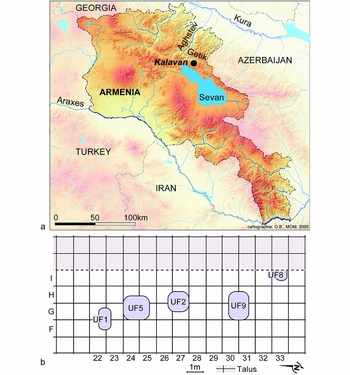
Recent approaches to the social and cognitive dimensions of the use of animal species or their bones in burials and in artefact production consider human-animal relationships as integral to the use practices (e.g. Choyke Reference Choyke, Campana, Crabtree, deFrance, Lev-Tov and Choyke2010; Morey Reference Morey2010; Losey et al. Reference Losey, Bazaliiski, Garvie-Lok, Germonpré, Leonard, Allen, Katzenberg and Sablin2011). The practices are interpreted in terms of cultural attitudes, but burials may be windows to individual actions. Recently, two perforated upper molars of dog (Canis familiaris) were found in direct association with a child skeleton at the Kura-Araxes burial ground of Kalavan-1, north-eastern Armenia (Figure 1). This type of tooth artefact occurs in different periods and regions, but actual finds of this kind are rare. This article examines contextual, morphological and wear data in order to explore the cultural logic that guided the use of dog molars in the ornamentation of the dead.
The location of the Kalavan-1 cemetery in Armenia (a) and the position of the burials within the excavation grid (b).

The Kura-Araxes cultural phenomenon, dated to 3600/3500–2500/2400 cal BC, extends throughout most of the Early Bronze Age in the South Caucasus region, and can be traced south-westwards in north-east Anatolia and, by the beginning of the third millennium, to the Upper Euphrates as far as the Mediterranean coast (e.g. Smith Reference Smith2005, Reference Smith and Potts2012; Kohl Reference Kohl2009; Chataigner & Palumbi Reference Chataigner and Palumbi2014). In the east, it stretched southwards from south-eastern Daghestan to north-western Iran. The culture is best known for handmade burnished ceramics and numerous settlements of various types, dispersed at different environmental and altitudinal zones. The reason for this dispersal—economic buffering, population growth, cultural assimilation and so on—remains elusive, largely due to the dynamic character of the culture. Current discussions revolve around spatial, social and material variability and the multidirectional flows of people, objects and influence. With regard to mortuary activities, cemetery burials became a recurrent practice, and the process of tomb diversification that had started in the Chalcolithic period continued within the Kura-Araxes horizon (Poulmarc'h Reference Poulmarc'h2014; Poulmarc'h & Le Mort Reference Poulmarc'h and Le Mort2016). Stone-built tombs appeared for the first time during this latter period and were used alongside kurgans (burial mounds) and pit graves, which could be covered with stone heaps. While the kurgans have Chalcolithic antecedents, it is not yet clear whether the stone-heap pit-graves were an entirely new phenomenon. Despite diversity, the Kura-Araxes burials are simple and contrast with their ostentatious counterparts of the north-west Caucasian Chalcolithic Maikop culture and the south Caucasian Middle Bronze Age. The Kura-Araxes grave goods, when present, are few and consist of local ceramics and personal ornaments, namely stone (usually carnelian) beads and bronze rings and bracelets. They do not relate to burial type, or to the age or gender of the deceased, suggesting that status was ascribed on an individual basis (e.g. kinship bond). This is not, however, supported by other observations in the zones of geographic expansion of the Kura-Araxes culture; for example, the association of local and non-native elements in the rich assortment of ceramic and metal artefacts from the grave of the ‘Signiore di Arslantepe’ in the Upper Euphrates basin (Frangipane et al. Reference Frangipane, Di Nocera, Hauptmann, Morbidelli, Palmieri, Sadori, Schultz and Schmidt-Schultz2001).
The perforated dog molars from Kalavan-1, so far unique in the South Caucasus and adjacent regions, enrich the Kura-Araxes material assemblage. The cemetery has been assigned to this period on the basis of pottery types and absolute dates. Dog remains are rare in the faunal assemblages from the area (e.g. Mirzoyan & Manaseryan Reference Mirzoyan, Manaseryan, Vila, Gourichon, Choyke and Buitenhuis2008; Piro Reference Piro, Vila, Gourichon, Choyke and Buitenhuis2008; Bălășescu et al. Reference Bălășescu, Vila, Radu, Badalyan and Chataigner2010; Wilkinson et al. Reference Wilkinson, Gasparyan, Pinhasi, Avetisyan, Hovsepyan, Zardaryan, Areshian, Bar-Oz and Smith2012; Berthon et al. Reference Berthon, Decaix, Kovaćs, van Neer, Tengberg, Willcox and Cucchi2013), and the molars are an even more exceptional example of body adornment. The closest comparison to the Kalavan-1 specimens is a naturally worn upper dog molar with a single perforation, discovered in a Neolithic burial at Parma-via Guidorossi, Italy, and dated to the mid fourth millennium BC (Bernabò Brea et al. Reference Bernabò Brea, Mazzieri and Micheli2010: 134–35 & fig. 19). It was part of a necklace comprised exclusively of dog teeth. Geographically nearer to the Armenian specimens is an upper second dog molar with a perforated root from the Bronze Age settlement of Százhalombatta-Földvár, Hungary, dated to c. 2100–1600 cal BC (Choyke et al. Reference Choyke, Vretemark, Sten, O'Day, Neer and Ervynck2004: 186 & fig. 17). Several dog and wolf molar and premolar pendants are also known from the Latvian Mesolithic and early Neolithic graves of Zvejnieki, which span c. 9000–4100 cal BC (Lõugas Reference Lõugas, Larsson and Zagorska2006: 84–85, fig. 7; 14C dates: Mannermaa et al. Reference Mannermaa, Zagorska, Jungner and Zarina2007). Also recorded is a dog's lower carnassial (first molar) with a double perforation from the late Natufian (12000 cal BP) burial cave of Hilazon Tachtit, Israel (Grosman Reference Grosman2003: 575 & fig. 6). Since the Palaeolithic, the use of canid molars and premolars in the production of portable art appears erratic, in contrast to the more frequent use of canines and incisors (e.g. Barge-Mahieu & Taborin Reference Barge-Mahieu, Taborin and Camps-Fabrer1991; Vanhaeren & d'Errico Reference Vanhaeren and d'Errico2006). Much could be said about the selection of dogs, based on their physical state and appearance or ante mortem relation to humans (e.g. Copet-Rougier Reference Copet-Rougier1988). Any attempt to assess the influence of such symbolic connotations on the mortuary behaviour in the South Caucasus region is constrained by the paucity of dog skeletal material. Below, we consider evidence for the symbolic use of canid bones during the Kura-Araxes period and discuss change in funerary artefacts. We accept that symbols can be transformed through their use (Sewell Reference Sewell, Bonnell and Hunt1999: 46–47), and argue that small-scale actions, like the shaping, use and burial of dog molars, suggest such variability within the Kura-Araxes society. They may hint at individuals or groups striving to maintain social and cultural coherence in a changing economic and political environment. They may also suggest loose connections between groups and a lack of competition. As has been argued elsewhere (Hamilakis Reference Hamilakis, Driessen, Schoep and Lafinneur2002: 183), “competition needs a common basis for comparison [. . .] and the same media” and may concern only certain parts of the society. No such tensions or divisions are documented within the Kura-Araxes agro-pastoral communities of the South Caucasus region, which represent small-scale societies with a material culture attesting to local variability. It could be argued that the dynamism of the period provided opportunities for individual action and innovation in the symbolic sphere, while new mortuary symbols would not be tolerated or desired in a period of stability.
The site and the burial ground
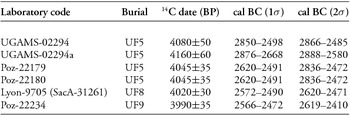
Kalavan-1 is an open-air site situated 1640m asl on the south-west-facing slopes of the Aregunyats Range north of Lake Sevan. Archaeological and geological investigations were conducted between 2005 and 2009 as part of a collaborative Armenian and French project (Chataigner et al. Reference Chataigner, Gasparyan, Montoya, Arimura, Melikyan, Liagre, Petrosyan, Ghukasyan, Colonge, Fourloubey, Arakelyan, Astruc, Nahapetyan, Hovsepyan, Balasescu, Tomé, Radu, Avetisyan and Bobokhyan2012; Montoya et al. Reference Montoya, Balasescu, Joannin, Ollivier, Liagre, Nahapetyan, Ghukasyan, Colonge, Gasparyan and Chataigner2013). The excavation revealed two main levels of occupation dated to the Terminal Palaeolithic, overlain by the Kura-Araxes burial ground. Due to the steep topography above Kalavan-1 (13–14° slope), which lies near the bottom of the deep valley of the Barepat River, a tributary of the Getik, connecting through Aghstev with the Kura River, only limited exposures of the archaeological remains were made. The total excavated area approached 70m2. Five burial pits were uncovered, of which four, referred to as UF1, UF2, UF8 and UF9 (Figure 1b), contained single primary burials; the fifth, UF5, held the remains of at least three individuals. Six consistent 14C dates on human skeletal material from UF5, UF8 and UF9 bracket the use of the burial site between c. 2850 and 2490 cal BC (Table 1) in the late Kura-Araxes phase. Age at death and sex were assigned to three individuals: two adult females and a juvenile aged between five years and six months and six years and six months (Table 2). The other skeletons belonged to adults, but poor preservation precluded age or sex estimates.
AMS radiocarbon dates from the burial ground of Kalavan-1; calibrated date ranges were obtained using IntCal13 and OxCal v4.2.

Burial data from Kalavan-1.

1 Based on Bruzek (Reference Bruzek2002); 2based on Schmitt (Reference Schmitt2005); 3 based on Moorrees et al. (Reference Moorrees, Fanning and Hunt1963).
The graves were excavated following the ‘archaeothanatology’ method, which is based on detailed analysis of the skeletal and other remains within the burial, and of the acts related to the treatment and management of the dead (Duday Reference Duday2009). Stone heaps rising to around 0.7m in height marked the graves of the adults. These structures were of oval plan with an average major axis of 1m, and of 1.7m for the heap above UF5. The position of the body in the pits varied: sitting, tightly flexed and flexed. The three single adult burials yielded evidence for the post-sepulchral retrieval of bones as a mortuary practice. Movement of bones away from the initial volume of the corpse had also occurred, indicating that the body had decomposed within an ‘empty space’. We propose that the deceased and associated burial goods were placed in a box made of perishable material, possibly wood. The adult burials were furnished with similar assemblages of black burnished pottery: one goblet with a tripartite profile, and two or three large bowls. UF9 also contained two bronze ornaments: a ring and a bracelet.
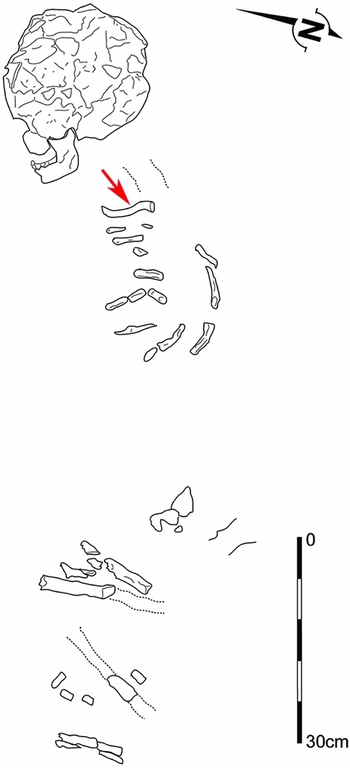
The child burial, UF8 (Figure 2), represents an undisturbed deposit. The skeleton was found articulated. It was lying flexed on the right side. The east–west orientation of thebody (head to the east) conforms to the pattern observed in the single adult burials. The child was probably adorned with a neck-ornament composed of the two dog molars and two stone beads, one made from carnelian and the other from a blue stone, probably a pebble.
Plan of the child burial from Kalavan-1, Armenia (the arrow indicates the location of the ornaments; drawn by Modwene Poulmarc'h).

The dog molars
We now turn to the anatomical origin, preservation, manufacture and use of the Kalavan-1 tooth artefacts. Surface damage was studied using a stereomicroscope and a metallographic microscope of up to 200× magnification. Manufacturing and use-wear features were further examined with a scanning electron microscope. High magnifications were employed to interpret wear that had resulted in a polished appearance (e.g. Legrand & Sidéra Reference Legrand, Sidéra, Gates St-Pierre and Walker2007), and to observe the extent and variety of accidental damage.
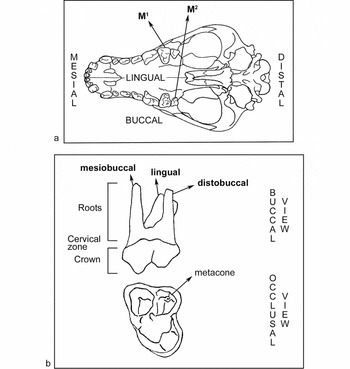
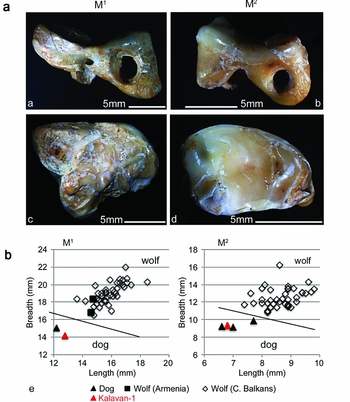
The two specimens comprise one upper left first and one upper right second molar (M1 and M2, respectively; Table 3 & Figures 3 & 4a–d). In the dog, these teeth appear in the permanent dentition. Species identification was based on metrics available from prehistoric sites in Armenia and recent wolf populations of the central Balkans (Figure 4e), currently the largest and geographically closest sample to Kalavan-1. Both teeth had fully erupted, indicating animals aged six months or older (Schmid Reference Schmid1972: tab. X). The occluding surface of M1 displays increased wear compared to that of M2, as was expected given the size and position of the molars in the animal's mouth. The observed wear suggests that these were from sub-adult or adult dogs, yet the Kalavan-1 specimens are isolated finds, and wear stages as defined by Horard-Herbin (Reference Horard-Herbin and Crockford2000) could not be correlated with skeletal material in order to obtain age estimates. Moreover, as mentioned above, regional data are too poor to permit evaluation of the tooth wear rate. Nor is it possible to know whether the two molars came from the same individual.
Metrical data on Kalavan-1 dog molars (measurements in millimetres). Internal diameters are approximate because of damage in the interior of the holes. The external diameter varies on each one of the cones; the values given below are indicative.

a Based on von den Driesch (Reference Driesch1976); b length from the coronal to the apical region of the cone; c length from the mesial to the buccal region of the cone.
Canid dentition: a) upper jaw showing position of M1 and M2 (based on von den Driesch Reference Driesch1976: fig. 14c); b) schematic upper molar (based on Schmid Reference Schmid1972: fig. 19) with anatomical terms employed in the text.

a & b) Mesial aspect of the Kalavan-1 dog molars; c & d) occlusal surfaces. The M1 cusps are worn down at even height; the M2 cusps are worn but clearly defined; the M2 metacone is faceted; e) comparison of recent wolf M1 and M2 (Dimitrijević & Vuković Reference Dimitrijević and Vuković2015) and prehistoric specimens from Armenia. Summary of metrics in Table S1 in online supplementary material (see Table 3 for Kalavan-1; photographs by Rozalia Christidou).

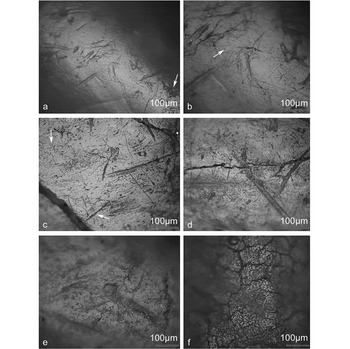
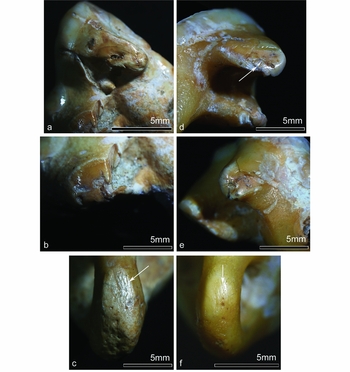
Post-burial modification of the Kalavan-1 dog molars: a & b) M1, crown, mesial view, pitted areas (indicated by arrows) appear unpolished; c & d) M1, mesiobuccal root, the arrows show microscopic cracks (upper left) and abrasion (lower); e) M1, lingual root, detail of cracked surface near the apex; f) M2, mesiobuccal root, detail of cracked mesial surface (photographs by Rozalia Christidou).

Both teeth are complete, but post-burial damage, consisting of cracking, pitting and flaking (Figures 4a–d & 5), affects their entire surface. Encrustations, light abrasion and recent removals are also present. About 50% of the surface of M2 is affected; M1 has suffered more damage. Decay is more advanced on the human skeletal remains, which are brittle and easily pulverised. Temperature change and solifluction at Kalavan-1 have probably aggravated bone corrosion. Soil composition was not studied, and the burial environment could not be examined as a potential agent of bone diagenesis.
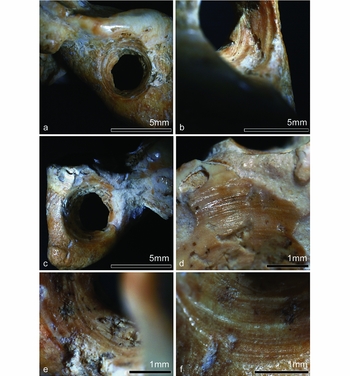
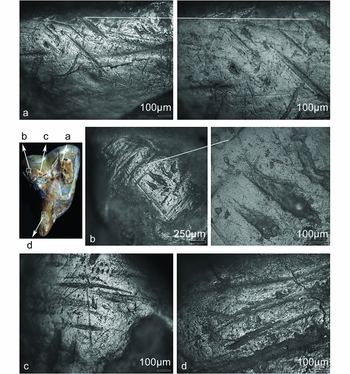
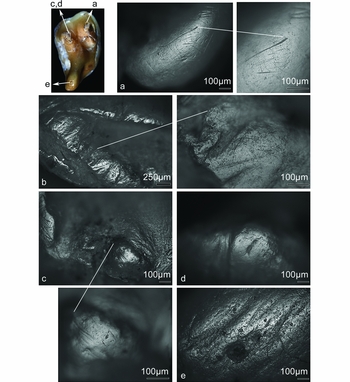
The post-depositional effects on the teeth hindered observation of the manufacturing and use marks, but the overall pattern could be analysed. Manufacturing consisted of hole shaping and root trimming. Both teeth were perforated by a circular hole cut through the lingual root in a mesiodistal direction, immediately below the cervical region. This root is shorter and more massive than the buccal roots (Figure 3b); it is also compressed mesiodistally, providing space for boring small holes (Table 3). The opening is slightly elongated in a coronal/buccal–apical/lingual direction on M1 and rounded on M2. The perforations were cut from opposite sides (‘biconical’; Figures 6 & 7) using a revolving, tapered, lithic tool. On M2, the mesial cone is slightly deeper than the distal cone. The angles at which the perforations were made are slanted; cone profiles are lopsided, partly due to the natural shape of the molars, which bulge above the roots. Overall, the outer edges of the holes appear sharp or flaring, indicating variations in the angles cut during the shaping of each one of the cones. The walls of the perforations (best preserved on M2) display groups of well-formed curving grooves separated by flat plateaus or ridges. Deviations from the intended course and intersections of linear marks also occur. These latter features and the profiles of the holes indicate changes in inclination and incomplete turns of the carving tool, and exclude uniform rotation by mechanical means or a hand drill (Stordeur Reference Stordeur and Camps-Fabrer1977; Stordeur & Pion Reference Stordeur and Pion1993).
Kalavan-1 dog M1: a) mesial cone, plan view; b) detail of the apical side of the cone; c) distal cone, plan view; d) detail of the occlusal side of the cone; e & f) apical side of the cone (photographs by Rozalia Christidou).

Kalavan-1 dog M2: a–c) mesial cone; d–f) distal cone; the arrows mark use polishing on (a) and (d) and intersecting striations on (b), (c) and (f) (photographs by Rozalia Christidou).

The buccal roots were broken in order either to remove the teeth from the jaw or to reduce their length (Table 3; Figures 4a–b & 8a–b & d–e). Both buccal roots of M2 and the distobuccal root of M1 show V-shaped fractures. Fracture type was not determined for the M1 mesiobuccal root, which was thoroughly worked after the breakage and almost completely removed. The broken end of the distobuccal root of M1 and the apex of the lingual roots (Figure 8b–c & f) were flattened using grinding (cf. Figures 9 & 10e), creating small facets with variable inclinations. On the M2 mesiobuccal root, grinding was employed to smooth the high relief of the fracture surface (Figures 8d & 10b). The broken end of the M2 distobuccal root shows no further modification prior to use (Figure 8e).
Apical view of the Kalavan-1 dog molars: a–c) M1; d–f) M2; mesiobuccal roots on the upper side of (a) and (d); lingual roots on (c) and (f); the arrows indicate shaping marks worn through use (photographs by Rozalia Christidou).

Kalavan-1 dog M1, root-end wear state: a) mesiobuccal; b & c) distobuccal; d) lingual facets; details for (a) and (b) at 200× (photographs by Rozalia Christidou).

Kalavan-1 dog M2, root-end wear state: a) mesiobuccal root, extremity; b) mesiobuccal root, ground surface; c & d) distobuccal root, extremity, distal and mesial views; e) lingual facet; details for (a), (b) and (c) at 200× (photographs by Rozalia Christidou).

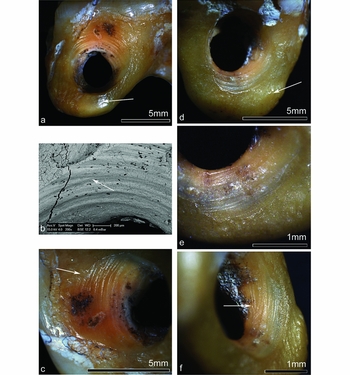
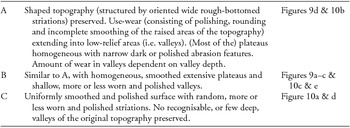
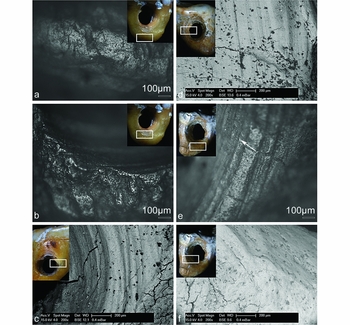
Use-wear on the teeth included polishing, rounding and smoothing, which was most developed on the root ends. The holes exhibit the highest degree of use-wear at the intersection of the cones, in the centre of the perforation. This wear is perceptible at low magnifications (e.g. Figure 7e), as are polishing and smoothing on the high natural relief between the apex of the lingual roots and the holes (Figure 7a & d) and on the perforation marks on the margin of the crown (Figure 7c). Under high magnification, three main wear patterns, corresponding to different degrees of use damage, were defined on the root ends (Table 4). Patterns B and C indicate heavy wear and are observed on the high relief (i.e. edges and convexities) of the root extremities. Wear fades away from these areas as shown by the presence of pattern A on their margins (Figures 9d, 10b & 11a). The polishing is somewhat developed farther away, towards the holes and in low-relief areas (Figure 11b). Greater wear on the margin of the crown, as described above, is a result of these raised areas being more exposed to friction.
Root-end wear state defined at 200× magnification. Topography is also observed at 100× magnification. Use striations on B and C surfaces have no preferred orientation. The amount of use pits is difficult to evaluate due to post-depositional damage.

Holes: a) M2, distal view, homogenised margin of the apex (cf. Figure 7a & d); b) M2, distal view, natural topography unmodified, uneven, superficial polishing; c) M2, mesial view, shaped topography unmodified, light use-wear; d) M1, mesial view, shaped upper relief, rounding; e) M1, distal view, shaped upper relief, use striations (indicated by the arrow) and polishing; f) M1, internal edge, smoothing (photographs a, b & e by Rozalia Christidou; c, d & f by Hala Alarashi).

The outer parts of the holes show use-wear on the highest points of the original surface relief (Figure 11c–e). Towards the inner part of the cones, the grooved topography is preserved, but use-wear becomes stronger, as indicated by worn-down valleys and homogeneous, smoothed and polished plateaus; the polishing is crossed by closely packed fine striations that are perpendicular or oblique to the manufactured grooves. This wear appears mainly on and near the apical region of the holes and is connected to the smoothing of their internal edge (Figure 11f). The limits of these modifications are either undetermined because of accidental damage, or ill-defined because the wear faded out.
Artificial and post-burial wear and tear indicates similar processes of manufacturing, use and post-depositional damage. The shaping process shows minor variations mostly related to the treatment of the roots. The nature and amount of use-wear on the apical side of the molars and on the protruding rim of the tooth crown suggest loose but prolonged contact with soft animal tissue, as well as handling (e.g. d'Errico Reference d'Errico, Anderson, Beyries, Otte and Plisson1993; Stordeur & Christidou Reference Stordeur, Christidou and Ibáñez2008). The type and distribution of the wear within the perforations and on their margins towards the apex of the lingual root show that a thread of plant fibres passed through the hole, and that the molars were suspended. The location of the perforations on the lingual roots indicates that the crowns would be the most visible part of the teeth, which were probably worn as pendants.
Discussion
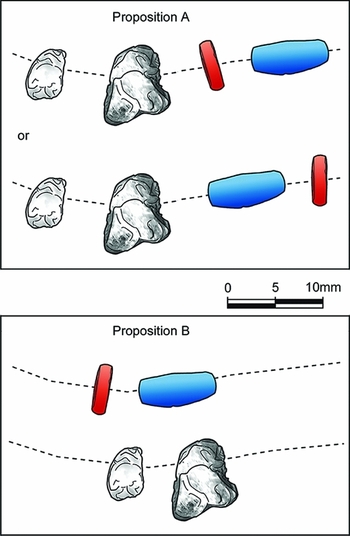
The choice of upper dog molars and the shaping and use of the objects made from these teeth indicate an orderly pattern. Both specimens were worked using the same method in order to be used in the same way, probably as part of the ornamental cluster that included the stone beads. Figure 12 reveals the lack of consistency and symmetry; shapes, sizes and colours vary. No technological study of the stone beads has been conducted, but it is probable that texture, and therefore touch and reflectivity, also varied and perhaps influenced the perception and the meaning of the colours (e.g. Pastoureau & Simonnet Reference Pastoureau and Simonnet2010: 35). The raw materials appear distinctive: the white crowns of the teeth, which show no deliberate modification, contrast with the red and blue shaped stone pieces. The manufacturing technique of the perforated molars indicates simple preparation for displaying the crown; there is no evidence of skilful shaping or finishing, suggesting that any individuality or style was intrinsic and not created by the manufacturing process. Moreover, tooth eruption and occlusal wear imply that the dog(s) from which the molars were derived had lived long enough to develop ties with humans, possibly with the wearer. Such links would explain the choice of molars and personalise the ornament. On the other hand, recent discoveries within the territory of the Republic of Armenia hint that dogs and wolves played a symbolic role in the burial and cultic practices of the Kura-Araxes populations. These findings include dog teeth collected in the dromos of mound N1 of the Jrvezh necropolis near Yerevan (Tumanyan Reference Tumanyan, Tiratsyan, Kalantaryan and Areshyan1993) and a votive deposit of seven wolf skulls from the cult building of Mets Sepasar, north-west Armenia (Yeganyan Reference Yeganyan and Gambashidze2011). These are dated to the early and late Kura-Araxes, respectively.
Two possible reconstructions of the neck-ornament incorporating the dog molars and the carnelian (in red) and blue stone (in blue) beads, based on the excavation data (drawn by Hala Alarashi).

The cemetery site, the grave type and the adult grave goods of Kalavan-1 conform to the Kura-Araxes burial customs and artefact repertoire, indicating cultural unity. The small cluster of graves suggests use by a residential or kin group, representative of the social structure of the period. The perforated dog molars represent, in many respects, an unusual piece of work, perhaps an adaptation or new element in the funerary symbolism. Such changes can involve materials, objects and styles from various sources that were used as symbols. The production and use of ornaments from the dog molars may have borrowed from theKura-Araxes cult or other burial practices, pointing to a desire to modify symbolism. The ornaments could embody kin or cultural affiliation, or even age differentiation, as the adult burials yielded other kinds of burial goods. Nevertheless, the distribution of the Kura-Araxes funerary objects does not seem to have been age-related. Either way, the seemingly eclectic taste of the neck-ornament could express a desire to connect with wider trends within the Kura-Araxes sphere, as well as communicate a spirit of change.
Technological analysis is often conducted in order to discover the perceptions that structure the choice and use of raw materials. In the present study, technological data supplement contextual evidence and prompt examination of the means by which, and the extent to which, individual or group agency contributed to the evolution of the Kura-Araxes phenomenon. Local use of the ornament type examined probably reflects a context-bound process of appropriation and classification, but it cannot predict the way (e.g. observation or oral communication) in which knowledge of the type was acquired. Prediction would require monitoring diachronic andcross-cultural uses and manufacturing modes of the ornament, and bridging gaps created by research organised on a regional basis.
Acknowledgements
Permits and facilities for the excavation and study of material from Kalavan-1 were offered by Pavel Avetisyan and Boris Gasparyan (IAE-NAS RA). The French Ministry of Foreign Affairs (‘Mission Caucase’) and the Armenian Branch of the Gfoeller Fund of the America Corporation provided financial support. We acknowledge: Alexandra Legrand and Régis Vallet for providing access to SIMO-MAE (Nanterre) for optical analysis of the molars; and Suzanne Jacomet for help with SEM analysis at CEMEF (Sophia Antipolis). Danielle Stordeur was the first to examine the ornaments. Ruben Badalyan answered questions about absolute dates from Kura-Araxes sites. Sevil Gülçur, Panagiotis Karkanas, Alexandra Legrand and Dimitra Malamidou made comments on the draft of the document. We also thank: Laurence Astruc for consistent support at Nanterre; Anne Bridault for advice and comparisons with osteological reference material; Jwana Chahoud, Alice Choyke, Lionel Gourichon, Heidi Luik and Gaëlle Le Dosseur for answers to questions about dog molars; Cyril Montoya for a helpful report on the stratigraphy of Kalavan-1; and Hara Procopiou and Giulio Palumbi for bibliographical aid. Thanks, too, go to Frédéric Abbès for knapping obsidian used to verify perforation marks by experiment. Lastly, we want to express our great appreciation for the recommendations of Philip Kohl and the two anonymous reviewers that helped improve the paper.
Supplementary material
To view online supplementary material for this article, please visit http://dx.doi.org/10.15184/aqy.2016.132.