Contagious agalactia (CA) affects small ruminants and is caused by several species of mycoplasma. Clinical symptoms of CA are the typical triad of mastitis, arthritis and keratoconjunctivitis, along with pneumonia and sporadic abortion. The mycoplasma species that mostly produce CA are Mycoplasma agalactiae, the ‘classic’ agent of the disease in sheep and goats, and Mp. mycoides subsp. mycoides LC type (MmmLC), which especially affects goat herds. A further two species, Mp. capricolum subsp. capricolum (Mp. capricolum) and Mp. putrefaciens have also been associated with the disease in goats (Corrales et al. Reference Corrales, Esnal, De la Fe, Sánchez, Assunçao, Poreda and Contreras2007).
Contagious agalactia is considered endemic in many countries although, owing to a lack of detailed reports on the number of herds and animals infected in each geographical region, it is unfortunately very difficult to estimate the real health and economic impacts of the disease in endemic areas. The reason for this lack of information is basically the cost of assessing and controlling the disease, a cost that is considered too high by the health authorities of affected countries. Despite this, even when a control programme is adopted in a given region, Mycoplasma spp. are often missed since infected herds in CA endemic areas frequently lack typical symptoms and contain many asymptomatic carriers (De la Fe et al. Reference De la Fe, Assunçao, Rosales, Antunes and Poveda2005; Tardy et al. Reference Tardy, Mercier, Solsona, Saras and Poumarat2007). This determines that many herds infected with Mycoplasma spp. remain undiagnosed. The links between chronic infection of a goat herd with Mycoplasma spp. and the presence of Mycoplasma spp. in the bulk tank milk (BTM) and somatic cell counts (SCC) have been explored by Corrales et al. (Reference Corrales, Sánchez, Luengo, Poveda and Contreras2004) and Contreras et al. (Reference Contreras, Miranda, Sánchez, De la Fe, Sierra, Luengo and Corrales2008) respectively, but the effects on the quality of milk produced by CA-infected herds remains unknown. Such possible effects on BTM composition are crucial since sheep and goat milk are mainly used in cheesemaking (Pirisi et al. Reference Pirisi, Lauret and Dubeuf2007).
CA has been endemic in the Canary Islands (Spain) for some time. The disease was first reported in the 1990s (Villalba et al. Reference Villalba, Poveda, Fernández, Rodríguez, Gutiérrez and Gómez-Villamandos1992) and is presently considered one of the major problems affecting the goat population of the archipelago. The island of Lanzarote was selected for the present study, since in previous studies we were able to confirm the endemic status of the disease (Assunçao et al. Reference Assunçao, De La Fe, Ramírez, Andrada and Poveda2004; De la Fe et al. Reference De la Fe, Gutiérrez, Poveda, Assunçao, Ramírez and Fabelo2007). Our study was designed to evaluate the effects of the presence of Mycoplasma spp. in a herd on several indicators of milk quality such as milk composition or microbiological quality.
Material and Methods
Herds
The study was performed on 26 goat herds reared on separate farms in Lanzarote (Spain) comprising a total of 14 000 Majorera goats, a breed that is native to the Canary Islands. The herds ranged in size from 50 to 1850 animals and represent about 70% of the goats of the island. On these farms, dairy goats are managed according to an extensive or semi-intensive production programme, and are milked once daily in the morning using milking machines. The milk is refrigerated after milking. There is no programme for the control of clinical or subclinical mastitis or CA.
Mycoplasma status and sample collection
CA status of the herds was defined according to the combined results of microbiological analysis realized on individual and BTM samples to detect the presence of Mycoplasma spp. A herd was considered infected by mycoplasmas when at least one sample (individual or BTM) was positive. Asymptomatic goats were randomly selected from herds whose CA status was unknown. The sample size required for detection of disease was established according to the size of each herd and the expected prevalence in the area (Assunçao et al. Reference Assunçao, De La Fe, Ramírez, Andrada and Poveda2004) using Win Episcope 2.0 software (Thursfield et al. Reference Thrusfield, Ortega, de Blas, Noordhuizen and Frankena2001).
Milk samples were obtained from 570 udder halves and 266 BTM samples were analysed monthly (9–12 samples obtained per herd) throughout the study. Before morning milking, teats were carefully cleaned with 70% ethanol, and the first three streams of foremilk were discarded. Ten millilitres of milk were collected aseptically from each mammary gland. All samples were immediately stored at 4°C for 2–4 h until bacteriological analysis.
Bacteriological analysis
Solid and liquid pH media (Kirchhoff & Rosengarten, Reference Kirchhoff and Rosengarten1984) were inoculated with 0·2 ml of each BTM sample and udder sample for Mycoplasma spp. isolation, and incubated at 37°C in a 5%-CO2 humid atmosphere. After conducting previously described biochemical (Poveda, Reference Poveda, Miles and Nicholas1998) and serological (Poveda & Nicholas, Reference Poveda, Nicholas, Miles and Nicholas1998) identification tests, final identification was based on the results of specific PCR-based detection assays for Mp. agalactiae (Tola et al. Reference Tola, Idini, Manunta, Galleri, Angioi, Rocchigiani and Leori1996), MmmLC and Mp. capricolum (Hotzel et al. Reference Hotzel, Sachse and Pfützner1996) and Mp. putrefaciens (Peyraud et al. Reference Peyraud, Woubit, Poveda, De la Fe, Mercier and Thiaucourt2003).
In each BTM sample, standard plate counts (SPC) and Staphylococcus aureus status were also determined according to IDF Standard 100B (1991) and IDF Standard 145A (1997) procedures, respectively.
A 0·01-ml aliquot from each udder sample was also plated onto blood-agar plates containing 5% washed sheep red blood cells. Plates were incubated aerobically at 37°C and examined at 24, 48 and 72 h. Isolation of 5 identical colonies (500 cfu/ml) was established as the threshold for defining an animal as having a subclinical intramammary infection. Isolation of three or more different colony types was considered contamination. Bacterial identification was performed according to the recommendations of the National Mastitis Council (Harmon et al. Reference Harmon, Eberhart, Jasper, Langlois and Wilson1990).
BTM composition
Milk components (fat, total protein, lactose, and total solids) of the BTM samples were determined in duplicate using a MilkoScan FT 120 (Foss Electric, Hillerød, Denmark).
Statistical analyses
The PROC MIXED procedure of SAS (SAS institute, 1998) was followed using a mixed model in which the effect of the herd was random and the month (12 levels), mycoplasma status and Staph. aureus status of the herds were fixed. The mycoplasma status of the herd was assigned two levels: infected and non infected. The Staph. aureus status of the herd was described as two levels: infected or non infected. A herd was defined as infected with Staph. aureus when at least one BTM sample was positive for the bacterium. The dependent variables included in the model were: fat, total protein, lactose, total solids and log bacterial SPC.
Results and Discussion
Of the 26 goat herds examined, 13 (50%) were classified as infected with Mycoplasma spp. Mp. agalactiae and MmmLC were isolated in the same flock on four occasions and on a further occasion, MmmLC was present together with Mp. capricolum. MmmLC and Mp. agalactiae were each found alone in seven and one herd respectively.
During the study, none of the goats in the herds showed clinical symptoms associated with CA, except for the odd case of mastitis attributed to different microorganisms or sporadic respiratory problems due to Pasteurella spp. or Mannheimia spp. Mycoplasmas were isolated from 52 milk samples. A total of 31, 10 and 11 strains of MmmLC, Mp. agalactiae and Mp. capricolum were isolated. No strain of Mp. putrefaciens was isolated.
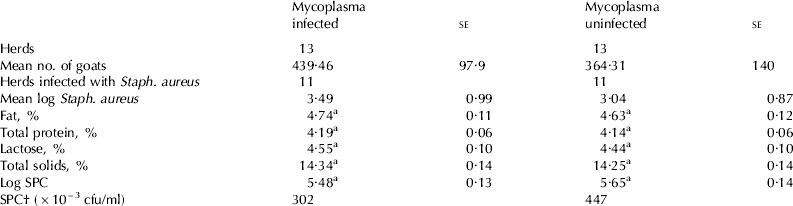
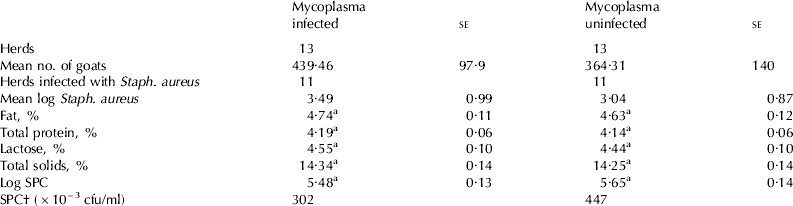
The data obtained in the analysis of the possible effect of mycoplasmas on BTM quality parameters are provided in Table 1. Our results indicate that the presence of mycoplasmas in a herd has no repercussions on the quality of the BTM. Despite the scarce information available on mycoplasma detection in the BTM for goat herds and no data in the literature on the effects of the pathogen on BTM composition, our results are in agreement with those reported in cows (Fox et al. Reference Fox, Hancock, Mickelson and Britten2003) and are also consistent with the observations of Corrales et al. (Reference Corrales, Sánchez, Luengo, Poveda and Contreras2004) who noted no significant changes in the SSC of BTM samples collected from herds chronically infected with mycoplasmas and uninfected herds, in the absence of clinical signs of CA. Collectively, these findings point to no substantial variation in the composition of the BTM of herds not infected or chronically infected with mycoplasmas. Despite no clinical signs or effects on the BTM observed in infected herds, there is a clear need for strict control measures in these herds. The recent observation that field strains of the bacterium can produce clinical outbreaks under certain conditions of stress or reduced host immunity (De la Fe et al. Reference De la Fe, Gutiérrez, Poveda, Assunçao, Ramírez and Fabelo2007) highlights the high clinical and economic impact of the presence of mycoplasmas in endemic areas.
Herd size, Staphylococcus aureus status and least square means and se of bulk tank milk components and standard plate counts (SPC) according to the mycoplasma status of the herd
a Means with different superscripts within a row differ significantly (P<0·001)
† Geometric mean of SPC
In the present study, the mean log SPC (n=265) was 5·51±0·07 (geometric mean: 324×103 cfu/ml). Goat milk produced in Lanzarote is pasteurized and used to make cheese. The mean SPC for each herd was always below the limits (1·0×106 cfu/ml) established according to EU Directive 92/46 of health and bacteriological quality criteria applied to sheep and goat products based on heat-treated milk (Pirisi et al. Reference Pirisi, Lauret and Dubeuf2007). Despite this, some of the individual milk samples did exceed this threshold. This may be explained by the fact that plate counts are undertaken on samples that may have been in the bulk milk tank for more than a day, since in most farms on the island, the distributing lorries collect the milk every 2 or 3 d. Effectively, this factor has been associated with the higher SPC recorded in the BTM of small ruminants (Zweifel et al. Reference Zweifel, Muehlherr, Ring and Stephan2005). Other factors influencing the microbiological quality of milk, such as the hygiene conditions of milking or breeding practices (Foschino et al. Reference Foschino, Invernizzi, Barucco and Stradiotto2002) should be revised in an effort to reduce the SPC for the herds. SPC differences between the herds with a different mycoplasma status were non-significant. Despite the lack of information available, these observations are in accordance with the findings of Gonzalo et al. (Reference Gonzalo, Carriedo, Beneitez, Juárez, De La Fuente and San Primitivo2006) who observed that clinical outbreaks of CA in sheep did not significantly increase the total bacterial count. Other authors have also observed that the contribution of a particular microbial group to the total count in milk was only consistent for samples collected from the same herd, whereas it varied considerably for samples from different producers (Foschino et al. Reference Foschino, Invernizzi, Barucco and Stradiotto2002).
Staphylococcus aureus was isolated from 22 of 26 (84·6%) of the herds examined. The mean Staph. aureus log count was 3·30±0·96 (a geometric mean of 2×10³ cfu/ml) suggesting the high prevalence of this microorganism among the herds of the island. This finding is a cause of concern owing to the public health consequences of consuming contaminated unpasteurized or raw-milk products (Muehlerr et al. Reference Muehlerr, Zweifel, Corti, Blanco and Stephan2003). Toxins produced by this species can contaminate even pasteurized milk. Our statistical analysis also revealed that the Staph. aureus status of a herd contributed significantly to BTM fat levels (5·21±0·20% in uninfected herds v. 4·63±0·08% in infected herds). Given a previous suggestion that lactose, protein or fat concentrations could be affected by intramammary infection (Leitner et al. Reference Leitner, Merin, Lavi, Egber and Silanikove2007) along with the fact that staphylococci are the pathogens most commonly isolated from the mammary glands of goats (Contreras et al. Reference Contreras, Corrales, Sanchez and Sierra1997), future studies should try to determine the specific effects of Staph. aureus on the composition of BTM.
In conclusion, in Lanzarote, an area where CA is endemic but typical symptoms are not currently observed, the existence of mycoplamas in a given goat herd failed to have any significant affect on the quality of the BTM and neither were any significant differences noted in the SPC or Staph. aureus status of the herds attributable to mycoplasma infection.
We thank Drs René Macías and Raquel Betancor and Carmelo Hernández and Hugo Curbelo for technical assistance. This work was supported by the Consejería de Industria del Gobierno de Canarias, Spain (Proyectos de investigación industrial/aplicada N° IDT-LP-03/026 and N° IDT-LP-04/040), the Spanish Ministry of Education and Culture (Plan Nacional I+D. Proyecto AGL2006-03105/GAN) and by the Fundación Seneca, Agencia de Ciencia y Technología de la Región de Murcia, Spain (Proyecto 05693/PI/07).