INTRODUCTION
Herpes zoster (HZ), or shingles, is the clinical manifestation of the reactivation of latent varicella zoster virus (VZV), commonly acquired in childhood (chickenpox) (Reference Kimberlin and Whitley1–Reference Guenther3). Shingles mainly affects people over fifty and is rare in children and young adults (Reference Kimberlin and Whitley1–Reference Gialloreti, Merito and Pezzotti4).
HZ main symptom is pain, while its most severe complication is the postherpetic neuralgia (PHN), pain persisting or occurring at least 1 month (Reference neuralgia2), 3 months (Reference Oxman, Levin and Johnson5–Reference Scott, Leedham‐Green and Barrett‐Muir7), or 6 months (Reference Bresse, Annemans and Préaud8;Reference Moore, Remy, Martin, Beillat and Mcguire9) after the rash onset. PHN symptoms are numbness, tingling, allodynia (Reference Kimberlin and Whitley1–Reference Guenther3), sleep disorders, anorexia, weight loss, chronic fatigue, and depression (Reference Gialloreti, Merito and Pezzotti4). Both for HZ and PHN, a correlation between incidence, severity, and duration of pain exists. Advanced age and high intensity pain are relevant risk factors for the development of PHN (Reference Kimberlin and Whitley1–Reference Guenther3).
In Italy, there are approximately 24.2 million people aged ≥50. Assuming annual incidence of 6.3 per 1,000 person-years (observed in the immuno-competent population in 2003–05), it is projected that at least 153,000 new cases of HZ occur annually, representing 73 percent of cases in the adult population (Reference Gialloreti, Merito and Pezzotti4).
HZ and PHN have a significant impact on patients’ quality of life and generate a notable economic burden to the National Healthcare Service. In Italy, HZ and PHN were responsible for 2,829 hospitalizations per year among the adult population, in 2003–05. Of these, 2,611 (92.3 percent) related to patients with multiple hospital admissions (Reference Gialloreti, Merito and Pezzotti4). Moreover, the average incidence of hospitalizations for HZ and PHN was 4.61 per 100,000 persons per year as a primary diagnosis. Overall, 16.9 percent of hospitalizations for HZ is due PHN, for which 0.94 per 100,000 patients are admitted every year. In 50-year-old patients, the average length of hospital stay for HZ is 7.8 ± 5.4 days.
HZ can be diagnosed by general practitioners (GPs) only when the cutaneous rash appears. The pharmaceutical management of HZ is meant to reduce acute pain, avoid the onset of complications, and hinder the development of HZ. The European Guidelines recommend the use of acyclovir, famciclovir, valacyclovir, or brivudine, which are only effective if implemented within 48–72 hours from the rash onset (Reference Oxman, Levin and Johnson5). The prevention of PHN in patients suffering HZ is more problematic, due to the scarcity of scientific evidence on medications effectiveness. Thus available treatments, such as tricyclic antidepressants, gabapentin, pregabalin cream 5 percent lidocaine, opioids, tramadol, capsaicin cream and patch, aim to reduce pain severity and duration rather than to prevent PHN (Reference Kimberlin and Whitley1–Reference Gialloreti, Merito and Pezzotti4).
Zostavax vaccine received the marketing authorization from the European Medicines Agency on May 2006, for routine vaccination of individuals aged 60 and over to prevent HZ. Such an authorization was updated in 2007, extending the eligible population to individuals aged 50 and over.
The vaccine could be a strategic tool to prevent the disease onset, avoiding large quality of life and productivity losses to the patients and large healthcare resource consumption. At the moment, this is the only drug indicated for HZ prevention in Europe, while treatments for the management of the acute phase often led to unsatisfactory results (Reference Oxman, Levin and Johnson5).
The aim of this study is to investigate the cost-effectiveness of Zostavax vaccine for the prevention of HZ, compared with an alternative scenario that does not involve any preventive measure but only the treatment of symptomatic individuals, within the Italian context.
METHODS
Model Structure
The cost-effectiveness analysis has been investigated adopting both the Italian National Health Service (I-NHS) perspective and the societal perspective. Progression of HZ and PHN was simulated through a Markov model comparing two arms, one representing the administration of Zostavax vaccine and the other representing the current strategy for the HZ management not involving any preventive measure. This model, already used in previous studies (Reference Bresse, Annemans and Préaud8–Reference Szucs, Kressig and Papageorgiou11), has been adapted to explore the vaccine cost-effectiveness within the Italian setting.
The study population is made up of 12,418,626, 60- to 79-year-old hypothetical individuals divided into 5-year age cohorts to account for age-related incidence and prevalence rates. The model includes four health states: healthy, herpes zoster and postherpetic neuralgia (further split by pain severity), and death. By assumption, individuals can experience recurrent HZ and PHN only once in their lives. The frequency of recurrent herpes zoster in immuno-competent individuals ranges between 1.7 percent and 5.2 percent (Reference Johnson, McElhaney, Pedalino and Levin12). Supplementary Figure 1 reports the model structure.
The model horizon is lifetime with monthly cycles, coherent with the mean duration of herpes zoster episodes. An annual discount rate of 3.5 percent was applied to costs and quality-adjusted life-years (QALYs), as recommended by the National Institute for Health and Care Excellence.
Model Parameters
Data on the population size and gender distribution were extracted from the National Institute of Statistics database (13). The assumed percentage of women among patients with HZ and PHN was 55.5 percent and 60 percent, respectively (Reference Volpi, Gatti and Serafini14;Reference Volpi, Gatti and Pica15).
The probability of developing HZ without vaccination is based on disease incidence (Reference Oxman, Levin and Johnson5;Reference Thyregod, Rowbotham and Peters16–Reference Rothberg, Virapongse and Smith18). More in detail, incidence rates were converted to probabilities applying the formula: p(t)=1−e(-rt). The vaccine efficacy has been used to weight the probability of developing HZ in the vaccination arm (Reference Oxman, Levin and Johnson5;Reference Schmader, Levin and Gnann19).
The incidence of HZ and PHN was derived from two previous studies. The former (Reference Gialloreti, Merito and Pezzotti4) is a retrospective, population-based study determining the incidence of HZ and PHN in Italy and their burden; the latter is a longitudinal, prospective study assessing the prevalence of HZ-associated pain, and its duration and management in Italy (Reference Bricout, Perinetti and Marchettini17).
A mean duration of 1 month was hypothesized for HZ, while a mean duration of 9 months was assumed for PHN (Reference Oxman, Levin and Johnson5). The monthly transition probabilities were extracted from previous studies. The probability for healthy people developing HZ, split by age, was extracted from the literature (Reference Gialloreti, Merito and Pezzotti4). It was derived from the annual incidence rate dividing by 12, under the assumption that the risk of developing HZ is evenly distributed across months. The risk of developing PHN was done likewise with a 3-month horizon.
PHN-associated pain decreases over time until it ceases (Reference Oxman, Levin and Johnson5). Age-related mortality rates were used to identify patient probability of transition to the “death” state.
Vaccine Related Parameters
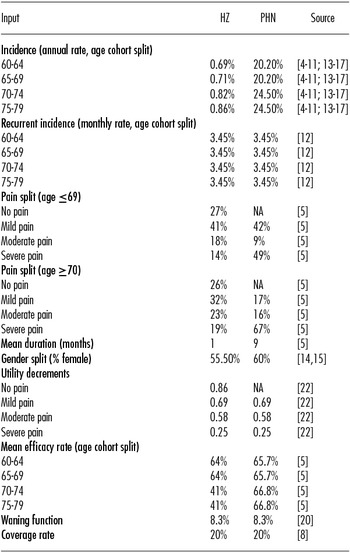
Vaccine efficacy data on HZ incidence were obtained from SPS study (Reference Oxman, Levin and Johnson5) and equaled, on average, 64 percent in the 60- to 69-year-old group and 41 percent in the 70- to 79-year-olds. The mean efficacy rate on PHN incidence, among patients with HZ, was 65.7 percent in the 60- to 69-year-old age group and 66.8 percent in the >70-year-olds (Reference Oxman, Levin and Johnson5).
The model also took the possible waning of efficacy over time into consideration, assuming a waning rate of 8.3 percent with vaccine efficacy lasting on average 10 years, both for HZ and PHN (Reference Pellissier, Brisson and Levin20).
The vaccination coverage rate of 20 percent was assumed, similar to influenza vaccination (Reference Blank, Schwenkglenks and Szucs21), and coherent with previous literature (Reference Bresse, Annemans and Préaud8).
Utilities
Disease-specific utility decrements were used to calculate the proportion of the baseline value to be subtracted to obtain the state-specific utility score. For the base case, utilities estimated in the study by Oster et al. 2005 (Reference Oster, Harding, Dukes, Edelsberg and Cleary22) were considered. Utility decrements for HZ with no pain were extracted from Pellissier et al. (Reference Pellissier, Brisson and Levin20). The values of Pellissier et al. (Reference Pellissier, Brisson and Levin20) and Bala et al. (Reference Bala, Wood and Zarkin23) were used for the sensitivity analysis. Clinical and utility data used to populate the model are reported in Table 1.
Clinical and Utility Inputs

HZ, herpes zoster; PHN, post herpetic neuralgia.
Cost Data
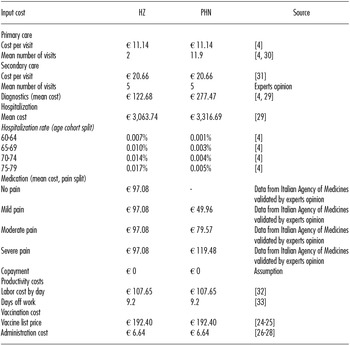
Direct costs were computed accounting for the different age cohorts included in the model and the different degrees of HZ-related and PHN-related pain intensity. Medical treatment options for HZ and PHN were identified through experts’ opinion. The overall cost of medical treatment results from the dose indicated for HZ and PHN and the unitary cost of drugs. The latter was computed based on the ex-factory price of drugs and the number of tablets per package published by the Italian Agency of Medicine.
The list price of vaccine (year 2014) is EUR 192.40 (24). However, Italian law imposes a minimum 50 percent discount rate when drugs and vaccines are sold to public hospitals and local healthcare services (25). In the model, we also considered the administration cost of vaccination (EUR 6.64) obtained from the literature (Reference Mennini, Baio and Montagano26–Reference Coudeville, Brunot, Giaquinto, Lucioni and Dervaux28).
The unit costs of HZ and PHN-related hospital admissions were derived from the literature (Reference Panatto, Bragazzi and Rizzitelli29) and weighted for the hospitalization rate (Reference Gialloreti, Merito and Pezzotti4). The overall cost of outpatient diagnostics, GP consultations, and primary assistance were derived from the literature (Reference Gialloreti, Merito and Pezzotti4;Reference Panatto, Bragazzi and Rizzitelli29;Reference Di Legami, Gianino and Atti30).
The average number of specialist visits was taken from the literature, while the calculation of related costs was based on the National Health Care Fees for specialist outpatient care (31). Cost data were validated by the Italian Society of General Practice.
Productivity losses were estimated using the labor cost by day (32) and the days of absence form work (Reference Mick, Gallais and Simon33). Indirect costs were calculated by multiplying this value by the proportion of patients claiming productivity losses (Reference Mick, Gallais and Simon33). Data on resource consumption are reported in Table 2.
Cost Inputs

HZ, herpes zoster; PHN, post herpetic neuralgia.
Cost-Effectiveness
The model results were expressed in terms of cost per QALY gained in the vaccinated group compared with the alternative protocol. Results are also presented in terms of cost per HZ case avoided and cost per PHN case avoided 3 months after the onset of HZ.
Sensitivity Analysis
A one-way deterministic sensitivity analysis (DSA) was carried out to appraise the effect of the variation of critical parameters on the incremental cost-effectiveness ratio (ICER). Intervals used in DSA are reported in Supplementary Table 1.
A probabilistic sensitivity analysis was performed to assess the impact of the simultaneous variation of parameters on model results. Where enough data were available, cost parameters were assumed to vary according to a gamma distribution while effectiveness, epidemiology data, utilities, and transition rates were varied based on an inverse normal distribution. The resulting 10,000 Monte Carlo realizations were reported on a cost-effectiveness plane and ordered a cost-effectiveness acceptability curve (CEAC).
RESULTS
Base Case Analysis and Scenario Analysis
The base case results are reported in Table 3. Base case focuses on the 60- to 79-years cohort. An additive method was used for utilities. When the I-NHS perspective is considered, the cost per QALY gained with Zostavax vaccine is EUR 11,943. The cost per HZ case avoided is EUR 1,224 and cost per PHN case avoided EUR 6,090.
Base Case Results per Million People

I-NHS, Italian National Health Service; HZ, herpes zoster; PHN, post herpetic neuralgia.
From the societal perspective, the vaccine cost per QALY gained is EUR 11,248. Moreover, the vaccination induces an additional cost of EUR 1,153 per HZ case avoided, whereas the cost per PHN case avoided with vaccination equals EUR 5.736 at 3 months from the disease onset.
In the scenario analysis, two different age cohorts (65–79 and 70–79) are considered. Results are fully reported in Supplementary Table 2. Compared with the base case, costs and effectiveness in both cohorts are lower, due to different conflicting drivers. On the one hand, the proportion of employed individuals is smaller in this cohort, resulting in lower productivity losses in the comparator arm, giving rise to a larger incremental cost. On the other hand, the size of this cohort is smaller while the disease incidence and the vaccine efficacy are higher. It means that the cost of vaccination is optimized, reducing incremental costs.
Sensitivity Analyses
The one-way sensitivity analysis showed that, regardless of the perspective adopted, the parameters that mostly impact on ICER variability are epidemiologic data, vaccine-induced protection duration, vaccine efficacy, and vaccine price. Not surprisingly, when HZ and PHN incidence and vaccine-induced protection duration increase, the ICER decreases, being these parameters inversely related to ICER. Conversely, when Zostavax price increases, the ICER increases too.
A higher overall cost of disease management also makes Zostavax ICER more favorable, whereas a higher discount rate for costs and outcomes results in a higher cost per QALY. Indeed, a preventive measure (the vaccine) is being compared with a treatment option: the vaccine allows avoiding future treatment costs, but requires an immediate investment to which a lower discount factor is applied.
With regard to utilities, this analysis shows that ICER values are higher than the base case for both the scenarios because utility decrements used in DSA (Reference Schmader, Levin and Gnann19, Reference Oster, Harding, Dukes, Edelsberg and Cleary22) are smaller than those applied in the base case. Smaller ICER variations are observed in case of waning rate, discount rates of outcomes and costs, and total costs. However, none of these scenarios is associated to a cost per QALY gained higher than the conventional threshold of EUR 30,000 (Reference Culyer34;Reference Garber and Phelps35).
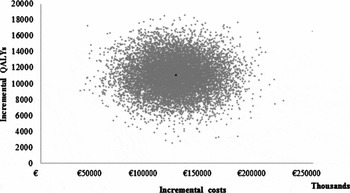
Results of DSA are shown in Supplementary Figure 2. Both from I-NHS and societal perspectives, all Monte Carlo realizations fall on the first quadrant of the cost-effectiveness plane, meaning that the vaccine is more costly and more effective than the comparator.
For the I-NHS perspective, positive ICERs were ordered on a CEAC. If a cost-effectiveness acceptability threshold of EUR 30,000/QALY gained is considered, Zostavax vaccine is cost effective with a probability of 99 percent. In Italy, there is no explicit threshold value for cost-effectiveness acceptability but, according to the Italian Health Economics Society, a range between EUR 25,000 and 40,000/QALY gained can be assumed, in line with similar healthcare systems. Monte Carlo analysis results for societal perspective are depicted in Figure 1, while those concerning I-NHS perspective are reported in Supplementary Figures 3A and 3B.
Cost-effectiveness plane, 10,000 Monte Carlo realizations. Societal perspective.

DISCUSSION
The estimated incidence of HZ in Europe is 2 to 4.6 cases per 1,000 people. In Italy, incidence rates range from 0.63 to 5.78 per thousand people and increases with age (Reference Di Legami, Gianino and Atti30). PHN affects approximately 25 percent of HZ patients aged >60 years and 33 percent of patients ≥80 years (Reference McKendrick, McGill and Wood36).
HZ and PHN do not lead to death but impact on individual's quality of life and on the overall economic and social system. Because policy makers deal with limited healthcare resources to satisfy potentially limitless healthcare needs, it is necessary to decide which is the most reasonable, efficient, and appropriate way to allocate resources. Therefore, the introduction of a healthcare technology requires a careful evaluation of the impact of disease on the healthcare system and on individuals.
The aim of this study was to evaluate the cost-effectiveness of Zostavax in the prevention of herpes zoster and postherpetic neuralgia. Under the I-NHS perspective, a cost per QALY gained of EUR 11,943 was obtained in the base case. Moreover, the cost per case avoided was EUR 1,224 for HZ and EUR 6,090 for PHN, respectively. From the societal perspective, the cost per QALY gained was EUR 11,248, the cost per HZ case avoided EUR 1,153, and the cost per PHN case avoided is EUR 5,736. Deterministic and probabilistic sensitivity analyses proved the robustness of model results. In particular, the Monte Carlo analysis showed that the ICER of Zostavax vaccine is below EUR 30,000/QALY in more than 99 percent of scenarios. However, the one-way sensitivity analysis showed that epidemiologic data, vaccine-induced protection duration, vaccine efficacy, and vaccine price can strongly affect the model results.
Kawai et al. 2014 (Reference Kawai, Preaud, Baron-Papillon, Largeron and Acosta37) conducted a review of 15 cost-effectivenss studies in Europe and North America. They found that, in most studies, zoster vaccination is cost-effective. Differences in results among studies were largely due to differing assumptions regarding duration of vaccine protection and a loss in quality of life associated with HZ and PHN. Most studies found that vaccinating adults aged 60–70 is more cost-effective than vaccinating adults aged ≥ 80. In spite of the high burden of HZ, ICER may not be favorable in adults aged ≥80 due to lower vaccine efficacy and shorter life expectancy.
One of the main strenghts of this work is that it is based on an internationally validated model that allows the comparison of results across countries. The model structure makes results easily transferable to other high income countries, with amall adaptations of cost drivers and utility scores. Studies using the same model have already been conducted in France (Reference Bresse, Annemans and Préaud8), United Kingdom (Reference Moore, Remy, Martin, Beillat and Mcguire9), Belgium (Reference Annemans, Bresse, Gobbo and Papageorgiou10), and Switzerland (Reference Szucs, Kressig and Papageorgiou11). Differences between our results and those obtained in other settings depend on variations in epidemiology, assumed vaccine price, costs of managing the disease, and age of target population. Supplementary Table 3 summarizes the main features of other studies performed using the same model.
The study limitations concern the lack of reliable national data for some crucial parameters. Even though data used to populate the model come from good quality studies published on indexed and peer reviewed journals, local data would have allowed a more precise estimate of vaccination benefits relevant to the Italian decision makers.
Moreover, the model has been populated with efficacy data, rather than real-world effectiveness values. Indeed, real-world effectiveness data are already available for the United States. In particular, Langan et al. demonstrated the effectiveness of the vaccine against incident HZ in immunosuppressed individuals, reporting an effectiveness rate of 48 percent (Reference Langan, Smeeth, Margolis and Thomas38). Also, Tseng et al. (Reference Tseng, Smith and Harpaz39) demonstrated the effectiveness of the vaccine in immunocompetent patients with an effectiveness of 55 percent against incident HZ. Given the similarity of these figures, despite the differences in the study population, we are quite confident that real-world effectiveness data would not differ substantially from efficacy estimates.
Finally, no inflation correction was applied to cost data, because most of the estimates used in the model are based on tariffs, for which such a correction in not feasible.
CONCLUSION
In conclusion, our analysis proved that Zostavax vaccine can be considered as a promising and cost-effective tool for the prevention of HZ and PHN in individuals between 60 and 79 years of age, as an innovation to the current management of the disease, which does not involve any prevention initiative but only the treatment of symptomatic patients.
SUPPLEMENTARY MATERIAL
Supplementary Figure 1: http://dx.doi.org/10.1017/S0266462316000337
Supplementary Table 1: http://dx.doi.org/10.1017/S0266462316000337
Supplementary Table 2: http://dx.doi.org/10.1017/S0266462316000337
Supplementary Figure 2: http://dx.doi.org/10.1017/S0266462316000337
Supplementary Figure 3: http://dx.doi.org/10.1017/S0266462316000337
Supplementary Table 3: http://dx.doi.org/10.1017/S0266462316000337
CONFLICTS OF INTEREST
This study was funded by Sanofi Pasteur MSD. However, no writing assistance was used for the development of the current manuscript and publication of results was not contingent on sponsors approval.