


Introduction
Schema theory proposes that certain early and inflexible belief patterns, also known as early maladaptive schemas (EMS), can develop in childhood and broadly lead to psychopathology (Young, Reference Young1990). These EMS are proposed to develop due to chronic unmet needs during childhood (Young et al., Reference Young, Klosko and Weishaar2003). Another important aspect of schema theory is the concept of schema modes (Young, Reference Young1990; Young et al., Reference Young, Klosko and Weishaar2003), which are moment-to-moment states that reflect clusters of activated schemas and their associated thoughts, feelings and behaviours (Voderholzer et al., Reference Voderholzer, Schwartz, Thiel, Kuelz, Hartmann, Scheidt and Zeeck2014). There are currently up to 18 proposed schema modes, within four categories: maladaptive child modes, maladaptive coping modes, maladaptive parent modes, and the healthy modes, the latter comprising the Healthy Adult and Happy Child modes (Bamelis et al., Reference Bamelis, Renner, Heidkamp and Arntz2011). It is proposed that maladaptive coping modes function to help people cope with the intense activated feelings that result from needs thwarting, but paradoxically make it harder for an individual to have their core emotional needs met. In contrast, it is purported the healthy adult mode more successfully works to have these needs met; the mode is concerned with the longer term need satisfaction of the individual (Young et al., Reference Young, Klosko and Weishaar2003). Schema modes have been associated with various psychiatric disorders, including personality disorders (Bamelis et al., Reference Bamelis, Renner, Heidkamp and Arntz2011; Johnston et al., Reference Johnston, Dorahy, Courtney, Bayles and O’Kane2009; Lobbestael et al., Reference Lobbestael, Arntz and Sieswerda2005; Lobbestael et al., Reference Lobbestael, Van Vreeswijk and Arntz2008) and other disorders such as bulimia (Talbot et al., Reference Talbot, Smith, Tomkins, Brockman and Simpson2015), obsessive compulsive disorder (Basile et al., Reference Basile, Tenore, Luppino and Mancini2017) and behaviour problems (van Wijk-Herbrink et al., Reference van Wijk-Herbrink, Bernstein, Broers, Roelofs, Rijkeboer and Arntz2018). Positive outcomes of schema therapy (e.g. Giesen-Bloo et al., Reference Giesen-Bloo, Van Dyck, Spinhoven, Van Tilburg, Dirksen, Van Asselt and Arntz2006; Sempertegui et al., Reference Sempertegui, Karreman, Arntz and Bekker2013), which derives from schema theory, including with older people (Videler et al., Reference Videler, van Alphen, van Royen, van der Feltz-Cornelis, Rossi and Arntz2017), provides support for the application of this theory to clinical populations.
A primary component of Young’s (Reference Young1990) schema theory is the importance of core emotional needs. Young et al. (Reference Young, Klosko and Weishaar2003) propose a set of core emotional needs that are universal to all individuals. The thwarting of the satisfaction of a specific need is considered likely to result in the development of a corresponding EMS, for example a child that grows up in an environment with little safety is likely to develop a cognitive schema that says the ‘world is dangerous’. Young and colleagues propose five core emotional needs: secure attachments to others, autonomy, competence and sense of identity, freedom to express valid needs and emotions, spontaneity and play, and realistic limits and self-control, which correspond to broad schema domains. More recently, it has been proposed that there are more specific core emotional needs that correspond to each of the EMS (Lockwood and Perris, Reference Lockwood, Perris, van Vreeswijk, Broersen and Nadort2012).
Needs are a core component of many psychological theories and therapies, but are often not well defined (Flanagan, Reference Flanagan2010). One attempt to specify these needs is Deci and Ryan’s (Reference Deci and Ryan1985) self-determination theory. This theory proposes that three basic psychological needs drive human motivation. These psychological needs are described as requirements that are universal and innate and are essential to an individual’s motivation and emotional wellbeing. These basic needs are competence, autonomy, and relatedness. Any thwarting of these needs is thought to lead to psychopathology and ‘ill-being’, while satisfaction of these needs will lead to healthy development and well-being. In a meta-analysis, Ng et al. (Reference Ng, Ntoumanis, Thøgersen-Ntoumani, Deci, Ryan, Duda and Williams2012) found that higher levels of perceived competence, autonomy and relatedness were associated with lower levels of depression and anxiety. Lower basic psychological needs satisfaction has been associated with suicidal behaviour (Britton et al., Reference Britton, Van Orden, Hirsch and Williams2014), depressive symptoms in chronic pain (Lu et al., Reference Lu, Uysal and Teo2011), and post-partum depression (Gauthier et al., Reference Gauthier, Guay, Senécal and Pierce2010). The present study therefore considers basic psychological needs as defined in self-determination theory to broadly correspond with Young’s (Reference Young1990) concept of core emotional needs, seeking to draw links between the two theories.
Young’s schema theory proposes a relationship between schema modes and needs. It suggests that should individuals come to rely on certain maladaptive modes in order to express, or cope with need frustrations, these modes will ultimately prove to be self-defeating (Flanagan, Reference Flanagan2010), maintaining further need frustration and forming a pattern of ‘schema maintenance’ (Young et al., Reference Young, Klosko and Weishaar2003). For example, an individual may shift into the angry child mode, where the affect is angry and frustrated, much like a child having a tantrum (Young et al., Reference Young, Klosko and Weishaar2003) in an attempt to have a core emotional need, such as attachment to others, met. Ultimately, however, the result of expressing high levels of anger may have the effect of pushing others away, fuelling further disconnect with others. Schema therapy aims to reduce over-reliance on these maladaptive modes, and to open up the opportunity for healthier ways of coping, via the healthy adult mode (Young et al., Reference Young, Klosko and Weishaar2003). Indeed, higher levels of healthy adult mode are generally associated with lower levels of psychopathology (Lobbestael et al., Reference Lobbestael, Arntz and Sieswerda2005). If the presence of the healthy adult mode allows the individual to have their core emotional needs met, it follows that the relationship between maladaptive coping modes and unmet core emotional needs would be mediated by the presence of the healthy adult mode. Despite the fact that there is a proposed link between modes and thwarted emotional needs in Young’s schema theory, this link has not yet been studied empirically.
The present study aimed for the first time to investigate the relationship between schema modes and psychopathology in older adults, proposing that higher levels of maladaptive child modes would be associated with higher levels of depression, anxiety, and disordered personality symptoms. Conversely, it was also expected that higher levels of healthy adult mode would be associated with lower levels of psychopathology. Furthermore, the present study aimed to validate schema theory in older adults by testing whether the presence of maladaptive child modes leads to the individual being less able to have their core needs (autonomy, competence, and relatedness) met. It was hypothesized that this relationship would be mediated by the presence of higher levels of the healthy adult mode. Given the need not to overburden participants with too many items, only select maladaptive child modes were used in the present study. These maladaptive child modes were chosen because the development of these schema modes is thought to be a direct result of needs thwarting environments. They were considered to be the best representative of activated core schemas.
Method
The method for the current study is described in detail elsewhere (Phillips et al., Reference Phillips, Brockman, Bailey and Kneebone2017). It is part of a research stream broadly considering schema theory in older people (Phillips et al., Reference Phillips, Brockman, Bailey and Kneebone2017). The study received ethics approval from the University of Technology Sydney Human Research Ethics Review Committee and reciprocal approval from the Human Research Ethics Committee of Western Sydney University (approvals 2015000482-24 and H11617, respectively). The authors abided by the Ethical Principles of Psychologists and Code of Conduct as set out by the APA (http://www.apa.org/ethics/code/).
Measures
The Young-Atkinson Mode Inventory (YAMI; Young et al., 2005) consists of 187 self-report items that investigate the presence of 10 different schema modes. To reduce the burden on participants in the current study, only the questions referring to the vulnerable child, angry child, and healthy adult modes were given. Previous studies have found internal reliability of the YAMI to be acceptable (van Vreeswijk et al., Reference van Vreeswijk, Spinhoven, Eurelings-Bontekoe and Broersen2012), and Phillips et al. (Reference Phillips, Brockman, Bailey and Kneebone2017) found schema modes to be closely associated with EMS in older adults supporting convergent validity. The Basic Psychological Needs Scale (BPNS; general version) assesses unmet needs (autonomy, competence and relatedness) (Deci and Ryan, Reference Deci and Ryan2000; Gagné, Reference Gagné2003). The BPNS consists of 21 items, with higher scores on the scale indicating higher needs satisfaction. Its subscales and total score are internally consistent (Gagné Reference Gagné2003; Kashdan et al., Reference Kashdan, Mishra, Breen and Froh2009; Meyer et al., Reference Meyer, Enstrom, Harstveit, Bowles and Beevers2007; Niemiec et al., Reference Niemiec, Lynch, Vansteenkiste, Bernstein, Deci and Ryan2006; Wei et al., Reference Wei, Philip, Shaffer, Young and Zakalik2005) and validity is evident from subscale and total scores associations with psychosocial well-being (e.g. pro-social behaviour, vitality, and happiness) and negative relationships to anxiety and depression (e.g. Gagné Reference Gagné2003; Meyer et al., Reference Meyer, Enstrom, Harstveit, Bowles and Beevers2007; Niemiec et al., Reference Niemiec, Lynch, Vansteenkiste, Bernstein, Deci and Ryan2006). The Geriatric Depression Scale (GDS; Yesavage et al., Reference Yesavage, Brink, Rose, Lum, Huang, Adey and Leirer1982) is a 30-item scale (yes/no format) designed to assess symptoms of depression in adults over the age of 60 years. The GDS is a reliable and valid measure of depression (Stiles and McGarrahan, Reference Stiles and McGarrahan1998). The Geriatric Anxiety Inventory (GAI; Pachana et al., Reference Pachana, Byrne, Siddle, Koloski, Harley and Arnold2006) is a self-report questionnaire with 20 items (agree/disagree format) measuring anxiety in adults over 60 years of age. It also has sound psychometric properties (Johnco et al., Reference Johnco, Knight, Tadic and Wuthrich2015). The Germans’ (Personality) Screener (Germans et al., Reference Germans, Van Heck, Masthoff, Trompenaars and Hodiamont2010), is a scale consisting of 10 items which have been adapted from the Structured Clinical Interview for DSM-IV Personality Disorders (SCID-II; First et al., Reference First, Spitzer, Gibbon, Williams, Davies, Borus and Rounsaville1995) and is designed to screen for personality disorders. It has been found to correctly classify 78% of adults as having a personality disorder (First et al., Reference First, Spitzer, Gibbon, Williams, Davies, Borus and Rounsaville1995).
Procedure
One hundred and four older adult participants were recruited from a pre-existing volunteer database (54 males and 50 females). Participants were given information about the study over the telephone. If they consented to participate, they met with the researcher face-to-face and completed the questionnaire package. Participant data was included in the study if it was confirmed they were aged over 60 years of age, functioned independently and were free of significant cognitive impairment. The latter was determined by a score of 81 or more (Hsieh et al., Reference Hsieh, McGrory, Leslie, Dawson, Ahmed, Butler and Hodges2015) on the Addenbrooke’s Cognitive Examination, Third Edition (ACE-III; Hsieh et al., Reference Hsieh, Schubert, Hoon, Mioshi and Hodges2013). Volunteers were reimbursed AUD$20 for participating in the study.
Statistical analysis
First, correlational analyses were conducted to investigate the relationship between the schema modes and measures of psychopathology, as well as the modes and basic psychological needs scores. A mediation analysis was then conducted to investigate the hypothesis that maladaptive schema modes lead to unmet needs in adulthood, and that this relationship is mediated by healthy adult mode. Two analyses were carried out, where the independent variable was first vulnerable child mode and then angry child mode, and the dependent variable was level of needs satisfaction (consisting of autonomy, relatedness and competence). The mediator was the healthy adult mode. The hypothesized a-path was that as levels of vulnerable or angry child increase, levels of healthy adult mode would decrease. The hypothesized b-path was that the mediator, healthy adult mode, would predict higher levels of total needs satisfaction. The hypothesized c-path was that vulnerable and angry child mode would lead to lower levels of total needs satisfaction.
The present study used the PROCESS plug-in for SPSS (Hayes, Reference Hayes2013) in order to conduct bootstrapping analyses on the indirect path (ab-path). The indirect effect, i.e. the mediation effect, was estimated using non-parametric bootstrapping (n = 10,000), in order to create a confidence interval for the indirect effect (95% CI). All analyses were conducted using IBM SPSS statistics package version 20.
Results
Participants
In total, 10 participants were removed from the sample due to a large proportion of missing responses, an incomplete ACE-III or failure to score above the cut-off on the ACE-III. This resulted in a final sample of 94 participants. The mean age of participants was 72.34 years (SD = 5.93, range 60–84) and 50% were female. Around half had 12 years formal education or longer and for the majority (88%) their first language was English. Sixty-five per cent were married or in a long-term relationship.
Correlation analysis
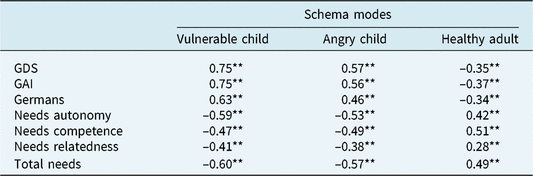
Pearson correlation coefficients (r) were calculated between the schema modes and measures of psychopathology. As can be seen in Table 1, vulnerable child mode correlated positively with depression, anxiety and disordered personality and negatively with psychological needs in general, autonomy, competence, and relatedness. Angry child mode demonstrated positive correlations with depression, anxiety and disordered personality, and negative correlations with autonomy, competence and relatedness, as well as total needs. The healthy adult mode showed the opposite pattern, correlating negatively with depression, anxiety and disordered personality. As also evident in Table 1, higher levels of healthy adult mode were associated with higher levels of psychological needs being met in general, as well as autonomy, competence and relatedness individually. All correlations were observed to be moderate to strong.
Pearson r correlation of the schema modes, measures of psychopathology and needs

GDS, Geriatric Depression Scale; GAI, Geriatric Anxiety Inventory; Germans, Germans’ (Personality) Screener. **p < .01.
Mediation analysis
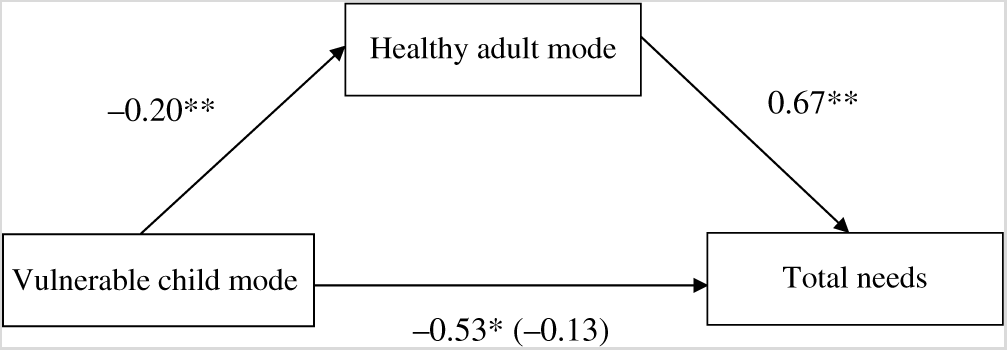
As Fig. 1 illustrates, vulnerable child mode was a significant predictor of healthy adult mode, where higher levels of vulnerable child predicted lower levels of healthy adult mode (β = –0.20, SE = 0.05, p < 0.01). Higher levels of healthy adult mode predicted higher total needs satisfaction (β = .67, SE = 0.19, p < 0.01). The direct effect between vulnerable child and total needs satisfaction was significant (β = –0.53, SE = 0.09, p < 0.01). Non-parametric bootstrapping analyses (Hayes, Reference Hayes2013) indicated a significant indirect effect of vulnerable child mode on total needs satisfaction through the healthy adult mode (ab = –0.13, BCa CI [–0.29, –0.04]). The mediator accounted for one-fifth of the total effect, PM = 0.20. As the direct effect was also significant, these results are consistent with partial mediation.
Standardized regression coefficients for the relationship between vulnerable child mode and total needs satisfaction as mediated by healthy adult mode. The standardized regression coefficient between vulnerable child mode and total needs satisfaction and, controlling for healthy adult mode, is in parentheses.

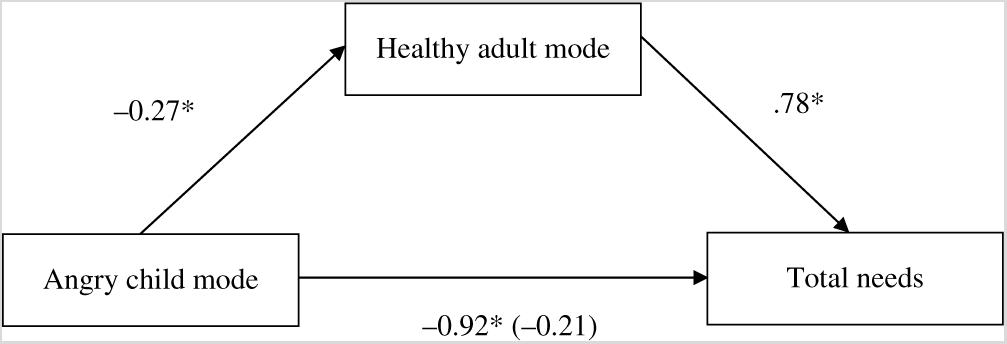
As Fig. 2 illustrates, angry child mode was a significant predictor of healthy adult mode, where higher levels of angry child mode predicted lower levels of healthy adult mode (β = –0.27, SE = 0.09, p < 0.01). The relationship between healthy adult mode and total needs satisfaction was also significant (β = .78, SE = 0.18, p < 0.01). Angry child was a significant negative predictor of total needs satisfaction (β = –0.92, SE = 0.16, p < 0.01). Again, bootstrapped confidence intervals (Hayes, Reference Hayes2013), revealed a significant indirect effect for angry child mode on total needs satisfaction via the healthy adult mode (ab = –0.21, BCa CI [–0.47, –0.05]), again consistent with partial mediation. The mediator accounted for roughly one-fifth of the total effect, PM = 0.19.
Standardized regression coefficients for the relationship between angry child mode and total needs satisfaction as mediated by healthy adult mode. The standardized regression coefficient between angry child mode and total needs satisfaction, controlling for healthy adult mode, is in parentheses.

Discussion
The present study aimed to investigate the applicability of schema mode theory to older adults. As predicted, higher levels of the vulnerable and angry child modes were associated with higher levels of psychopathology, while higher levels of healthy adult mode were associated with lower levels of psychopathology. This is in line with findings in younger samples that the healthy adult mode is lowest in patients with psychopathology and personality disorders such as borderline personality disorder, and that higher levels of dysfunctional schema modes are associated with psychopathology (Arntz et al., Reference Arntz, Klokman and Sieswerda2005; Lobbestael et al., Reference Lobbestael, Arntz and Sieswerda2005). As additionally predicted by schema theory, the healthy adult mode was found to be associated with higher levels of autonomy, competence and relatedness need satisfaction, and the vulnerable and angry child modes with lower needs satisfaction in these areas. This study provides the first empirical support for the hypothesized need-mode link using a psychometric measure of need satisfaction. By doing so it establishes a link between schema theory, and over 30 years of theory and research from the well-being literature that has culminated in Self-Determination Theory (Deci and Ryan, Reference Deci and Ryan2000). The current study also provided further support for schema theory, finding that the relationship between maladaptive child modes (angry and vulnerable child mode) and needs satisfaction was partially mediated by the healthy adult mode. We interpret this in line with schema theory, i.e. there is an indelible link between emotional vulnerable and angry mood states and the experience of need satisfaction (or thwarting), and that this link is at least partially explained by the resulting presence of absence of the healthy adult mode. While these results are significant, they are also only relatively small (and partial), and there is substantial variance between core emotional schema modes and needs that is direct.
The results of the present study have possible implications for the application of schema theory, as well as schema therapy, in an older adult population. The mediation analysis supported the schema mode model, finding that the healthy adult mode mediates the relationship between two maladaptive child modes and needs satisfaction (Young et al., Reference Young, Klosko and Weishaar2003) specifically in an older adult population. This implies that schema therapy, which aims to weaken maladaptive modes while also strengthening the adaptive (healthy adult) modes to facilitate core emotional need satisfaction (van Vreeswijk et al., 2014; Young et al., Reference Young, Klosko and Weishaar2003), may be effective in older adults. Previous research into schema therapy with older adults has found that maladaptive schema modes decrease and healthy adult mode increases between pre- and post-treatment (Videler et al., Reference Videler, Rossi, Schoevaars, van der Feltz-Cornelis and van Alphen2014). It follows that specifically targeting schema modes in treatment of personality disorders with older adults may reduce symptoms of psychopathology and increase their needs satisfaction. As modes are thought to be present in all adults, not only those with personality disorders (van Genderen et al., Reference van Genderen, Rijkeboer, Arntz, van Vreeswijk, Broersen and Nadort2012), schema therapy may provide an appropriate modality for treating various other psychological disorders in this population. Future research should test this relationship in older adults receiving schema therapy.
More broadly, this study also provided support for Young et al. (Reference Young, Klosko and Weishaar2003) schema theory. While this theory proposes that maladaptive schema modes maintain a sense of unmet core emotional needs, neither the needs themselves, nor the assertion that maladaptive modes are associated with lower needs satisfaction, has been empirically established. The present study demonstrated the predicted relationship. The study also provides a link between schema theory and self-determination theory (Deci and Ryan, Reference Deci and Ryan2000). The three basic psychological needs can potentially be linked to the core emotional needs of schema theory. For example, the authors Lockwood and Perris (Reference Lockwood, Perris, van Vreeswijk, Broersen and Nadort2012) have proposed that there is overlap between the connection and acceptance cluster of needs in schema theory and the relatedness need of self-determination theory.
As far as the authors of the present study are aware, this work is the first to specifically investigate schema theory in older adults with respect to psychopathology. It is also unique in its attempt to demonstrate that the healthy adult mode mediates the relationship between maladaptive child modes and needs satisfaction in any population, a key proposition of the theory. In terms of limitations, the study had a relatively small sample size and was cross-sectional, thereby limiting conclusions of causality. In addition, several measures used in the study, namely the Basic Psychological Needs Scale, the Yami-Atkinson Mode Inventory, and the Germans’ (Personality) screener have not been validated in an older adult sample. Our sample of data, however, demonstrates some initial validity for their use in an older adult sample. While the lack of clinical group, particularly a lack of a group with a diagnosed personality disorder, can be seen as a limitation, the sample recruited does indicate the relevance of the schema model to all older adults, not just those with these conditions. We would expect stronger findings in a clinical sample given that maladaptive schema modes are hypothesized to be more common and prominent in people with personality disorders. In addition, only maladaptive child modes were investigated in the present study. Future research should expand on the modes studied in the current study to see if the schema mode model holds across all the hypothesized models.
These results lend further support to the use of schema therapy in older adults. Targeting the healthy adult mode and reducing the impact of maladaptive modes via therapy might allow older adults to have their needs met in areas such as autonomy, relatedness and competence. It also suggests that lowering maladaptive modes has the potential to reduce general psychopathology. Further research investigating the relevance of schema therapy and schema theory to older adults with psychopathology is warranted. Treatment studies of schema therapy that specifically target schema modes are another potential direction for future research, and would support the ongoing development of protocols for schema therapy with older adults.
Acknowledgements
None.
Financial support
This work was supported in part by the Australian Research Council under Discovery Project Grant (grant number DP130101420) to P. Bailey.
Conflict of interest
The authors have no conflicts of interest to declare with respect to this publication.



Comments
No Comments have been published for this article.