I. INTRODUCTION
Titanium dioxide is a very important material in a wide range of applications, such as photocatalysis, solar cells, gas sensors, biomaterials, and memory devices. Owing to its large dielectric constant and refractive index, the TiO2/rutile polymorph is commonly used in electronic devices such as capacitors, interference filters, optical waveguides, and gas sensors. In addition to these applications, it is used as a white pigment and an opacifier to exploit its high reflectivity across the visible spectrum. In addition, the TiO2/anatase polymorph is frequently used as a photocatalyst due to its high photoreactivity for both homogeneous and heterogeneous catalysis.Reference Labat, Baranek, Domain, Minot and Adamo1
To understand the reactivity of these TiO2 nanoparticles, interactions of water, methanol, and other organic molecules with anatase and rutile surfaces have been intensively studied. Formic acid is of particular interest because it is the simplest organic acid. Investigations on rutile (110) have shown dissociative adsorption, with formate (HCOO−) adsorbing in bidentate bridging configurations.Reference Tanner, Liang and Altman2–Reference Fukui, Onishi and Iwasawa6 In contrast, work on anatase surfaces is limited, and conclusive results have not been achieved yet.Reference Tanner, Liang and Altman2, Reference Popova, Andrushkevich, Chesalov and Stoyanov7, Reference Vittadini, Selloni, Rotzinger and Gratzel8 Some experimental studies using temperature-programmed desorption (TPD) measurements on anatase powders proved that formic acid can be adsorb via associative (i.e., molecular) or dissociative mechanisms.Reference Kim and Barteau9 For example, Popova et al.Reference Popova, Andrushkevich, Chesalov and Stoyanov7 studied the adsorption of formic acid on anatase TiO2 and reported various formate adsorption geometries by using in situ fast Fourier transform infrared (FTIR) spectroscopy, and Vittadini et al.Reference Vittadini, Selloni, Rotzinger and Gratzel10 investigated adsorption of formic acid on clean and hydrated anatase (101) surface using DFT calculations. They found that molecular adsorption is favored on the clean surface, while dissociative adsorption is dominant on the hydrated surface, which is inconsistent with experimental results indicating that dissociated formic acid is stable on anatase particles.Reference Rotzinger, Kesselman-Truttmann, Hug, Shklover and Gratzel11
Tanner et al.Reference Tanner, Liang and Altman2 studied formic acid adsorption on the TiO2 anatase (001) surface using atomic resolution scanning tunneling microscopy and noncontact atomic force microscopy and proposed that dissociative adsorption occurs at the ridges. Recently, Wang et al.Reference Wang, Groenzin and Shultz12 compared the adsorption of acetic acid, water, and methanol on anatase TiO2 colloidal nanoparticles by using sum frequency generation vibrational spectroscopy and found that water and methanol have similar adsorption behavior, while acetic acid (CH3COOH) can irreversibly replace dissociated water and methanol. Panayotov et al.Reference Panayotov, Burrows and Morris13 found that methanol adsorbs through a dissociative pathway on the surface of 4-nm rutile nanoparticles to produce surface methoxy and hydroxyl groups by using FTIR spectroscopy.
Tilocca and SelloniReference Tilocca and Selloni14 studied the adsorption and reactivity of methanol on TiO2 anatase (101) surfaces through first-principles total energy calculations and Car–Parrinello molecular dynamics simulations. Their results indicated that molecular adsorption is favored on the anatase surface, if defects or surface hydroxyls do not exist. Liu et al.Reference Liu, Wang, Guo, Fang, Wei, Lu and Lu15 have performed first-principles calculations to study the methanol adsorption on clean and hydroxylated TiO2 (100) surface with bridging hydroxyl and terminal hydroxyl (TH) groups and they found that TH groups play a role as proton channels on the surface. The reactions between TiO2 and water have been intensively studied. Whether TiO2 surfaces are covered by –OH groups or not is important because it can affect the surface chemistry of TiO2 dramatically. It is understood that factors such as phase components, surface orientation, surface reconstruction and defects, and water coverage will have a critical impact on the nature of the H2O–TiO2interactions.Reference Sun, Liu, Selloni, Lu and Smith16
Much work has been done on the interaction of H2O with several rutile and anatase TiO2 surfaces. The rutile (110) surface is most common surface for TiO2. Over the last decades, a large number of experimental and theoretical studies have been carried out on this surface.Reference Diebold, Ruzycki, Herman and Selloni17–Reference Vittadini, Casarin and Selloni19 Experimental studiesReference Kurtz, Stockbauer, Madey, Roman and Desegovia20–Reference Krischok, Hofft, Gunster, Stultz, Goodman and Kempter26 show that water does not dissociate over defect-free rutile (110) at low water coverage regime. However, there is still controversy regarding whether water can dissociate over rutile (110) when multiple layers of water are present because the calculated energy differences between molecular and dissociative adsorption are relatively small.Reference Liu, Zhang, Thornton and Michaelides27, Reference Wesolowski, Sofo, Bandura, Zhang, Mamontov, Predota, Kumar, Kubicki, Kent, Vlcek, Machesky, Fenter, Cummings, Anovitz, Skelton and Rosenqvist28 Compared to rutile, the interaction of water with anatase surfaces has been studied less extensively, though anatase has a higher reactivity in photocatalytic applications. Since the anatase (101) has lowest surface formation energy, its reaction with water has been the subject of several studies.Reference Diebold, Ruzycki, Herman and Selloni17, Reference Tilocca and Selloni29 Selloni et al.Reference Selloni, Vittadini and Gratzel30 reported that water is absorbed in the associated state. This was supported by a dynamic simulation at 450 K.Reference Vittadini, Selloni, Rotzinger and Gratzel8 This observation was later confirmed by TPD and x-ray photoelectron spectroscopy experiments,Reference Herman, Dohnalek, Ruzycki and Diebold31 which found that the water on anatase (101) is adsorbed in molecular state. For anatase (001) surface, because all surface species (Ti5c and O2c) are undercoordinated, it has a much larger surface energyReference Lazzeri, Vittadini and Selloni32 and higher reactivity than anatase (101). When water adsorbs to the surface, all theoretical resultsReference Vittadini, Selloni, Rotzinger and Gratzel8, Reference Selloni, Vittadini and Gratzel30, Reference Bredow and Jug33, Reference Fahmi and Minot34 support dissociative adsorption at low water coverage regimes.
Although significant experimental researches have been performed regarding reaction between TiO2 nanoparticles and organic solvents, many things remain to be solved. Also, as is mentioned before, DFT can discover and solve some issues. However, the substantial computational cost of DFT limits atom numbers and time duration for nanoparticle simulations. For this reason, we are using a recently developed ReaxFF TiO2 force fieldReference Kim, Kumar, Persson, Sofo, van Duin and Kubicki35 in this study. ReaxFF can handle much bigger size of simulations while maintaining an accuracy similar to DFT.
The purpose of the current work was to simulate interactions between TiO2nanoparticles and water, methanol, and formic acid by using a ReaxFF reactive force field enabling larger spatial and temporal scale simulations. This will allow for larger spatial scale, longer temporal scale, and more realistic exploration of phase space compared to DFT calculations while allowing for chemical reactions to occur in the system. The ultimate goals were to contrast differences in nanoparticle and bulk interfaces with solutions, predict the surface chemistry of nanoparticles, and model the nucleation process.
II. COMPUTATIONAL METHODS
In the ReaxFF method, the forces are derived from a general energy expression:
 $$E_{{\rm{system}}} = \,\,E_{{\rm{bond}}} + E_{{\rm{over}}} + E_{{\rm{under}}} + E_{{\rm{lp}}} + E_{{\rm{val}}} + E_{{\rm{vdWaals}}} + E_{{\rm{coulomb}}} .$$
The partial contributions in Eq. (1) include bond energies (E bond), energy to penalize overcoordination (E over) and stabilize undercoordination of atoms (E under), lone pair energies (E lp), valence angle energies (E val), and terms to handle nonbonded Coulomb (E coulomb) and van der Waals (E vdWaals) interaction energies. All terms except the last two include bond order dependence and depend on the local environment of each atom. The Coulomb energy (E coulomb) of the system is calculated using a geometry-dependent charge distribution determined using the electronegativity equalization method.Reference Mortier, Ghosh and Shankar36 All other nonbonded interactions (short-range Pauli repulsion and long-range dispersion) are included in the van der Waals term (E vdWaals). Bond order independent terms (E coulomb and E vdWaals) are screened by a taper function and shielded to avoid excessive repulsion at short distances. For a more detailed description of the ReaxFF method, see van Duin and LarterReference van Duin and Larter37 and Chenoweth et al.Reference Chenoweth, van Duin and Goddard38 All derived parameters are included in the Supplemental Information for this article.
III. RESULTS AND DISCUSSION
A. Force field testing
The recently developed Ti/O/H force field parametersReference Kim, Kumar, Persson, Sofo, van Duin and Kubicki35 were combined with the existing C/N/O/H force field for glycine/water interactions,Reference Rahaman, van Duin, Goddard and Doren39 which was recently applied to study TiO2surface interactions with small peptides.Reference Monti, van Duin, Kim and Barone40
The ReaxFF Ti/O/H parameters were fitted against DFT and experimental data aiming to reproduce the equations of state, water adsorption energies, surface formation energy, heats of formation, reaction barriers, and geometries.Reference Kim, Kumar, Persson, Sofo, van Duin and Kubicki35 The Cl/O/H parameters were taken from Ref. Reference Rahaman, van Duin, Bryantsev, Mueller, Solares, Goddard and Doren41, while the Na/O/H parameters were developed against a training set similar to the one recently used for the Ca/O/H ReaxFF description,Reference Manzano, Ulm, van Duin, Pellenq, Marinelli and Moeni42, Reference Manzano, Pellenq, Ulm, Buehler and van Duin43 which includes Na+ and NaOH binding energies to 1–6 water molecules, a water/Na dissociation curve, and equations of state of metallic Na in fcc, bcc, simple cubic, and a15 configurations. These Ti/Na/O/C/H ReaxFF parameters are attached in Supplementary Information. This parameter format can be used with LAMMPS and ADF/ReaxFF distributions. To validate the force field, two tests have been performed. We have calculated and compared the amount of water dissociated for two different water coverage regimes, 1 monolayer (ML) and 3 ML, with that observed in the quantum mechanical molecular dynamics (QMMD) calculations. The rutile slab used in this calculation has three layers of TiO2 in the direction perpendicular to the surface with 4 × 2 surface unit cells parallel to the surface. The water dissociation percentage is defined as the number of TH attached to the 5-fold coordinated Ti atoms divided by the total number of TH and terminal H2O molecules [i.e., (TiOH)/(TiOH + TiOH2)]. ReaxFF successfully predicts the water dissociation percentage as 37% and 25% for both 1 ML and 3 ML water coverage regime, respectively, as compared to the DFT-molecular dynamics (MD) simulations 35% and 22%. The overall amount of dissociation decreases as more H2O is added to the system. This result is consistent with previous DFT-MD simulations.Reference Kumar, Neogi, Kent, Bandura, Kubicki, Wesolowski, Cole and Sofo44
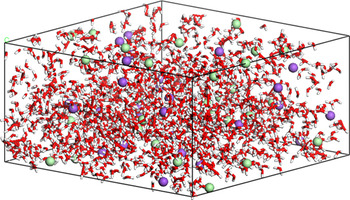
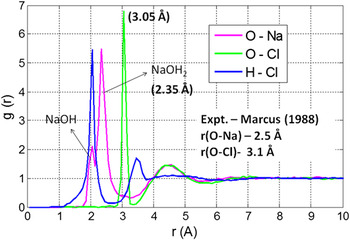
Our second test was for the NaCl–water system. The total time duration of this simulation is 250 ps. 30 Na+, 30 Cl−, and 1629 H2O were used; Fig. 1 shows a snapshot from the simulation. The simulation temperature is 300 K. The radial distribution function (RDF) is shown in Fig. 2 for Na–O and Cl–O, and comparison is made to experimental results.Reference Marcus45 There are two peaks for Na–O. One is from the NaOH and the other is from the NaOH2. These results indicate that ReaxFF predicts that Na cations cause a low level of water self-dissociation, with the proton potentially stabilized by Cl anions. Such self-dissociation is not observed in pure-water ReaxFF simulations, indicating that this must be related to the Na/Cl additives. The presence of the NaOH peak in the ReaxFF RDF indicates that ReaxFF overestimates the stabilization of hydroxyl anion by Na+ the stabilization of the associated proton by the Cl− anion. The differences between our NaOH2 results and experimental value are within 0.15 Å, which indicates that ReaxFF gives a reasonable description of the Na/water/TiO2system.
NaCl–water system (Na+: purple, Cl−: green).

RDFs for Na–O, Cl–O,Reference Marcus45 and H–Cl and comparison to the experimental results for the NaCl–water system shown in Fig. 1.

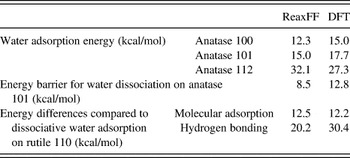
Water binding energy comparisons between ReaxFF and DFT are shown in Table I. For molecular adsorption of H2O onto the three different anatase faces, the maximum ReaxFF error compared to DFT results is 5 kcal/mol. This is a significant error when attempting to derive equilibrium constants from simulated thermodynamics, but it is typical for classical simulations compared to quantum results and experimental data.
Comparison between ReaxFF and DFT for water adsorption energy.Reference Kim, Kumar, Persson, Sofo, van Duin and Kubicki35

The energy of adsorption for molecular H2O onto the (110) surface of rutile is predicted more accurately relative to the DFT results (Table I). In this case, the agreement to within 0.3 kcal/mol is probably fortuitous, but this result does indicate that ReaxFF is performing reasonably well in reproducing DFT energetics. The H-bonding mechanism for water adsorption is overestimated by 10 kcal/mol, however, as this mechanism is only 20 kcal/mol above the stable molecular form compared to the 30 kcal/mol calculated via DFT. These results indicate that the ReaxFF simulation results should be treated with caution because they only qualitatively reproduce more accurate quantum calculations.
B. TiO2–H2O–NaCl system
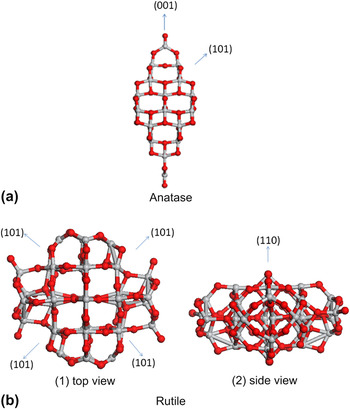
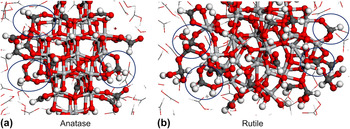
Figure 3 shows the surfaces, which consist of rutile and anatase nanoparticles used in this study. As is shown, rutile nanoparticle is composed of (110) and (101) facets, which have two lowest surface formation energies. For anatase nanoparticle, (101) and (001) facets make the surfaces.
TiO2nanoparticles used in this study.Reference Hummer, Kubicki, Kent, Post and Heaney46

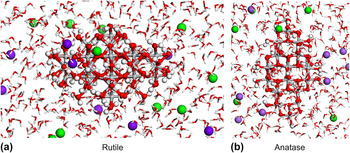
Based on 1-nm-diameter particles constructed using these faces, two simulations have been performed for the TiO2–H2O–NaCl system; one for the anatase and the other for the rutile nanoparticle. These anatase and rutile particles are composed of 105 and 120 atoms, respectively. 1740 H2O, 31 Na+, and 31 Cl− were used (i.e., ≈1 M Na/Cl aqueous solution). The temperature was set to 300 K and a total time duration is 250 ps was used. The MD time step was 0.25 fs. A number volume temperature (NVT) ensemble was used with a Berendsen thermostat with a relaxation constant of 5.0 ps. The thermostat was applied to all the atoms in the simulations, and the low relaxation constant allows the system to achieve an equilibration state quickly, which can prevent unrealistic dissociation of water before equilibration. For each simulation, three trajectories were carried out and the mean values are shown in the results. The total simulation box density was 0.38 kg/dm3; during the simulation, a water droplet is formed that completely covers the nanoparticle. Figure 4 shows the initial configurations of these TiO2–H2O–NaCl systems.
Initial configurations of the TiO2–H2O–NaCl systems.

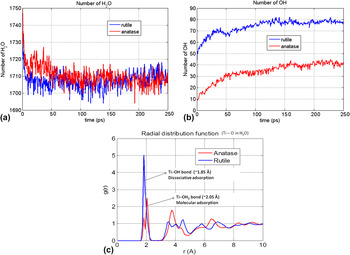
Figure 5(a) shows the numbers of H2O molecules and hydroxyl groups attached to the two nanoparticles types versus time. The numbers of adsorbed H2O molecules are similar for rutile and anatase. However, the numbers of hydroxyl groups are significantly different. The number of hydroxyls attached to the rutile nanoparticle is much higher than those attached to the anatase nanoparticle, which indicates that water dissociates more strongly on rutile nanoparticles compared to its anatase counterpart [Fig. 5(b)]. Also, the RDFs between Ti and O in H2O show that dissociative adsorption is dominant for the rutile particle, while much less dissociation happens for the anatase particle [Fig. 5(c)]. The number of the exposed surface Ti atoms is 34 for the rutile nanoparticle and the anatase nanoparticle. Normalizing by these values does not significantly alter our conclusions.
The numbers of surrounding H2O (a) and hydroxyl groups (b) attached to the particles with respect to time and (c) RDF between Ti and O, where the oxygen belongs to a water molecule.

C. TiO2 nanoparticle surface reactivity with methanol and formic acid
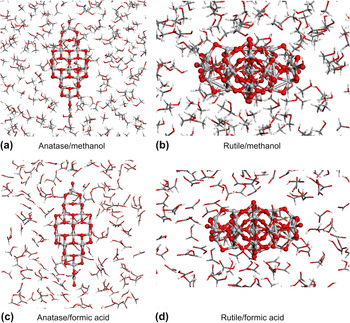
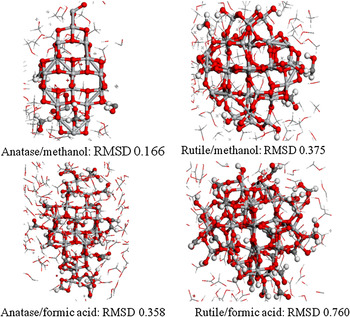
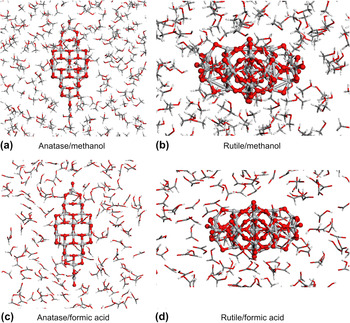
For nanoparticle surface reactivity, the goal was to study the dissociation of water and organic solvent at the TiO2 surfaces and the distortions of TiO2 nanoparticles in water and organic solvents. Toward this goal, we have performed simulations on four systems (Fig. 6), namely anatase and rutile nanoparticles with, respectively, 300 methanol and 200 formic acid molecules, using MD settings similar to those used previously for the water/nanoparticle simulations (Fig. 4). Figure 7 shows the nanoparticle structures at the end of the MD simulation, indicating substantial distortion due to the surface chemistry. The root-mean-squared displacement (RMSD) shows the distortion relative to the initial structure of the nanoparticles. This RMSD was calculated by removing rotation and translation by using the center of mass of the nanoparticles. The rutile nanoparticle is more reactive to methanol and formic acid and undergoes a more significant surface rearrangement. Formic acid adsorption to TiO2 nanoparticles results in major surface and subsurface rearrangements. Ti atoms were pulled out of the nanoparticle surface by bidentate formic anions. For methanol, only monodentate adsorption occurs on the edges of the nanoparticles for both anatase and rutile, whereas for formic acid, monodentate and bidentate adsorption occurs. Again, most of the formic acids bind to the edges of the nanoparticles, although some adsorption occurs on the faces of the nanoparticles as well. Bidentate adsorption happens only on the edges of rutile (110) and anatase (101), which indicates that strong bonding can occur on the edges of the nanoparticles because edges have lower energy barrier for binding than faces (Fig. 8). This observation is consistent with the previous experimental results showing dissociative adsorption in bidentate bridging configurationsReference Tanner, Liang and Altman2–Reference Fukui, Onishi and Iwasawa6 on rutile (110).
Initial configurations of the 1-nm TiO2nanoparticles (anatase, rutile) with organic solvents (300 methanol and 200 formic acid molecules, respectively).
Nanoparticle distortion due to surface chemistry. The RMSD was calculated compared to the initial structure of the nanoparticles.

Snapshots from the ReaxFF MD simulations showing formic acid anion bidentate adsorption on anatase and rutile nanoparticle edge sites.

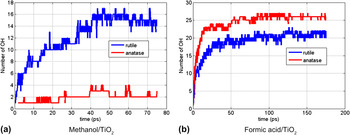
Figure 9 shows the attached number of hydroxyl groups for the TiO2/methanol and TiO2/formic acid systems. The rutile particle induces significantly more methanol deprotonation than anatase, which supports the claim that molecular adsorption is favored on the anatase (101) surface by Tilocca and SelloniReference Tilocca and Selloni14 and that methanol adsorbs on the surface of rutile nanoparticles dissociatively to produce surface methoxy and hydroxyl groups by Panayotov et al.Reference Panayotov, Burrows and Morris13 Formic acid generates a full ML of surface protons and bound formate anions for both anatase and rutile nanoparticle. In contrast to TiO2/methanol systems, the number of OH attached to anatase is larger than rutile, which is due to the fact that formic acid can easily donate proton. In the current case, the anatase nanoparticle has more surface area to absorb protons compared to the rutile nanoparticle. In other words, for formic acid case, the attached number of OH is related to the number of exposed Ti and O of the nanoparticles rather than their reactivity toward it.
Surface chemistry analysis for the hydroxyl groups.

IV. CONCLUSION
We performed molecular dynamics simulations for H2O–NaCl, TiO2–H2O–NaCl, TiO2–methanol, and TiO2–formic acid systems. The water dissociative adsorption percentage and RDFs of O–Na and O–Cl are compared with quantum mechanics (QM) and experimental results, respectively, for the test of the recently developed force field, and satisfactory results are obtained.
Simulations of the TiO2–H2O–NaCl system were conducted for anatase and rutile nanoparticles. The numbers of surrounding H2O molecule are similar in both cases. However, the numbers of hydroxyl groups attached to the particles at the end of the simulations are significantly different, indicating that this rutile nanoparticle is more likely to dissociate H2O molecule than the anatase nanoparticle. H2O, methanol, and formic acid distort the rutile nanoparticle significantly more than the anatase nanoparticle. Formic acid distorts the nanoparticle more than H2O and methanol, and the percentage of hydroxyl groups forming on the surface is higher for rutile than anatase when methanol and H2O are the solutions. Interestingly, when formic acid is solution, the percentage of hydroxyl groups forming on the surface is higher for the anatase nanoparticle than for the rutile nanoparticle, which can be explained by the high reactivity of the formic acid and the higher surface area of the anatase nanoparticle. Through this work, we demonstrated that ReaxFF enables the study of reaction chemistry at the organic/inorganic interface, including effects of surface facets, local strain, and crystal structure.
Supplementary Material
Supplementary materials can be viewed in this issue of the Journal of Materials Research by visiting http://journals.cambridge.org/jmr.
ACKNOWLEDGMENTS
This research is supported by funds from NSF (EAR—0842555) award. Computational support was provided by the Research Computation and Cyber infrastructure group at The Pennsylvania State University.