Data from recent studies and outbreak investigations indicate that lapses in the processes and quality of healthcare cleaning and disinfection are common and have significant adverse consequences for patients.Reference Weber, Rutala, Miller, Huslage and Sickbert-Bennett 1 , Reference Otter, Yezli and French 2 These problems occur despite institutional disinfection cleaning policies consistent with national guidelines, possibly due, in part, to the lack of an objective method for measuring cleaning practice. 3 ,4
Visual assessment of a room’s cleanliness has been the primary method for monitoring the quality of disinfection cleaning in healthcare facilities.Reference Dancer 5 However, several studies demonstrated that patients admitted to rooms that previously housed patients colonized or infected with methicillin-resistant Staphylococcus aureus (MRSA), vancomycin-resistant enterococci (VRE), or Clostridium difficile could acquire these organisms even though the rooms were cleaned between patient admissions.Reference Carling and Bartley 6 To address these issues, an evaluation system for objectively assessing the thoroughness of disinfection cleaning in acute healthcare settings was developed in 2005.Reference Carling, Briggs, Hylander and Perkins 7 Initial studies utilizing the system determined that most hospitals have substantial opportunities for improving patient room cleaning when patients are discharged (terminal disinfection cleaning).Reference Carling, Briggs, Hylander and Perkins 7 – Reference Carling and Eck 9 On the basis of these findings, a standardized intervention incorporating both education for staff and feedback of data on the thoroughness of disinfection cleaning was developed and evaluated in a pilot study across 3 hospitals.Reference Carling, Briggs, Perkins and Hylander 10 Subsequently, a study in 36 acute-care hospitals found that this intervention was associated with significantly improved disinfection cleaning.Reference Carling, Parry, Rupp, Po, Dick and Von Beheren 11 All of these hospitals implemented the evaluation and education program without substantially increasing resources for infection prevention or for environmental cleaning.
Because regional efforts may be needed to control the spread of resistant microorganisms,Reference Ostrowski, Trick and Sohn 12 we sought to determine whether numerous hospitals of varying sizes and designations across a state could implement the intervention and if the intervention was effective in this setting. A grant from the Centers for Disease Control and Prevention (CDC; grant no. CI00583-03) on prevention of MRSA infections provided an opportunity to test the intervention in hospitals across Iowa. For many years, hospitals in Iowa have collaborated on studies of healthcare-associated infections.Reference Lee, Bartsch and Wong 13 – Reference McDanel, Ward and Leder 16 Moreover, Iowa’s active statewide infection prevention network was supported by a course for new infection preventionists and a yearly continuing education program organized by the University of Iowa Hospitals and Clinics Program of Hospital Epidemiology, which fostered communication and collaboration among infection preventionists. Thus, Iowa was an ideal setting for this study.
METHODS
Participating Institutions
Of 118 acute-care hospitals in Iowa, 56 (47%) participated in the project. The hospitals ranged in size from 15 to 415 (mean 105) beds and were located throughout the state. Among the participating hospitals, 34 (61%) were government-defined Critical Access Hospitals (≤25 beds) serving rural communities.
Study Method
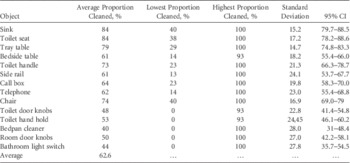
We conducted a prospective, quasi-experimental pre-/postintervention trial to evaluate and improve the thoroughness of terminal room disinfection cleaning. Infection preventionists, trained to mark and evaluate targets in a consistent manner, applied a transparent, environmentally stable marking solution that is easily removed with cleaning and fluoresces when exposed to ultraviolet light (DAZO, Ecolab, St Paul, MN) to a standardized group of 14 environmental surfaces (Table 1) as previously described.Reference Carling, Parry, Rupp, Po, Dick and Von Beheren 11 The standardized group of objects included the “high-touch surfaces” for which CDC recommends more frequent cleaning [#9 SEC I. E. 3.] 3 and other surfaces that are frequently contaminated with C. difficile, MRSA, or VRE.Reference Carling, Briggs, Hylander and Perkins 7 As in previous studies, an object was defined as “cleaned” only if the florescent target was removed completely. Infection preventionists marked these high-risk objects (HROs) in study rooms when they were unoccupied. We defined the cleaning effectiveness for individual objects and for all objects together as the number of HROs cleaned divided by the number of HROs tested, and we referred to this proportion as the thoroughness of disinfection cleaning (TDC) and expressed it as a percentage.
Thoroughness of Disinfection Cleaning for 14 High-Risk Objects in the Patient Zone During the Preintervention (Phase 1) Portion of the Project

Phase 1: Preintervention analysis
Infection preventionists at each participating hospital covertly marked the standardized group of HROs in a convenience sample of patient rooms and adjoining bathrooms on adult general medical, surgical, and specialized care units. The infection preventionists covertly assessed whether TDC removed the fluorescent marker from each object to establish a baseline TDC percentage for the study HROs and an overall TDC for their individual hospitals. The project director (PC) collated the results to create hospital-specific graphs illustrating the results and sent them to each hospital’s infection preventionist.
Phase 2: Programmatic analysis and educational interventions
Following phase 1, the infection preventionists at each site met with relevant administrative personnel to review the findings and to develop intervention plans, which included a standardized educational program for line and supervisory environmental services personnel. The educational program (1) demonstrated the evaluation tool, clarified why HROs must be cleaned thoroughly; (2) reviewed data demonstrating that disinfection cleaning is essential for patient, environmental services personnel, and healthcare worker safety; and (3) emphasized the important role environmental services personnel have in the institution’s infection prevention activities. Subsequently, the infection preventionists covertly re-evaluated terminal cleaning as described for phase 1. Standardized graphs of the results were created, and the infection preventionists reviewed these results with environmental services management and subsequently with the line personnel.
Phase 3: Performance feedback and programmatic analysis
Infection preventionists shared the results of phase 2 with environmental services staff, and using these results, they developed additional hospital-specific interventions. During phase 3, the infection preventionists again applied the fluorescent marker to the HROs and evaluated cleaning thoroughness as in phases 1 and 2. Most participating hospitals used the findings of several (1–3) performance assessment and feedback cycles, group and 1-on-1 teaching interventions, and administrative process interventions (eg, clarifying who cleans electronic equipment and working with bed control to allow adequate time for terminal disinfection cleaning after patients were discharged) to optimize terminal cleaning. During this study phase, the investigators consulted directly with infection preventionists at participating hospitals, provided additional graphic displays of the cleaning thoroughness results (TDC scores), and provided advice on improving disinfection cleaning processes.
Concurrent Feedback From Participants
During the project, the participating infection preventionists provided feedback on the program’s merits, its value to their institutions, impediments to implementing the program, and interventions to improve cleaning processes. We reviewed all communications from the sites and identified themes regarding favorable and challenging aspects of the program. We sent a questionnaire (Online Supplementary Appendix A) to infection preventionists at hospitals that withdrew from the study after either phase 1 or 2 to identify why hospitals did not continue with the project. These infection preventionists were asked to rank 9 possible reasons for withdrawing from the study in order of their importance and to mark any that did not apply as “NA.” They could also write in other reasons for withdrawing.
Data Collection and Statistical Analysis
Infection preventionists at each site collected data in the same manner. We used Instant 3.0 (GraphPad Software, San Diego, CA) to do unpaired t tests on data from the sites to assess change in TDCs over time.
RESULTS
Adequacy of Disinfection Cleaning
Phase 1
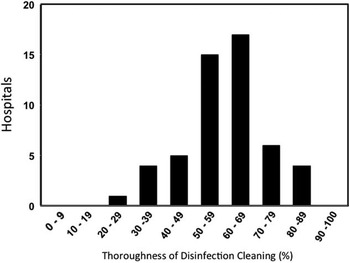
Infection preventionists covertly evaluated an average of 22 rooms (6%–9% of all rooms) at each of the 56 study hospitals. The actual furnishings in patient rooms varied when infection preventionists marked items with DAZO or when they evaluated cleaning effectiveness. Therefore, infection preventionists sometimes evaluated more than 14 HROs per room, with a mean of 12.8 HROs per room. At baseline, 61% (95% CI, 56.7%–64.4%) of 15,658 study HROs in 1,220 patient rooms were cleaned adequately during terminal room disinfection cleaning. While the overall TDC varied widely among hospitals (25%–88%), half of the hospitals clustered between 5% below and 5% above the average for the study group (Figure 1). Overall, preintervention TDCs were essentially identical for critical access hospitals (60%) and larger hospitals (59%). In addition, the TDCs for most HROs varied over a relatively narrow range. However, TDCs varied substantially by HRO; some HROs such as toilet seats, were cleaned significantly better than average (84%; P≤.001) and others, such as bedpan cleaners, were cleaned significantly less well than average (40%; P≤.001) (Table 1).
Preintervention thoroughness of disinfection cleaning for the 56 hospitals in the Iowa project.

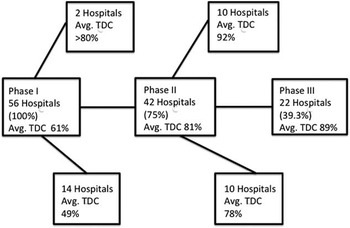
As noted in Figure 2, 14 (25%) of the 56 hospitals completed only phase 1. Of the 14 hospitals that discontinued the study after phase 1, 2 stopped the study after learning that their baseline TDC scores were >80%. However, 12 of these 14 (85.7%) hospitals had an average phase 1 TDC of 49%.
A summary of the 3 phases of the Iowa project.

Phases 2 and 3
In total, 42 hospitals (75%) with an average phase 1 TDC of<80%, participated in phase 2. After reviewing their phase 1 data, personnel at each site developed intervention plans, which included implementing a structured educational program for the environmental services line staff (similar for all hospitals). Subsequently, the mean overall TDC for these 42 hospitals improved significantly from 60% to 81% (P≤.0001). As noted in Figure 2, 20 of these 42 hospitals (47.6%) withdrew after phase 2; 10 of the hospitals that withdrew after phase 2 had an average phase 2 TDC of 72%, and 10 had a TDC of >80% (average, 92%). Of the original 56 hospitals, 22 (39.3%) continued into phase 3. The average TDC for these 22 hospitals was 51% at baseline, 61% after phase 2, and 89% at the end of phase 3 (P ≤.005). The average TDC for critical access hospitals completing phase 2 and 3 (ie, 83%) was slightly higher than for the larger hospitals (ie, 79%), and the difference was not significant (P=.40). After completing phase 2 or phases 2 and 3, 16 of 42 sites (26%) achieved TDC scores >90%. Subsequently, 6 of these hospitals independently maintained the program beyond the planned study period and maintained TDCs >90% for at least 38 months.
Concurrent Feedback From Participants
Of the 24 sites that received the study materials but did not submit any data or withdrew after phase 1, infection preventionists at 19 sites (79.2%) indicated that they lacked the time needed to complete the study (3 ranked this reason first, 6 ranked it second, and 10 ranked it third or below). Furthermore, 6 sites (29%) withdrew because the infection preventionist who started the study left the job. In addition, 2 hospitals withdrew in part and 1 primarily because environmental services leaders did not support the project. None of the 21 sites withdrew because hospital administrators or nursing leaders did not want to participate in the process improvement project.
DISCUSSION
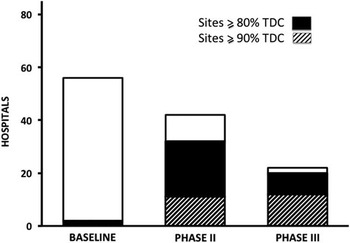
This study is the first to assess whether a standardized programmatic intervention can improve terminal patient room disinfection cleaning concomitantly in numerous hospitals across a state. The study confirmed prior findings that most hospitals need to improve their terminal disinfection cleaning substantiallyReference Carling, Po, Bartley and Herwaldt 17 – Reference Holmer, Russel, Steger, Speer, Lakhanpal and Chen 20 and demonstrated that hospitals ranging from critical access facilities to moderate-size community hospitals can achieve this goal if they (1) implement an objective assessment of cleaning thoroughness, (2) regularly share objective data on TDC with environmental services staff and supervisors, and (3) implement a structured education program that addresses both general and hospital-specific issues (Figure 3). The study also demonstrated that TDC scores >80% can be maintained over time by repeated cycles of assessment paired with repeated feedback and education sessions. Notably, 27% of hospitals completing phase 3 independently maintained TDC scores that were >90% for >3 years, suggesting that infection prevention and environmental services programs can maintain the required assessment and process improvement activities over time, and highlighting the critical role of ongoing feedback for sustaining excellent terminal disinfection cleaning. A recent study by Rupp et alReference Holmer, Russel, Steger, Speer, Lakhanpal and Chen 20 confirmed this observation. They used the DAZO targeting system to evaluate disinfection cleaning over 46 months. Within the first 6 months of the study, they increased the overall TDC from ~47% to ~78%. However, the TDCs decreased periodically, and the investigators had to add interventions, such as immediate feedback to environmental services staff, to maintain high TDC scores.
A summary of the relative change in the thoroughness of disinfection cleaning (TDC) during each of the 3 study phases demonstrating the achievement of high levels of cleaning thoroughness for essentially all hospitals that remained in the project.

While this study demonstrated that an objective structured programmatic process can enable a large group of hospitals to achieve and maintain high TDC scores, it also documented the challenges of implementing such activities. For example, ~40% of the hospitals, which likely could have benefitted significantly from the program, withdrew before achieving TDC scores >80% primarily because either the infection preventionists did not have time to mark the HROs and do the follow-up assessments or because the infection preventionists that began the project left these positions. Infection preventionists in small hospitals often have many different responsibilities, including patient safety, quality improvement, employee health, and direct patient care. Given such competing demands, they may not have time to implement important process improvement interventions. Moreover, infection prevention staff in small hospitals change frequently, which substantially affects the likelihood that these hospitals can maintain process improvement interventions long term. Unfortunately, we were not able to determine whether the infection preventionists reporting that they did not have time to do the study lacked the motivation to do it, did not understand its relevance, or actually were restricted by time constraints. However, recent studies, which found that infection preventionists working in acute care hospitals experienced substantial administrative pressure,Reference Conway, Riley, Saiman, Cohen, Alper and Larson 21 , Reference Conway, Raveis, Pogorzelska-Maziarz, Uchida, Stone and Larson 22 support the infection preventionists’ perception that they did not have time to do the study and suggests that their administrators did not make environmental cleaning a hospital priority. Conversely, infection preventionists and environmental services staff at 71% of sites with low baseline TDC scores invested the time necessary to complete phase 2’s first round of feedback and process improvement interventions. These hospitals benefited from this investment by achieving TDC scores of >80%.
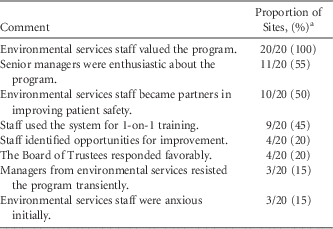
As noted in Table 2, in addition to improving TDC scores, the program helped hospital leaders, environmental services supervisors, and environmental services staff appreciate the important role environmental services personnel have in infection prevention and patient safety activities in acute-care hospitals. Finally, this study found that hospital administrators, environmental services supervisors, environmental services staff, and even boards of trustees at hospitals completing the program felt the objective performance evaluation and feedback was beneficial and was worth the time invested. These positive perspectives were expressed by staff at the hospitals that completed the program and, thus, may reflect selection bias. However, the unanimity of these perspectives suggests that many of the hospitals that did not complete the program would have realized similar results if they had remained in the study.
Comments From 20Footnote a of the Hospitals That Completed Phases 1–3

a Two hospitals did not provide feedback on the program.
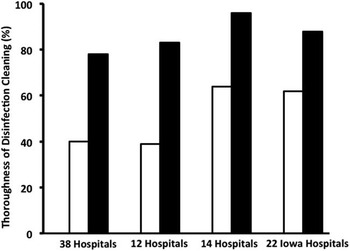
Our study had several strengths. It is the largest study of its kind to date, and it included a range of community hospitals across an entire state, demonstrating that this program could be a component in a regional program to decrease spread of healthcare-associated pathogens, including highly antibiotic resistant enteric pathogens. In addition, actual hospital staff, not research personnel, implemented the assessment and the intervention that significantly improved terminal cleaning. Given that we conducted the study in a rural Midwestern state, our results might not be generalizable to other states or regions. However, as illustrated in Figure 4, 3 other groups of hospitals in different areas of the United States (14 states) had similar results when implementing this program. While some hospitals did not complete all 3 phases of the study, this limitation highlights an important fact: hospital administrators must provide the necessary personnel resources if they wish to improve environmental disinfection cleaning.
A comparison of the results of the 3 previously published multisite studies compared with results from the Iowa project. White bars represent the average baseline TDCs and black bars represent the average final TDCs for sites that completed each study.

In conclusion, the results of this study together with the results of prior studies of our Healthcare Environmental Hygiene Study GroupReference Carling, Parry, Rupp, Po, Dick and Von Beheren 11 , Reference Carling and Eck 18 confirm that objective structured assessment and education programs significantly improve environmental cleaning and are, therefore, important components of infection prevention and patient safety efforts. In addition, the study demonstrated the broad feasibility of such programs. Moreover, these programs are consistent with recommendations in the 2010 CDC guideline, “Options for Evaluating Environmental Cleaning,”Reference Guh and Carling 23 the “National Action Plan to Prevent Health Care-Associated Infections: Roadmap to Elimination, 2012,” 24 and the recent AHRQ Technical Brief “Environmental Cleaning for the Prevention of Healthcare-Associated Infections,” 25 all of which include monitoring disinfection cleaning performance as an integral components of patient safety initiatives. During the past decade, our studies have moved this systematic intervention from translational research phase 0 (T0) to phase 3 (T3).Reference Pronovost, Cardo, Goechel, Berenholtz, Saint and Jernigan 26 Unfortunately, our current study found that some hospitals are reluctant to invest the resources necessary for such programs. Thus, strong local and national support will be necessary to facilitate national implementation (T4) of the CDC’s evidence-based recommendations.
ACKNOWLEDGMENTS
Financial support: This study was funded in part by the Centers for Disease Control and Prevention (grant no. R518CI000583).
Potential conflicts of interest: P.C. is a consultant for Ecolab and for the Association of periOperative Registered Nurses (AORN) and holds a patent license with Ecolab. L.H. has no potential conflicts to disclose.
SUPPLEMENTARY MATERIAL
To view supplementary material for this article, please visit https:/doi.org/10.1017/ice.2017.109